sensor AUDI TT ROADSTER 2015 Owner's Manual
[x] Cancel search | Manufacturer: AUDI, Model Year: 2015, Model line: TT ROADSTER, Model: AUDI TT ROADSTER 2015Pages: 244, PDF Size: 60.74 MB
Page 133 of 244
typical 1 year-old chi ld, the Advanced Airbag
System compares the weig ht meas ured by the
weight sensing mat with t he informat ion stor
ed in the electron ic control unit.
The electronic control unit a lso registers the
tension on the front passenger safety be lt.
The tens ion on the safety belt for the front
passenger seat will be different for an adult
who is properly using the safety belt as com
pared to the tension on the be lt when it is
used to attach a child restraint to the seat.
The sensor below the latch for the safety be lt
for the front seat passenger measu res the
tension on the be lt. T he inp ut from this sen
sor is then used with the we igh t to "decide",
whether there is a chi ld restraint with a typica l
1 year-old child o n the front passenger seat
and whether or not the airbag must be turned
off.
Child restraints and Advanced Airbags
Regardless of the child restraint that you use,
make sure that it has been ce rtified to meet
United States Federal Motor Vehicle Safety
Standa rds and has been certified by its manu
facture r fo r u se wi th a n air bag. If in excep
tional c ircu ms tances you m ust use it on the
front passenger seat, caref ully read all of the
i n formation on c hild safety and Advanced Air
bags and heed all of the app licable WARN
INGS. Make certain that the child restraint is
correctly recognized by the weig ht-sensing
mat inside the front passenger seat, that the
fro nt passenger airbag is tur ned off and that
the airbag status is a lways correctly signaled
by the
PASSENGER AIR BAG OFF light.
Many types and models of child restra ints
h ave been ava ilable over the years, new mod
e ls are introduced regularly incorporating new
and improved designs a nd older models a re
t aken out of p rod uction. Child restrain ts are
not standardized . Ch ild restra ints o f the same
type typically have different weights and sizes
and diffe rent 'footprints,' the size and shape
of the bottom of the child restraint that sits
on the seat, when they are installed on a vehi
cle seat. These differences make it virtually
Child Sa fet y 131
impossible to certify comp liance with the re
quirements for advanced airbags with eac h
and every child restra int that has ever been
sold in the past or will be sold over the course
of the useful life of your veh icle.
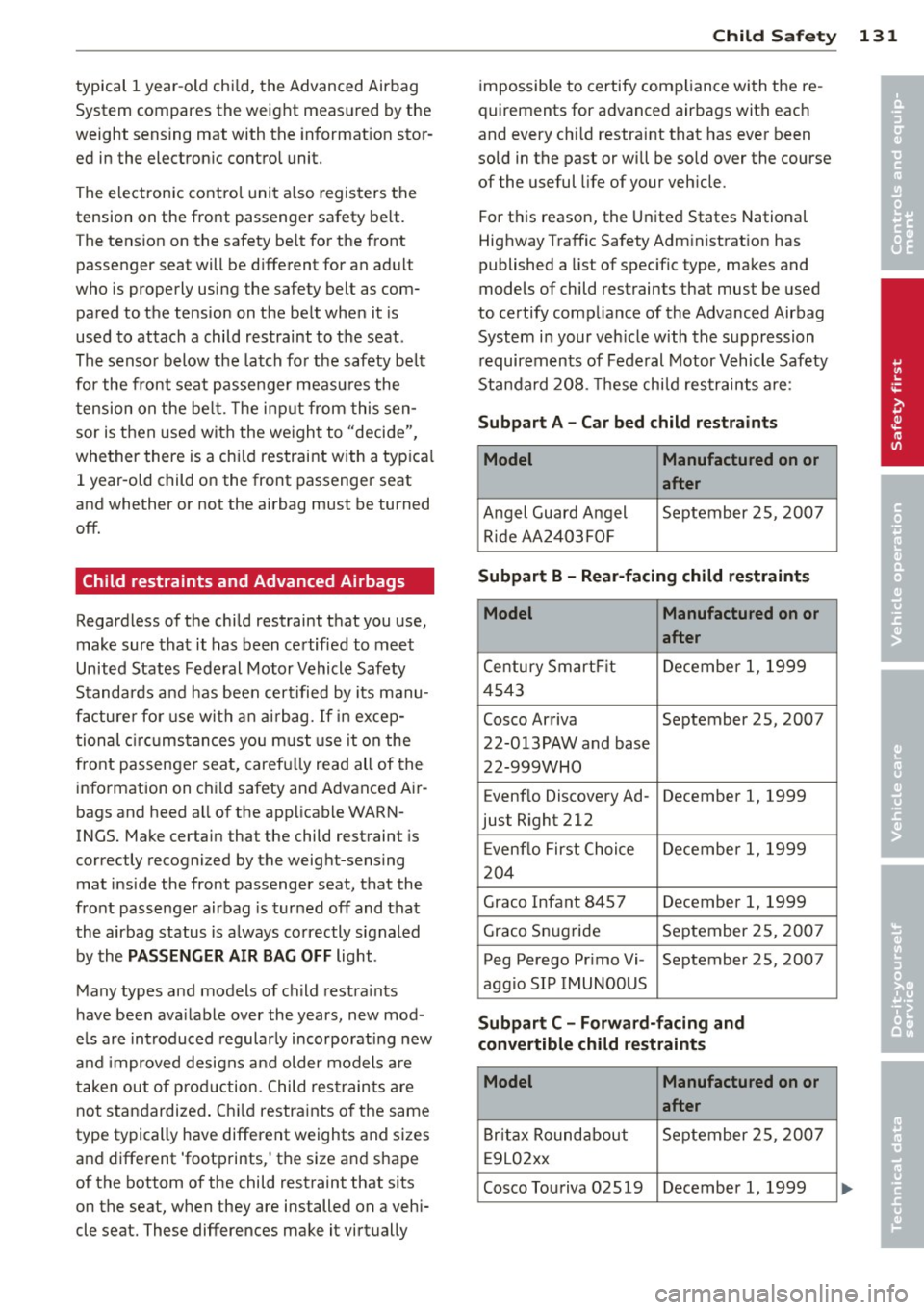
Fo r th is reason, the United States National
Highway Traffic Safety Adm inistrat ion has
published a list of spec ific type, makes and
models of child restraints that must be used
to certify compliance of the Advanced Airbag
System i n your veh icle with the suppression
requirements of Federal Motor Vehicle Safety
Standard 208. These child re straints are:
Subpart A -Car bed child restraints
Model Manufactured on or
after
Angel Guard Angel September 2S, 2007 R ide AA 2403FOF
Subpart B - Rear-facing child restraints
Model Manufactured on or
after
Ce ntury Smart Fit Decembe r 1, 1999
4S 43
Cosco Ar riva September 2S, 2007
22-013PAW and base
22-999WHO
Evenflo Discovery Ad -December 1, 1999
just Right 212
E ven flo First Choice Decembe r 1, 1999
20 4
Graco Infant 8457 December 1, 1999
Graco Snugride September 25, 2007
Peg Perego Primo Vi- September 25, 2007
aggio SIP IMUNOOUS
Subpart C -Forward-facing and
convertible child restraints
Model Manufactured on or
after
Br itax Roundabout September 2S, 2007
E 9L02xx
Cosco Touriva 02519 December 1, 1999
•
•
Page 156 of 244
154 Vehicle care and cleaning
Vehicle care and
cleaning
General information
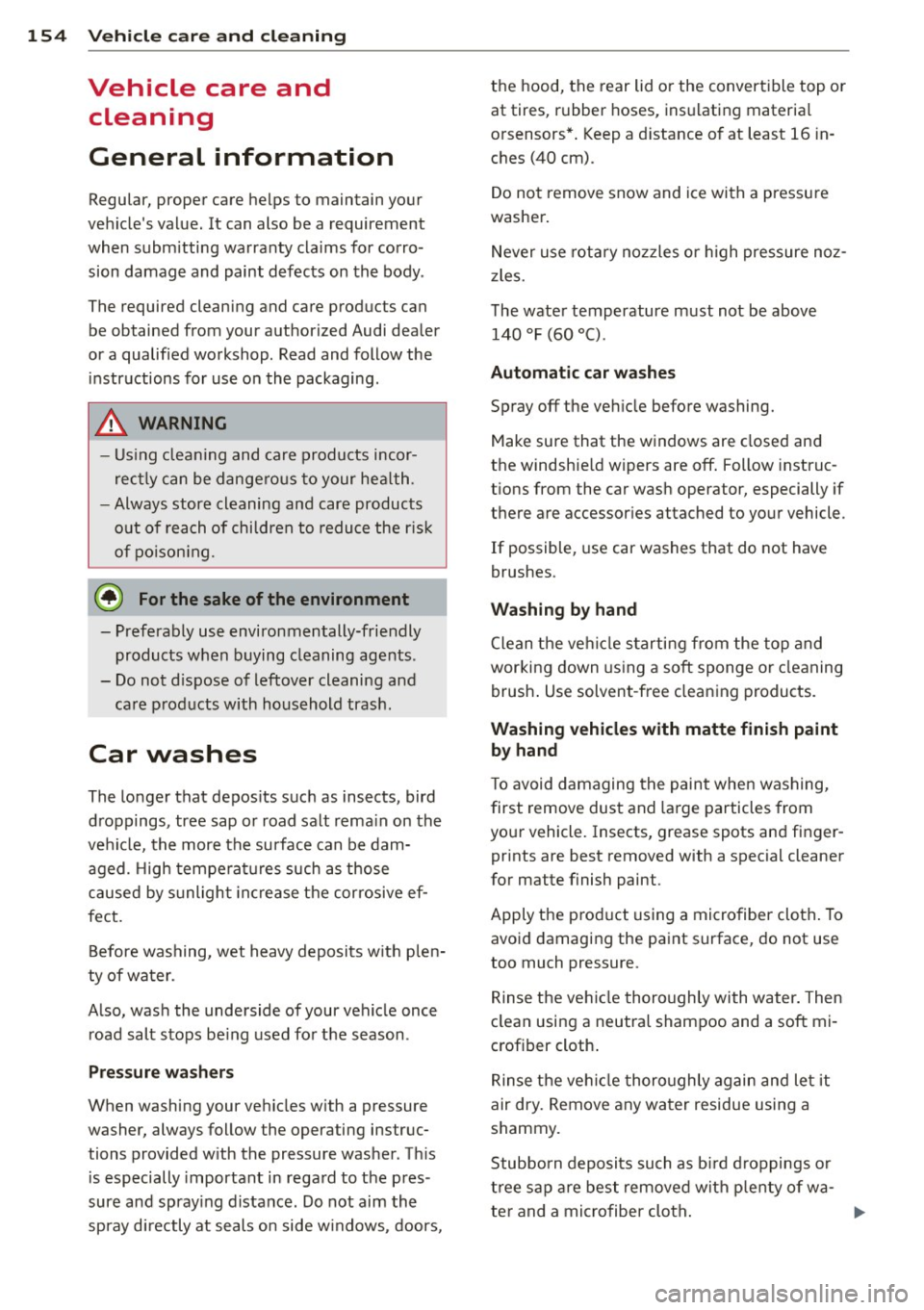
Regular, proper care helps to maintain your
vehicle 's value. It can also be a requirement
when subm itting warranty claims for corro
sion damage and paint defects on the body .
The required cleaning and care products can be obtained from your authorized Audi dealer
or a qualified workshop. Read and follow the instructions for use on the packaging .
A WARNING
-Us ing cleaning and care products incor
rectly can be dangerous to your hea lth .
- Always store cleaning and care products
out of reach of children to reduce the ris k
of poisoning.
@ For the sake of the environment
-Preferably use environmentally-friendly
products when buying cleaning agents .
- Do not d ispose of leftover cleaning and
ca re products with household trash .
Car washes
-
The longer that deposits such as insects, bird
droppings , tree sap or road salt rema in on the
vehicle, the more the surface can be dam
aged. High temperatures such as those
caused by s unligh t increase the corrosive ef
fect.
Before washing, wet heavy deposits with plen
ty of water.
Also, wash the underside of your vehicle once
road salt stops be ing used for the season .
Pressure wa shers
When washing your vehicles with a pressure
washer, always follow the operating instruc
tions provided w ith the pressure washer. Th is
is especially important in regard to the pres
sure and spray ing distance . Do not aim the
spray directly at seals on side w indows, doors, the
hood, the rear lid or the convertible top or
at tires, rubber hoses, insulating material
orsensors* . Keep a distance of at least 16 in
ches (40 cm) .
Do not remove snow and ice with a pressure
washer.
Never use rotary nozzles or high pressure noz
zles.
The water temperature must not be above
140
°F (60 °() .
Automatic car washes
Spray off the vehicle before washing.
Make sure that the windows are closed and
the windshie ld wipers are off. Follow instruc
tions from the car wash operator, especially if
there are accessories attached to your vehicle .
If possible, use car washes that do not have
brushes .
Washing by hand
Clean the vehicle starting from the top and
working down using a soft sponge or cleaning
brush . Use solvent-free cleaning products.
Washing vehicles with matte finish paint
by hand
To avoid damaging the paint when washing,
first remove dust and large particles from
your vehicle. Insects, grease spots and finger
prints are best removed with a special cleaner
for matte finish paint .
Apply the product using a microfiber cloth. To
avoid damaging the paint surface, do not use
too much pressure.
Rinse the vehicle thoroughly with water. Then
clean using a neutra l shampoo and a soft mi
crofiber cloth.
Rinse the vehicl e thoroughly again and let it
air dry. Remove any water residue using a sham my.
Stubbo rn deposits such as bird droppings o r
tree sap are best removed with p lenty of wa-
ter and a microfiber cloth. .,.
Page 157 of 244
Vehicl e ca re a nd cl eanin g 155
& WARNING
-Only wash the vehicle when the ignition
is off and follow the instructions from
the car wash operator to reduce the risk
of accidents.
- To reduce the risk of cuts, protect your
self from sharp meta l components when
washing the underbody or the inside of
the wheel housings.
- After washing the vehicle, the braking ef
fect may be delayed due to moisture on
the brake rotors or ice in the winter . The
brakes must be dried first with a few
careful brake applicat ions .
{[) Note
-If you wash the vehicle in an automatic
car wash, you must retract the extend a ble rear spo iler* if necessary, and fold
the exte rior m irrors in to reduce the risk
of damage. Power folding exterior mir rors* must only be folded in and out us
i ng the power folding function .
- To prevent pa int damage, do not wash
the veh icle in direct sunlight.
- To reduce the risk of damage, do not
wash the power top with a p ressure
washer. -
To reduce the r isk of damage, do not
wash decorative decals * with a pressure
washer.
- To reduce the risk of damage to the sur
face, do not use insect removing spong
es, kitchen sponges or similar items.
- Matte finish painted vehicle compo
nents:
- To reduce the risk of damage to the
surface, do not use polishing agents or hard wax.
- Never use car wash cycles that apply
protective wax.
It can destroy the
matte fi nish effect.
- Do not place any stickers o r magnet ic
signs on vehicle parts painted w ith
matte fin ish paint. The paint cou ld be
damaged when the stickers o r magnets
are removed.
@ For the sake of the environment
Only wash the vehicle in facilities spec ia lly
designed for that purpose. This will reduce
the risk o f dirty water contaminated with
oil from entering t he sewer system.
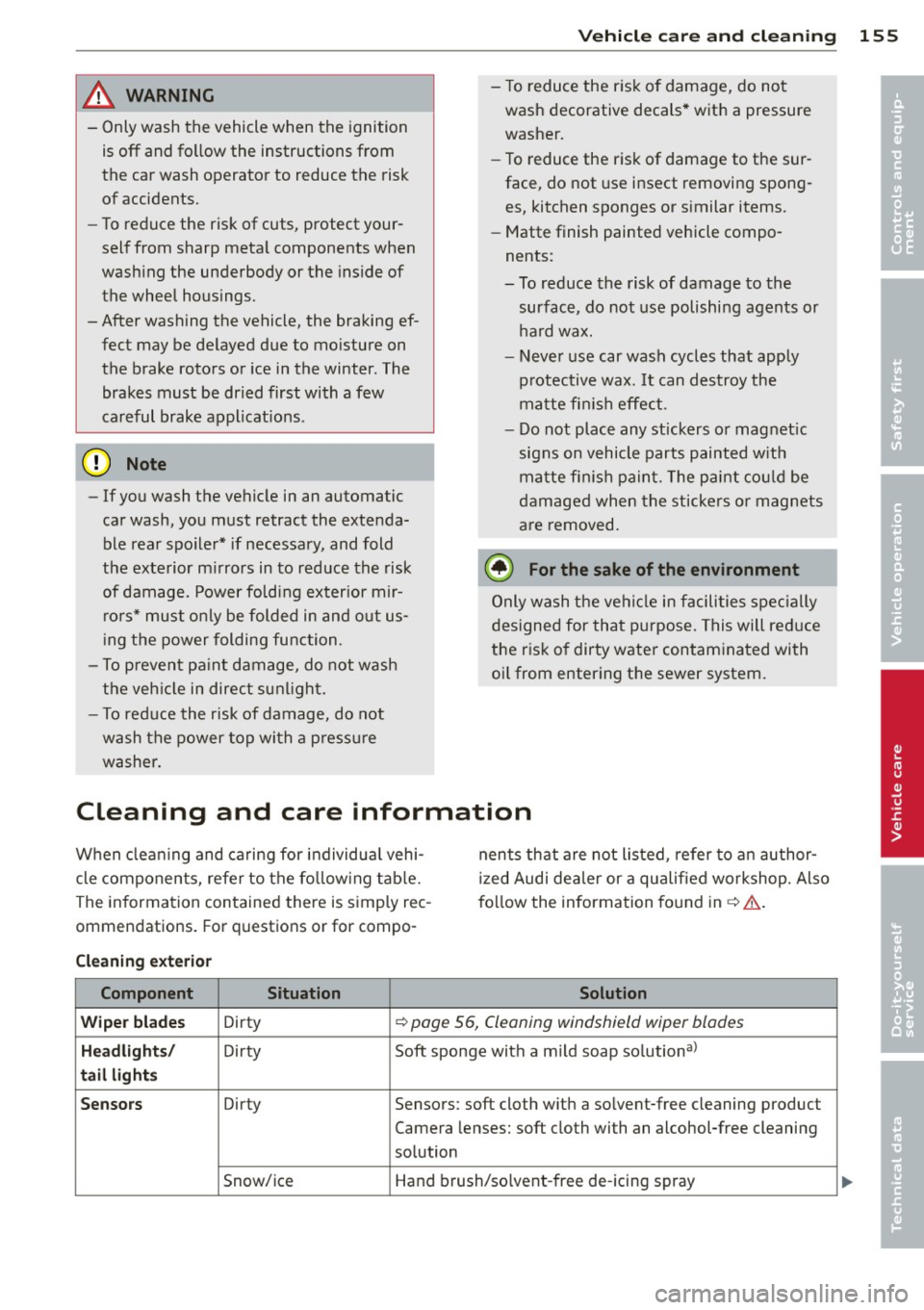
Cleaning and care information
When clean ing and caring for individual vehi
cle components, refer to the fo llow ing tab le.
The information contained there is simp ly rec
ommendations. For questions or for compo- nents that are not listed,
refer to an author
ized Audi dea ler or a qualified workshop. Also
follow the information found in ~ .&. -
Clean in g e xterior
Component Situ ation Solution
Wiper bl ade s
Dirty ~ page 5 6, Cleaning windshield wiper blades
Hea dligh ts/ Dirty Soft sponge with a mild soap solution al
tail ligh ts
Sen sor s
Dirty Sensors: soft cloth w ith a solvent-free cleaning product
Camera lenses: soft cloth with an alcohol-free cleaning
solution
Snow/ice Hand brush/so
lvent-free de-icing spray
•
•
...
Page 174 of 244
172 Checking and filling
Checking the engine coolant level
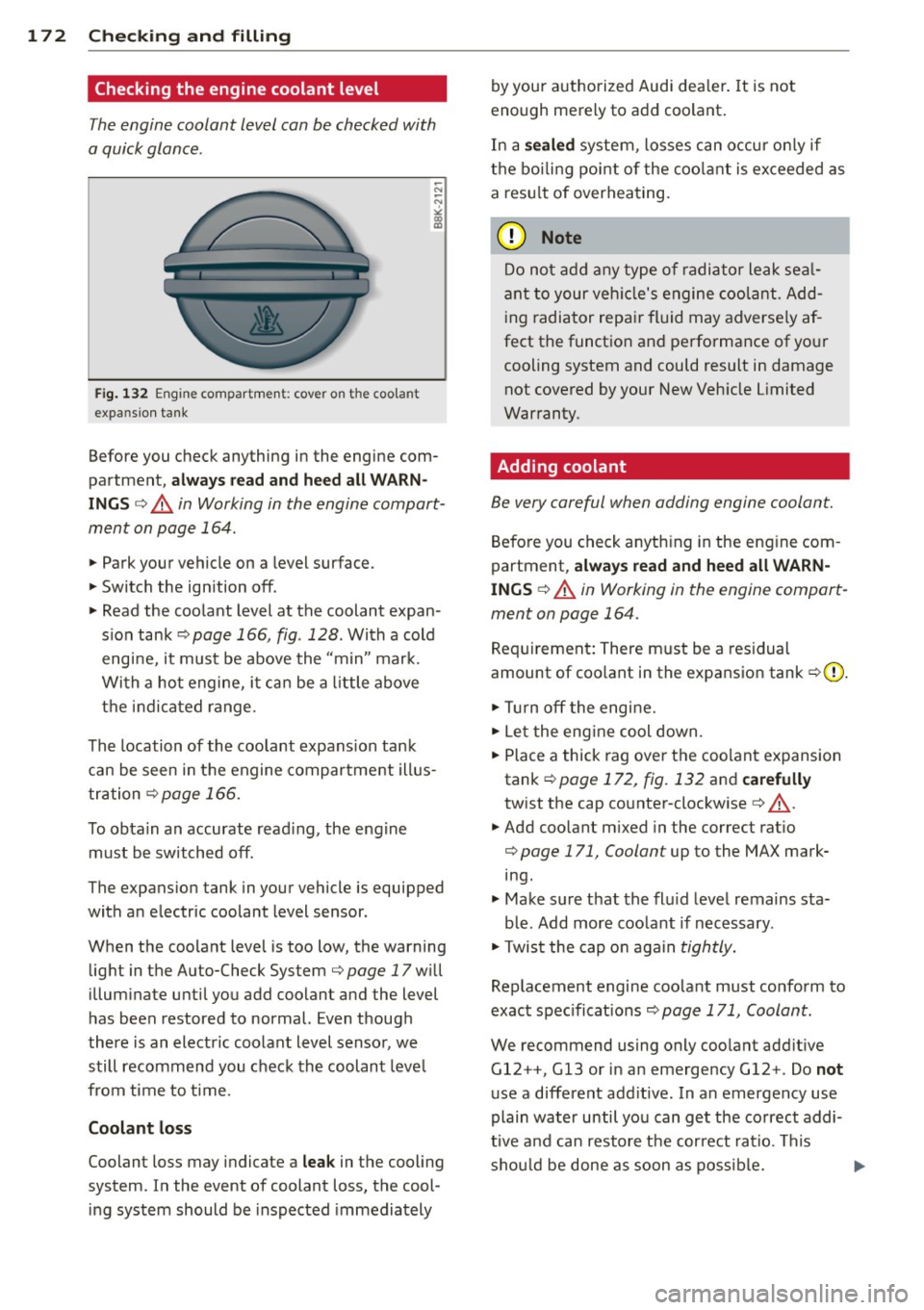
The engine coolant level can be checked with
a quick glance.
F ig. 132 Eng ine compartme nt: cover on the coo lant
expansion tank
Before you check anything in the engine com
partment,
a lway s read and he ed a ll WARN
ING S o .A in Working in the engine compart
ment on page 164.
., Park your vehicle on a level surface.
., Switch the ign ition
off .
., Read the coolant level at the coolant expan
sion tank
opage 166, fig . 128. With a cold
engi ne, it must be above the "min" mark.
With a hot engine, it can be a l ittle above
the indicated range.
The location of the coolant expans ion tank
can be seen in the engine compartment illus
tration
o page 166.
To obtain an accurate read ing, the eng ine
must be sw itched
off.
The expans ion tank in your vehicle is equipped
with an electric coolant level sensor.
When the coolant level is too low, the warning
light in the Auto-Check System
opage 17will
illum inate until you add coolant and the level
has been restored to normal. Even thoug h
there is an electric coolant level sensor, we
still recommend you check the coolant leve l
from time to t ime.
Coolant lo ss
Coolant loss may indicate a leak in the cooling
system. In the event of coolant loss, the cool
ing system should be inspected immediately by your authorized Audi dea
ler .
It is not
enough merely to add coo lant .
In a
seal ed system, losses can occu r on ly if
the boi ling po int o f the coo lan t is exceeded as
a res ult of overheating.
(D Note
Do n ot add any type o f radiator leak se al
ant to your veh icle's engine coo lant. Add
i ng radiator repa ir fl uid may adverse ly af
fect the functio n and performance of you r
cooling system and could result in damage
not cove red by your New Veh icle l imited
Warranty.
Adding coolant
Be very careful when adding engine coolant.
Before you check anyth ing in the engine com
partment,
a lways read and heed all WARN
INGS o .A in Working in the engine compart
ment on page 164.
Req uirement: There m ust be a res idual
amount of coo lant in the expansio n tank
o (D .
., Tur n off the engi ne .
., le t t he eng ine cool down.
., Place a thick rag ove r the coolant expansion
tank
o page 172, fig. 132 and carefully
twist the cap counter-clockwise o _A .
., Add coolant m ixed in the correct ratio
o page 171, Coolant up to the MAX mark
ing.
.. Make sure that the flu id level remains sta-
b le. Add more coo lant if necessary.
., Twi st the cap o n aga in
tightly.
Replacement engine coo lant must conform to
exact spec ificat ions
o page 171, Coolant .
We recommend using only coolant addit ive
Gl2++, Gl3 or in an emergency Gl2+. Do
not
use a different add itive . In an emergency use
plain water until you can get the co rrect addi
t ive and can resto re the correct ratio. This
sho uld be done as soon as poss ib le.
Page 201 of 244
remain continuous ly illuminated . This se
quence will continue upon subsequent vehicle
start-ups as long as the ma lfunction ex ists.
When the malfunct ion indicator is ill uminat
ed, the system may not be able to detect or
signa l low tire pressure as intended. TPMS
malfunct ions may occur for a variety of rea
sons, including the installat ion of replace
ment or alternate tires or wheels on the veh i
cle that prevent the TPMS from funct io ni ng
properly. Always check the TPMS malfunct ion
tellta le afte r replacing one or more t ires or
wheels on your veh icle to ensure that the re
p lacement or a lternate tires and wheels allow
the TPMS to continue to function properly.
Tire pressure indicator appears
Applies to vehicles: with tire pressure monitoring system
The tire pressure indicator in the instrument
cluster informs you if the tire pressure is too
low or if there is a system malfunction.
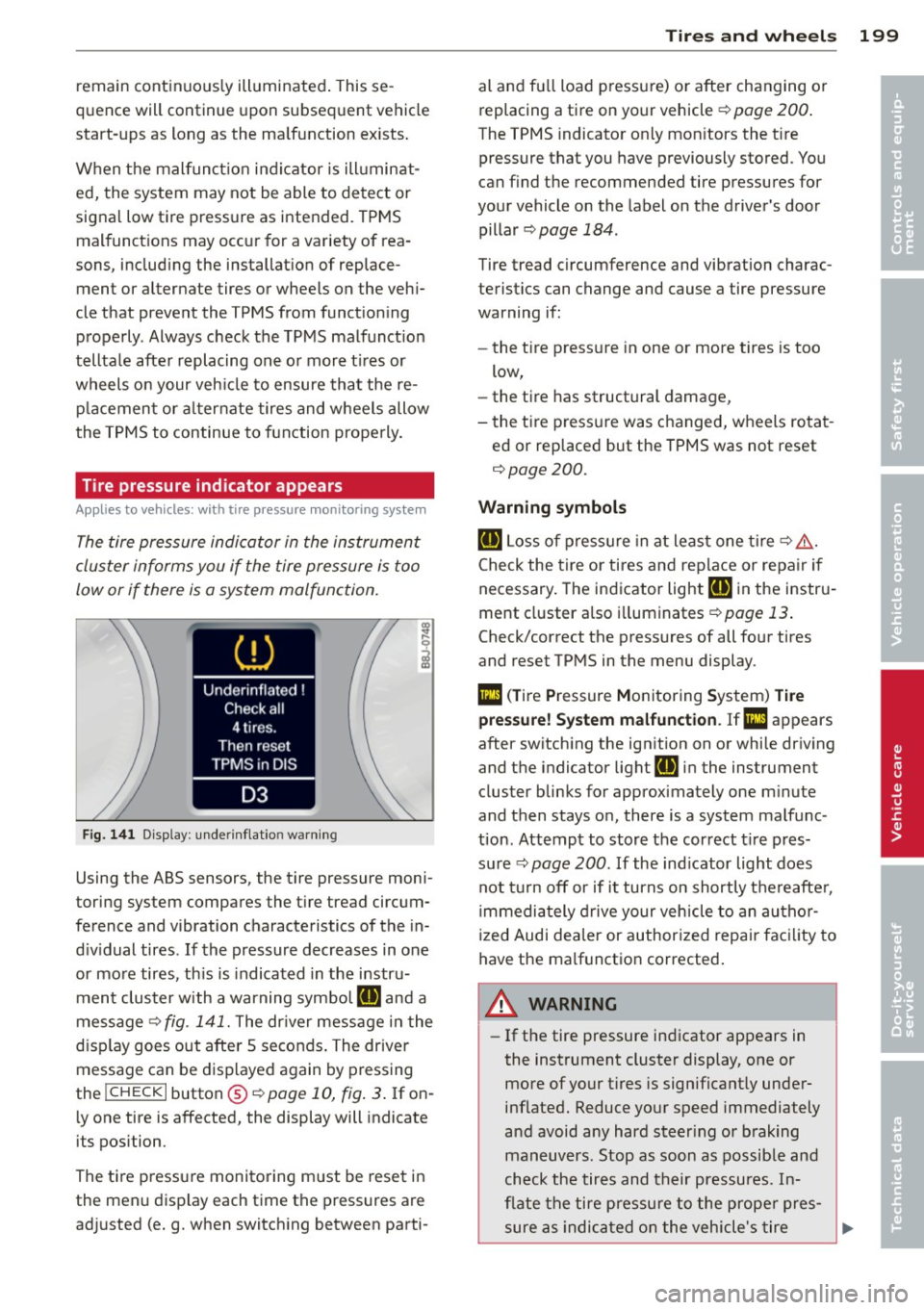
F ig. 1 41 Disp lay : under in fla tion warn ing
Using the ABS sensors, the tire pressure moni
toring system compares the t ire tread circum
fe rence and vibration characteristics of the in
d iv idual tires . If the pressure decreases in one
or mo re tires, th is is indicated in the instru
ment clus ter with a warning symbol
[I] and a
message
'* fig. 141. The dr iver message in the
d isp lay goes out after 5 seconds . The driver
message can be d isplayed again by pressing
the
! CHECK I button @¢ page 10, fig . 3 . If on
ly one tire is affected, the display will indicate
its pos ition.
The ti re pressure monito ring m ust be reset in
the menu display each time the pressures are
ad justed (e.g. when switching between parti-
Tire s an d wheel s 199
al and fu ll load pressure) or after changing o r
replacing a tire on your vehicle '*
page 200.
The TPMS indicator on ly mon itors the t ire
pressure that you have previously stored . You
can f ind the recommended tire pressures for
your vehicle on the label on the driver's door
pillar ¢
page 184 .
Tire tread circumference and vibration charac
teristics can change and cause a tire pressure
warning if:
- the t ire press ure in one or more tires is too
low,
- the tire has structural damage,
- the t ire press ure was changed, wheels rotat -
ed or rep laced but the TPMS was not reset
¢ page 200.
Warning symbo ls
[I] Loss of press ure in at least one tire'*& .
Check the tire or tires and rep lace or repa ir if
necessary . The indicator light
[I] in the instru
ment cluster a lso i lluminates
¢ page 13.
Check/correct the press ures of all four tires
and reset TPMS in the menu display .
mm (T ire Pressure Monitoring System) Ti re
pre ssure! System malfun ction . Ifll appears
after switching the ign it ion on or while dr iving
and the indicator light
[I] in the instrument
clus ter blinks fo r approximately one m inute
and then stays on, there is a system malfunc
tion . Attemp t to store the correct t ire pres
su re '*
page 200 . If the ind icator light does
not turn off or if i t turns on shortly thereafte r,
immedia tely drive your vehicle to an au thor
ized Audi dea ler or author ized repai r fac ility to
have the malfunction corrected .
A WARNING
=
-If the tire pressure indicator appears in
the instrument cluster display, one or
more of your t ires is significant ly under
inflated. Reduce your speed immediately
and avoid any hard steer ing or b rak ing
maneuvers. Stop as soon as possib le and
check the tires and their pressu res . In
flate the tire pressure to the prope r pres-
sure as indicated on the vehicle's tire .,..
•
•
Page 215 of 244
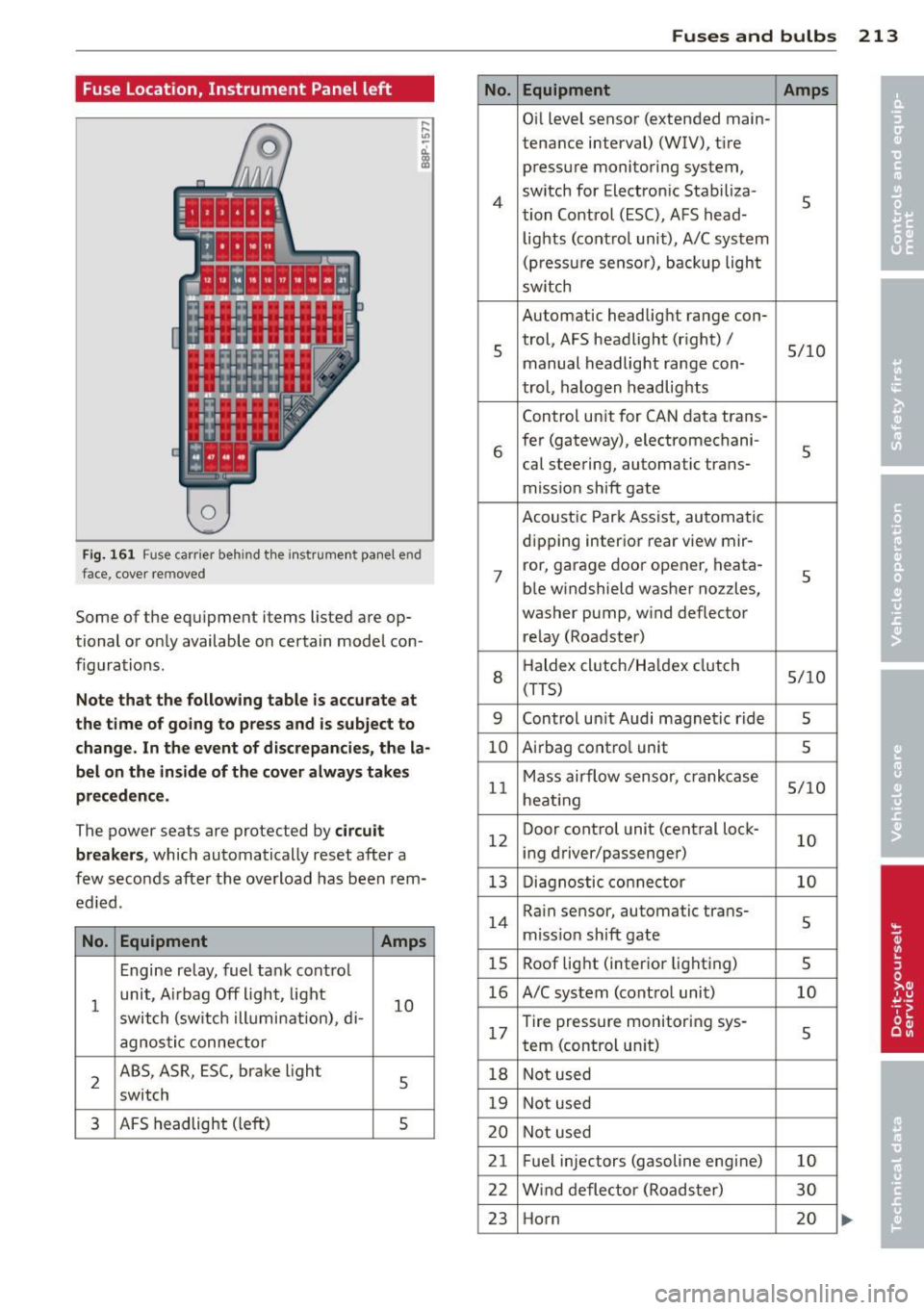
Fuse Location, Instrument Panel left
0
Fig. 161 Fuse carrier behind the instrument panel end
face, cover removed
Some of the eq u i prnent items listed a re op
tional or only available on certain model con
f igurations.
Note that the following table is accurate at
the time of going to press and is subject to
change. In the event of d iscrepancies, the la
bel on the in side of the cover always takes
precedence .
The power seats are protected by circuit
breakers ,
which automatically reset after a
few seconds after the overload has been rem
ed ied.
No. Equipment Amps
Engine relay, fuel tank cont ro l
1
unit, A irbag Off light, light
10 switch (sw itch illumi nation), di-
agnostic connector
2
ABS, ASR, ESC, brake light
5 switch
3 AFS headlight (left) 5
No.
4
5
6
7
8
9
10
11
12
13
14
15
16
17
18
19
20
21 22
23
Fuses and bulbs 213
Equipment Amps
Oil level sensor (extended main-
tenance interval)
(WIV), t ir e
press ure monitoring system,
sw itch for Electron ic Stabiliza-
5 tion Control (ESC), AFS head-
lights (control unit), A/C system
(pressure sensor), backup light
sw itch
Automatic headlight range con- trol, AFS headlight (right) /
5/10
manual headlight range con-
trol, halogen headlights
Control unit for CAN data trans-
fer (gateway), electrornechani-
5 cal steering, automatic trans-
miss ion shift gate
Acoustic Park Assist, automatic
d ip ping interior rear
view rnir-
ror, garage door opener, heata-
5 ble windshield washer nozzles,
washer pump, w ind deflector
relay (Roadster)
H aldex clutch/Ha ldex clutch
5/10 (TTS)
Control un it Audi magnetic ride
5
A irbag contro l unit 5
Mass airflow sensor, crankcase 5/10
heating
Door control unit (central lock -
10 ing driver/passenger)
Diagnostic connector
10
Rain sensor, automatic trans-
5 miss ion sh ift gate
Roof light (interior lighting)
5
A/C system (contro l unit) 10
Tire pressure monitoring sys -
5 tern (control un it)
Not used
Not used
Not used
Fuel injectors (gasoline eng ine)
10
Wind deflector (Roadster) 30
Horn 20
Page 216 of 244
214 Fuses and bulb s
No. Equipment
24 Transmi ssion (contro l un it)
25 Heate
r rear window Coupe /
heated rear window Roadster
26 Driver'
s side power window
27 Passenger's s ide power window
28 No
t used
29 Washer pump
30 Cigarette lighter
31 Start er
32 Steering column module
33 Instrument clust er
34 Radio navigation system , radio
35 Aud io amplifi er
36 Engine (control un it)
37 CAN (Gat
eway)
38 Ciga
rette lighter
39 Not us ed
40 Not used
4 1 Not u sed
42 Not used
43 No t used
44 Not used
45 No
t used
46 Not used
47 SOARS tuner, cell phone pack-
age,
TV tuner
48 VOA interface
49 Not used
Fuse location, left side of engine
compartment Amps
15
30/ 20
30 30
15
20
40 5
5
20/15
30 10
5
20
5 5
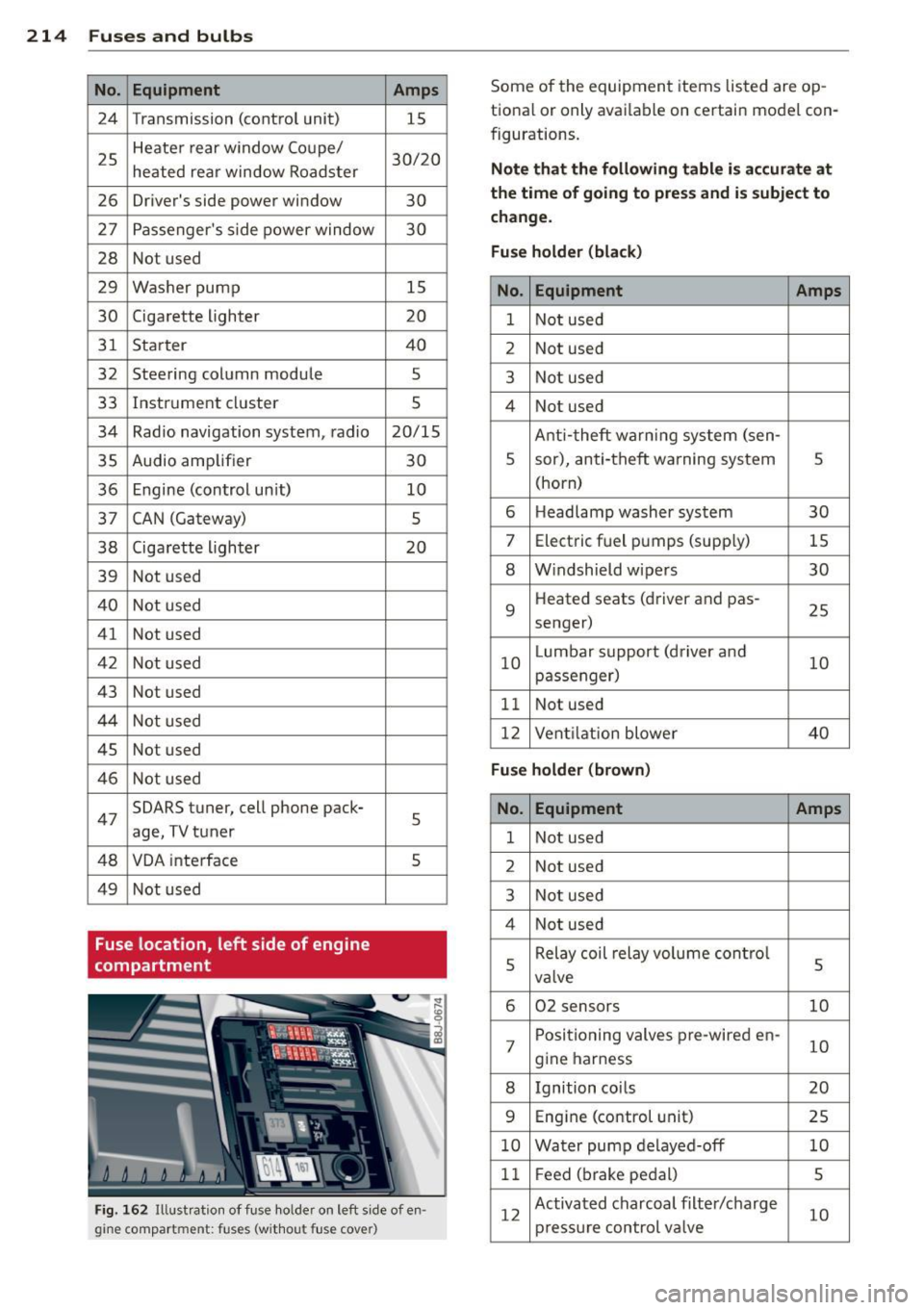
Fi g. 162 Ill ustra tion of fus e ho lde r on l eft side o f en·
gi ne compar tment: fuse s (withou t fuse c over)
Some of the equipment items listed are op
tiona l or only avai lable on c ertain mod el con
figurations.
Note tha t the foll owing table i s ac cur ate at
the time of going to pre ss and is subject to
change .
Fus e holder (bla ck )
No . Equipment Amps
1 Not used
2 Not used
3 Not used
4 No t used
Anti- theft warning system (sen -
5 sor), ant
i-theft warn ing system
5
(horn)
6 Headlamp washer system
30
7 Elec
tric fuel pumps (supp ly)
15
8 W
indshield wipers
30
9 H
eat ed seats (dr iver and pas-
25
senger)
10 L
umbar support (d river and
10
passenger)
11 Not u sed
12 Vent ilation blower 40
Fus e holder (brown )
No. Equipment Amps
1 Not used
2 Not used
3 Not used
4 Not used
5 Relay coil
relay volume cont ro l
5
va lve
6 02
sensors
10
7 P
ositioning valves pre-wired en-
10
gine harness
8 Ignition coi ls 20
9 Eng
in e (cont rol unit)
25
10 Water pump de layed-off 10
1 1 F
e e d (brak e pedal)
5
1 2 Activated charcoal filter/charge
10
p ress ure control va lve
Page 234 of 244
232 Index
E
Efficiency program ....... .. .. .. .... .. 27
F ue l economy messages ... .. .. .... .. 27
Memory levels . . . . . . . . . . . . . . . . . . . . . 23
Other equipment .. ......... .. .. .. .. 2 7
E lapsed time ... .... ....... .. .. .. .. .. 23
Electro -mechanical power assist . . . 17 , 145
Elect ronic differential lock (EDL) . . . . . . . 141
Warn ing/ indicato r lights ... .. .. .... .. 18
E lect roni c immobili ze r . . . . . . . . . . . . 12, 33
Electronic power co ntrol
EPC warning/ind icator light .. .. .. .... 19
Electronic speed limiter . . . . . . . . . . . . . . . 30
E lect ron ic S tabilization Control ( ESC) .. . 141
War ning/ indica tor l ights . .. .. .. .. .. .. 17
E mergency flasher . . . . . . . . . . . . . . . . . . . 51
War ning/ indicator lights . ...... .. .. .. 21
Emergency locking . . . . . . . . . . . . . . . . . . . 3 7
E mergency opera tion
Conve rtible top .......... .. .. .. .. .. 44
Rear lid . . . . . . . . . . . . . . . . . . . . . . . . . . . 38
E mergency sta rting .. ... ... .. .. .. .. . 216
Emergency towing ......... .. .. .. .. . 218
Ene rgy management ....... .. .. .. .. . 14 6
B att ery power . . . . . . . . . . . . . . . . . . . . 148
D river notification . . . . . . . . . . . . . . . . . 148
Eng ine
C he ckin g and fill ing locations . .. .. .. . 166
Coolan t .. .. ............. .... .. .. . 17 1
D ata .... .. ... ... .... ... .. .. .... . 224
Hood . ..... ... . ...... ... .. .. .... . 164
Starting . . . . . . . . . . . . . . . . . . . . . . 72, 73
Starting with jumper cab les .. .. .... . 216
Stopping . ................. ...... .. 74
E ng ine compartmen t ....... .. .. .. .. . 166
Safety instructions ... ... .. .. .. .... . 164
Working in the engine compa rtment .. 164
E ng ine cooling system ...... .. .. .. .. . 17 1
A dding coolant ........... .. ...... . 17 2
Chec king the eng ine coolan t leve l .. .. . 172
M alfunc tion . . . . . . . . . . . . . . . . . . . . . . . 17
Radiato r fan . .. .. ..... ... .. .. .... . 173
Temperature ga uge .. ... .. .. .. .... .. 11
E ng ine hood
C losing .. ............... .... .... . 164
H ow to release the hood ... .. .. .... . 164 E
ngine oi l .. .... .. ... .. ..... .... . .. 166
Adding ... .... .. .. ... ..... ... .. .. 169
Additives . ... .. .. ... .. ..... ... .. .. 169
Changi ng ..... .. ............. .... 170
Checking the engine oil level ..... .... 169
Indications and conditions requir ing ex -
tra checking ... .. ... .. .. ... ..... .. 169
Oil consumpt io n .. .......... ...... . 168
Oil g rades . .. .... ............. .. .. 166
Recommende d oi l c he ck interv als . .. .. 169
Spec ifi cat ion an d viscosity .. ... .. .. .. 166
T emperature display . .. ..... .... . .. . 26
En gine o il level .. .. ................ .. 19
Engine oi l pressure (ma lfunction) .. .. .. . 16
En gine oi l sensor defective . . . . . . . . . . . . 20
Engine oil temperature indicator ........ 26
Engine speed limitation .. ..... ... .. .. . 19
En vironment
Br eak-in per io d ... ............. .. .. 149
Catalytic converter . .. .. ..... ... .. .. 150
Disposing of your veh icle ba ttery ... .. 175
Driving at high speeds . . . . . . . . . . . . . . 152
Driving to minimi ze po llution and noise 151
Fuel ...... .... .. .. ............... 162
Fuel economy .... ................. 151
Leakage from your vehicle ..... ... ... 164
L etting the vehicle stand a nd warm up . 152
Proper disposal of d rained brak e flu id . 174
P roper d isposal of d rained eng ine cool-
an t ...... .... .. ................. 172
Proper disposal of d rained eng ine
oi l . . . . . . . . . . . . . . . . . . . . . . . . . 169, 170
Recycling used engine oil ..... ... .. .. 169
Un leaded fuel .. .. ............. .. .. 160
What shou ld I do with an o ld battery? . 175
EP C
refer to Elect ronic power co ntrol ... .. . 19
E SC (Electronic Stab ilizat io n Control)
Warning/ind icator lights ........ .. .. . 17
Event Data Recorder (EDR) ........ .... 141
E xhaust tail pipes
Cleaning . ..... .. ... .. ..... .... . .. 156
E xpansion tank . . . . . . . . . . . . . . . . . . . . . 172
Exterior m irrors
Adjust ing . .... .. ............. .... . 52
Dimming ...... .. ..... ....... ... .. . 53
Heating ....... .. ..... ....... ... .. . 52
Page 237 of 244
Matte finish paint cleaning .... .. .. .. . 154
Menu button . . . . . . . . . . . . . . . . . . . . . . . . 25
Menu display . . . . . . . . . . . . . . . . . . . . . . . .
24
M irrors
Activating the digital compass . ... .. ..
58
Ad justing the exterior mirrors ... .. .. .. 52
dimming ... ..... ..... ... ... ... .... 53
M on itoring the Advanced Airbag System
118
N
Natural leather
Cleaning . .. .. .. .. .. .... ... .. .. .. .
157
New tires and wheels
NHTSA 191
Contacting ..... .. .... ... .. .. .. .... 98
Number of seats ................. ... 100
0
Occupant seating posit ions ...... ... ... 92
Octane rating . .. .. ..... ... .. .. .. .. .
160
Odometer . .. .... ......... .. .. .. .... 1 2
O il
refer to Engine oil . ....... .. .. .. .. . 166
On -Board Diagnostic System (OBD)
Data Link Connector (DLC) . ... .. .. .. .. 30
E lectronic speed limiter . . . . . . . . . . . . . . 30
Malfunct ion Indicator Lamp (MIL) . .. .. 30
Open door or front lid warning . . . . . . . . . 22
Opening convert ible top
manually . ......... ......... .... ... 42
Operate your vehicle econom ica lly and
minim ize pollution ......... .. .. .. .. .
151
Opt iona l equipment
M arked with an asterisk . . . . . . . . . . . . . . . 6
Othe r equipment (effic iency p rog ram) . .. 27
Outlets . .. .. ............. .... .. .. ..
64
Outside m irrors
refer to Exterior mirrors . . . . . . . . . . . . . 52
Outside temperature display ..... ... ... 22
Owner 's man ua l
H ow the Owner's Manua l is organized . . . 6
p
Paint damage 156
P aint No ... .. .... ......... .. .. .. .. . 22 2
Inde x 235
Park assist . ... .... ... .. .. ..... ... .. . 79
Cleaning sensors lenses . ..... ... .. .. 155
Pa rking . . . . . . . . . . . . . . . . . . . . . . . . 75 , 83
Parking brake . .. .. ................. . 74
Parking brake warning . ... .... ... .. .. . 15
Pa rking on a decline (downhill) ....... .. 75
Pa rking on an incline (uphill) ... ... .. .. . 75
Pa rts replacement . .... ......... .. .. 2 27
Pass-through . . . . . . . . . . . . . . . . . . . . . . . . 62
PASSE NGER A IR BAG OF F light . ... .. ..
119
Passive safety system .... ....... .... .. 91
Pedals ....... .. .. .................. 96
Physi cal p rinciples of a fron tal collision 101
Plastic parts
Cleaning ........ .. ...............
156
Polishing ... .. .. .. .... ............. 156
Pollen filter . . . . . . . . . . . . . . . . . . . . . . . . . 68
Pollutant filter .. .. .. ................ 68
Power locking switch .. .. ..... ... .. .. . 36
Power loc king system ... ......... .. .. . 34
Convenience close/open feature . . . . . . .
40
Locking and unloc king the veh icle from
1 ns1de . ... .. .... .. . .. .. ..... ... .. . 36
Opening and closing the win dows ... ...
40
Rear lid/tru nk lid ... . .. ..... ... .. .. . 37
Remote contro l .. ............. .. .. . 33
U nlocking and locking vehicle .... .. .. . 35
Power out lets . . . . . . . . . . . . . . . . . . . . . . .
64
Power seats
Adjustment . . . . . . . . . . . . . . . . . . . . . . .
61
Power steer ing
refer to Electro-mechanical power as-
s ist . . . . . . . . . . . . . . . . . . . . . . . . .
17, 145
Power top
Cleaning .. .. .. .. .. ...............
156
Convenience close/open feature .. .. .. . 43
Convenience openi ng/clos ing ...... .. . 43
Power window switches .. ..... ... .. .. . 39
Reactivating the system ..... ... .. .. .
40
Pregnant women
S p eci al considerations w hen we aring a
sa fe ty be lt .. .. .. .... .............
105
Programming the Homeli nk universal re
mote control . . . . . . . . . . . . . . . . . . . . . . . .
88
Proper occupant seating positions . .. .. . 92
Pro per safety belt posi tion ........ .. ..
104
•
•
Page 238 of 244
236 Index
Proper seating position Front passenger . . . . . . . . . . . . . . . . . . . . 93
Occupants . .... ............ .. .... .. 92
Protecting . .. .... .. ... .... .. .. .. .. . 156
Q
Quartz clock . . . . . . . . . . . . . . . . . . . . . . . . 11
quatt ro
refer to All-wheel dr ive .... .. .. .... . 146
Question What happens to unbe lted occupants? 101
Why safety be lts? . . . . . . . . . . . . . . . . . 100
R
Radiator fan .... . ...... ... .. .. .... . 173
Ra in sensor defect ive .... .... .... ..... 21
Reading lights .... ..... ...... .. .. .. .. 51
Rear lid . .. .. .... .... ..... .. .. .. .. .. 37
E mergency release . . . . . . . . . . . . . . . . . . 38
Rear lig ht defective . . . . . . . . . . . . . . . . . . 20
Rear spoiler . . . . . . . . . . . . . . . . . . . . . . . . 143
Rear v iew mirro r . . . . . . . . . . . . . . . . . . . . . 53
Rear window defogger . . . . . . . . . . . . . . . . 70
Refue lling ... ... . ...... ... .. .. .... . 162
Release lever for hood .......... .. ... 164
Remote control . . . . . . . . . . . . . . . . . . 33, 36
Remote control garage door opene r
( H omelink) . . . . . . . . . . . . . . . . . . . . . . . . . 88
Remote master key Un lock ing and locking ..... .. .. .. .. . . 35
Remote rea r lid release . .... .. .. .. .. . . 37
Repair manua ls .. .. ..... ... .. .. .... . 225
Repairs Airbag system ............ ... .. .. . 12 1
Replacement parts ........... .. .. .. . 227
Replacing Wheel rims .... .. ..... ... .. .. .... . 19 1
Replacing a fuse .... ... .. .. .. .. .. .. . 212
Replacing light bulbs ....... .. .. .... . 215
Replacing tires a nd wheels ... .. .. .. .. . 19 2
Replacing w indshield wiper blades .. .. . . 57
Report ing Safety Defects . ... .. .. .... . . 98
Reset b utton . ............. .. .. .. .. .. 12
Resett ing remote control .... .. .. .. .. . . 36
Retractor .... ... ... .... ... .. .. .... . 103 Reve
rse (A utomat ic transm iss ion) . ... .. . 81
Rims Cleaning .. .... .. ............. .... 156
Rep lac ing . .. .. .. ............. .. .. 191
Run-fl at t ires .. .. .. .. .. ...... ... .. .. 201
Driving ....... .. .. ... ........... . 202
Introduction ..... ................ . 201
Replac ing defects pa rts ......... .. .. 203
s
SAFE .. ..... ... .. .. ... ........... .. 12
Saf e driving habits ... ... ..... ... .. .. . 91
Safety be lt pos ition ............. .... 104
Safety be lts worn by pregnan t women 105
Safety be lt pretensioner
Se rv ice and d isposal ... .. ... ..... .. 106
Safety be lts . .. .. .. ............. .. .. 103
Cleaning .. .. .. .. ... ...... .... .... 157
Danger to passengers who do not wear a
safety belt .. .. .. .......... ...... . 101
Fastening ... .. .. ... .. .. ... ..... .. 103
Improperly worn . ................. 105
Not worn . .... .. ............. .... 101
pretensioners .. .. ............. .... 106
Safety be lt pos ition .. .. ..... ... .. .. 104
Safety i nstr uctions . .... ..... ... .. .. 102
Securing child safety seats . ... .. .. .. 137
Spec ial considerations for pregnant
women ... .... .. .. ............... 105
U nfastening ... ... ................ 105
Warning/ind icator light ............ . 100
Why YOU MUST wea r them .. .. .. .. .. 100
Worn p rope rly . .. ............. .. .. 102
Safety be lt warning light . . . . . . . . . 16, 100
S afety comp liance s ticker ..... ... .. .. 222
Safety eq uipme nt .. ................ .. 91
Safety features for occ upant restraint and
protection .. .... .. ............. .... . 91
Safety gu idelines
Seat adjustment. . . . . . . . . . . . . . . . . . . . 59
Safety instr uctions
E ngine compartment ... ... ..... .. .. 164
for using ch ild safety seats ...... .. .. 132
F or usi ng sa fe ty belts .......... .. .. 102
Monito ring the Advanced Airbag Sys -
tem . ... .. .... .. .. ... .. ..... ... .. 120
Safety lock (Ignition k ey) . . . . . . . . . . . . . . 73