weight AUDI TT ROADSTER 2015 Owner's Manual
[x] Cancel search | Manufacturer: AUDI, Model Year: 2015, Model line: TT ROADSTER, Model: AUDI TT ROADSTER 2015Pages: 244, PDF Size: 60.74 MB
Page 136 of 244
134 Child Safe ty
light comes on and stays on. If the PAS·
SEN GER AIR BAG OFF
light does not
come on and stay on the inflating airbag
will hit the child safety seat or infant car
rier with great force and will smash the
child safety seat and child against the
backrest, door or roof. Have the airbag
system inspected immediately by your
Audi dealer .
Child safety seats
Infant seats
Babies and infants up to about one year old
and 20 lbs. or
9 kg need special rearward-fac
ing child restraints that support the back,
neck and head in a crash.
I
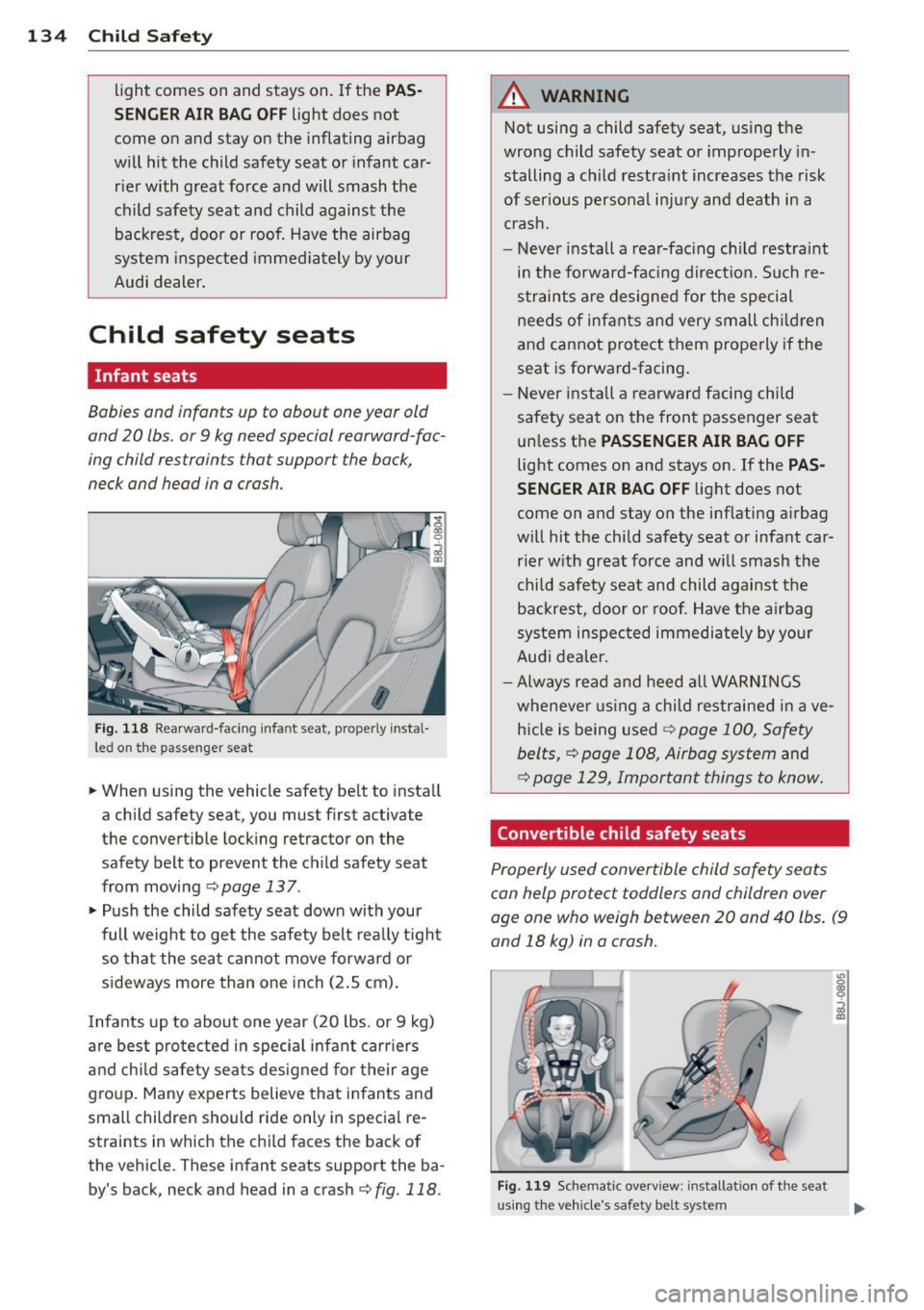
Fi g. 118 Rearwa rd-facing infant seat, proper ly insta l·
led on the passenge r seat
~ When using the vehicle safety belt to install
a child safety seat, you must first activate
the convertible locking retractor on the
safety belt to prevent the child safety seat
from moving
c:::;, page 13 7 .
~ Push the child safety seat down with your
full weight to get the safety belt rea lly t ight
so that the seat cannot move forward or
sideways more than one inch (2.5 cm).
I nfants up to about one year (20 lbs . or 9 kg)
are best protected in specia l infant carriers
and chi ld safety seats des igned for their age
group. Many experts believe that infants and
small children should ride only in special re
straints in which the child faces the back of
the vehicle. These infant seats support the ba·
by's back, neck and head in a crash
c:::;, fig. 118 .
A WARNING
-
Not using a child safety seat, using the
wrong child safety seat or improperly in
stalling a ch ild restra int increases the risk
of ser ious personal in jury and death in a
crash.
- Never install a rear-fac ing ch ild restra int
in the forward-fac ing direct ion. Such re
straints are designed for the special
needs of infants and very small ch ildren
and cannot protect them properly if the
seat is forward-facing.
- Neve r install a rearward faci ng ch ild
safety seat on the front passenger seat
un less the
PASSENGER AIR BAG OFF
light comes on and stays on. If the PAS
SENGER AIR BAG OF F
light does not
come on and stay on the inflating airbag
will hit the child safety seat or infant car
rier with great force and w ill smash the
child safety seat and child against the
backrest, door or roof. Have the a irbag
system inspected immediately by your
Aud i dealer.
- Always read and heed all WAR NINGS
wheneve r using a child res trained in ave
hicle is being used
c:::;, page 100, Safety
belts,
c:::;, page 108, Airbag system and
c:::;, page 129, Important things to know .
Convertible child safety seats
Properly used convertible child safety seats
can help protect toddlers and children over
age one who weigh between 20 and 40 lbs . (9
and 18 kg) in a crash .
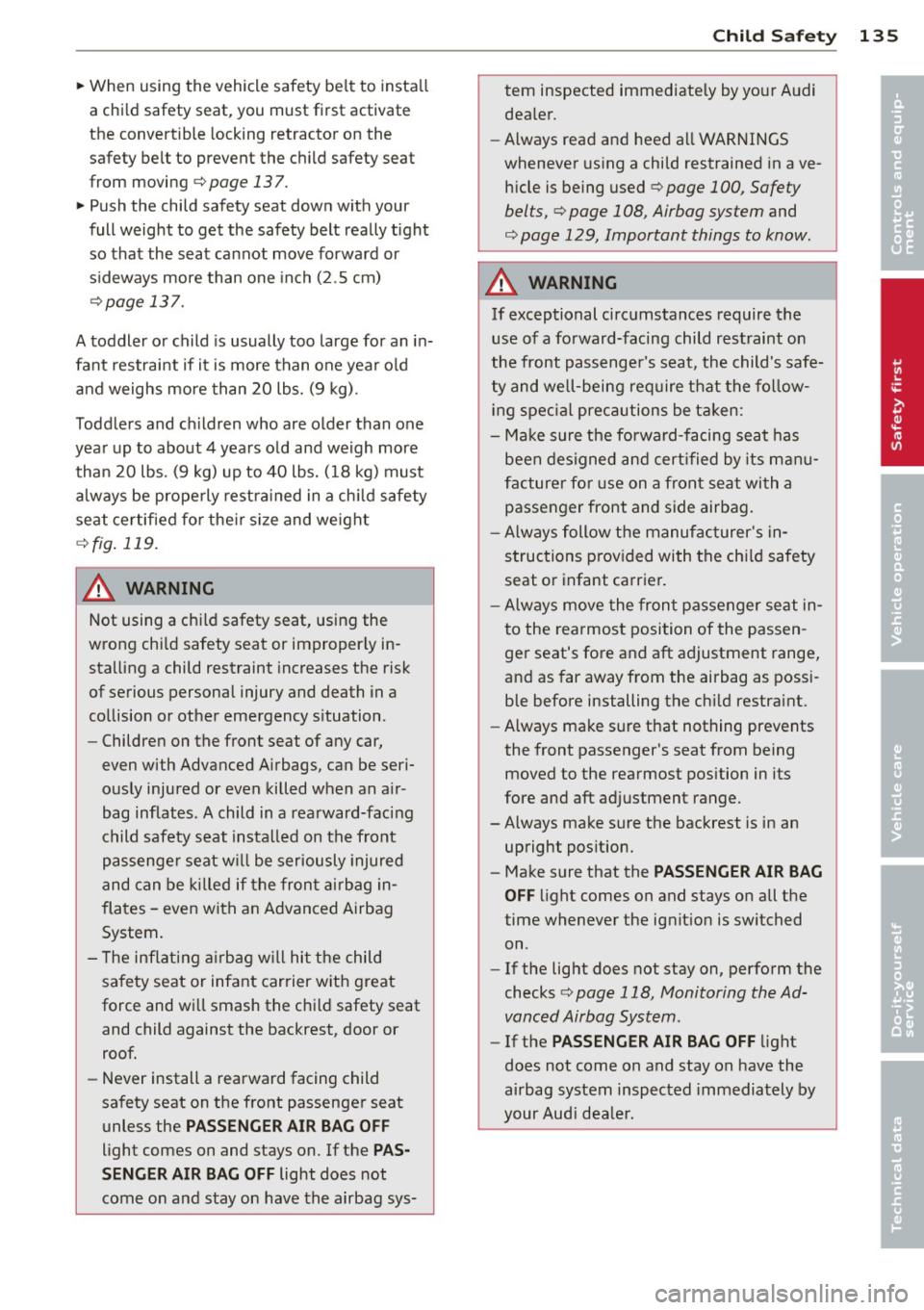
Fig . 1 19 Schema tic overview: ins tallat ion of the seat
using the vehicle's safety be lt sys te m
Ill>
Page 137 of 244
~ When using the vehicle safety belt to insta ll
a chi ld safety seat, you must first activate
the convertible locking retractor on the
safety belt to prevent the ch ild safety seat
from moving
c:::, page 137.
~ Push the child safety seat down with your
f ull weight to get the safety belt really t ight
so that the seat cannot move forward or
s ideways more than one in ch (2.5 cm)
¢page 137.
A toddler or child is usually too large for an in
fant restra int if it is more than one yea r old
and weighs more than
20 lbs. (9 k g) .
Toddlers and c hildren who are older than one
yea r up to about
4 years o ld and weigh more
than
20 lbs. (9 k g) up to 40 lbs. (1 8 kg) must
always be properly restra ined in a ch ild safety
seat certified fo r the ir s ize and we ight
¢ fig . 119.
& WARNING
Not using a child safety seat, using the
wrong chi ld safety seat or improper ly in
stalling a child restraint increases the risk
of serious personal injury and death in a
co llision or othe r emergency s ituation.
- Children on the front seat of any car,
even with Advanced A irbags, can be seri
o usly injured or even killed when an a ir
bag inflates. A child in a rearward-facing
child safety seat installed on the front
pas senge r seat w ill be seriously injured
and can be killed if the fron t air bag in
fla tes -even with an Advanced Airbag
System .
-
- The inflating airb ag w ill hit the child
sa fety seat or infant carrier w it h great
force and w ill smash the ch ild safety seat
and child against the backrest, door or
roof.
- Never install a rearward facing child
sa fety seat on the front passenge r seat
unless the
PASSENGER AIR BAG OFF
light comes on and stays on. If the PAS
SENGER AIR BAG OFF
light does not
come o n and stay on have the airbag sys-
Child Sa fet y 135
tern inspected immediately by you r Audi
dea le r.
- Always rea d and heed all WAR NIN GS
whenever us ing a child restrained in ave
hicle is being used
c:::, page 100, Safety
belts,
c:::, page 108, Airbag system and
c:::, page 129, Important things to know.
A WARNING
If exceptional circ umstances require the
use of a forward -facing child r est raint on
the front passenge r's seat, the child's safe
ty an d we ll-being re quire t hat the fol low
ing spec ial prec autions be t aken:
- Ma ke sure the forward-facing seat has
been designed and certified by its m anu
f a cturer fo r use on a fro nt sea t wi th a
passenger front and side airbag.
- Always follow the manuf acturer's in
struc tions p rov ided with the ch ild safety
seat o r infant ca rr ier.
- Always move the fron t passenger sea t in
to the rearmos t position of the passen
ger seat's fo re and aft adjustment range,
and as far away f rom the airbag as possi
ble before installing the ch ild restraint.
- Always make sure that nothing prevents
the front passenger's seat from being
moved to the rearmost position in its
fore and aft adjustment range.
-Always make sure the backrest is in an upright pos ition.
- Make sure that the
PASSENGER AIR BAG
OFF
li ght comes on and stays on all the
time wheneve r the ignit ion is switched
on.
- If the light does not stay on, perform the
checks
c:::, page 118 , Monitoring the Ad
vanced Airbag System .
-If the PASSENGER AIR BAG OFF light
does not come on and stay on have the
airbag system inspec ted immedia tely by
your Aud i dea le r. •
•
-
Page 138 of 244
136 Child Safet y
Booster seats and safety belts
Properly used booster s eats can help protect
children weighing between about 40 lbs . and
80 lbs . (18 kg and 36 kg) who are less than 4
ft. 9 in. (57 inches/1 .45 meters) tall.
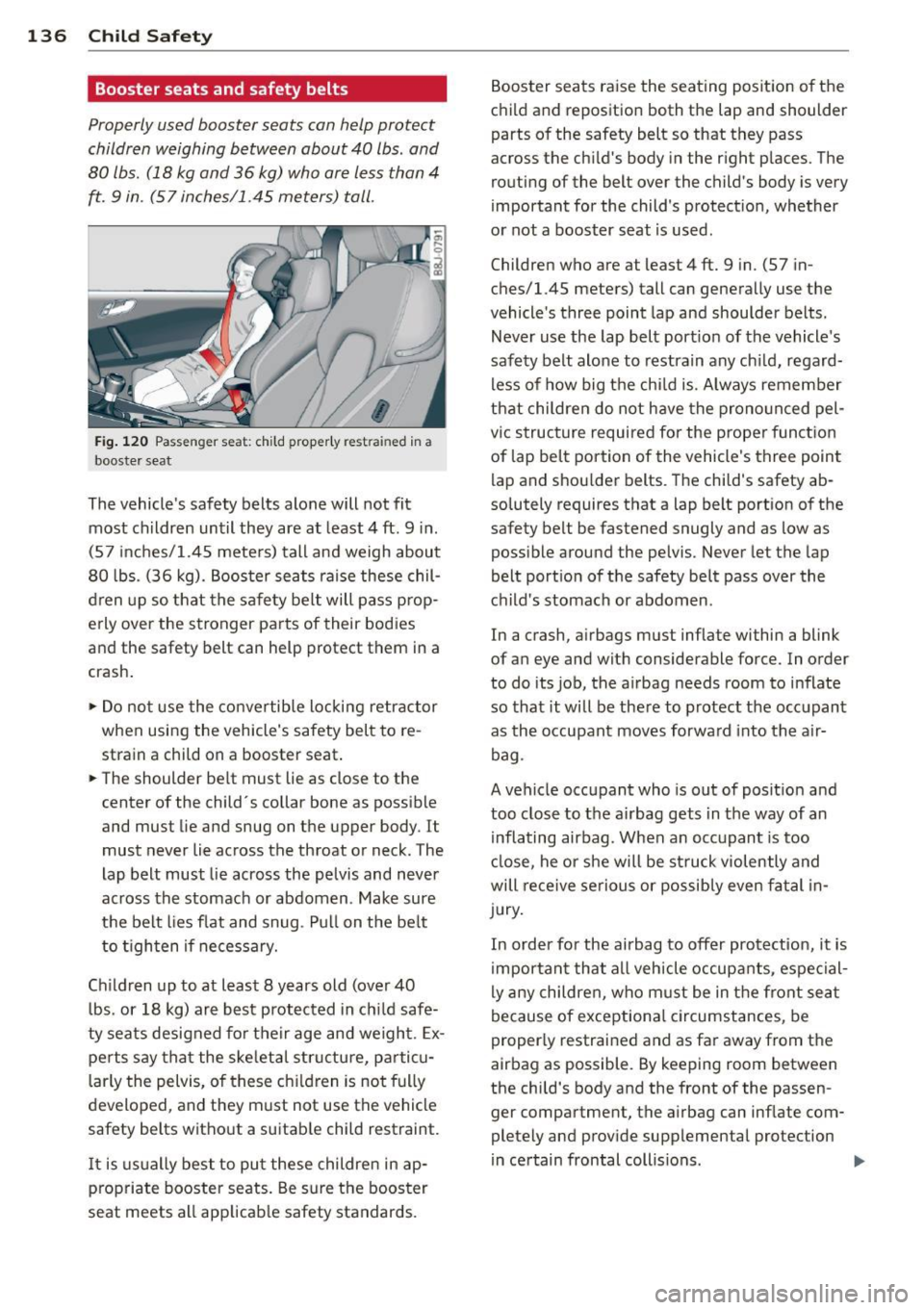
Fig . 120 Passenger seat: child proper ly rest ra in ed in a
booster seat
The vehicle's safety belts alone will not fit
most children until they are at least 4
ft. 9 in .
(57 inches/1.45 mete rs) tall and weigh about
80 lbs . (36 kg). Booster seats ra ise these chil
dren up so that the sa fety belt will pass p rop
erly over the stronger pa rts of their bodies
and the safety belt can help protect them in a
crash.
.. Do no t use the co nvertible locki ng retractor
when using the vehicle's safety belt to re strain a chi ld on a booster seat .
.. The shoulder be lt must lie as close to the
center of the child 's collar bone as possible
and must lie and snug on the upper body. It
must never lie across the throat or neck . The
lap belt must
lie across the pelvis and never
across the stomach or abdomen . Make sure
the belt lies f lat and snug . Pull on the be lt
to t ighten if necessary.
Ch ildren up to at least 8 years old (over 40
l bs. or 18 kg) are best protected in ch ild safe
ty seats designed fo r their age and weight . Ex
pe rts say that the ske leta l structure, pa rticu
larly the pelvis, of these ch ildren is not ful ly
developed , and they m ust not use the vehicle
safety belts without a suitab le child restraint.
It is us ually best to put these childre n in ap
propriate booster seats . Be sure the booster
seat meets all applicab le safety standards. Booster seats raise the seating position of the
c
h ild and reposition both the lap and shoulder
parts of the safety belt so that they pass
across the ch ild's body in the right p laces. The
ro uting of the belt over the child's body is very
important for the child's protect ion, whether
o r not a booster seat is used .
Children who are at least 4
ft. 9 in. (57 in
ches/1.45 meters) tall can generally use the
vehicle's three point lap and shoulder belts .
Never use the lap belt port io n of the vehicle's
safety belt alone to restrain any ch ild, regard
less of how big the chi ld is. A lways remember
that children do not have the prono unced pel
vi c structure required for the proper funct ion
of lap be lt portion of the vehicle's three point
lap and shou lde r belts . T he child 's safety ab
solutely requires that a lap belt port ion of the
safety belt be fastened snugly and as low as
possible around the pelvis. Never let the lap
belt portion of the safety be lt pass over the
c hi ld 's stomach or abdomen.
In a crash, a irbags must inflate within a blink
of a n eye and wi th considerable force. In order
to do its job, the airbag needs room to inflate
so that it will be the re to protect t he occupant
as the occupant moves forwa rd into the a ir
bag .
A vehicle occupant who is out of posit ion and
too close to the a irbag gets in t he way of an
inflating airbag . When an occupant is too
cl ose, he or she w ill be struck v iolently and
will receive serious or possibly even fatal in
Jury .
In order for the airbag to offer prote ction, it is
importan t that a ll vehicle occupa nts, espe cial
ly any childre n, who m ust be in t he front se at
because of exceptiona l circumstances , be
proper ly restrained and as fa r away from the
airbag as possible. By keeping room between
the chi ld's body and the front of the passen
ger compartment, the airbag can inf late com
pletely and prov ide supplemental protection
in certain frontal collisions .
..
Page 140 of 244
138 Child Safety
in place during normal driving or in a
crash.
- Always buckle the child safety seat firmly
in place even if a child is not sitting in it.
A loose child safety seat can fly around
during a sudden stop or in a collision
- The inflating airbag will hit the child safety seat or infant carrier with great
force and will smash the child safety seat and child against the backrest, door or
roof.
- Forward-facing child safety seats or in
fant carriers installed on the front pas
senger's seat may interfere with the de
ployment of the airbag and cause serious
injury to the child.
- Always read and heed all WARNINGS
whenever using a child restrained in ave
hicle is being used
~page 129. Special
precautions apply when installing a child
safety seat on the front passenger seat
~ page 109, Child restraints on the front
seat -some important things to know.
A WARNING
-
Always take special precautions if you
must install a forward or rearward-facing
child restraint on the front passenger's
seat in exceptional situations:
- Whenever a forward or rearward-facing
child restraint is installed on the front
passenger seat, the
PASSENGER AIR
BAG OFF
light must come on and stay on
whenever the ignition is switched on.
- If the
PASSENGER AIR BAG OFF light
does not come on and stay on, perform
the checks described
~ page 118, Moni
toring the Advanced Airbag System.
- If the PASSENGER AIR BAG OFF light
does not come on and stay on whenever
the ignition is switched on the inflating
airbag will hit the child safety seat or in
fant carrier with great force and will smash the child safety seat and child
against the backrest, door or roof . Have
the airbag system inspected immediately by your Audi dealer . -
Improper installation of child restraints
can reduce their effectiveness or even
prevent them from providing any protec
tion .
- An improperly installed child restraint
can interfere with the airbag as it de
ploys and seriously injure or even kill the
child.
- Always carefully follow the manufactur
er's instructions provided with the child
safety seat or carrier.
- Never place additional items on the seat that can increase the total weight regis
tered by the weight-sensing mat and can
cause injury in a crash.
A WARNING
Forward-facing child restraints:
- Always make sure the forward-facing
seat has been designed and certified by
its manufacturer for use on a front seat
with a passenger front and side airbag.
- Never put the forward-facing child re
straint up, against or very near the in
strument panel.
- Always move the passenger seat into its
rearmost position in the seat's fore and
aft adjustment range, as far away from
the airbag as possible before installing
the forward-facing child restraint. The
backrest must be adjusted to an upright position.
- Make sure that the
PASSENGER AIR BAG
OFF
light comes on and stays on all the
time whenever the ignition is switched
on .
A WARNING ~
Rearward-facing child restraints:
- A child in a rearward-facing child safety
seat installed on the front passenger
seat will be seriously injured and can be
killed if the front airbag inflates - even
with an Advanced Airbag System.
- The inflating airbag will hit the child
safety seat or infant carrier with great
force and will smash the child safety seat
Ill>
Page 141 of 244
and child against the backrest, door or
roof.
- Always be especially caref ul if you must
install a rearward facing child safety seat
on the front passenger seat in exception
al circumstances.
- Make sure that the
PASSENGER AIR BAG
OFF
light comes on and stays on all the
t ime whenever the ignition is switched
on.
- Never install a rearward facing child
safety seat on the front passenger seat unless the
PASSENGER AIR BAG OFF
light comes on and stays on . If the PAS
SENGER AIR BAG OFF
light does not
c ome on and stay on have the airbag sys
tem inspected immediately by your Audi
dealer .
Activating the convertible locking
retractor
Use the convertible locking retractor to se
cure a child restraint.
A lways heed the child sa fety seat manufactur
er's instructions when installing a chi ld re
straint in your vehicle . To activate the conver
tible locking ret ractor:
.,. Place the child restraint on a seat.
.,. Slow ly pull the be lt
all the way out.
.,. Route it around or through the chi ld re
stra int be lt path
c:> &_ .
.,. Push the child safety seat down with your
full weight to get the safety belt really t ight.
.,. Insert the belt tongue into the buckle for
that seating position .
.,. Gu ide the safety belt back into the retractor
until the belt lies flat and snug on the chi ld
safety seat.
.,. You should hear a "clicking" noise as the
belt winds back into the inertia reel. Test the
convertible locking retractor by pulling on
the belt . You should no longer be able to
pull the belt out of the retractor. The con
vertib le locking retractor is now act ivated.
Child Sa fet y 139
.,. Make sure that the red release button is fac
ing away from the child restraint so that it
can be unbuckled qui ck ly.
.,. Pull on the belt to make sure the safety belt
is properly tight and fastened so that the
seat cannot move forward or sideways more
than one inch (2 . S cm).
A WARNING
Using the wrong child res traint o r an im
properly installed chi ld restraint can cause
serious personal injury or death in a crash.
- Always ma ke sure that the safety belt re-
tractor is loc ked when insta lling a child
safety seat . An unlocked safety belt re
tractor cannot hold the child safety seat in place during norma l driving or in a
crash.
- Always buckle the child safety seat firmly
in place even if a chi ld is not sitting in it.
A loose child safety seat can fly around during a sudden stop or in a crash.
- Always make sure the seat backrest to
which the child restraint is installed is in
an upright pos ition. Otherw ise, the seat
back with the ch ild safety seat attached
to it could fly forward in the event of an accident or other emergency situation .
-Always read and heed all WARNINGS
whenever using a child restrained in ave hicle is being used
c:> page 129. Special
precautions apply when insta lling a child
safety seat on the front passenger seat
c:> page 109, Child restraints on the front
seat -some important things to know .
Deactivating the convertible locking
, retractor
-
The convertible locking retractor for child re
straints will be deactivated automatically when the belt is wound all the way back in to
the retractor.
.,. Press the red button on the safety belt buck
le . The belt tongue will pop out of the buck
le .
.,. Guide the safety belt all the way back into
its stowed position . •
•
Page 182 of 244
180 Tire s and wheel s
Tires and wheels
Tires
General notes
Tires may be the least appreciated and most
abused parts of a motor vehicle .
Tires may be the least appreciated and most
abused parts of a motor vehicle . Tires are,
however, one of the most important parts of a
vehicle, particularly considering the compara
tive ly small patch of rubber on each tire that
assures that a ll-impo rtant contact between
you, your vehicle and the road.
Maintaining the correct tire pressure, mak ing
sure that your vehicle and its tires do not have
to carry mo re weight than they can safe ly han
d le, avoiding damage from road hazards and
reg ularly inspecting t ires for damage includ
ing cuts, slashes irregu la r wear and ove rall
condition are the most important things that
you can do to he lp avoid sudden tire failure in
cluding tread separation and blowouts.
Avoiding damage I f you have to drive over a curb or similar ob
stacle, drive very s low ly and as close as possi
b le at a right angle to the curb.
A lways keep chem ica ls includ ing gre ase, o il,
gasoline and b rake fluid off the ti res .
Inspect the t ires regularly for damage (cuts,
cracks or b listers, etc.). Remove any fo reign
bod ies embedded in the treads.
Storing tires Mark tires when you remove them to indicate
the direction of rotation . Th is ensures you to
be ab le to mount them correctly when you re
install t hem.
When removed, the whee ls or t ires should be
stored in a cool, d ry and preferably dark place .
Store tires in a vertical pos ition if they are not
mounted on rims, in a horizontal pos it ion if
they are mounted on rims. New tire
s
New t ires have to be broken in¢&,. .
T he tread depth of new t ires may vary, accord
ing to the type a nd make of t ire and the tread
pa tte rn .
Hidden damage
Damage to tires and r ims is ofte n not readily
vis ible . If you notice unusual v ibrat ion or the
vehicle p ulls to one side, th is may ind icate
t h at one of the t ires has been damaged . Th e
t ir es m ust be checked immed iate ly by an au
tho rized Aud i dea le r or q uali fied wor ks hop.
Unidirectional t ires
A un idirectional tire can be identified by ar
rows on the sid ewa ll, that po int in the direc
t ion the t ire is desig ned to rotate. You mus t
f ol low the specified d irection of rotation . This
is necessary so that these tires can develop
their optimum characterist ics regarding grip,
road no ise, wear and hyd rop laning resistance.
For more information
¢page 211.
A WARNING
-New tires or tires that are old, worn or
damaged cannot provide maximum con
trol and braking ability .
-
-New tires tend to be slippery and must
be broken in . To reduce the risk of losing
control, a co llision and ser ious personal
in jur ies, d rive w ith special ca re fo r the
fi rst 350 m iles (560 km).
- Driving with worn or damaged tires can
le ad to loss of control, sudden tire fail
ure, including a blowou t and sudden de
fl ation, c rashes and seriou s personal in
juries . Have wo rn or damaged t ires re
p laced immediate ly .
- T ires age even if they are not being used
an d can fai l sudden ly, especially at high
speeds. Tires that are more than 6 years
old can only be used in an emergency
and then w ith specia l care and at low
speed.
Page 183 of 244
-Never mount used tires on yo ur vehicle if
yo u are not sure of their "previous histo
ry." Old used tires may have been dam
aged even though the damage cannot be
seen that can lead to sudden tire failure
and loss of vehicle control.
- If you notice unusual vibration or if the
vehicle pulls to one side when d riving, al
ways stop as soon as it is safe to do so
and check the wheels and tires for dam
age .
(D Note
-Please note that summer and winter
tires are designed for the cond itions that
are typ ic al in those seasons. Aud i recom
mends using w inter t ires du ring the win-
Glossary of tire and loading terminology
Accessory weight
means the comb ined weight (in excess of
those standard items which may be replaced)
of automatic tra nsmission, power steering,
power brakes, power windows, power seats,
radio, and heater, to the extent that these
items are availab le as factory-installed equip
ment (whether installed or not) .
Aspect ratio
means the ratio of the height to the width of
the tire in percent . Numbers of 55 or lower in
d icate a low sidewall for improved steering re
sponse and better overall handling on dry
pavement .
Bead
means the pa rt of the ti re that is made of
steel wires, wrapped or reinforced by ply cords
and that is shaped to fit the rim.
Bead s eparation
means a b reakdown of the bond between
components in the bead.
Cord
means the strands forming the plies in the
tire.
Tire s an d wheel s 181
ter months . Low temperatu res signifi
cantly decrease the elastic ity of summer
t ires, which affects traction and braking
ability. If summer tires are used in very
co ld temperatures, cracks can form on
the tread bars, res ulting in permanent
ti re damage that can cause loud drivi ng
noise and unbalanced tires. Aud i is not
responsib le for this type of damage.
- Burn ished, polished or chromed rims
must not be used in winter weather. Th e
surfa ce of the rims does not have suffi
c ien t cor rosion pro te cti on for this and
c o ul d be pe rmanen tly damaged by road
salt or similar substances. This damage
is not covered by warranty.
Cold tir e inflation pressure
me ans the t ire press ure re commended by the
vehicle manufacturer fo r a tire o f a des igna ted
size that has not bee n driven for more than a
coup le of miles (k ilomete rs) at low speeds in
the three hour pe riod before the tire press ure
is measured or adjusted.
Curb weight
means the weight o f a motor vehicle with
standard equipment including the maximum
capacity of fuel, o il, and coolant, air cond i
tion ing and additional weight of optiona l
equipment.
E xtra load tire
means a tire designed to operate at higher
l oads and at higher inflation press ures than
the corresponding standard tire. Extra load
tires my be ident ified as "XL", "xl", "EXTRA
LOAD", or "RF" on the sidewall.
Gross Axle Weight Rating ("GAWR")
means the load-carrying capacity of a single
axle system, measured at the tire-ground in-
ter~ces.
~
•
•
Page 184 of 244
182 Tires and wheels
Gross Vehicle Weight Rating ("GVWR")
means the maximum total loaded weight o f
the vehicle.
Groove
means the space between two adjacent tread
ribs.
Load rating (code)
means the maximum load that a tire is rated
to carry for a given inflat ion pressure. You
may not find this informat ion on all tires be
cause it is not requ ired by law .
Maximum load rating
means the load rating for a t ire at the maxi
mum permissible inflation pressure for that
tire .
Maximum loaded vehicle weight
means the sum of:
(a) Curb weight
(b) Accessory weight
(c) Vehicle capacity we ight, and
(d) Production opt ions weight
Maximum (permissible) inflation pressure
means the maximum cold inflation pressure
to which a tire may be inflated . Also called
"maximum inflation press ure."
Normal occupant weight
means 150 lbs. (68 kilog rams) times the
number of occupants seated in the vehicle up
to the tota l seating capacity of your vehicle.
Occupant distribution
means distribution of occupants in a veh icle.
Outer diameter
means the overall diameter of an inflated new
tire.
Overall width
means the linear distance between the exteri
ors of the sidewalls of an inflated tire, includ
ing elevations due to labeling, decorations, or
protective bands or ribs .
Ply
means a layer of rubbe r-coated parallel cords.
Production options weight
means the combined weight of those installed
regular production opt ions we ighing over 5
lbs. (2.3 kg) in excess of those standa rd items
wh ich they replace, not previously considered
in curb weight or accessory weight, including
heavy duty brakes, ride levelers, heavy duty
battery, and specia l trim .
Radial ply tire
means a pneumat ic tire in which the ply cords
that extend to the beads are laid at substa n
tially 90 deg rees to the centerline of the
tread.
Recommended inflation pressure
see <=;> page 181, Cold tire inflation pressure .
Reinforced tire
means a tire designed to operate at higher
loads and at higher inflation pressures than
the corresponding standard tire. Re inforced
t ir es my be identified as "XL", "xl", "EXTRA
LOAD", or "RF" on the sidewall.
Rim
means a metal support for a tire or a t ire and
tube assembly upon which the tire beads are
seated .
Rim diameter
means nominal diameter of the bead seat. If
you change your wheel s ize, you will have to
purchase new tires to match the new r im di
ameter .
Rim size designation
means rim diameter and width.
Rim width
means nom inal distance between rim flanges.
Sidewall
means that portion of a t ire between the
tread and bead .
Page 185 of 244
Speed rating (letter code)
means the speed at wh ich a tire is des igned to
be driven for extended periods of t ime . The
ratings range from 93 mph (150 km/h) to
186 mph (298 km/h)
¢page 192. You may
not find this information on all tires because
it is not required by law.
The speed rating letter code, where applica b le, is molded on the tire sidewall and indi
cates the maximum permissible road speeds
¢ &. in Winter tires on page 196.
Tire pressure monitoring system
means a system that detects when one or
more of a vehicle's tires are underinflated and
illuminates a low tire pressure warn ing te ll
tale .
Tread
means that portion of a tire that comes into
contact with the road.
Tread separation
means pulling away of the tread from the tire
carcass .
Treadwear indicators (TWI)
means the projections within the princ ipal
grooves designed to give a visual indication of
the degrees of wear of the tread. See
¢
page 190, Tread Wear Indicator (TWI) for
more informat ion on measuring tire wear.
Uniform Tire Quality Grading
is a tire information system developed by the
United States National Highway Traffic Safety
Admin istration (NHTSA) that is designed to
h elp buyers make relative comparisons among
tires . Th e U TQG is not a safety rating and not a
g uar antee that a tire will last for a prescribed
number of mi les or per form in a certain way.
It simply gives tire buyers additional informa
tion to combine with other considerations,
Tires and wheels 183
such as price, brand loyalty and dealer recom
mendations . Under UTQG, tires are graded by
the tire manufact urers in three areas: tread
wear, traction and temperature resistance .
The UTQG informat ion on the tires, molded in
to the sidewalls .
U.S. DOT Tire Identification Number (TIN)
This is the tire's "serial number" It begins
with the letters "DOT" and indicates that the
tire meets all federa l standards. The next two
numbers or letters ind icate the plant where it
was manufactured, and the last four numbers
represent the week and year of manufacture.
For example,
DOT ... 2213 ...
means that the tire was produced in the 22nd
week of 2013. The other numbers are market
ing codes that may or may not be used by the
tire manufacturer. This information is used to
contact consumers if a tire defect requires a
recall.
Vehicle capacity weight
means the rated cargo and luggage load plus
150 lbs . (68 k ilograms) times the vehicle's to
tal seating capacity as listed on the label lo
cated on the driver's side B -pillar .
Vehicle maximum load on the tire
means that load on an individual tire that is
determined by distributing to each axle its
share of the maximum loaded vehicle weight
and dividing by two.
Vehicle normal load on the tire
means that load on an individual tire that is
determined by distributing to each ax le its
share of the curb weight, accessory weight,
and normal occupant weight (distr ibuted in
accordance with table below¢
page 184)
and dividing by two.
•
•
Page 186 of 244
184 Tires and wheels
Occupant loading for vehicle normal load (no luggage)
Designated seating capacity, number of occu- Vehicle normal load (no luggage), number of
pants occupants
2 2
Cold tire inflation pressure
Tire pressure affects the overall handling, performance and safety of a vehicle.
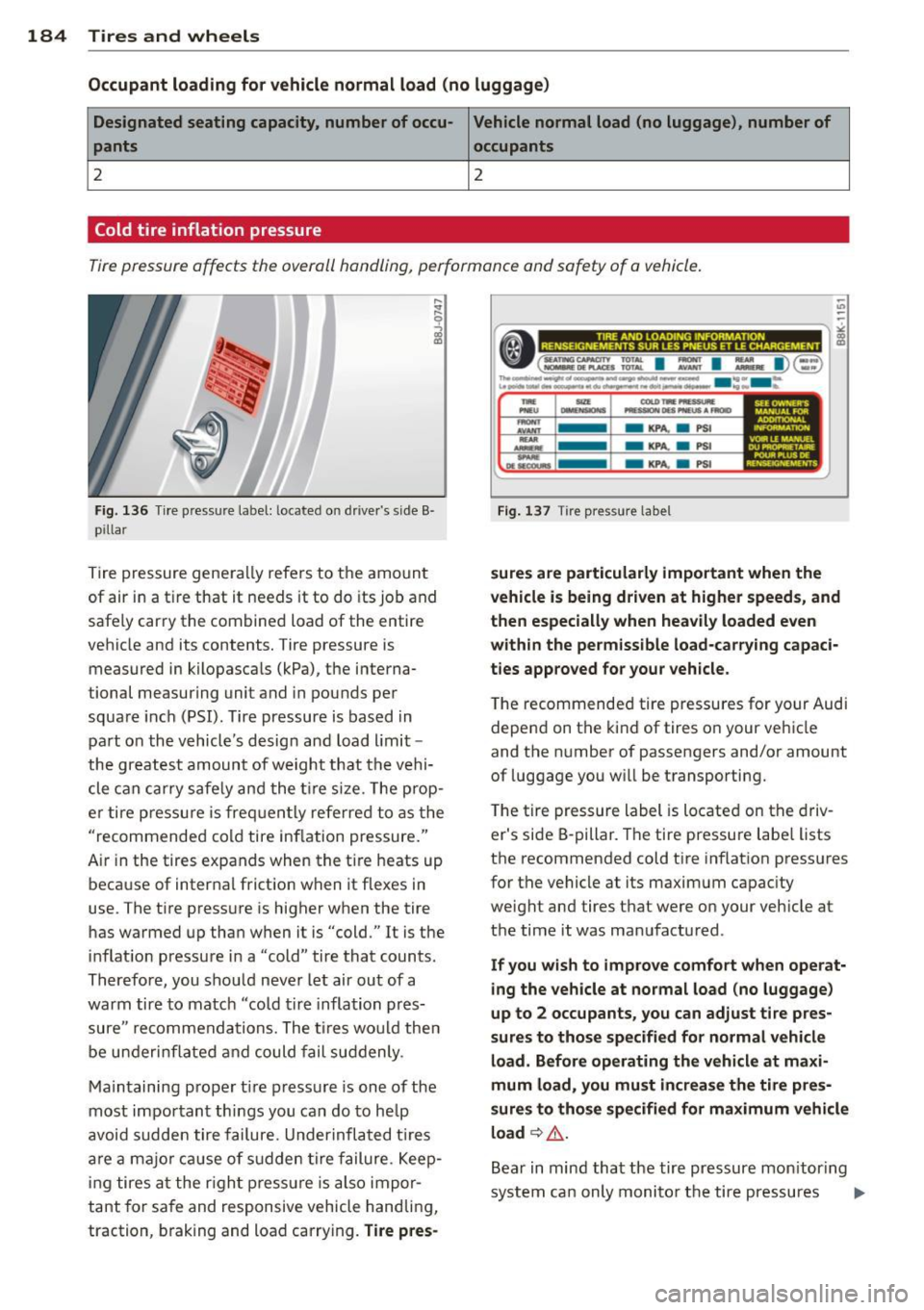
Fig. 136 Tire pressure label: located on driver's side B
pillar
Tire pressure genera lly refers to the amount
of air in a tire that it needs it to do its job and
safely carry the combined load of the entire
vehicle and its contents. Tire pressure is
measured in kilopascals (kPa), the interna
tional measuring unit and in pounds per
square inch (PSI). Tire pressure is based in
part on the vehicle's design and load limit -
the greatest amount of we ight that the vehi
cle can carry safe ly and the tire size. The prop
e r tire pressure is freq uent ly referred to as the
"recommended cold tire inflation pressure."
A ir in the tires expands when the tire heats up
because of interna l frict ion when it flexes in
use. The t ire pressure is higher when the tire
has warmed up than when it is "cold." It is the
inflation pressure in a "cold" tire that counts.
Therefore, you shou ld never let air out of a
warm tire to match "cold tire inflation pres
sure " recommendations. The tires would then
be underi nflated and could fail suddenly .
Maintaining proper tire pressure is one of the
most important things you can do to help
avoid sudden tire failure. Underinflated tires
are a major cause of sudden tire failure . K eep
ing tires at the rig ht pressure is also impor
tant for sa fe and responsive vehicle handling,
traction, braking and load carrying.
Tire pres-
-ID
-
-----------------~ ,.
•===~=~~=~~=-= :g
c
==. ~: I = I ::,,. I)@ TI- ........ ....,..,____, ..... _.,....,.._,...... .... _ ... "-.................. ~ ... --................ ..
1N SIZE COlD lWIE MlS5UM. ,..-u .,...,,..... PlillSSION OU flH£US A fllOD ,_,.
AVNff -KPA, a PSI
---KPA, a PSI
-.. _ -KPA, a PSI
Fig. 137 Tire pre ssure label
SEE OW9'Ell"'S MA.HUAlFOI' ADDITIOII IAL lo~FOAMATlON VOIIIU MAMJ(L OU PROf'Wl£TAJRE '°'-'AP\USDf R£NSEIOHEMUITS
sures are particularly important when the
vehicle is being driven at higher speeds, and
then especially when heavily loaded even
within the permissible load-carrying capaci
ties approved for your vehicle.
The recommended tire pressures for your Audi
depe nd on the kind of tires on your vehicle
and the number of passengers and/or amount
of luggage you will be transporting.
Th e tire pressure label is located on the driv
er's side B-pillar . The tire pressure labe l lists
the recommended cold tire inflation pressures
for the vehicle at its maximum capac ity
weight and tires that were on your veh icle at
the time it was manufactured .
If you wish to improve comfort when operat
ing the vehicle at normal load (no luggage)
up to 2 occupants, you can adjust tire pres
sures to those specified for normal vehicle
load. Before operating the vehicle at maxi
mum load, you must increase the tire pres
sures to those specified for maximum vehicle
load ~&. -
Bear in mind that the tire pressure monitoring
system can only monitor the tire pressures ..,.