weight AUDI TT ROADSTER 2015 Owner's Guide
[x] Cancel search | Manufacturer: AUDI, Model Year: 2015, Model line: TT ROADSTER, Model: AUDI TT ROADSTER 2015Pages: 244, PDF Size: 60.74 MB
Page 187 of 244
Tires an d wheel s 185
you have stored. The system does not
recognize the load condition of your vehicle.
The effectiveness of the ti re pressu re monitor
ing sys tem w ill be impaired if you store no r
mal load pressures but then operate the vehi
cle at its maximum load¢,&.
See the illustration¢
fig. 136 for the location
of the label on dr iver's side B-pillar (color of
the actual labe l and exact location on the ve
hicle wi ll vary slig htly) .
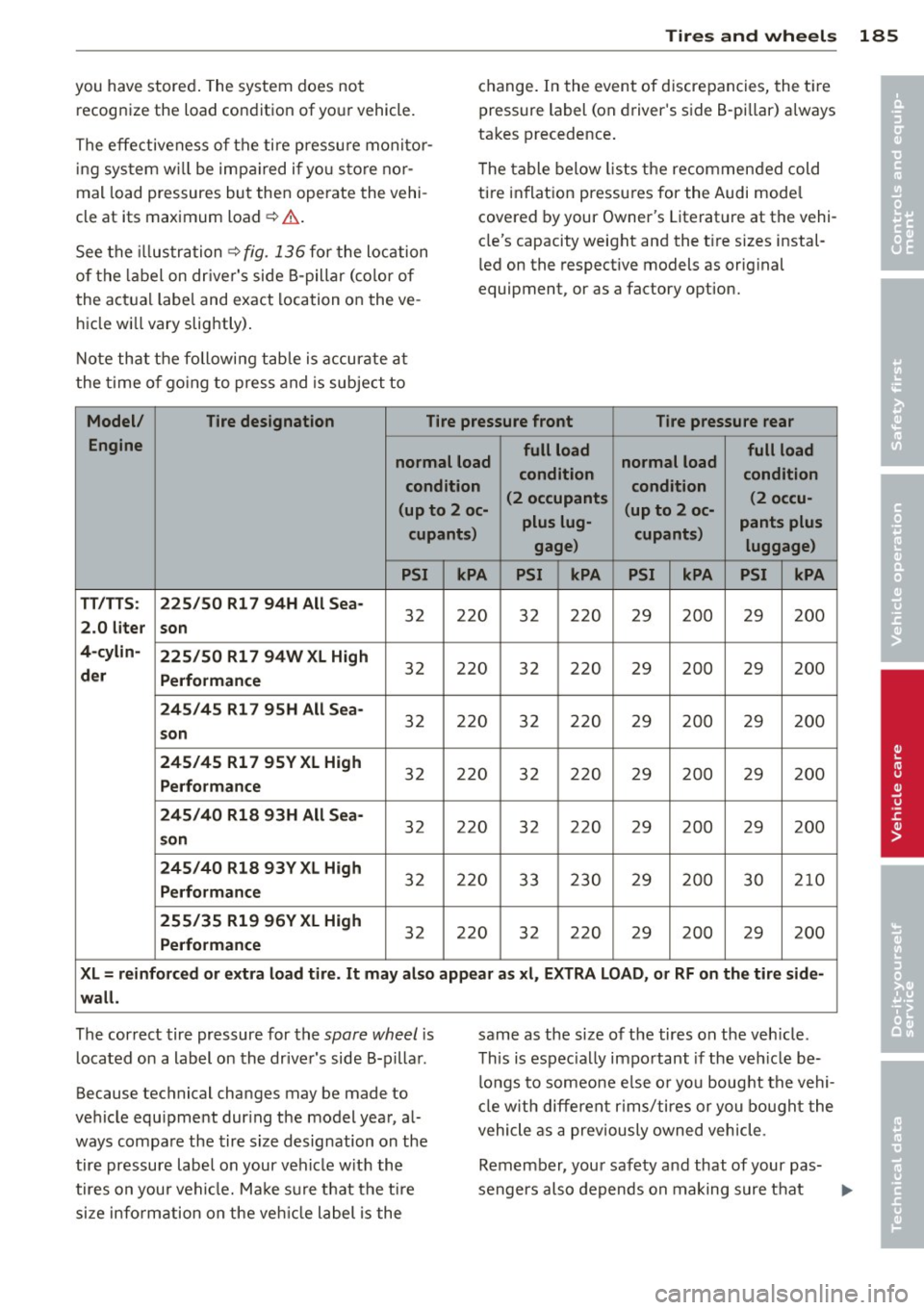
Note that the fo llowing tab le is accurate at
the t ime o f go ing to press and is subject to change. In the
event of discrepancies, the ti re
pressure label (on driver's side B-pi llar) always
takes precedence .
T he table below lists the recommended cold
ti re inflation pressures for the Audi mode l
covered by your Owner's Literature at the vehi
cle's capacity weight and the t ire sizes instal
led on the respective models as orig inal
equipment, or as a factory option.
Model/ Tire designation Tire pressure front Tire pre ssure rear
Engine full load full load
normal load condition normal load
condition
condition
(2 occupants condition
(2 occu-
( upto 2 oc-
plus lug- (
up to 2 oc-
pants plus
cupants) gage ) cupants)
luggage)
PSI kPA PSI kPA PSI kPA PSI kPA
TT /TI S: 225 /50 Rl 7 94H All Sea -
32 220 32 220 29 200 29 200 2.0 liter son
4-cyl in-
225/50 Rl 7 94W XL Hi gh
d er
Perf or man ce
32 220 32 220 29 200 29 200
24 5/ 45 Rl 7 95 H All S ea-
32 220 32 220 29 200 29 200 son
245 /45 R1 7 95YX L High
32 220 32 220 29 200 29 200 Performance
245 /40 R18 93H All S ea-
32 220 32 220 29 200 29 200 son
2 45 /40 R18 93Y XL High
32 220 33 230 29 200 30 210 Perf or mance
255 /35 R19 96 Y XL High
32 220 32 220 29 200 29 200
Perfo rmance
X L= r einf orced or extra lo ad tire. It ma y al so app ear a s xl, EX TR A LO AD, or RF on the tir e side-
wa ll.
The correct tire pressure for the spare wheel is
located on a label on the driver's side B-pillar.
Because technical changes may be made to
vehicle equ ipment during the model year, al
ways compare the tire size designation on the
tire pressure label on your vehicle w ith the
tires on your vehicle. Ma ke sure that the tire
size information on the veh icle label is the same
as the size of the tires on the veh icle.
Th is is espec ially important if the veh icle be
longs to someone else o r you boug ht the vehi
cle w ith diffe rent rims/tires or you bought the
vehicle as a prev iously owned vehicle.
Remember, your safety and that of your pas-
sengers also depends on making sure that
IJll,
•
•
Page 188 of 244
186 Tire s and wheel s
load limits a re not exceede d. Vehicle load in
cludes everybody and everything in and on t he
ve hicle . These load limits are technically refer
red to as the vehicle's Gross Vehicle We ight
Rating ("GVWR"). The Gross Axle Weight Rat
ing ("GAWR") is the maximum load that can
be applied at each of the veh icle 's two axles .
The Gross Vehicle Weight Rating and the
Gross Axle Weigh t Rat ing a re listed on the
safety compliance st ic k er labe l located on the
driver's side B-pill ar. T he tire pressure label on
your Audi lists the maximum combined weight of a ll of the occupants and luggage or
othe r cargo that the vehicle can carry. For the
locat ion of the tire pressure label¢
fig. 136.
A WARNING
Overloading a vehicle can cause loss of ve
hicle control, a crash or other acc ident, se
r ious personal in jury, and even death.
- Carry ing more weight than your vehicle
was desig ned to carry will prevent the
vehicle from hand ling p roperly and in
cr ease the risk of a loss of veh icle con
t ro l.
- T he brakes on a veh icle that has been
overloaded may not be ab le to stop t he
vehicle within a sa fe distance.
- Ti res on a vehicle that has been ove rload
ed can fail suddenly causi ng lo ss of con
tro l and a crash .
A WARNING
-Incorre ct tire pressures and/or underin
flation can lead to a serious o r fatal acci
dent.
- Incorrect tire pressures and/or underin
flation cause increase d tire wear and can
affect the handling of t he vehicle .
- Incorrect tire pressures and/o r underin
flation can also lead to sudden tire fa il
ure, incl uding a blowo ut and sudden de
flation, causing loss of vehicle control.
Checking tire pressure
The correct tire pressure for the tires original
ly installed on your vehicle is listed on the tire
pressure label located on driver's side 8-pil lar.
The recommended tire pressures are on the
t ir e p ressu re label a nd in the table
¢
page 184, Cold tire inflation pressure. This
means tha t the pressu re m ust be che cked and
adjus ted whe n the t ire has not been dr iven fo r
more than a couple of miles (kilometers) at
l ow speeds d uring the previous t hree ho urs.
Air in the tires expands when the tire heats up as a result of interna l frict ion as it flexes in
use. The tire pressure is higher when the tire
has warmed up than whe n it is "cold ."
It is the inflation pressure in a "co ld" t ire that
counts. Therefore, you should never let a ir o ut
of a warm tire to match "Cold t ire inflat ion
pressure" recommendat io ns ¢
page 184 . The
t ires wou ld then be unde rinflated and could
fail suddenly .
The tire pressure label on your Audi lists the recommended co ld tire inflation pressures fo r
the new, orig inal equ ipment tires that were
o n your veh icle at the time it was manufac
tu red. Fo r the lo cat ion of t he labe l
¢page 184, fig . 136.
Most t ires lose air naturally over t ime . They
can a lso lose some air if you d rive over a pot
hole or hit a curb while par king. It is usually
not poss ible to see whethe r the rad ial tires
u sed today are underinfla ted just by loo king
at them .
T he refore, be sure to check t ire p ressu res at
l east on ce a mo nth and a lways befo re going
o n a long trip. M ake s ure to ta ke the n umbe r
of peop le and the amount of luggage into ac
count when a djusting tire pressure for a trip -
even on e that yo u wo uld not conside r to be
" long." See ¢
page 188, Tires and vehicle
load limits
for more important information .
Always use an accurate tire press ure ga uge
when checking and ad justing inflat ion pres
s u res. Check all of the tires and be sure not to ..,.
Page 190 of 244
188 Tire s and wheel s
-If the tire pressure is too low or too high,
the tires w ill wear prematurely and the
vehicle will not handle well.
- If the t ire is not flat and you do not have
to change a wheel immed iately, drive at
reduced speed to the nearest service sta
t ion to check the tire pressure and add
air as required.
(D Note
Dr iving without va lve stem caps can cause
damage to the t ire va lves. To prevent this ,
always make sure that facto ry installed
valve stem caps on all wheels a re securely
mounted on the valve.
@ For the sake of the environment
Underinf lated tires will a lso increase t he
fue l cons umption .
Tires and vehicle load limits
There are limits to the amount of load or
weight that any veh icle and any t ire can c arry.
A vehicle that is overloaded w ill not h andle
well and is more difficult to s top. Over load ing
can not on ly lead to loss of vehicle contro l,
but can a lso damage important parts of the
ve hicle and can lead to sudden tire failure, in
cluding a blowout and sudden deflation that
can cause the veh icle to crash .
Your safety and that of your passengers a lso
depends on making sure that load limits are
not exceeded. Vehicle load includes everybody
and eve ryth ing in and on the vehicle . These
l oad limits a re tech nica lly refe rred to as the
ve hicl e's
Gross V ehicle Weight Rating
("GVWR").
The "GVWR" includes the we ight of the basic
vehicle , all factory insta lled accesso ries , a fu ll
tank of f uel, oi l, coo lant and othe r fluids pl us
maximum load. The maxim um load includes
the number o f passenge rs that t he vehi cle is
intended to carry ("seating capacity") with an
assumed weig ht of 150 lbs (68 kg) for each
passenger at a designated seating position and the total weight of any luggage
in the ve
hicle .
T he
Gro ss Axle Weight Rating (" G AWR") is
the max imum load th at ca n be applied at e ach
of the vehicle's two axles .
T he Gross Vehicle Weight Rat ing and the
G ross Ax le Weight Ra ting are listed on the
sa fety comp liance s ticke r label lo cated on the
driver's side B-pillar. Yo ur Audi has 2 seat ing
positions . Each seating position has a safety
belt
~ page 100, Safety belts.
T he fac t th at there is an upper limit to yo ur
vehicle's G ross Vehicle Weight Rating means
t h at the total weight of whatever is being car
ried in the vehicle is lim ited . T he more passen
gers in the vehicle or passengers who are
heavier than the standard we ights assumed
mea n that less we ight can be carried as lug
gage.
The tire pressure label on your Aud i also lists
the maximum combined weig ht of a ll of the
occupants and luggage or other cargo t hat
the vehicle can ca rry . For t he loca tion of the
label
~ page 184, fig . 136 .
.&, WARNING
Overloadi ng a veh icle can cause loss of ve
hicl e co ntr ol, a crash or o the r ac cident, se
rious personal injury, and even dea th .
- Ca rrying more we igh t tha n your ve hicle
was des igned to carry wi ll preve nt the
veh icle from handling proper ly an d in
crease the risk of the loss of ve hicle con
trol.
- The brakes on a ve hicle that has been
overloaded may not be able to stop the
veh icle w ith in a safe distance.
- Tires on a vehicle t hat has been over load
ed can fail s udden ly, incl uding a blowout
and sudden deflation, causing loss of
control and a crash .
Page 191 of 244
Determining correct load limit
Use the example below to cal
culate the total weight of the
passengers and luggage or oth
er things that you plan to trans
port so that you can make sure
that your vehicle will not be overloaded.
Steps for Determining
Correct Load Limit
1. Locate the statement "THE
COMBINED WEIGHT OF OC
CUPANTS AND CARGO
SHOULD NEVER EXCEED XXX KG OR XXX LBS"on your vehi
cle's placard (tire inflation pressure label)
¢ page 184,
fig . 136 .
2. Determine the combined
weight of the driver and pas sengers that will be riding in
your vehicle .
3 . Subtract the combined
weight of the driver and pas sengers from
"XXX" kilo
grams or
"XXX" pounds
shown on the sticker
¢ page 184 , fig. 136.
4. The resulting figure equals
the available amount of car
go and luggage load capaci
ty. For example, if the
"XXX"
amount equals 1400 lbs.
Tires and wheels
and there will be five 150 lbs. passengers in your vehi
cle, the amount of available
cargo and luggage load ca pacity is 650 lbs. (1400-7 50
(5
X 150) = 650 lbs.)
5 . Determine the combined
weight of luggage and cargo
being loaded on the vehicle .
That weight may not safely exceed the available cargo
and luggage load capacity
calculated in Step
4.
6. If your vehicle will be towing
a trailer, load from your trail
er will be transferred to your
vehicle. Consult this manual
to determine how this reduces the available cargo
and luggage load capacity of
your vehicle.
,...Check the tire sidewall
(¢ page 191 , fig. 140) to de
termine the designated load rating for a specific tire.
189
•
•
'
Page 195 of 244
V up to 149 mph (240 km/h)l)
Z over 149 mph (240 km/h)
1
)
W up to 168 mph (270 km/h)ll
Y up to 186 mph (298 km/h)
1 )
Your veh icle is norma lly factory equipped with
t ires, which posses s excellen t driving charac
ter istics and give your Audi opt imum driving
comfort . An electronic speed limiter
¢ page 30 w ill normally prevent your vehicle
from go ing faste r th an the tire speed rating
¢ &_ .
U.S. DOT T ire Identification Number (TIN )
and tire manufactur e date
This is the t ire's "serial numbe r" . It begins
with the le tters "DOT" and indicates that the
tire meets all federal standards . The next two
numbers or letters indicate the p lant where it
was manufactured, and the last four numbers represent the week and year of manufactu re.
Fo r example, the numbers 2213 mean that
t he t ire was produced in the 22nd week of
2013 . T he other numbers are marketing co
des that may or may not be used by the t ire
manufacturer . This information is used to con
tact consume rs if a tire defect requires a re
call.
Audi Original tire
Tires with the ident ificat ion "AO" or "RO" have
been spec ially matched with your Aud i. We
recommend using only these tires because
they meet the highest standards regard ing
safety and driving charac ter istics whe n used
correctly. Yo ur authorized Audi dealer will
g lad ly provide you with more informat ion.
Tire ply composition and materials used
The numbe r of p lies ind icates the numbe r of
l ayers of rubber -coa ted fabric in the t ire. In
general, the greater the number of p lies, the
mo re weight a tire can support . Tire manufac
turers also must indicate the materials in the
1) F o r tires wit h a m ax im um s pee d ca pabil ity over 149
mph (2 4 0 k m/h) , tire ma nufa cturers some times use
t h e le tters "Z R."
Tire s an d wheel s 193
tire, which include stee l, nylon, po lyester, and
others .
Maximum Load Rating
This number indicates the max imum load in
kil ograms and po unds that can be ca rr ied by
the tire.
Tire quality grading for treadwear ,
tract ion , and temperature resistance
T read wear, t raction and tempe ra tur e grades
¢page 194 .
Maximum Permissible Inflation Pressure
This number is the greatest amount of a ir
pressure that should ever be put in the tire
u nder norma l dr iv ing cond itions .
_&. WARNING
-Using incorrect o r unm atc hed tires and/
or wheels or improper tire and wheel
comb inat ions can lead to loss of control
,
collision and serio us personal inj ury .
- Always use t ires, rims and whee l bolts
that meet the specifications of original
factory- insta lled tires or other combina
tions that have been specifically ap proved by the vehicle manufacturer.
- Tires age even if they are not being used
and can fai l sudden ly, especially at hig h
speeds. Tires that are more than 6 years
old can only be used in an emergency
and then w ith special care and at lower
speeds .
- Never mount used tires on your veh icle if
you are not sure of the ir "previous histo
ry ." O ld used tires may have been dam
a ged even thoug h the damage cannot be
seen tha t can lead to sudden tire fai lure
and loss of vehicle control.
.
- All fo ur whee ls must be fitted wit h ra dial
tires of the same type, size (rolling cir
cumference) and the same tread pattern . ..,
•
•
Page 223 of 244
Lifting vehicle
lifting with workshop hoist and with
floor jack
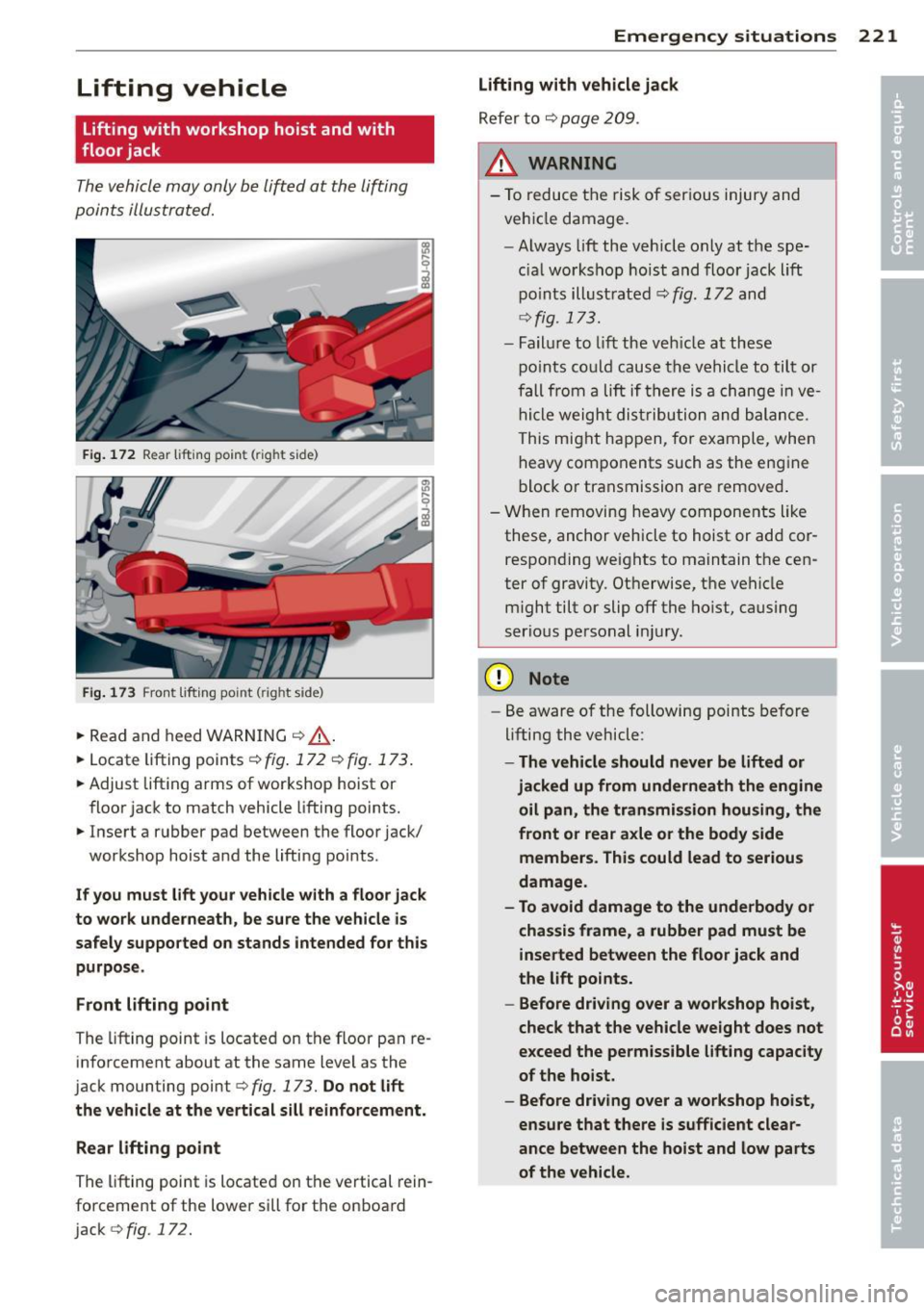
The vehicle may only be lift ed at the lifting
poin ts illustra ted.
F ig. 1 72 Rear lift ing point (right side)
Fi g. 1 73 Front lift ing po int fright side)
• Rea d and heed W ARNI NG¢,&. .
• Locate lifting points ¢fig . 172 Qfig . 173 .
• Adjust lifting arms of workshop hoist or
floor jac k to match vehicle lifting points.
• Inse rt a r ubber pad between the floor jack/
workshop hoist a nd the lifting poi nts.
If you must lift your vehicle with a floor jack
to work underneath, be sure the vehicle is safely supported on stands intended for this
purpose.
Front lifting point
The lifting point is locate d on the f loor pan re
inforcement about at the same level as the
jack mounting point¢
fig. 173. Do not lift
the vehicle at the vertical s ill reinforcement .
Rear lifting point
The lifting poi nt is locate d on t he vertical rein
forcement of the lower sill for t he on boa rd
jack
Q fig. 172.
Emergency situations 221
lifting with vehicle jack
Refer to c::> page 2 09.
_&. WARNING
- To reduce t he risk of ser ious injury an d
ve hicl e damage.
- Alwa ys lift the vehicle only at t he spe
c ial w orkshop hoist and floor jack lift
p oin ts ill ust rated ¢
fig. 172 and
¢fig. 173.
-Fa il ure to li ft th e ve hicle a t these
p o ints co uld cau se the ve hi cle t o til t or
f all from a lift if there i s a cha nge in ve
h icl e weigh t distr ibuti on and b alan ce.
This mi ght h appen, fo r ex am ple, whe n
h eavy co mponent s such as the eng ine
b lock o r transmission are remove d.
- Wh en re m oving hea vy components li ke
these, anchor vehicle to hoist or ad d co r
respo nding wei ghts to maintain t he ce n
ter of gravity. Ot herwis e, th e ve hicle
might tilt or slip off the ho ist, caus ing
serio us pe rsonal in jury.
CI) Note
-Be aware of the following points before
lifting the vehicle:
- The vehicle should never be lifted or
jacked up from underneath the engine
oil pan, the transmission housing, the
front or rear axle or the body side
members. This could lead to seriou s
damage.
- To avoid damage to the underbody or
chassis frame, a rubber pad must be inserted between the floor jack and
the lift points.
- Before driving over a workshop hoist ,
check that the vehicle weight does not
exceed the permissible lifting capacity
of the hoist.
- Before driving over a workshop hoist ,
ensure that there is sufficient clear
ance between the hoist and low parts
of the vehicle.
-
Page 224 of 244
222 Technical Data
Technical Data
Vehicle identification
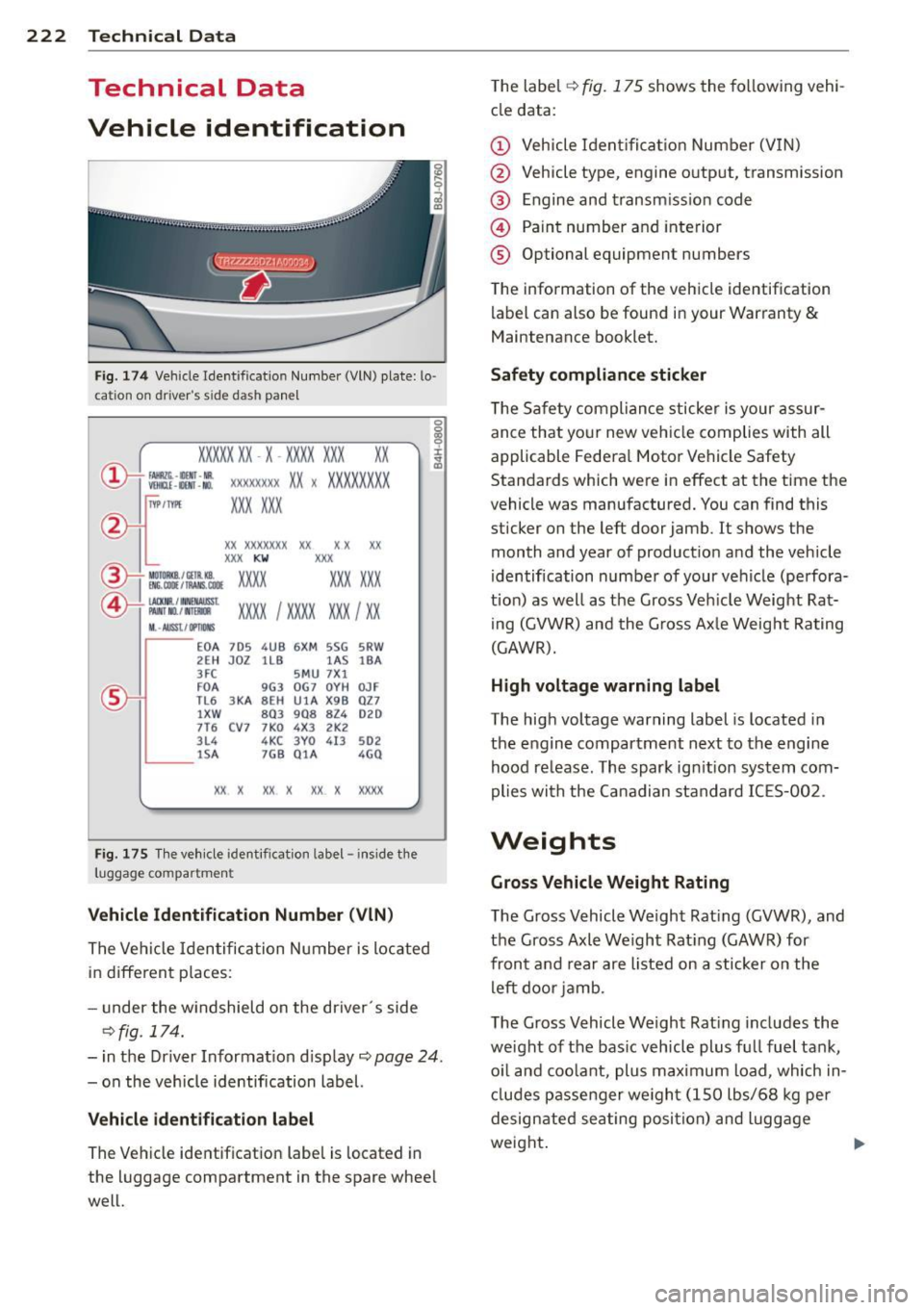
Fig . 174 Vehicle Ident ification Number (VlN) plate: lo·
cat ion on driver 's s ide dash panel
XXXXX XX · X -XXXX XXX xx
r,"\__l f~ -11!111 · NII. ~ V!Hlll -llllll . NO.
IYP IT'fl'E
XXXXXXXX XX X XXXXXXXX
XXX XXX
XX XXXXXXX XX X X XX
XXX
KW XXX
®i ~~:f :l~~ XXXX XXX XXX
@+ ~~r= XXXX I XXXX XXX I XX M ,. AIIISl./ lflllllS
EOA 7D5 4 UB 6XM SSG 5RW
2E H JDZ llB l AS lBA
3FC 5MU 7Xl
FO A
9G3 OG7 O
YH OJF
TL6 3
KA BEH
UlA X9B QZ 7
l XW
8Q3 9Q8 82 4 020
7T6 CV 7 7KO 4X3 2K2
3L4 4 KC 3YO 4I3 502
lS A 7GB Q1A 4GQ
XX X XX X XX X XXXX
Fig. 175 The vehicle identificat ion label - inside the
luggage co mpa rtmen t
Vehicle Identification Number (VlN)
The Vehicl e Identification Number is located
in different p laces:
- under the w indshield on the driver 's side
c::>fig . 174.
-in the Driver Information display c::> page 24.
- on the vehicle identification label.
Vehicle identification label
The Vehicle identification label is located in
the luggage compartment in the spare whee l
well. T
he label
c::> fig. 175 shows the following vehi
cle data:
(D Vehicle Identificat ion Number (V IN)
@ . Vehicle type, engine output, transmission
® Engine and transm iss ion code
@ Paint number and interior
® Optional equipment numbers
The information of the vehicle identification
label can also be found in your Warranty
&
Maintenance booklet.
Safety compliance sticker
The Safety compliance sticker is your assur
ance that your new veh icle complies with all
applicable Federal Motor Vehicle Safety
Standards which were in effect at the time the
vehicle was manufactured. You can find this
sticker on the left door jamb. It shows the
month and year of product ion and the vehicle
identif ication number of your vehicle (perfora
tion) as well as the Gross Veh icle Weight Rat
ing (GVWR) and the Gross Axle Weight Rating
(GAWR).
High voltage warning label
The high voltage warning label is located in
the engine compartment next to the engine
hood re lease . The spark ignition system com
plies with the Canadian standard IC ES-002.
Weights
Gross Vehicle Weight Rating
The Gross Vehicle Weight Rat ing (GVWR), and
the Gross Axle Weight Rating (GAWR) for
front and rear are listed on a sticker on the
left door jamb.
The Gross Vehicle Weight Rat ing includes the
weight of the bas ic vehicle plus fu ll fuel tank,
o il and coolant, plus max imum load, which in
cludes passenger we ight (150 lbs/68 kg per
designated seating position) and luggage
weight. .,.
Page 225 of 244
Gross Axle We ight Rating
The G ross Axle Weight Rating is the maxim um
l oad that can be applied at each axl e of the
vehicle
c::> &. .
Vehicle capacity weight
The vehicle capac ity we ight (max. load) is list
ed eithe r on the dr iver's side B-pillar o r inside
the fue l filler flap.
& WARNING
-
- The ac tual Gross Axle Weight Rat ing at
the front and rea r axles sho uld not ex
ceed the pe rm iss ible weights, and their
combination must not exceed the Gross
Vehicle Weight Rat ing .
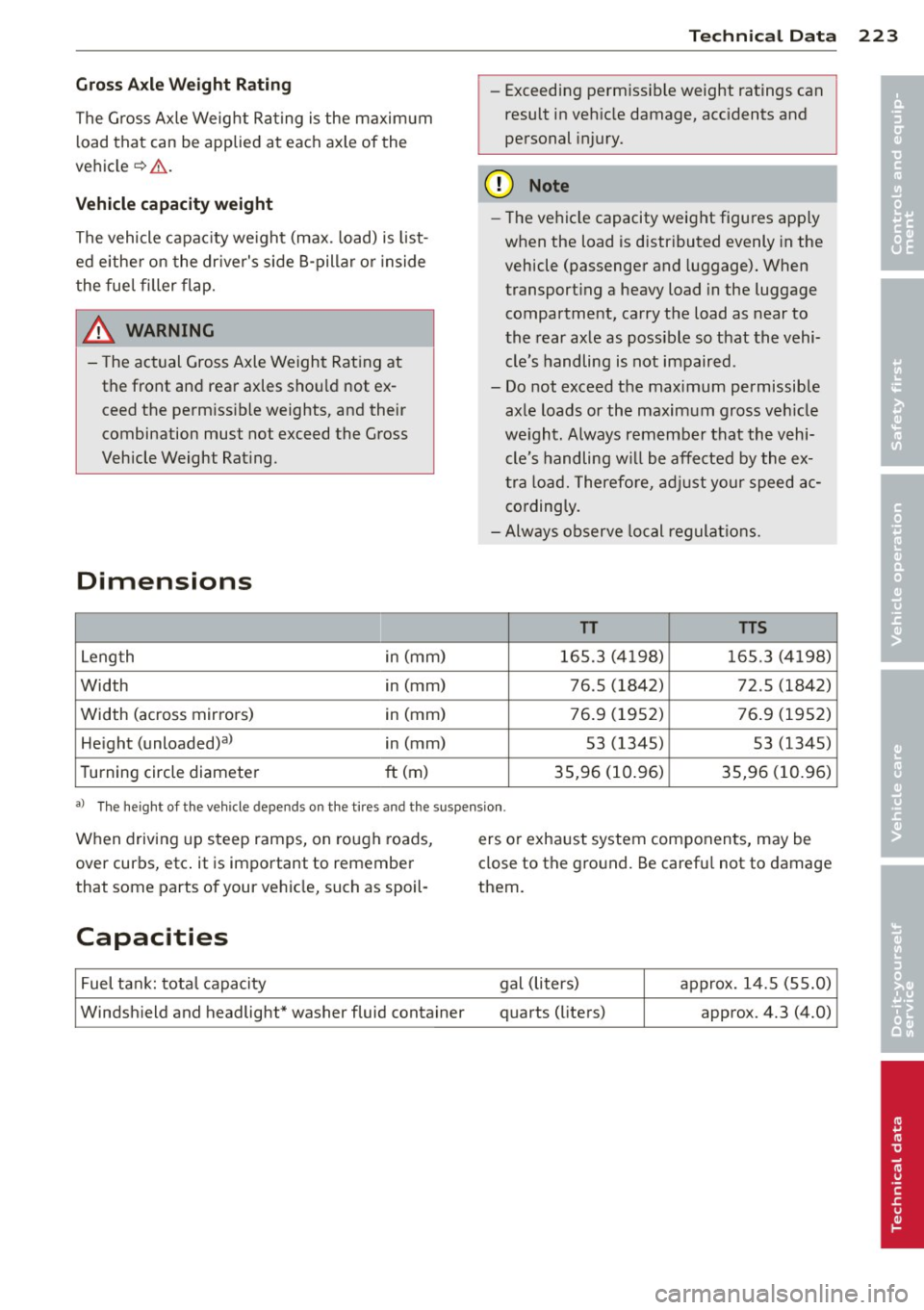
Dimensions
Leng th in (mm)
Width in (mm)
Width (across mir rors) in (mm)
He ight (unloaded) a) in (mm)
T urning circle diamete r
ft (m)
Technical Dat a 223
-Exceeding perm iss ible weight ratings can
result in veh icle damage, acc idents and
pe rsonal injury.
([) Note
-Th e ve hicl e capacity weig ht figu res apply
when the load is d istr ibuted evenly in the
vehicle (passenger and luggage) . When
transport ing a heavy load in the luggage
compartment , carry the load as near to
t he rear ax le as poss ible so that the vehi
cle's handling is not impaired .
- Do not exceed t he maximum permissible
ax le loads or the maxim um gross veh icle
we ight. A lways remember that the v ehi
cl e's handling w ill be affe cted by the ex
t ra lo ad. Therefo re, adju st yo ur speed ac
c o rding ly.
- Alway s observe loc al regulat io ns.
TT ns
16S.3 ( 4198 ) 16S .3 ( 41 98)
76 .5 (1842) 72 .5 (1842)
76.9 (195 2) 76.9 (19 52)
53 ( 1345) 53 (1345)
35 ,96 (10 .96) 35,96 (10.96)
•
•
aJ The heig ht of t he ve hicle depen ds o n th e t ires and th e suspen sio n.
When driving up s teep ramps, on ro ugh roads,
over cur bs, etc . it is impo rtant to remembe r
that som e parts of your ve hicle, such as spoil -
Capacities
Fuel ta nk: tota l capacity
Windsh ield and headlight* washer fluid containe r ers o
r exha ust system componen ts, may be
close to the ground. Be carefu l not to damage
them .
gal (liters) approx. 14.5 (55.0)
quarts (lite rs) approx. 4.3 (4.0)
Page 231 of 244
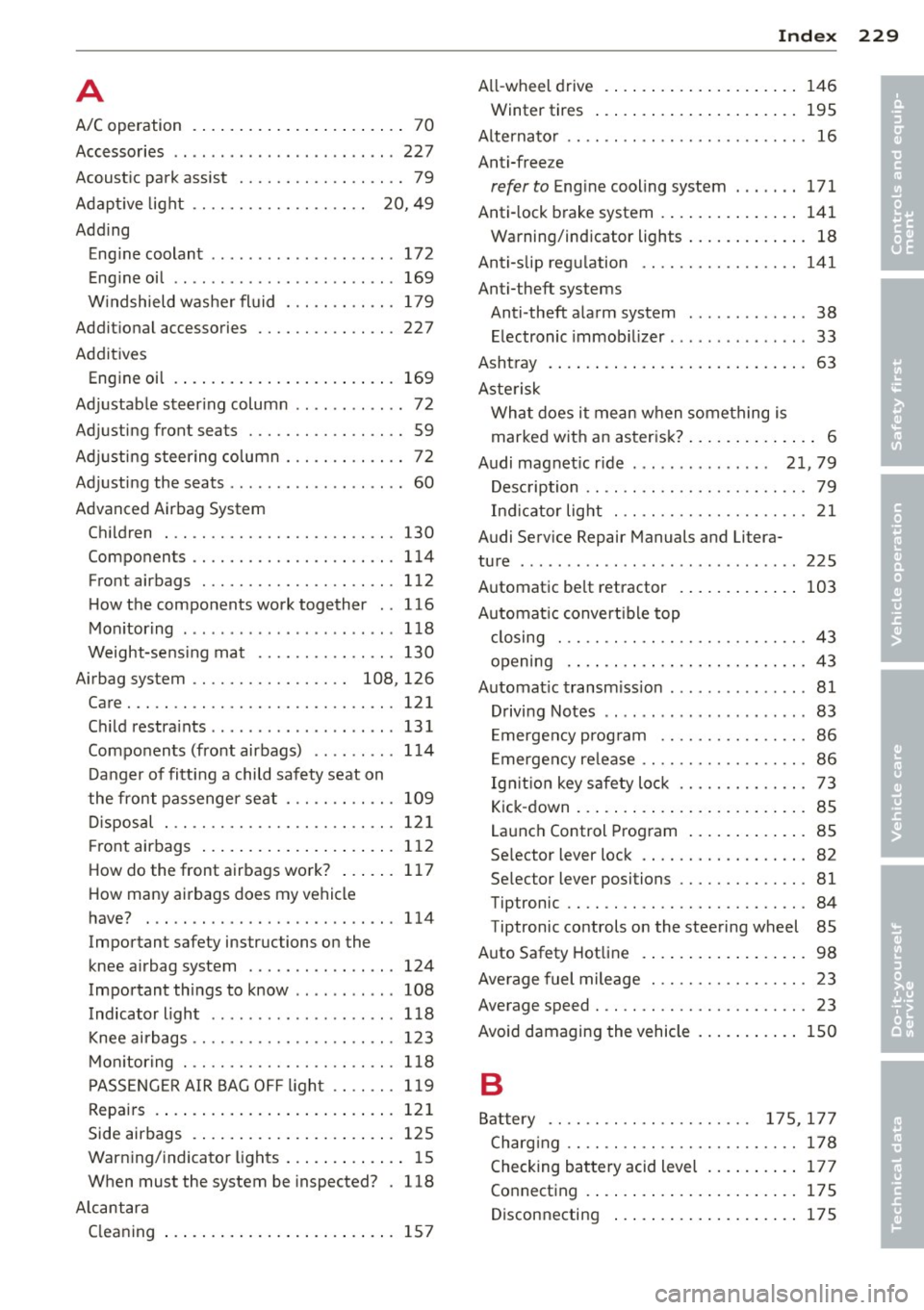
A
A/C operation . . . . . . . . . . . . . . . . . . . . . . . 70
Accessories .. ... .. .. ... ... .. .. .. .. . 227
Acoustic park assist . . . . . . . . . . . . . . . . . . 79
Adapt ive light . . . . . . . . . . . . . . . . . . . 20, 49
Adding Eng ine coolant .................. .. 172
Eng ine oi l ...................... .. 169
W indshield washer flu id . . . . . . . . . . . . 179
Addit ional accessories ............... 227
Additives Engine oil . ... .... .... ... .. .. .. .. .
Ad justab le steer ing column ........... .
Ad justing front seats ................ . 169
72
59
Ad justing s teering co lumn ... .. .. .. .. .. 72
Adjust ing the seats ................... 60
Advanced Airbag System Ch ildren
130
Components ............. .... .. ... 114
Front airbags . . . . . . . . . . . . . . . . . . . . . 112
H ow the components work together .. 116
Mon itoring . . . . . . . . . . . . . . . . . . . . . . . 118
Weight -sens ing mat ............... 130
Airbag system . . . . . . . . . . . . . . . . . 108, 126
Care ... .. .. ................. .. ... 121
Ch ild restra ints .................. .. 131
Components (front airbags) . . . . . . . . . 114
Danger of fitting a child safety seat on
the front passenger seat . .. .. .. .. .. . 109
Di sposal . .. ............. .... .. .. .
Fr ont airbags .. .. ..... ... .. .. .. .. .
How do the front airbags work? ... .. .
How many airbags does my vehicle
have? . ... . .... ............. .. .. .
Important safety instructions on the
knee airbag system ........ ... .. .. .
Important th ings to know .......... .
Indicator light ... .. ... ... .. .. .. .. . 12
1
112
1 17
114
124
108
118
Knee ai rbags ............. .... .. .. . 123
M oni tor ing . ............. .. .. .. .. . 118
P ASSENG ER AIR BAG O FF ligh t .. .. .. . 119
Repai rs .. .. ... .. ..... ... .. .. .. .. . 121
Side airbags . . . . . . . . . . . . . . . . . . . . . . 125
Warning/ indicato r lights ... .. ...... .. 15
When must the system be inspected? . 118
A lcantara
C leaning ... .. ... ..... ... .. .. .. .. . 157
Inde x 229
All-wheel drive . ..... . .. .. ..... ... .. 146
Winter tires ... .... . ... ...... ... .. 195
Alternato r .. .. .. .. ................. . 16
Anti-free ze
refer to Engine cool ing system ....... 171
Anti -lock brake system . .. ..... ... .. .. 141
Warning/indicator lights ..... ... .. .. . 18
Anti-s lip reg ulation ............. .... 141
Anti-theft systems
Anti -theft alarm system ............. 38
E lectronic immob il izer .. .. ..... ... .. . 33
Ashtray . ... .. .. .. .. .. ... ..... ... .. . 63
Aste ris k
Wha t does i t mean when something is
marked w ith an aster isk? . . . . . . . . . . . . . . 6
Audi magnet ic r ide . . . . . . . . . . . . . . . 21, 79
Desc ription .. .. .. .... ........... .. . 79
Ind icator light . .. .. .. ........... .. . 21
Audi Service Repair Manuals a nd Litera-
ture .......... ... .. .............. . 225
Automatic be lt retractor .. .... ... .. .. 103
Automat ic convert ible top
cl osing
... .. .. .. .... ........... .. . 43
opening . ... .. .. .. . .. ... .... ... .. . 43
Automat ic transm iss ion ......... .... .. 81
Driving Notes . . . . . . . . . . . . . . . . . . . . . . 83
E mergency p rog ram ........... .. .. . 86
E mergency re le a se .................. 86
Ign it ion key safety loc k ......... .... . 73
K ick -down ... .... .. . .. .. ..... ... .. . 85
La unc h Control Program
..... ... .. .. . 85
Se lector lever lock
82
Se lector lever positions ......... .. .. . 81
Tiptronic .. .. .. .. ................. . 84
Tiptronic controls on the steering wheel 85
Auto Safety Hot line . .. .. ..... ... .. .. . 98
Ave rage fuel mileage . . . . . . . . . . . . . . . . . 23
Average speed . . . . . . . . . . . . . . . . . . . . . . . 23
Avoid damaging the vehicle .... ... .. .. 150
B
Bat tery . . . . . . . . . . . . . . . . . . . . . . 175, 17 7
Charg ing .. .. .. .. ................. 178
Checking ba ttery acid level ... ... .. .. 177
Connect ing . ... .... . ... ...... ... .. 175
Disconnecting 175
•
•
Page 241 of 244
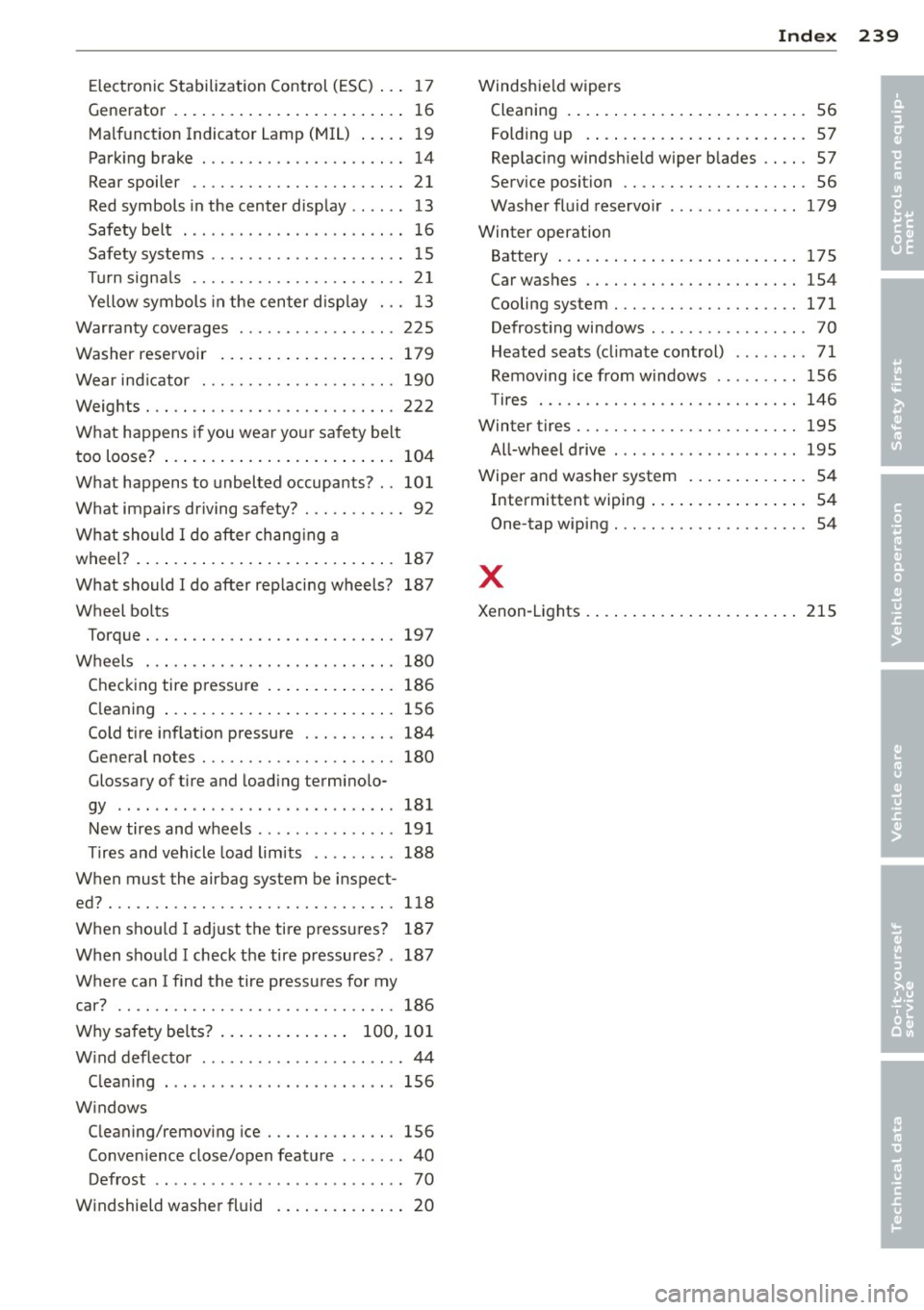
Electronic Stabilization Control (ESC) . . . 17
Generator .. .......... ... ... ... .... 16
Malfunct ion Indicator Lamp (MIL) ... .. 19
Parking brake ............ .... .. .... 14
Rear spoiler . . . . . . . . . . . . . . . . . . . . . . .
21
Red symbols in the center disp lay ...... 13
Safety belt .... .. .. ..... ... .. .. .. .. 16
Safety systems .................. ... 15
Tu rn signa ls ............. .. .. .. .. ..
21
Yellow symbols in the center disp lay . .. 13
Warranty coverages .................
225
Washer reservoir .. ..... ... .. .. .. ... 179
Wear ind icator ............ .... .. ... 190
Weights ... .. .. .. ........... .......
222
W hat happens if you wear your sa fety belt
too loose? ... .. .... .... ... .. .. .. ... 104
What happens to unbelted occupants? .. 101
What impairs driving safety? . . . . . . . . . . . 92
What should
I do after chang ing a
wheel? .... .. .. .. .. .. .... ... .. .. ... 187
What should I do after replacing wheels? 187
Wheel bolts Torque ..... ................. .. ... 197
Wheels ... .. .. .. ........ ... .. .. .. . 180
C hecking tire pressure .. ... .. .. .. .. . 18 6
C leaning ... .. .... .... ... .. .. .. ... 156
Cold tire inflat ion pressure . .. .. .. .. . 184
General notes . . . . . . . . . . . . . . . . . . . . . 180
Glossary of tire and load ing termino lo-
gy ...... ...................... .. 181
New tires and wheels ...... .. .. .. .. . 19 1
Tires and vehicle load lim its ......... 188
When must the airbag system be inspect-
ed? ... .... .. .. ............. .. .. ... 118
When shou ld I ad ju st the tire p ressu res? 187
When should I check the tire pressures? . 187
Where can I find the tire pressures for my
car? ...... .. ................. .. ... 186
W hy safety belts? . . . . . . . . . . . . . . 100, 10 1
W ind deflector ............. ...... ... 44
C lea ning ......................... 156
W indows
C leaning/remov ing ice .............. 156
Conven ience close/open feature ... .. .. 40
Defrost .. ...................... ... 70
W indshield was he r fl uid . ... .. .. .. .. .. 20
Inde x 239
Windshie ld wipers
Cleaning . . . . . . . . . . . . . . . . . . . . . . . . . . 56
Fo lding up . ... .. .. . .. ... .... ... .. . 57
Rep lacing windsh ield wiper b lades .. .. . 57
Serv ice position . . . . . . . . . . . . . . . . . . . . 56
Washer fluid reservo ir ............. . 179
Winter operation Battery ... .. .. .. .. .. .. ...... ... .. 175
Car washes . . . . . . . . . . . . . . . . . . . . . . . 154
Cooling system . . . . . . . . . . . . . . . . . . . . 171
Defrost ing windows . ................ 70
Heated seats (cl imate control) ..... .. . 71
Removing ice from windows ......... 156
T ires ....... .. .. ................. 146
Winter tires . .. .. .. ................. 195
All-wheel drive .... ................ 195
Wiper and washer system ..... ... .. .. . 54
Intermittent wiping . . . . . . . . . . . . . . . . . 54
One-tap wiping . .. .... ............. . 54
X
Xenon-Lights . ....... . .. .. ..... ... .. 215
•
•