ECO mode AUDI TT ROADSTER 2015 Owner's Guide
[x] Cancel search | Manufacturer: AUDI, Model Year: 2015, Model line: TT ROADSTER, Model: AUDI TT ROADSTER 2015Pages: 244, PDF Size: 60.74 MB
Page 187 of 244
Tires an d wheel s 185
you have stored. The system does not
recognize the load condition of your vehicle.
The effectiveness of the ti re pressu re monitor
ing sys tem w ill be impaired if you store no r
mal load pressures but then operate the vehi
cle at its maximum load¢,&.
See the illustration¢
fig. 136 for the location
of the label on dr iver's side B-pillar (color of
the actual labe l and exact location on the ve
hicle wi ll vary slig htly) .
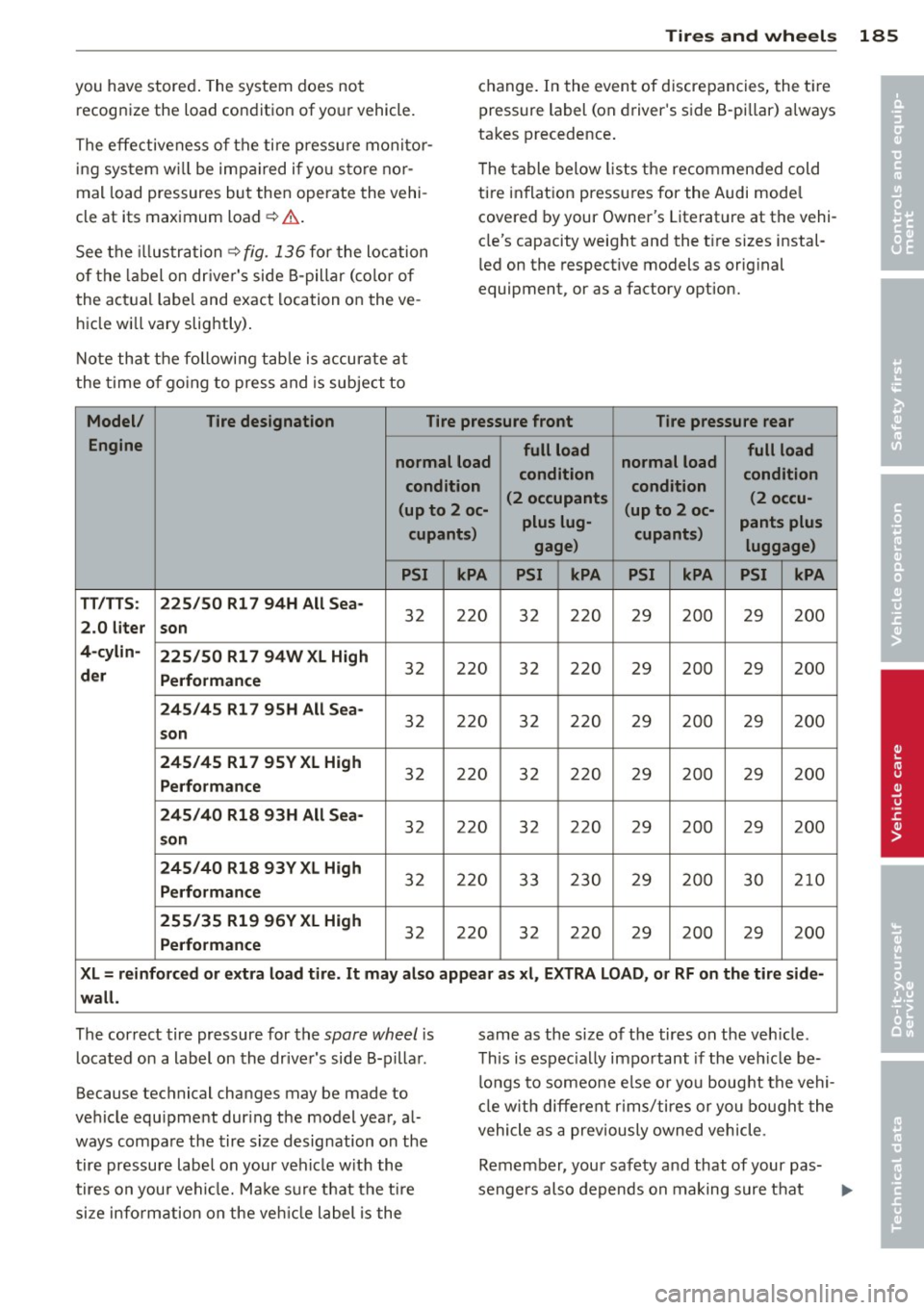
Note that the fo llowing tab le is accurate at
the t ime o f go ing to press and is subject to change. In the
event of discrepancies, the ti re
pressure label (on driver's side B-pi llar) always
takes precedence .
T he table below lists the recommended cold
ti re inflation pressures for the Audi mode l
covered by your Owner's Literature at the vehi
cle's capacity weight and the t ire sizes instal
led on the respective models as orig inal
equipment, or as a factory option.
Model/ Tire designation Tire pressure front Tire pre ssure rear
Engine full load full load
normal load condition normal load
condition
condition
(2 occupants condition
(2 occu-
( upto 2 oc-
plus lug- (
up to 2 oc-
pants plus
cupants) gage ) cupants)
luggage)
PSI kPA PSI kPA PSI kPA PSI kPA
TT /TI S: 225 /50 Rl 7 94H All Sea -
32 220 32 220 29 200 29 200 2.0 liter son
4-cyl in-
225/50 Rl 7 94W XL Hi gh
d er
Perf or man ce
32 220 32 220 29 200 29 200
24 5/ 45 Rl 7 95 H All S ea-
32 220 32 220 29 200 29 200 son
245 /45 R1 7 95YX L High
32 220 32 220 29 200 29 200 Performance
245 /40 R18 93H All S ea-
32 220 32 220 29 200 29 200 son
2 45 /40 R18 93Y XL High
32 220 33 230 29 200 30 210 Perf or mance
255 /35 R19 96 Y XL High
32 220 32 220 29 200 29 200
Perfo rmance
X L= r einf orced or extra lo ad tire. It ma y al so app ear a s xl, EX TR A LO AD, or RF on the tir e side-
wa ll.
The correct tire pressure for the spare wheel is
located on a label on the driver's side B-pillar.
Because technical changes may be made to
vehicle equ ipment during the model year, al
ways compare the tire size designation on the
tire pressure label on your vehicle w ith the
tires on your vehicle. Ma ke sure that the tire
size information on the veh icle label is the same
as the size of the tires on the veh icle.
Th is is espec ially important if the veh icle be
longs to someone else o r you boug ht the vehi
cle w ith diffe rent rims/tires or you bought the
vehicle as a prev iously owned vehicle.
Remember, your safety and that of your pas-
sengers also depends on making sure that
IJll,
•
•
Page 199 of 244
snow c hains are suitably cove red . Check
the position of the snow chains after
driving a few yards and correct if neces
sary. Follow the instructions from the
snow cha in manufacturer when doing so.
Where snow cha ins are mandatory oncer
tain roads, this normally also applies to
veh icles with all-wheel dr ive.
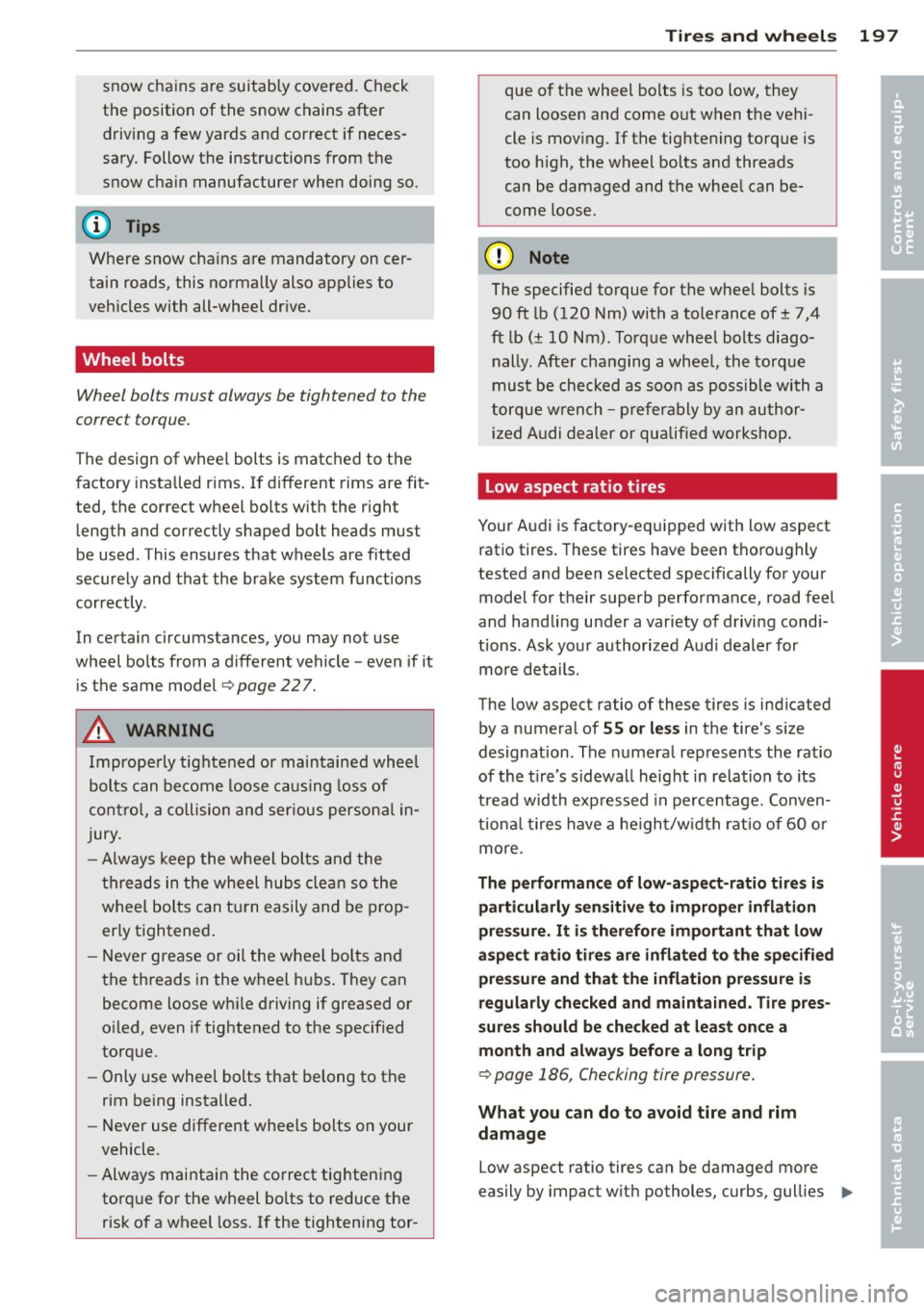
Wheel bolts
Wheel bolts must always be tightened to the
correct torque.
The design of whee l bolts is matched to the
factory insta lled r ims . If different rims are fit
ted, the correct wheel bo lts with the right
length and correctly shaped bolt heads must
be used. This ensures t hat wheels are fitted
securely and that the brake system functions
correctly .
In certain circumstances, you may not use
wheel bo lts from a different vehicle -even if it
i s the same model
¢ page 227.
A WARNING
Imprope rly tig htened or maintained wh eel
bolts can become loose ca using loss of
con trol, a collision and serious person al in
jury.
- Always keep the w heel bolts and the
threads in the wheel hubs clea n so the
wheel bolts can tu rn easily and be p rop
er ly tightened .
- Never grease or oil the wheel bo lts and
the threads in the wheel hubs. They can become loose w hile driving if greased or
o iled, even if tig htened to the specif ied
torque.
- Only use whee l bolts that belong to the
rim being installed.
- Never use different whee ls bolts on your
vehicle.
- Always maintai n the co rrect tig htening
torq ue fo r the wheel bo lts to reduce the
risk of a wheel loss. If the tightening tor-
Tire s an d wheel s 197
que of t he whee l bolts is too low, they
can loosen and come out when the vehi
cle is mov ing. If the tig htening torq ue is
too high, the wheel bolts and threads
can be damaged and the whee l can be
come loose.
(D Note
The specified torque for the whee l bolts is
90 ft lb (120 Nm) with a tolerance of± 7,4
ft lb(± 10 Nm). Torq ue whee l bolts diago
nally. After changing a whee l, the tor que
must be checked as soon as possible with a
torq ue w rench -prefe rably by an au thor
iz ed A udi de aler or qu alified workshop .
Low aspect ratio tires
Your Audi is factory -eq uipped w ith low aspect
r atio tires . These tires have been tho roughly
tested and been se lected specifically for your
model for their superb performance, road fee l
and handli ng under a var iety of driving condi
tions . Ask your authorized Audi dealer for
more d etails.
The low aspect ratio of these t ires is ind icated
by a numeral of
55 or less in the tire's s ize
designation . The numeral represents the ratio
of the t ire's sidewa ll height in relation to its
t read width exp ressed in pe rce ntage. Conven
t iona l tires have a he ight/w idth rat io of 60 or
more.
The performanc e of low-a spect-ratio tire s is
particularly sensitive to impr oper inflation
pre ssure .
It is therefore important that low
a spect ratio tire s are inflated to the specified
pres sure and that the inflation pressure is
regularly checked and maintained. Tire pre s
sures should be checked at least once a month and always befo re a long trip
¢ page 186, Checking tire pressure.
What you can do to avoid tire and rim
damage
Low aspect ratio tires can be damaged mo re
easily by impact w it h potholes, curbs, gul lies ..,.
•
•
Page 205 of 244
Handling characteristics change when
driving with low air pressure or with flat
tires even with special run-flat tires
A low pressure or flat front tire affects vehicle
handling characteristics by pu lling the vehicle
slightly to the side where the tire is mounted
and reduces braking performance .
A low pressure or flat
rear tire also affects
driving character istics by pulling to the side
where the tire is mounted and also reduces
brak ing performance. The effect on vehicle
handling is most not iceable when driving
around curves.
A WARNING
Changed vehicle handling character istics
when driving in the run -f lat mode can
cause loss of vehicle contro l, a crash and
serious personal injury.
- Driving on special run-flat tires in the
run-f lat mode wi ll change vehicle han
dling characteristics during braking,
when cornering and under heavy acceler
ation.
- Never drive faster than the maximum
rated speed of 50 mph (80 km/h) when
dr iv ing in the run -flat mode.
- Always adjust vehicle speed to traffic,
road and weather cond itions and drive
slower than the max imum rated speed if
necessary weather and road conditions
are taken into account.
- Always obey speed limits and other traf
fic laws.
Q) Note
We always recommend driving w ith even
more care when using these special t ires in
the run-flat mode . Always avo id sudden
maneuvers.
Tires and wheels 203
Replacing run-flat tires and rims
App lies to veh icles : w it h Run -flat t ires
Your vehicle was especially designed to use
special run-flat tires.
You may use and combine only approved run
flat tires and special matching rims that have
been designed for run-flat tires. Mounting
special run-flat tires on standard wheels will not work and w ill not prov ide the advantages
fo the ru n-falt feature . Never use spec ial run
flat tires on standa rd wheel rims.
After dr iving with a tire i n the run-flat mode,
always have the veh icle and affected tire(s)
and rim(s) inspected by a n authorized Audi
dealer. Tires that have been driven in the run
f lat mode must be rep laced .
A WARNING
-Use of damaged run-flat tires and rims can
cause vehicle damage that can lead to loss
of vehicle control, a crash and serious per
sonal injury.
- Always have the vehicle and affected
tire(s) and r im(s) inspected by an author
ized Audi dealer after driving a tire in the
run-flat mode .
- Tires that have been dr iven in the run
f lat mode must be replaced.
•
•
Page 215 of 244
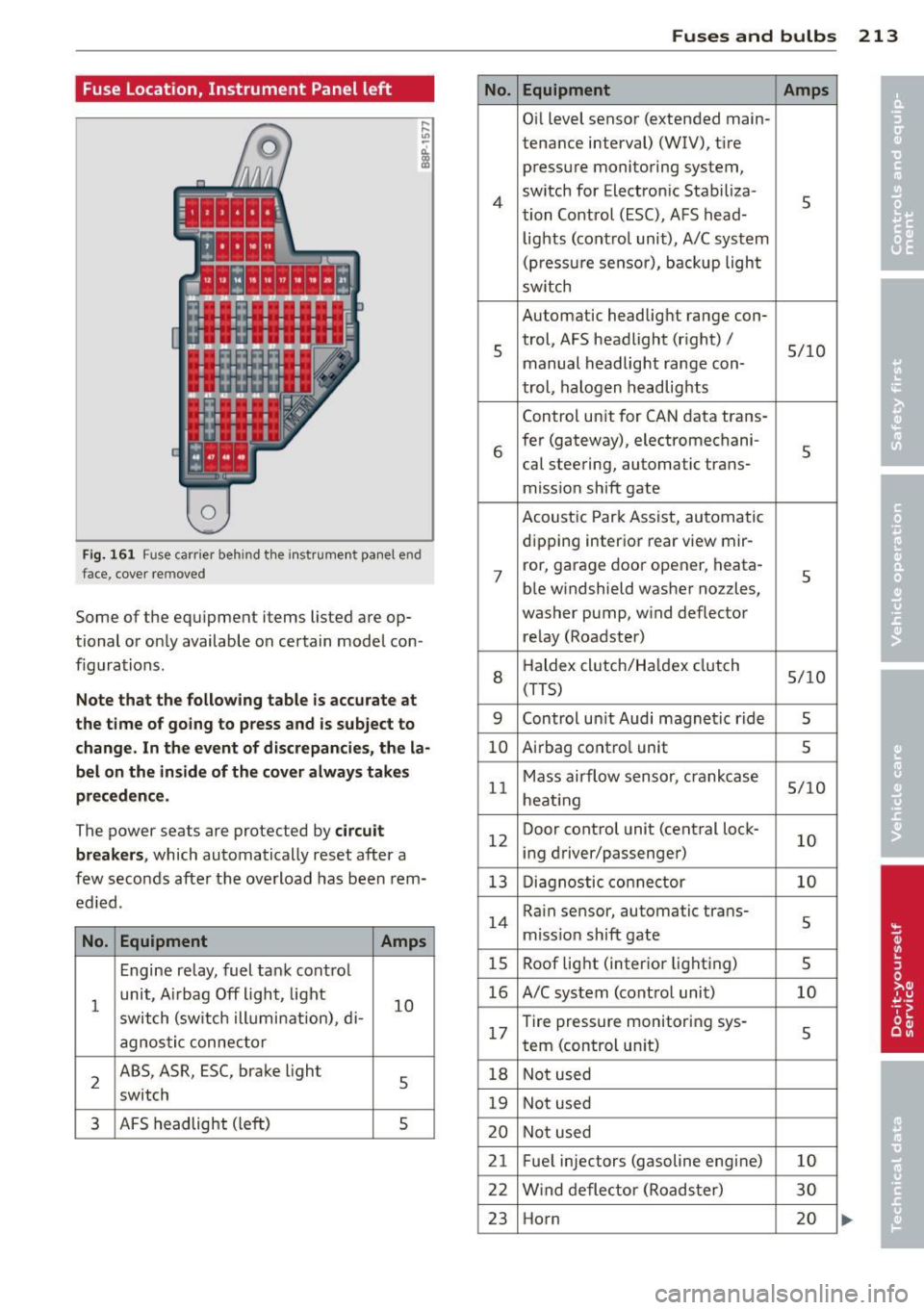
Fuse Location, Instrument Panel left
0
Fig. 161 Fuse carrier behind the instrument panel end
face, cover removed
Some of the eq u i prnent items listed a re op
tional or only available on certain model con
f igurations.
Note that the following table is accurate at
the time of going to press and is subject to
change. In the event of d iscrepancies, the la
bel on the in side of the cover always takes
precedence .
The power seats are protected by circuit
breakers ,
which automatically reset after a
few seconds after the overload has been rem
ed ied.
No. Equipment Amps
Engine relay, fuel tank cont ro l
1
unit, A irbag Off light, light
10 switch (sw itch illumi nation), di-
agnostic connector
2
ABS, ASR, ESC, brake light
5 switch
3 AFS headlight (left) 5
No.
4
5
6
7
8
9
10
11
12
13
14
15
16
17
18
19
20
21 22
23
Fuses and bulbs 213
Equipment Amps
Oil level sensor (extended main-
tenance interval)
(WIV), t ir e
press ure monitoring system,
sw itch for Electron ic Stabiliza-
5 tion Control (ESC), AFS head-
lights (control unit), A/C system
(pressure sensor), backup light
sw itch
Automatic headlight range con- trol, AFS headlight (right) /
5/10
manual headlight range con-
trol, halogen headlights
Control unit for CAN data trans-
fer (gateway), electrornechani-
5 cal steering, automatic trans-
miss ion shift gate
Acoustic Park Assist, automatic
d ip ping interior rear
view rnir-
ror, garage door opener, heata-
5 ble windshield washer nozzles,
washer pump, w ind deflector
relay (Roadster)
H aldex clutch/Ha ldex clutch
5/10 (TTS)
Control un it Audi magnetic ride
5
A irbag contro l unit 5
Mass airflow sensor, crankcase 5/10
heating
Door control unit (central lock -
10 ing driver/passenger)
Diagnostic connector
10
Rain sensor, automatic trans-
5 miss ion sh ift gate
Roof light (interior lighting)
5
A/C system (contro l unit) 10
Tire pressure monitoring sys -
5 tern (control un it)
Not used
Not used
Not used
Fuel injectors (gasoline eng ine)
10
Wind deflector (Roadster) 30
Horn 20
Page 227 of 244
Consumer Information
Warranty coverages
Your Audi is covered by the following war
ranties :
-New Vehicle Limited Warranty
- Limited Warranty Against Corrosion Perfo-
ration
- Emissions Control System Warranty
- Emissions Performance Warranty
- California Emissions Con trol Warranty (USA
vehicles only)
- California Emissions Performance Warranty
(USA vehicles only)
Detailed information regarding your warran
ties can be found in your
Warranty & Mainte
nance booklet .
Operating your vehicle
outside the U.S.A. or
Canada
Government regulations in the United States
and Canada require that automobiles meet
specific emission regulations and safety
standards. Therefore, veh icles built for the
U.S.A. and Canada differ from vehicles sold in
other countries .
If you p lan to take your vehicle outside the
continental limits of the United States or Can
ada, there is the possibility that:
- unleaded fuels for vehicles with cata lytic
converter may not be available;
- fuel may have a considerably lower octane
rating . Improper fuel may cause engine
damage ;
- service may be inadequate due to lack of
proper service facilities, tools or testing
equipment ;
- replacement parts may not be readily availa
ble.
- Navigation systems for vehicles built for the
U.S.A. and Canada will not necessari ly work
in Europe, and may not work in other coun
tries outside of North America.
Consumer Information 225
@ Note
Audi cannot be responsible for mechanical
damage that could result from inadequate
fuel, service or parts availab ility.
Audi Service Repair
Manuals and Literature
Audi Offic ial Factory Service Manuals and Lit
erature are published as soon as possible after
model introduction. Service Manuals and liter
atu re are availabl e to order from the Audi
T echnical Literature Ordering Center at:
www.audi.techliterature.com
Maintenance
' General
Your vehicle has been designed to help keep
maintenance requirements to a minimum.
However, a certain amount of regular mainte
nance is still necessary to assure your vehicle's
safety, economy and reliability . For detailed
vehicle maintenance consult your Warranty
&
Maintenance booklet.
Under difficult operating conditions , for ex
ample at extremely low outside temperatures ,
in very dusty regions, etc., some service work
shou ld be pe rformed between the intervals
specified. This applies particularly to:
- oil changes, and
- cleaning or replacing the air fi lter.
@ For the sake of the environment
By regu larly maintaining your vehicle, you
help make sure that emission standards
are maintained, thus min imizing adverse
effects on the environment.
Important considerations for you and
your vehicle
T he increasing use of electron ics, soph isticat
ed fuel injection and emission control sys
tems, and the generally increasing technica l
complexity of today's automobiles, have ..,_
•
•
Page 232 of 244
230 Index .:..:..:..::....::.....:..._ ___________________________ _
Important warn ings 176
Location . . . . . . . . . . . . . . . . . . . . . . . . . 176
Low ... .. .. ................ ..... . 146
Replacing the battery . . . . . . . . . . . . . . 17 5
State of charge . . . . . . . . . . . . . . . . . . . . 146
Winter operation ............. .. ... 175
Working on the battery .... .. .. .. .. . 176
Before driving . . . . . . . . . . . . . . . . . . . . . . . 91
Blended gasoline .......... .. .. .... . 160
Boost ... .. .. .. . .......... .. .. .... .. 26
Booster seats .............. ... .... . 136
Boost pressure indicator ........ .. .. .. 26
Brake fluid Changing the brake fluid ... .. .. .. .. . 174
Checking the brake fluid level . .. .. .. . 17 4
What is the correct brake fluid level? .. 174
What should I do if the brake fluid warn-
ing light comes on? ....... .. .. .... . 174
Brake system ................ .. .... . 174
Anti-lock brake system . . . . . . . . . . . . . . 18
Brake assist system ........ ..... .. . 141
Brake fluid . .............. ... .. ... 174
Brake fluid spec ificat ions for refill and re-
p lacement . ... .......... .. .. .. .. . 17 4
Brake light defective ........ .. .. .. .. 20
Brake pads ............... ... .... . 149
General information ....... ..... .. . 144
How does the moisture or road salt affect
the brakes? .............. .. .. .. .. . 144
Malfunction . . . . . . . . . . . . . . . . . . . . . . . 14
Warning/indicator lights .... ..... .. .. 14
Worn brake pads symbol . ........ .. .. 19
Break-in period ................ .. .. . 149
Brake pads .............. .... .... . 149
Tires .. .. .. ............. .. .. .. ... 149
Bulbs 215
C
California Proposition 6S Warning .... . 165
Battery specific .......... .. .. .. .. . 177
Capacities . .. ................ ... ... 223
Carbon parts Cleaning . . . . . . . . . . . . . . . . . . . . 156, 157
Care .. .. .. .. ... .......... .. .. .. .. . 154
Cargo area
refer to Luggage compartment . . . . . . . . 96
Catalytic converter ......... .. .. .... . 150 CD changer
..... .. ............. ..... 65
Certification ...... ................ . 228
Changing a flat tire . ... .......... .. .. 208
Changing engine oil ............. .... 170
Checking Battery acid level ...... ........... . 177
Engine coolant level .... ........... . 172
Checking tire pressure ........... .... 186
Child restraint Danger of using child restraints in the
front seat ..... .. ................ . 109
Child restraints
Where can I get additional informat ion
about child restraints and their use? .. 140
Child safety ..... .. .......... ...... . 129
Convertible locking retractor . .. ... ... 137
Impo rtant safety instructions for using
child safety seats ... ........... .. .. 132
Important things to know when driving
with children .... ................ . 129
Child safety seat ... ..... ........... . 134
Convertible locking retractor . .. .. .. .. 137
Installing . .... .. ............. .... 137
Child safety seats
Booster seats .. .. ................ . 136
Convertible child seats ... ...... .. .. 134
How do I properly install a child safety . h' l
? 132
seat in my ve 1c e . ............... . .
Infant seats . .. .. ... .......... .. .. 134
Safety instructions ................ . 132
Cigarette lighter . . . . . . . . . . . . . . . . . . . . . 64
Cleaning ... .... .. ............. .... 154
Climate controls ... ............. .. .. . 67
A/C operat ion . . . . . . . . . . . . . . . . . . . . . . 70
Air distribution ... ................ .. 69
Air recircu lation mode ............... 70
Automatic mode . . . . . . . . . . . . . . . . . . . 70
Controls . . . . . . . . . . . . . . . . . . . . . . . . . . 67
Defrost . .. .. .. .. ............. .. .. . 70
Economical use .. ....... ...... .. .. . 71
Fan .. ..... ... .. .. .............. .. 68
Heated seats .. .. .......... ...... .. 71
Heating ... .. .. .. .. ... ........ .... . 67
Pollutant filter ... ............. .. .. . 67
Rear window defogger ............... 70
Switching on and off .............. .. 68