ignition AUDI TT ROADSTER 2015 Service Manual
[x] Cancel search | Manufacturer: AUDI, Model Year: 2015, Model line: TT ROADSTER, Model: AUDI TT ROADSTER 2015Pages: 244, PDF Size: 60.74 MB
Page 82 of 244
80 On the road
chimes can be adjusted through the menu dis
p lay
~ page 24 .
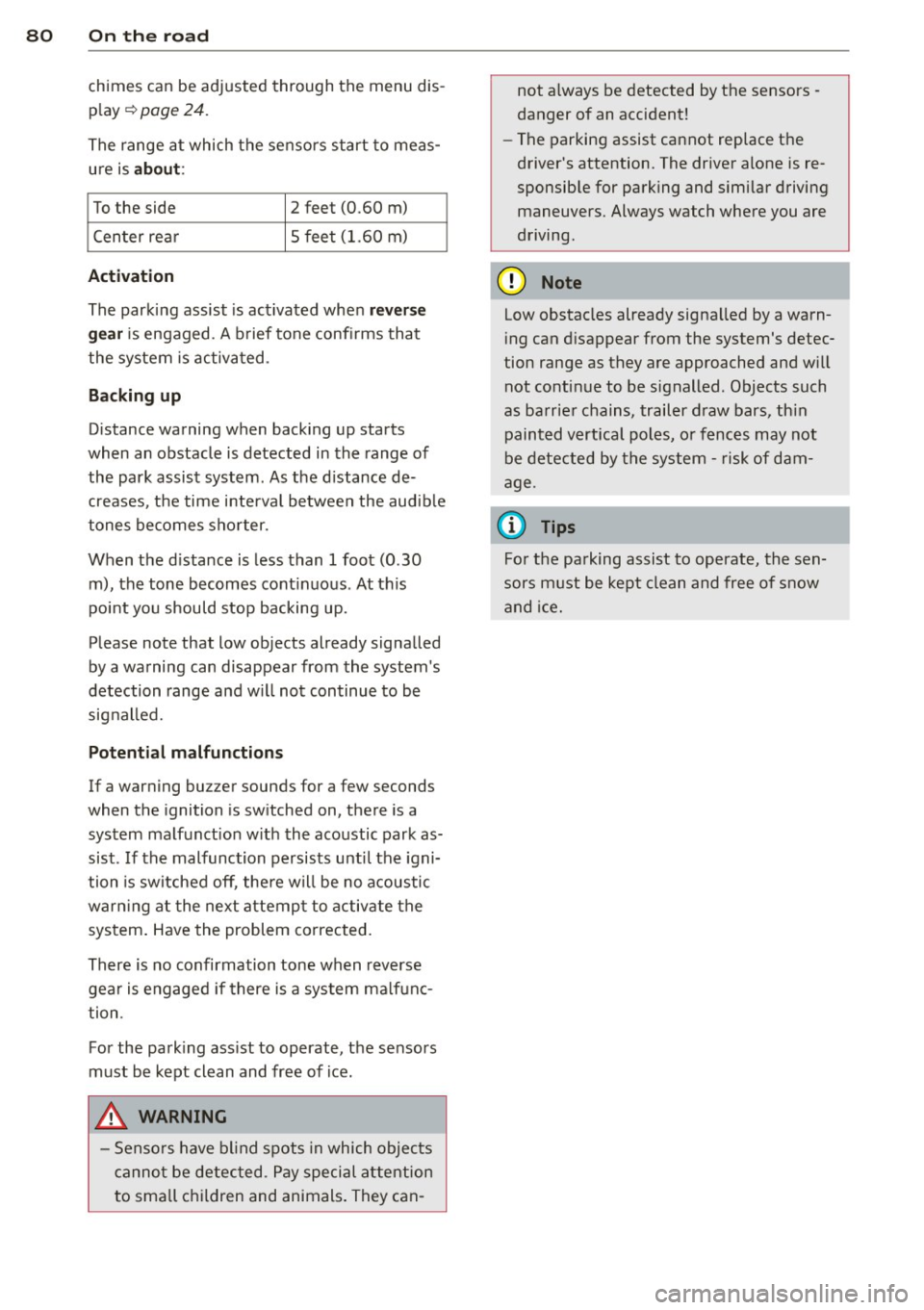
The range at which the sensors start to meas
ure is
a b ou t:
To the side 2 feet (0.60 m)
Center rea r 5 feet (1.60 m)
Activation
The parking assist
is activated when r ev erse
ge ar is engaged . A b rief tone confi rms that
the system is activated .
Backing up
Distance warning when back ing up starts
when an obstacle is detected in the range of
the park assist system . As the d istance de
creases, the time i nterva l between the audible
tones becomes shorter.
When the d istance is less than 1 foot (0.30
m), the tone becomes cont inuous . At this
poi nt you should stop backing up.
Please note that low objects already signalled
by a warning can disappear from the system 's
detection range and w ill not continue to be
signalled.
Potenti al malfunction s
If a warning buz zer sounds for a few seconds
when the ignition is sw itched on, there is a
system malfunction w ith the acoustic park as
sist . If the malfunction persists unti l the igni
tion is switched off , there will be no acoustic
warn ing at the next attempt to activate the
system . Have the problem corrected.
There is no confirmation tone when reverse
gear is engaged if there is a system ma lfunc
tion .
For the park ing ass ist to operate, the sensors
must be kept clean and free of ice.
_& WARNING
- Sensors have blind spots in which objects
cannot be detected . Pay special attention
to sma ll children and animals. They can- not a
lways be detected by the sensors -
danger of an accident!
- The parking assist cannot rep lace the
driver's attention. The driver alone is re
sponsible for parking and similar driving maneuvers. Always watch where you are
driving.
(D Note
Low obstacles already signa lled by a warn
i ng can d isappear from the system's detec
tion range as they are approached and w ill
not continue to be signalled. Objects such
as barrier chains, trailer draw bars, th in
painted vertical poles, o r fences may not
be detected by the system - risk of dam
age .
@ Tips
For the parking assist to operate, the sen
sors must be kept clean and free of snow
and ice.
Page 83 of 244
Transmission S tronic transmission
Introduction
Your vehicle is equipped with a S tronic trans miss ion, also called a double-clutch system/
transmission.
Power is transferred between the engine and
the transmission by means of two i ndepend
ent clutches. They replace the to rque convert
e r of conventional automat ic transm iss ions
and a llow the vehicle to acce lerate without a
noticeable break in the power flow .
W ith the aid
of tiptr oni c, the gea rs can op
tionally be sh ifted
manually¢ page 84.
Selector lever positions
All the selector lever positions are explained
in this section.
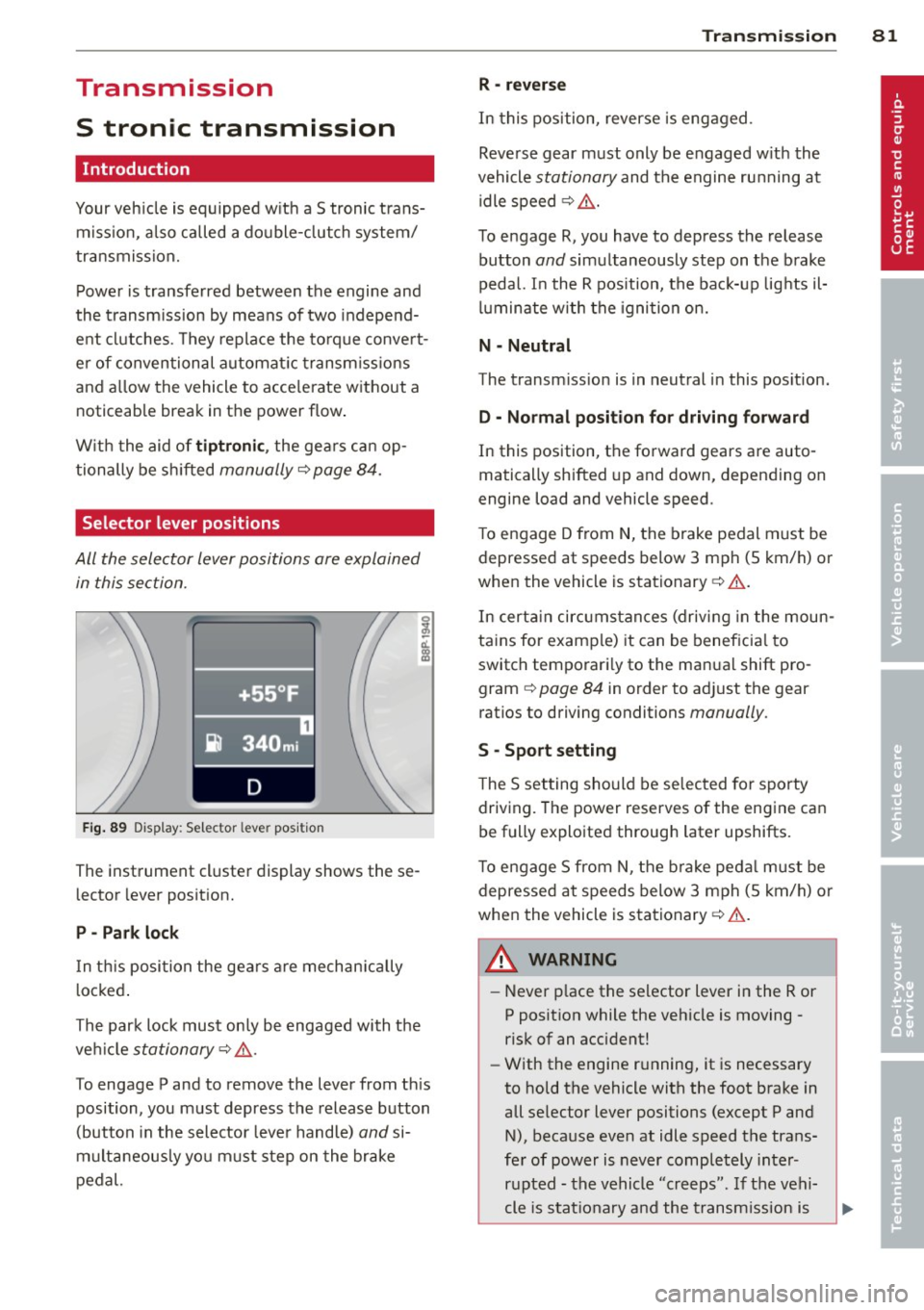
F ig . 89 Display: Selector lever position
The instrument cluster display shows these
l ector lever position.
P -Park loc k
In th is position the gea rs are mechan ically
l ocked .
The park lock must on ly be engaged with the
ve hicle
stationary¢ /1. .
To engage P and to remove the lever from th is
position, you must depress the release button
(button in the selector lever handle)
and si
multaneously you must step on the brake
pedal.
Tran sm iss ion 8 1
R -re ver se
In this position, reverse is engaged.
Reverse gear must only be engaged w ith the
vehicle
stationary and the engine ru nning at
idle speed ¢
/1..
To engage R, you have to depress the release
button
and simultaneously step on the brake
pedal. I n the R pos ition, the bac k-up lights il
luminate w ith the ignition on.
N -Neutral
The transm iss ion is in neutral in this pos ition.
D -Normal po sition fo r dri ving fo rward
In this position, the forward gears are auto
matically shifted up and down, depending on
engine load and vehicle speed.
T o engage D from
N, the brake pedal must be
depressed at speeds below 3 mph (5 km/h) or
when the vehicle is stationary¢&. .
In certa in circ umstances (driving in the moun
tains for examp le) it can be beneficia l to
switch temporari ly to the man ual shift pro
gram ¢
page 84 in order to adjust the gear
ratios to driving conditions
manually .
S -Sport setting
The S set ting should be se lected for sporty
driving. The power reserves of the engine can
be fully exploited through later upshifts.
T o e ngage 5 from N, the b rake peda l must be
depressed at speeds below 3 mph (5 km/h) or
when the vehicle is stationary¢&. .
A WARNING
-Never p lace the selector lever i n the R or
P posit ion while the veh icle is moving -
risk of an accident!
- With the engine r unning, it is necessary
to hold the vehicle with the foot brake in
all se lector lever positions (except P and
N), because even at idle speed the trans
fe r of power is never completely inter
r u pted -the vehicle "creeps". If t he vehi
cle is stat io nary and the transm ission is
Page 84 of 244
82 Transmi ssion
engag ed, the engine shou ld neve r be
spe eded up unintentionally (e.g. manual
ly from under the hood). Otherwise the
vehicle will immediately start to move -
sometimes even if the parking brake is
firmly applied -risk of an accident!
- Before you or other persons open the
hood and work on a running eng ine, the
selector lever must be move d to P and
t h e parking bra ke applied fi rm ly -ris k of
an a ccident! Fo ll ow the warning stickers .
a) Tips
If you have inadvertently s hifted into N
while the veh icle is moving, you should r e
move your foo t from the accelerato r and
wait until the eng ine speed h as droppe d to
id le before shifting back to Dor S.
Selector lever lock
The selec tor Lever Lo ck prevents a gear from
being engaged occidentally and unintention
ally setting the vehicle in motion .
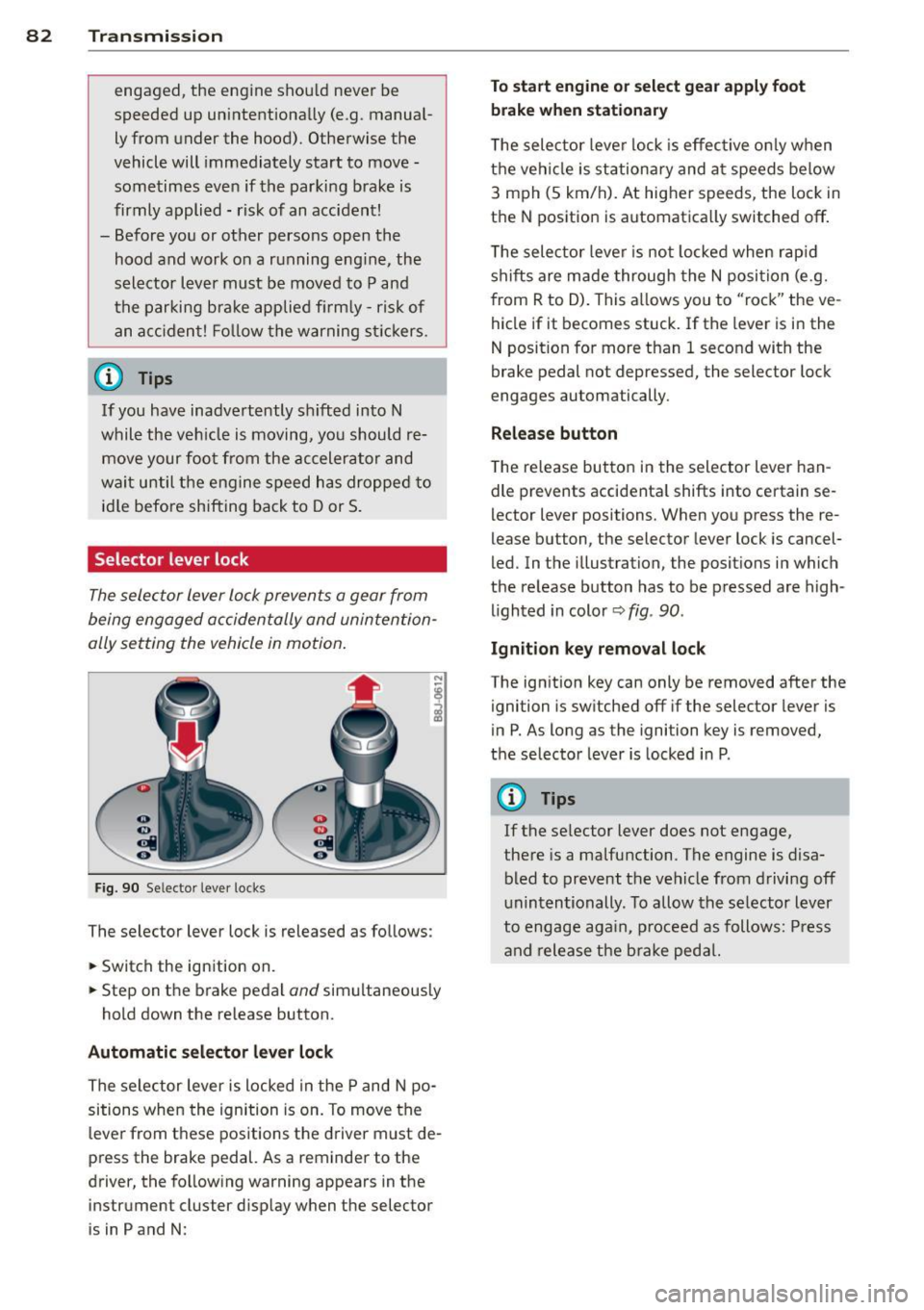
Fig. 90 Selecto r lever lo cks
The selector lever lock is released as follows:
.. Switch the ign ition on .
.. Step on the brake pedal
and simultaneous ly
hold down the release button .
Automatic selector lever lock
The selector lever is locked in the P and N po
sitions when the ignition is on. To move the
leve r from t hese positions the d river m ust de
press the brake pedal. As a reminder to the
driver, the fo llowing warning appears in the
inst rument cluster d isp lay when the selector
is in P and N :
To start engine or select gear apply foot
brake when stationar y
The selec tor leve r lock is effec tive on ly w hen
t h e veh icle is stationary and a t speeds below
3 m ph (5 km/h). At higher speeds, the lock in
t h e N position is automatica lly switched off .
T he selec tor leve r is not locked whe n rap id
shifts are made through the N posi tion (e.g.
from R to D). This a llows you to "rock" the ve
hicle if it becomes stuck. If the lever is in the
N position for more than 1 second with the
brake pedal not depre ssed, the selector lock
engages au tomatically.
Release button
T he re lease bu tton in the selector lever han
dle prevents accidenta l shifts into certain se
lector leve r positions. When you press the re
lease button, the selector lever lock is cancel
led. In the illustration, the posit ions i n which
the re lease button has to be p res sed are high
lighted in color ~
fig. 90 .
Ignition key remo val lock
The ign it ion key can only be removed after the
ignition is sw itched off if the selector lever is
in P . As long as the igni tion key is removed ,
the selector lever is locked in P.
(D Tips
If the se lector lever does not engage,
the re is a malfunction. The engine is disa
bled to prevent t he veh icle from drivi ng off
unintentionally . To allow the selector lever
to engage aga in, p roceed as follows: Press
an d release the bra ke peda l.
Page 91 of 244
Phase 1:
p rogramming th e overh ead keypad
1. Make sure yo ur vehicle is wit hin ope rating
range of the remote contro lled garage
door opener .
2. Set the parking brake
q A in General in
formation on page 88 .
3. Tur n the ignition on . Do not sta rt the en
g ine!
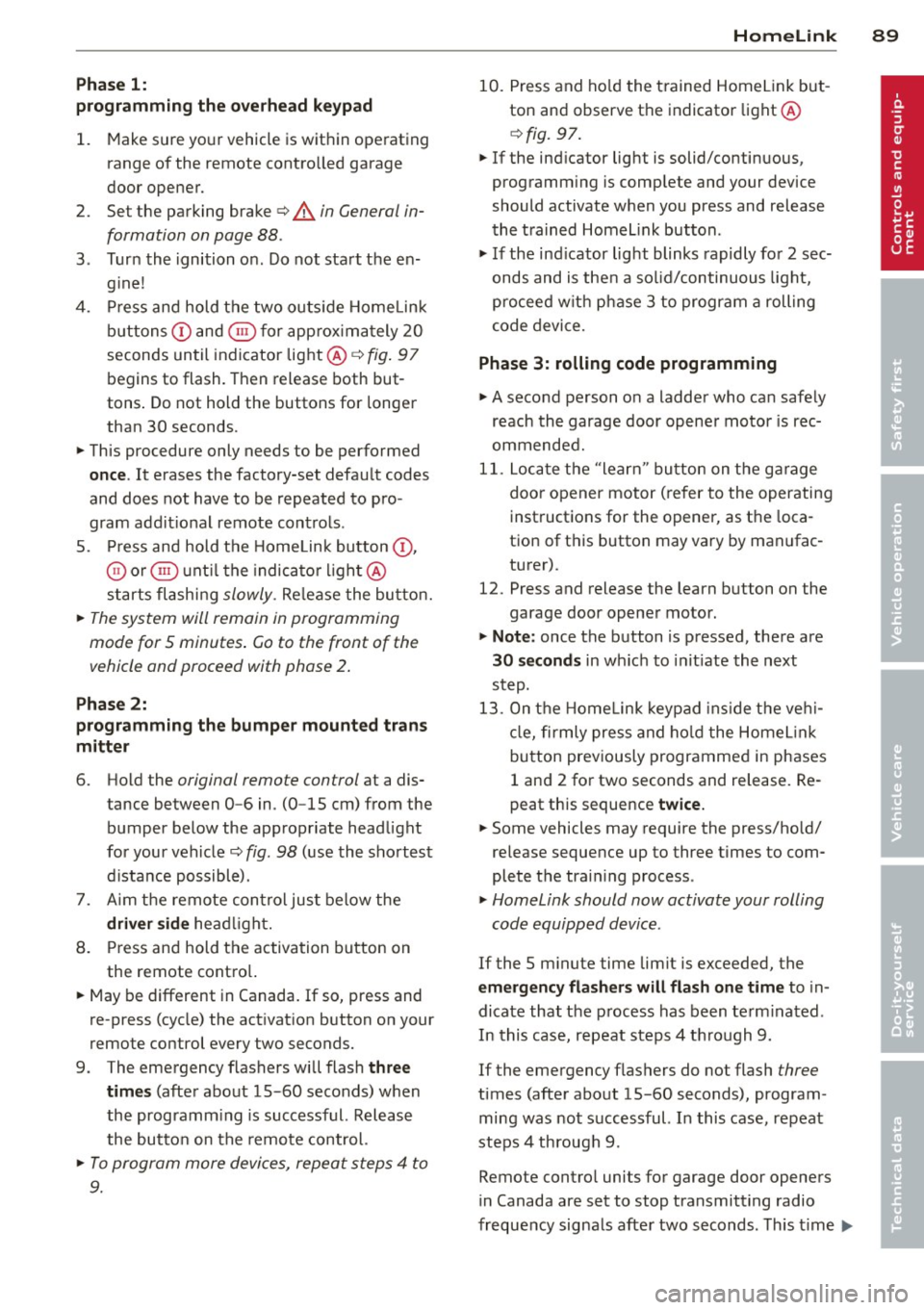
4. P ress and hold the two o utside Home Link
b uttons
(D and @for app rox ima tely 20
seconds until indicator light @
q fig . 97
begins to flash. Then release both but
tons . Do not hold the buttons for longer
than 30 seconds.
.,. This procedure only needs to be performed
once . It erases the factory-set defau lt codes
and does not have to be repeated to pro
gram add it ional remote controls .
S. Pr ess and hold t he Home link button (D ,
® or@ unt il the indicato r ligh t@
starts flashing
slowly . Release the bu tton.
.,. The system will remain in programming
mode for 5 minutes . Co to the front of the
vehicle and proceed with phase 2 .
Phase 2:
programming the bumper mounted trans
mitter
6. Hold the original remote control at a dis
tance between 0 -6 in . (0 -15 cm) from the
bumper below the appropriate head light
for your vehicle
q fig . 98 (use th e sho rtest
d istance possible) .
7. A im t he remote con trol jus t be low the
driver side head ligh t.
8 . Pr ess and hold the activa tion button on
the remote cont ro l.
.,. May be different in Canada.
If so, press and
re -press (cycle) the act ivat ion button on your
remote control every two seconds.
9 . The emergency flashers will flash
three
time s
(after about 15 -60 seconds) when
the prog ramm ing is successful. Release
the butto n on the re m ote control.
.,. To program more devi ces, repeat steps 4 to
9.
Homelink 89
10. Press and ho ld the t rained Home link b ut
ton and observe t he indicator light @
qfig. 97.
.,. If the ind icator light is solid/contin uous,
programm ing is comp lete and your device
should activate w hen you press and release
t he t ra ined Homel ink button .
.,. If the ind icator light blinks rapidly fo r 2 sec
onds and is t hen a so lid/continuous light,
p roceed w it h phase 3 to progr am a roll ing
code device.
Phase 3: rolling code programming
.,. A second pe rson o n a ladde r who can safely
reach th e garage door opene r motor is rec
ommended .
11. Loc ate t he "lea rn" bu tton on t he g arage
doo r opener motor ( re fer to the operating
inst ruct ions for the opener, as t he loca
t ion of t his button may va ry by man ufac
turer) .
12 . Press and release the learn b utton on the
garage door opener motor .
.,. Note : once the b utton is p ressed, there are
30 seconds in w hich to initiate the next
step.
13 . On t he Home link keypad ins ide t he ve hi
cl e, firmly press and hold t he Home link
bu tton prev iously progr ammed in phases
1 and 2 fo r two seconds and release . R e
peat this seque nce
twice.
.,. Some vehicles may require the press/ho ld/
re lease sequence up to three t imes to com
plete t he trai ning process .
.,. Homelink should now activate your rolling
code equipped device .
If the S minute time limit is exceeded , the
emergency flashers will flash one time to in
dicate that the p rocess has been te rm ina ted .
In this case, repeat steps 4 t hrough 9.
If the emergency flashers do not flash
three
times (afte r about lS -60 seconds) , program
ming was not successful. In this case, repeat
steps 4 through 9 .
Remote contro l units for garage door openers
in Canada are set to stop transmitting radio
fr eque ncy signa ls afte r two seconds . This t ime
Ill-
Page 112 of 244
110 Airbag sys te m
Safety Standard 208 as applicable at the time
your vehicle was manufactured.
The Standard requires the front a irbag on t he
passenger side to be turned off ("sup
pressed") if a child up to about one year of
age restrained in one of the rear-facing or for
ward -facing infant restra ints listed in Federal
Motor Vehicle Safety Standard 208 with which
the Advanced A irbag System in your vehicle
was certified has been installed on the front passenger seat . For a listing of the child re
straints that were used to certify compliance
with the US Safety Standard¢
page 131.
The PASSENG ER AIR BAG OFF light in the in
strument panel tells you when the front Ad
vanced A irbag on the passenger side has been
turned off by the e lectronic control unit.
Each t ime you turn on the ignition, the
PAS
SENGER AIR BA G OFF
light w ill come on for a
few seconds and:
- will stay on if the front passenger seat is not
occupied,
- will stay on if there is a small child or child
restraint on the front passenger seat,
- wi ll go off if the front passenger seat is oc
cupied by an adult as registered by the
weight-sensing mat
¢ page 118, Monitor
ing the Advanced Airbag System .
The PASSEN GER AIR BAG OFF light comes on
when the control un it detects a total weight
on the front passenger seat that requires the
front airbag to be turned off .
If the tota l weight on the front passenger
seat is more than that of a typical 1 year-old
child but less than the weight of a small
adult, t he front airbag on the passenger s ide
can dep loy (the
PAS SENGER AIR BAG OFF
light does not come o n). If the PASSENGER
AIR BAG OFF
l igh t does not come on , the
front airbag on the passenger side has not
been turned off by the electronic control unit
and can dep loy if the control unit senses an
impact that meets the conditions stored in its
memory .
For example , the airb ag ma y depl oy if :
- a small ch ild tha t is heav ier than a typical 1
year-old chi ld is on the front passenger seat
(regard less of whether the child is in one of
the child safety seats listed
¢ page 131), or
- a child who has outgrown child restraints is
on the front passenger seat.
If the front passenger airbag is turned off, the
PASSENGER AIR BAG OFF light comes on in
t h e instr ument pane l and stays on.
T he front airbag on the passenge r side may
not dep loy (the PASSENGER AIR BAG OFF
li ght does not illum inate and stay lit) even if a
small adult or teenager, or a passenger who is
not sitt ing upright w ith their back against a
non-recl ined backrest w it h their feet on the
vehicle floor in front of the seat is on the front
passenger seat¢
page 92, Proper seating po
sition for the driver .
If the front passenger airbag deploys, the
Federal Standard requ ires the airbag to meet
the "low risk" deployment cr iteria to reduce
the risk of injury th rough interact ion w ith the
airbag. "Low risk" deployment occurs in those
crashes that ta ke pla ce at lower dece le rat io ns
as de fined in t he electronic control uni t
¢ page 119, PASSENGER AIR BAG OFF light.
Always remember, a child safety seat or infant
ca rrier in stalled on the fron t seat may be
stru ck and knoc ked out of posit ion by the rap
idly in flat ing passenger 's airbag in a fronta l
collision. The a irbag co uld great ly red uce the
effectiveness of the ch ild restraint and even
seriously in jure the chi ld during inflation .
A WARNING
-
A child in a rearward-fac ing ch ild safety
seat installed on the front passenger seat
will be serious ly injured and can be killed if
the front airbag inflates -even with an Ad
van ced A irbag System.
- The inflating airbag will h it the ch ild
safety seat or infant carrie r with great
for ce and will smash the child safety seat
a nd child ag ai nst t he backrest, door or
roof.
Page 113 of 244
-Never install a rearward facing child
safety seat on the front passenger seat
unless the
PAS SEN GER AIR BAG OFF
light comes on and stays on. If the PA S
SEN GER AIR BA G OFF
light does not
com e on an d stay on th e inflating airbag
will hit the child safety seat or inf ant ca r
rier with great force and will smash the
child safety seat and child against the
backrest, door or roof . Have the airbag
system inspected immediately by your
authorized Audi dealer .
- Forward-facing chi ld safety seats instal
led on the front passenger's seat may in
terfere with the deployment of the air bag and cause serious personal injury to
the ch ild.
A WARNING
If, in exceptional c ircumstances, you must
install a forward-facing child restra int on
the front passenger's seat:
- Always make sure the forward-fac ing
seat has been des igned and certified by
its manufacturer for use on a front seat
with a passenger front and side airbag.
- Never put the forward-facing child re
straint up aga inst or very near the instru
ment pane l.
- Always move the passenger seat into its
rearmost position in the seat's fore and
aft adjus tment range, as far away from
the a irbag as poss ible be fore installing
the forward -facing child restraint. The
backrest m ust be adjusted to an upright
posit ion.
- Make sure that the
PASSENGER AIR BAG
OFF
light comes on and stays on all the
t ime whenever the ignition is switched
on.
A WARNING
To reduce the risk of serious injury, make sure that the
PASSENGER AIR BAG OFF
light will be d isplayed whenever a ch ild re
st raint is installed on the front passenger
seat and the ig nit io n is switched on.
A irbag system 11 1
-If the PASSENGER AIR BAG OF F light
does not stay on, perform the checks de
scribed
c> page 118, Monitoring the Ad
vanced Airbag System .
-Have the airbag system inspected by
your Aud i dea ler immediately.
-Always carefully follow instructions from
child restraint manufacturers when in
stalling ch ild restra ints .
A WARNING
--=
If, in except ional circumstances, you must
install a forward o r rearward-facing child
restra int on the front passenger's seat:
- Improper installation of ch ild restraints
can reduce their effectiveness or even prevent them from providing any protec
tion.
- An improperly installed ch ild restra int
can interfere with the airbag as it de
ploys and seriously inj ure o r even kill the
child -even with an Advanced Airbag
System.
- Always carefu lly follow the manu fact ur
er 's ins truc tions p rov ided with the chi ld
safety seat or carrier .
- Never p lace ad dition al items on the seat
that can increase the total weight reg is
tered by the weight-sensing mat and can cause injury in a crash.
•
•
Page 116 of 244
114 Airbag sys te m
- a small adu lt or teenager is on the front pas
senger seat
- a passenger who is not sitting upright with
their back against a non-reclined backrest
with their feet on the vehicle floor in front
of the seat is on the front passenger seat.
I f the front passenger airbag deploys, the
Federal Standard requires the airbag to meet
the " low risk" deployment criteria to help re
duce the risk of in jury through interaction
with the airbag . "Low risk" deployment occurs
in those cr ashes that take place at lower de
celerations as defined in the electronic control un it
Q page 118 .
Always rem ember : Please be sure to read the
impor tant informa tion in the sections tha t
follow and be sure to heed all of the WARN
INGS .
A WARNING
To reduce the r isk of injury when an airbag
inf lates , a lways wear safety belts prope rly.
- If you are unrestrained, lean ing forward,
sitting sideways or out of position in any
way, your risk of in jury is much higher.
- You w ill also receive serious inju ries and
cou ld even be killed if you are up against
the a irbag or too close to it whe n it in
flates - even with an Advanced Airbag
Q page 108.
A WARNING
-
A child in a rearward-facing child safety
seat insta lled on the front passenger seat
w ill be seriously injured and can be k illed if
the front a irbag inflates - even with an Ad
vanced Airbag System .
- Although the Advanced A irbag System in
your vehicle is designed to turn off the
front a irbag when a rearward -fac ing
child restraint has been installed on the
front passenger seat, nobody can abso l u te ly guarantee that deployment is im
poss ible in a ll conce ivable situations th at
may happen d uring the useful life of your
vehicle. -
The inflating airbag will h it the ch ild
safety seat or infant carrier with great
force and will smash the child safety seat and child aga inst the backrest, door, or
roof.
- If you must install a rearward fac ing
child safety seat on the front passenger
seat because of exceptiona l circumstan
ces and t he
PASSENGER AIR BAG OFF
light does not come on and s tay on have
the airbag system inspecte d by your Audi
dealer.
A WARNING
--=
If, in exceptiona l circumstances, you m ust
i nstall a forward -facing child restraint on
the front passenger's seat:
- Always make sure the forward- facing
seat has been designed and certified by
its manufacturer for use on a front seat
wit h a passenger front and s ide a irbag.
- Never p ut the fo rward-facing chi ld re
straint up against or very near the instru
ment panel.
- Always move the passenger seat into its
rea rmost pos ition in the seat's fore and
aft ad justment range, as far away from
the airbag as possible, before install ing
the forward-fac ing ch ild restra int . The
backrest must be ad justed to an up right
position.
- Make sure that the
PASSENGER AIR BAG
OFF
li ght comes on a nd stays o n all the
time wheneve r the ignit ion is switched
on .
Advanced Airbag System components
The front passenge r seat in yo ur vehicle has a
lot of very important parts of the Advanced
Airbag System in it . These parts i nclude the
weight-sensing mat, sensors, wiring, brack ets, and more. The funct ion of the system in
the front passenger seat is checked by the electron ic control unit when the ignition is on .
The cont rol unit monito rs the Advanced A ir
bag System and turns the airbag indicato r
li ght on w hen a malfun ct io n in t he system
Page 119 of 244
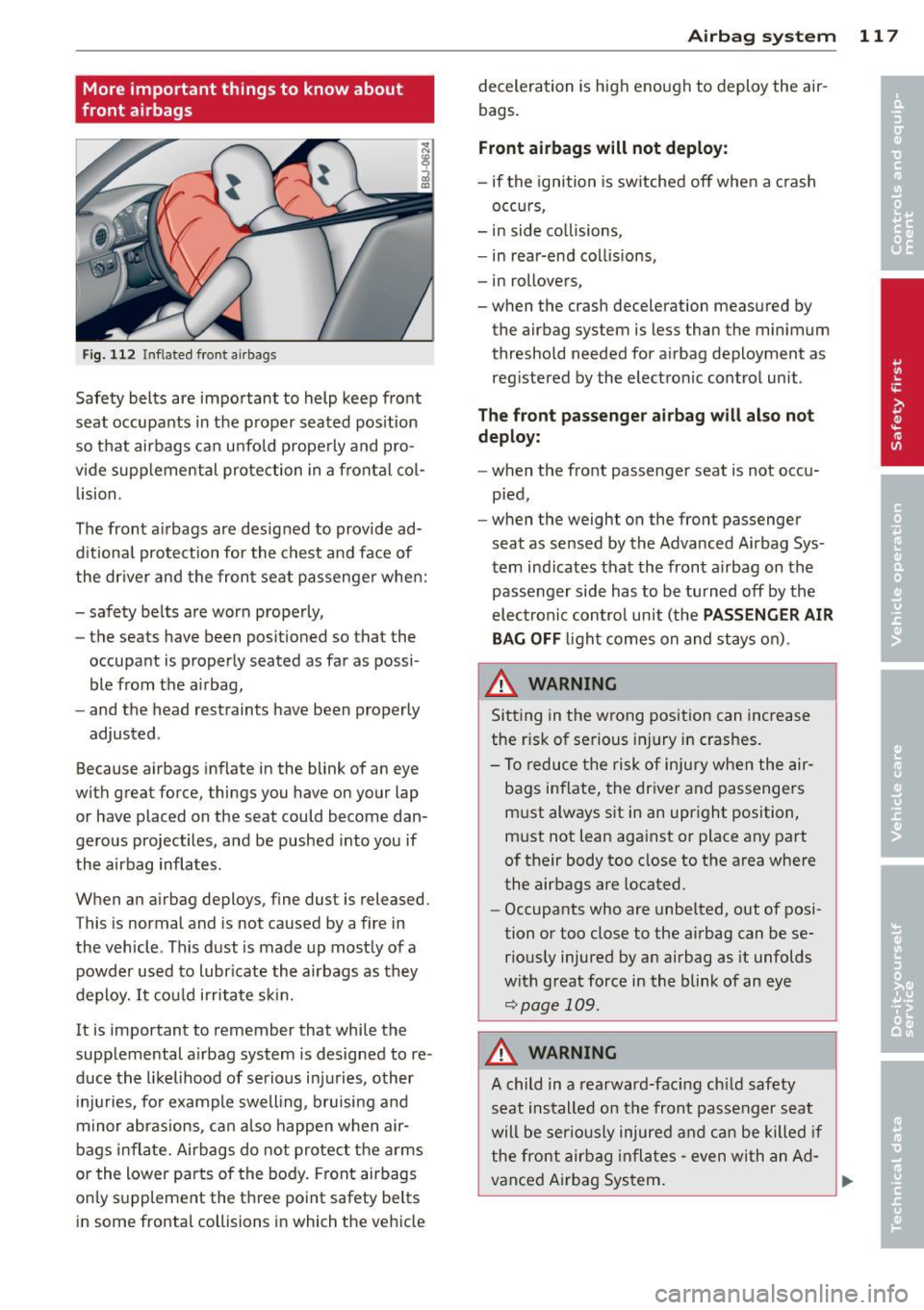
More important things to know about
front a irbags
F ig. 112 Inflated front airba gs
Safety belts are important to help keep front
seat occupants in the proper seated pos it ion
so that airbags can u nfold prope rly and pro
v ide supp lemental protection in a fronta l co l
lision .
The front a irbags are designed to provide ad
d itiona l protect io n for the chest and face of
the dr iver and the fron t seat passenger whe n:
- safety belts are wor n prope rly,
- the seats have been posit ioned so tha t the
occupant is proper ly seated as far as possi
ble from the a irbag,
- and the head restraints have been properly
adjusted .
Because airbags inflate in the blink of an eye
with great force, things you have on your lap or have placed on the seat could become dan
gerous projectiles, and be pushed into you if
the airbag inflates .
When an a irbag deploys, fine dust is released.
This is normal and is not caused by a fire in
the vehicle . This dust is made up most ly of a
powder used to lubr icate the airbags as they
deploy. It cou ld i rritate s kin .
It is important to remember that while the
supp lemental airbag system is designed to re
duce the likelihood of serious i njuries, other
inj uries, fo r example swell ing, bru isi ng a nd
minor abrasions, ca n also happen when air
bags inflate. Airbags do not protect the a rms
or the lower pa rts of the body. Front airbags
only s upplement the t hree point safety be lts
in some frontal collisions in which the vehicle
A irba g sy stem 11 7
deceleration is high eno ugh to deploy the air
bags .
Front airbags will not deploy :
-if t he ignition is sw itched off when a crash
occu rs,
- in side co llisions,
- in rear-end co llis ions,
- in rollovers,
- when the crash dece leration measured by
the airbag system is less than the minimum
threshold needed for a irbag deployment as
reg istered by the electronic con tro l unit .
The front pa ssenger airbag will also not
deploy:
- when the front passenge r seat is not occu
pied,
- when the weight on the front passenger
seat as sensed by the Advanced Airbag Sys
tem ind icates that the front a irbag on the
passenger side has to be tu rned off by th e
elec tronic con trol un it (the
PASSENGER AIR
BAG OFF
li ght comes on and st ays o n).
&_ WARNING ~
Si tti ng in the wrong pos ition can inc rease
the r isk of se rious in ju ry in crashes.
- To reduce t he ris k of injury when the air
ba gs inflate, the drive r and passenge rs
must always s it in an upr ight position,
m ust not lean against or place any part
of their body too close to the area whe re
the airbags a re located.
- Occupants who are unbe lted, out of posi
tion or too close to the airbag can be se rious ly injured by an airbag as it unfolds
with g reat force in the blink of an eye
~page 109 .
&_ WARNING
-
A child in a rearwar d-fac ing ch ild safety
seat installed on th e front passe nger seat
will be ser ious ly injured a nd ca n be killed if
the front ai rb ag inflate s - even wi th an Ad-
vanced Ai rbag Sys tem.
Ill-
Page 120 of 244
118 Airbag sys te m
- The inflating airba g will hit the child
safety seat or infant carri er w it h great
force and w ill smash the ch ild safety seat
and child against the backrest, cente r
arm r est, door or ro of.
- Ne ver install a r earward facing child
sa fety seat on the fro nt passenger seat
unl ess the
PASSENGER AIR BAG OFF
ligh t co me s on and stays on. If the PA S
SENGER AIR BAG OFF
ligh t does no t
come on and stay on, the inflating airbag
will hit the child safety seat or infant car
rier with great force and will smash the
child safety seat and child against the
backrest, door or roof. Have the airbag
system inspected immediately by your
authorized Audi dealer .
A WARNING
Objects between you and the a irbag will
increase the risk of injury in a crash by in
terfering with the way the airbag unfolds
or by being pushed into you as the a irbag
inflates.
- Never hold th ings in your hands or on
yo ur lap when the vehicle is in use.
- Never transport items on or in the area
of the front passenge r seat. Objects
c ou ld move into the area of the front air
bags dur ing braking or other s udden ma
neuver and become dange rous projec
tiles that can cause serious personal in
jury if the airbags inflate.
- Never place o r attach accessories or oth
er objects (such as cup ho lders, tele
phone brackets, large, heavy or b ulky ob
jects) on the doors, over or near the area
marked "AIRBAG" on the steering wheel,
instrument panel, seat backrests or be
tween those a reas and yourself. These
objects co uld cause injury in a crash, es
pecially when the airbags inflate.
- Never recline the front passenger's seat
to transport objects. Items can also
move in to the area o f the side airb ag or
the front airbag dur ing braking or in a
sudden maneuver. Objects near the air -
-
bags can become projectiles and cause
inju ry, partic ularly when the seat is re
clined.
A WARNING
The fine dust created when airbags deploy
can cause breathing prob lems for people
with a history of asthma or other breath
i ng cond itions.
- To reduce the risk of breath ing problems,
those with asthma o r othe r respiratory
conditions shou ld get fresh air righ t
away by getting o ut of the ve hicle or
open ing win dows or doors.
- I f you are i n a collision in which airbags
deploy, wash your hands and fa ce with
mild soap and wate r before ea ting.
- Be ca reful not to get the dust into your
eyes, o r into any c uts or s cratches.
- If the res id ue should get into your eyes,
flush them w ith wate r.
Monitoring the
Advanced Airbag System
tii Airbag monitoring indicator light
Two separate indicators monitor the function
of the Advan ced Airbag Sy stem: the airbag
monitoring indicator light and the
PASSEN
GER AIR BAG OFF
light.
T he Advanced A irbag Sys tem ( incl uding the
ele ctron ic cont rol unit, sensor circ uits and sys
tem wir ing) is monitored continuously to
make sure that it is functioning properly
whenever the ignition is on. Eac h time you
turn on the ignition, the a irbag monitoring in
dicator light . will come on for a few sec
onds (self diagnostics).
The system must be inspected when the
i ndicator light•=
-does not come on when the ignition is
sw itched on,
- does not go out a few seconds after you
have switched on the ignit ion, or
Page 121 of 244
- comes on while driving.
I f an airbag system malfunct io n is dete cted ,
the ind icator light will firs t start flashing to
catch the driver 's attention and then stay on
continuously to serve as a constant reminder
to have the system inspected immed iately.
If a malfunction occurs tha t tur ns the fron t
ai rbag on the passenger side off, the
PA SSEN
GER AIR BAG OFF
li ght wi ll come on and stay
on wheneve r the ignition is on.
A WARNING
An airbag system that is not funct ioning
properly cannot provide supplemental pro
tection in a frontal crash.
- If the airbag indicator light comes on, it
means that the re may be somet hing
wrong with the Adva nced Airbag System .
It is possible that the airbag will inflate
w hen it is not s upposed to, or w ill not in
flate when it should.
- Have the airbag system inspected imme
diately by your Aud i dealer .
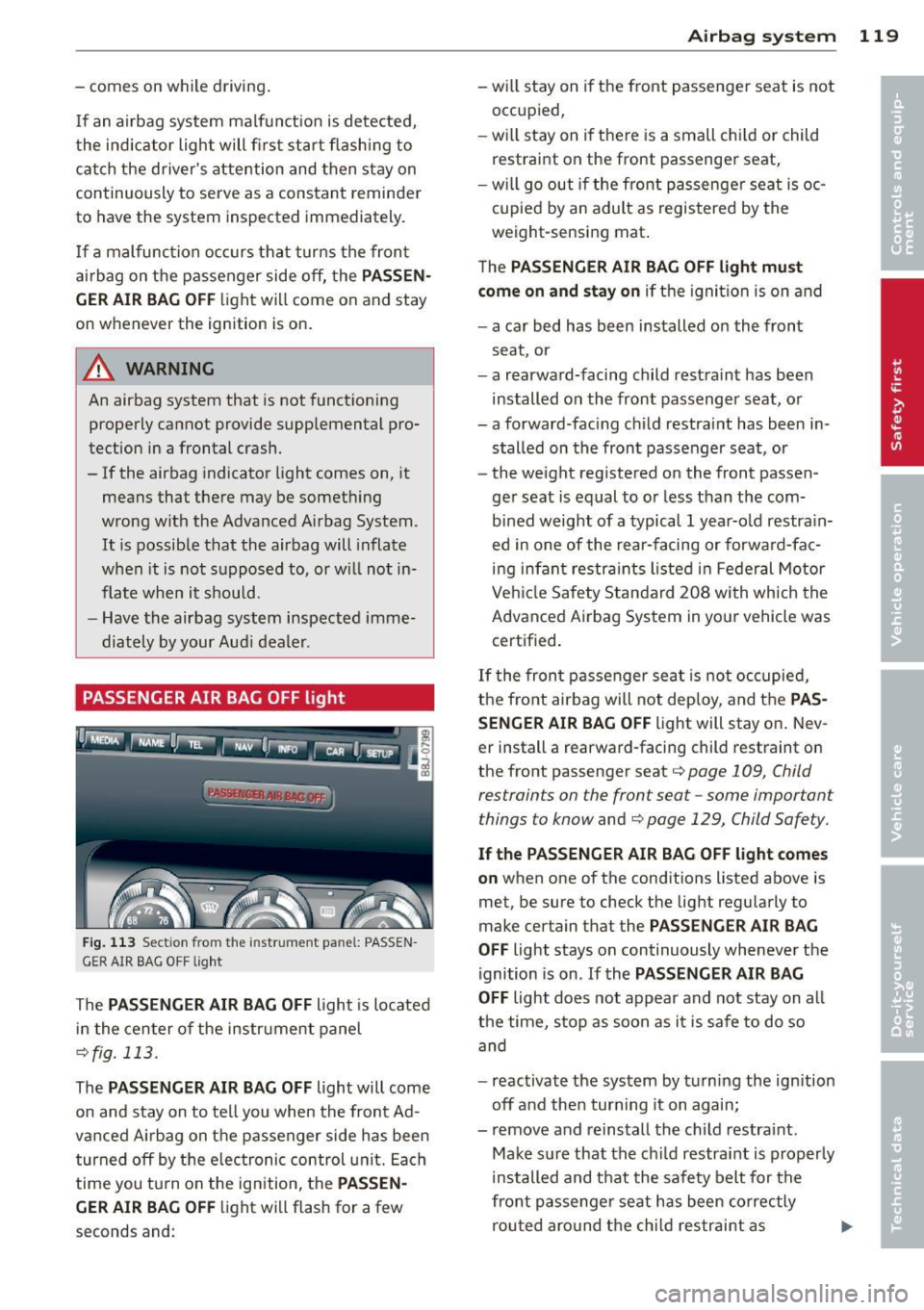
PASSENGER AIR BAG OFF light
Fig. 11 3 Section fr om the inst ru men t pa nel: PASS EN
G ER AIR BAG O FF light
The PASSENGER AIR BAG OFF light is located
i n the cen ter of the instrument panel
c:> fig. 113 .
The PASSENGER AIR BAG OFF light will come
on and stay on to tell you when the front Ad
vanced A irbag on the passenger side h as been
turned off by t he e lectronic control u nit. Each
time you tu rn on the ign ition, the
PASSEN
GER AIR BAG OF F
light will flash for a few
seconds and:
A irba g sy stem 119
- will stay on if the front passenger seat is not
occupied,
-w ill stay on i f there is a small ch ild or child
restraint on the front passenger seat,
- will go out if the fron t passenger seat is oc
cupied by an adult as registered by the
weight-sensing mat .
T he
PAS SENGER AIR BAG OFF light must
com e on and sta y on
if t he igni tion is on and
- a car bed has been installed on the front
seat , or
- a rearward-facing child restraint has been installed on the front passenger seat, or
- a forward -fac ing ch ild restra int has been in
stalled on the front passenger seat, or
- the weight reg istered on the front passen
ger seat is equal to or less than the com
bi ned weight of a typical 1 year-old restra in
ed in one of the rear-facing or forward-fac
ing infant restra ints listed in Federal Motor
Ve hicle Safety Standa rd 208 wi th which the
Advanced Airbag System in you r veh icle was
certified.
If t he fron t passenger seat is not occupied,
the fro nt airbag will not deploy, and the
PAS
SENGER AIR BAG O FF
light will stay on . Nev
er install a rearward-facing child restraint on
the front passenger seat
c:> page 109 , Child
res train ts on the front sea t-some important
things to know
and c:> page 129, Child Safe ty .
If the PASSENGER AIR BAG OFF light come s
o n
when one of the cond itions listed above is
met, be sure to check the light regularly to
make certain that the
PASSENGER AIR BAG
OFF
light stays on continuously wheneve r the
ignition is on .
If the PASSENGER A IR BAG
OFF
light does not appear and not stay on all
the time, stop as soon as it is safe to do so and
- reactivate the system by turn ing the ign ition
off and then turn ing it on again;
- remove and reinstall the ch ild restra int .
Make s ure that the ch ild restraint is proper ly
installed and that the safety belt for the
front passenge r seat has been correc tly
rou ted aro und t he chi ld restraint as