ignition AUDI TT ROADSTER 2015 Repair Manual
[x] Cancel search | Manufacturer: AUDI, Model Year: 2015, Model line: TT ROADSTER, Model: AUDI TT ROADSTER 2015Pages: 244, PDF Size: 60.74 MB
Page 162 of 244
160 Fuel supply and filling your fuel tank
Fuel supply and filling
your fuel tank
Gasoline
Fuel supply
Using the right fuel helps keep the environ
ment clean and prevents engine damage .
Fuel recommendation
The fuel recommended for your vehicle is un
leaded premium
grade gasoline . Audi recom
mends using TOP TIER Detergent Gasoline
with a minimum octane rating of 91 AKI (95
RON) . For more information on TOP TIER De
tergent Gasoline, please go to the official
website (www.toptiergas.com).
The recommended gasoline octane rating for
your engine can also be found on a label locat
ed on the inside of the fuel filler flap. This rat
ing may be specified as AKI or RON.
Your vehicle may also be operated using un leaded regular gasoline with a minimum oc
tane rating of 87 AKI/91 RON. However, using
87 AKl/91 RON octane fuel will slightly re
duce engine performance.
Use unleaded gasoline only. Unleaded gaso
line is available throughout the USA, Canada,
and in most European countries. We recom mend that you do not take your vehicle to
areas or countries where unleaded gasoline
may not be available.
For more information on refueling your vehi
cle, see ¢
page 161.
Octane rating
Octane rating indicates a gasoline's ability to
resist engine damaging "knock" caused by
premature ignition and detonation. Therefore,
buying the correct grade of gasoline is very
important to help prevent possible engine
damage and a loss of engine performance.
Gasoline most commonly used in the United
States and Canada has the following octane ratings that can usually be found on the filler
pump : -
Premium Grade: 91 -96 AKI
- Regular Grade: 87 -90 AKI
Explanation of the abbreviations:
AKI= Anti Knock Index= (R+M)/2 = (RON
+MON)/2
RON= Research Octane Number
MON = Motor Octane Number .
@ Note
-Do not use any fuel with octane ratings
lower than 87 AKI or 91 RON otherwise
expensive engine damage will occur.
- Do
not use leaded gasoline! The use of
leaded gasoline will severely damage
your vehicle's catalytic converter and its
ability to control exhaust emissions.
Blended gasoline
Use of gasoline containing alcohol or
MTBE (methyl tertiary butyl ether)
You may use unleaded gasoline blended with
alcohol or MTBE (commonly referred to as
oxygenates) if the blended mixture meets the
following criteria:
Blend of gasoline methanol (wood alcohol or
methyl alcohol)
- Anti-knock index must be 87 AKI or higher.
- Blend must contain no more than 3% meth-
anol.
- Blend must contain more than 2% co-sol-
vents.
Blend of gasoline and ethanol (grain alcohol
or ethyl alcohol)
- Anti-knock index must be 87 AKI or higher.
- Blend must not contain more than 10%
ethanol.
Blend of gasoline and MTBE
- Anti-knock index must be 87 AKI or higher.
- Blend must contain not more than 15%
MTBE.
Seasonally adjusted gasoline
Page 166 of 244
164 Checking and filling
Checking and filling
Engine hood
Releasing the engine hood
The engine hood is released from inside the
vehicle .
Fig. 126 Driver' s side footwe ll: e ngin e hood release
lever
.. Open the driver's door .
.. Pull the release lever on the left under the
instrument panel
c> fig . 126 in the direction
of the arrow .
The hood pops up slight ly under spring pres
sure.
Opening the engine hood
Fig . 127 Re lease lever under the engine hood
Before opening the engine hood, make sure
that the windshie ld wipers are flat against the
windshie ld. Otherwise, they cou ld damage the
pain t on the hood.
.. Lift the hood slight ly
c> .&, .
.. Pull up on the release under the hood
c> fig . 12 7. This releases the catch .
.. Open the hood all the way.
A WARNING
-Hot engine coolant can burn you.
- To reduce the risk of being burned, never
open the hood if you see or hear steam
or coo lant escaping from the eng ine
compartment . Wait unt il no steam or
coolant can be seen or heard before care
fu lly opening the hood.
Closing the engine hood
.. Pull the hood down until the pressure from
the struts is reduced .
.. Let the hood
drop down and latch in p lace.
Do not try to push it shut; it may fail to en
gage
c> .&, .
A WARNING
--
A hood that is not completely latched
could fly up and b lock your view while dr iv
i ng.
- When you close the engine hood, check it
to make sure the safety catch has proper
ly engaged . The hood should be flush
with the surrounding vehicle body parts.
- If you notice while dr iv ing that the hood
is not secured properly, stop at once and
close it .
Working in the engine compartment
Be especially careful whenever you work in
the engine compartment!
Whene ve r y ou must pe rform any wo rk in th e
eng ine compartment, for e xample chec king
and filling the diff ere nt fluids, ther e is a risk
of injury , burn s and accident s. To prevent
p ers onal injury alwa ys obs erv e the follo win g
WARNING S. Th e engin e c ompartm ent of an y
v e hicl e is a hazardou s area!
c> .&.
A WARNING
To help avoid injury, before you check any
thing under the hood:
- Sw itch off the engine .
- Remove the ignition key.
Page 167 of 244
-Apply the parking brake.
- Move selector lever to "P" (Park).
- Always let the engine cool down. Hot
components will burn skin on contact.
- To reduce the risk of being burned, never
open the hood if you see or hear steam
or coolant escaping from the engine
compartment. Wa it until no steam or
coolant can be seen or heard before care
fully opening the hood.
- Keep children away from the engine com
partment .
- Never spill fluids on hot engine compo
nents. They can cause a fire.
- Never touch the radiator fan. The auxili
ary electric fan is temperature controlled
and can switch on suddenly.
- Never open the coolant reservoir cap
when the engine is still warm. The cool
ant system is pressurized and hot cool
ant could spray out .
- Protect your face, hands and arm from
steam or hot engine coolant by placing a
thick rag over the cap when you open the
coolant reservoir .
- Do not remove the engine cover under
any circumstances . This increases the
risk of burns.
- If work on the fuel system or the electri
cal system is necessary:
- Always disconnect the battery .
- Never smoke or work near heaters or
open flames. Fluids in the engine com
partment could start a fire.
- Keep an approved fire extinguisher im
mediately available.
- To avoid electrical shock and personal in
jury while the engine is running or being
started, never touch:
- Ignition cables
- Other components of the high voltage
electronic ignition system.
- If you must perform a check or repair
with the engine running:
Checking and filling 165
- First, fully apply the parking brake,
move selector lever to "P" (Park) .
- Always use extreme caution to prevent
clothing, jewelry, or long hair from get
ting caught in the radiator fan, V-belts
or other moving parts, or from contact
ing hot parts . Tie back hair before
starting, and wear no clothing that will hang or droop into the engine.
- Minimize exposure to emission and
chemical hazards~&. .
A WARNING
California Proposition 65 Warning:
- Engine exhaust, some of its constituents,
and certain vehicle components contain
or emit chemicals known to the State of
California to cause cancer and birth de
fects and reproductive harm. In addition,
certain fluids contained in vehicles and
certain products of component wear con
tain or emit chemicals known to the State of California to cause cancer and
birth defects or other reproductive harm.
- Battery posts, terminals and related ac
cessories contain lead and lead com
pounds, chemicals known to the State of
California to cause cancer and reproduc
tive harms. Wash hands after handling.
Q) Note
When adding fluids, always make sure that
they are poured into the proper container
or filler opening, otherwise serious dam
age to vehicle systems will occur .
@ For the sake of the environment
To detect leaks in time, inspect the vehicle
floor pan from underneath regularly . If
you see spots from oil or other vehicle flu ids, have your vehicle inspected by an au
thorized Audi dealer. •
•
Page 175 of 244
If you have lost a consi derable amount of
coolant, then you should add co ld antifreeze
and cold water only when the engine is co ld .
Always use
new engine coolant when refi lling.
D o not fi ll coolant above the "MAX " mark . Ex
cess coolant will be forced out th rough the
p ress ure rel ief valve in the cap when the en
g ine becomes hot .
A WARNING ,_________
- The cooling system is under press ure and
can get very hot . Reduce the risk of
sca ld ing from hot coo lant by following
these steps.
- Tur n
off the eng ine and a llow itto cool
down.
- P rotect your face, hands and arms from
escap ing f lu id a nd steam by cover ing
the cap wi th a la rge, thick rag.
- Turn the cap slow ly and very ca refully
in a cou nte r-clockw ise d irect ion while
a pply ing ligh t, downw ard p ress ure on
the to p of the cap.
- T o avo id being burned, do no t sp ill an
tifreeze or coolan t on the exhaust sys
tem or hot engine parts . U nder certa in
conditions, the ethylene glyco l in en
gine coolant can catc h fire .
- Antifreeze is poisonous . Always store an
tifreeze in its original container and we ll
o ut o f the reach of children.
- If you drain the coolant , it must be
caught and safely stored in a proper con
tainer clearly marked "poison".
@ Note
- Do not add coolant if the expansion tank
i s empty . Ai r could enter the cooling sys
tem and damage the engine. If this is
the case, do not continue driving. Seek professional assistance.
- Coolant po llutes the env ironment and
could cause a n engine fire. Excess coo l
ant wi ll be f orced out through the pres
su re re lief valve in the cap when the en
gine becomes hot.
Checkin g and fillin g 173
- If, in an eme rgency, on ly wate r can be
added, the co rrect ratio between water
and antifreeze ¢
page 171 must be re
stored as soon as possible.
@) For the sake of the environment
Drained coolant sho uld not be reused. A l
ways d ispose of used coolant while observ
i ng a ll environmental regulations.
, Radiator fan
The radiator fan switches on automatically by
itself .
The electric radiator fan is controlled by ther
moswitches that switch on and
off depending
on coo lant and eng ine compartment tempera
tures.
An a uxiliary electric radiato r fan* sw itches on
and
off depending on coolant temperature
and othe r vehicle ope rat ion conditions .
After yo u switch the eng ine off, the aux iliary
f an can continu e running for up to 10 m inut es
- even with the ignition off. It can even switch
on again later by itself¢ & , if
- t he temperatu re of the engine coo lant rises
due to the hea t build -up from the engine in
the engine compa rtment, or
- the engine compa rtment heats up because
the vehicle is parked in intense sunlig ht.
A WARNING ~
- To reduce the risk of persona l in ju ry nev-
er touch the radiator fan .
- The a uxiliary electric fan is tempe rat ure
contro lled and can switch on suddenly
even when the engine is not running.
- The a uxiliary radiator fa n sw itches on a u
tomatically when the engine coo lant
reaches a certai n temperature and will
continue to ru n until the coo lant temper
ature drops. •
•
Page 177 of 244
@ For the sake of the environment
Because of the problem of proper disposa l
of brake flu id as we ll as the special tools
requ ired and the necessary expert ise, we
recommend that you have the brake fluid
changed by your author ized Audi dealer .
Battery
General information
Your vehicle is equipped with a special bat
tery, an
ACM battery. This battery is located
in the luggage compartment and must be re
p laced w ith an original equipment battery .
Under normal operati ng conditions, the bat
tery is
maint enan ce -fre e.
Have the battery checked when you take your
ve hicle in for service. You are well adv ised to
replace a battery that is older than
5 years.
Di sconn ect ing the battery terminal s
Some vehicle functions (power window regu
lators, for example) are lost if the battery ter
minals are d isconnected. These functions have
to be re learned after the battery terminals are
connected again . To prevent this, the battery
should only be d isconnected from the vehicle
e lectr ica l system when absolutely necessary
for repairs .
Vehicles not driven for l ong period s
If you do not drive your vehicle over a period
of several days or weeks, electrical compo
nents are gradually cut back o r switched off .
This reduces energy consumption and main
tains sta rting capab ility over a longer per iod
c::> page 146. Some of the convenience func
tions may not operate, s uch as the interior
lights or power seat adjustment. The conven
ience functions will be avai lab le again when
you switch on the ignition and start the en g ine.
Winter operation
D uring the winter months, ba tte ry capaci ty
tends to decrease as temperatures d rop. This
is because more powe r is also consumed while
Checkin g and fillin g 175
starting, and the headlights, rear window de
fogger, etc ., are used more often .
Avoid unnecess ary powe r consumpt io n, p ar
t icu lar ly in city traffic o r when traveling only
sho rt distances. Let your authorized A udi
dealer check the capacity of the vehicle bat
tery before winter sets in
c::> page 178. A well
charged battery will not on ly prevent starting
problems when the weather is cold, but will
also last longer .
Replacing battery
The new battery must ha ve the same capaci
ty, voltage (12 volts), amperage, construction
and plug sea ling, as the original battery. Spec
ifications are listed o n the battery housing.
Batter ies spec ia lly developed by Audi fulfill
the maintenance, outp ut, and safety require
ments.
When installing the battery, make sure the ig nition and a ll electrical consumers are switch
ed off
c::> (D .
We recommend that you use maintenance
free or
cycle -res istant /leak-proof batter ies
accord ing to the standards TL 825 06 (from
Apr il 2008) and VW 7 50 73 (from Ap ril
2010).
Rep lacing the battery should be carried by a
qualified workshop. Please fo llow the instruc
tions on the battery cover.
([) Note
-All work on the battery requ ires techn i
cal know ledge. P lease contact an Audi
deale rship o r anot her au tho rized fac ility
for questions abo ut the batte ry -dang er
of a cid b urns and exp losion ha zard!
- T he battery must not be opened! Do not
try to cha nge the battery 's liquid level,
ot herwise de tona ting gas will esc ape
from the ba ttery -explosion ha zard!
- T he AGM battery in the l uggage com
p artment cannot leak, because the elec
tro lyte for this battery is abso rbed into a
special glass mat. This lea k-p roof battery
Iii>
•
•
Page 179 of 244
-Do not interchange the positive and neg
ative cables .
- When working on the battery , be sure
not to short-circuit the terminals with
tools or other metal objects. This would cause the battery to heat up very quickly,
which could lead to damage or explosion and personal injury.
- When a battery is charged, it produces
hydrogen gas which is explosive and
could cause personal injury .
- Always keep the battery well out of the reach of children .
- Before work is done on the electrical sys
tem, disconnect the negative ground ca
ble .
- Before performing any work on the elec
trical system , switch off the engine and
ignition as well as any electrical equip
ment. The negative cable on the battery
must be disconnected. If you are just go
ing to replace a light bulb, then it is
enough to switch off the lights.
- Before disconnecting the battery , switch
off the anti-theft alarm system! Other
wise you will set off the alarm.
- When disconnecting the battery, first
disconnect the negative cable and then
the positive cable.
- Before reconnecting the battery, make
sure all electrical consumers are switch
ed off. Reconnect the positive cable first
and then the negative cable. Never inter
change the cables - this could start a fire!
- Never charge a fro zen or a thawed-out
battery. It could explode! If a battery has
frozen, then it must be replaced. A dis
charged battery can freeze over at 32 °F
(0 °C) .
-Make sure the vent hose is always attach
ed to the opening on the side of the bat
tery.
- Never use batteries which are damaged.
Danger of explosion! Always replace a
damaged battery.
Checking and filling 177
A WARNING
California Proposition 65 Warning:
- Battery posts, terminals and related ac cessories contain lead and lead com
pounds, chemicals known to the State of
California to cause cancer and reproduc
tive problems . Wash hands after han
dling.
Q) Note
- Do not disconnect the vehicle battery
when the ignition is switched on or when
the engine is running, otherwise , you will
damage electronic components in the
electrical system.
- If your vehicle is going to stand for a
long period of time without being driven,
protect the battery from "freezing", oth
erwise it will be damaged and will then
have to be replaced.
Checking the battery acid level on magic
eye batteries*
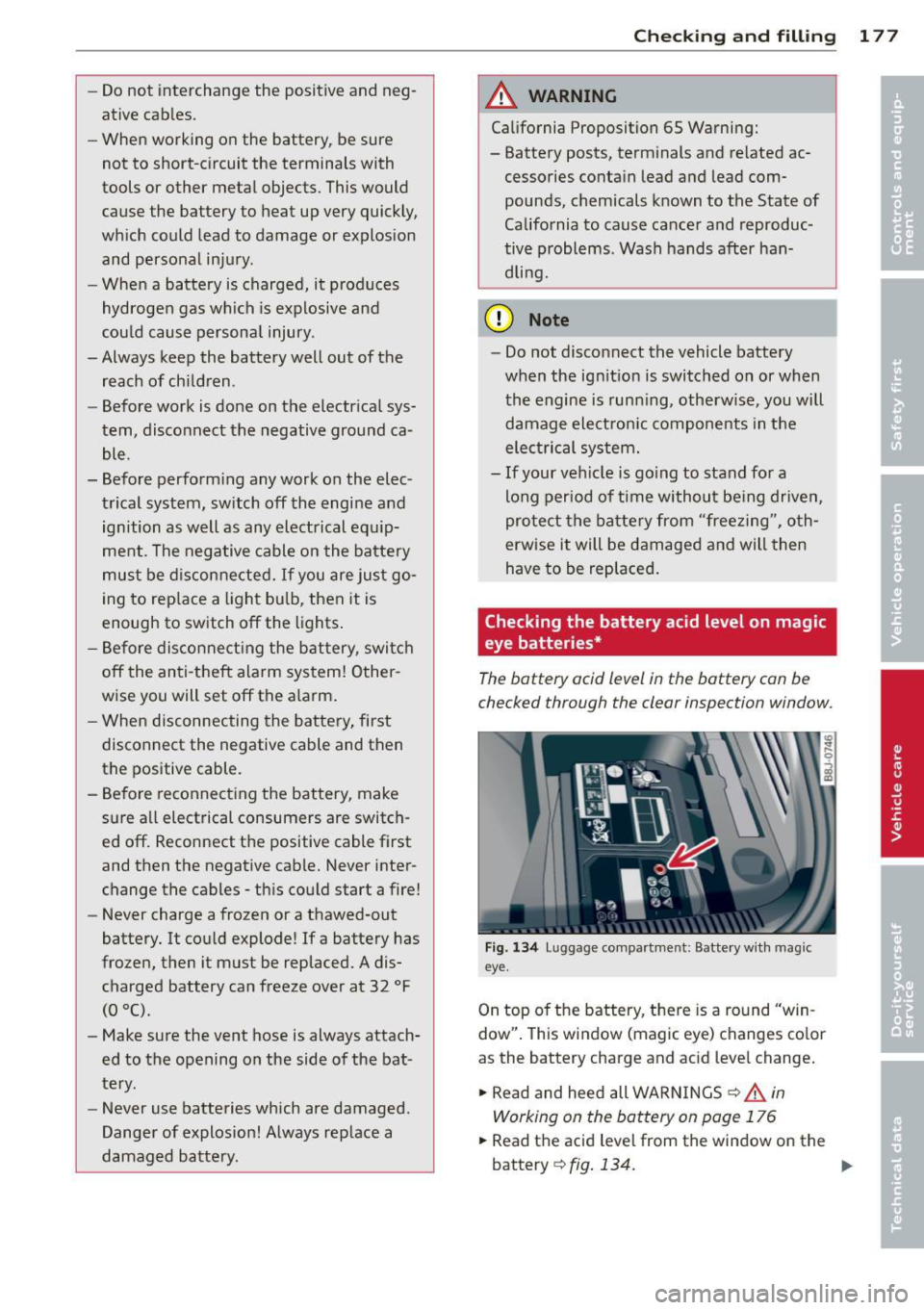
The battery acid level in the battery can be
checked through the clear inspection window .
Fig. 134 Lugg age compar tme nt: Battery w ith mag ic
e ye .
On top of the battery, there is a round "win
dow". This window (magic eye) changes color
as the battery charge and acid level change.
.,. Read and heed all WARNINGS
~.&_ in
Working on the battery on page 176
.. Read the acid level from the window on the
battery ~
fig. 134. Ill>-
Page 203 of 244
@ Tips
-Before resetting the TPMS, the current
pressures of
all four tires must corre
spond t o the specified va lues. Adjust the
tire pressu re and reset the pressure in
the tire pressure mon itor ing system ac
cord ing to the load yo u are carry ing
<=> pag e 184.
- Do not store the tire pressure if there are
snow cha ins on the tire . Othe rwise, a
system malfunct ion may occ ur.
Reset tire pressure monitoring system
(Step2}
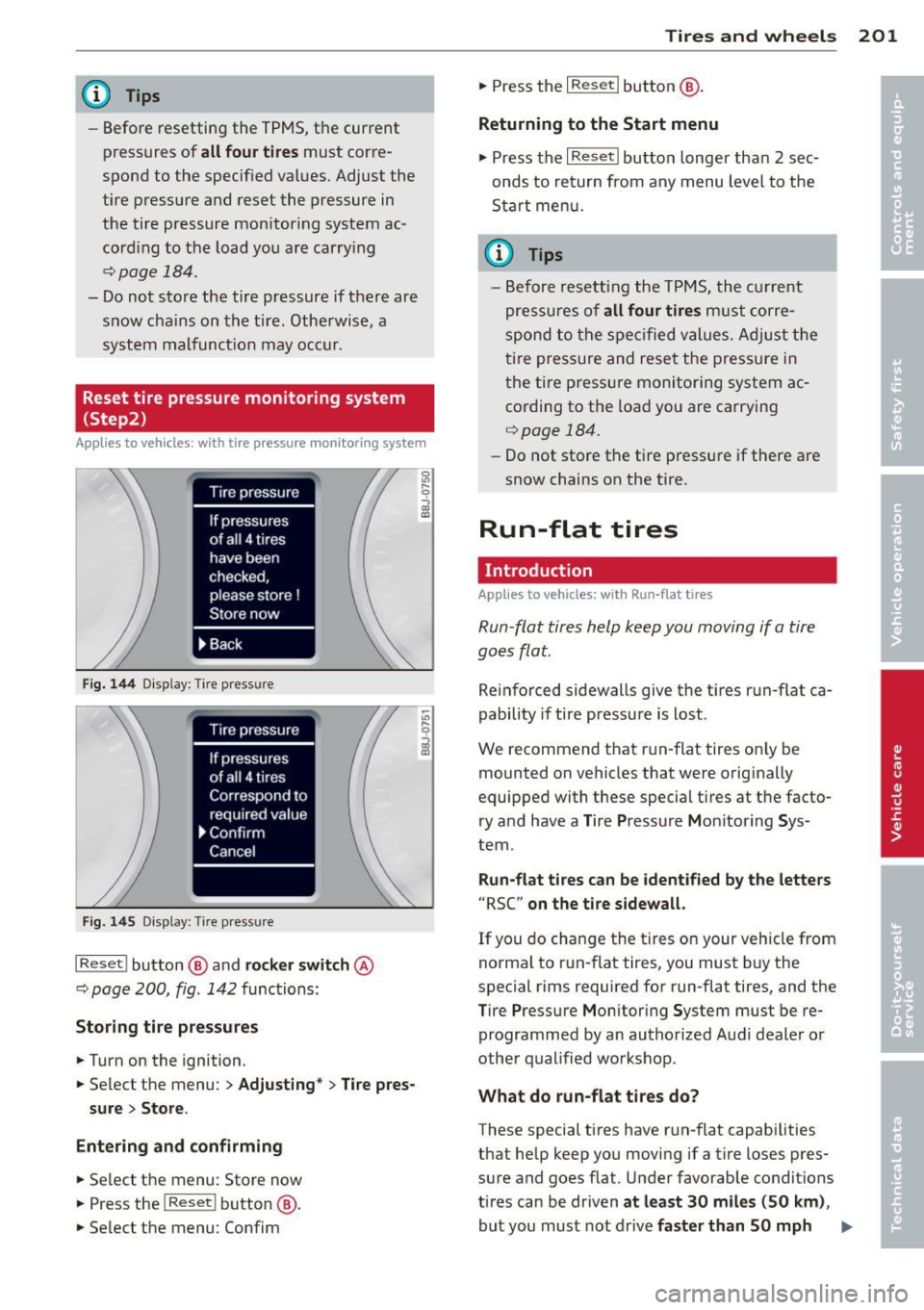
Applies to vehicles: with tire pressure monitoring system
Fig. 144 D isplay: Tir e press ure
Fi g. 145 Display: Tir e pr ess ure
I Reset ! button @ and rock e r swit ch @
~ page 200, fig . 142 func tions:
Storing tire pressures
.. Turn on the ignition .
.. Select the menu :
> Adjusting * > Tire pres-
sure
> Store .
Entering and confirming
.. Se lect t he menu : St ore now
.,. Press the
l Reset ! button @.
.. Se lect the menu : Confim
Tires and wheels 201
.. Press the I Rese t I button @.
Returning to the Start menu
.,. Press the I R eset I butto n longer than 2 sec
onds to retur n from any menu level to the
S ta rt me nu.
{!) Tips
- B efore resett ing the TP MS, the c urrent
pre ssures o f
all four tires must co rre
spond to t he s pec ified v alue s. A dju st t he
tire pressure and rese t the pressure i n
the tire p ressu re monito ring system ac
co rding to the loa d you are carrying
<=> page 184.
-Do not store the tire p ress ure if there are
snow chains on the tire .
Run-flat ti res
Introduction
Applies to vehicles: with Run -f lat tires
Run-flat tires help keep you moving if a tire
goes flat.
Re inforced sidewalls give the tires run-flat ca
pability if tire pressure is lost .
We recommend that r un-flat tires on ly be
m ounted on vehicles that were orig inally
equipped with these special tires at t he facto
ry and have a Tire Pressure Moni toring Sys
tem .
Run-flat tires can be identified by the letters
"RSC" on the tire sidewall.
If you do change the tires on your veh icle from
norma l to run- flat tires, you must b uy the
special rims required for run-flat tires, and the
T ire Pressure Monitor ing System must be re
programmed by an authorized Aud i dealer o r
other qualified worksho p .
What do run-fl at tires do?
These special tires have r un-flat capabilities
that help keep you moving if a t ire loses pres
sure and goes flat . Under favorable conditions
ti res can be dr iven
at least 30 miles (50 km) ,
but you mus t not dr ive faster than 50 mph Ill-
Page 209 of 244
~ Remove the dust cap from the valve of the
defective tire.
~ Screw the hose@) onto the va lve 0
¢ fig . 151.
~ Inser t the plug @¢ fig. 150 into the socket
for the cigarette lighter.
~ Switch on the ignition.
Inflating t ire
~ Move the switch@¢ fig. 151 on the e lec
tric a ir pump
l ) to posit ion I. After 5 mi
nutes, t ire pressure must have reached at
least 1.8 bar .
~ Switch the electric a ir pump off -switch in
pos ition
0 . If the requ ired tire pressure of at
least 1.8 bar has not been reached, follow
the i nstructions in the sec tion
Re-inflating
tire.
Re -inflating tire
~ Remove the hose from the valve and pull the
plug out of the socket.
~ Drive the vehicle slow ly 10 mete rs bac kward
or forward. This helps to dist ribu te t he sea l
ant better .
~ Remove the empty inflation bott le and
screw the hose®¢
fig. 150 from the elec
tric pump directly onto the valve.
~ I nsert the plug@¢ fig. 150 into the socket
for the ciga rette lighter.
~ Switch on the ignition .
~ Move the switch @¢ fig. 151 on the elec
t ric a ir pump
ll to pos it io n I. After 5 mi
nutes, t ire pressure mus t have reached at
least 1.8 b ar.
~ Switch the electric a ir pump off -switch in
position
0 . If the required tire pressure of at
l east 1.8 bar has not been reached, it is not
poss ib le to make a repa ir with the tire seal
ant. Seek professional ass istance.
Disas sembling Tire Mobility System
~ Remove the hose from the valve and p ull the
plug out of the soc ket .
~ Screw the d ust cap onto the va lve.
l ) The e lectr ic a ir pu m p sho uld never r un for lo ng er than
6 m in utes.
What do I do now? 207
~ Place the empty sea lant bott le back in the
original packaging and clip it in place under
the floor so that no tire sea lant can run out
into the veh icle.
~ Place the electric air pump in the luggage
compartment for the t ime being .
~ Start driv ing right away so that the sealant
is dist ributed in the tire.
.&_ WARNING
- Follow the manufacturer 's safe ty inst ru c
tions on the de cal for the ai r pump and
the sealan t bottle .
- If a tire pressure of 1.8 bar cannot be
achieved after pumping for 5 minutes,
the ti re is too severe ly damaged. Do not
continue to drive .
- Seek pro fessional assistance if it is not
possible to repa ir the tire with the t ire
sealant.
(D Tips
- Do not opera te the elec tric air pump fo r
more than 6 minutes without stopping,
otherwise it can overheat . When the ai r
pump has coo led down, you can continue
to use it.
- If sea lant has escaped, allow it to dry,
then yo u can peel it off.
Final check
App lies to vehicles : wi th Tire Mobility Sys tem
After d riv ing for a short d istance , tir e
pressure must be checked
~ After driving for about 10 mi nutes, stop and
check the tire pressure .
~ If tire pressu re is st ill at least 1.3 bar, in
flate the tire to specified press ure (see dr iv
er's side B-pillar), drive to the next repa ir
shop and have the tire and the sealant bot
tle replaced.
~ If tire pressu re is less than 1.3 bar, the t ire
is too severely damaged. Do not continue to
drive . Seek professional assistance. ..,.
•
•
Page 214 of 244
212 Fuses and bulbs
Fuses and bulbs
Electrical fuses
Replacing fuses
Fuses that have blown will have metal strips
that have burned through .
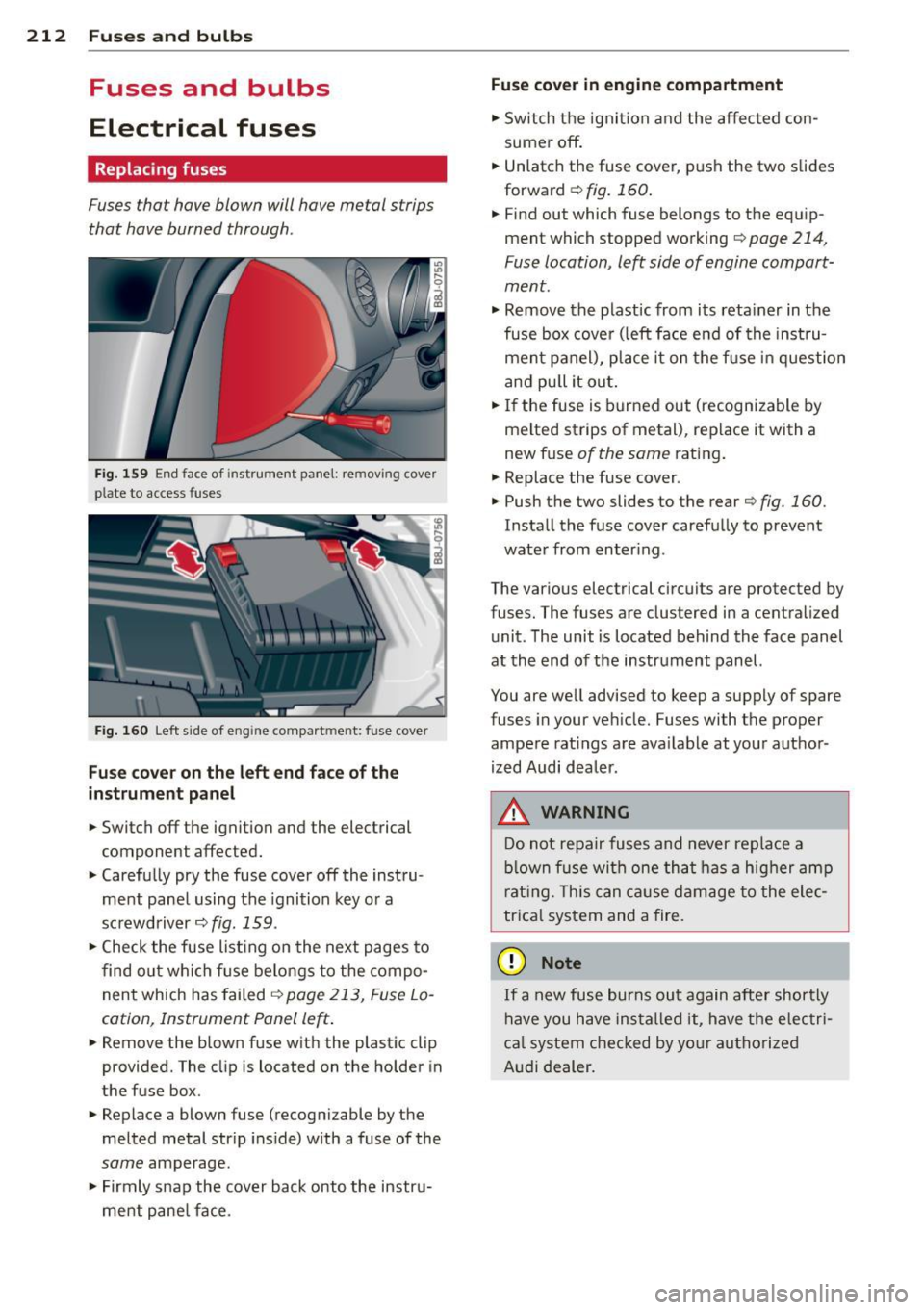
Fig. 159 End face of instrument panel: rem ov ing cover
p la te to access fuses
Fig. 160 Left side of eng ine compart men t: fuse cove r
Fuse cover on the left end face of the
inst rument pane l
.. Switch off the ignition and the electrical
component affected.
.. Carefully pry the fuse cover off the instru
ment panel using the ignition key or a
screwdriver
c;::> fig. 159 .
.. Check the fuse list ing on the next pages to
find out which fuse belongs to the compo
nent which has failed
o page 213, Fuse Lo
cation, Instrument Panel left .
.. Remove the blown fuse with the plastic clip
provided. The cl ip is located on the holder in
the fuse box .
.. Replace a blown fuse (recognizable by the
melted metal str ip ins ide) with a fuse of the
same amperage .
.. Firmly snap the cover back onto the instru
ment pane l face .
Fuse cover in engine compartment
.. Switch the ignit ion and the affected con
sumer off .
.. Unlatch the fuse cover , push the two slides
forward
c;::> fig. 160.
.. Find out which fuse belongs to the equip
ment which stopped working
c;::> page 214,
Fuse location , le~ side of engine compart
ment .
.. Remove the plastic from its retainer in the
fuse box cover (left face end of the instru
ment panel), place it on the fu se in question
and pull it out .
.. If the fuse is burned out (recognizable by
melted strips of metal), replace it with a
new fuse
of the same rating.
.. Replace the fuse cover .
.. Push the two slides to the rear
o fig. 160.
Install the fuse cover carefully to prevent
water from enter ing .
The various electrical circuits are protected by
fuses. The fuses are clustered in a centralized unit. The unit is located behind the face panel
at the end of the instrument panel.
You are well advised to keep a supply of spare
fuses in your vehicle. Fuses with the proper
ampere ratings are available at your author
ized Audi dealer.
A WARNING -
Do not repa ir fuses and never replace a
blown fuse with one that has a higher amp
rating. This can cause damage to the elec
trica l system and a fire.
(D Note
If a new fuse burns out again after shortly
have you have installed it, have the electri
ca l system checked by your authorized
Audi dealer.
Page 216 of 244
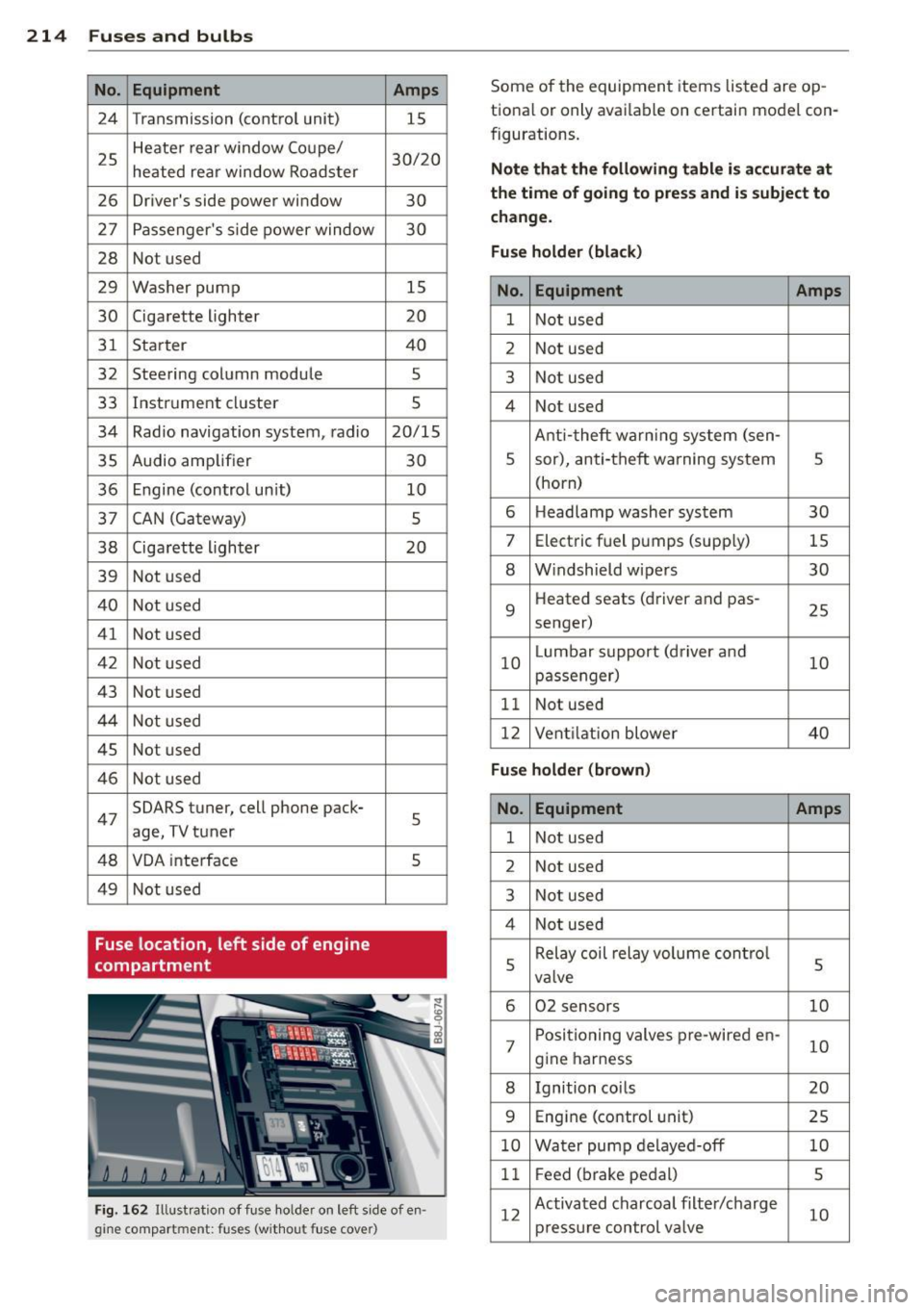
214 Fuses and bulb s
No. Equipment
24 Transmi ssion (contro l un it)
25 Heate
r rear window Coupe /
heated rear window Roadster
26 Driver'
s side power window
27 Passenger's s ide power window
28 No
t used
29 Washer pump
30 Cigarette lighter
31 Start er
32 Steering column module
33 Instrument clust er
34 Radio navigation system , radio
35 Aud io amplifi er
36 Engine (control un it)
37 CAN (Gat
eway)
38 Ciga
rette lighter
39 Not us ed
40 Not used
4 1 Not u sed
42 Not used
43 No t used
44 Not used
45 No
t used
46 Not used
47 SOARS tuner, cell phone pack-
age,
TV tuner
48 VOA interface
49 Not used
Fuse location, left side of engine
compartment Amps
15
30/ 20
30 30
15
20
40 5
5
20/15
30 10
5
20
5 5
Fi g. 162 Ill ustra tion of fus e ho lde r on l eft side o f en·
gi ne compar tment: fuse s (withou t fuse c over)
Some of the equipment items listed are op
tiona l or only avai lable on c ertain mod el con
figurations.
Note tha t the foll owing table i s ac cur ate at
the time of going to pre ss and is subject to
change .
Fus e holder (bla ck )
No . Equipment Amps
1 Not used
2 Not used
3 Not used
4 No t used
Anti- theft warning system (sen -
5 sor), ant
i-theft warn ing system
5
(horn)
6 Headlamp washer system
30
7 Elec
tric fuel pumps (supp ly)
15
8 W
indshield wipers
30
9 H
eat ed seats (dr iver and pas-
25
senger)
10 L
umbar support (d river and
10
passenger)
11 Not u sed
12 Vent ilation blower 40
Fus e holder (brown )
No. Equipment Amps
1 Not used
2 Not used
3 Not used
4 Not used
5 Relay coil
relay volume cont ro l
5
va lve
6 02
sensors
10
7 P
ositioning valves pre-wired en-
10
gine harness
8 Ignition coi ls 20
9 Eng
in e (cont rol unit)
25
10 Water pump de layed-off 10
1 1 F
e e d (brak e pedal)
5
1 2 Activated charcoal filter/charge
10
p ress ure control va lve