engine AUDI TT ROADSTER 2015 Workshop Manual
[x] Cancel search | Manufacturer: AUDI, Model Year: 2015, Model line: TT ROADSTER, Model: AUDI TT ROADSTER 2015Pages: 244, PDF Size: 60.74 MB
Page 152 of 244
150 Driving and en vironm ent
Avoid damaging the
vehicle
When you are driving on poor roads, or over
curbs, steep ramps, etc ., make certain that
low-lying parts such as spoilers and exhaust
system parts do not bottom out and get dam
aged.
This is especially true for vehicles with low
slung chassis (sports chassis) and fully loaded
vehicles .
Driving through water
on roads
Note the following to avoid vehicle damage
when driving through water, for example on
flooded roads:
- T he water must not be any highe r tha n the
bottom of the vehi cle body.
- Do no t drive faster than wa lking speed.
_& WARNING
After d riving through water, m ud, slush,
etc., the brakes may be slow to take effect
because o f wet brake ro tors and pads . Dry
the brakes fi rst by braking carefully to re
store the full braking effect.
(]) Note
Vehicle components such as the engine,
transmiss ion, suspension or electrical sys
tem can be severely damaged by driving
through water.
- Check the depth o f the water before driv
ing through it.
- Do not stop the veh icle, dr ive in reverse
or switch the engine
off when driving
through water.
- Keep in mind that oncoming vehicles may c reate waves that raise the water
l evel and make it too deep for your vehi
cle to drive through safely.
- Avoid driving thro ugh salt water because
it can ca use corrosion.
-
Catalytic converter
It is very important that your emission con
trol system (catalytic converter) is function
ing properly to ensure that your vehicle is run
ning in an environmentally sound manner.
.. Always use lead-free gasoline¢ page 160,
Fuel supply .
.. Never run the tank down all the way to emp
ty.
.. Never put too much moto r o il in yo ur eng ine
¢ page 169, Adding engine oil ~-
.. Never try to push- or tow-st art you r vehicle.
The catalytic co nverter is an efficient "clean
u p" dev ice built into the exhaust system of
t h e vehi cle. The cata lytic conve rter bu rns
many of the pollutan ts in the exha ust gas be
f ore they are re leased into the atmosphere.
T he exclusive use of unleaded fuel is critically
impor tant for the life of the catalyt ic convert
er and prope r funct ion ing of the engi ne.
A WARNING
- Do not park or operate the vehicle in
areas where the hot exha ust system may
come in contact with dry g rass, brush,
fue l spill or other material wh ich can
cause a fire.
- Do not app ly additiona l undercoating or
r u stproofing on or near the exhaust
manifold, exhaust pipes, catalytic con
verter or heat sh ields. Dur ing driv ing, the
substance used fo r undercoating could
overheat and cause a fire.
(D Note
- Be aware that just one tank filling with
leaded fuel will already ser iously de-
grade the performance of the catalytic
converte r.
- Do not exceed the correct engi ne oil level
¢page 169.
-Do not drive until the fuel tank becomes
completely empty . The engine co uld mis-
fire. Unburned fuel could also get into ..,.
Page 154 of 244
152 Driving and en vironm ent
Avoid full throttle
Driving at moderate speeds saves fuel and
improves your mileage .
"'Try and keep well below your car 's maximum
speed.
Accelerating gently reduces fuel consump
tion, engine wear, and does not disturb the
environment. F ue l consumption, exhaust emissions and en
gine no ise increase disproportionately at high
speeds. If you drive at approximately three
quarters of top speed, fuel consumption will be reduced by one half. Never dr ive faster
than the posted speed limit and weather con
d itions permit .
Reducing unnecessary idling
Even when your car is just idling it burns up
fuel.
"'Shut the engine off when you are not driv ing
the vehicle .
"'Do not warm up the veh icle by letting the
engine run at idle .
It makes sense to shut
off the e ngine in traff ic
jams, when waiting for trains to pass at ra il
road crossings , or at traff ic lights that have
l ong wa its on red. Turning the engine
off fo r
just
30-40 seconds saves more fue l than is
burned s tarting the eng ine again .
It takes a long time for the engine to warm up
fully when it is running at idle . Howeve r, wear
and nox ious em issions are especially high
when the engine is warming up. So you should
drive away as soon as you start the engine and
avoid running at high RPMs while the engine
is sti ll warming up.
([) Note
Do not leave engine idling unattended af
ter starting . If warning lights should come
on to indicate improper operation, they
wou ld go unheeded. Extended idling also
produces heat, which cou ld result in over- heating or other damage to the vehicle or
other property .
Regular maintenance
A badly tuned engine unnecessarily wastes a
lot of fuel.
"' Have your ve hicle serviced at reg ular in ter -
vals.
By having your veh icle regu la rly serviced by an
Audi dealer he lps to ensure that it runs p rop
erly and economically. The condition of your
vehicle not only affects its sa fety and ability to
hold its val ue, it also affects
fuel con sum p
tion .
Check your oil e ach time you fill your t ank .
The amount of o il used is related to engine
load and speed .
It is normal for the oil consumption of a new
engine to reach its lowest value after a certa in
mileage has been driven.
You must drive your veh icle about 3,000 m iles
(5,000 kilometres) before you can properly
assess oil consumpt ion.
This also app lies to fue l cons umption and en
gine output.
(D Note
- Have your vehicle maintained proper ly
and in accordance with the service rec
ommendations in your Warranty
& Main
tenance booklet. Lack of proper ma inte
nance as well as improper use of the ve
hicle will impair the function of the
em iss ion contro l system and cou ld lead
to damage.
- Do not alter or remove any component of
the Emission Control Sys tem unless ap
proved by the manufacturer.
- Do not alte r or remove any device, such
a s hea t sh ie lds, switches, ig nition w ires,
valves, which are designed to protec t
your vehicle's Emission Control System
and other impo rtant vehicle compo
nents .
Page 155 of 244
Fewer short trips
Fuel consumption will always be relatively
high on short trips.
11-Try to avoid driving short distances with a
cold eng ine.
The engine and catalyt ic converte r have to
reac h their optimal
operating temperature to
reduce fuel consumption and noxious emis
sions effective ly .
- Just after starting, a co ld eng ine in a mid
s iz e car burns the fuel at a poor rate of 6-8
miles per gallon (30-40 l/l00km). Half a
mile dow n the road, the m ileage improves
to 12 MPG (20 l/100 km) .
It will take the
engine no less than
two and a half mil es
(4 km) of d riving to warm up to its proper
oper ating tempe ra tu re and ope ra te at an
eco nomic mileage. This explains why taking
the car for shor t tr ips is a rather wastef ul
convenience.
- T he
outside temperature is also cr it ica l in
t hi s re gard . You r car cons umes more fuel in
the winter than in t he summer .
Trailer towing
General information
Your Audi TT Roadster is not designed to tow
a trailer.
Towing a tra iler with yo ur Audi TI Roadster is
n ot recommended and can cause damage to
the car . Damaged caused by towing a trailer is
n ot covered by your Aud i War ranty .
Driving and environment 153
•
•
Page 162 of 244
160 Fuel supply and filling your fuel tank
Fuel supply and filling
your fuel tank
Gasoline
Fuel supply
Using the right fuel helps keep the environ
ment clean and prevents engine damage .
Fuel recommendation
The fuel recommended for your vehicle is un
leaded premium
grade gasoline . Audi recom
mends using TOP TIER Detergent Gasoline
with a minimum octane rating of 91 AKI (95
RON) . For more information on TOP TIER De
tergent Gasoline, please go to the official
website (www.toptiergas.com).
The recommended gasoline octane rating for
your engine can also be found on a label locat
ed on the inside of the fuel filler flap. This rat
ing may be specified as AKI or RON.
Your vehicle may also be operated using un leaded regular gasoline with a minimum oc
tane rating of 87 AKI/91 RON. However, using
87 AKl/91 RON octane fuel will slightly re
duce engine performance.
Use unleaded gasoline only. Unleaded gaso
line is available throughout the USA, Canada,
and in most European countries. We recom mend that you do not take your vehicle to
areas or countries where unleaded gasoline
may not be available.
For more information on refueling your vehi
cle, see ¢
page 161.
Octane rating
Octane rating indicates a gasoline's ability to
resist engine damaging "knock" caused by
premature ignition and detonation. Therefore,
buying the correct grade of gasoline is very
important to help prevent possible engine
damage and a loss of engine performance.
Gasoline most commonly used in the United
States and Canada has the following octane ratings that can usually be found on the filler
pump : -
Premium Grade: 91 -96 AKI
- Regular Grade: 87 -90 AKI
Explanation of the abbreviations:
AKI= Anti Knock Index= (R+M)/2 = (RON
+MON)/2
RON= Research Octane Number
MON = Motor Octane Number .
@ Note
-Do not use any fuel with octane ratings
lower than 87 AKI or 91 RON otherwise
expensive engine damage will occur.
- Do
not use leaded gasoline! The use of
leaded gasoline will severely damage
your vehicle's catalytic converter and its
ability to control exhaust emissions.
Blended gasoline
Use of gasoline containing alcohol or
MTBE (methyl tertiary butyl ether)
You may use unleaded gasoline blended with
alcohol or MTBE (commonly referred to as
oxygenates) if the blended mixture meets the
following criteria:
Blend of gasoline methanol (wood alcohol or
methyl alcohol)
- Anti-knock index must be 87 AKI or higher.
- Blend must contain no more than 3% meth-
anol.
- Blend must contain more than 2% co-sol-
vents.
Blend of gasoline and ethanol (grain alcohol
or ethyl alcohol)
- Anti-knock index must be 87 AKI or higher.
- Blend must not contain more than 10%
ethanol.
Blend of gasoline and MTBE
- Anti-knock index must be 87 AKI or higher.
- Blend must contain not more than 15%
MTBE.
Seasonally adjusted gasoline
Page 163 of 244
Many gasoline grades are blended to perform
especia lly we ll for winter or summer driving.
During seasonal change-over , we suggest that
you fill up at busy gas stations where the sea sonal adjustment is more likely to be made in
time.
Q;) Note
- Methanol fuels which do not meet these
requirements may cause corrosion and
damage to plastic and rubber compo
nents in the fuel system.
- Do not use fuels that fail to meet the
spec ified criter ia in this chapter .
- If you are unable to determine whether
or not a particular fuel blend meets the
spec ificat ions, ask your service station or
i ts fuel supplier .
- Do not use fuel for which the contents
cannot be identified.
- Fuel system damage and performance
problems resulting from the use of fuels
different from those specified are not
the respons ibility of Audi and are not
covered under the New Vehicle or the
Emission Control System Warranties.
- If you experience a loss of fue l economy
or driveability and performance prob l ems due to the use of one of these fuel
blends, we recommend that you switch
to unblended fuel.
Gasoline additives
A major concern among many auto manufac
turers is carbon deposit build-up caused by
the type of gasoline you use .
Although gasoline grades differ from one manufacturer to another, they have cer tain
things in common. All gasoline grades contain substances that can cause deposits to collect
on vital engine parts, such as fuel injectors
and intake valves. Although most gasoline
brands include additives to keep engine and
fuel systems clean, they are not equally effec
tive.
Fuel supply and filling your fuel tank 161
Audi recommends using TOP TIER Detergent
Gasoline . For more information on TOP TIER
Detergent Gasoline, please go to the official
website (www .toptiergas .com) .
After an extended period of using inadequate
fuels, built -up carbon deposits can rob your
engine of peak performance.
CJ) Note
Damage or malfunction due to poor fuel
quality is not covered by the Audi New Ve
hicle Limited Warranty.
Fuel tank
Fuel filler neck
The fuel filler neck is located on the right rear
s ide panel behind the fuel filler flap.
If the unlocking system should fail, you can
still open the flap manually -for detailed in
structions see
~ page 163.
You can find the fuel tank capacity of your ve
hicle in
~page 223 .
The label on the inside of the fuel filler flap
tells you the correct fuel for your vehicle. For
more information about fuel specifications,
see
~ page 160 .
Your vehicle fuel tank has an on-board refuel
ling vapor recovery system. This feature helps
to prevent fuel vapors from escaping from the
tank and pollut ing the environment while you
refuel your vehicle. In order to fill the tank
properly while protecting the environment,
please follow this refueling procedure careful
ly.
A WARNING ~
Under normal operating conditions, never
carry additional fuel containers in your car.
Gas canisters and other containers used to
transport fuel can be dangerous. Such con
tainers, full or empty, may leak and could
cause a fire in a collision . If you must
transpo rt fuel to use for your lawn mower, ..,.
•
•
Page 164 of 244
162 Fuel suppl y and filli ng your fuel t ank
snow blower, etc., be very careful and al
ways observe local and state laws regard ing the use, transportat ion and storage of
such fuel containers . Make certain the con
tainer meets industry standards (ANSI/
ASTM F852 -86) .
(D Note
Never drive your vehicle unt il the fuel tank
is completely dry . The irregular supply of
fuel can ca use misfir ing . Gasoline could
enter into the exhaust system and damage
the cata lytic conve rter.
Refuelling
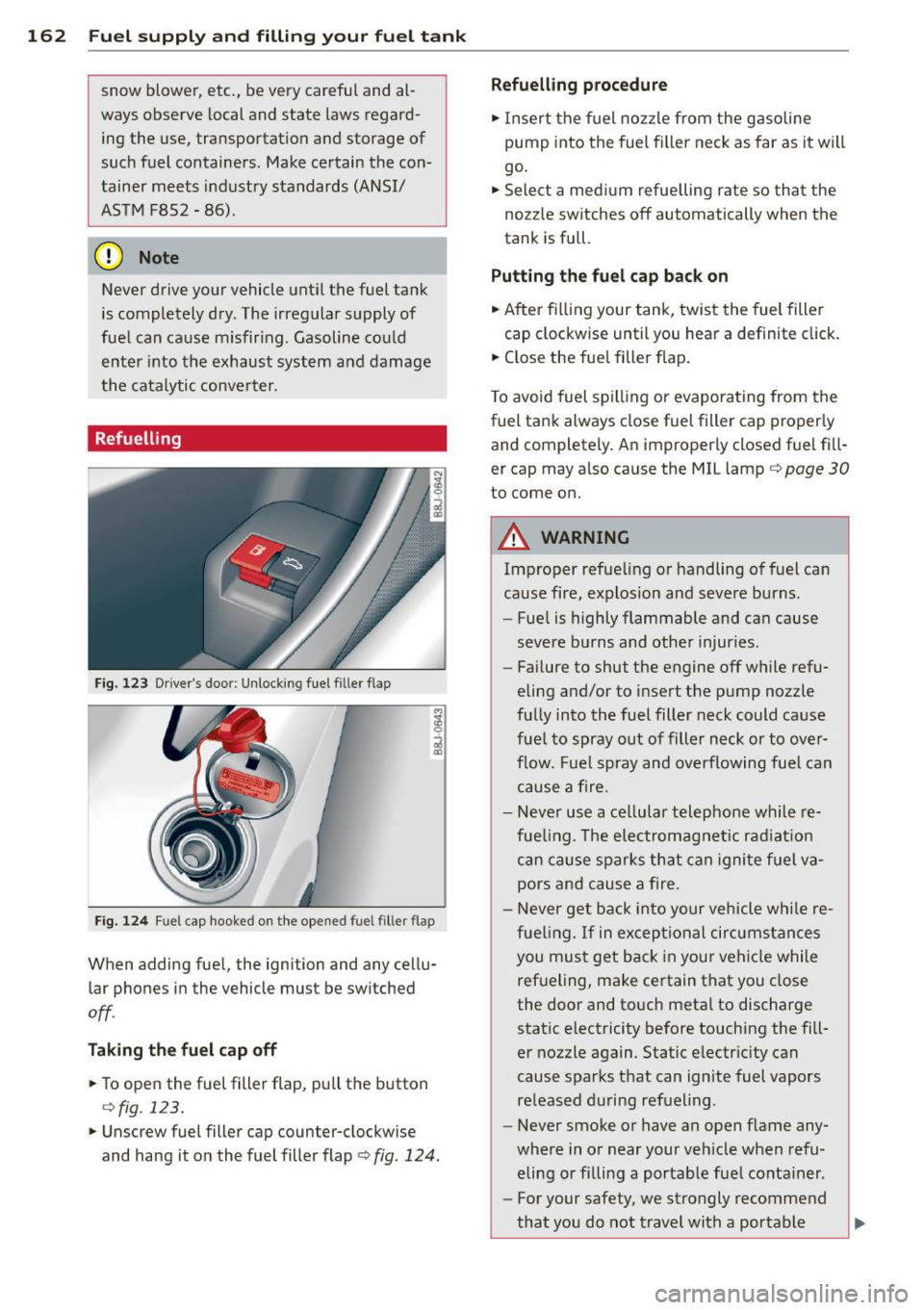
Fig. 123 D rive r's doo r: Unl ocking fuel filler flap
Fig. 124 Fu el cap hooke d on the opened fuel fill er fla p
When adding fuel, the igni tion and any cellu
lar phones in the vehicle must be swi tched
off .
Tak ing the fu el cap off
• To open the fuel fill er flap , pu ll the b utton
r=> fig . 123.
• Unscrew fuel filler cap counte r-clockwise
and hang it on the fuel filler flap
c> fig . 124.
Refuelling proc edur e
• Insert the fuel nozzle from the gasoline
pump into the fuel fi ller neck as far as it wi ll
go .
• Select a med ium r efuelling rate so that the
no zzle switches off automatically when the
tank i s full.
Putting th e fu el cap bac k on
• After f illing your tank, twist the fuel filler
cap clockwise until you hear a definite click.
• Close the fue l fill er flap.
T o avoid fuel spilling or evaporating from the
fuel tank always close fuel filler cap properly and completely. An improperly closed fuel fi ll
er cap may also cause the MIL lamp
c> page 30
to come on.
A WARNING
Improper refue ling or handling of fuel can
cause fire, explosion and severe burns.
- Fuel is highly flammable and can cause
severe burns and other injuries .
- Fai lure to shut the engine off while refu
eling and/or to insert the pump nozzle
fully into the fuel filler neck could cause
fuel to spray out of filler neck or to ove r
f low. F ue l spray and overflowing fuel can
cause a fire.
- Never use a ce llular telephone whil e re
fue ling . T he electromagnet ic rad iat io n
can cause spa rks that can igni te fuel va
pors and cause a fire.
- Never get back into your vehicle whi le re
fue ling.
If in exceptio nal circumstances
you must get back in your vehicle while
ref ueling, make certain that you close
the door and touch metal to discharge
static electricity before touching the fill
er nozzle again . Static e lectricity can
cause sparks that can ignite fuel vapors
re leased d uring refueling .
- Never smoke or have an open f lame any
where in or near your veh icle when refu
eling or filling a portable fue l conta iner .
- For your safety, we strongly recommend
that you do not travel with a portable
Page 166 of 244
164 Checking and filling
Checking and filling
Engine hood
Releasing the engine hood
The engine hood is released from inside the
vehicle .
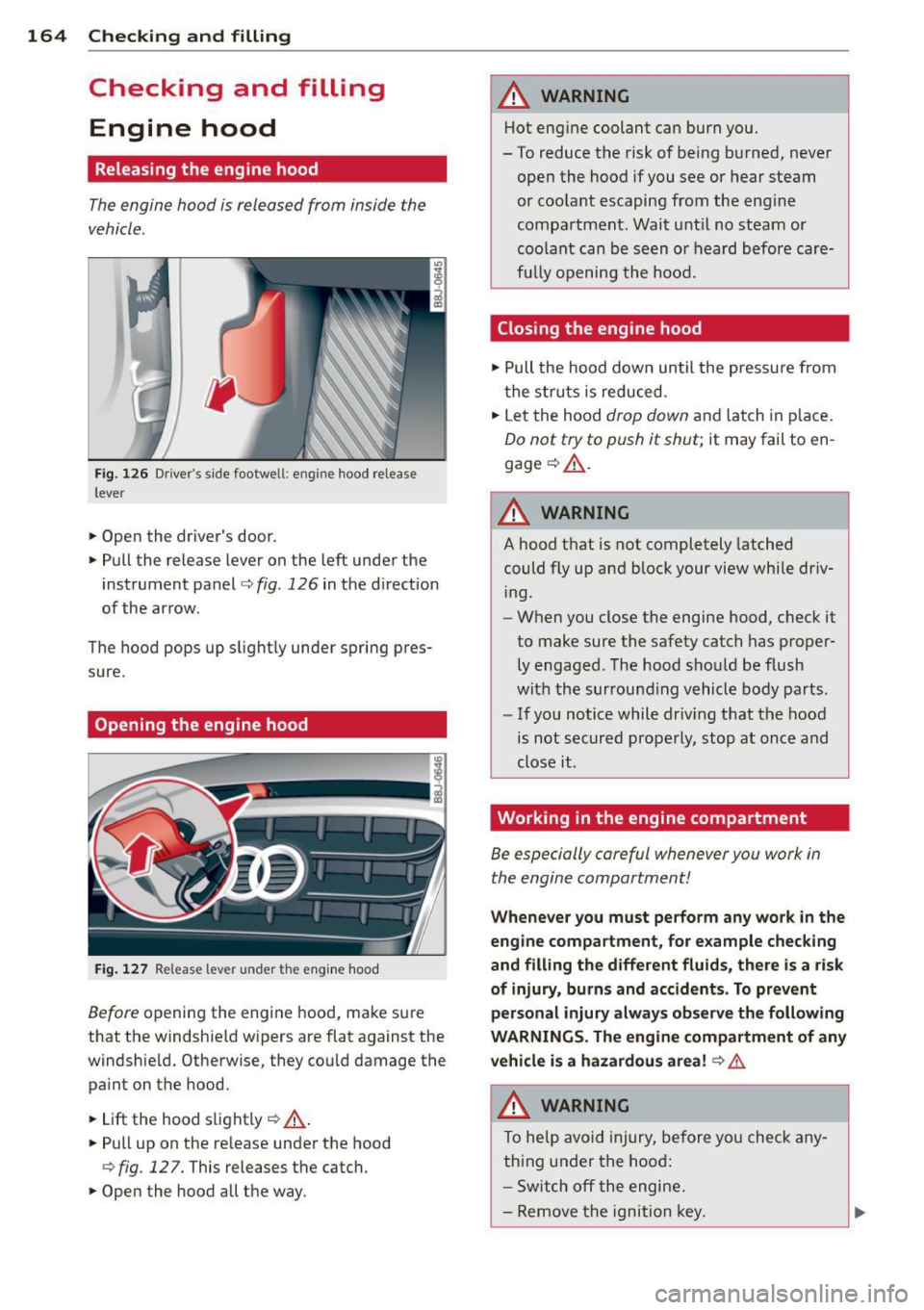
Fig. 126 Driver' s side footwe ll: e ngin e hood release
lever
.. Open the driver's door .
.. Pull the release lever on the left under the
instrument panel
c> fig . 126 in the direction
of the arrow .
The hood pops up slight ly under spring pres
sure.
Opening the engine hood
Fig . 127 Re lease lever under the engine hood
Before opening the engine hood, make sure
that the windshie ld wipers are flat against the
windshie ld. Otherwise, they cou ld damage the
pain t on the hood.
.. Lift the hood slight ly
c> .&, .
.. Pull up on the release under the hood
c> fig . 12 7. This releases the catch .
.. Open the hood all the way.
A WARNING
-Hot engine coolant can burn you.
- To reduce the risk of being burned, never
open the hood if you see or hear steam
or coo lant escaping from the eng ine
compartment . Wait unt il no steam or
coolant can be seen or heard before care
fu lly opening the hood.
Closing the engine hood
.. Pull the hood down until the pressure from
the struts is reduced .
.. Let the hood
drop down and latch in p lace.
Do not try to push it shut; it may fail to en
gage
c> .&, .
A WARNING
--
A hood that is not completely latched
could fly up and b lock your view while dr iv
i ng.
- When you close the engine hood, check it
to make sure the safety catch has proper
ly engaged . The hood should be flush
with the surrounding vehicle body parts.
- If you notice while dr iv ing that the hood
is not secured properly, stop at once and
close it .
Working in the engine compartment
Be especially careful whenever you work in
the engine compartment!
Whene ve r y ou must pe rform any wo rk in th e
eng ine compartment, for e xample chec king
and filling the diff ere nt fluids, ther e is a risk
of injury , burn s and accident s. To prevent
p ers onal injury alwa ys obs erv e the follo win g
WARNING S. Th e engin e c ompartm ent of an y
v e hicl e is a hazardou s area!
c> .&.
A WARNING
To help avoid injury, before you check any
thing under the hood:
- Sw itch off the engine .
- Remove the ignition key.
Page 167 of 244
-Apply the parking brake.
- Move selector lever to "P" (Park).
- Always let the engine cool down. Hot
components will burn skin on contact.
- To reduce the risk of being burned, never
open the hood if you see or hear steam
or coolant escaping from the engine
compartment. Wa it until no steam or
coolant can be seen or heard before care
fully opening the hood.
- Keep children away from the engine com
partment .
- Never spill fluids on hot engine compo
nents. They can cause a fire.
- Never touch the radiator fan. The auxili
ary electric fan is temperature controlled
and can switch on suddenly.
- Never open the coolant reservoir cap
when the engine is still warm. The cool
ant system is pressurized and hot cool
ant could spray out .
- Protect your face, hands and arm from
steam or hot engine coolant by placing a
thick rag over the cap when you open the
coolant reservoir .
- Do not remove the engine cover under
any circumstances . This increases the
risk of burns.
- If work on the fuel system or the electri
cal system is necessary:
- Always disconnect the battery .
- Never smoke or work near heaters or
open flames. Fluids in the engine com
partment could start a fire.
- Keep an approved fire extinguisher im
mediately available.
- To avoid electrical shock and personal in
jury while the engine is running or being
started, never touch:
- Ignition cables
- Other components of the high voltage
electronic ignition system.
- If you must perform a check or repair
with the engine running:
Checking and filling 165
- First, fully apply the parking brake,
move selector lever to "P" (Park) .
- Always use extreme caution to prevent
clothing, jewelry, or long hair from get
ting caught in the radiator fan, V-belts
or other moving parts, or from contact
ing hot parts . Tie back hair before
starting, and wear no clothing that will hang or droop into the engine.
- Minimize exposure to emission and
chemical hazards~&. .
A WARNING
California Proposition 65 Warning:
- Engine exhaust, some of its constituents,
and certain vehicle components contain
or emit chemicals known to the State of
California to cause cancer and birth de
fects and reproductive harm. In addition,
certain fluids contained in vehicles and
certain products of component wear con
tain or emit chemicals known to the State of California to cause cancer and
birth defects or other reproductive harm.
- Battery posts, terminals and related ac
cessories contain lead and lead com
pounds, chemicals known to the State of
California to cause cancer and reproduc
tive harms. Wash hands after handling.
Q) Note
When adding fluids, always make sure that
they are poured into the proper container
or filler opening, otherwise serious dam
age to vehicle systems will occur .
@ For the sake of the environment
To detect leaks in time, inspect the vehicle
floor pan from underneath regularly . If
you see spots from oil or other vehicle flu ids, have your vehicle inspected by an au
thorized Audi dealer. •
•
Page 168 of 244
166 Checking and filling
Engine compartment
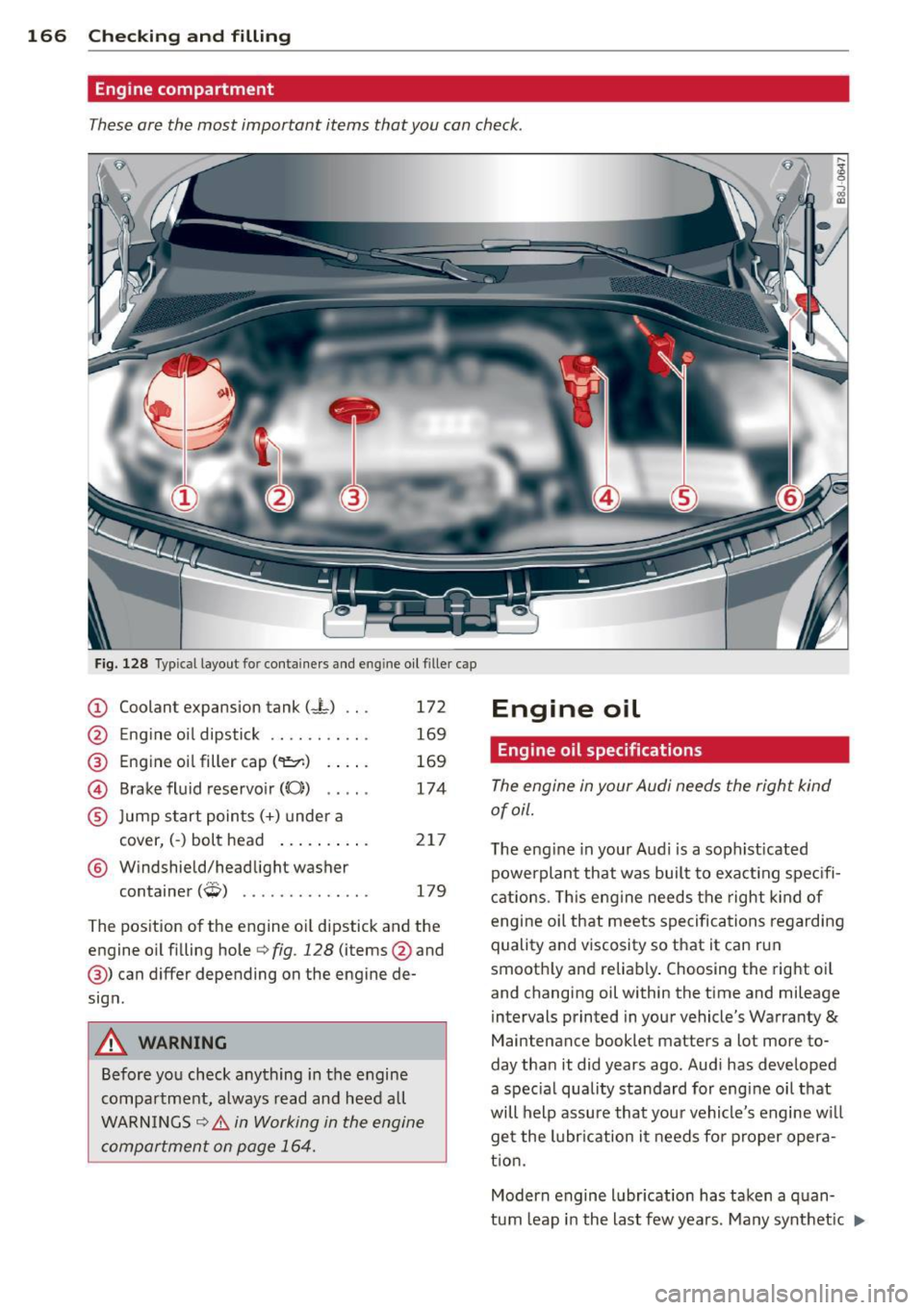
These are the most important items that you can check .
•
Fig. 128 Typ ica l layout for containers and eng ine oil filler cap
CD Coolant expansion tank (-L) .. .
'2' E . 'l d. . k \61 ngIne 0 1 1pst1c .......... .
@ Engine oil filler cap ('1:::r.) .. .. .
@ Brake fluid reservoir((();) .. .. .
® Jump start points(+) under a
cover, (-) bolt head .... ... .. .
® Windshield/headlight washer
t . (
;;p, ) con ainer ,-!,, •••.•••.•.•••.
172
169
169
174
217
179
The pos ition of the engine o il dipstick and the
engine o il fi lling hole
r::> fig. 128 (items @and
@) can differ depending on the engine de
sign .
A WARNING
Before you check anything in the engine
compartment, always read and heed all
WARN INGS
c::> .& in Working in the engine
compartment on page 164.
Engine oil
Engine oil specifications
The engine in your Audi needs the right kind
of oil.
T he eng ine in your Aud i is a soph ist icated
powerplant that was built to exact ing spec ifi
cat ions . T his engine needs the right kind of
engine oil that meets specifications regarding
quality and viscosity so that it can run
smooth ly and reliably . Choosing the right o il
and changing oil within the time and mileage
i ntervals printed in your vehicle's Warranty
&
Maintenance booklet matters a lot more to
day tha n it did years ago. Audi has developed
a spec ia l quality standard for engine oil that
will help assure that you r vehicle's engine w ill
get the lubr ication it needs fo r proper opera
t ion.
Modern engine lubr ication has taken a quan
tum leap in the last few years. Many synthet ic
1J.
Page 169 of 244
oils available today provide better engine lu
brication that can outlast traditional petrole
um-based oils, making them a smart choice
for use throughout the life of your Audi.
Whether you use synthetic or petroleumbased engine oil, the oil that you use must
conform to Audi's oil quality standard
VW 502 00 to help keep your vehicle's engine running smoothly and help prevent the for
mation of harmful deposits, sometimes called
" sludge," that over time can lead to expensive
repairs .
At the time of printing, engine oils available in the U .S . and Canada that meet the exacting
specifications of Audi oil standard VW 502 00
are synthetic engine oils . This does not mean,
however, that every synthetic engine oil will
meet Audi oil standard VW 502 00 . So always
be sure that you use an approved oil.
To help prevent the formation of harmful de posits use only oil with the following specifi
cations printed on the oil container :
Audi oil standard VW S02 00
Oil container labels may carry the specifica
tion singly or in combination with other desig
nations and oil quality standards .
Viscosity
Engine oils are graded according to their vis
cosity . The proper viscosity grade oil for your
engine depends on climactic or seasonal con
ditions where you drive. You can use oil with a
viscosity grade of SA E SW40 across all tem
perature ranges for normal driving conditions.
However, if engine oil viscosity grade SAE
SW40 is not available, you can also use viscos
ity grade SAE SW-30 or SAE OW-40 as long as
it meets Audi oil quali ty standard VW 502 00
specifications .
Because engine oil that meets the Audi oil
standard may not be available everywhere
when you need it, we strongly recommend
that you always carry with you an extra quart (liter) of oil that expressly conforms to the
Checking and filling 167
VW 502 00 specification, in case you have to
top
off the oil while on the road.
Only if the level of the oil is at or below the
minimum mark on the oil dipstick - and no oil
that expressly conforms to Audi oil standard
VW 502 00 specifications is available - may
you top
off with a high quality engine oil, pref
erably synthetic-based, that meets ACEA A3
or API SM specifications, but even then, only
in viscosity grades SA E SW-40, SA E 5W -30, or
SAE OW-40. However, during the entire time
between oil change intervals, never top
off
with more than a total of 0.5 qt/liter engine
oil that does not conform to Audi oil specifica
tion VW 502 00.
For more information about engine oil that
has been approved for your vehicle, please
contact either your autho rized Audi dealer or
Audi Customer Relations at 1 (800) 822-2834
or visit our web site at www.audiusa .com or
www.audicanada.ca . Here you will also find a
current list of oils (manufacturers, brand
names etc.) that conform to Audi oil standard
vw 502 00.
Changing the engine oil
The engine oil and oil filter must be changed
according to the mileage (kilometers) and
time intervals specified in your vehicle's War
ranty
& Maintenance booklet. Do not exceed
these intervals -harmful deposits from old
engine oil can reduce engine performance and
can lead to expensive engine repairs.
Changing the oil at the recommended inter
vals is so very important because the lubricat
ing properties of oil decrease gradually during
normal vehicle use. If you are not sure when
you have your oil changed, ask your author
ized Audi Serv ice Adv isor.
Under some circumstances the engine oil
should even be changed more frequently. Change oil more often if you drive mostly
short distances, operate the vehicle in dusty
areas or mostly under stop-and-go traffic con
ditions, or when you use your vehicle where
temperatures stay below freezing point for
long periods.
•
•