engine AUDI TT ROADSTER 2015 Service Manual
[x] Cancel search | Manufacturer: AUDI, Model Year: 2015, Model line: TT ROADSTER, Model: AUDI TT ROADSTER 2015Pages: 244, PDF Size: 60.74 MB
Page 103 of 244
Why safety belts?
Frontal collisions and the law of physics
Frontal crashes create very strong forces for
people riding in vehicles .
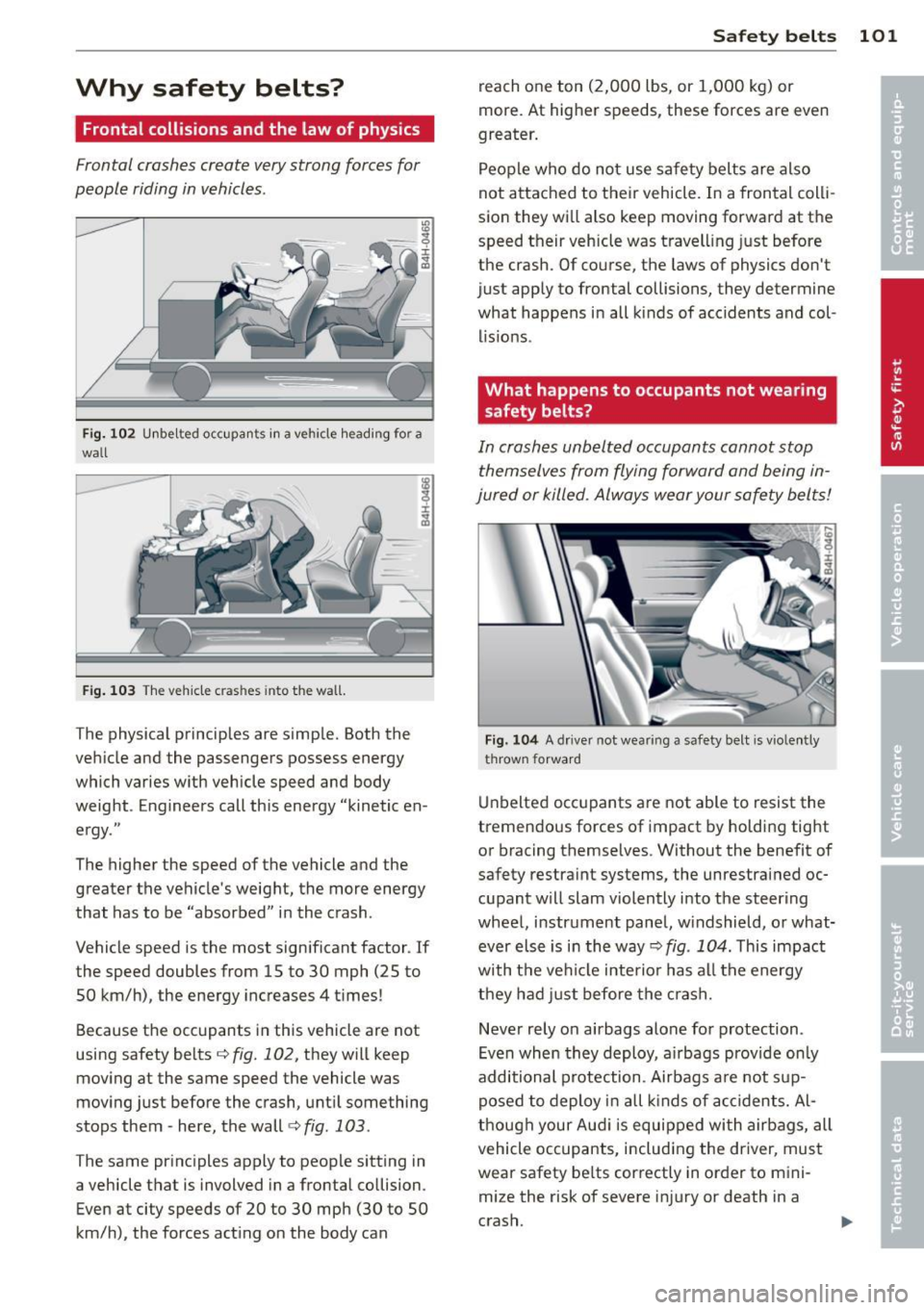
Fig. 102 Unbelted occupants in a ve hicle heading for a
wall
Fig. 103 The vehicle c ras hes into the wall.
The physical principles are simple. Both the
vehicle and the passengers possess energy
which varies with vehicle speed and body
weight . Engineers call this energy "kinetic en
ergy ."
The higher the speed of the vehicle and the greater the vehicle 's weight, the more energy
that has to be "absorbed" in the crash .
Vehicle speed is the most significant factor . If
the speed doubles from 15 to 30 mph (25 to
50 km/h) , the energy increases 4 times!
Because the occupants in this vehicle are not
using safety belts
r::;, fig. 102, they will keep
moving at the same speed the vehicle was
moving just before the crash, until something
stops them -here, the wall
c:> fig . 103 .
The same principles apply to people sitting in
a vehicle that is involved in a frontal collision .
Even at city speeds of 20 to 30 mph (30 to 50
km/h), the forces acting on the body can
Safety belts 101
reach one ton (2,000 lbs, or 1,000 kg) or
more. At higher speeds, these forces are even
greater.
People who do not use safety belts are also
not attached to their vehicle. In a frontal colli
sion they will also keep moving forward at the
speed their vehicle was travelling just before
the crash. Of course, the laws of physics don't
just apply to frontal collisions, they determine what happens in all kinds of accidents and col
lisions .
What happens to occupants not wearing
safety belts?
In crashes unbelted occupants cannot stop
themselves from flying forward and being in
jured or killed. Always wear your safety belts!
Fig. 104 A driver not wear ing a safety belt is v io len tly
thrown forward
Unbelted occupants are not able to resist the
tremendous forces of impact by holding tight
or bracing themselves . Without the benefit of
safety restraint systems, the unrestrained oc cupant will slam violently into the steering
wheel, instrument panel, windshield, or what
ever else is in the way r::;, fig . 104 . This impact
with the vehicle interior has all the energy
they had just before the crash.
Never rely on airbags alone for protection .
Even when they deploy , airbags provide only
additional protection . Airbags are not sup
posed to deploy in all kinds of accidents. Al
though your Audi is equipped with airbags, all
vehicle occupants, including the driver, must
wear safety belts correctly in order to mini
mize the risk of severe injury or death in a
crash.
Page 104 of 244
102 Safet y belt s
Remember too, that airbags wi ll deploy on ly
once and that your safety belts are always
there to offer protect ion in those accidents in
which airbag s are not suppo sed to deploy or
when they have already deployed . Unbelted
occupants can also be thrown out of the vehi
cle where even more severe o r fatal inju ries
can occu r.
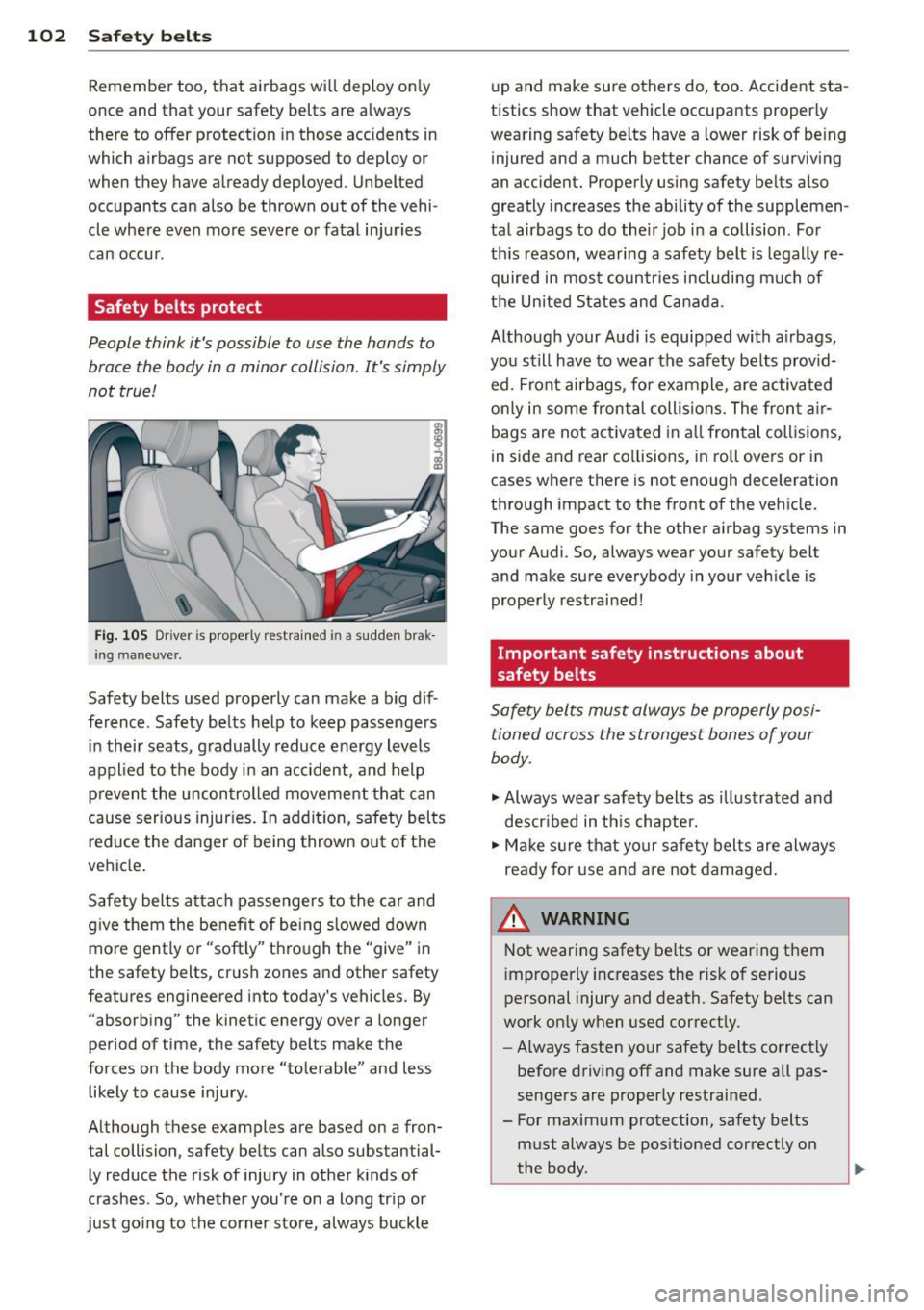
Safety belts protect
People think it's possible to use the hands to
brace the body in a minor collision. It's simply
not tru e!
Fig . 10 5 Driver is properl y re strain ed in a sudd en br ak
ing man euve r.
Safety belts used properly can make a big dif
ference . Safety be lts help to keep passengers
in their seats , g radually reduce energy levels
applied to the body in an accident, and help
preven t the uncontro lled moveme nt that can
cause serious injur ies . In additio n, safety belts
reduce the danger of being thrown out of the
ve hicle .
Safety belts attach passengers to the car and
g ive them the benefit of being s lowed down
more gently or "softly" t hrough t he "give" in
the safety belts , crush zones and other safety
fe atures engineered into today's vehicles. By
"absorb ing" the kinetic energy over a longer
period of time, the safety belts make the
forces on the body more "to lerable" and less
likely to cause injury .
Although these examples are based on a fron tal collision , safety belts can also subs tan tial
ly reduce the risk of injury in other k inds of
crashes . So, whether you' re on a long tr ip or
just going to the corner store, always buckle u
p and make sure others do, too. Accident sta
tist ics show that veh icle occupants properly
wearing safety belts have a lower risk of be ing
injured and a much better chance of surviving
an accident. Properly using safety belts also
greatly increases the ability of the supplemen
tal airbags to do the ir job i n a collision . Fo r
t hi s reason, wea ring a safety belt is legally re
quired in mos t countr ies includi ng m uch of
t h e Un ited States and Canada .
Although your Aud i is equipped wi th a irbags,
you still have to wear the safety be lts prov id
ed. Front ai rbags , fo r example , a re activated
only in some front al collisions. The fron t air
bags are not act ivated in a ll frontal coll is ions,
in side and rear co llisions, in roll overs or in
cases where there is not eno ugh deceleration
through impact to the front of the veh icle.
The same goes for the other a irbag systems in
your Aud i. So, always wear yo ur safety belt
and make su re everybody in your veh icle is
properly restrai ned!
Important safety instructions about
safety belts
Safety belts must always be properly posi
tioned across the strongest bones of your
body.
" Always wear safety belts as illust rated and
descr ibed in th is chapte r.
" Ma ke su re that yo ur safety belts are always
ready for use and are not damaged.
A WARNING
-
Not wear ing safety be lts or wearing them
i mproperly i ncreases the r is k of se rious
personal injury and death. Safety belts can
work on ly when used correctly.
- Always fasten your safety belts correct ly
befo re driving off and make sure all pas
sengers are properly restrained.
- For maximum protection, safety belts
must always be pos itioned c orrectly on
the body .
Page 143 of 244
Intelligent technology Notice about data
recorded by vehicle
control modules
Your vehicle is not equipped with an Event Da
ta Recorder (EDR), installed by some manu
facturers for the express purpose of capturing
data for retrieval after an accident or crash
event. EDR's are sometimes called "crash re
corders".
Some state laws restrict the retr ieval or down
loading of data stored by EDR's that were in
stalled in a vehicle for the express purpose of
retrieving data after an accident or crash
event without the owner's consent.
Although your vehicle is not equipped with an
EDR, it is equipped with a number of electron
ic control modules for various vehicle systems
such as, for examp le, engine function, emis
sion control, as well as for the airbags and
safety belts.
These electronic control modules also record
vehicle-related data during norma l vehicle op
eration for diagnostic and repair purposes.
The recording capacity of the electronic con
trol modules is limited to data (no sound is re
corded) and only a small amount of data is ac
tually recorded over a very limited period of
time and stored when a system fault or other
condition is sensed by a control unit. Some of
the data then stored may relate to vehicle
speed, direction, braking as we ll as restraint
system use and performance in the event of a
crash or other condition. Stored data can only be read and downloaded with special equip
ment.
Electronic Stabilization
Control (ESC)
Description
ESC helps to improve road holding and vehicle
dynamics to help reduce the probability of
skidding and loss of veh icle control. It works
only when the engine is running. ESC detects
Intelligent technology 141
certain difficult driving situations, including
when the vehicle is beginning to spin (yaw)
out of control and helps you to get the veh icle
back under control by se lectively braking the
wheels, and/or reducing engine power and
providing steering ass istance to help hold the
vehicle on the driver's intended course. The in
dicator light
B.J in the instrument cluster
blinks when ESC is taking action to help you
control the vehicle.
ESC has limitations .
It is important to remem
ber that ESC cannot overcome the laws of
physics.
It will not always be able to help out
under all conditions you may come up against.
For example, ESC may not always be able to
help you master situations where there is a
sudden change in the coefficient of friction of
the road surface. When there is a section of dry road that is suddenly covered with water,
slush or snow, ESC cannot perform the same
way it would on the dry surface. If the vehicle
hydroplanes (rides on a cushion of water in
stead of the road surface), ESC will not be
able to help you steer the vehicle because con
tact with the pavement has been interrupted
and the vehicle cannot be braked or steered .
During fast cornering, particularly on winding
roads, ESC cannot always deal as effectively
with difficu lt driving situations as at lower
speeds.
Always adjust your speed and driving style to
road, traffic §&and weather conditions. ESC
cannot override the vehicle's physical limits,
increase the available traction, or keep a vehi
cle on the road if road departure is a result of
driver inattention. Instead, ESC improves the
poss ibility of keeping the vehicle under con
trol and on the road dur ing extreme maneu
vers by usin g the driver's steering inputs to
help keep the vehicle going in the intended di
rection. If you are traveling at a speed that
causes you to run off the road before ESC can
provide any assistance, you may not experi
ence the benefits of ESC.
ESC includes and/or works together with the
anti- lock brake system (ABS), brake assist sys -
tem and anti-slip regu lation (ASR). ESC is
Ill>
•
•
Page 144 of 244
142 Intelligent technology
switched on all the time. In certain situations
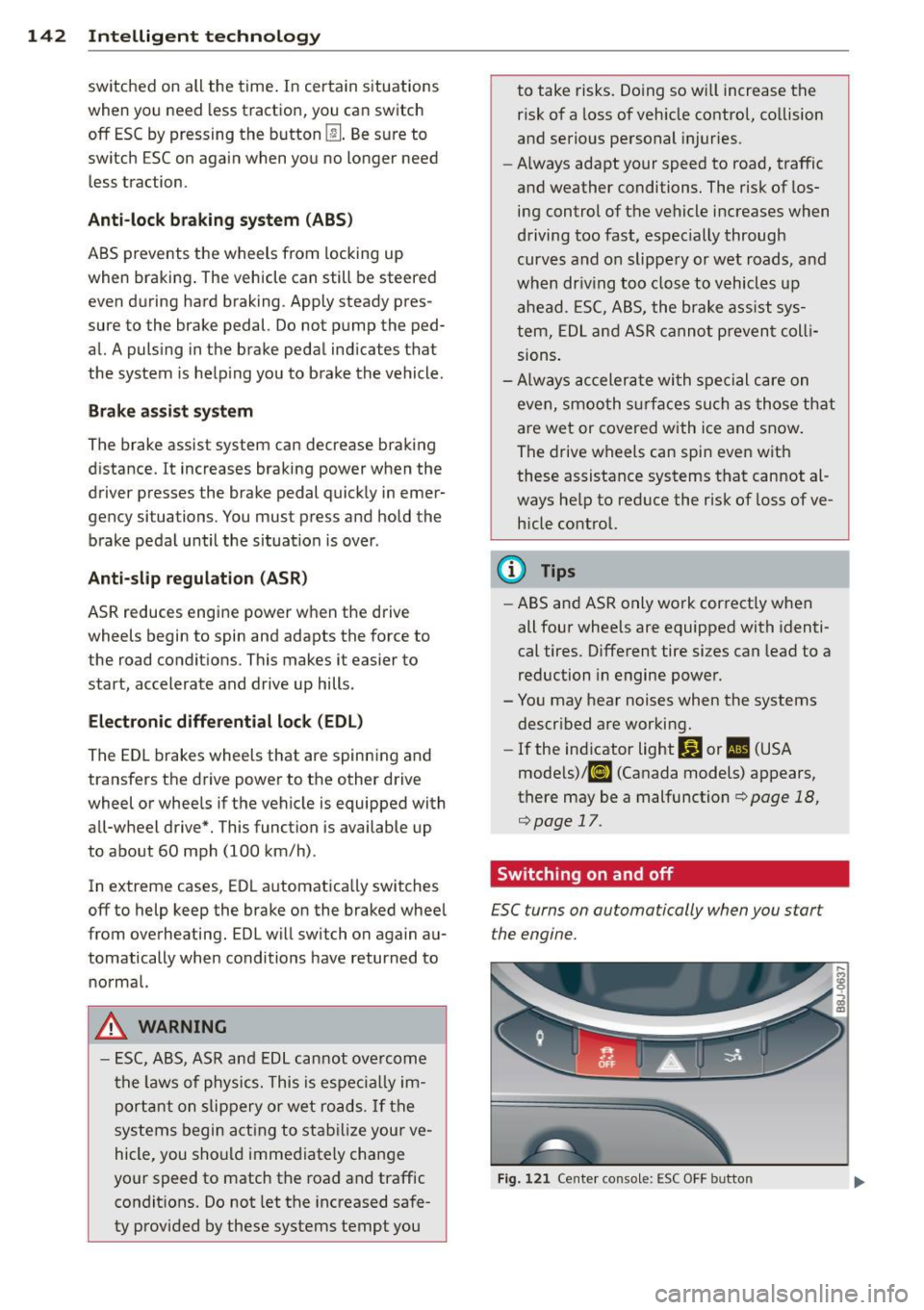
when you need less traction, you can switch
off ESC by pressing the button
l!l . Be sure to
switch ESC on again when you no longer need
less traction.
Anti -toc k brak ing system (ABS)
ABS prevents the wheels from lock ing up
when braking . The vehicle can still be steered
even during hard brak ing . Apply steady pres
sure to the brake pedal. Do not pump the ped
al. A puls ing in the brake pedal ind icates that
the system is he lp ing you to brake the vehicle .
Brake assist sy stem
The brake assist system can decrease braking
d istance. It increases braking power when the
driver presse s the brake pedal quickly in emer
gency si tuations. You must press and hold the
brake peda l until the situation is over .
Anti-slip regulation (ASR)
ASR reduces engine power when the drive
wheels begin to spin and adapts the force to the road conditions . This makes it easier to
start, accelerate and drive up hills.
E lectronic differential lock (EDL )
The ED L brakes wheels that are spinning and
transfers the drive power to the other drive
wheel or whee ls if the vehicle is equipped with
all-wheel drive*. This function is available up
to about 60 mph (100 km/h) .
In extreme cases, EDL a utomatica lly switches
off to help keep the brake on the braked whee l
from overheating. EDL will switch on aga in au
tomatically when conditions have returned to normal.
A WARNING
- ESC, ABS, ASR and ED L can not ove rcome
t h e laws of phy sics. This is espe cial ly im
por tant on slip pery or wet ro ads .
If th e
sys tems begin a ct in g to stab ilize your ve
hicle, you shou ld imme diately change
yo ur speed to match the road and traffic
condit ions. Do not let the inc reased safe
ty provided by these systems tempt you to take risks. Do
ing so w ill increase the
risk of a loss of veh icle control, co llision
and serious pe rsonal injuries .
- Always adapt your speed to road, traffic
and weather conditions. The risk of los
ing control of t he vehicle increases when
driving too fast, espec ially through
curves and on slippe ry or wet roads, and
wh en dr iv ing too clos e to vehicl es u p
ahead. ESC, A BS, the brake ass ist sys
tem, ED L and ASR cannot p reven t coll i
si ons .
- Always acceler ate wi th sp ecial c are on
even, smoo th s urfaces such as those th at
are wet or covered with ice and snow .
The drive wheels can spin even with
these assistance systems that cannot al ways he lp to reduce the risk of loss of ve
h icle co ntrol.
(D Tips
- ABS an d ASR only wo rk correct ly when
all four whee ls are equipped with identi
cal tires . D ifferent tire si zes can lead to a
reduction in engine powe r.
- Yo u may hear noises when the systems
descr ibed are working.
- If the ind icator light Ii) or II (USA
mode ls)/ Ei] (Canada models) appears,
there may be a malfunction
¢ page 18,
¢ page 17.
Switching on and off
£SC turns on automatically when you start
the engine.
Fig . 12 1 Ce nte r conso le: ESC OFF b utto n
Page 146 of 244
144 Intelligent technology
-Never push the ve hicle or app ly force to
the rea r spo ile r - i t co uld be damaged .
- To prevent damage to the rear spoiler do
not lean o r place a nyth ing o n it.
- Only ope rate the rear spoi ler manually
when the rear lid is closed and t he rear
spo ile r moving parts are not blocked.
Otherwise, damage could occur.
C lean the spoi le r compartment every 2 to
3 months . The spoiler compartment must
always be free of ice, snow, leaves or other
debris.
Braking
General information
What affects braking efficiency?
Operating conditions and d riving habit s
The brakes on today's automob iles are st ill
subject to wea r, depend ing largely on operat
i ng cond itions and dr iv ing habits
c:> & . On
ve hicles that a re e ithe r dr iven mostly in stop
and-go city traffic o r a re driven ha rd , the
b rake pads should be checked by yo ur auth or
iz ed A udi dealer more often th an specifie d in
the
Warranty & Maintenance booklet . Fail ure
to have your b ra ke pads inspected can res ult
in red uced b rake performance.
O n steep slopes, yo u sh ou ld use t he b ra ki ng
effect of the engine . This way, yo u preven t un
necessa ry wear on the brake system . If you
must use yo ur brakes, do not ho ld the bra kes
down continuously . P u mp the brakes at inter
va ls.
N oises may occur w hen braking depending on
the speed, bra king force and outside condi
tions s uch as temperature and h umidity.
Moisture or road salt
Unde r cert a in co ndi tions, for examp le, w hen
d riving through wate r or ve ry heavy rain , or
even after washing yo ur vehicle , the braking effect can be
reduced due to mois ture (or in
freez ing cond itions ice) on the brake pads. A
f ew cautio us brake applications s hou ld dry off
the brake pads or remove any ice coatings.
T he effec tiveness of the brakes can be red uce d
whe n the vehicle is d riven on a sa lt -covered
road and the b rakes are not used . Likewise,
yo u clean off acc umulated salt coat ing from
brake d iscs and pads with a few cautio us ap
plicat ions o f th e b rake
c:> & .
Corrosion
The re may be a tendency for dirt to build up
on the brake pads and corros ion to form on
t h e d iscs if the car is not driven regu larly or
o n ly for short trips w ith litt le use of the
brakes .
If the brakes are not used frequently, or if cor
ros ion has formed on the discs, it is adv isable
to clean off t he pads a nd d iscs by braking
firmly a few times from a moderately h igh
s p eed
c:> & .
Faults in the brake system
If you shou ld notice a sudden increase i n
brake pedal trave l, then one of the two brake
c ircuits may have fa iled
c:> & .
Low brake fluid level
Malfunctions ca n occ ur in the bra ke system if
t h e b rake fluid level is too low. The brake flu id
level is monitored electronica lly.
Brake booster
T he br ake boos ter inc reases the pressure tha t
yo u genera te with the b ra ke peda l. It works
o nl y when t he engine is runnin g
.c:> .&
Brake lining wear status
Br ake lining wear may be che cked by visual in
spe ct io n of th e condition o f the br ake pa ds
t h ro ugh the open ing s in the wheel. If neces
sa ry, the w heel may be removed fo r thi s i n
spect ion
c:> page 208, What should I be
aware of when changing a tire?.
Page 147 of 244
A WARNING
-You should perform brak ing maneuvers
for the purpose of cleaning the brake
system only if road cond it ions permit .
Other road users must not be put at r isk -
yo u may cause an acc ident!
- Before descending a steep grade, reduce
speed and shift transm iss ion into a lowe r
gear or lowe r driving range. Do not ride
the brakes or hold the pedal down too
long or too often . This cou ld cause the
brakes to get hot and diminish braking
efficiency.
- Do not "ride the b rakes" by resting your
foot on the pedal when yo u do not intend
to brake . Th is may cause the brakes to
overheat, premature wear and increased
stopp ing distance.
- Under certain climat ic and operating
condit ions such as passing throug h wa
ter, driving in heavy rai n or after wash ing
the vehicle, the effect iveness of the
brakes can be reduced. In winter, ice can
accumulate on the brake pads, lini ngs,
discs and d rums. Carefully apply brakes
f or a test . B rakes wi ll dry and ice coat
ings wi ll be cleaned
off after a few ca re
ful brake applications.
- Driv ing for an ex tended pe riod of time on
salt -covered roa ds without using your
brakes can also affect braking efficiency.
Clean
off accumulated salt coating from
brake discs and pads with a few cautious
brake applicat ions.
- If you damage the front spoiler, or if you install a different spoiler, be sure the air
flow to the front brakes is not obstruct
ed . Otherwise the brake system could
overheat reducing the eff ectiveness of
the ent ire brake system.
- Failure of one bra ke c ircuit will impair
the brak ing capability resulting in an in
cr eased stopp ing distan ce. Avoid dr iv ing
the ve hicle and have it towed to the near
est Aud i dea le r or q ualified workshop .
- Never le t the vehicle ro ll to a stop w ith
the engine shu t off.
Int ellig ent technolog y 145
-If the brake booster is not working, the
brake peda l must be pressed considera
bly harder to make up for the lack of
booster assistance.
Electro-mechanical
power assist
The ele ctro-mechanical power assist helps
the driver when steering .
The degree of power assist is electronically
matched to veh icle speed.
The powe r steering system assists the driver
so that he can steer the vehicle with reduced
physical effort.
Power steer ing will not work if the engine is
off . As a result, the steering wheel will be hard
to turn .
A WARNING
If the system develops a problem, you
must seek qualified professiona l assis
tance.
(D Note
-
If there is an electronic malfunction, ser
votronic
will still function like a conven
tiona l powe r steering system, providing a
constant steering support force tha t is no
l onger proportionate to the vehicle speed.
This is most noticeable when t urning the
steering wheel at low speeds (for example
when parking), - more effort w ill be re
quired than usual.
- Be aware of the different than usual
steering response and adjust your steer
ing force accordingly.
- Have the problem checked and set right
by an authori zed Aud i dea ler as soon as
possible.
- If a steering malfunction occurs, th is is
signa led w ith the
ls4 or .• indicator
lights and a warn ing tone, see. •
•
Page 148 of 244
146 Intellig ent technolog y
-If the power steering system should fail,
or if the eng ine is not running (for exam
ple, while being towed), yo u wi ll st ill be
able to steer the veh icle. However, more
effort will be requ ired to do so .
- If the power steering system is not func
tioning properly, contact your authorized
Audi dealer immediately .
Driving with your
quattro
App lies to vehicles: with all-wheel drive
With all-wheel drive, all four wheels are driv
en.
General information
W ith all-whee l drive , power is distributed to
a ll four wheels . This happens automa tica lly
depending on your dr iv ing sty le and the road
conditions at the time. See also ~
page 141.
The all-wheel drive concept is designed for
high engine powe r. You r vehicle is exception
ally powerful and has ex ce ll ent dr iving charac
teristics bot h under normal driving conditions
and on snow and ice. Always read and fo llow
safety precautions ¢
.&..
Winter ti re s
When dr iving in the w inte r, your ve hicle w ith
a ll-wheel d rive has an advantage, even with
regular tires . In winter road conditions it may
be advisable to mount winter tires (or all-sea
son tir es) for improv ed driveability and brak
ing: these tires must be mounted on
a ll fo ur
wheels . See also ¢ page 195, Win ter tires.
Snow cha in s
Where tire chains are mandatory on certain roads, this normally a lso applies to vehicles
with a ll-wheel drive¢
page 196, Snow
chains.
Replacing whe els /t ires
Vehicles wit h all-wheel drive mus t always
have tires of the same size . Also avoid tires
with different tread depths. For details see page
q page 191, New tires and replacing
tires and wheels .
Off-Road driving ?
Your Aud i does no t have enough g round clear
ance to be used as an off-road vehicle. It is
therefore bes t to avoid rough tracks and un
even terrain as much as possib le . Also refer to
¢ page 150 .
A WARNING
-Always ad just your dr iv ing to road and traf-
f ic conditions. Do not let the extra safety
afforded by all-wheel drive tempt you into
taking extra risks.
- Although the all-wheel drive is very ef
fective, always remember that braking capacity is lim ited by tire t raction . You
should therefore not d rive at excessive
speeds on icy or slippe ry road surfaces.
- On wet road surfaces, be careful not to
d rive too fast because the front whee ls
could begin to slide o n top of the water
(aquaplan ing). If th is should occur, yo u
will have no warning from a s udden in
crease in eng ine speed as wit h a front
wheel drive vehicle. Always drive at
speeds which are su ited to the road con
d itions. -risk of crash.
Energy management
Starting ability is optimized
Energy management controls the distribution
of electrical energy and thus optimizes the
availability of electrical energy for starting the engine.
If a vehicle with a conventional energy system
is not driven for a long per iod of t ime, the bat
te ry is discharged by idling cur rent consume rs
(e .g. immobili zer) . In cert ain circumstances it
can resu lt in the re being insufficient energy
available to start the eng ine.
Intelligent energy management in you r vehi
cle h andles the dis trib ution of e lectr ica l ene r
gy. Start ing ability is ma rkedly improved and
the life of the battery is extended . .,._
Page 149 of 244
Basically, energy management consists of
batter y di agno sis, idling cur rent man age
ment
and d yn ami c en ergy m anagement.
Battery diagnosis
Battery d iagnosis continuously dete rmines
the state of the battery. Senso rs determ ine
battery vo ltage, battery current and battery
temperature. This determines the current
state of charge and the power of the battery.
Idling curre nt management
Idling c urrent management red uces energy
consumption while the vehicle is standing.
With the ignition switched off, it contro ls the
energy supply to the various electrica l compo
nents . Data from battery diagnosis is consid
ered.
Depending on the battery's state of charge,
individua l consumers are grad ually turned off
to prevent excess ive d ischarge of the battery
and thus mainta in start ing capability.
Dynam ic energ y manag em ent
While the vehicle is being driven, dynamic en
ergy management distributes the energy gen
erated according to the needs of the individu
a l components. It regu lates consumption, so
that more electrical energy is not being used
than is being generated and ensures an opti
mal state of charge for the battery .
(D Tips
-But even energy management cannot
negate the limits of physics. Consider
that the power and life of a battery are l imited.
- If starting ab ility is threatened, you are
i nformed by a warn ing
c!;> page 148,
Driver notification in the instrument
cluster display.
Int ellig ent technolog y 147
What you should know
The highest priority is given to maintaining
starting capability.
The battery is severely taxed in short-distance
driv ing, in city traff ic and during the cold time
of year . Abundant electrical energy is re
quired, but only a l ittle is generated .
It is also
c ritical if the engi ne is not running and electri
ca l components are turned on . In this in
stance ene rgy is be ing consumed but none is
being generated.
It i s in precise ly these situations that you will
notice ene rgy management act ive ly regu lat
ing the d istribu tion of ene rgy.
V ehicle stands for an extended period
If you do not drive your vehicle over a period
of several days or weeks , e lectr ica l compo
nents a re g radually cut back or switched off.
T his reduces energy consumption and ma in
ta ins s tart ing capability over a longer pe riod .
Take into considerat ion that when you unlock
you r vehicle, some convenience functions,
s u ch as the remo te key o r power seat adjust
ment, may not be available. The convenience
f unct ions wi ll be available again when you
turn on the ignition and start the engine.
With the engine turned off
If you listen to the radio, for examp le, w ith
the engine tu rned o ff, the battery is being dis
charged .
If starting capabi lity is jeopardized due to en
ergy consumption , a message appears in the
driver in formation d isplay.
You have to start t he engine to charge the
battery.
With the engine running
Although electrical energy is generated when
the vehicle is being driven, the battery can be come discharged . This happens mostly when
little energy is being gene rated and a great
deal consumed and the battery's state of
c h arge is not opt imal.
•
•
Page 150 of 244
148 Intelligent technology
To bring the energy balance back into equilibrium, consumers which require especia lly
l arge amo unts of energy are temporari ly c ut
back or switched off. Heating systems in par
ticular requ ire a great dea l of energy. If you
n otice, for example, that the heated seats * or
the heated rea r window a re not heating, they
have been temporar ily cut back o r switched
off. These sys tems will be ava ilable again as
soon as the energy ba lance has bee n restored.
You will also not ice that engine idle speed has
been inc reased slightly. This is no rma l and not
a cause fo r concern . By increas ing engine idle
spee d the add itiona l ene rgy required is gener
ated and the ba ttery is charged .
Driver notification in the instrument
cluster display
If battery power drops into the range where it
can limit the ability of the engine to start, th is
i s shown in the instrument cluster display
with the following driver message:
(•) Low battery charge : battery will be
cha rged while dri ving
This notification reminds you that the starti ng
capability of the engine may be limited. As
soon as you start driving aga in, the battery
will be recharged and the notification will go
out .
Driv er notificat ion appears and goes out
again
If t his driver notification appears after the ig
ni tion is turned on or while driv ing and it goes
out again after a while, the battery has been
adequately rec harged.
Driver notification appears and does not
go out again
If t his driver notification appears after the ig
n ition is turn ed on or while driv ing and does
n ot go ou t aga in, t he battery's s tate of charge
is not i n the opt imal range. St arting ability is
restricte d. Have the bat tery checked as soon
as possible by a n authorized Audi dealer or
q ua lified workshop.
Page 151 of 244
Driving and
environment
The first 1
1000
miles
(11500 km) and
afterwards
New engine
The engine needs to be run-in during the first
1,000 miles (1 ,500 km) .
For the first 600 mile s (1,000
kilometre s):
.,. Do not use full throttle .
.,. Do not drive at engine speeds that are more
than 2/3 of the max imimum permitted
RPM .
.,. Avoid high engine speeds.
From 600 to 1,000 miles (1 ,000 to
1,500 kilometres):
.. Speeds can gradually be increased to the
maximum pe rm iss ib le road or eng ine speed .
During and after break-in period
.. Do not rev the engine up to high speeds
when it is cold . T hi s applies whether the
transmission is in N (Neutral) o r in gear.
After the break- in period
.. Do not exceed max imum eng ine speed un
der any circumstances .
.. Upshift into the next hig her gear
before
reaching the red area at the end of the tach
ometer scale
<::;> page 10.
During the first few hours of driving, the en
g ine 's inter na l friction is higher than later
when all the moving pa rts have been broken
i n. How well this break-in p rocess is done de
pends to a considerable ex tent on the way t he
ve hicl e is driven d uring the first 1,000 miles
(1, 500 kilome tres) .
(D Note
Extremely high engine speeds a re auto
mat ic al ly reduced. However, t hese RPM-
Driving and environment 149
limits were programmed for an eng ine
well run-in, not a new eng ine.
@ For the sake of the environment
Do not d rive wi th unnecessar ily h igh en
gine speeds -upshifting ear ly saves f uel,
r educes noise and protects the environ
ment.
New tires
If your vehicle is running on new tires, drive
particularly carefu l for the first 350 miles
(500 ki lometres) after fitting .
A WARNING
-New tires tend to be s lippery and must a l-
so be "b roken-in". Be s ure to remembe r
this dur ing t he firs t 35 0 m iles (500 kilo
me tres) . Brake gent ly . Avo id following
closely behind other vehicles or other sit uations that m ight require sudden, hard
b raking.
New brake pads
Remember that new brake pads do not have a
full brak ing effect during the first 250 miles
(400 kilometres) after they are installed.
New brake pads have to be "burnished in" be
fore they have optima l grab¢ .&..
D uring the break-in period, yo u should avoid
putting seve re loads on the brakes . Severe
l oads include, for example, su dden hard brak
ing, in particular at very h igh speeds or, for
example, on mou nta in passes.
A WARNING
Until t hey develop the maximum "bite" fo r
best stopping power, the s urfaces on new
b rake pads requ ire some "brea king- in" dur
in g the initial 10 0 to 150 miles (15 0 to
20 0 kilome tres) of normal c ity dr iv ing. Yo u
can compensate for this by press ing the
b rake peda l more f irm ly . This applies
whenever new pads are installed.
•
•