wheel AUDI TT ROADSTER 2015 Workshop Manual
[x] Cancel search | Manufacturer: AUDI, Model Year: 2015, Model line: TT ROADSTER, Model: AUDI TT ROADSTER 2015Pages: 244, PDF Size: 60.74 MB
Page 200 of 244
198 Tire s and wheel s
or ridges on the road, part icu larly if the tire is
u nderinflated .
I n o rder to m inim ize the o ccurrence of impact
damage to the t ires of your vehicle, we recom
mend that you observe the following precau
tions:
- Always maintain recommended infla tion
pressures. Chec k your tire pressure every
2,000 miles (3,000
km) and add air if neces
sary .
- Drive carefu lly on roads with potholes, deep
gullies or ridges. The impact from driving
t h rough or over such obstacles can damage
your tires. Impact with a curb may also cause damage to your tires.
- After any impact, immediately inspect your
tires or have them inspected by the nearest
authorized Aud i dealer. Replace a damaged
t ire as soon as possible .
- Inspect your t ires every 2,000 miles (3,000
km) for damage and wear . Damage is not al
ways easy to see . Damage can lead to loss of
air and underinflation, wh ich could eventu
ally cause t ire failure . If you be lieve that a
t ire may have been damaged, replace the
t ir e as soon as possible.
- T hese tires may wea r mo re quick ly than oth
ers.
- Please a lso remember that, wh ile these t ires
deliver respons ive handling, they may ride
l ess comfortably and make mo re no ise than
other choices.
Reduced performance in winter /co ld
sea son condit ion s
All ti res a re des igned for certa in pu rposes.
The low aspect ratio, ultra high performance
tires originally installed on your vehicle are in
tended for max imum dry and wet road per
formance and handling. They are not suitable
for cold, snowy or icy weather condit ions. If
you dr ive under those circumstances, you
should equip your vehicle with all -season or
winter tires, which offer better traction under
those cond it ions. We suggest you use the rec
ommended snow or all-season tires specified
fo r your vehi cle, or their eq uivalent. Refer to
q page 195
for more detailed infor
mation regarding winter tires.
Tire pressure monitoring system
General notes
Applies to veh icles: w ith tire pressure monitoring system
Each tire, incl uding the spare ( if provided),
sho uld be checked monthly when co ld and in
flated to the inflation pressure recommended by the veh icle manufacturer on the veh icle
placard or tire inflation pressure label. (If your
vehicle has tires of a different size than the
s ize indicated on the vehicle placard or tire i n
flat ion p ressure label, you should dete rmine
the p roper t ire infla tion p ress ure fo r th ose
t i res.)
As an added safety featu re, your ve hicle has
been equipped with a tire pressure mon itoring
system ( TPMS) tha t illum inates a low ti re
pressure tel ltale when one o r more of your
tires is significant ly under-inflated . Acco rding
l y, when the low tire pressure telltale i llumi
nates, you shou ld stop and check your tires as
soon as possib le, and inflate them to the
proper pressure. Driving on a sign ificantly un
der- inflated t ire causes the tire to overheat
and can lead to tire fa ilure . Under-inflat ion al
so reduces fuel effic iency and tire tread life ,
and may affect the vehicle 's hand ling and
stopp ing abili ty.
Please note that the TPMS is not a substitute
for proper tire ma intenance, and it is the d riv
er's respons ibility to maintain co rrect tire
pressure, even if under-inflation has not
reached the leve l to tr igger illum inat ion of the
T PMS low tire pressu re tellta le .
You r vehicle has also been equipped w ith a
T PMS ma lf u nction indicator to ind icate when
the sys tem is not o perating p roperly . Th e
T PMS ma lfunction indicator is combined w ith
t h e low tire pressure te lltale. When the sys
tem detects a malfunction, the telltale will
flash for approximately one min ute and then ..,_
Page 201 of 244
remain continuous ly illuminated . This se
quence will continue upon subsequent vehicle
start-ups as long as the ma lfunction ex ists.
When the malfunct ion indicator is ill uminat
ed, the system may not be able to detect or
signa l low tire pressure as intended. TPMS
malfunct ions may occur for a variety of rea
sons, including the installat ion of replace
ment or alternate tires or wheels on the veh i
cle that prevent the TPMS from funct io ni ng
properly. Always check the TPMS malfunct ion
tellta le afte r replacing one or more t ires or
wheels on your veh icle to ensure that the re
p lacement or a lternate tires and wheels allow
the TPMS to continue to function properly.
Tire pressure indicator appears
Applies to vehicles: with tire pressure monitoring system
The tire pressure indicator in the instrument
cluster informs you if the tire pressure is too
low or if there is a system malfunction.
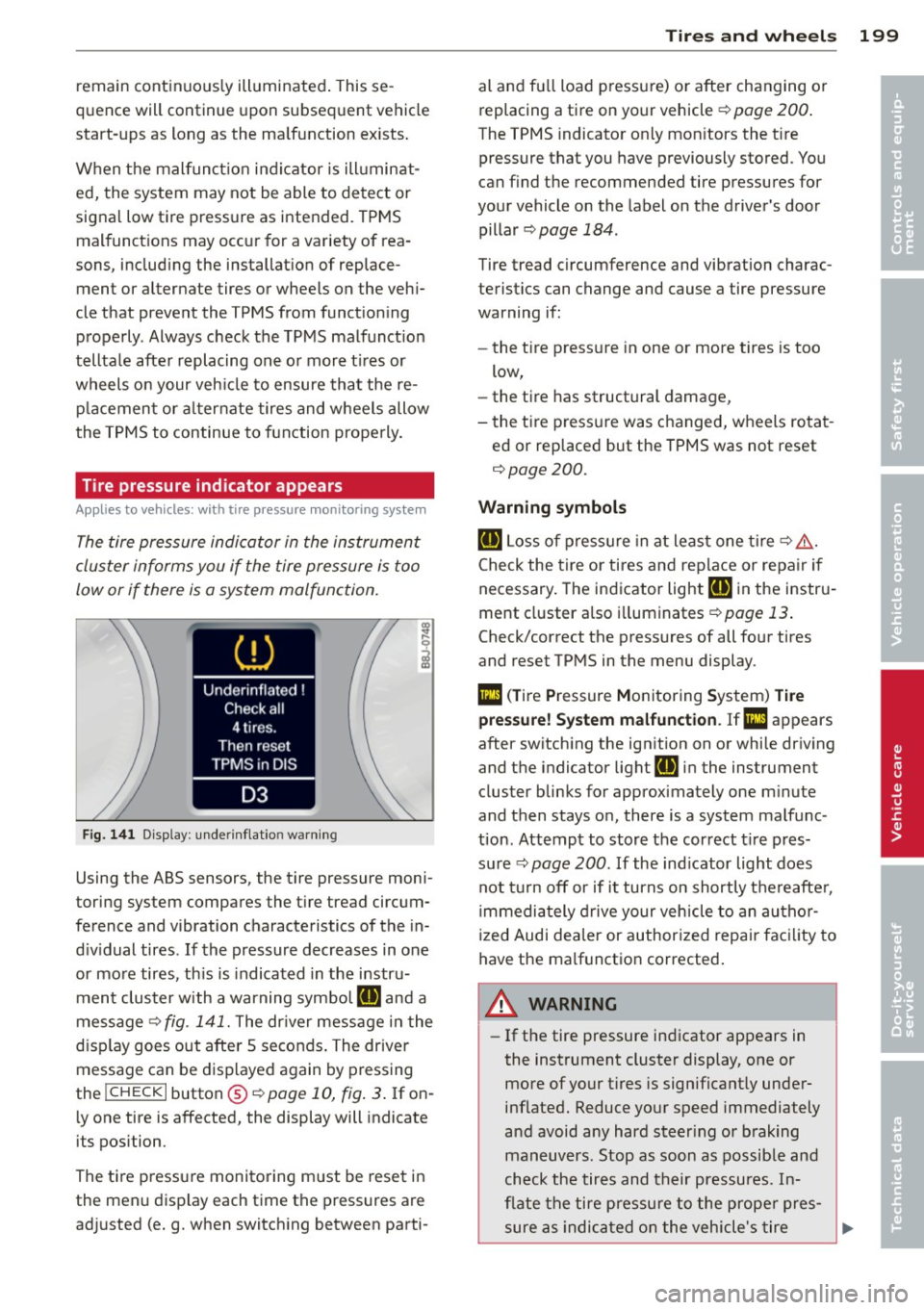
F ig. 1 41 Disp lay : under in fla tion warn ing
Using the ABS sensors, the tire pressure moni
toring system compares the t ire tread circum
fe rence and vibration characteristics of the in
d iv idual tires . If the pressure decreases in one
or mo re tires, th is is indicated in the instru
ment clus ter with a warning symbol
[I] and a
message
'* fig. 141. The dr iver message in the
d isp lay goes out after 5 seconds . The driver
message can be d isplayed again by pressing
the
! CHECK I button @¢ page 10, fig . 3 . If on
ly one tire is affected, the display will indicate
its pos ition.
The ti re pressure monito ring m ust be reset in
the menu display each time the pressures are
ad justed (e.g. when switching between parti-
Tire s an d wheel s 199
al and fu ll load pressure) or after changing o r
replacing a tire on your vehicle '*
page 200.
The TPMS indicator on ly mon itors the t ire
pressure that you have previously stored . You
can f ind the recommended tire pressures for
your vehicle on the label on the driver's door
pillar ¢
page 184 .
Tire tread circumference and vibration charac
teristics can change and cause a tire pressure
warning if:
- the t ire press ure in one or more tires is too
low,
- the tire has structural damage,
- the t ire press ure was changed, wheels rotat -
ed or rep laced but the TPMS was not reset
¢ page 200.
Warning symbo ls
[I] Loss of press ure in at least one tire'*& .
Check the tire or tires and rep lace or repa ir if
necessary . The indicator light
[I] in the instru
ment cluster a lso i lluminates
¢ page 13.
Check/correct the press ures of all four tires
and reset TPMS in the menu display .
mm (T ire Pressure Monitoring System) Ti re
pre ssure! System malfun ction . Ifll appears
after switching the ign it ion on or while dr iving
and the indicator light
[I] in the instrument
clus ter blinks fo r approximately one m inute
and then stays on, there is a system malfunc
tion . Attemp t to store the correct t ire pres
su re '*
page 200 . If the ind icator light does
not turn off or if i t turns on shortly thereafte r,
immedia tely drive your vehicle to an au thor
ized Audi dea ler or author ized repai r fac ility to
have the malfunction corrected .
A WARNING
=
-If the tire pressure indicator appears in
the instrument cluster display, one or
more of your t ires is significant ly under
inflated. Reduce your speed immediately
and avoid any hard steer ing or b rak ing
maneuvers. Stop as soon as possib le and
check the tires and their pressu res . In
flate the tire pressure to the prope r pres-
sure as indicated on the vehicle's tire .,..
•
•
Page 202 of 244
200 Tires and wheels
pressure label¢ page 184. Driving on a
significantly under-inflated tire causes the tire to overheat and can lead to tire
failure . Under-inflation also is likely to
impair the vehicle's handling and stop
ping ability .
- The driver is responsible for mainta ining
the correct tire pressures. You must
check the tire pressures regularly.
- Under certain conditions (such as a spor
ty driving style, winter conditions or un
paved roads), the pressure monitor indi
cator may be delayed.
- Ask your author ized Audi dealer if run
flat tires may be used on your veh icle.
Your vehicle registration becomes inval id
if you use these tires when not permit
ted. Damage to your vehicle or accidents
cou ld also resu lt.
- If you switch between standard and run
flat tires, an authorized Audi dealer or
qualified workshop must reprogram the
control module .
@ Tips
-The tire pressure monitoring system may
stop working when there is an ESC mal
funct ion .
- Using snow chains may result in a system
malfunction.
- The tire pressure monitoring system on
your Audi was developed using tires with
the "AO" or "RO" identif ication on the
tire sidewall ¢
page 191. We recom
mend using these tires.
Reset tire pressure monitoring system
(Stepl)
Applies to vehicles: with tire pressure monitoring system
If the tire pressure is adjusted, wheels are ro
tated or changed, the TPMS must be reset in
the menu display.
----- ®
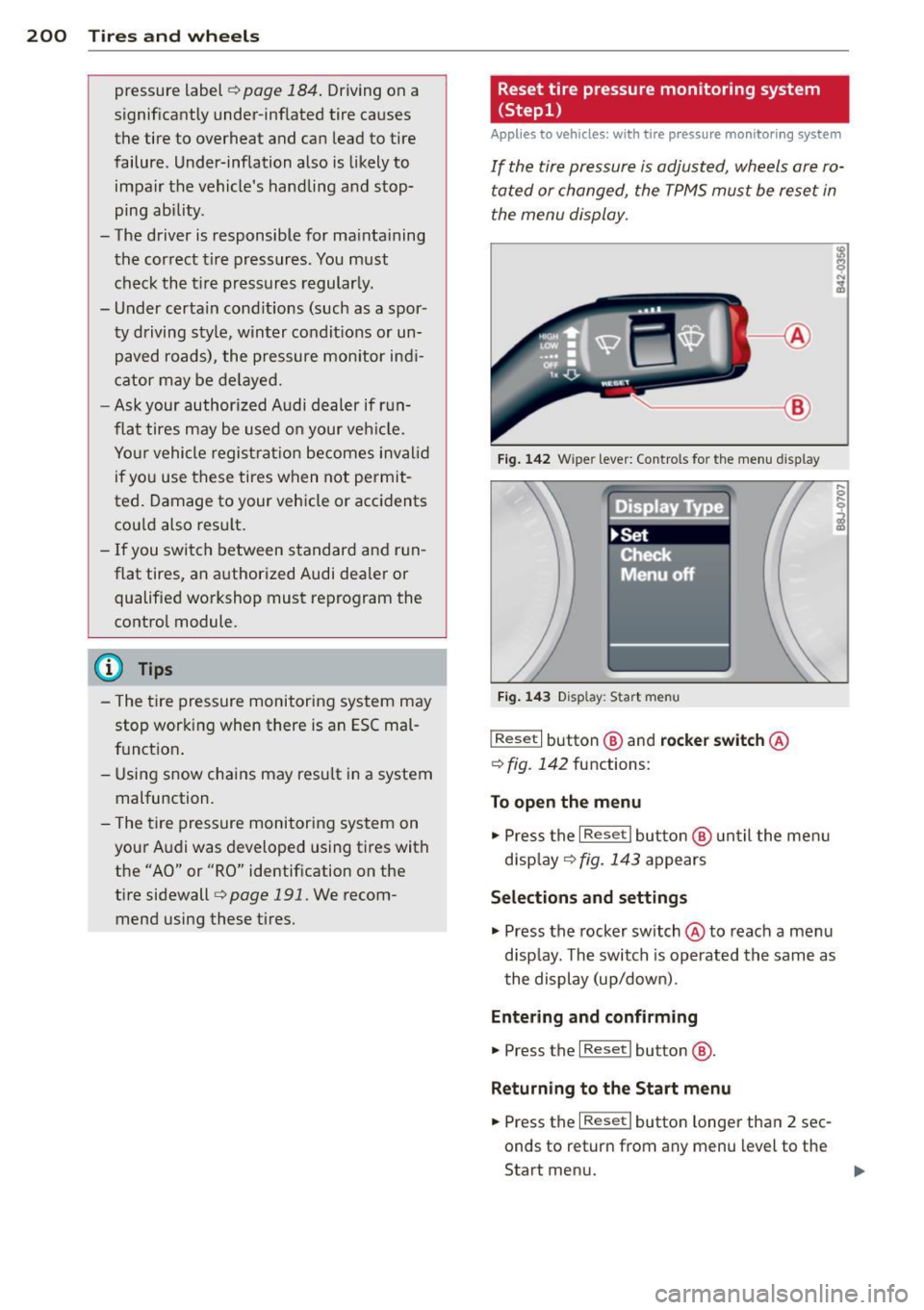
Fig. 142 Wiper lever: Contro ls fo r the menu displ ay
Fig. 143 Disp lay: S tar t m en u
I Reset I button @ and rocker switch @
¢
fig . 142 functions:
To open the menu
" Press the I Rese t I button @ until the men u
disp lay
¢ fig . 143 appears
Selections and settings
" Press the rocker switch @ to reach a menu
disp lay. The switch is operated the same as
the display (up/down) .
Entering and confirming
" Press the I Re set I bu tton @.
Returning to the Start menu
" Press the I Reset I button longer than 2 sec
onds to return from any m enu l evel to the
Start menu.
Page 203 of 244
@ Tips
-Before resetting the TPMS, the current
pressures of
all four tires must corre
spond t o the specified va lues. Adjust the
tire pressu re and reset the pressure in
the tire pressure mon itor ing system ac
cord ing to the load yo u are carry ing
<=> pag e 184.
- Do not store the tire pressure if there are
snow cha ins on the tire . Othe rwise, a
system malfunct ion may occ ur.
Reset tire pressure monitoring system
(Step2}
Applies to vehicles: with tire pressure monitoring system
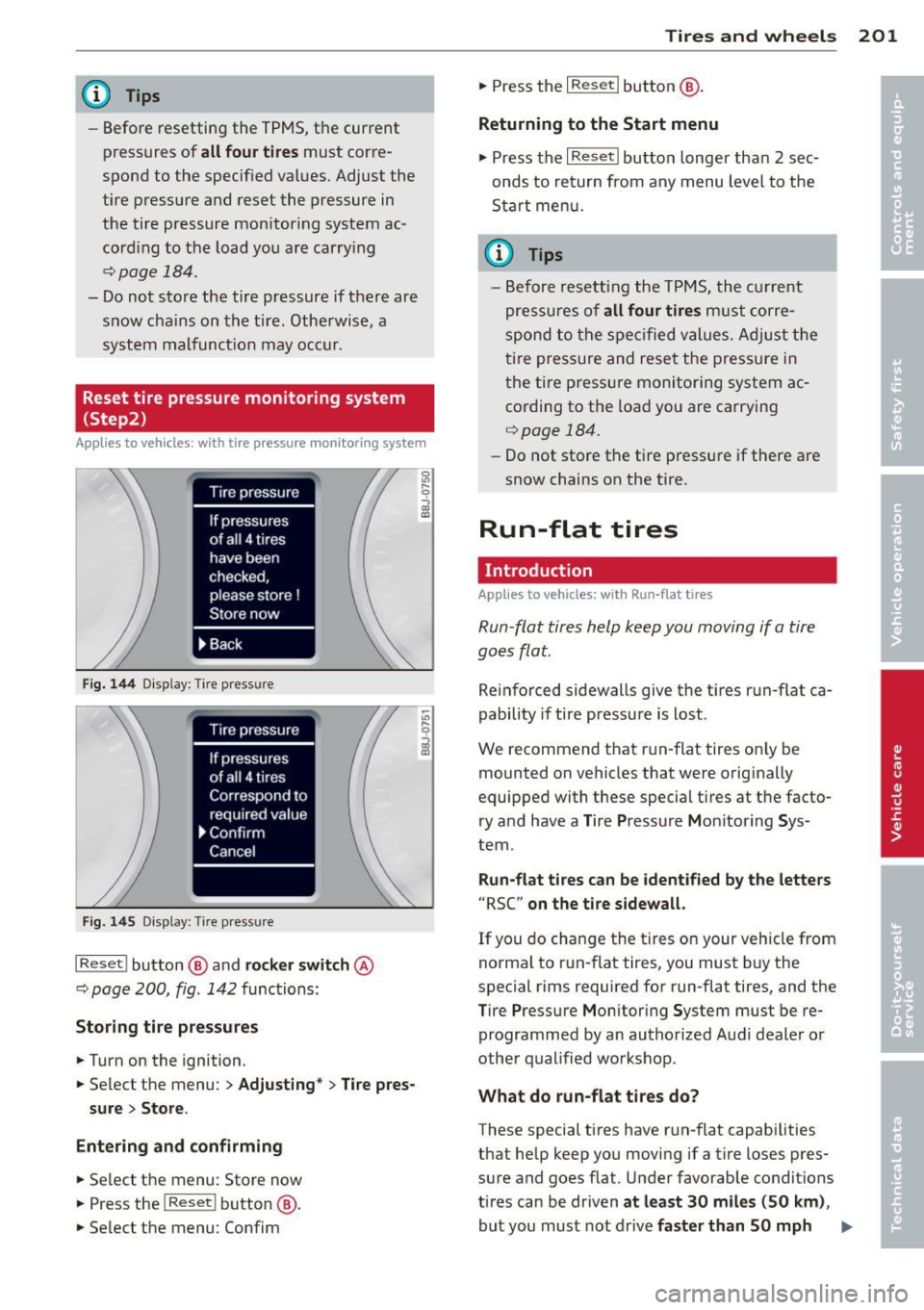
Fig. 144 D isplay: Tir e press ure
Fi g. 145 Display: Tir e pr ess ure
I Reset ! button @ and rock e r swit ch @
~ page 200, fig . 142 func tions:
Storing tire pressures
.. Turn on the ignition .
.. Select the menu :
> Adjusting * > Tire pres-
sure
> Store .
Entering and confirming
.. Se lect t he menu : St ore now
.,. Press the
l Reset ! button @.
.. Se lect the menu : Confim
Tires and wheels 201
.. Press the I Rese t I button @.
Returning to the Start menu
.,. Press the I R eset I butto n longer than 2 sec
onds to retur n from any menu level to the
S ta rt me nu.
{!) Tips
- B efore resett ing the TP MS, the c urrent
pre ssures o f
all four tires must co rre
spond to t he s pec ified v alue s. A dju st t he
tire pressure and rese t the pressure i n
the tire p ressu re monito ring system ac
co rding to the loa d you are carrying
<=> page 184.
-Do not store the tire p ress ure if there are
snow chains on the tire .
Run-flat ti res
Introduction
Applies to vehicles: with Run -f lat tires
Run-flat tires help keep you moving if a tire
goes flat.
Re inforced sidewalls give the tires run-flat ca
pability if tire pressure is lost .
We recommend that r un-flat tires on ly be
m ounted on vehicles that were orig inally
equipped with these special tires at t he facto
ry and have a Tire Pressure Moni toring Sys
tem .
Run-flat tires can be identified by the letters
"RSC" on the tire sidewall.
If you do change the tires on your veh icle from
norma l to run- flat tires, you must b uy the
special rims required for run-flat tires, and the
T ire Pressure Monitor ing System must be re
programmed by an authorized Aud i dealer o r
other qualified worksho p .
What do run-fl at tires do?
These special tires have r un-flat capabilities
that help keep you moving if a t ire loses pres
sure and goes flat . Under favorable conditions
ti res can be dr iven
at least 30 miles (50 km) ,
but you mus t not dr ive faster than 50 mph Ill-
Page 204 of 244
202 Tires and wheels
(80 km/h)
¢ page 202, Driving with run -flat
tires .
When it is not possible to continue
driving, even with run-flat tires?
- If the E lectronic Stabilization Control (ESC)
is not working or keeps coming on.
- If the Tire Pressure Monitoring System does
not work .
-If the tire has been severely damaged, in a
crash, for example. The tread can separate
from a damaged tire as the whee l turns , and
hit parts of the vehicle , such as the fuel tank
filler neck, fuel lines or brake lines.
- Do not continue driving if severe vibration
occurs or if the tire starts to smoke because
the tire is running hot.
- Do not continue driving if damage to the
tire, such as cracks in the sidewall, appears.
A WARNING
Improper use of run-flat t ires can cause
veh icle damage that can lead to loss of ve
hicle control, a crash and serious pe rsonal
injury.
- Run-flat tires can only be used with spe cial rims.
- Run-flat tires must always be mon itored
with a properly programmed Tire
P re
ssure Mon itor ing System.
- Always inspect a tire that has lost air to
make sure it is safe to drive with the tir e
in the run-flat mode.
- Never drive with run-flat tires that have
been damaged in a collision .
- Never drive with run-flat tires if heat
build-up causes the tire to give off
smoke .
- Never drive with run-flat tires if the vehi
cle shakes or v ibrates severely.
- Never drive with a run-flat tire that de
velops sidewall cracks or other damage
wh ile in use .
- If you switch between standard and run
flat tires, an authorized Audi dealer or qualified workshop must reprogram the
control module .
-
(D Note
Run-flat tires have specia l characteristics
and requirements, that are very different
from conventional tires. Run-flat tires re
quire special rims for run-flat use and can
not be used on conventional wheel rims.
(D Tips
- If you are not able to cont inue driving
with run-flat tires, please seek professio
nal assistance.
- Please contact your authorized Audi
dealer or Audi of America, Inc. if you
have questions about tires and rims .
Driving with run-flat tires
Applies to vehicles: wit h Run -flat tires
Handling characteristics change when tire
pressure is low .
Driving on tires with low tire pressure changes
the way a vehicle handles, particularly when
cornering and braking. The handling charac
teristics of run-flat tires do not seem to
change a lot even when driving on low pres
sure or in the run-flat mode . Nevertheless you
must still take specia l precautions when ope r
at ing a vehicle on run-flat tires when tire pres
sure is low o r the tire(s) is flat:
.,. The Electronic Stabilization Control (ESC)
must be switched on.
.,. Never drive faster than 50 mph (80 km/h)
¢&_ .
.,. Plan ahead when driving and anticipate
what you will have to do considering traffic
and road conditions up ahead .
.,. Accelerate carefully.
.,. Avo id unnecessary and sudden steering and
brak ing maneuvers.
.,. Reduce your speed in plenty of time before
intersections, curves and other places where
you may have to react quickly.
Please see :
¢ page 202, When it is not possi
ble to continue driving, even with run-flat
tires?
Page 205 of 244
Handling characteristics change when
driving with low air pressure or with flat
tires even with special run-flat tires
A low pressure or flat front tire affects vehicle
handling characteristics by pu lling the vehicle
slightly to the side where the tire is mounted
and reduces braking performance .
A low pressure or flat
rear tire also affects
driving character istics by pulling to the side
where the tire is mounted and also reduces
brak ing performance. The effect on vehicle
handling is most not iceable when driving
around curves.
A WARNING
Changed vehicle handling character istics
when driving in the run -f lat mode can
cause loss of vehicle contro l, a crash and
serious personal injury.
- Driving on special run-flat tires in the
run-f lat mode wi ll change vehicle han
dling characteristics during braking,
when cornering and under heavy acceler
ation.
- Never drive faster than the maximum
rated speed of 50 mph (80 km/h) when
dr iv ing in the run -flat mode.
- Always adjust vehicle speed to traffic,
road and weather cond itions and drive
slower than the max imum rated speed if
necessary weather and road conditions
are taken into account.
- Always obey speed limits and other traf
fic laws.
Q) Note
We always recommend driving w ith even
more care when using these special t ires in
the run-flat mode . Always avo id sudden
maneuvers.
Tires and wheels 203
Replacing run-flat tires and rims
App lies to veh icles : w it h Run -flat t ires
Your vehicle was especially designed to use
special run-flat tires.
You may use and combine only approved run
flat tires and special matching rims that have
been designed for run-flat tires. Mounting
special run-flat tires on standard wheels will not work and w ill not prov ide the advantages
fo the ru n-falt feature . Never use spec ial run
flat tires on standa rd wheel rims.
After dr iving with a tire i n the run-flat mode,
always have the veh icle and affected tire(s)
and rim(s) inspected by a n authorized Audi
dealer. Tires that have been driven in the run
f lat mode must be rep laced .
A WARNING
-Use of damaged run-flat tires and rims can
cause vehicle damage that can lead to loss
of vehicle control, a crash and serious per
sonal injury.
- Always have the vehicle and affected
tire(s) and r im(s) inspected by an author
ized Audi dealer after driving a tire in the
run-flat mode .
- Tires that have been dr iven in the run
f lat mode must be replaced.
•
•
Page 206 of 244
204 What do I do now ?
What do I do now?
Trunk escape handle
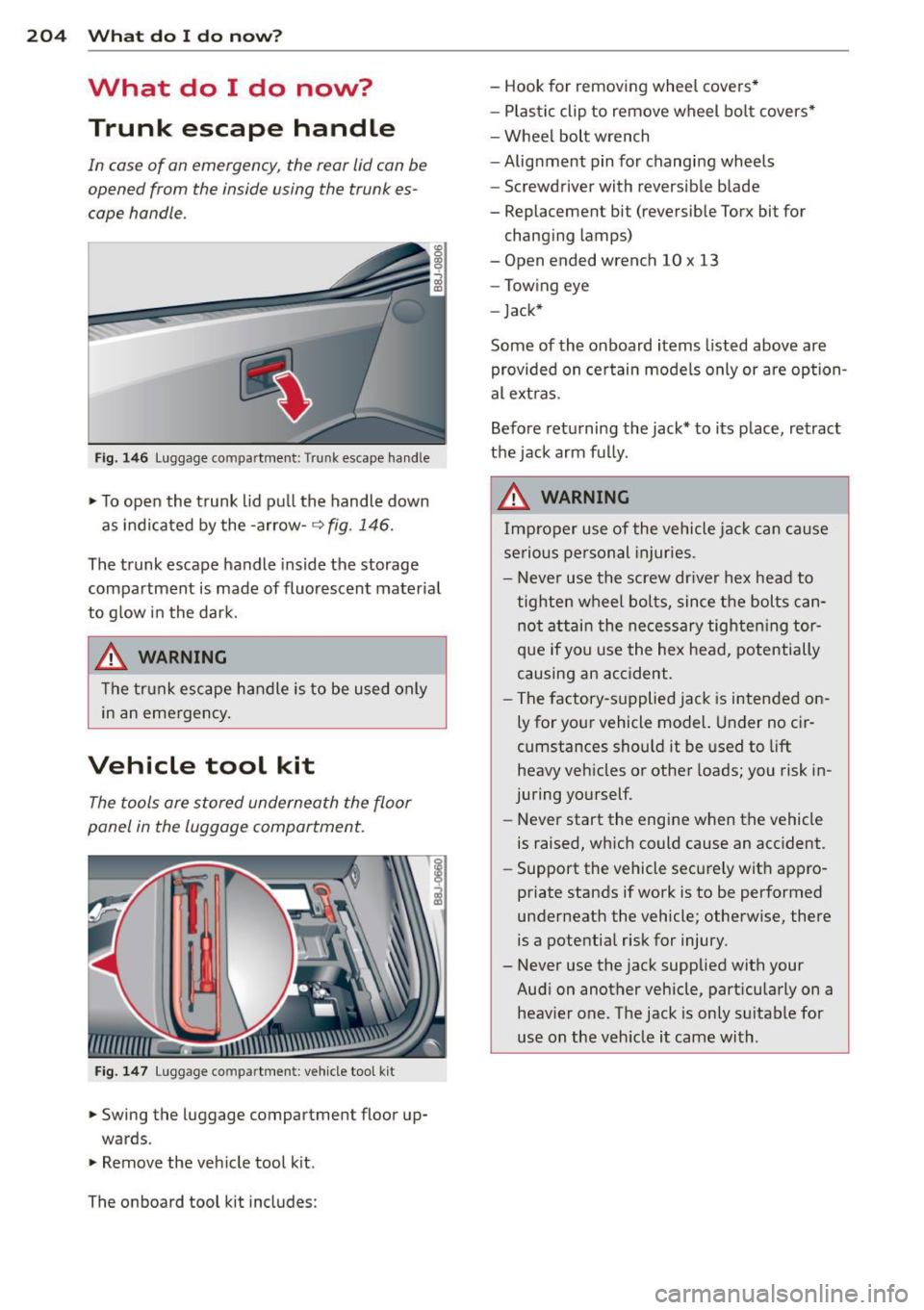
In case of an emergency, the rear lid can be
opened from the inside using the trunk es
cape handle.
Fig. 1 46 Luggage compartment: Trunk escape handle
... To open the trunk lid pu ll the handle down
as indicated by the -arrow-~
fig. 146.
The trunk escape handle inside the storage
compartment is made of fluorescent materia l
to g low in the dark.
A WARNING
The trunk escape handle is to be used only
in an emergency.
Vehicle tool kit
The tools are stored underneath the floor
panel in the luggage compartment.
Fig. 1 47 Luggage co mpa rtment : veh icle too l kit
... Swing the luggage compartment floor up
wards .
... Remove the veh icle tool k it.
The on board tool kit includes: -
Hook for removing wheel covers *
- Plastic clip to remove wheel bo lt covers•
- Wheel bolt wrench
-Alignment pin for changing wheels
- Screwdriver with reversible blade
- Replacement bit (reversible Torx bit for
chang ing lamps)
- Open ended wrench 10 x 13
- Towing eye
- Jack*
Some of the on board items listed above are
provided on certain mode ls only or are option
al ext ras.
Before returning the jack* to its place, retract
the jack arm fully .
A WARNING
Im proper use of the vehicle jac k can cause
serious personal injuries .
- Never use the screw driver hex head to tighten wheel bo lts, since the bolts can
not attain the ne cessary tighten ing tor
que if you use the hex head, potentially
causing an accident.
- The factory-supplied jack is intended on ly for your vehicle model. Under no cir
cumstances should it be used to lift
heavy vehicles or other loads; you risk in
juring yourself.
- Never start the engine when the vehicle
is raised, wh ich could cause an acc ident.
- Support the vehicle secure ly wit h appro
priate stands if work is to be performed
underneath the vehicle; otherwise, there
is a potential risk for injury.
- Never use the jack supplied with your
Audi on another vehicle, part icularly on a
heavier one. The jack is only su itable for
use on the veh icle it came with .
Page 210 of 244
208 What do I do now ?
A WARNING
If tire pressure is less than 1.3 bar after
driving for 10 m inutes, the tire is too se
verely damaged . Do not continue to d rive .
Seek professional assistance .
@ Tips
After a tire repair, have the sealant bo ttle
replaced at a dealersh ip. This restores full
functionality to t he Tire Mob ility System .
What should I be
aware of when
changing a tire?
General information
The fo llow ing se ctions will prov ide yo u with
importa nt information o n how to change a
tire using the vehicle tool kit .
H oweve r, we recomme nd that you have a
q uali fied servi ce center change t he tire and
perform all work associated with changi ng it.
Wheels with cap-covered wheel bolts
Applies to vehicles: with cap-covered wheel bolts
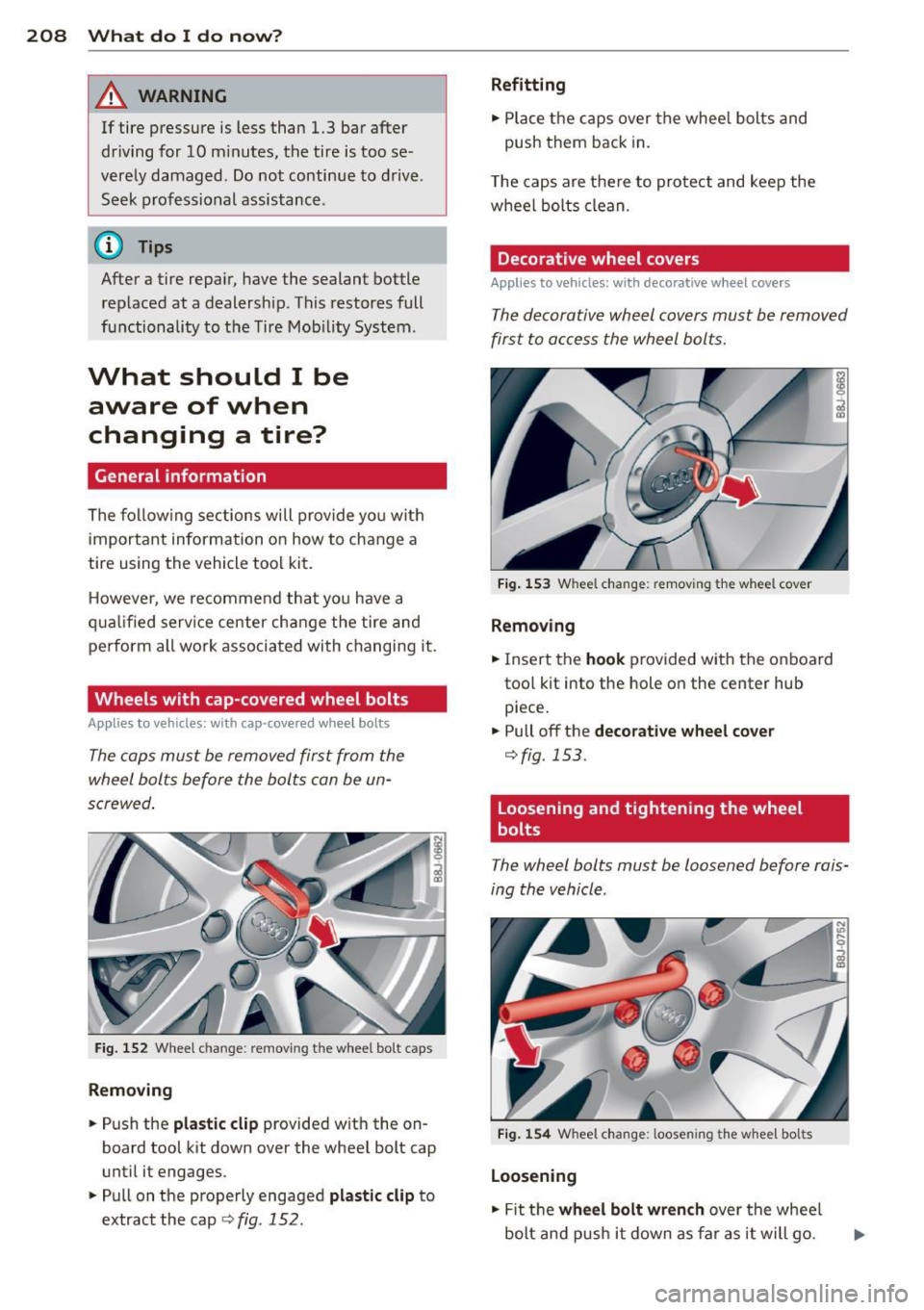
The caps must be removed first from the
wheel bolts before the bolt s can be un
screwed .
Fig. 152 W hee l chan ge: remo ving th e whee l b o lt c aps
R em oving
.. Push the plastic cl ip provided w it h the on
bo ard tool k it down over the wheel bolt cap
until i t engages .
.,. Pull on the properly engaged
plastic clip to
extract the cap
r:> fig . 152 .
Refitting
.,. Place the caps over the whee l bolts and
push them back in.
T he caps are the re to protect and keep the
whee l bolts clean .
Decorative wheel covers
Applies to vehicles: with decorative wheel covers
The d ecorative wheel covers must be remov ed
first to acc ess the wheel bolts.
Fi g. 1 53 Wheel c hang e: re moving t he wh eel c over
Removing
.. Insert the hook provided with the o n board
too l kit into the hole on the center hub
piece .
.. Pull off the
decor ative wheel cover
r:>fig.153 .
Loosening and tightening the wheel
bolts
T he wheel bolts mus t be loosened before rais
ing the vehicle .
Fig . 1 54 Whee l cha nge: loose ning t he whee l bol ts
Loosening
., Fit t he whe el bolt wren ch over the whee l
bolt an d pus h it down as far a s it will go .
Page 211 of 244
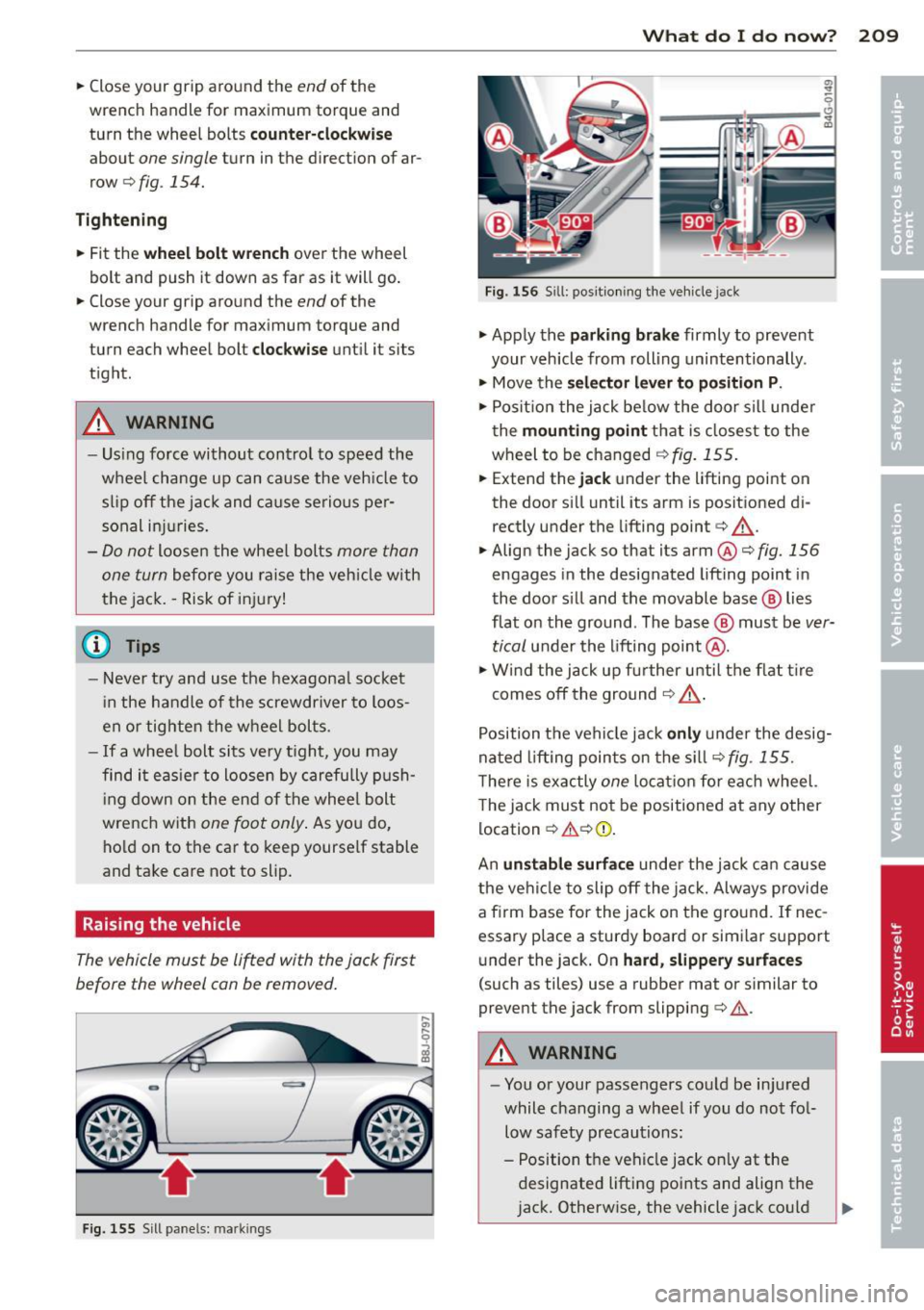
.. Close your grip around the end of the
wrench handle for maximum torque and
turn the wheel bolts
c ounter-clockwis e
about one single turn in the direct ion of ar
row
r:> fig . 154.
Tightening
.. Fit the wheel bol t wrench over the wheel
bolt and push it down as far as it will go .
.. Close your grip around the
end of the
wrenc h handle for maximum torque and
turn each wheel bolt
cl ock wis e unt il it sits
t ight .
A WARNING
-Us ing fo rce without control to speed the
wheel change up can cause the veh icle to
slip off the jack and ca use se rious pe r
sonal in juries.
-Do not loosen the wheel bolts more than
one turn
before you ra ise the veh icle with
the jack. -Risk of inj ury!
(1) Tips
- N ever t ry and use the hexagona l socket
i n the handle of the screwdriver to loos
en or tighte n the wheel bolts .
- If a whee l bolt sits very t ight, you may
find i t easie r to loosen by carefully p ush
i ng down on the end of the whee l bolt
wrench with
one foot only . As you do,
ho ld on to the car to keep yourse lf stable
and ta ke care not to slip .
Raising the vehicle
The vehicle must be lifted with the jack first
before the wheel can be removed .
..
Fig. 155 Sill p ane ls: m arkin gs
What do I do now ? 209
Fig. 1 56 Sill : pos itio ning the ve hicle jac k
.. App ly the pa rkin g brake firmly to prevent
your veh icle from rolling unintentionally .
.. Move the
se lect or lever to p osition P .
.. Posit io n the jack be low the door sill unde r
t he
m ounting point tha t is closest to the
wheel to be changed
r=> fig. 155 .
.. Extend the jack under the lifting point on
the door s ill until its arm is positioned di
rectly under the lifting point
c> ,& .
.. Align the jack so that its arm@¢ fig. 156
engages in the designated lift ing point in
the door s ill and the movable base ® lies
flat on the ground . The base @ must be
ver
tical
under the lifting point @ .
.. Wi nd the jack up fu rther u ntil t he f lat t ire
comes off the ground
c> ,& .
Position t he vehicle jack only under the desig
na ted lifting points on the s ill
r:>fig . 155.
T he re is exactly one locat io n for eac h wheel.
T he jack must not be positioned at any other
location ¢
,&¢(D .
An unstable surfa ce unde r the jack ca n cause
the ve hicl e to slip off the jack. Always provide
a firm base for the jack on the gro und . If nec
essary place a sturdy board or s im ilar support
u nder the jack. On
hard , slippery surf aces
(such as tiles) use a rubber mat or similar to
prevent the jack from slipping ¢
.&.
A WARNING
-You or your passengers cou ld be in jured
while changing a wheel if you do not fo l
low safety precautions:
- Position the veh icle jack on ly at the
designated lifting poi nts and align the
j ack. Otherwise, the vehicle jack co uld
Page 212 of 244
210 What do I do now?
slip and cause an injury if it does not
have sufficient hold on the vehicle.
- A soft or unstable surface under the
jack may cause the vehicle to slip off
the jack. Always provide a firm base for
the jack on the ground . If necessary,
use a sturdy board under the jack.
- On hard, slippery surface (such as tiles)
use a rubber mat or similar to prevent
the jack from slipp ing .
- To help prevent injury to yourself and
your passengers:
- Do not raise the vehicle unti l yo u are
sure the jack is securely engaged.
- Passengers must not remain in the ve
hicle when it is jacked up.
- Make sure that passengers wait in a
safe p lace away from the vehicle and
well away from the roadway and traffic.
- Make sure jack position is correct, ad
just as necessa ry and then continue to
ra ise the jack .
(D Note
A floor jack or the pads on the hoist arms
must
not be posit ioned at the points
shown
-arrows- .
Taking the wheel off
Follow these instructions step-by-step for
changing the wheel.
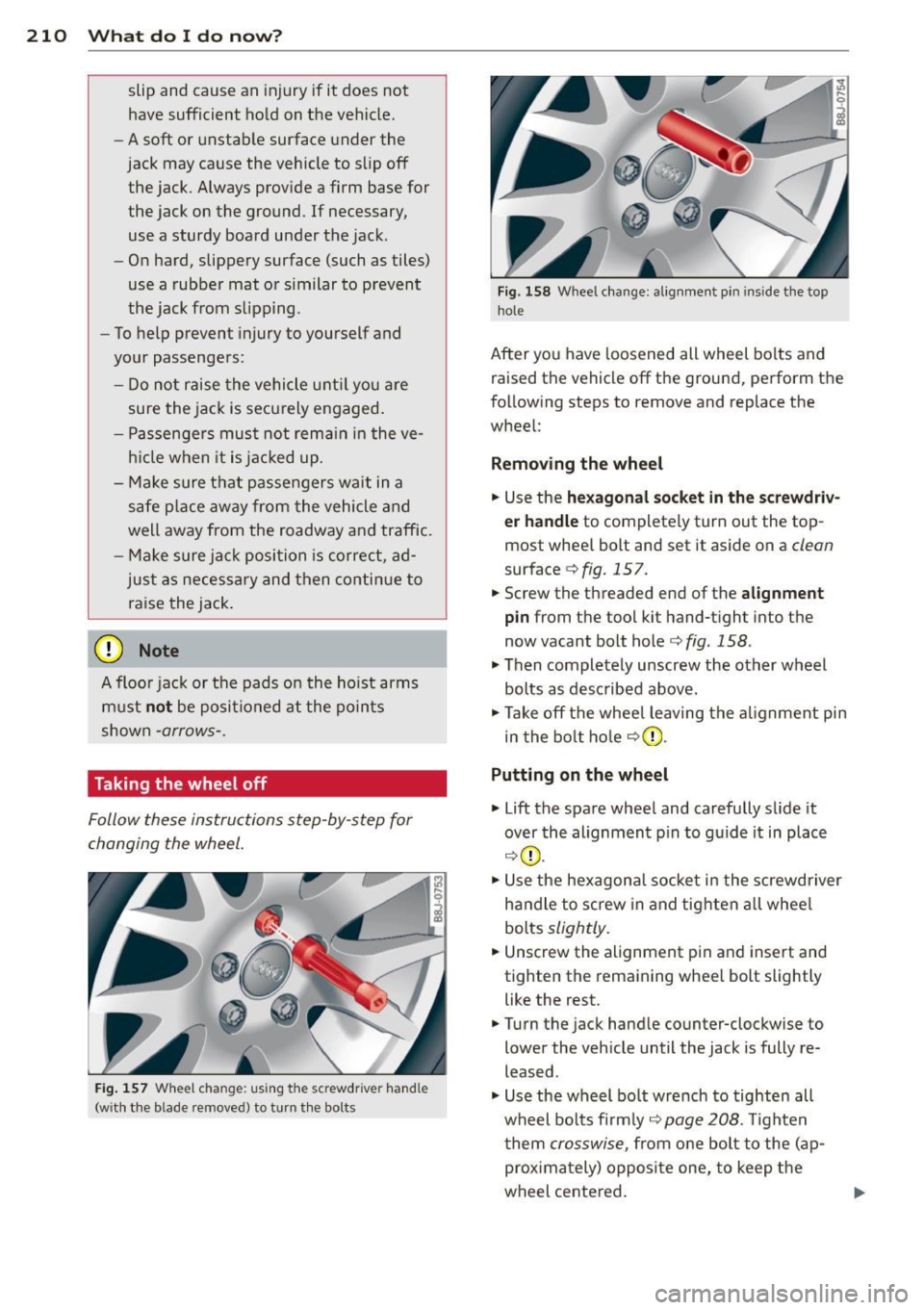
Fig. 157 Wheel ch an ge: us ing the sc rewdrive r hand le
(w ith the b lade removed) to turn the bolts
Fig. 158 Whee l change : alignmen t pin inside the top
hol e
After you have loosened all wheel bolts and
raised the vehicle off the ground, perform the
following steps to remove and replace the
wheel:
Removing the wheel
.,. Use the hexagonal socket in the screwdriv
er handle
to completely turn out the top
most whee l bolt and set it aside on a
clean
surface c;, fig. 15 7.
.,. Screw the threaded end of the
alignment
pin from the tool kit hand-tight into the
now vacant bolt hole <=>
fig. 158 .
.,. Then completely unscrew the other wheel
bolts as described above.
.,. Take off the whee l leaving the alignment pin
in the bolt hole
c;,(D .
Putting on the wheel
.,. Lift the spare wheel and carefully s lide it
over the alignment p in to guide it in place
c;,(D .
.,. Use the hexagonal socket in the screwdriver
handle to screw in and tighten all whee l
bolts
slightly .
.,. Unscrew the alignment p in and insert and
tighten the remaining wheel bolt slightly like the rest .
.,. Turn the jack handle counter-clockwise to
lower the vehicle until the jack is fully re
leased .
.,. Use the wheel bo lt wrench to tighten all
wheel bolts firmly ,=:,
page 208 . Tighten
t hem
crosswise, from one bolt to the ( ap
proximately) opposite one, to keep the
wheel centered.