ESP AUDI TT ROADSTER 2015 Repair Manual
[x] Cancel search | Manufacturer: AUDI, Model Year: 2015, Model line: TT ROADSTER, Model: AUDI TT ROADSTER 2015Pages: 244, PDF Size: 60.74 MB
Page 195 of 244
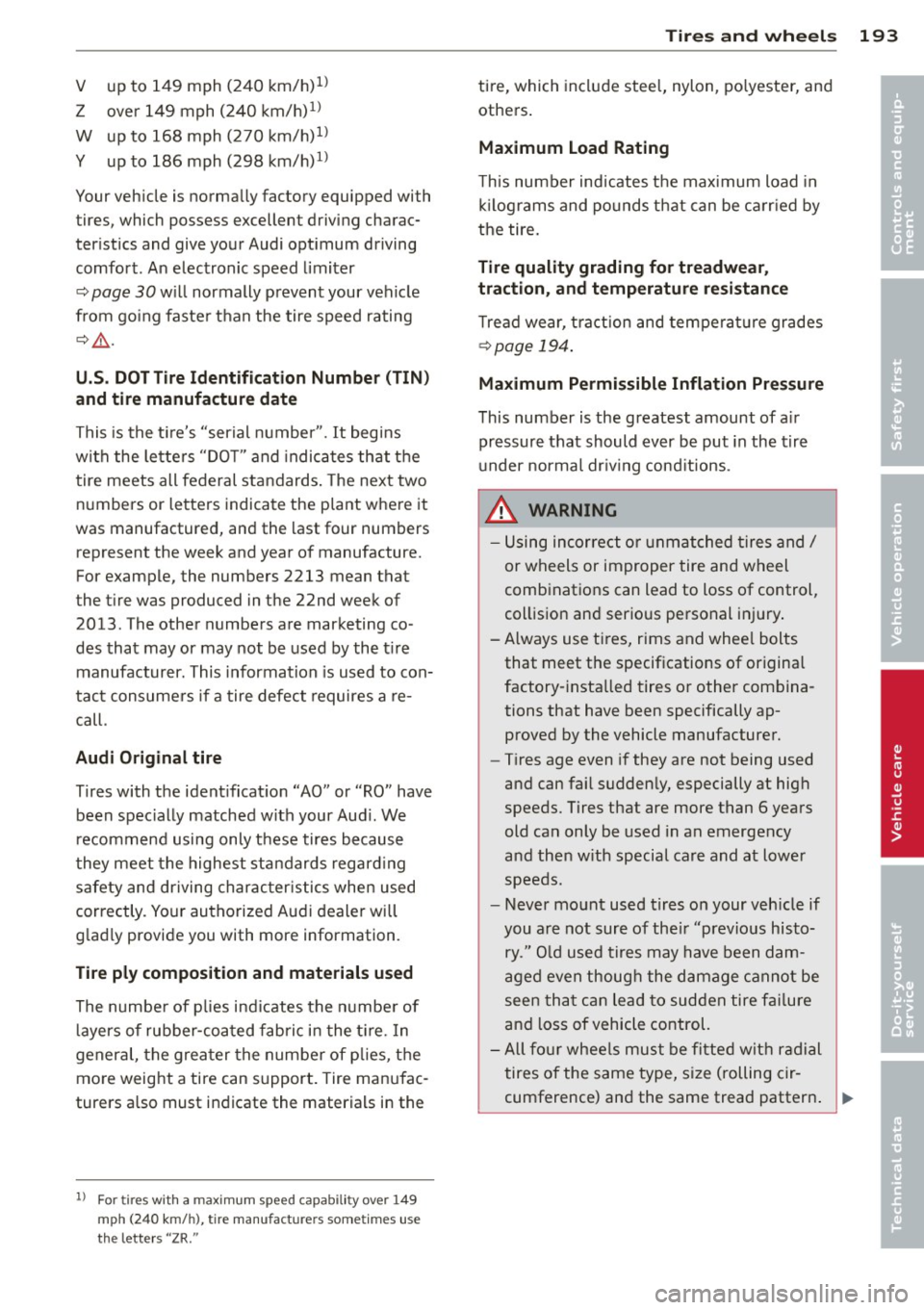
V up to 149 mph (240 km/h)l)
Z over 149 mph (240 km/h)
1
)
W up to 168 mph (270 km/h)ll
Y up to 186 mph (298 km/h)
1 )
Your veh icle is norma lly factory equipped with
t ires, which posses s excellen t driving charac
ter istics and give your Audi opt imum driving
comfort . An electronic speed limiter
¢ page 30 w ill normally prevent your vehicle
from go ing faste r th an the tire speed rating
¢ &_ .
U.S. DOT T ire Identification Number (TIN )
and tire manufactur e date
This is the t ire's "serial numbe r" . It begins
with the le tters "DOT" and indicates that the
tire meets all federal standards . The next two
numbers or letters indicate the p lant where it
was manufactured, and the last four numbers represent the week and year of manufactu re.
Fo r example, the numbers 2213 mean that
t he t ire was produced in the 22nd week of
2013 . T he other numbers are marketing co
des that may or may not be used by the t ire
manufacturer . This information is used to con
tact consume rs if a tire defect requires a re
call.
Audi Original tire
Tires with the ident ificat ion "AO" or "RO" have
been spec ially matched with your Aud i. We
recommend using only these tires because
they meet the highest standards regard ing
safety and driving charac ter istics whe n used
correctly. Yo ur authorized Audi dealer will
g lad ly provide you with more informat ion.
Tire ply composition and materials used
The numbe r of p lies ind icates the numbe r of
l ayers of rubber -coa ted fabric in the t ire. In
general, the greater the number of p lies, the
mo re weight a tire can support . Tire manufac
turers also must indicate the materials in the
1) F o r tires wit h a m ax im um s pee d ca pabil ity over 149
mph (2 4 0 k m/h) , tire ma nufa cturers some times use
t h e le tters "Z R."
Tire s an d wheel s 193
tire, which include stee l, nylon, po lyester, and
others .
Maximum Load Rating
This number indicates the max imum load in
kil ograms and po unds that can be ca rr ied by
the tire.
Tire quality grading for treadwear ,
tract ion , and temperature resistance
T read wear, t raction and tempe ra tur e grades
¢page 194 .
Maximum Permissible Inflation Pressure
This number is the greatest amount of a ir
pressure that should ever be put in the tire
u nder norma l dr iv ing cond itions .
_&. WARNING
-Using incorrect o r unm atc hed tires and/
or wheels or improper tire and wheel
comb inat ions can lead to loss of control
,
collision and serio us personal inj ury .
- Always use t ires, rims and whee l bolts
that meet the specifications of original
factory- insta lled tires or other combina
tions that have been specifically ap proved by the vehicle manufacturer.
- Tires age even if they are not being used
and can fai l sudden ly, especially at hig h
speeds. Tires that are more than 6 years
old can only be used in an emergency
and then w ith special care and at lower
speeds .
- Never mount used tires on your veh icle if
you are not sure of the ir "previous histo
ry ." O ld used tires may have been dam
a ged even thoug h the damage cannot be
seen tha t can lead to sudden tire fai lure
and loss of vehicle control.
.
- All fo ur whee ls must be fitted wit h ra dial
tires of the same type, size (rolling cir
cumference) and the same tread pattern . ..,
•
•
Page 197 of 244
The relative perform a nee of ti res depends
upon the actua l conditions of their use, how
ever, and may depart sign ificantly from the
norm due to var iat ions in dr iving habits, serv
ice practices and differences in road character
istics and climate .
Trac tion
The traction grades, from highest to lowest,
are AA, A, Band
C. Those grades represent the
tire's ability to stop on wet pavement as measured under controlled cond itions on
specified government test surfaces of asphalt
and concrete . A tire marked C may have poor
traction performance ¢,&. .
Temp erature
The temperature grades are A (the h ighest),
B, and
C, representing the t ire's resistance to
the generat ion of heat and its ability to dissi
pate heat when tested under controlled condi
tions on a specified i ndoor laboratory test
wheel.
Sustained high temperature can cause the
materia l of the tire to degenerate and reduce
tire life, and excessive temperature can lead
to sudden ti re fa ilu re ¢ ,&. .
The grade
C corresponds to a level of perform
ance which all passenger car tires must meet
u nder the Federa l Moto r Veh icle Safety Stand
a rd No.
1 09. G rades Band A represent h igher
l eve ls of perfo rmance on the laboratory tes t
wheel than the m inimum required by law .
A WARNING
The traction grade assigned to this ti re is
based on stra ight-ahead b raking t raction
tests, and does not include acceleration,
cornering, hydrop lan ing or peak traction
character istics.
A WARNING
The temperature grade for this t ire is es
tablished for a t ire that is p roperly inflated
and not overloaded. Excessive speed, un
derinflation, or excessive loading, either
-
Tire s an d wheel s 195
separately or in combinat ion, can ca use
heat bui ldup and possible tire failure.
Winter tires
Winter tires can improve vehicle handling on
snow and ice. At temperatures below 45 °F (7 °C) we recommend changing to winter
tires.
In some heavy snow areas, local governments
may require true winter o r "snow" tires, those
with very deeply cut tread. These tires should
o nly be used in pairs and be installed o n all
four wheels . Make sure you purchase snow
t ires that are the same size and construction
type as the other tires on you r vehicle.
If your vehicle is equipped w ith all-whee l
drive*, th is w ill improve traction during winter
driv ing, even with the standa rd tires. Howev
er, we stro ngly recommend that you always
equip all fou r whee ls o n your veh icle w ith co r
rect ly fi tted winter tires o r all-season tires,
when w inter road condit ions are expe cted .
T his also improves the veh icle's b raking per
formance and reduces stopping distances.
Summe r tires provide less grip on i ce and
snow.
Winter tires (snow tires) must always be fitted
o n all fo ur wheels .
Ask your authorized Audi dealer or qualified
workshop for permitted
winter tire size s. Use
o nly rad ial w inter t ires.
Winter tires lose their effectiveness when the
tread is worn down to a depth of
0 .157 inch
(4 mm) .
Only drive w ith w inter t ires under w inter con
dit ions. Summer t ires handle better when
there is no snow or ice on the roads and the
temperature is above 45 °F (7 °() .
If you have a flat tire, see notes on spare
whee l
¢page 191.
Please a lways remember that winter tires may
have a lowe r speed rating than the tires o rigi -
nally installed on your vehicle at the time it .,.
•
•
Page 200 of 244
198 Tire s and wheel s
or ridges on the road, part icu larly if the tire is
u nderinflated .
I n o rder to m inim ize the o ccurrence of impact
damage to the t ires of your vehicle, we recom
mend that you observe the following precau
tions:
- Always maintain recommended infla tion
pressures. Chec k your tire pressure every
2,000 miles (3,000
km) and add air if neces
sary .
- Drive carefu lly on roads with potholes, deep
gullies or ridges. The impact from driving
t h rough or over such obstacles can damage
your tires. Impact with a curb may also cause damage to your tires.
- After any impact, immediately inspect your
tires or have them inspected by the nearest
authorized Aud i dealer. Replace a damaged
t ire as soon as possible .
- Inspect your t ires every 2,000 miles (3,000
km) for damage and wear . Damage is not al
ways easy to see . Damage can lead to loss of
air and underinflation, wh ich could eventu
ally cause t ire failure . If you be lieve that a
t ire may have been damaged, replace the
t ir e as soon as possible.
- T hese tires may wea r mo re quick ly than oth
ers.
- Please a lso remember that, wh ile these t ires
deliver respons ive handling, they may ride
l ess comfortably and make mo re no ise than
other choices.
Reduced performance in winter /co ld
sea son condit ion s
All ti res a re des igned for certa in pu rposes.
The low aspect ratio, ultra high performance
tires originally installed on your vehicle are in
tended for max imum dry and wet road per
formance and handling. They are not suitable
for cold, snowy or icy weather condit ions. If
you dr ive under those circumstances, you
should equip your vehicle with all -season or
winter tires, which offer better traction under
those cond it ions. We suggest you use the rec
ommended snow or all-season tires specified
fo r your vehi cle, or their eq uivalent. Refer to
q page 195
for more detailed infor
mation regarding winter tires.
Tire pressure monitoring system
General notes
Applies to veh icles: w ith tire pressure monitoring system
Each tire, incl uding the spare ( if provided),
sho uld be checked monthly when co ld and in
flated to the inflation pressure recommended by the veh icle manufacturer on the veh icle
placard or tire inflation pressure label. (If your
vehicle has tires of a different size than the
s ize indicated on the vehicle placard or tire i n
flat ion p ressure label, you should dete rmine
the p roper t ire infla tion p ress ure fo r th ose
t i res.)
As an added safety featu re, your ve hicle has
been equipped with a tire pressure mon itoring
system ( TPMS) tha t illum inates a low ti re
pressure tel ltale when one o r more of your
tires is significant ly under-inflated . Acco rding
l y, when the low tire pressure telltale i llumi
nates, you shou ld stop and check your tires as
soon as possib le, and inflate them to the
proper pressure. Driving on a sign ificantly un
der- inflated t ire causes the tire to overheat
and can lead to tire fa ilure . Under-inflat ion al
so reduces fuel effic iency and tire tread life ,
and may affect the vehicle 's hand ling and
stopp ing abili ty.
Please note that the TPMS is not a substitute
for proper tire ma intenance, and it is the d riv
er's respons ibility to maintain co rrect tire
pressure, even if under-inflation has not
reached the leve l to tr igger illum inat ion of the
T PMS low tire pressu re tellta le .
You r vehicle has also been equipped w ith a
T PMS ma lf u nction indicator to ind icate when
the sys tem is not o perating p roperly . Th e
T PMS ma lfunction indicator is combined w ith
t h e low tire pressure te lltale. When the sys
tem detects a malfunction, the telltale will
flash for approximately one min ute and then ..,_
Page 202 of 244
200 Tires and wheels
pressure label¢ page 184. Driving on a
significantly under-inflated tire causes the tire to overheat and can lead to tire
failure . Under-inflation also is likely to
impair the vehicle's handling and stop
ping ability .
- The driver is responsible for mainta ining
the correct tire pressures. You must
check the tire pressures regularly.
- Under certain conditions (such as a spor
ty driving style, winter conditions or un
paved roads), the pressure monitor indi
cator may be delayed.
- Ask your author ized Audi dealer if run
flat tires may be used on your veh icle.
Your vehicle registration becomes inval id
if you use these tires when not permit
ted. Damage to your vehicle or accidents
cou ld also resu lt.
- If you switch between standard and run
flat tires, an authorized Audi dealer or
qualified workshop must reprogram the
control module .
@ Tips
-The tire pressure monitoring system may
stop working when there is an ESC mal
funct ion .
- Using snow chains may result in a system
malfunction.
- The tire pressure monitoring system on
your Audi was developed using tires with
the "AO" or "RO" identif ication on the
tire sidewall ¢
page 191. We recom
mend using these tires.
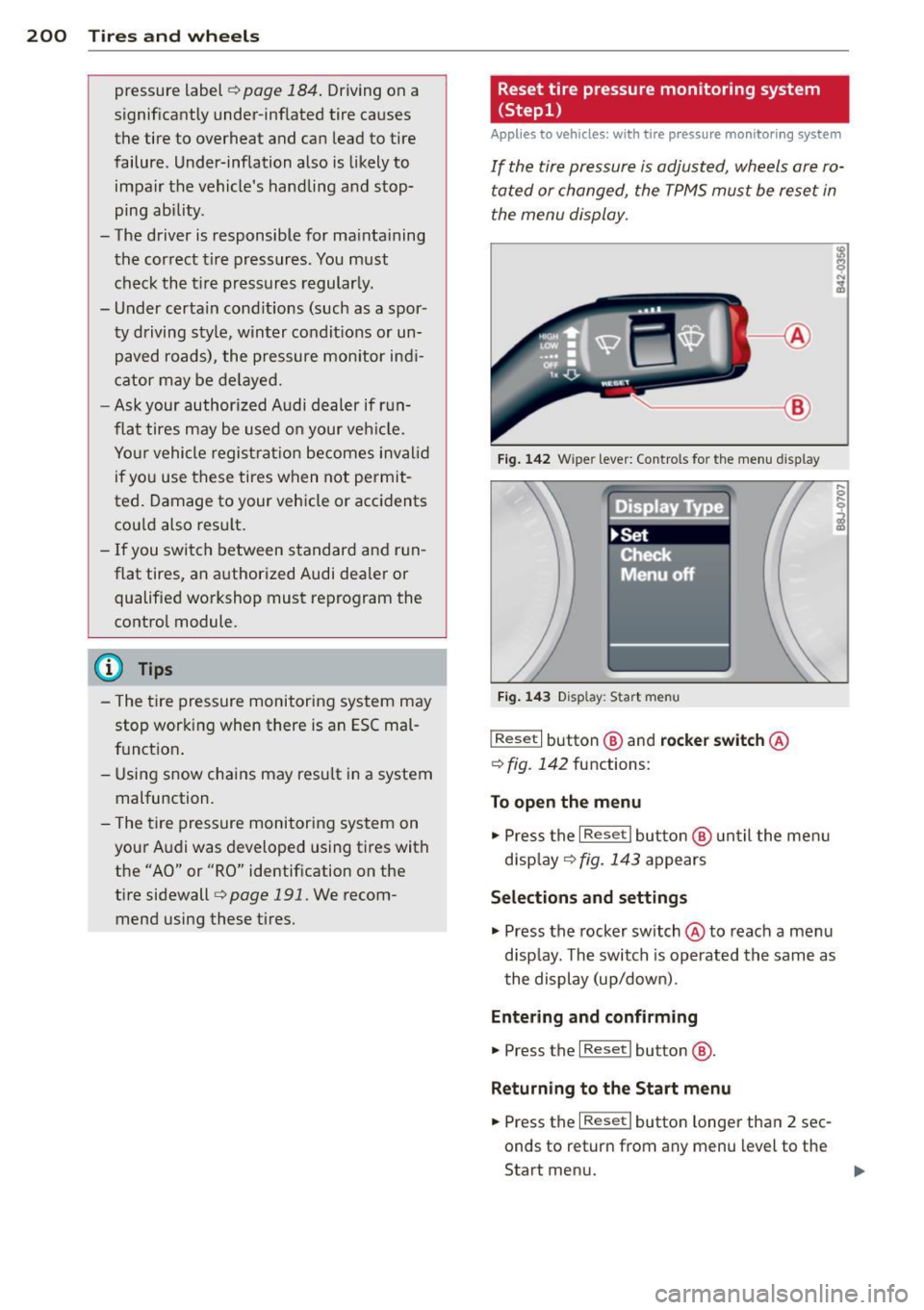
Reset tire pressure monitoring system
(Stepl)
Applies to vehicles: with tire pressure monitoring system
If the tire pressure is adjusted, wheels are ro
tated or changed, the TPMS must be reset in
the menu display.
----- ®
Fig. 142 Wiper lever: Contro ls fo r the menu displ ay
Fig. 143 Disp lay: S tar t m en u
I Reset I button @ and rocker switch @
¢
fig . 142 functions:
To open the menu
" Press the I Rese t I button @ until the men u
disp lay
¢ fig . 143 appears
Selections and settings
" Press the rocker switch @ to reach a menu
disp lay. The switch is operated the same as
the display (up/down) .
Entering and confirming
" Press the I Re set I bu tton @.
Returning to the Start menu
" Press the I Reset I button longer than 2 sec
onds to return from any m enu l evel to the
Start menu.
Page 205 of 244
Handling characteristics change when
driving with low air pressure or with flat
tires even with special run-flat tires
A low pressure or flat front tire affects vehicle
handling characteristics by pu lling the vehicle
slightly to the side where the tire is mounted
and reduces braking performance .
A low pressure or flat
rear tire also affects
driving character istics by pulling to the side
where the tire is mounted and also reduces
brak ing performance. The effect on vehicle
handling is most not iceable when driving
around curves.
A WARNING
Changed vehicle handling character istics
when driving in the run -f lat mode can
cause loss of vehicle contro l, a crash and
serious personal injury.
- Driving on special run-flat tires in the
run-f lat mode wi ll change vehicle han
dling characteristics during braking,
when cornering and under heavy acceler
ation.
- Never drive faster than the maximum
rated speed of 50 mph (80 km/h) when
dr iv ing in the run -flat mode.
- Always adjust vehicle speed to traffic,
road and weather cond itions and drive
slower than the max imum rated speed if
necessary weather and road conditions
are taken into account.
- Always obey speed limits and other traf
fic laws.
Q) Note
We always recommend driving w ith even
more care when using these special t ires in
the run-flat mode . Always avo id sudden
maneuvers.
Tires and wheels 203
Replacing run-flat tires and rims
App lies to veh icles : w it h Run -flat t ires
Your vehicle was especially designed to use
special run-flat tires.
You may use and combine only approved run
flat tires and special matching rims that have
been designed for run-flat tires. Mounting
special run-flat tires on standard wheels will not work and w ill not prov ide the advantages
fo the ru n-falt feature . Never use spec ial run
flat tires on standa rd wheel rims.
After dr iving with a tire i n the run-flat mode,
always have the veh icle and affected tire(s)
and rim(s) inspected by a n authorized Audi
dealer. Tires that have been driven in the run
f lat mode must be rep laced .
A WARNING
-Use of damaged run-flat tires and rims can
cause vehicle damage that can lead to loss
of vehicle control, a crash and serious per
sonal injury.
- Always have the vehicle and affected
tire(s) and r im(s) inspected by an author
ized Audi dealer after driving a tire in the
run-flat mode .
- Tires that have been dr iven in the run
f lat mode must be replaced.
•
•
Page 217 of 244
Bulbs
Replacing light bulbs
For your safety, we recommend that you have
your authorized Audi dealer replace burned
out bulbs for you .
It is becoming increasingly more and more
difficult to replace vehicle light bulbs since in many cases, other parts of the car must first
be removed before you are able to get to the
bu lb. This appl ies especially to the light bu lbs
in the front of your car which you can on ly
reach through the engine compartment .
Sheet metal and bulb ho lde rs can have sharp
edges that can cause ser ious cuts, and parts
must be correctly taken apart and then prop
erly put back together to help prevent break
age of parts and long term damage from wa
ter that can enter housings that have not been
properly resealed.
F or your safety, we recommend that you have
your authorized Audi dealer replace any bulbs
for you, since your dealer has the proper tools,
the correct bu lbs and the expertise.
G as disc harge la mp s (X enon li ght s)*:
Due to the high electrical voltage, have the
bu lbs rep laced by a qualified technician.
H eadlights with Xenon l ight can be ident ified
by the high voltage sticker .
A WARNING
Contact with hig h-voltage components of
the electrica l system and improper re
placement of gas discharge (Xenon) head
light bulbs can cause serious personal in
jury and death .
- Xenon bulbs are pressurized and can ex plode when be ing changed.
- Chang ing Xenon lamps requires the spe
c ial train ing, instructions and equip
ment.
- Only an authorized Aud i dea ler or other
qualified workshop should change the
bulbs in gas discharge lamps .
Fuses and bulb s 215
A WARNING
There are parts with sharp edges on the
openings and on the bulb holders that can
cause ser ious cuts.
- If you are uncertain about what to do,
have the work performed by an author
ized Audi dealer or other qualified work
shop. Ser ious personal i nju ry may result
from imprope rly perfo rmed wo rk.
(D Tips
- If you must replace the light bulbs your
self, always remember that the eng ine
compartment of any vehicle is a hazard
ous area to work in. A lways read and
heed a ll WARN INGS
°* page 164, Work
ing in the engine comportment"*&. .
- It is best to ask your authorized Audi
dealer whenever yo u need to change a
bulb .
• -
•
Page 223 of 244
Lifting vehicle
lifting with workshop hoist and with
floor jack
The vehicle may only be lift ed at the lifting
poin ts illustra ted.
F ig. 1 72 Rear lift ing point (right side)
Fi g. 1 73 Front lift ing po int fright side)
• Rea d and heed W ARNI NG¢,&. .
• Locate lifting points ¢fig . 172 Qfig . 173 .
• Adjust lifting arms of workshop hoist or
floor jac k to match vehicle lifting points.
• Inse rt a r ubber pad between the floor jack/
workshop hoist a nd the lifting poi nts.
If you must lift your vehicle with a floor jack
to work underneath, be sure the vehicle is safely supported on stands intended for this
purpose.
Front lifting point
The lifting point is locate d on the f loor pan re
inforcement about at the same level as the
jack mounting point¢
fig. 173. Do not lift
the vehicle at the vertical s ill reinforcement .
Rear lifting point
The lifting poi nt is locate d on t he vertical rein
forcement of the lower sill for t he on boa rd
jack
Q fig. 172.
Emergency situations 221
lifting with vehicle jack
Refer to c::> page 2 09.
_&. WARNING
- To reduce t he risk of ser ious injury an d
ve hicl e damage.
- Alwa ys lift the vehicle only at t he spe
c ial w orkshop hoist and floor jack lift
p oin ts ill ust rated ¢
fig. 172 and
¢fig. 173.
-Fa il ure to li ft th e ve hicle a t these
p o ints co uld cau se the ve hi cle t o til t or
f all from a lift if there i s a cha nge in ve
h icl e weigh t distr ibuti on and b alan ce.
This mi ght h appen, fo r ex am ple, whe n
h eavy co mponent s such as the eng ine
b lock o r transmission are remove d.
- Wh en re m oving hea vy components li ke
these, anchor vehicle to hoist or ad d co r
respo nding wei ghts to maintain t he ce n
ter of gravity. Ot herwis e, th e ve hicle
might tilt or slip off the ho ist, caus ing
serio us pe rsonal in jury.
CI) Note
-Be aware of the following points before
lifting the vehicle:
- The vehicle should never be lifted or
jacked up from underneath the engine
oil pan, the transmission housing, the
front or rear axle or the body side
members. This could lead to seriou s
damage.
- To avoid damage to the underbody or
chassis frame, a rubber pad must be inserted between the floor jack and
the lift points.
- Before driving over a workshop hoist ,
check that the vehicle weight does not
exceed the permissible lifting capacity
of the hoist.
- Before driving over a workshop hoist ,
ensure that there is sufficient clear
ance between the hoist and low parts
of the vehicle.
-
Page 227 of 244
Consumer Information
Warranty coverages
Your Audi is covered by the following war
ranties :
-New Vehicle Limited Warranty
- Limited Warranty Against Corrosion Perfo-
ration
- Emissions Control System Warranty
- Emissions Performance Warranty
- California Emissions Con trol Warranty (USA
vehicles only)
- California Emissions Performance Warranty
(USA vehicles only)
Detailed information regarding your warran
ties can be found in your
Warranty & Mainte
nance booklet .
Operating your vehicle
outside the U.S.A. or
Canada
Government regulations in the United States
and Canada require that automobiles meet
specific emission regulations and safety
standards. Therefore, veh icles built for the
U.S.A. and Canada differ from vehicles sold in
other countries .
If you p lan to take your vehicle outside the
continental limits of the United States or Can
ada, there is the possibility that:
- unleaded fuels for vehicles with cata lytic
converter may not be available;
- fuel may have a considerably lower octane
rating . Improper fuel may cause engine
damage ;
- service may be inadequate due to lack of
proper service facilities, tools or testing
equipment ;
- replacement parts may not be readily availa
ble.
- Navigation systems for vehicles built for the
U.S.A. and Canada will not necessari ly work
in Europe, and may not work in other coun
tries outside of North America.
Consumer Information 225
@ Note
Audi cannot be responsible for mechanical
damage that could result from inadequate
fuel, service or parts availab ility.
Audi Service Repair
Manuals and Literature
Audi Offic ial Factory Service Manuals and Lit
erature are published as soon as possible after
model introduction. Service Manuals and liter
atu re are availabl e to order from the Audi
T echnical Literature Ordering Center at:
www.audi.techliterature.com
Maintenance
' General
Your vehicle has been designed to help keep
maintenance requirements to a minimum.
However, a certain amount of regular mainte
nance is still necessary to assure your vehicle's
safety, economy and reliability . For detailed
vehicle maintenance consult your Warranty
&
Maintenance booklet.
Under difficult operating conditions , for ex
ample at extremely low outside temperatures ,
in very dusty regions, etc., some service work
shou ld be pe rformed between the intervals
specified. This applies particularly to:
- oil changes, and
- cleaning or replacing the air fi lter.
@ For the sake of the environment
By regu larly maintaining your vehicle, you
help make sure that emission standards
are maintained, thus min imizing adverse
effects on the environment.
Important considerations for you and
your vehicle
T he increasing use of electron ics, soph isticat
ed fuel injection and emission control sys
tems, and the generally increasing technica l
complexity of today's automobiles, have ..,_
•
•
Page 230 of 244
228 Consumer Information
Technical Modifications
Our guidelines must be complied with when technical modifications are made .
Always consult an authorized Audi dealer be
fore starting work on any modifications.
This will help ensure that vehicle function,
performance and safety are not impaired
¢ &. .
Attempting to work on electronic components
and the software used with them can cause
malfunctions. Because of the way electronic
components are interconnected with each
other, such malfunctions can also have an ad
verse affect on other systems that are not di
rectly involved. This means that you risk both
a substantial reduction in the operational
safety of your vehicle and an increased wear of
ve hicle parts ¢
A:,..
Author ized Audi dealers will perform th is
wo rk in a professiona l and competent manner
or, in special cases, refer you to a professional
company that specializes in such modifica
tions .
A WARNING
Improper repairs and modifications can
change the way vehicle systems work and
cause damage to the veh icle and serious
personal injury.
If emergency repairs must be performed
elsewhere, have the vehicle examined by
an authorized Audi dealership as soon as
possible.
Declaration of Compliance, Telecommu
nication or Electronic Systems
-
Radio Frequency Devices and Radiocommuni
cation Equipment User Manual Notice.
The manufacturer is not responsible for any
radio or TV interference caused by unauthor
ized modifications to th is equ ipment.
Devices
T he following devices each comply with FCC
Part 15.19, FCC Part 15.21 and RSS-Gen Issue
1:
- Cell phone package
- Electron ic immobilizer
- Homelink universal remote control
- Remote control key
FCC Part 15.19
This device complies with part 15 of the FCC
Rules . Operation is subject to the fo llowing
two conditions:
(1) This device may not cause harmful inter
f erence, and
(2) this device must accept any interference
received, including interference that may
cause undesired operation.
FCC Part 15.21
CAUTION:
Changes or modifications not expressly ap
proved by the party responsible for compli
ance could vo id the user's authority to operate
the equipment.
RSS-Gen Issue 1
Operation is subject to the following two con
ditions:
(1) this device may not ca use interference,
and
(2) this device must accept any interference,
including interference that may cause unde
s ired operation of the device.