warning light AUDI TT ROADSTER 2016 Owner's Manual
[x] Cancel search | Manufacturer: AUDI, Model Year: 2016, Model line: TT ROADSTER, Model: AUDI TT ROADSTER 2016Pages: 306, PDF Size: 31.82 MB
Page 39 of 306
Downloaded from www.Manualslib.com manuals search engine 0
N
,.....
N
......
0
,.....
Vl
CX) programming
operation has failed or the five
minute programming period has expired. Re
peat the programming procedure starting
with the 3rd step, or try holding the trans
mitter nearer or further away from the radia
tor grille.
9. If the garage door or other system still fails
to be activated using the buttons in the oper
ating unit after programming is completed,
it is possible that the system might be work
ing with a rolling code instead of the normal
fixed security code. If this is the case, a roll
ing code progr amming is required in addi
tion to the steps described above
¢page 37.
Follow the instructions above to program the
other two buttons. Start with the 3rd step.
Erasing the button programming
Programmed buttons can only be erased all at
once; it is not possible to erase them individually.
Reprogram the buttons if necessary.
� Switch on the ignition.
� Press and hold down the two outer buttons on
the operating unit until the yellow LED @
goes
out and the green LED CD
flashes.
Reprogramming the buttons
� Switch on the ignition.
� To reprogram an individual button, press and
hold the desired button until the green LED CD
goes out and the yellow LED @
starts to flash
(after about 20 seconds). Then release the but
ton immediately. The programming mode is
then activated for S minutes.
� Continue with the 5th step.
ij) Note
- The required distance between the hand
held transmitter and the Homelink module
inside the radiator grille¢ Fig. 29 depends
on the system you are programming.
- With some types of systems, you may need
to briefly release the button during pro
gramming and then press it again. When
programming a new device, keep the button
pressed for at least 15 seconds before try- Doors
and windows
ing again with the transmitter in a different
position. Watch out for your vehicle's haz
ard warning lights while doing so.
Rolling code programming
Applies to: vehicles with garage door opener (Homelink)
Some devices require rolling code programming.
Identifying a rolling code
� Press a programmed button in the operating
unit again and hold it down.
� Watch the green LED CD
¢ page 36, Fig. 28. If
the green LED starts flashing rapidly, this indi
cates that the system you wish to operate, such
as a garage door, is equipped with a rolling
code.
� Program the rolling code as follows:
Activating a system's drive unit
� Locate
the programming button on the sys
tem's drive unit. The exact location and colour
of the button may vary depending on the type
of system.
� Press
the programming button on the system's
drive unit (this will normally cause an indicator
lamp on the unit to light up). You now have
about 30 seconds to start and complete pro
gramming of the button in the operating unit.
Programming the button in the operating
unit
� Press the previously programmed button in the
operating unit for 2 seconds.
� Press the button for 2 seconds again to com
plete rolling code programming.
� For some systems, the button may have to be
pressed a third time to complete the program
ming sequence.
After programming, the system should recognise
the signal and respond when the button in the
operating unit is pressed. Now the other control
buttons can be programmed as required.
@ Note
- Having a second person assist you makes
programming of the rolling code easier and
faster. ..,_
37
Page 42 of 306
Downloaded from www.Manualslib.com manuals search engine Soft
top (folding roof)
� Note
- To avoid draining the vehicle battery, do not
operate the soft top repeatedly with the en
gine switched off.
-A message will be displayed in the instru
ment cluster if a soft top malfunction oc
curs ¢ page 40.
- The soft top can also be operated manually
in the event of a malfunction ¢page 41,
Manual operation of the soft top. The cause
of the fault should be traced and rectified
by a qualified workshop as soon as possible.
- If you park the car with the soft top open,
remember that this leaves the interior ex
posed to intruders and to potential damage
in sudden adverse weather. Lock any be
longings you leave behind in the luggage
compartment. Close the soft top before you
leave the vehicle unattended.
- The windows in the doors are automatically
lowered slightly while the soft top is open
ing/closing.
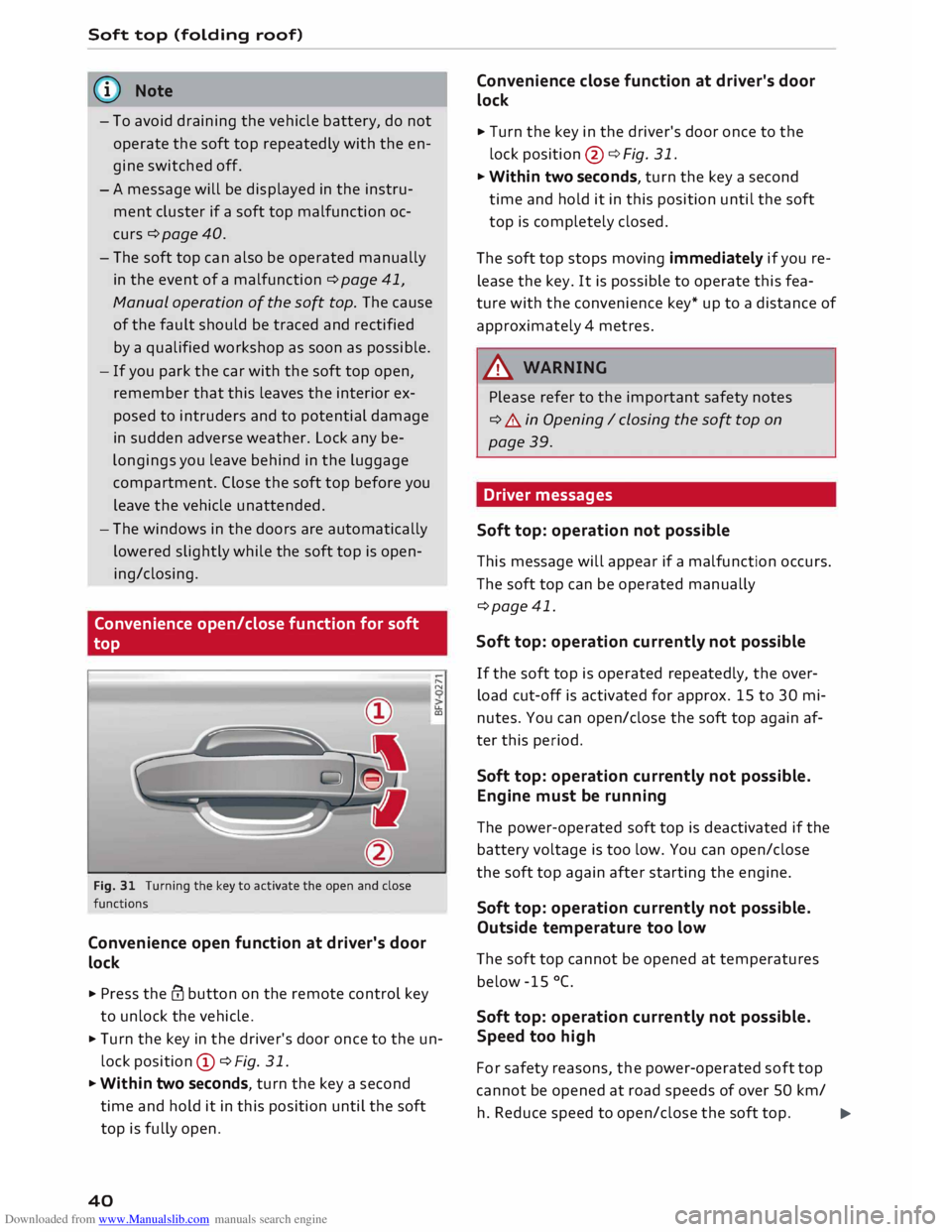
Convenience open/close function for soft
top
Fig. 31 Turning the key to activate the open and close
functions
Convenience open function at driver's door
lock
.. Press the@ button on the remote control key
to unlock the vehicle. .....
N
u..
a:,
.. Turn the key in the driver's door once to the un
lock position CD ¢Fig. 31.
.. Within two seconds, turn the key a second
time and hold it in this position until the soft
top is fully open.
40 Convenience
close function at driver's door
lock
.. Turn the key in the driver's door once to the
lock position @¢ Fig. 31.
.. Within two seconds, turn the key a second
time and hold it in this position until the soft
top is completely closed.
The soft top stops moving immediately if you re
lease the key. It is possible to operate this fea
ture with the convenience key* up to a distance of
approximately 4 metres.
A WARNING
Please refer to the important safety notes
¢ A in Opening I closing the soft top on
page 39.
Driver messages
Soft top: operation not possible -
This message will appear if a malfunction occurs.
The soft top can be operated manually
¢page 41.
Soft top: operation currently not possible
If the soft top is operated repeatedly, the over
load cut-off is activated for approx. 15 to 30 mi
nutes. You can open/close the soft top again af
ter this period.
Soft top: operation currently not possible.
Engine must be running
The power-operated soft top is deactivated if the
battery voltage is too low. You can open/close
the soft top again after starting the engine.
Soft top: operation currently not possible.
Outside temperature too low
The soft top cannot be opened at temperatures
below -15 °C.
Soft top: operation currently not possible.
Speed too high
For safety reasons, the power-operated soft top
cannot be opened at road speeds of over 50 km/
h. Reduce speed to open/close the soft top.
�
Page 46 of 306
Downloaded from www.Manualslib.com manuals search engine Lights
and vision
Lights and vision
Exterior lights
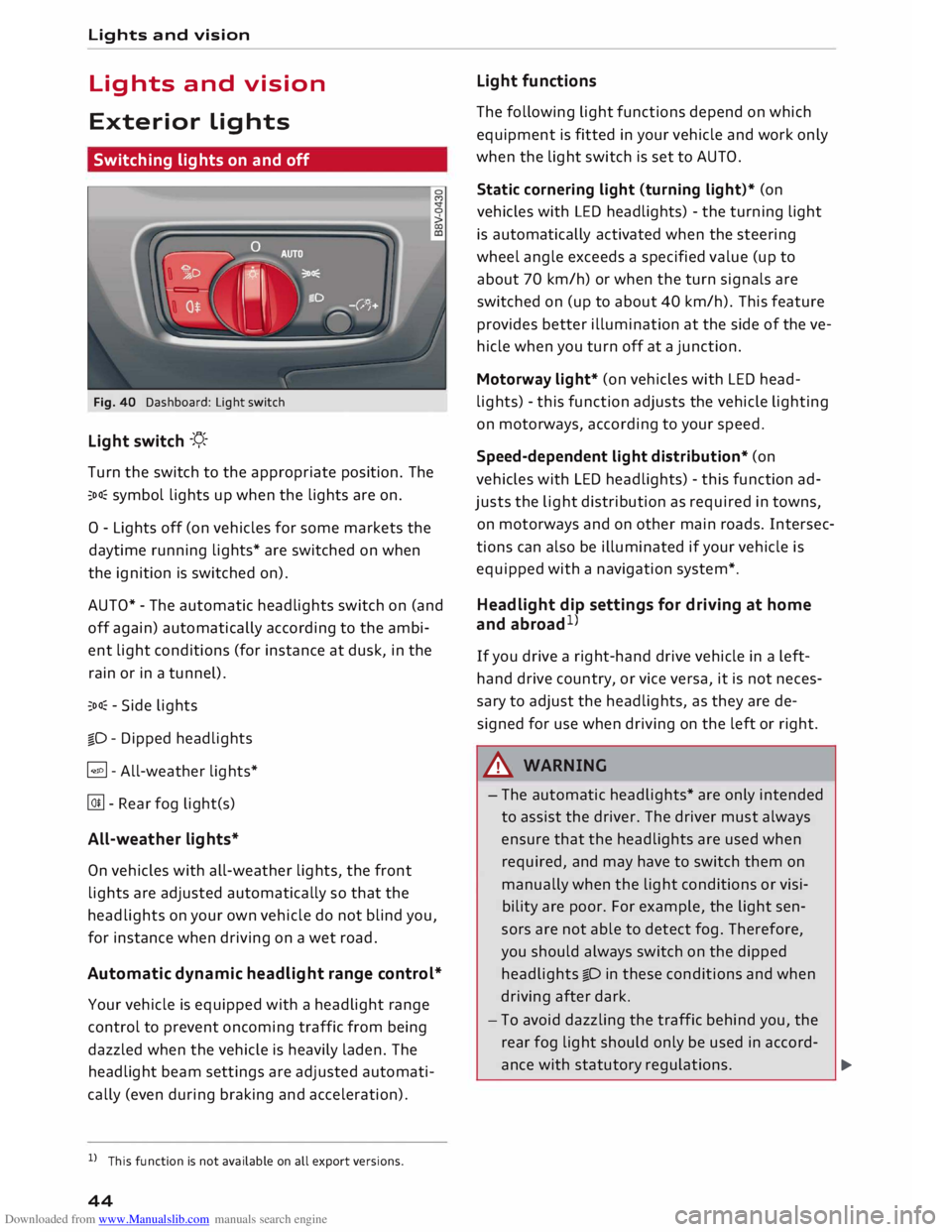
Switching lights on and off
Fig. 40 Dashboard: Light switch
Light switch -f/_-
T urn the switch to the appropriate position. The
::oo� symbol lights up when the lights are on.
0 - Lights off (on vehicles for some markets the
daytime running lights* are switched on when
the ignition is switched on).
AUTO* -The automatic headlights switch on (and
off again) automatically according to the ambi
ent light conditions (for instance at dusk, in the
rain or in a tunnel).
::oo� -Side lights
io -Dipped headlights
�- All-weather lights*
@!l - Rear fog Lig ht(s)
All-weather lights*
On vehicles with all-weather lights, the front
lights are adjusted automatically so that the
headlights on your own vehicle do not blind you,
for instance when driving on a wet road.
Automatic dynamic headlight range control*
Your vehicle is equipped with a headlight range
control to prevent oncoming traffic from being
dazzled when the vehicle is heavily laden. The
headlight beam settings are adjusted automati
cally (even during braking and acceleration).
l l
This function is not available on all export versions.
44 Light
functions
The following Light functions depend on which
equipment is fitted in your vehicle and work only
when the Light switch is set to AUTO.
Static cornering light (turning light)* (on
vehicles with LED headlights) -the turning Light
is automatically activated when the steering
wheel angle exceeds a specified value (up to
about 70 km/h) or when the turn signals are
switched on (up to about 40 km/h). This feature
provides better illumination at the side of the ve
hicle when you turn off at a junction.
Motorway light* (on vehicles with LED head
lights) -this function adjusts the vehicle Lighting
on motorways, according to your speed.
Speed-dependent light distribution* (on
vehicles with LED headlights) -this function ad
justs the light distribution as required in towns,
on motorways and on other main roads. Intersec
tions can also be illuminated if your vehicle is
equipped with a navigation system*.
Headlight dip settings for driving at home
and abroad 1
)
If you drive a right-hand drive vehicle in a left
hand drive country, or vice versa, it is not neces
sary to adjust the headlights, as they are de
signed for use when driving on the left or right.
A WARNING
- The automatic headlights* are only intended
to assist the driver. The driver must always
ensure that the headlights are used when
required, and may have to switch them on
manually when the Light conditions or visi
bility are poor. For example, the light sen
sors are not able to detect fog. Therefore,
you should always switch on the dipped
headlights io in these conditions and when
driving after dark.
- To avoid dazzling the traffic behind you, the
rear fog light should only be used in accord-
ance with statutory regulations.
..,.
Page 47 of 306
Downloaded from www.Manualslib.com manuals search engine 0
N
,.....
N
....
0
,.....
Vl
CX) -
If the battery has been losing charge for a
while, the side lights or parking lights may
be switched off automatically. Always park
your car in a safe and suitably lit place ac
cording to the applicable regulations. Avoid
using the side lights for long periods (sever
al hours). If possible, switch the left or right
parking lights on.
- Observe all relevant statutory requirements
when using the lighting systems described
here.
(D} Note
- The light sensor for the automatic head
lights* is located in the mounting for the in
terior mirror. Do not affix any stickers on
this section of the windscreen.
- Some of the settings for the exterior light
ing can be adjusted ¢ page 47.
-A buzzer will sound if you switch off the ig
nition and open the door when the exterior
lighting is on.
- On vehicles for some markets, the rear
lights switch on together with the daytime
running lights.
- In cool or damp weather, the inside of the
headlights, turn signals or rear lights can
sometimes mist up, due to the temperature
difference between the interior and exterior
of the car. They should clear again partially
or completely soon after you switch on the
headlights. This phenomenon has no influ
ence on the life expectancy of the vehicle
lights. Lights
and vision
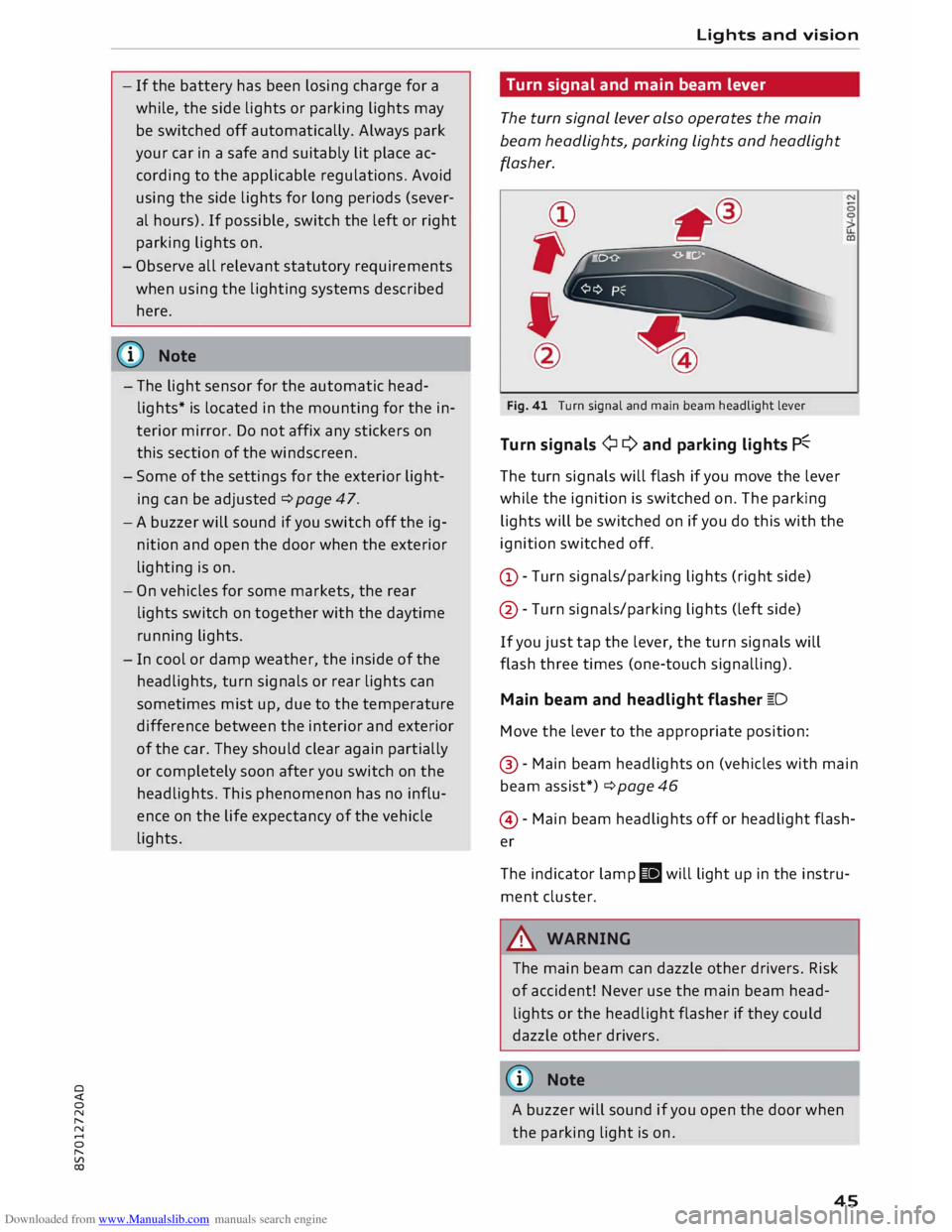
Turn signal and main beam lever
The turn signal Lever also operates the main
beam headlights, parking Lights and headlight
flasher.
Fig. 41 Turn signal and main beam headlight lever
Turn signals ¢ Q and parking lights P�
The turn signals will flash if you move the lever
while the ignition is switched on. The parking
lights will be switched on if you do this with the
ignition switched off.
(D -Turn signals/parking lights (right side)
@ -Turn signals/parking lights (left side)
If you just tap the lever, the turn signals will
flash three times (one-touch signalling).
Main beam and headlight flasher �D
Move the lever to the appropriate position:
@ -Main beam headlights on (vehicles with main
beam assist*) ¢ page 46
@ -Main beam headlights off or headlight flash
er
The indicator lamp II will light up in the instru
ment cluster.
A WARNING
The main beam can dazzle other drivers. Risk
of accident! Never use the main beam head
lights or the headlight flasher if they could
dazzle other drivers.
(© Note
A buzzer will sound if you open the door when
the parking light is on .
45
Page 48 of 306
Downloaded from www.Manualslib.com manuals search engine Lights
and vision
Main beam assist
Applies to: vehicles with main beam assist
The main beam assist automatically switches
the main beam headlights on or off depending
on the surrounding light conditions.
A sensor (Located in the mounting for the interior
mirror) detects light sources from other road
users. The main beams are activated or deactiva
ted automatically depending on the position of
vehicles on either side of the road, on the road
speed, and on other traffic and ambient condi
tions.
On vehicles with matrix LED headlights, individu
al segments of the main beam are activated or
deactivated. The relevant sector in front of the
vehicle is masked, while the surrounding areas
remain lit. The ambient surroundings are thus il
luminated optimally without dazzling other road
users.
Activating the main beam assist
Important: The light switch must be set to AUTO,
the dipped beam headlights must be on and the
main beam assist must be activated on the info
tainment system¢ page 47.
... Press the lever forwards ®¢ page 45, Fig. 41
to activate the main beam assist. The indicator
lamp� will light up in the infotainment dis
play and the main beams will be switched on/
off automatically. An indicator lamp. lights
up when the main beams are switched on.
Switching the main beams on/off manually
If the main beams are not switched on or if the
headlights are not dipped as expected, you can
control the dip function manually:
.., To switch on the main beams manually, push
the lever to position @. The indicator lamp.
will light up .
... To dip the headlights manually, pull the lever
towards you@. The main beam assist will be
deactivated.
Flashing the headlights
... Pull the lever towards you© to flash the head
lights when the main beam assist is activated
46 and
the main beams are dipped. The main
beam assist will remain activated.
Driver messages on the infotainment display
Main beam assist: fault. See owner's manual
Drive to a qualified workshop soon and have the
fault rectified. You can still switch the main
beam headlights on and off manually.
Main beam assist: currently unavailable. Cam
era view restricted due to surroundings. See
owner's manual
The camera vision is impaired, e.g. by stickers or
dirt.
The sensor is located between the interior mirror
and the windscreen. Do not affix any stickers on
this section of the windscreen.
A WARNING
The main beam assist is only intended to as
sist the driver. The driver must always ensure
that the headlights are used when required,
and may have to switch them on or off man
ually, e.g. when the light conditions or visibili
ty are poor. In the following situations man
ual intervention may be necessary:
- Hazardous weather conditions such as fog,
heavy rain and snow or water splashes
- Roads on which oncoming traffic is partially
concealed (e.g. on motorways)
- Indiscernible road users (e.g. cyclists with
insufficient lighting or vehicles with dirty
rear lights)
- Tight corners, steep hill crests or valleys
- Poorly lit towns
- Highly reflective objects, such as road signs
- Windscreen misted up, dirty, frosted or cov-
ered by stickers in front of the sensor
(CD) Note
The main beam assist is deactivated whenever
you intervene by switching the main beams
on or off manually @.
Page 49 of 306
Downloaded from www.Manualslib.com manuals search engine 0
N
,.....
N Adjusting
the settings for the exterior
lighting
You can change the settings for these functions
on the infotainment system .
.., Select the following on the infotainment sys
tem: I MENU
I button >Car> left control button
> Vehicle settings > Exterior lighting.
Automatic headlights
The following settings are available in the Auto
matic headlights menu:
Activation time -You can determine how soon
the lights are switched on by using the settings
early, medium or late to adjust the sensitivity of
the light sensor.
Main beam assist* -You can switch the main
beam assist* on and off.
Audi adaptive light* -You can switch the adap
tive light on and off.
Headlight dip settings for driving at home
and abroad
If you drive a rig ht-hand drive vehicle in a left
hand drive country, or vice versa, it is not neces
sary to adjust the headlights, as they are de
signed for use when driving on the left or right.
Entry/exit lights
The entry lights illuminate the area around the
vehicle after dark when the vehicle is unlocked.
To activate this function, select Entry/exit lights.
The exit lights illuminate the area around the ve
hicle after dark when the ignition has been
switched off and the driver's door opened. To ac
tivate this function, select Entry/exit lights.
The entry and exit lights are operational after
dark when the light switch is set to AUTO.
8 l} This function is not available on all models or export ver
,.....
� sions. Lights
and vision
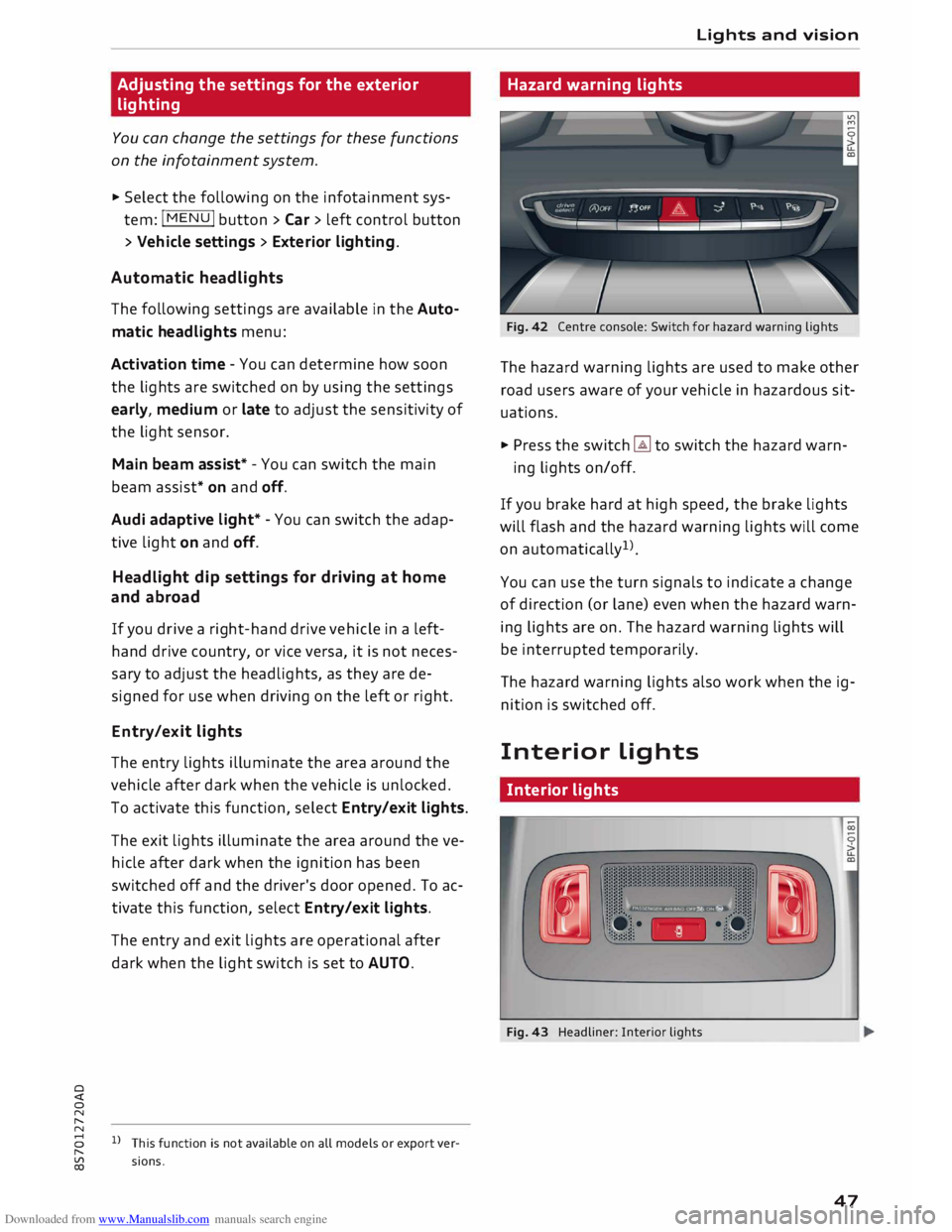
Hazard warning lights
Fig. 42 Centre console: Switch for hazard warning lights
The hazard warning lights are used to make other
road users aware of your vehicle in hazardous sit
uations.
.., Press the switch � to switch the hazard warn-
ing lights on/off.
If you brake hard at high speed, the brake lights
will flash and the hazard warning lights will come
on automatically 1
).
You can use the turn signals to indicate a change
of direction (or lane) even when the hazard warn
ing lights are on. The hazard warning lights will
be interrupted temporarily.
The hazard warning lights also work when the ig
nition is switched off.
Interior Lights
Interior lights
Fig. 43 Headliner: Interior lights
47
Page 50 of 306
![AUDI TT ROADSTER 2016 Owners Manual Downloaded from www.Manualslib.com manuals search engine Lights
and vision
[i]- Courtesy light position. The interior lights are
switched on and off automatically when this
function is acti](/img/6/57670/w960_57670-49.png "AUDI TT ROADSTER 2016 Owners Manual Downloaded from www.Manualslib.com manuals search engine Lights
and vision
[i]- Courtesy light position. The interior lights are
switched on and off automatically when this
function is acti")
Downloaded from www.Manualslib.com manuals search engine Lights
and vision
[i]- Courtesy light position. The interior lights are
switched on and off automatically when this
function is activated.
It is no longer necessary to operate a switch to
turn on the reading lights. Simply swipe or tap
your finger on the light to switch it on or off. The
light can be dimmed by keeping your finger in
contact with the reading light after switching it
on.
Interior lights
Various optional lighting functions are available
for the vehicle interior. The settings for certain
functions can be adjusted on the infotainment
system. Select the following on the infotainment
system: I MENU I button > Car > left control but
ton > Vehicle settings> Background lighting.
Instrument lighting
Fig. 44 Instrument lighting
The brightness of the lighting in the instrument
cluster and the centre console can be adjusted as
required.
.,. Briefly press the knob to release it.
.,. Turn the knob towards "-" or"+" to reduce or in
crease the brightness of the lighting.
.,. Briefly press the knob again to engage it.
48 Clear
vision
Adjusting the exterior mirrors
Fig. 45 Driver's door: Adjuster knob for exterior mirrors
Turn the knob to the appropriate position:
Q/P - To adjust the exterior mirror (left or right
side). Move the knob in the desired direction.
(fill - To heat the mirrors (depends on the outside
temperature).
8 - To fold in the exterior mirrors*. One of the
infotainment settings allows you to control
whether or not the mirrors are folded in when
you lock the vehicle �page 31.
Tilt function for exterior mirror on passenger
side*
The mirror is tilted slightly to provide a better
view of the kerb when parking backwards. This
feature only works when the knob is in the posi
tion for adjusting the mirror on the passenger
side.
You can adjust the tilted mirror surface by mov
ing the knob in the desired direction. This new
position is automatically stored and assigned to
the remote control key when you take the car out
of reverse .
The mirror returns to its original position as soon
as you drive forwards at over 15 km/h or switch
off the ignition.
A WARNING
Convex or wide-angle* exterior mirrors give a
larger field of vision. However, they make ob-
jects look smaller and further away than they
�
Page 51 of 306
Downloaded from www.Manualslib.com manuals search engine 0
N
,.....
N
......
0
,.....
Vl
CX) really
are. If you use these mirrors to esti
mate the distance to vehicles behind you
when changing lane, you could misjudge the
distance. Risk of accident!
CD CAUTION
If one of the mirror housings is knocked out
of position (e.g. when parking), the mirrors
must first be fully retracted with the electric
control. Do not readjust the mirror housing by
hand, as this will interfere with the mirror ad
juster function.
(!J) Note
If the electrical adjustment should fail to op
erate, both of the mirrors can be adjusted by
hand by lightly pressing the edge of the mir
ror glass.
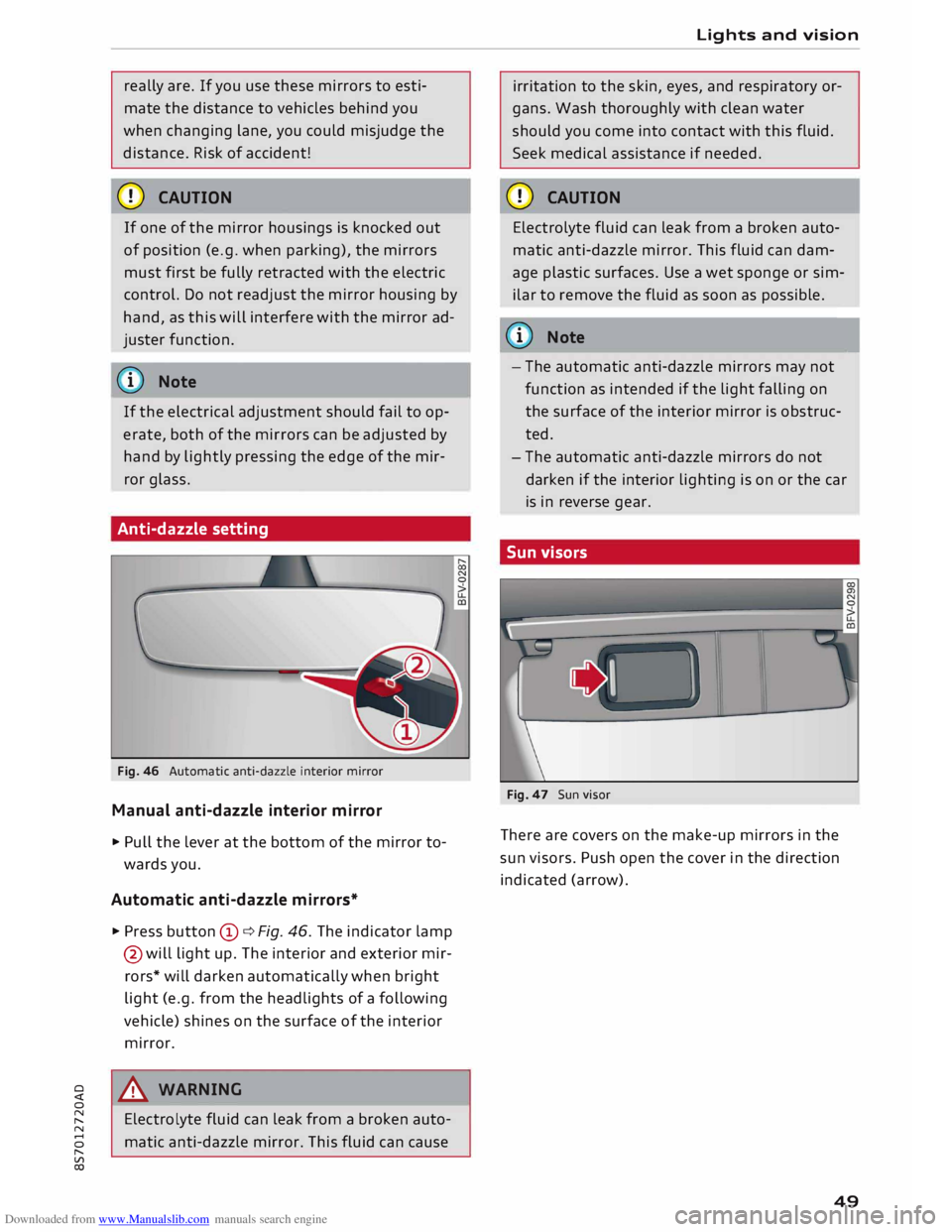
Anti-dazzle setting
Fig. 46 Automatic anti-dazzle interior mirror
Manual anti-dazzle interior mirror
... Pull the lever at the bottom of the mirror to
wards you.
Automatic anti-dazzle mirrors*
.., Press button (D ¢ Fig. 46. The indicator lamp
@ will light up. The interior and exterior mir
rors* will darken automatically when bright
light (e.g. from the headlights of a following
vehicle) shines on the surface of the interior
mirror.
8_ WARNING
Electrolyte fluid can leak from a broken auto
matic anti-dazzle mirror. This fluid can cause Lights
and vision
irritation to the skin, eyes, and respiratory or
gans. Wash thoroughly with clean water
should you come into contact with this fluid.
Seek medical assistance if needed.
CD CAUTION
Electrolyte fluid can leak from a broken auto
matic anti-dazzle mirror. This fluid can dam
age plastic surfaces. Use a wet sponge or sim
ilar to remove the fluid as soon as possible.
@ Note
- The automatic anti-dazzle mirrors may not
function as intended if the light falling on
the surface of the interior mirror is obstruc
ted.
- The automatic anti-dazzle mirrors do not
darken if the interior lighting is on or the car
is in reverse gear.
Sun visors
Fig. 47 Sun visor
There are covers on the make-up mirrors in the
sun visors. Push open the cover in the direction
indicated (arrow).
49
Page 52 of 306
Downloaded from www.Manualslib.com manuals search engine Lights
and vision
Windscreen wipers
Switching on the windscreen wipers
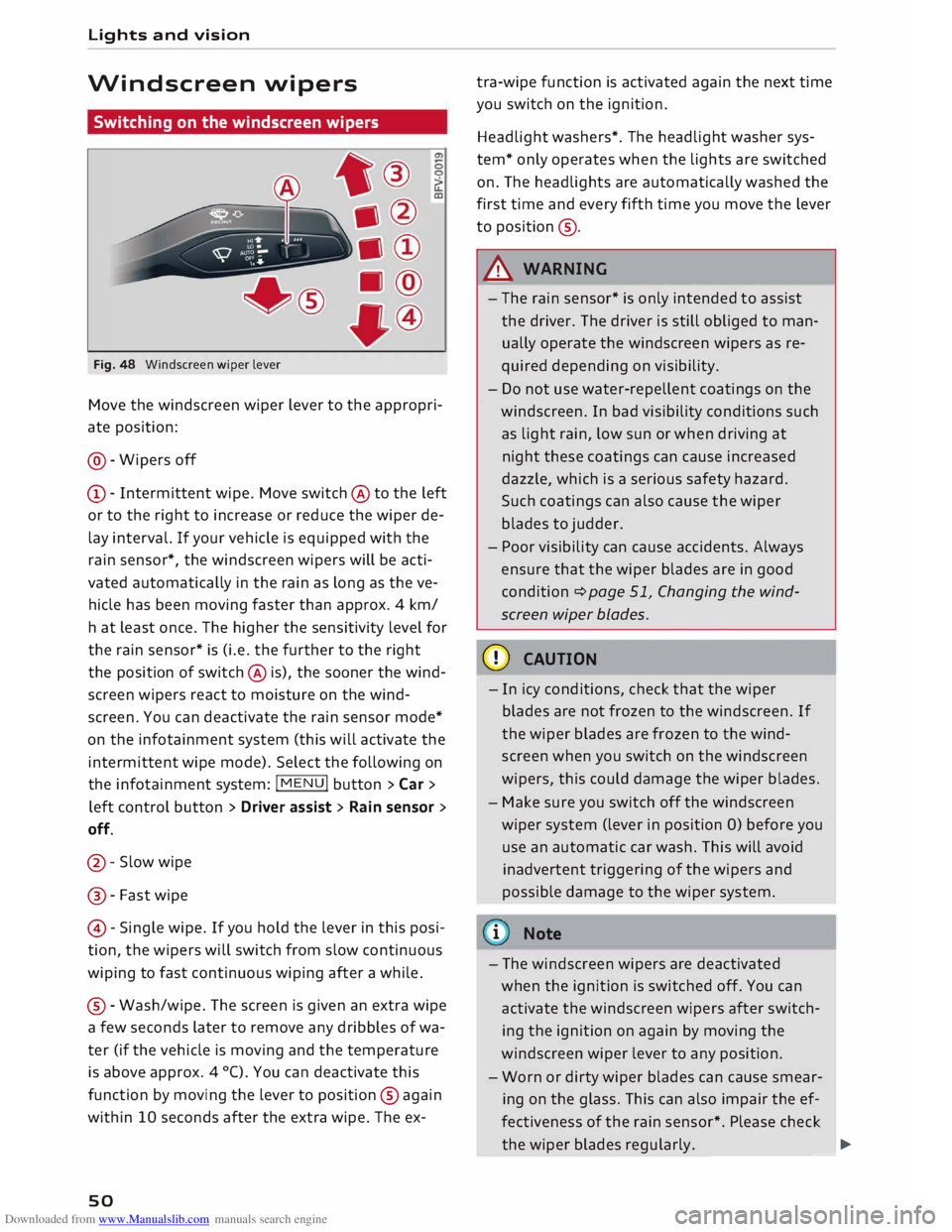
Fig. 48 Windscreen wiper lever
Move the windscreen wiper lever to the appropri
ate position:
@- Wipers off
CD- Intermittent wipe. Move switch @ to the left
or to the right to increase or reduce the wiper de
lay interval. If your vehicle is equipped with the
rain sensor*, the windscreen wipers will be acti
vated automatically in the rain as long as the ve
hicle has been moving faster than approx. 4 km/
ha t least once. The higher the sensitivity level for
the rain sensor* is (i.e. the further to the right
the position of switch @ is), the sooner the wind
screen wipers react to moisture on the wind
screen. You can deactivate the rain sensor mode*
on the infotainment system (this will activate the
intermittent wipe mode). Select the following on
the infotainment system: !MENU! button> Car >
left control button > Driver assist> Rain sensor >
off.
@- Slow wipe
@ -Fast wipe
@ -Single wipe. If you hold the lever in this posi
tion, the wipers will switch from slow continuous
wiping to fast continuous wiping after a while.
® -Wash/wipe. The screen is given an extra wipe
a few seconds later to remove any dribbles of wa
ter (if the vehicle is moving and the temperature
is above approx. 4 °C). You can deactivate this
function by moving the lever to position @again
within 10 seconds after the extra wipe. The ex-
so tra-wipe
function is activated again the next time
you switch on the ignition.
Headlight washers*. The headlight washer sys
tem* only operates when the lights are switched
on. The headlights are automatically washed the
first time and every fifth time you move the lever
to position ®·
A WARNING
- The rain sensor* is only intended to assist
the driver. The driver is still obliged to man
ually operate the windscreen wipers as re
quired depending on visibility.
- Do not use water-repellent coatings on the
windscreen. In bad visibility conditions such
as light rain, low sun or when driving at
night these coatings can cause increased
dazzle, which is a serious safety hazard.
Such coatings can also cause the wiper
blades to judder.
- Poor visibility can cause accidents. Always
ensure that the wiper blades are in good
condition ¢ page 51, Changing the wind
screen wiper blades.
CD CAUTION
- In icy conditions, check that the wiper
blades are not frozen to the windscreen. If
the wiper blades are frozen to the wind
screen when you switch on the windscreen
wipers, this could damage the wiper blades.
- Make sure you switch off the windscreen
wiper system (lever in position 0) before you
use an automatic car wash. This will avoid
inadvertent triggering of the wipers and
possible damage to the wiper system.
i Note
- The windscreen wipers are deactivated
when the ignition is switched off. You can
activate the windscreen wipers after switch
ing the ignition on again by moving the
windscreen wiper lever to any position.
- Worn or dirty wiper blades can cause smear
ing on the glass. This can also impair the ef
fectiveness of the rain sensor*. Please check
the wiper blades regularly. ______ �
Page 53 of 306
Downloaded from www.Manualslib.com manuals search engine 0
N
,.....
N
......
0
,.....
Vl
CX) -
The windscreen washer jets are heated*
when the ignition is switched on if the out
side temperature is low.
- If you stop briefly, e.g. at traffic lights, the
wiper speed setting will automatically be re
duced by one level.
Cleaning windscreen wiper blades
Clean the wiper blades if the wipers leave smear
ing on the glass. Clean the wiper blades using a
soft cloth and a glass cleaning solution.
11- Set the wiper arms to the service position
¢page 51.
11- Lift the wiper arms away from the glass.
A WARNING
Dirty wiper blades can impair the driver's view
- risk of accident!
Changing the windscreen wiper blades
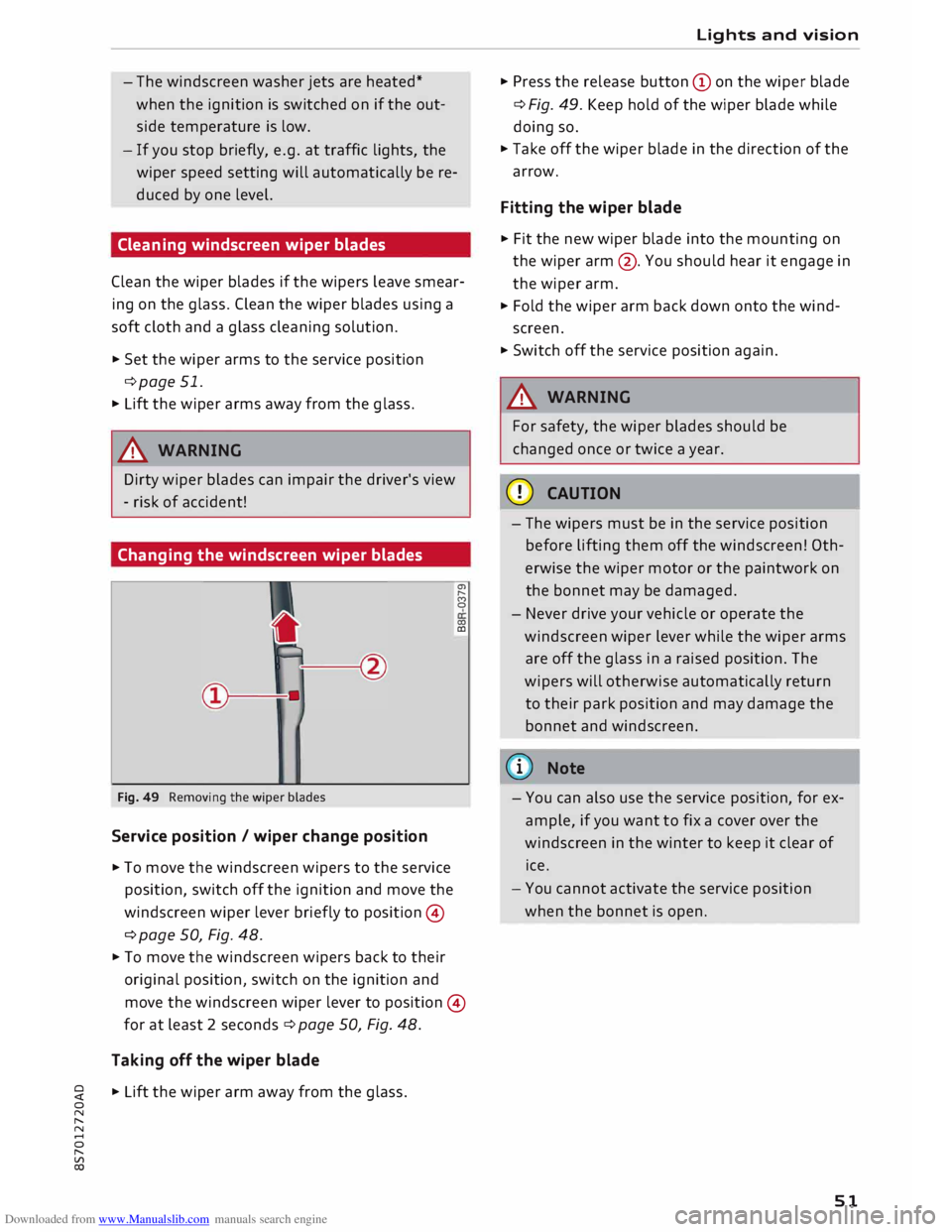
Fig. 49 Removing the wiper blades
Service position / wiper change position
11- To move the windscreen wipers to the service
position, switch off the ignition and move the
windscreen wiper lever briefly to position ©
¢ page 50, Fig. 48. a,
,._.
(')
0
0)
CD
11- To move the windscreen wipers back to their
original position, switch on the ignition and
move the windscreen wiper lever to position ©
for at least 2 seconds¢ page 50, Fig. 48.
Taking off the wiper blade
11- Lift the wiper arm away from the glass. Lights
and vision
11- Press the release button (Don the wiper blade
¢ Fig. 49. Keep hold of the wiper blade while
doing so.
11- Take off the wiper blade in the direction of the
arrow.
Fitting the wiper blade
11- Fit the new wiper blade into the mounting on
the wiper arm@. You should hear it engage in
the wiper arm.
11- Fold the wiper arm back down onto the wind
screen.
11- Switch off the service position again.
A WARNING
For safety, the wiper blades should be
changed once or twice a year.
CD CAUTION
- The wipers must be in the service position
before lifting them off the windscreen! Oth
erwise the wiper motor or the paintwork on
the bonnet may be damaged.
- Never drive your vehicle or operate the
windscreen wiper lever while the wiper arms
are off the glass in a raised position. The
wipers will otherwise automatically return
to their park position and may damage the
bonnet and windscreen.
(D) Note
- You can also use the service position, for ex
ample, if you want to fix a cover over the
windscreen in the winter to keep it clear of
ice.
- You cannot activate the service position
when the bonnet is open.
51