ESP AUDI TT ROADSTER 2018 Workshop Manual
[x] Cancel search | Manufacturer: AUDI, Model Year: 2018, Model line: TT ROADSTER, Model: AUDI TT ROADSTER 2018Pages: 310, PDF Size: 46.95 MB
Page 207 of 310
Cl 00 .-< N r-N .-< 0 r-Vl 00
in fact is not, or that the person on the seat
is heavier than he or she actually is. The
c h ange in electric capac itance b ecause o f
such obj ects can caus e the passenger front
airbag to be turned on when it should be
off, or can cause the a irbag to wo rk in a way
that is diffe rent from the way it would have
wor ked witho ut objec ts on the se at.
- Always make sure that the re is nothing on
the fron t passenger sea t that w ill cause the
c apa citi ve passenger dete ction system in
the seat to sign al to the Airbag Sys tem tha t
the seat is occupied by a person when it is not, or to signa l that it is occ upied by some
one who is heavier than the person actually
sitting on the seat. The presence of an ob
ject could cause the passenger front a irbag
to be t urned on when it sho uld be off, or
cou ld cause the ai rbag to wo rk in a way that
is d ifferent from the way it wou ld have
wor ked witho ut the ob je ct on the seat.
A WARNING
The fine dust cre ate d when air bag s d eploy can
c ause bre athing problems for peop le w ith a
history of asthma or other breathing condi
tions .
- T o reduce the risk of brea thing pro blems,
those w ith asthma or other respiratory con
ditions should get fresh air right away by
gett ing out of the veh icle or opening w in
dows o r doors.
- If you are in a collision in which airbags de
ploy, wash your hands and face with mild
soap and water before eat ing.
- Be careful not to get the dust into your eyes,
o r into any cuts or sc ratches.
- If the resi due should get into your eyes,
flush them with water .
Airbag syste m
Monitoring the
Advanced Airbag System
Airbag monitoring indicator light
T wo separate indi cators monitor the func tion of
t he Advan ced Airbag Sys tem: the
E,I ligh t and
t he
PASSENGER AIR BAG OFF '1,; ; ON @ light.
The Adva nced A irbag System as well as the s ide
airbags with e je ct ion m itigat ion fe atures (i nclud
i ng the e lectron ic cont ro l un it, senso rs and sys
tem wiring) are all monito red contin uous ly to
make su re that they are functioning proper ly
whenever the ignition is on. Eve ry t ime yo u tur n
o n the ignition, the a irbag system indicator light
m w ill come o n for a few seconds (function
check) .
The sy stem mu st be in spected when the
indicator light
E,I:
- does not come on when the ignition is sw itched
on,
- does not go out a few seconds afte r you have
sw itched on the ignition, or
- comes on while driv ing.
If an airbag system mal func tion is detected, t he
indicator light will come on to se rve as a constant
r eminder to have the system inspected immedi
ately.
If a ma lfunction occurs tha t turns the front air
bag on the passenge r side off , the
PASSENGER
AIR BAG OFF
'1,; ; light will come on and stay on
whenever the ignition is on.
A WARNING "---
An a irbag system that is not functioning prop
e rly cannot prov ide supplemental protect ion
i n a fronta l crash.
- If the ai rbag ind icator light
<=> page 14
comes when the veh icle is being used, have
the system inspected immedia tely by your
author ized Audi dealer . It is possib le that
the air bag will inflate when i t is not sup
posed to, or w ill not in flate w hen it should.
205
Page 211 of 310
Cl 00 .-< N r-N .-< 0 r-Vl 00
-Never install seat covers or replacement
upholstery over the front seatbacks that
have not been specifically approved by
Aud i.
- Never use add itiona l seat cushions that
cover the areas where the s ide airbags in
flate.
- Damage to the origina l seat covers or to
the seam in the area of the side airbag module must always be repaired immedi
ately by an authorized Audi dealer.
- The airbag system can deploy only once . Af
ter an airbag has been deployed, it must be
rep laced with new rep lacement parts de
signed and approved especially fo r you r
Audi mode l version. Replacement of com
plete airbag systems or airbag components
must be performed by qualified workshops
only . Make sure that any airbag service ac
tion is entered in your Audi Warranty
&
Maintenance booklet under AIRBAG RE
PLACEMENT RECORD.
- For safety reasons in severe accidents, the
alternator and starter are separated from
the vehicle battery with a pyrotechn ic circuit
interrupter.
-Work on the pyrotechnic circu it interrupt
er must only be performed by a qualified
technicians who have the experience, in
formation and special tools necessary to perform the work safely.
-If the vehicle or the circuit interrupter is
scrapped, all app licab le safety precautions
must be followed.
@ For the sake of the environment
Undep loyed airbag modu les and pretension
ers might be classified as Perch lorate Materi
al
-special handling may apply, see
www.dtsc.ca.gov/hazardouswaste/perchlo
rate . When the veh icle or parts of the re
straint system including airbag modules and
safety belts with p retensioners are scrapped,
all appli cable laws and regulations must be
observed. Your authorized Audi dealer is fa
m il iar with these requi rements and we re com
mend that you have you r dealer per form this
service for you.
Airbag syste m
Other things that can affect Advanced
Airbag performance
Changing the vehicle's suspension system can
change the way that the Advanced Airbag System
performs in a crash. For example, using tire-rim
combinations not approved by Audi, lowering the
vehicle, changing the stiffness of the suspension, including the springs, suspension struts, shock
absorbers etc . can change the forces that are
measured by the airbag sensors and sent to the
electronic cont rol u nit. Some suspension c hanges
can, for example, increase the fo rce leve ls meas
u red by the sensors and make t he a irbag system
deploy in crashes in which it wou ld not deploy if
the changes had not been made. Other kinds of
changes may reduce the force levels measured by
the sensors and prevent the a irbag from deploy
ing when it should.
A WARNING
-
Changing the vehicle's suspension including use of unapproved tire-rim combinations can
change Advanced Airbag perfo rmance and in
crease the risk of serious personal injury in a
crash.
- Never install suspension components that
do not have the same performance charac
ter istics as the components o riginally instal
led on your vehicle .
-Never use tire-rim combin ations that have
not been approved by Audi .
209
Page 213 of 310
Cl co .... N ,....
N .... 0 ,....
Vl co
How knee airbags work
The risk of injury to the leg area can be reduced
by fully inflated knee airbags.
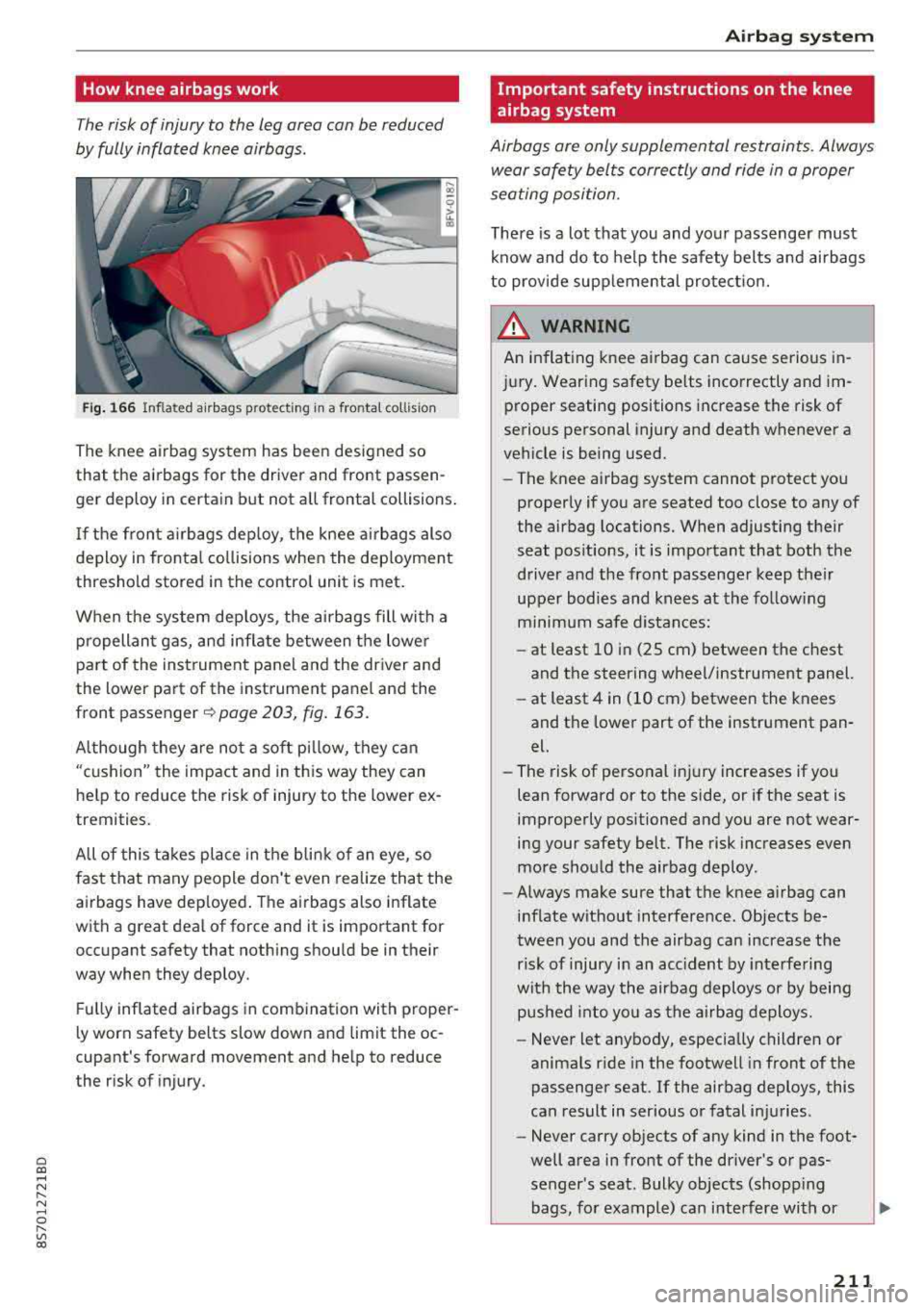
Fig. 166 Inflated airbags protecting in a frontal collision
The knee airbag system has been designed so
that the airbags for the driver and front passen
ger deploy in certain but not all frontal collisions.
If the front airbags deploy, the knee airbags also
deploy in frontal collisions when the deployment
threshold stored in the control unit is met.
When the system deploys, the airbags fill with a propellant gas, and inflate between the lower
part of the instrument panel and the driver and
the lower part of the instrument panel and the front
passenger ~ page 203, fig. 163.
Although they are not a soft pillow, they can
"cushion" the impact and in this way they can
help to reduce the risk of injury to the lower ex
tremities.
All of this takes place in the blink of an eye, so
fast that many people don't even realize that the
airbags have deployed. The airbags also inflate
with a great deal of force and it is important for
occupant safety that nothing should be in their
way when they deploy .
Fully inflated airbags in combination with proper
ly worn safety belts slow down and limit the oc
cupant 's forward movement and help to reduce
the risk of injury.
Airbag system
Important safety instructions on the knee
airbag system
Airbags are only supplemental restraints . Always
wear safety belts correctly and ride in a proper
seating position .
There is a lot that you and your passenger must
know and do to help the safety belts and airbags
to provide supplemental protection.
_& WARNING
-
An inflating knee airbag can cause serious in-
jury. Wearing safety belts incorrectly and im proper seating positions increase the risk of
serious personal injury and death whenever a
vehicle is being used.
-The knee airbag system cannot protect you properly if you are seated too close to any of
the airbag locations. When adjusting their
seat positions, it is important that both the
driver and the front passenger keep their
upper bodies and knees at the following minimum safe distances:
-at least 10 in (25 cm) between the chest
and the steering wheel/instrument panel.
-at least 4 in (10 cm) between the knees and the lower part of the instrument pan
el.
-The risk of personal injury increases if you
lean forward or to the side, or if the seat is
improperly positioned and you are not wear
ing your safety belt. The risk increases even
more should the airbag deploy .
- Always make sure that the knee airbag can
inflate without interference. Objects be
tween you and the airbag can increase the risk of injury in an accident by interfering
with the way the airbag deploys or by being pushed into you as the airbag deploys.
-Never let anybody, especially children or
animals ride in the footwell in front of the
passenger seat. If the airbag deploys, this
can result in serious or fatal injuries .
-Never carry objects of any kind in the foot
well area in front of the driver's or pas
senger's seat. Bulky objects (shopping bags, for example) can interfere with or
~
211
Page 215 of 310
Cl co .... N ,....
N .... 0 ,....
Vl co
with deployed side airbags. Remember too, side
airbags wi ll deploy on ly once and on ly in certain
kinds of acc idents -your safety be lts are always
there to offer protection.
Vehicle damage, repair costs or even the lack of
ve hicle damage are not necessarily an indication
of over-sensitive or failed airbag act ivation. In
some collisions, both front and side a irbags may
inflate. Remember too, that airbags will deploy
only once and only in ce rtain kinds of coll is ions
-
your safety belts are always there to offer protec
tion in those acc idents in which airbags are not
supposed to deploy or when they have already
deployed.
The side airbag system will not deploy:
-when the ign ition is switched off
-in side collisions when the acceleration meas-
ured by the sensor is too low
-in front-end collisions
-in rear-end collisions
-in rollovers.
I n some types of accidents the front airbags and
side airbags may be triggered together.
_& WARNING
-Safety belts and the airbag system will only
provide protection when occupants are in
the proper seating position¢
page 214.
-If the airbag indicator light q page 14
comes when the vehicle is being used, have
the system inspected immed iate ly by your
authorized Audi dealer. It is possible that
the a irbag will inflate when it is not sup
posed to, or will not inflate when it should.
Airbag system
How supplemental side airbags work
Side airbags deploy instantly and can help re
duce the risk of upper torso injuries for occu
pants who are properly restrained.
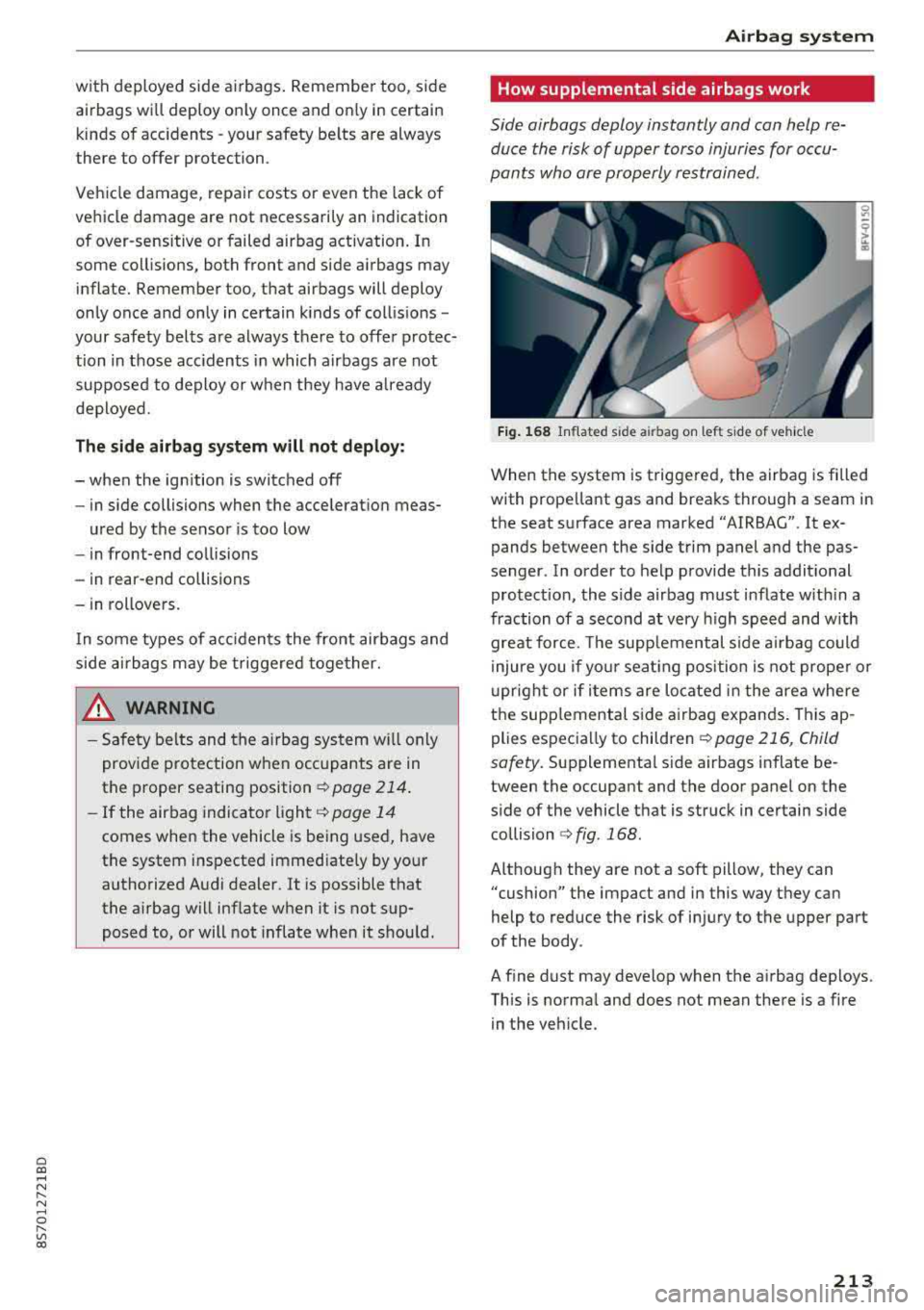
Fig. 168 Inflated side airbag on left side of vehicle
When the system is triggered, the airbag is filled
with propellant gas and breaks through a seam in
the seat surface area marked "AIRBAG". It ex
pands between the side trim panel and the pas
senger . In order to help provide this addit ional
protect ion, the side airbag must inflate w ith in a
fraction of a second at very high speed and with
great force. The supplemental sid e a irbag could
injure you if you r seating position is not proper or
u pr ight or if items are located in the area where
the supp lemental side airbag expands . This ap
plies especially to children
¢ page 216, Child
safety.
Supplementa l side airbags inflate be
tween the occupant and the door panel on the
s ide of the vehicle that is struck in certain side
collision ¢
fig. 168.
Although they are not a soft pillow, they can
"cushion" the impact and in this way they can
help to reduce the risk of injury to the upper part
of the body .
A fine dust may develop when the airbag deploys.
This is normal and does not mean there is a fire
in the veh icle.
213
Page 218 of 310
Child safety
Child safety
Important information
Introduction
The physical princip les of what happens when
your veh icle is in a cras h apply also to childr en
¢ page 188, What happens to occupants not
wearing safety belts?.
But unlike adults and
teenagers, their muscles and bones are not fully
developed. In many respects children are at
greater risk of serious injury in crashes than
adu lts.
Because children's bodies are not fu lly devel
oped, they require restraint systems especially
designed for their size, weight, and body struc
ture. Many countries and all states of the United
States and provinces of Canada have laws requir
ing the use of approved child restraint systems
for infants and small children .
In a frontal crash at a speed of 20-35 mph (30-56 km/h) the forces acting on a 13 lbs (6 kg)
infant will be more than 20 times the we ight of
the child . This means the weight of the child
wou ld suddenly be more than 260 lbs ( 120 k g).
Under th ese conditions, only an appropriate child
rest raint properly used can reduce the r isk of se
rio us injury. Child restraints, like adult safety
be lts, must be used properly to be effective.
Used improperly, they can increase the risk of se
rious inj ury in an accident.
If you must install a child restraint on the front
passenger seat in exceptional circumstances, be
sure to read and heed the important information
and warn ings
¢ page 195. Infants and other ch il
dren who are properly restrained in an appropri
ate child restraint that is for their size and age
can benefit from the protection that supplemen
tal side airbags provide in some kinds of crashes .
For more information please see information
provided by the:
- Nationa l Highway Traffic Safety Administration
(NHTSA), current ly at: http:/ /www .safe
rcar.gov (for the USA)
- Transport Canada Information Centre, current
ly at: http://www.tc .gc.ca (for Canada)
216
Consult the child safety seat manufacturer's in
structions in order to be sure the seat is right for
your ch ild's s ize
¢ page 219, Important safety
instructions for using child safety seats.
Please
be sure to read and heed all of the important in
format ion and WARNINGS about child safety,
Advanced Airbags, and the installation of child
restraints in this chapter.
There is a lot you need to know about the Ad
vanced Airbags in your veh icle and how they work
when infants and children in ch ild restraints are
on the front passenger seat . Because of the large
amount of impo rtant informat ion, we ca nnot re
peat it all he re. We urge you to read the detailed
inf ormation in this owner's manual about airbags
and the Advanced Airbag System in your vehicle
and the very important information about trans
porting children on the front passenger seat.
Please be sure to heed the WARNINGS
-they are
extremely important for your safety and the safe
ty of your passengers, especially infants and
small children .
.&_ WARNING
All vehicle occupants and especially child re n
must be restrained properly whenever riding
in a vehicle. An unrestrained or improperly re
stra ined child could be injured by striking the
interior or by being ejected from the vehicle
during a sudden maneuver or impact . An un
restrained or improperly restrained child is al
so at greater r isk of injury or death through
contact w ith an inflating airbag.
A WARNING
Children on the front seat of any car even with
Advanced Airbags can be seriously injured or
even killed when an airbag inflates. A ch ild in
a rearward-fac ing child safety seat installed
on the front passenger seat will be seriously
in ju red and can be killed if the front airbag in
flates.
- The inflat ing airbag will hit the child safety
seat or infa nt carrier with great force and
will smash the child safety seat and child
against the backrest, center armrest, or
door.
Page 221 of 310
Cl 00 ... N r-N ... 0 r-Vl 00
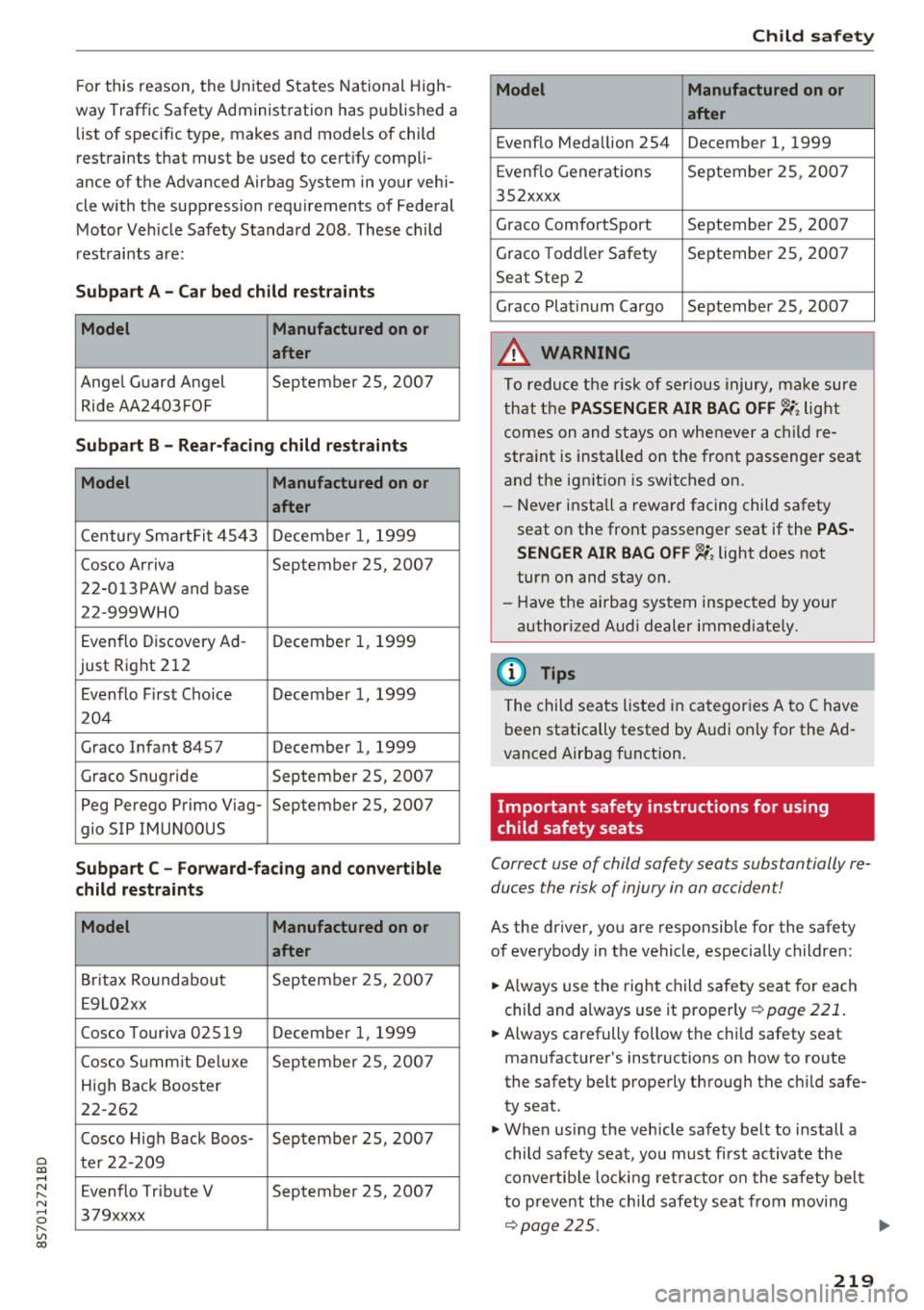
For this reason, the United States National High
way Traffic Safety Administration has published a list of specific type, makes and models of child
restraints that must be used to cert ify compli
ance of the Advanced Airbag System in your vehi
cle with the suppression requ irements of Federal
Motor Vehicle Safety Standard 208 . These child
restraints are:
Subp art A - C ar bed child re str aint s
Model Manufactured on or
after
Angel Guard Angel September 25, 2007 Ride AA2403FOF
Subp art B -Re ar-f acing child restr aint s
Model Manufactured on or
aft er
Century Sma rtFit 4543 December 1, 1999
Cosco Arriva September 25, 2007
22-013PAW and base
22-999WHO
Evenflo Discovery Ad -December 1, 1999
just Right 2 12
Evenflo F irst Cho ice December 1, 1999
204
Grace Infant 8457 December 1, 1999
G race Snug ride September 25, 2007
Peg Perego Primo Viag- September 25, 2007
gio SIP IMUNOOUS
Subp art C - Forward-facing and con vertibl e
child res traints
Model Manufactured on or
after
B ritax Roundabout September 25, 2007
E 9 L02xx
Cosco Tour iva 02519 December 1, 1999
Cosco S umm it Deluxe September 25, 2007
High Back Booster
22-262
Cosco High Back Boos- September 25, 2007
te r 22-209
Evenflo Tribute V September 25, 2007
379xxxx
Ch ild saf ety
Model Manufactured on or
after
Evenflo Meda llion 254 December 1, 1999
E venflo Generat io ns September 25 , 200 7
352xxxx
Graco ComfortSport September 25, 2007
Graco Todd le r Safety September 25, 2007
Seat Step 2
Graco Plat inum Cargo September 25, 2007
_&. WARNING
To reduce the risk of serious injury, ma ke sure
t hat the
PASSENGER AIR BAG OFF '-1; light
comes on and stays on whenever a child re
straint is installed on the front passenger seat
and the ign it ion is switched on.
- Never install a reward facing child safety
seat on the front passenger seat if the
PAS
S ENGER AIR BAG
OFF '-1; light does not
turn on and stay on.
- Have the ai rbag system inspected by your
author ized Audi dealer immed iate ly.
(D Tips
The child seats listed in categor ies A to C have
been statically tested by Audi only for the Ad
vanced Airbag f unction.
Important safety instructions for using
child safety seats
Correct use of child safety seats substantially re
duces the risk of injury in an accident!
As the driver, you are responsib le for the safety
of everybody in the vehicle, especia lly children:
.. Always use the right child safety seat for each
child and always use it properly ¢
page 221.
.. Always carefully follow the chi ld safety seat
manufacturer's instructions on how to route
the safety belt properly through the ch ild safe
ty seat.
.. When us ing the veh icle safety belt to install a
child safety seat, you must first activate the
convertib le loc king ret racto r on the safety belt
to p revent the ch ild safety seat from moving
q page 225 . ..,
219
Page 222 of 310
Child sa fety
~ Push the child sa fety seat down with your fu ll
weight to get the safety be lt really tight so that
the seat cannot move forward and s ideways
more than 1 in (2.5 cm).
A lways remember: Even though your vehicle is
equipped with an Advanced Airbag system, a
child should always ride in the seat properly re
stra ined for its age and size.
A WARNING
Not using a ch ild safety seat, using the wrong
child safety seat or improperly install ing a
child restra int increases the r isk of se rious
personal inju ry and death.
- All veh icle occupants and especially children
must be rest rained p roperly whenever riding
in a vehicle. An unrestrained or imprope rly
restra ined child could be injured by s tri king
the interior or by being ejected from the ve
hicle d uring a sudden maneuver or impact .
An unrestrained or improperly restrained
child is also at greater risk of injury or death
through contact with an inflating airbag.
-Commercially available chi ld safety seats
are required to comply with U.S. Federa l
Motor Vehicle Safety Standard (FMVSS) 213
(in Canada CMVSS 213).
-When b uying a ch ild rest raint, se lect one
that fits your child and the vehicle .
-Only use child rest raint systems that fully
con tact the flat portion o f the seat cush
ion. The child restraint must not tip or
lean to either side . Audi does not recom
mend using child safety seats that rest on
legs or tube-like frames. They do not pro
vide adequate contact with the seat.
-Always heed a ll legal requirements per
taining to the installat ion and use of child
safety seats and carefully follow the in
structions provided by the manufacturer
of the seat you a re us ing .
-Never let more than one child occupy a child
safety seat.
-Never let babies or older children ride in a
vehicle while sitting on the lap of another passenge r.
220
-Holding a child in your arms is never a sub
stitute fo r a child restraint system.
-The strongest person cou ld not hold the
ch ild with the forces that exist in an acc i
dent. The child will strike the interior of
the veh icle and can also be struck by the
passenger.
-The child and the passenger can also in
ju re each other in an accident.
-Never install rear-facing child safety seats
or infant carriers on the front passenger
seat. A child will be seriously injured and
can be k illed when the passenger a irbag in
flates -even with an Advanced Airbag Sys
tem.
-The inflating airbag will h it the ch ild safety
seat o r infant ca rr ier with great force and
will sm ash the child s afety seat and child
aga inst the ba ckres t, center armres t, door
or roof.
-I f exceptional ci rcums tances requi re the use
of a forward-f acing child restrain t on the
front passenger's seat, the chi ld's safety
and well-being require that the following
special precautions be taken:
-Make su re the forwa rd-facing seat has
been designed and ce rtified by its manu
fa ctu rer for use on a front se at with a pas
senger front and side ai rb ag.
-Always ca refully follow the man ufa ctu rer 's
i nst ru ct ions prov ided with t he ch ild sa fety
seat or carrier.
-Always move the fron t passenger seat into
the rearmost posit ion of the passenger
seat's fo re and aft adjustment range, and
as far away from the airbag as possib le be
fore installing the child restraint .
-Always make sure that nothing prevents
the front passenger's seat from being
moved to the rearmost position in its fore
and aft adjustment range.
-Always make s ure t hat the backrest is in
the up right pos ition.
-Never place or use any elect rical device
(such as a laptop, CD p layer, electronic
games device, powe r inverter or seat heat-
er for child seats) on the front passenger
~
Page 226 of 310
Child safety
The vehicle 's safety belts alone will not fit most
chi ldren until they are at least 4
ft 9 in (57 in/
1.45 m) tall and weigh about 80 lbs (36 kg) .
Booster seats raise these children up so that the
safety belt will pass properly over the stronger
parts of their bodies and the safety belt can help
protect them in a crash .
.. Do not use the convertible locking retractor
when using the vehicle 's safety belt to restrain
a child on a booster seat .
.. The shoulder belt must lie as close to the cen
ter of the child's collar bone as poss ible and
must lie flat and s nug on the upper body. It
must never lie across the throat or neck. The
lap belt must lie across the pelvis and never
across the stomach or abdomen . Make sure the
belt lies flat and snug . Pull on the belt to tight
en if necessary .
Chi ldren up to at least 8 years old (over 40 lbs or
18 kg) are best protected in chi ld safety seats de
signed for their age and weight . Experts say that
the skeleta l structure, particularly the pelvis, of
these children is not fully developed, and they
must not use the vehicle safety belts without a
suitable child restraint.
It is usually best to put these children in appro
priate booster seats. Be sure the booster seat
meets all applicable safety standards .
Booster seats raise the seating position of the
child and repos ition both the lap and shoulder
parts of the safety be lt so that they pass across
the child's body in the right places. The rout ing of
the belt over the child's body is very important
for the child's protection, whether or not a boos
ter seat is used.
Never use the lap belt portion of the vehicle's
safety belt alone to restrain any child, regardless
of how big the child is. Always remember that
chi ldren do not have th e pronounced pelvic struc
ture required fo r the proper function of lap belt
port ion of the vehicle's three point lap and
shoulder belts. The child's safety absolute ly re
quires that a lap belt portion of the safety belt be
fastened snugly and as low as possible around the pelvis . Never let the lap belt portion of the
224
safety belt pass ove r the child's stomach or abdo
men .
In a crash, airbags must inflate w ith in a blink of
an eye and with considerable force. In order to do
its job, the airbag needs room to inflate so that it
will be there to protect the occupant as the occu
pant moves forward into the airbag .
A ve hicle occ upant who is o ut of pos it io n and too
close to the airbag gets in the way of an inflating
airbag . When an occupant is too close, he or she
will be struck vio lent ly and w ill rece ive serious or
possibly even fatal injury.
In order for the airbag to offer protection, it is
important that all vehicle occupants, especially
any ch ildren, who m ust be in the front seat be
cause of exceptional c ircumstances, be properly
restrained and as far away from the airbag as
possible . By keeping room between the child 's
body and the front of the passenger compart
ment, the a irbag can inflate completely and pro
v ide supplementa l protection in certa in frontal
collisions.
_& WARNING
Not using a booster seat, using the booster
seat improperly, incorrect ly installing a boos
ter seat or using the ve hicle safety belt im
properly increases the r isk of serious personal
injury and death in a collision or other emer
gency situation. To he lp reduce the risk of se
rious personal injury and/or death:
- The shou lder belt must lie as close to the
center of the child' s collar bone as possible
and must lie flat and snug on the upper
body. It must never lie across the throat or
neck. The lap belt must lie across the pelvis
and never across the stomach or abdomen.
Make sure that the belt lies flat and snug .
P ull on the belt to tighten if necessary .
- Failur e to properly route safety belts over a
child's body will cause severe injuries in an
accident or other emergency situation
¢page 187.
- The rear side of the child safety seat should
be positioned as close as possible to the
backrest on the ve hicle seat .
-
Page 228 of 310
Child sa fety
A WARNING
Always take specia l precautions if you must
install a forward or rearward-facing chi ld re
straint on the front passenger's seat in excep
tional situations:
- Whenever a forward or rearward-facing
child restraint is installed on the front pas
senger seat, the
P ASS ENGER AIR B AG OFF
'-i; light must come on and stay on whenev
er the ignition is sw itched on .
- If the
PASS ENGER AIR B AG O FF ~; light
does not come on and stay on, perform the
checks descr ibed
<=> page 205, Monitoring
the Advanced Airbag System.
- If the PA SSENGER AIR BAG OFF ~; light
does not come on and stay on whenever the
ignition is switched on the inflating airbag
will hit the child safety seat o r infant ca rr ier
with great force and will smash the child safety seat and child against the backrest,
center armrest, door or roof . Have the air
bag system inspected immediately by your
Audi dealer.
- Improper installation of chi ld restraints can
red uce their effect iveness or even prevent
them from providing any protection.
- An improperly installed chi ld restraint can
interfere with the airbag as it deploys and
seriously injure or even kill the child.
- Always carefully follow the manufacturer's
instructions provided w ith the ch ild safety
seat or carrier.
- After checking to make sure that the child
restra int is properly installed, make certain
that the child restraint is correctly recog
nized by the capac it ive passenger detection
system in the front passenger seat and that
the
PASSENGER AIR BAG OFF '-i; light sig
nals the co rrect front passenge r frontal air
bag status.
A WARNING
Forward-fac ing ch ild rest raints:
- Always make sure the forward-facing seat
has been designed and cert ified by its man
ufact urer for use on a front seat with a pas
senger front and side airbag .
226
--
Never put the forward-facing child restraint
up, against or very near the instrument pan
el.
- Always move the passenger seat into its
rearmost posit ion in the seat's fore and aft
adjustment range, as far away from the a ir
bag as poss ible before installing the for
ward-facing chi ld restraint. The backrest
must be adjusted to an upr ight position.
- Make sure that the
PASSENGER AIR BAG
OFF
'-i; light comes on and stays on all the
time wheneve r the ign it ion is switched on.
A WARNING
Rearward-facing chi ld restraints:
- A child in a rearward-fac ing ch ild safety seat
installed on the front passenger seat will be
serious ly injured and can be killed if the
front airbag inflates
-even with an Ad
vanced Airbag System.
- The inflating airbag will h it the ch ild safety
seat o r infant c arr ier with great force and
w ill smash the child safety seat and child
against the backrest, center armrest, door
or roof.
- Always be especially carefu l if you must in
stall a rearward facing child safety seat on
the front passenger seat in exceptiona l cir
cumstances.
- Make sure that the
PASSENGER AIR BAG
OFF
'-i; light comes on and stays on all the
time whenever the ign it ion is switched on.
- If the
PASSENGER AIR BAG OFF '-i; light
does not come on and stay on, have the air bag system inspected by your Audi dealer.
Activating the convertible locking retractor
Use the convertible locking retractor to secure a
child restraint.
A lways heed the c hil d safety seat manufacturer's
instructions when insta lling a child restraint in
your vehicle. To activate the convertib le locking
retractor:
.,. Place the chi ld restraint on a seat .
.,. Slowly pull the belt all the way out .
Page 231 of 310
Cl 00 .-< N r-N .-< 0 r-Vl 00
Checking and Filling Fuel
Gasoline grade
The correct gasoline grade is stated on the inside
of the fuel filler door .
The vehicle is equipped with a catalytic converter
and must only be driven with
unl ead ed g asoline.
Audi recommends using TOP TIER Detergent Gas
oline. Additiona l information on TOP TIER Deter
gent Gasoline can be found on the offic ial web
site (www .topt iergas.com).
The individua l gasoline grades are differentiated
by
oc ta n e ra ting s. This value is given with (R +M)/
2 equating to AKI or in RON.
The fo llowing headings match the corresponding
sticker in the fuel fi ller door .
UNLEADED FUEL ONLY MIN. (R+M )/2 8 7
R egula r/ MIN. RON 91 Regula r
Use regu la r gasoline with minimum 87 AKI/
91 RON ~ (Di .
The max imum engine power is only reached if
prem ium gaso line 91 AKI/ 95 RON is used.
UNLEADED FUEL ONLY PREMIUM MIN . (R
+M )/2 91 / SUPER MIN. RON 95
Using prem ium gaso line with minimum 91 AKI/
95 RON is recommended.
If premium gasoline is not available, you can also
use regula r gasoline 87 AKI/ 91 RON . However
this does reduce the engine powe r sli ght ly.
{LlJ) Note
- Fill ing the tank just one t ime with leaded
fuel or other meta llic additives wi ll cause
permanent deter io rat ion to the catalyt ic
conve rter function.
- When gasoline with an octane rat ing that is
too low is used, h igh speeds o r heavy eng ine
l oad can lead to eng ine damage.
Ch eck ing and F illing
(D Tips
The vehicle may be filled with fuel that has a
higher octane rating than what is requ ired by
the engine .
Blended gasoline
U se of g asoline cont aining alcohol or MTBE
( m eth yl tertiary butyl ether )
You may use unleaded gasoline blended with al
cohol or MTBE (commonly referred to as oxygen
ates) if the blended m ixture meets the fo llow ing
c riter ia:
Blend of ga soline me thanol ( wood alc ohol or
meth yl alcoh ol)
-Anti-knock index must be 87 AKI or h igher.
- Blend must contain no more than
3% metha-
nol.
- Blend must contain more than
2% co-solvents.
Blend of g asoline a nd eth ano l (g ra in a lcoh ol o r
eth yl alc ohol )
-Anti-knock index must be 87 AK I or h igher.
- Blend must not conta in more than
15% etha-
nol.
Blend of g asoline and MTBE
- Anti -knock index must be 87 AKI or higher.
- Blend must not contain more than
15% MTBE .
Seasonally a djust ed g aso lin e
Many gasoline grades are blended to perform es
pecially well for winter or summer dr iving . Dur
i ng seasonal change-over, we suggest that you
fill up at busy gas stat ions where the seasonal
adjustment is mo re likely to be made in t ime .
@ Note
-Methano l fuels which do not meet these re
quirements may cause cor rosion and dam
age to p lastic and rubbe r components in the
fue l system.
- Do not use fuels that fa il to meet the speci
fied cr ite ria in t his chapter.
229