ESP AUDI TT ROADSTER 2018 Repair Manual
[x] Cancel search | Manufacturer: AUDI, Model Year: 2018, Model line: TT ROADSTER, Model: AUDI TT ROADSTER 2018Pages: 310, PDF Size: 46.95 MB
Page 232 of 310

Checking and Filling
-If you a re unable to determine whether or
not a particular fuel blend meets the speci
fications, ask your service station or its fuel
supplier.
- Do not use fuel for which the contents can
not be identified.
- Fuel system damage and performance prob
lems resulting from the use of fuels differ
ent from those specified a re not the respon
sibility of Audi and are not covered under
the New Vehicle or the Emission Control System Warranties.
- If you experience a loss of fuel economy or
driveability and performance problems due
to the use of one of these fuel blends , we
recommend that you switch to unblended
fuel.
Gasoline additives
A major concern among many auto manufactur
ers is carbon deposit build-up caused by the type
of gasoline you use.
Although gasoline grades differ from one manu
facturer to another, they have certain things in
common. All gasoline grades contain substances
that can cause deposits to collect on vital engin e
parts, such as fuel injectors and intake valves. Al
though most gasoline brands include additives to keep engine and fuel systems clean, they are not
equally effective .
Audi recommends using TOP TI ER Dete rgent Gas
oline. For more information on TOP TIER Deter
gent Gasoline , please go to the official website
(www .toptiergas .com) .
After an extended per iod of us ing inadequate
fuels, carbon deposit build-ups can rob your
en
gine of peak performance.
(D Note
Damage or malfunction due to poor fuel qual
ity is not covered by the Audi New Vehicle Limited Warranty.
230
Refueling
Fueling procedure
Your vehicle is equipped with a capless fuel filler
system .
Fig. 172 R ight rea r sid e of the vehicle : ope ning the fuel
fil ler door
Fig. 173 R ig ht rea r sid e of t he ve hicle: fuel pum p nozz le
in ser ted
The fuel filler door is unlocked or locked by the
central locking system.
.. Press on the left side of the fuel filler door to
open
r:::;, fig . 172.
.. Insert the fuel pump nozzle all the way into the
fuel tank filler neck
r:::;, fig. 173. Make sure it is
seated correctly.
.. Begin fueling. Once the fuel pump no zzle turns
off the first time, the fuel tank is full. Do not
continue fueling, or else the expansion space in
the tank will be filled with fuel.
.. After the fuel pump has switched off, wait five
seconds before removing it to allow the rest of
the fuel to finish dripping into the fuel tank.
.. Close the fuel filler door and then press on the
left side until it latches.
The correct fuel type for your vehicle can be
found on a label located on the inside of the f uel
ll>
Page 233 of 310
Cl 00 .-< N r-N .-< 0 r-Vl 00
filler door . For additional info rmation on fuel,
see
~ page 229.
F or the tank capac ity in yo ur vehicle , refer to t he
Technical Data
~ page 288 .
To reduce the r isk of fuel leak ing out or vapors
escap ing, make su re t hat the fuel ta nk is closed
correct ly. O therwise
t he-¢..ij indicator light will
turn on.
I f the central lock ing system malfunct ions, the
fuel filler door may emergency release
~ page 232.
_& WARNING
An improper f uel ing p rocedure and improper
hand ling of fue l can lead to exp losions, fires,
severe b urns and other injuries .
- Do not smoke and keep away from open
flames .
- T he ig nition m ust be switched off whe n re
f ueling .
- Cell pho nes, radio devices and o ther radio
equipment s hou ld always be switched off
w hen refueling . Electromagnetic rays cou ld
cause sparks and start a fire .
- If you do not insert the fuel pump nozzle a ll
the way into the filler tube, then fue l can
leak out. Spilled fue l can ignite and start a
fire.
- Never get into the vehicle when refueling. If
there is an exceptional s ituation where the
vehicle must be entered, close the door and
touch a metal surface before touching the
fuel pump nozzle aga in . This will reduce the
r isk of electrostat ic d ischarge that can cause
flying sparks . Sparks can start a fire when
ref uel ing .
_& WARNING
We recommend that you do not t ransport any
fue l co nta iners in t he veh icle. Fue l cou ld leak
out of the containe r and ignite, espe cially dur
ing an accident. This can cause exp losions,
fires and injuries .
- If you must transport fuel in a fue l contain
er, please note the following:
Ch eck ing and F illing
- Always place a fue l container on the
ground before filling . Never fill the fue l
container with fuel while it is in or on the
vehicle . Electrostatic charge can occur
wh ile refueling and the fuel vapors could
i gnite .
- For fuel containers made of metal, the fuel p ump nozzle must always maintai n
contact with the conta iner to reduce the
r isk of s tat ic charge.
- Insert the fuel pump nozz le as far as pos
s ible into the fi lle r opening w hile refuel
ing .
-Fo llow lega l requ irements when using,
stor ing and t ransporti ng f uel conta iners.
- Make su re that the fuel containe r meets
t h e in dust ry standa rds, for example ANS I
o r ASTM F8S2 -86.
@ Note
- Remove fuel that has overflowed onto any
veh icle components immediately to reduce
the risk of damage to the vehicle.
- Never drive unt il the fuel
tank is completely
empty. The irregula r supply of fue l that re
sults from that can cause eng ine misfi res.
U nc ombus ted fuel will ente r th e exhaus t
system and increase the risk of damage to
the cata lytic converter.
@ For the sake of the environment
Do not overfill the fuel tank, otherwise f uel
ca n leak o ut w hen the ve hicle is warming up.
(D Tips
- If adverse weat her co nd it io ns cause the f uel
filler door to freeze shut, p ress o n the cen
t er of the fi ller door wit h the hee l of your
hand and then try opening it again .
- Th e fuel fi ller door on yo ur vehicle does no t
lock if yo u lock the vehicle from the inside
using the central locking switch.
(D Tips
- Yo ur vehicle is eq uipped w ith a misfue ling
guard. It a llows the vehicle to be f ueled on -
ly with the correct fue l pump nozz le .
.,.
2 3 1
Page 236 of 310
Check ing and F illing
be burned. Wait until no steam or coolant is
escaping.
- Keep children away from the engine com
partment.
- Never spill fluids on a hot engine . These flu
ids (such as the freeze protection contained
in the coolant) can catch fire.
- Avoid short circuits in the e lectrica l system,
especially to the battery.
- When working in the engine compartment,
remember that the radiator fan can switch
on even if the ign ition is switched off, which
increases the risk of personal in jury.
- Never open the cap on the coolant expan
sion tank when the eng ine is warm. The
cooling system is under pressure.
- To protect your face, hands, and arms from hot steam or coolant, cover the cap with a
large cloth when opening.
- Do not remove the engine cover under any circumstances. This increases the risk of
burns .
- If tests need to be performed w ith the en
gine ru nning, there is additional danger due
to moving components (such as the ribbed
belt, a lter nator and radiator fa n) and from
the high-voltage ign it io n system.
- Do not press the accelerator pedal inadver
tent ly if a gear is selected when the veh icle
is sta tionary and the eng ine is ru nning. Oth
erwise, the veh icle w ill start to move imme
diately and t his co uld r esult in an a ccid en t.
- Pay attention to the fo llow ing warnings list
ed whe n wo rk on the fuel system or on the
electri cal eq uipment is requ ired.
- Do not smoke.
- Never work near open flames.
- Always have a working fire extinguisher
nearby.
- All work on the battery or e lectrica l system
in yo ur vehicle can res ult in injuries, chemi
ca l burns, accidents or burns. Because of
t h is, all wor k must be performed
only by an
autho rized Aud i dealer or authorized Aud i
Service Facility .
- To reduce the risk of electric shock and in
jury , never touch the following components
234
when t he engine is runni ng or is being start
ed:
- Ig nition cable
- Other compone nts in the electron ic high-
vo ltage ig nition system
- If you must check or perform work on the
eng ine wh ile it is ru nning:
- Set the pa rking brake and p lace the selec
tor lever in the P (par k) position fi rst .
- Alw ays proceed w ith ext reme cau tion so
t h at clothing, jewelry or long hair do not
become ca ught in the radiator fan, fan
belt or other moving components or do
not come into contact with hot compo
nents. Tie back long hair before begin ning
work and do not wear clothing that can
hang dow n into the eng ine .
- Lim it your exposure to exhaust and chemi
cals to as short a time as possible
<=> &. .
A WARNING
Ca lifo rnia Proposition 65 Warning:
- Engine exhaust, some of its const ituents,
a nd certa in veh icle components conta in or
em it chem icals know n to the State of Cal i
fornia to ca use cancer and b irth defects and
reproductive harm. In add ition, certain flu
ids cont ained in vehicles a nd certai n prod
uc ts of component we ar con tain or em it
chemica ls known to the State o f Califo rnia
to cause cancer and birth defects or othe r
reproductive harm.
- Battery posts, terminals and related acces
sories contain lead and lead compounds,
chemicals known to the State of California
to cause cancer and reproductive harms.
Was h ha nds after handling.
@ Note
When filling fluids, be sure not to mix the flu
i ds up. Otherwise severe mal functions and en
g ine damage will occu r.
@ For the sake of the environment
You sho uld regularly check the gro und under
your vehicle in order to detect leaks quick ly. If
there are visible spots from oi l or othe r fluids,
ll-
Page 242 of 310
Checking and Filling
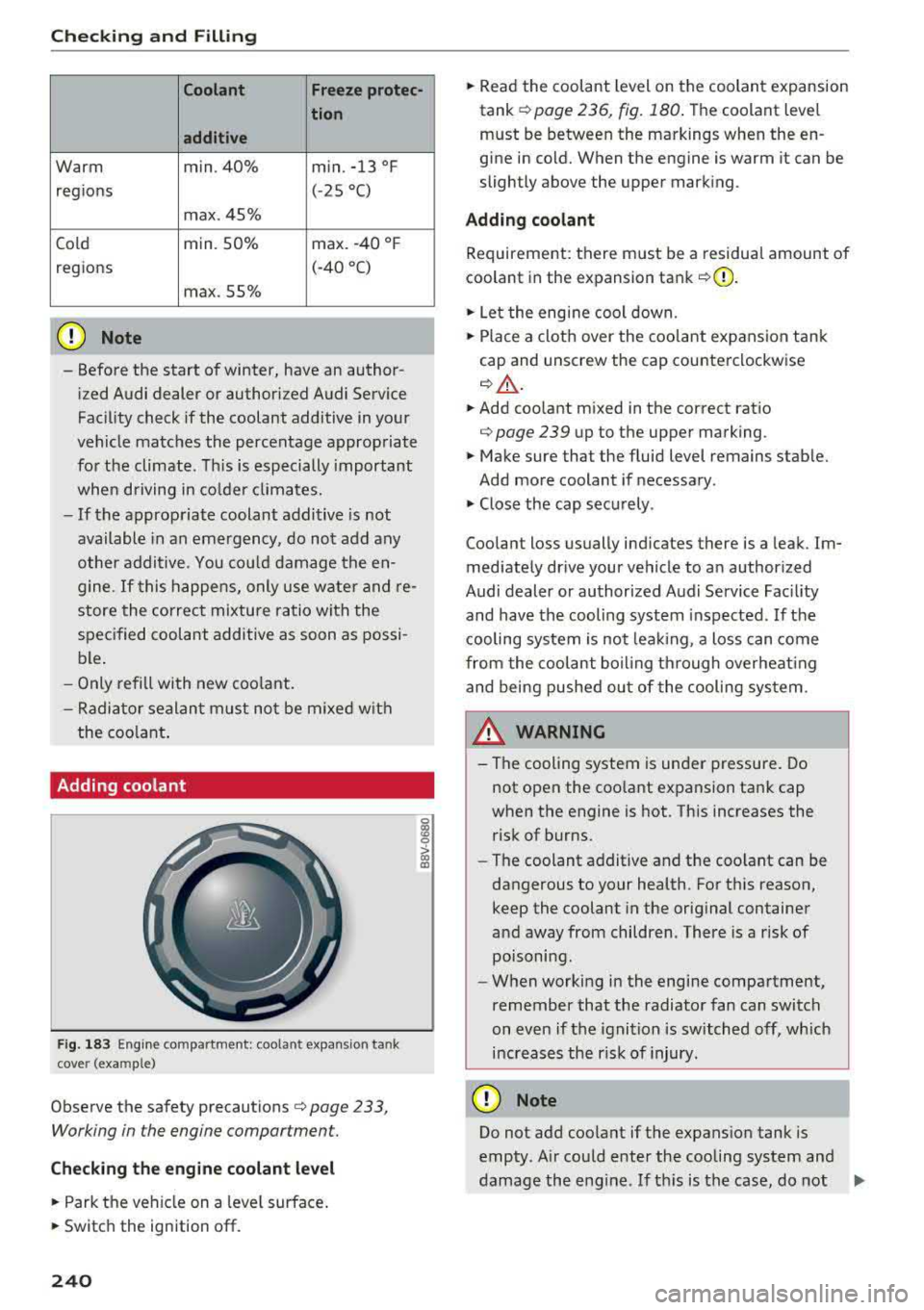
Coolant Freeze protec-
tion
additi ve
Warm min. 40% min. -13 °F
regions (- 25 °C)
max . 45%
Cold min. 50% max. -40 °F
regions (-40 °C)
max. 55%
@ Note
- Before the start of winter, have an author ized Audi dealer or authorized Audi Service
Facility check if the coolant additive in your
vehicle matches the percentage appropriate
for the climate. Th is is especially important
when driving in co lder climates.
- If the appropriate coolant additive is not
available in an emergency, do not add any
other additive . You cou ld damage the en
gine.
If t his happens, only use wate r and re
store the correct mixture ratio with the
specified coolant additive as soon as possi
ble .
- Only refill with new coo lant.
- Radiato r sealant must not be mixed w ith
the coo lant .
Adding coolant
Fig . 183 Eng ine co mpartment : coo lant expans ion ta nk
cove r (exa mple)
Observe the safety precautions c:::> page 233 ,
Working in the engine compar tment.
Che cking the engin e coolant l evel
.. Park the vehicle on a level surface .
.. Switch the ignition off .
240
~ 0 > 00 ID
.. Read the coolant level on the coolant expansion
tank
c:::> page 236, fig. 180 . The coolant level
must be between the markings when the en
gine in cold. When the engine is warm it can be
slightly above the upper mark ing .
Adding coo lant
Requirement : there must be a residual amount of
coolant in the expansion tank
c:::> @ .
.. Let the engine cool down.
.. Place a clot h over the coolant expansion tank
cap and unscrew the cap counterclockwise
c:::> ,A .
.. Add coo lant mixed in the correct rat io
c:::> page 239 up to the upper marking .
.. Make sure that the fluid level remains stable.
Add more coolant if necessary .
.. Close the cap securely .
Coolant loss usually ind icates there is a leak. Im
mediate ly dr ive your vehicle to a n author ized
Audi dealer or author ized Audi Service Fac il ity
and have the cooling system inspected. If the
cooling system is not lea king , a loss can come
from the coolant boiling through overheat ing
and being pushed ou t of the cooling system .
Lil WARNING
- The cooling system is under pressure. Do
not open the coo lant expansion tank cap
when the engine is hot. This increases the risk of burns.
-The coolant additive and the coolant can be dangerous to your health. For this reason ,
keep the coolant in the original container
and away from children. There is a risk of
poisoning.
-When working in the engine compartment,
remember that the radiator fan can switch
on even if the ignition is switched
off, wh ich
increases the r is k of injury.
@ Note
Do not add coolant if the expans ion tank is
empty . A ir could enter the cooling system and
-
damage the eng ine . If this is the case, do not ..,.
Page 245 of 310
Cl 00 .-< N r-N .-< 0 r-Vl 00
authorized Audi Service Facility for more in
formation.
- Do not connect or disconnect the charging
cable while charging because this increases
the risk of an exp losion.
(D Tips
- Only charge the vehicle battery through the
connections in the engine compartment.
- Read all of the manufacturer's instructions
for the charger before charging the vehicle
battery.
Windshield washer system
Fig. 186 Engine compa rtment: washer flu id reservo ir cap
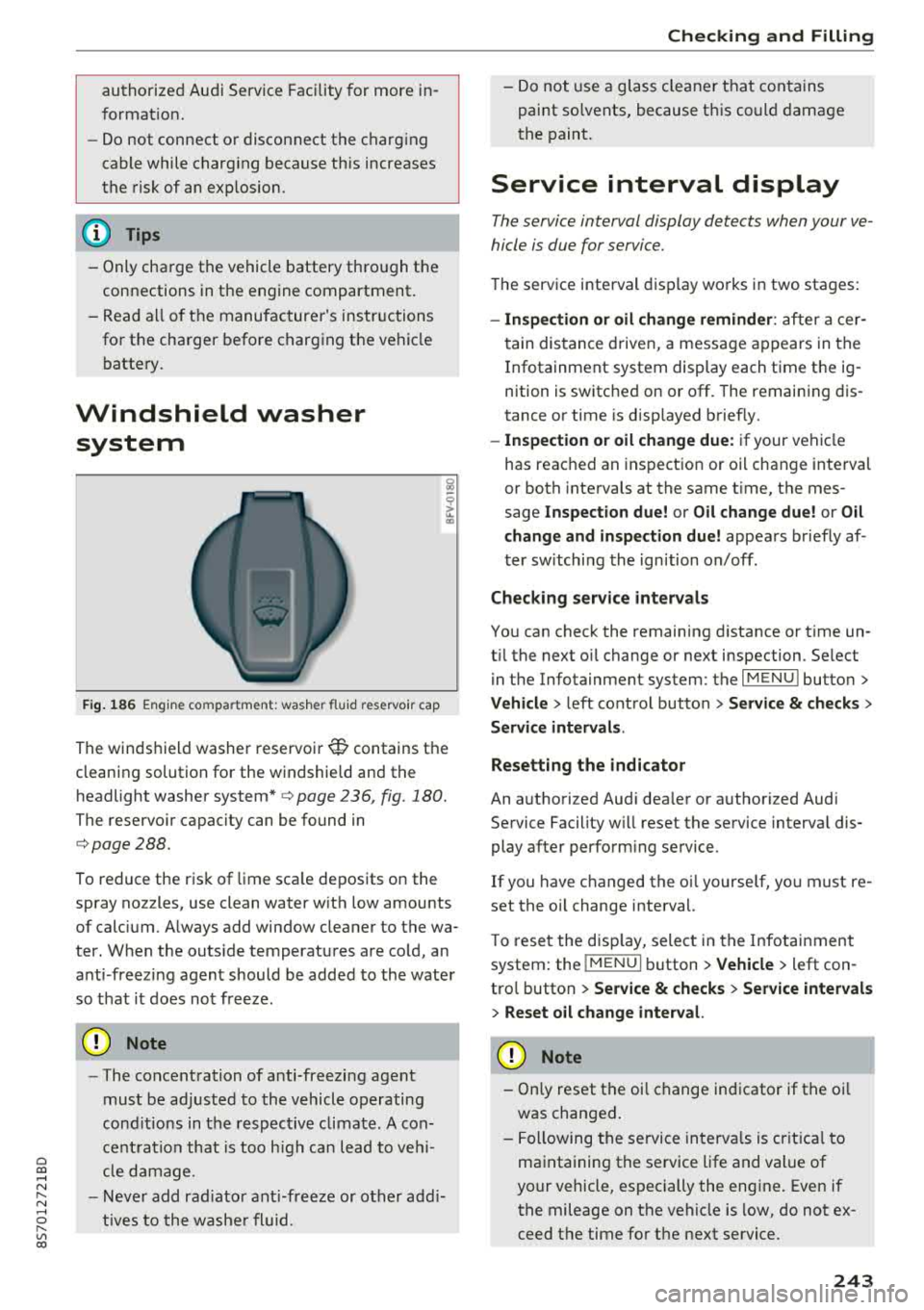
The windshield washer reservoir W contains the
cleaning solution for the windshie ld and the
headlight washer
system* ¢ page 236, fig . 180.
The reservoir capacity can be found in
¢page 288.
To reduce the risk of lime sca le deposits on the
spray nozzles, use clean water with low amounts
of calc ium. A lways add window cleaner to the wa
ter. When the outs ide temperatures are cold, an
anti -freezing agent should be added to the water
so that it does not freeze.
@ Note
-The concentration of anti-freezing agent
must be adjusted to the vehicle operating
cond itions in the respective climate. A con
ce ntrat ion that is too high can lead to vehi
cl e damage.
- Never add radiator anti-freeze or other addi
tives to the washer fluid.
Checking and Filling
- Do not use a glass cleaner that contains
paint so lvents, because t his could damage
the paint.
Service interval display
The service interval display detects when your ve
hicle is due for service .
The service interval display works in two stages:
-Inspection or oil change reminder : after a cer-
tain distance driven, a message appears in the
In fotainment system display each time the ig
nition is switched on or off. The remaining dis
tance or time is disp layed briefly.
- Inspection or oil change due: if your vehicle
has reached an inspection or oil change interval
or both intervals at the same t ime, the mes
sage
Inspection due! or Oil change due! or Oil
change and inspection due!
appears briefly af
ter switching the ignition on/off .
Checking service intervals
You can check the remaining distance or time un
t il the next oil change or next inspection. Se lect
in the Infotainment system: the
I MENU I button>
Vehicle > left control button > Service & checks >
Service intervals .
Resetting the indicator
An authorized Audi dea ler or authorized Audi
Service Facility w ill reset the service interval dis
play after performing service.
If you have ch anged the oi l yourse lf, you must re
set the oil change interval.
T o reset the disp lay, select in the Infotainment
system: the
I MENUI button> Vehicle> left con
trol button >
Service & checks > Service intervals
> Reset oil change interval.
@ Note
-Only reset the oil change indicator if the oi l
was changed.
- Following the service intervals is crit ica l to
maintaining the service life and value of
your vehicle, especially the engi ne. Even if
the mileage on the vehicle is low, do not ex
ceed the time for the next service.
243
Page 249 of 310
windows, power seats, radio, and heater, to the extent that these
items are available as factory- in
stalled equipment (whether in
stalled or not) .
Aspect ratio
means the ratio of the height to
the width of the tire in percent .
Numbers of 55 or lower indicate a
low sidewall for improved steer
ing response and better overall
handling on dry pavement .
Bead
means the part of the tire that is
made of steel wires , wrapped or
reinfo rced by ply cords and that is
shaped to fit the rim .
Bead separation
means a breakdown of the bond
between components in the bead .
Cord
means the strands forming the
plies in the tire.
Cold tire inflation pressure
means the t ire pressure recom
mended by the vehic le manufac
turer for a tire of a designated
Wheels
three hour period before the tire
pressure is measured or adjusted .
Curb weight
means the weight of a motor ve
hicle with standar d equipment in
c luding the maximum capacity of
f u el, oi l, and coolant, air condi
tioning and additional weight of
optional eq uipment.
Extra load ti re
means a t ire designed to operate
at higher loads and at higher in
flation pressures than the corre
sponding s tandard tire. Extra load
ti res may be identified as
"XL",
"xl" "EXT RA LOAD" or "RF" on , ,
the sidewall.
Gross Axle Weight Rating
(" GAWR ")
means the load -carrying capacity
of a single axle system, measured
at the tire -ground interfaces.
Gross Vehicle Weight Rating
( " GVWR ")
means the maxim um total loaded
weight of the vehic le .
Groove
size that has not been driven for means the space between two ad -
~ more than a co uple of miles (kilo -jacent tread ribs . .,.
"
8 meters) at low speeds in the
" "' a:,
2 47
Page 262 of 310
Wheels
Low -profile tires can become damaged more
quickly than standard tires when driving over large bumps, potholes, manhole covers, and
curbs. Therefore, it is particularly important to
maintain the correct tire pressure
c::;, page 254 .
To reduce the risk of damage to the tires and
rims, drive very carefully on poor roads.
Check your wheels regularly every 2,000 mi (3,000 km) for damage. For example, check for
bu lges/cracks on the tires or deformations/
cracks on the rims.
Afte r a heavy impact or damage, have the tires
and rims inspected or replaced immediate ly by
an authorized Audi dealer or authorized Audi
Service Facility.
L ow -profile tires can wear o ut faster than stand
ard tires.
Uniform tire quality grading
- Tread wear
- T raction
AA A B C
- T emperature ABC
Qual ity grades can be found where appl icable on
the tire side wall between tread shoulder and
maximum sect ion w idth
c::;, page 245, fig. 187.
For example: Tread wear 200, Traction AA, Tem
perature
A .
All passenger car tires must conform to Federal
Safety Requirements in addition to these grades.
Tread wear
The tread wear grade is a comparative rating
based on the wear rate of the tire when tested
under contro lled conditions on a specified gov
ernment test course.
F or examp le, a tire graded
150 would wear one
and one half
(1 1/2) times as well on the govern
ment course as a tire graded
100.
The relative performance of tires depends upon
the actual conditions of their use, however, and may depart significant ly from the norm due to
variations in driving habits, service practices and differences in road characteristics and climate.
260
Traction
The traction grades , from highest to lowest , are
AA,
A, Band C. Those grades represent the tire's
ability to stop on wet pavement as measured un
der controlled conditions on specified govern
ment test surfaces of asphalt and concrete. A tire
marked C may have poor traction performance
c::;, .&. .
Temperature
The temperature grades are A (the highest), B,
and C, representing the tire's resistance to the
generat ion of heat and its ability to dissipate
heat when tested under controlled conditions on
a specified indoor laboratory test wheel.
Sustained high temperature can cause the mate rial of the tire to degenerate and reduce tire life,
and excessive temperature can lead to sudden
tire failure
c::;, ,&. .
The grade C corresponds to a level of perform
ance which all passenger car tires must meet un
der the Federal Motor Vehicle Safety Standard
No .
109 . Grades Band A represent higher levels
of performance on the laboratory test wheel than
the m inimum required by law.
A WARNING -
The traction grad e assigned to this tire is
based on straight-ahead braking traction
tests, and does not include acceleration, cor
nering, hydroplaning or peak traction charac
teristics.
A WARNING
The temperature grade for this tire is estab
lished for a tire that is properly inflated and
not overloaded. Excessive speed, underinfla
tion, or excessive loading, either separately or
in comb inat ion, can cause heat bu ildup and
possible tire failure.
A WARNING
-
-
Temperature grades apply to tires that are
properly inflated a nd not over o r underinflat
ed.
Page 264 of 310
Wheels
store the pressure again in the Infotainment sys
tem
i::> page 262 .
mm (Tir e Pr essure Monitoring System) Tire
pressure: malfunction! See owner's manual -
if
mm appears after switching on the ignition or
while driving and then the
[DJ indicator light in
the instrument cluster also starts to blink for
about one minute and then stays on permanen t
ly, there is a system malfunction. Try to store the
correct tire pressures
<=:> page 262 . If the indica
tor light does turn off or turns on again after a
short period of time, drive to an authorized Audi
dealer or authorized Aud i Serv ice Facility immedi
ately to have the malfunction corrected .
_& WARNING
-If the tire pressure indicator appears in the
display, reduce your speed immediately and
avoid any hard steering or braking maneu
vers. Stop as soon as possible and check the
tires and their pressure.
- The driver is responsible for maintaining the
correct tire pressures. You must check the
tire pressures regularly.
-Under certain conditions (such as a sporty
driving style, winter conditions or unpaved
roads), the pressure monitor indicator may
be delayed .
- Do not use run-flat tires on your vehicle. Us
ing them when not permitted can lead to
vehicle damage or accidents .
(D Tips
- The tire pressure monitoring system can al
so stop working when there is an ESC mal
function.
- Using snow chains may result in a system
malfunction.
- The tires with the identification
"AO"
¢page 251 have been matched with your
Audi tire pressure monitoring system . Using
these tires is recommended.
262
Storing tire pressures
Applies to: vehicles with Tire P ressure Monitoring System in
dicator
If the t ire pr essure chang es or a tire is replaced ,
it must be confirmed in the Infotainment sys
tem.
.,. Make sure before storing that the tire pressures
of all four tires meet the specified values and
a re adapted to the load
<=:>page 253.
.,. Switch the ignition on.
.,. Select in the Infotainment system : the!M ENUI
button > Vehicle > left control button > Service
& checks> Tire pressure monitoring .
(D Tips
Do not store the tire pressures if snow chains
are installed .
Tire pressure monitoring
system
ill General notes
Each tire, including the spare (if provided),
should be checked monthly when cold and inflat
ed to the inflation pressure recommended by the
vehicle manufacturer on the vehicle placard or
tire inflation pressure label. (If your vehicle has
tires of a different size than the size indicated on
the vehicle placard or tir e inflation pr essure la
bel, you should determine the proper tire infla
tion pressure for those tires).
As an added safety feature, your vehicle has been
equipped with a tire pressure monitoring system
( T PMS) that illuminates a low tire pressure tell
tale when one or more of you r tires is significant
ly under-inflated. Accordingly, when the low tire
pressure telltale illuminates, you should stop and
check your tires as soon as possible, and inflate
them to the proper pressure . Driving on a signifi
cant ly under-inflated t ire causes the tire to over
heat and can lead to tire failur e. Under-inflation
also reduces fuel efficiency and tire tread life,
and may affect the vehicle's handling and stop-
ping ability.
..,.
Page 265 of 310
Cl 00 .-< N r-N .-< 0 r-Vl 00
Please note that the TPMS is not a substitute for
proper tire maintenance, and it is the driver's re
sponsibility to maintain correct tire pressure,
even if under-inflation has not reached the level
to trigger illumination of the TPMS low tire pres
sure telltale .
Your vehicle has also been equipped with a TPMS malfunction indicator to indicate when the sys
tem is not operating properly. The TPMS mal
function indicator is combined with the low tire pressure telltale. When the system detects a
malfunction, the telltale will flash for approxi
mately one minute and then remain continuously
illuminated. This sequence will continue upon
subsequent vehicle start-ups as long as the mal
function exists.
When the malfunction indicator is illuminated,
the system may not be able to detect or signal
low tire pressure as intended. TPMS malfunctions
may occur for a variety of reasons, including the
installation of replacement or alternate tires or
wheels on the vehicle that prevent the TPMS
from functioning properly . Always check the
TPMS malfunction telltale after replacing one or
more tires or wheels on your vehicle to ensure
that the replacement or alternate tires and
wheels allow the TPMS to continue to function
properly.
Description
Applies to: vehicles with tire pressure monitor ing system
The tire pressure monitoring system monitors
the pressure in the four tires when driving.
T he system uses sensors that measure the tem
perature and pressure in the tires . The data is
sent from these sensors to the control module by radio frequency.
T he tire pressure monitoring system shows the
current pressures and temperatures of the tires
in the Infotainment system while driving
¢ page 264. It also compares the current tire
pressures with the stored tire pressures and
gives a warning if the tire pressure is different
from what is stored
¢ page 264 .
Wheels
The system does not detect if the stored tire
pressures match the recommended tire pres
sures. You must store the tire pressures again
¢ page 264:
- every time the tire pressures change, for exam
ple when the load in the vehicle changes,
- after replacing a tire, or
- if wheels with new wheel sensors are used.
_& WARNING
- The tire pressure monitoring system assists
the driver in monitoring tire pressures. The
driver is responsible for having the tires in
flated to the correct pressure.
- Do not change the tire pressure when the
temperature of the tire is extremely high.
This could result in serious damage to the
tire and even cause the tire to burst, in
creasing the risk of an accident.
- A tire with low pressure flexes more. This heats the tire up too much. This could cause
the tread to separate and even cause the
tire to burst, increasing the risk of an acci
dent.
- The tire pressure monitoring system does not warn about damage or defects in the
tire construction that could cause the tire to
burst, for example. Inspect your tires regu
larly.
(D Tips
- If tires are replaced, the sensors/valves do
not need to be removed or replaced . Just re
placed the valve stem and, if necessary, the
valve and the wheel electronics. If you have questions, see an authorized Audi dealer or
authorized Audi Service Facility.
- An incorrect display or a malfunction in the
tire pressure monitoring system can occur
after using the tire mobility kit. Have the
sensors replaced by an authorized Audi
dealer or authori zed Audi Service Facility.
- For an explanation on conformity with the
FCC regulations in the United States and the
Industry Canada regulations, see
¢ page 293.
263
Page 268 of 310
Care and cleaning
Care and cleaning
General information
Regular, proper care helps to maintain your vehi
cle's value. It can also be a requirement when
submitting warranty claims for corrosion damage
and paint defects on the body.
The necessary care products can be obtained
from an authorized Audi dea ler or authorized
Audi Service Facility. Read and follow the instruc
tions for use on the packaging.
A WARNING
-Using cleaning and care products incorrectly
can be dangerous to your health.
- Always store clean ing and care products out
of reach of children to reduce the r isk of poi
sonin g.
@ For the sake of the environment
- Preferab ly purchase environmenta lly-friend
l y cleaning products.
- Do not dispose of leftover cleaning and care
products with household trash.
Car washes
The longer that deposits remain on the vehicle,
the more the surface may be damaged. High
temperatures such as those caused by sunlight increase the damaging effect .
Before washing, rinse
off heavy deposits with
p lenty of water.
Stubborn deposits such as bird droppings or tree
sap are best removed with plenty of water and a
microfiber cloth.
A lso, wash the underside of yo ur vehicle once
road sa lt stops being used for the season.
Pressure washers
When washing your veh icle w ith a pressure wash
er, always follow the operating instructions pro
vided with the press ure washer. This is espec ially
impor tant in r egard to the pressure and spraying
distance. Do not direct th e stream of water di
rect ly onto seals for the side windows, doors,
266
lug gage compartment lid or hood, or onto the
tires, rubber hoses, insulating material, sensors*
or camera lenses* . Keep a distance of at least 16
i n
(40 cm).
Do not remove snow and ice with a pressure
washer.
Never use cone nozz les or high pressure nozzles.
The water temperature must not be above
140 °F
(60 °() .
Automatic car washes
Spray off the vehicle before washing.
Make sure that the windows are closed and the
winds hield wipers are
off. Follow instructions
from the car wash operator, espec ia lly if there
are accessories attached to your veh icle.
If possible, use car washes that do not have
brushes.
Washing by hand
Clean the vehicl e starting from the top and work
in g down using a soft sponge or cl eaning br ush.
Use solvent-free cleaning products.
Washing vehicles with matte finish paint by
hand
To avoid damaging the paint when washing, first
remove dust and large part icles from you r vehi
cle. Insects, grease spots and fingerprints are
best removed with a special cleaner for matte
finish paint.
Apply t he product using a microfiber cloth. To
avoid damaging th e paint surface, do not use too
much pressure.
R inse the vehicl e thoroughly with wate r. Then
clean using a neutra l shampoo and a soft micro
f iber cloth .
Rinse the vehicl e thoroughly again and let it air
dry. Remove any water residue using a chamois.
A WARNING
-Only wash the vehicle when the ignition is
off and follow the instructions from the car
-