light AUDI TT ROADSTER 2018 Manual Online
[x] Cancel search | Manufacturer: AUDI, Model Year: 2018, Model line: TT ROADSTER, Model: AUDI TT ROADSTER 2018Pages: 310, PDF Size: 46.95 MB
Page 227 of 310
Cl 00 .-< N r--N .-< 0 r--Vl 00
-Children on the front seat of any car, even
with Advance d Airbags, can be seriously in
jured or even killed when an airbag inflates.
- Never let a child stand or knee l on the seat .
- Never let a child ride in the cargo area of
your vehicle.
-Always remember that a child leaning for
ward, sitting sideways or out of position in any way during an accident can be struck by
a deploying airbag . This will result in ser ious
personal injury or death.
- If you must install a booster seat on the front passenger seat because of exceptional c ircumstances the
PA SSENGER AIR BAG
OFF ~; light must come on and stay on,
whenever the ignition is switched on .
- If the PASSENGER AIR BAG OFF~; light
does not come on and stay on, perform the
checks descr ibed
¢ page 205, Monitoring
the Advan ced Airbag System.
- If the PASSENGER AIR BAG OFF ~; light
does not come on and stay on wheneve r the
ignition is switched on the infla ting airbag
will hit the child safety sea t or i nfant ca rr ier
with great force and will smash the child
safety seat and child against the bac krest,
center armrest, doo r or roof . Have the ai r
bag system inspected immediately by your
Audi dealer.
- Always read and heed all WARNINGS when
ever using a child restrained in a veh icle is
being
used¢ page 187, Safety belts,
¢ page 194, Airbag system and
¢page 216, Important information .
Securing child safety
seats
Securing a child safety seat using a safety
belt
Safe ty belts for the front passenger can be
locked with the convertible locking retractor to
properly secure child safety seats .
The safety belt emergency locking ret ractor fo r
the fro nt passenger's seat safety belt have a con
ve rt ible lock ing retractor for child restra ints . The
safety belt must be locked so t hat belt webb ing
Ch ild saf ety
cannot unreel. The retractor can be activated to
l ock the safety belt and p revent the safety be lt
webb ing from loosening up dur ing no rma l driv
ing . A chi ld safety seat can only be properly in
stalled when the safety belt is locked so that the
c hi ld and ch ild safety seat will stay in p lace .
Always remembe r: Even thoug h your ve hicle is
equipped with an Advanced Airbag system, a
c hi ld shou ld always r ide in the seat proper ly re
strained for its age and s ize .
A WARNING
-
Imp roperly installed child safety seats in
crease the ris k of serious personal injury and
d eat h in a co llision.
- Always make sure that the safety be lt re
tractor is locked w hen installing a child
safety sea t. An unlo cked safe ty be lt retra c
tor cannot hold t he ch ild sa fety sea t in place
du ring normal driving or in a crash.
- Always buckle the child safety seat fi rmly in
place even if a ch ild is not si tt ing in it . A
loose child safety seat can fly a round dur ing
a sudden s to p or in a co llision .
- If the backrest is not se curely latched, the
child and the ch ild restraint will be thrown
forward togethe r with the backrest and w ill
strike parts o f the veh icle inter ior. The child
can be seriously injured or killed.
- The inflating airbag will h it the ch ild safety
seat o r infant ca rrier with great force and
will smash the child safety seat and child
aga inst the backrest, center a rmrest, door
or roof.
- Forward-facing child safety seats o r infant
car riers installed on the front passenger's
seat may in terfere w ith the deployment o f
the airbag and ca use serio us in ju ry to t he
child.
- Always read and hee d all WARNINGS when
eve r using a child restrained in a vehicle is
be ing used
¢ page 216. Spe cial precautions
apply w hen ins tall ing a child safety seat on
the front passenge r seat
r=;, page 195, Child
restraints on the front seat
-some impor-
tant things to know .
~
225
Page 228 of 310
Child sa fety
A WARNING
Always take specia l precautions if you must
install a forward or rearward-facing chi ld re
straint on the front passenger's seat in excep
tional situations:
- Whenever a forward or rearward-facing
child restraint is installed on the front pas
senger seat, the
P ASS ENGER AIR B AG OFF
'-i; light must come on and stay on whenev
er the ignition is sw itched on .
- If the
PASS ENGER AIR B AG O FF ~; light
does not come on and stay on, perform the
checks descr ibed
<=> page 205, Monitoring
the Advanced Airbag System.
- If the PA SSENGER AIR BAG OFF ~; light
does not come on and stay on whenever the
ignition is switched on the inflating airbag
will hit the child safety seat o r infant ca rr ier
with great force and will smash the child safety seat and child against the backrest,
center armrest, door or roof . Have the air
bag system inspected immediately by your
Audi dealer.
- Improper installation of chi ld restraints can
red uce their effect iveness or even prevent
them from providing any protection.
- An improperly installed chi ld restraint can
interfere with the airbag as it deploys and
seriously injure or even kill the child.
- Always carefully follow the manufacturer's
instructions provided w ith the ch ild safety
seat or carrier.
- After checking to make sure that the child
restra int is properly installed, make certain
that the child restraint is correctly recog
nized by the capac it ive passenger detection
system in the front passenger seat and that
the
PASSENGER AIR BAG OFF '-i; light sig
nals the co rrect front passenge r frontal air
bag status.
A WARNING
Forward-fac ing ch ild rest raints:
- Always make sure the forward-facing seat
has been designed and cert ified by its man
ufact urer for use on a front seat with a pas
senger front and side airbag .
226
--
Never put the forward-facing child restraint
up, against or very near the instrument pan
el.
- Always move the passenger seat into its
rearmost posit ion in the seat's fore and aft
adjustment range, as far away from the a ir
bag as poss ible before installing the for
ward-facing chi ld restraint. The backrest
must be adjusted to an upr ight position.
- Make sure that the
PASSENGER AIR BAG
OFF
'-i; light comes on and stays on all the
time wheneve r the ign it ion is switched on.
A WARNING
Rearward-facing chi ld restraints:
- A child in a rearward-fac ing ch ild safety seat
installed on the front passenger seat will be
serious ly injured and can be killed if the
front airbag inflates
-even with an Ad
vanced Airbag System.
- The inflating airbag will h it the ch ild safety
seat o r infant c arr ier with great force and
w ill smash the child safety seat and child
against the backrest, center armrest, door
or roof.
- Always be especially carefu l if you must in
stall a rearward facing child safety seat on
the front passenger seat in exceptiona l cir
cumstances.
- Make sure that the
PASSENGER AIR BAG
OFF
'-i; light comes on and stays on all the
time whenever the ign it ion is switched on.
- If the
PASSENGER AIR BAG OFF '-i; light
does not come on and stay on, have the air bag system inspected by your Audi dealer.
Activating the convertible locking retractor
Use the convertible locking retractor to secure a
child restraint.
A lways heed the c hil d safety seat manufacturer's
instructions when insta lling a child restraint in
your vehicle. To activate the convertib le locking
retractor:
.,. Place the chi ld restraint on a seat .
.,. Slowly pull the belt all the way out .
Page 233 of 310
Cl 00 .-< N r-N .-< 0 r-Vl 00
filler door . For additional info rmation on fuel,
see
~ page 229.
F or the tank capac ity in yo ur vehicle , refer to t he
Technical Data
~ page 288 .
To reduce the r isk of fuel leak ing out or vapors
escap ing, make su re t hat the fuel ta nk is closed
correct ly. O therwise
t he-¢..ij indicator light will
turn on.
I f the central lock ing system malfunct ions, the
fuel filler door may emergency release
~ page 232.
_& WARNING
An improper f uel ing p rocedure and improper
hand ling of fue l can lead to exp losions, fires,
severe b urns and other injuries .
- Do not smoke and keep away from open
flames .
- T he ig nition m ust be switched off whe n re
f ueling .
- Cell pho nes, radio devices and o ther radio
equipment s hou ld always be switched off
w hen refueling . Electromagnetic rays cou ld
cause sparks and start a fire .
- If you do not insert the fuel pump nozzle a ll
the way into the filler tube, then fue l can
leak out. Spilled fue l can ignite and start a
fire.
- Never get into the vehicle when refueling. If
there is an exceptional s ituation where the
vehicle must be entered, close the door and
touch a metal surface before touching the
fuel pump nozzle aga in . This will reduce the
r isk of electrostat ic d ischarge that can cause
flying sparks . Sparks can start a fire when
ref uel ing .
_& WARNING
We recommend that you do not t ransport any
fue l co nta iners in t he veh icle. Fue l cou ld leak
out of the containe r and ignite, espe cially dur
ing an accident. This can cause exp losions,
fires and injuries .
- If you must transport fuel in a fue l contain
er, please note the following:
Ch eck ing and F illing
- Always place a fue l container on the
ground before filling . Never fill the fue l
container with fuel while it is in or on the
vehicle . Electrostatic charge can occur
wh ile refueling and the fuel vapors could
i gnite .
- For fuel containers made of metal, the fuel p ump nozzle must always maintai n
contact with the conta iner to reduce the
r isk of s tat ic charge.
- Insert the fuel pump nozz le as far as pos
s ible into the fi lle r opening w hile refuel
ing .
-Fo llow lega l requ irements when using,
stor ing and t ransporti ng f uel conta iners.
- Make su re that the fuel containe r meets
t h e in dust ry standa rds, for example ANS I
o r ASTM F8S2 -86.
@ Note
- Remove fuel that has overflowed onto any
veh icle components immediately to reduce
the risk of damage to the vehicle.
- Never drive unt il the fuel
tank is completely
empty. The irregula r supply of fue l that re
sults from that can cause eng ine misfi res.
U nc ombus ted fuel will ente r th e exhaus t
system and increase the risk of damage to
the cata lytic converter.
@ For the sake of the environment
Do not overfill the fuel tank, otherwise f uel
ca n leak o ut w hen the ve hicle is warming up.
(D Tips
- If adverse weat her co nd it io ns cause the f uel
filler door to freeze shut, p ress o n the cen
t er of the fi ller door wit h the hee l of your
hand and then try opening it again .
- Th e fuel fi ller door on yo ur vehicle does no t
lock if yo u lock the vehicle from the inside
using the central locking switch.
(D Tips
- Yo ur vehicle is eq uipped w ith a misfue ling
guard. It a llows the vehicle to be f ueled on -
ly with the correct fue l pump nozz le .
.,.
2 3 1
Page 235 of 310
Cl co .... N ,....
N .... 0 ,....
Vl co
Emissions control
systems
Catal ytic conve rt er
The vehicle may on ly be driven with unleaded
gasoline, otherwise the catalyt ic converter will be
destroyed.
Never drive until the tank is completely empty.
The irregular supply of f uel that results from that
can cause engine m isfires. Uncombusted fuel will
enter the exhaust system, wh ich can cause over
heat ing and damage to the catalyt ic converter .
A WARNING
The temperature of the exhaust system is
high, both when d riving and after stopping
the engine.
-
- Never touch the exhaust tail pipes once they
have become ho t. This could result in bu rns.
- Do not park your vehicle ove r flammable
materials such as g rass or leaves because
the high temperat ure of the em iss ions con
trol system co uld s tart a fire.
- Do not apply underbody p rotectant in the
exha ust system area, because this inc reases
the risk of fi re.
On Board Diagnostic
System (OBD)
The On -Board Diagnostic System monitors the
engine and transmission components that influ
ence emissions.
F ig . 177 Footwell on left side of the vehicle : connect ion
port for the On-Board Diagnostic System (OBD)
Chec king and Filling
On -Board Diagnostic System
Engine da ta can be read out at the On-Board Di
agnost ic System connection port using a spec ia l
testing
dev ice~ fig. 177 .
Indicator light
If thP ¢'4 ind icator light blinks or turns on, there
is a ma lf u nction that is caus ing poo r emissions
quality and that cou ld damage the catalytic con
verter .
Drive slowly to an a uthorized Aud i dea ler or au
t h orized Audi Serv ice Facili ty to have t he mal
f unct ion corrected.
A WARNING ..
Incorrect use of the connection port for the
On-Board D iagnostic System can cause ma l
f u nctions, which can then result in accidents
and serious injuries.
- Only allow an authorized Audi dea ler or au
thor ized Audi Service Fac ility to read out the
engine data.
Engine compartment
Working in the engine compartment
Special care is required if you are working in the
engine compartment
-
F o r work in the engine compa rtment such as
checking and fill ing fl uids , there i s a risk of in
jury , scalding, accident s, and b urn s. For thi s
re ason , follow all the warnings and general
safety pre cautions prov ided in the following
in
formati on. The engine compartm ent i s a dan
gerou s area .
~ .&..
A WARNING
-----Turn the engine off.
- Sw itch the igni tio n off.
- Set the parking brake.
- P lace the se lector lever in the P position.
-Let the eng ine cool down.
-Never open the hood when there is steam or
coolant escaping from the engine compart
ment, because there is a risk that you could
233
Page 237 of 310
Cl co .... N ,....
N .... 0 ,....
Vl co
bring your vehicle to an authorized Aud i dea l
er or authorized Audi Service Facility to be
checked.
Opening/closing the hood
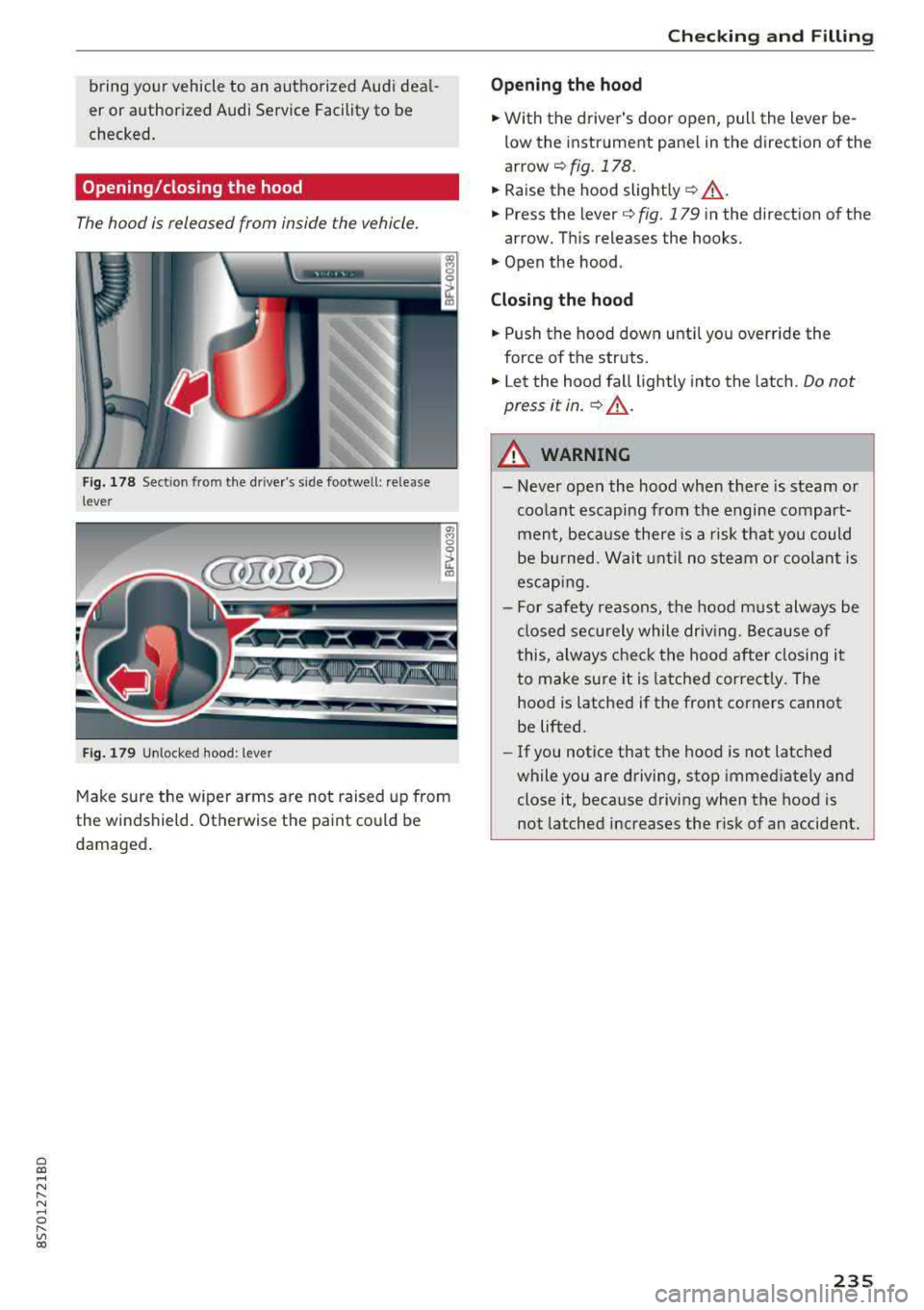
The hood is released from inside the vehicle.
F ig. 178 Sect ion from the drive r's side footwell: release
lever
F ig. 179 Unloc ked hood: lever
"' 8
~ (I)
Make sure the w iper arms are not raised up from
the windshield. Otherwise the pa int could be
damaged .
Checking and Filling
Opening the hood
... With t he driver's door open, pull the lever be
low the inst rument pane l in the direction of the
arrow ¢ fig. 178 .
... Raise the hood slightly ¢.&, .
... Press the lever¢ fig. 179 in the direction of the
arrow. Th is releases the hooks .
... Open the hood .
Closing the hood
... Push the hood down unti l yo u override the
force of the struts .
... Let the hood fall lightly into the latch. Do not
press it in.
¢ .&, .
A WARNING
--Never open the hood when there is steam or
coolant escaping from the engine compart
ment, because there is a risk that you could
be burned. Wait unt il no steam or coolan t is
escapi ng.
- F or safety reasons, the hood m ust always be
closed securely while driving. Because of
this, always che ck the hoo d after closing it
to make sure it is latched correct ly. The
hood is latched if the front corners cannot
be lifted.
-If you notice that the hood is not latched
while you are driving, stop immediately and
close it, because driving when the hood is not latched increases the r isk of an accident.
235
Page 241 of 310
Cl 00 .-< N r-N .-< 0 r-Vl 00
lubricating properties of oil diminish gradually
during normal vehicle use.
Unde r some c ircu mstances the eng ine o il should
be changed more frequently . Change oil mo re of
ten if you drive most ly short distances, ope rate
the vehicle in dusty areas or under predominant ly
stop-and -go traffic condit ions, or have your vehi
cle where temperatures remain below free zing
for extended periods.
Detergent additives in the oil will make fresh oil
l ook dark after the engine has been running for a
short time. Th is is normal and is not a reason to
change the oil more often than recommended.
Because of the problem of proper disposa l, along
with the special tools and necessary expertise re
qu ired, we strongly recommend that you have
your oil changed by an authorized
A ud i de ale r or
a qualified service station .
If you c hoo se to change your o il y our self , please
note the following important information:
A WARNING
To reduce the risk of personal injury if you
must change the engine oil in your veh icle
yourself:
- Wear eye protection .
- To reduce the risk of burns from hot engine oil, let the eng ine cool down to the touch.
-
- When removing the o il drain plug with your
fingers, stay as far away as poss ible. A lways
keep your forearm paralle l to the ground to
help prevent hot o il from runn ing down your
arm .
- Drai n the oil into a container designed for
this pu rpose, one large enough to hold at
least the total amount of oil in your e ng ine .
- Engine oil is poisonous . Keep it well out of
the reach of ch ild ren .
- Cont inuous contact w ith used eng ine oi l is
harmful to your sk in. A lways protect your
sk in by washing oil off thoroug hly w ith soap
and water.
@ Note
Never mix oil addit ives with your engine o il.
These additives ca n damage your eng ine and
Ch eck ing and F illing
adverse ly affect yo ur Audi Limited New Vehi
cle Warranty.
@ For the sake of the environment
- Before chang ing yo ur oil, first make sure
you know where you can proper ly d ispose o f
the used oi l.
- Always dispose of used engine o il properly.
Do not dump it on garden soil, wooded
areas, into open streams or down sewage
drains.
- Recycle used engine oi l by taking it to a used
engine oi l collection faci lity in you r area, or
contact a service station .
Cooling system
Coolant
The eng ine cooling system is fi lled w it h a m ixtu re
of purified water and coo lant additive at the fac
tory . This coolant must not be not c hanged.
T he coo lant level is mo nitored th ro ugh
the . in
dicator light
<:!) page 12. However, we do recom
mend occasionally checking the coolant leve l
manua lly.
If you must add coolant, use a mixture of wate r
and coolant additive . Mix ing t he coo lant add it ive
with dis tilled water is recommended.
Coolant additive
T he coolant add itive is made of anti-free zing and
cor rosion protect ion agents. On ly use the follow
i ng coolant additives . These add itives may be
mixed wi th ea ch o the r.
Coolant additive Specification
G 13 TL 774 J
G12++ TL 774 G
The amount of coolant additive that needs to be
mixed with water depends on the cl imate where
the vehicle w ill be oper ated. If the coo lant add i
t ive percentage is too low, the coolant can freeze
and damage the eng ine .
.,.
239
Page 242 of 310
Checking and Filling
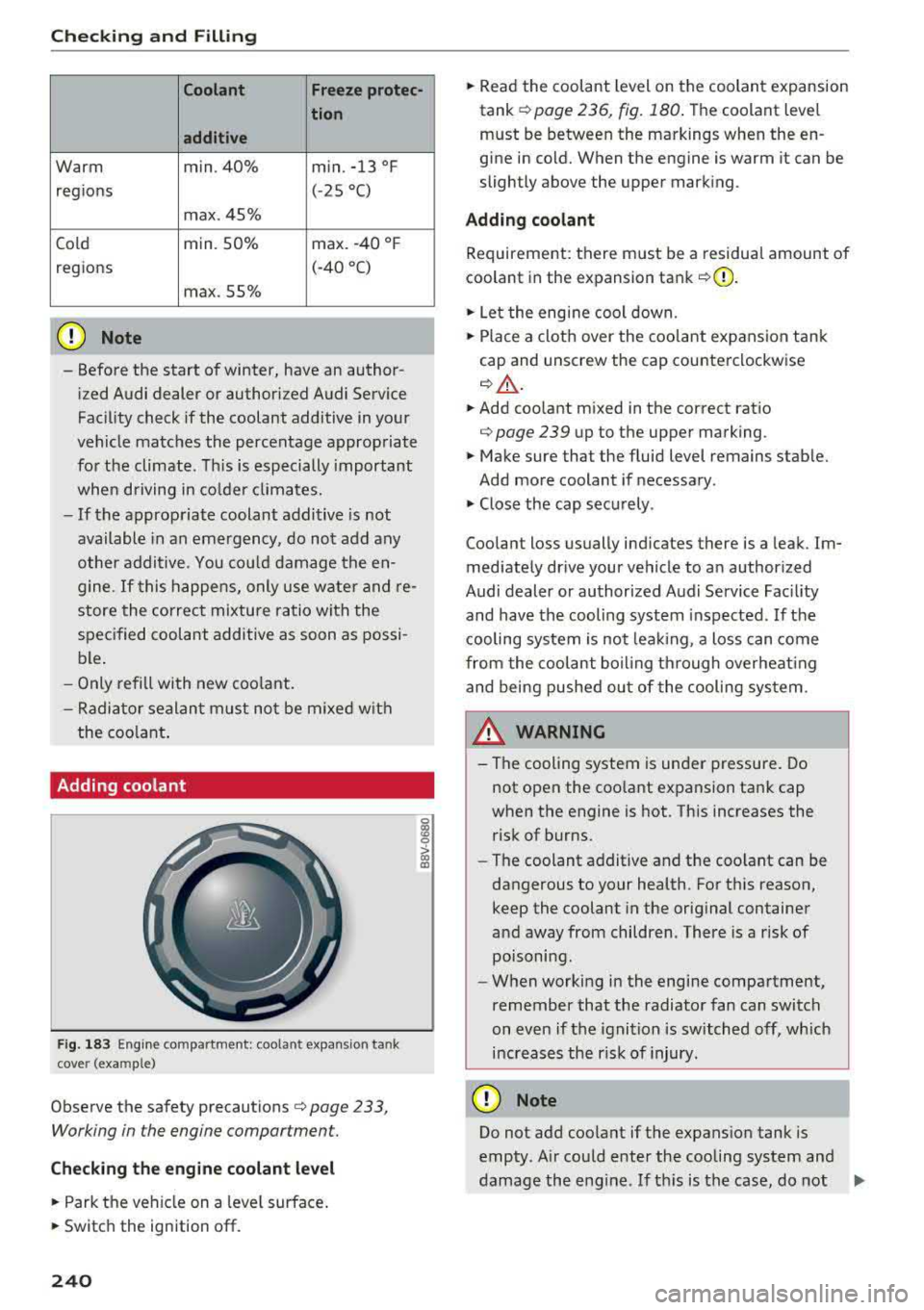
Coolant Freeze protec-
tion
additi ve
Warm min. 40% min. -13 °F
regions (- 25 °C)
max . 45%
Cold min. 50% max. -40 °F
regions (-40 °C)
max. 55%
@ Note
- Before the start of winter, have an author ized Audi dealer or authorized Audi Service
Facility check if the coolant additive in your
vehicle matches the percentage appropriate
for the climate. Th is is especially important
when driving in co lder climates.
- If the appropriate coolant additive is not
available in an emergency, do not add any
other additive . You cou ld damage the en
gine.
If t his happens, only use wate r and re
store the correct mixture ratio with the
specified coolant additive as soon as possi
ble .
- Only refill with new coo lant.
- Radiato r sealant must not be mixed w ith
the coo lant .
Adding coolant
Fig . 183 Eng ine co mpartment : coo lant expans ion ta nk
cove r (exa mple)
Observe the safety precautions c:::> page 233 ,
Working in the engine compar tment.
Che cking the engin e coolant l evel
.. Park the vehicle on a level surface .
.. Switch the ignition off .
240
~ 0 > 00 ID
.. Read the coolant level on the coolant expansion
tank
c:::> page 236, fig. 180 . The coolant level
must be between the markings when the en
gine in cold. When the engine is warm it can be
slightly above the upper mark ing .
Adding coo lant
Requirement : there must be a residual amount of
coolant in the expansion tank
c:::> @ .
.. Let the engine cool down.
.. Place a clot h over the coolant expansion tank
cap and unscrew the cap counterclockwise
c:::> ,A .
.. Add coo lant mixed in the correct rat io
c:::> page 239 up to the upper marking .
.. Make sure that the fluid level remains stable.
Add more coolant if necessary .
.. Close the cap securely .
Coolant loss usually ind icates there is a leak. Im
mediate ly dr ive your vehicle to a n author ized
Audi dealer or author ized Audi Service Fac il ity
and have the cooling system inspected. If the
cooling system is not lea king , a loss can come
from the coolant boiling through overheat ing
and being pushed ou t of the cooling system .
Lil WARNING
- The cooling system is under pressure. Do
not open the coo lant expansion tank cap
when the engine is hot. This increases the risk of burns.
-The coolant additive and the coolant can be dangerous to your health. For this reason ,
keep the coolant in the original container
and away from children. There is a risk of
poisoning.
-When working in the engine compartment,
remember that the radiator fan can switch
on even if the ignition is switched
off, wh ich
increases the r is k of injury.
@ Note
Do not add coolant if the expans ion tank is
empty . A ir could enter the cooling system and
-
damage the eng ine . If this is the case, do not ..,.
Page 244 of 310
Checking and Filling
A WARNING
California Proposit ion 65 Warning:
- Battery posts, terminals and related acces sories contain lead and lead compounds, chemicals known to the State of California
to cause cancer and reproductive problems .
Wash hands after handling .
Q) Note
If the vehicle will be parked for long periods
of t ime, protect it against the cold so that it
w ill not be destroyed by "freezing"
~page 242 .
Vehicle battery
The term "vehicle battery " refers to the 12 Volt
battery in your vehicle .
Not running the vehicle for long p eriods of
t ime
If you do not drive your vehicle for several days or
weeks, electrical equipment is gradually scaled
back or switched off . This reduces energy use and
ensures the veh icle w il l be able to sta rt after long
pe riods of time
i:::> page 91. Some convenience
functions, such as interior light ing or power sea t
adjustment, may not be available under certain
circumstances . These convenience functions will
be avai lab le again once you switch the ignition on
and start the engine.
Even when electrical equipment is switched off ,
the equipment can still drain the vehicle battery if the vehicle is not driven for long periods of
time. Deep draining results in a chemical reaction
that destroys the inside of the vehicle battery.
The vehicle battery must be charged every month to reduce the risk of this happen ing
i:::> page 242.
Contact an author ized Audi dealer or authorized
Aud i Serv ice Facility for more information.
Winter operati on
Cold weather places higher demands on the vehi
cle battery . This results in reduced start ing abili
ty . Have the vehicle battery checked by an au
thori zed Audi dealer or authorized Audi Service
Facility before the co ld time of year.
242
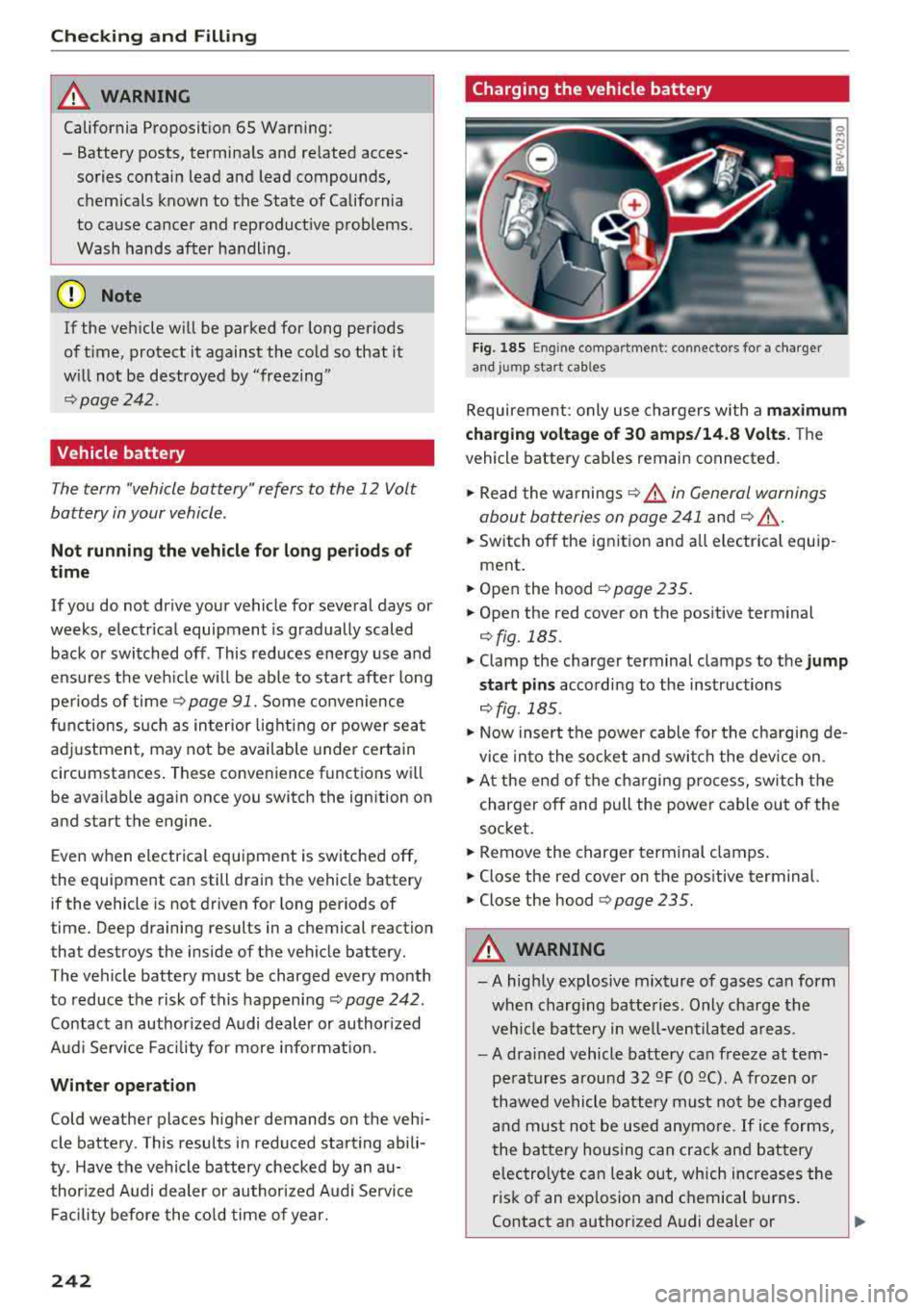
Charging the vehicle battery
Fig. 18 5 En g in e compartmen t: co nn ectors fo r a cha rger
a n d jum p start cab les
Requireme nt: only use chargers with a maximum
charging volt age of 30 amp s/14.8 Volts.
The
vehicle battery cables remain connected.
... Read the wa rnings i:::> ,& in General warnings
about batteries on page 241
and i:::> ,& .
... Switch off the ignition and all electrica l equip
ment .
... Open the hood i:::> page 235 .
... Open the red cover on the positive terminal
¢fig. 185.
... Clamp the charger terminal clamps to the jump
s ta rt pins
according to the instructions
c::> fig . 185 .
... Now insert the power cable for the cha rging de
vice into the socket and switch the device on .
... At the end of the charging process, switch the
charger off and pull the power cable out of the
socket .
... Remove the charger terminal clamps.
... Close the red cover on the pos itive terminal.
... Close the hood i:::> page 235.
A WARNING
-A highly explosive m ixture of gases can form
when charg ing batteries . Only charge the
veh icle battery in well-ventilated areas.
-A drained vehicle battery can freeze at tem
peratures around 32
QF (0 QC) . A frozen or
thawed vehicle battery must not be charged
and must not be used anymore. If ice forms,
the battery housing can crack and battery
electrolyte can leak out, which increases the
risk of an explosion and c hemical burns .
Contact an authorized Audi dealer or
..,_
Page 245 of 310
Cl 00 .-< N r-N .-< 0 r-Vl 00
authorized Audi Service Facility for more in
formation.
- Do not connect or disconnect the charging
cable while charging because this increases
the risk of an exp losion.
(D Tips
- Only charge the vehicle battery through the
connections in the engine compartment.
- Read all of the manufacturer's instructions
for the charger before charging the vehicle
battery.
Windshield washer system
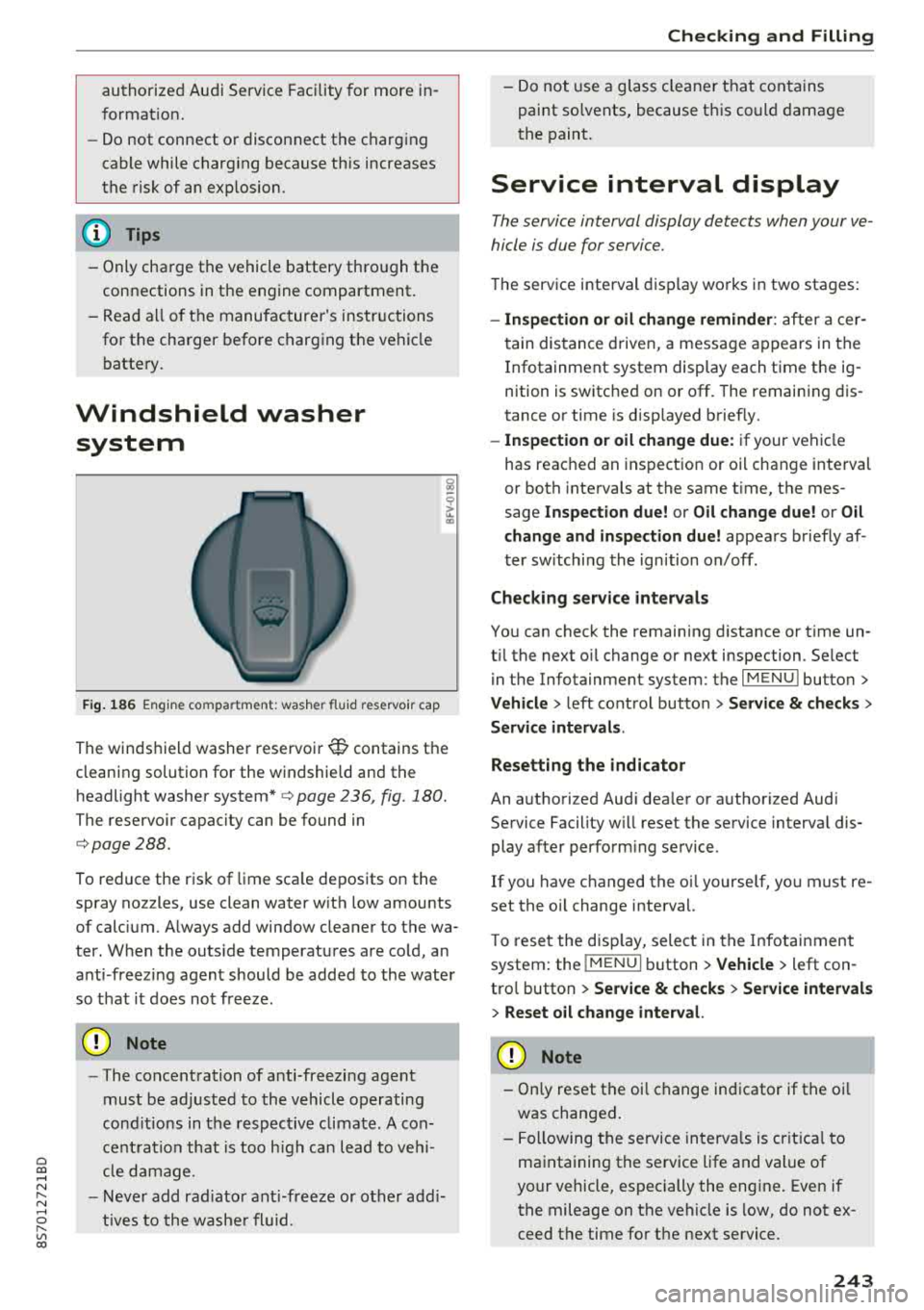
Fig. 186 Engine compa rtment: washer flu id reservo ir cap
The windshield washer reservoir W contains the
cleaning solution for the windshie ld and the
headlight washer
system* ¢ page 236, fig . 180.
The reservoir capacity can be found in
¢page 288.
To reduce the risk of lime sca le deposits on the
spray nozzles, use clean water with low amounts
of calc ium. A lways add window cleaner to the wa
ter. When the outs ide temperatures are cold, an
anti -freezing agent should be added to the water
so that it does not freeze.
@ Note
-The concentration of anti-freezing agent
must be adjusted to the vehicle operating
cond itions in the respective climate. A con
ce ntrat ion that is too high can lead to vehi
cl e damage.
- Never add radiator anti-freeze or other addi
tives to the washer fluid.
Checking and Filling
- Do not use a glass cleaner that contains
paint so lvents, because t his could damage
the paint.
Service interval display
The service interval display detects when your ve
hicle is due for service .
The service interval display works in two stages:
-Inspection or oil change reminder : after a cer-
tain distance driven, a message appears in the
In fotainment system display each time the ig
nition is switched on or off. The remaining dis
tance or time is disp layed briefly.
- Inspection or oil change due: if your vehicle
has reached an inspection or oil change interval
or both intervals at the same t ime, the mes
sage
Inspection due! or Oil change due! or Oil
change and inspection due!
appears briefly af
ter switching the ignition on/off .
Checking service intervals
You can check the remaining distance or time un
t il the next oil change or next inspection. Se lect
in the Infotainment system: the
I MENU I button>
Vehicle > left control button > Service & checks >
Service intervals .
Resetting the indicator
An authorized Audi dea ler or authorized Audi
Service Facility w ill reset the service interval dis
play after performing service.
If you have ch anged the oi l yourse lf, you must re
set the oil change interval.
T o reset the disp lay, select in the Infotainment
system: the
I MENUI button> Vehicle> left con
trol button >
Service & checks > Service intervals
> Reset oil change interval.
@ Note
-Only reset the oil change indicator if the oi l
was changed.
- Following the service intervals is crit ica l to
maintaining the service life and value of
your vehicle, especially the engi ne. Even if
the mileage on the vehicle is low, do not ex
ceed the time for the next service.
243
Page 246 of 310
Wheels
Wheels
Wheels and T ires
General information
~check your tires regularly for
damage (punctures, cuts, cracks
and bulges). Remove foreign ob
jects from the tire tread.
~ If driving over curbs or similar
obstacles, drive slowly and ap proach the curb at an angle.
~Have faulty tires or rims re
placed immediately.
~ Protect your tires from oil,
grease and fuel.
~ Mark tires before removing
them so that the same running
direction can be maintained if
they are reinstalled.
~Lay tires flat when storing and
store them in a cool, dry location
with as little exposure to light as
possible.
_&. WARNING -
-Never drive faster than the maximum permitted speed
for your tires. This could cause
the tires to heat up too much.
This increases the risk of an
accident because it can cause
the tire to burst .
-Always adapt your driving to the road and traffic condi-
244
tions . Drive carefully and re
duce your speed on icy or slip
pery roads . Even winter tires
can lose traction on black ice.
(@ Note
-Please note that summer and
winter tires are designed for
the conditions that are typical
i n those seasons . Aud i recom
mends using winter tires dur
ing the winter months . Low
temperatures significantly de
crease the elasticity of summ
er tires, which affects traction
and braking ability. If summer
tires are used in very cold
temperatures, cracks can form
on the tread bars, resulting in
permanent tire damage that
can cause loud driving noise
and unbalanced tires.
-Burnished, polished or chromed rims must not be used in winter driving condi
t ions. The surface of the r ims
does not have sufficient corro
sion protection for this and
could be permanently dam
aged by road salt or similar
substances.