air condition AUDI TT ROADSTER 2018 Owners Manual
[x] Cancel search | Manufacturer: AUDI, Model Year: 2018, Model line: TT ROADSTER, Model: AUDI TT ROADSTER 2018Pages: 310, PDF Size: 46.95 MB
Page 44 of 310
Lights and Vision
Dimming the mirrors
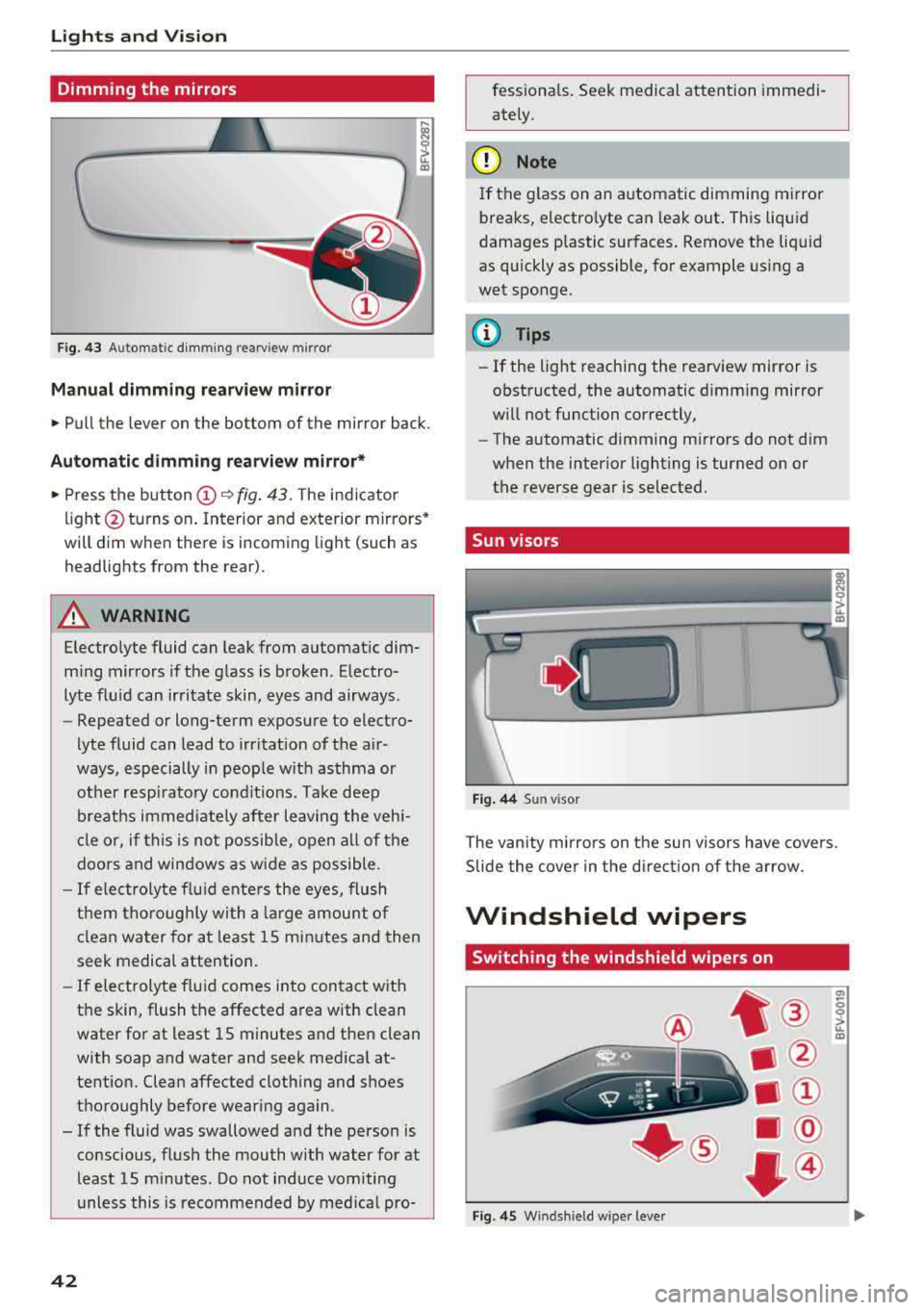
Fig. 43 Automatic dimming rearview mirror
Manual dimming rea rview mirror
• Pull the lever on the bottom of the mirror back.
Automatic dimming rearview mirror*
• Press the button (D ~ fig. 43. The indicator
light @turns on . Interior and exterior mirrors*
will dim when there is incoming light (such as
headlights from the rear) .
A WARNING
Electrolyte fluid can leak from automatic dim
m ing mirrors if the glass is broken. Electro
lyte fluid can irritate skin, eyes and airways.
- Repeated or long-term exposure to electro-
lyte fluid can lead to irritation of the a ir
ways, especially in people with asthma or
other resp irato ry conditions. Take deep
breaths immed iate ly after leaving the vehi
cle or, if this is not possible, open all of the
doors and windows as wide as possible .
-If electrolyte f lu id ente rs the eyes, flush
them thoroughly with a large amount of
clean water for at least 15 minutes and then
seek medical attention.
- If electrolyte f luid comes into contact with
the skin, flush the affected area with clean
water for at least 15 minutes and then clean
with soap and water and seek medical at
tention. Clean affected clothing and shoes
thoroughly before wearing again .
- If the fluid was swallowed and the person is conscious, flush the mouth with water for at
least 15 minutes. Do not induce vomiting
unless this is recommended by med ical pro-
42
fessionals . Seek medical attention immedi
ately .
(D Note
If the glass on an automatic dimming mirror
breaks, electro lyte can leak out . This liquid
damages plastic surfaces. Remove the liquid
as quickly as possible, for example us ing a
wet sponge.
(D Tips
- If the light reaching the rearview mirror is
obstructed, the automatic dimming mirror
will not function correctly,
- The automatic dimming mirrors do not dim
when the interior lighting is turned on or
the reverse gear is selected.
Sun visors
Fig. 44 Sun visor
T he vanity mirrors on the sun visors have covers .
Slide the cover in the direction of the arrow.
Windshield wipers
Switching the windshield wipers on
Fig . 45 W inds hield w iper leve r
(7>
0 0 > u. m
Page 55 of 310
Cl co .... N ,....
N ...... 0 ,....
Vl co
1- 1 Switching recirculation mode on and off
The recir cu lation mode can be turned o n m anu al
l y o r automat ically* .
- Swi tching m anual rec ircula tion mo de on an d
off: p res s
l'-"" I
- Automa tic* recircu lation mode: au to rec ircula
t io n needs to be ac tiva ted in the Info tainmen t
system. Selec t in the Infot ainme nt system :
I MENU I button > Vehicle > le ft co nt rol but ton
>Vehicle settings > Air conditioning > Auto re
circulation .
The ai r quality sensor that is de
s igned for diese l and gasoline exhaust auto
matically switches the recircu lation mode on or
off depend ing o n the level of pollutants in the
o utside air .
In recircu lation mode , the a ir inside the vehicle is
circu lated and fi ltered. This prevents the unfil
tered ai r outside the vehicle from entering the
ve hicle interio r. Switch ing recircu lation mode on
when dr iving t hrough a tunnel or when s itti ng i n
traffic is recomme nded
¢ .&, .
Recirculation mode is switched off by pressing
the
!""' I button o r I AUTO I or! MAX !.
I@ MAXI Switching defr ost on and off
The winds hield and side windows are defrosted
or cleared of condensation as q uickly as possib le.
The optimum amount of a ir flows main ly out of
the vents under the windshield. Rec irculat ion
mode switches off . The temperature is cont rolled
automatically .
The
IAU TOI button switches the defroster off .
I@ REAR I Switching the rear window defogger
on and off
I f the rear w indow defogger is activated when
the ignition is switched on, the battery manage
ment determines based on the batte ry charge if
it is possib le to turn on . Ot herwise , the rea r win
dow defogger functions with the engine running
and switches off automatically after approxi
mate ly 10
-2 0 mi nutes, depen ding on the out
side tem per ature.
To prevent t he rear w indow defogge r from
switch ing off automatically, press and ho ld the
I@ REARI b utton fo r more than two seconds. This
Warm and cold
remains stored up to approx imately 15 minutes
after t urning off the ignition.
A WARNING
-
You should not use the reci rculat ion mode for
an extended period since no fresh a ir is drawn
i n . With the air-conditioning switched off, the
windows can fog up, which increases the risk
of an acc ident .
Adjusting the air vents
Fig. 62 Cock pit: a djust ing the a ir ven ts
To adjust the di rection of air flow, tu rn the
ridged outer ad justment wheel
(D ¢ fig. 62.
T o adjust the
amount of air flow , move the lever
@on the a ir vent . To stop the air flow, move the
lever all the way to the left.
Seat heating
Fig. 63 A ir ve nts: seat heat ing
T he seat heating has th ree levels . The se lected
heat leve l is indicat ed by the LED .
.,. To switch the seat he ating on, press t he Q] but
t on once.
.,. To switch to a lower level, p ress the Q] button
aga in .
""
53
Page 90 of 310
Intelligent Technology
Wear
Brake pad wear depends largely on the way the
vehicle is driven and on operating conditions.
This is especially true if you are driving frequently
in the city and on curves or with a sporty driving
style.
Operating noise
Noises may occur when braking depending on the
speed, braking force and outside conditions such
as temperature and humidity.
Wet conditions or road salt
I n certain situations, for example after dr iving
through water, in heavy ra in or after washing
your car, the braking effect may be reduced due
to moisture or ice on the brake rotors and brake
pads . The brakes must be "dried" first with a few
careful brake applications.
At higher speeds and with the windshie ld wipers
turned on, the brake pads press against the brake
rotors for a short amount of time . This action,
which is not felt by the driver, happens at regular
intervals and ensures a better reaction time for
the brakes in wet weather .
The braking effect can also be reduced if you are
driving on sa lted roads and you do not apply the
brakes for long periods of time. The layer of salt
on the brake rotors and pads must be worn off
first when the brakes are applied.
Corrosion
Leaving the vehicle parked for long periods of
time, low mi leage and avoiding heavy braking
can contribute to corrosion on the brake rotors
and to dirty brake pads.
If you usually avoid heavy braking or if there is
corrosion present, occasional heavy braking at
h igh speeds is recommended to clean the brake
rotors and
pads¢ &.
Brake system malfunction
If you notice that the brake pedal travel has sud
denly increased, then a brake circuit in the dual
circuit brake system may have malfunctioned. Drive to an authorized Aud i dea ler or authorized
Aud i Serv ice Facility immediately to have the
88
problem corrected. On the way there, drive with
reduced speed and keep in mind that you will
need a longer distance to stop and you will need
to press the brake pedal harder.
Low brake fluid level
When the brake fluid level is low, malfunctions in
t h e brake system may occur . The brake fluid leve l
is electronically monitored .
Brake booster
The brake booster amplifies the pressure you ap
ply to the brake pedal.
& WARNING
- New brake pads do not achieve their full
braking effect during the first 250 mi
-
(400 km). They must be "broken in" first .
However, you can compensate for the
slightly reduced braking force by pressing
firm ly on the brake pedal. Avoid heavy brak
ing during the break-in period.
- On ly app ly the brakes for the purpose of
cleaning the brake system when road and
traffic conditions permit. You must not en
danger other road users . This increases the
r is k of an accident.
- On steep slopes, reduce the speed and se
lect a lower gea r or lower selector leve r po
sition. Drive as lit tl e as possible while press
ing the brake pedal and avo id putting yo ur
left foot on the brake pedal while driv ing .
This could ca use the brakes to overheat and
impair the efficiency of th e brakes.
- Do not let the brakes "grind" by always
keeping your foot on the brake pedal. This
can cause the brakes to overheat, increase
wear and increase braking distance unneces
sarily.
- Certain weather and operating conditions such as driving through water, dr iv in g in
heavy rain or driv ing after wash ing your ve
h icle can impair the effectiveness of the
brakes. In the winter, ice may build up on
the brake pads, rotors and drums. Check
these compon ents by braking carefully. Ap
plying the brakes carefully several times
dries the brakes and removes ice build-up.
Page 91 of 310
Cl 00 .-< N r-N .-< 0 r-Vl 00
-The efficiency of the brakes can also be im
paired by driving for long stretches on roads
covered with salt without using the brakes .
You can remove salt deposits from the
brake rotors and pads by carefully applying
the brakes severa l t imes .
- If the front spoiler is damaged or you install
another spoiler, make sure the front wheel
brakes are vent ilated proper ly . Otherwise,
the b rake system could overheat, w hich re
duces the ir effectiveness.
- Failure of a brake c ircuit impa irs b raking
perfo rman ce , which increases brak ing dis
tan ce. Avoid d riving the vehicle and have it
towed it to the nearest authorized Audi
dealer or authorized Audi Service Facility .
- Never let the vehicle roll while t he engine is
stopped because this increases the risk of an
accident.
- If the brake booster is not working, you will
have to press much harder on the brake
peda l to compensate for the lack of the
booster.
@ Note
- Never let the brakes "rub" by pressing the
pedal light ly when braking is not actually
necessary. This causes the brakes to over
heat and increases braking d istance and
causes wear.
- Before driving downhi ll a long distance on a
steep h ill, decrease your speed and select a
lower gear. This makes use of the engine
braking effect and relieves the brakes . If
you need to brake additionally, brake in in
tervals and not conti nuous ly .
0) Tips
- If the brake booster is not working, you
must press the brake pedal with much more
fo rce t han normal.
- If you retrofit your vehicle with a front spoil
er, whee l covers o r similar items, make sure
t h at the a ir flow to the front whee ls is not
i nte rru pted. Ot herw ise the brake system
ca n become too ho t.
In tellig ent T echn olo gy
Electromechanical
steering
The electromechanical steering supports the
driver 's steering movements .
Power steering adap ts elec troni cally based on
the vehicle speed .
Indicator li ghts and me ssages
• Stee ring: m alfun ction! Ple ase stop vehicle
If this indica to r li ght tur ns on and stays on and
this message appears, the powe r steering may
have failed.
Stop the veh icle in a safe location as soon as pos
s ible. Do
n o t cont inue d riving. See an autho rized
Audi dealer or authorized A udi Service Facility for
assistance .
(;r,ij Ste ering : malfun cti on! You may con tinu e
dri vin g
If the indicator l ight turns on, the steering wheel
may be more d ifficult to move or more sensit ive
t h an usual. The steer ing whee l may also be at an
angle when d riving stra ight.
Drive slowly to an authorized Aud i dealer or au
thorized Aud i Serv ice Facility to have the mal
funct ion corrected.
(D Tips
If the . or (;r,ij ind icator light only stays on
fo r a short t ime, yo u may continue d riving.
All wheel drive (quattro)
In all wheel drive, all four wheels are powered.
Gener al informat ion
In all wheel dr ive, the dr iving power is divided be
tween all four wheels . This happens automatical
ly depending on your dr iv ing behavior as well as
t h e cur rent road condit ions. A lso
see ~ page 86,
Electronic stabilization control (ESC).
The all wheel dr ive concept is des igned for high
engine power . You r vehicle is except ionally pow
erfu l and has excellent driv ing cha racter istics
bot h unde r normal d riving conditions and o n
89
Page 181 of 310
Cl 00 .-< N r--N .-< 0 r--Vl 00
Safe driving Basics
Safe driving habits
Please remember -safety first!
The individua l safety features of your vehicle can
work together as a system to help protect you
and your passengers in a wide range of accidents.
These features cannot work as a system if they
are not always correctly adjusted and correctly
used .
This chapter contains important informat ion,
tips, instruct ions and warn ings that you need to
read and observe for your own safety, the safety
of your passenge rs and others . We have summar
i zed here w hat you need to know about safety
be lts, a irbags, child restra ints as well as child
safety. Yo ur safety is for us priority number 1. Al
ways observe the information and warnings in
this section - for your own safety as well as that
of your passengers.
The informa tion in t his sect ion app lies to all
model versions of your vehicle. Some of the fea
tures described in t his sections may be standard
eq uipment on some models, or may be optional
equ ipment on others. If you are not sure, ask
your author ized Audi dealer.
A WARNING
-Always make sure that you follow the in
st ruct ions and heed the WAR NINGS in t his
Manua l. It is in your i nterest a nd in the in
t e res t of your passengers .
-
-Always keep the complete Owner's Litera
t ur e in yo ur Audi whe n you lend or se ll yo ur
vehicle so tha t this import ant information
w ill a lways be available to t he d rive r and
passengers.
-Alw ays keep t he Owne r's lite rature h andy so
that you can f ind it easily if yo u have ques
tions .
Safe dri ving
Important things to do before driving
Safety is everybody 's job ! Vehicle and occupant
safety always depends on the informed and care
ful driver .
For your safety and the safety of your passenger,
b efor e driving alw ay s:
.. Make sure that a ll lights and s ignals are operat
ing correctly.
.. Make sure tha t the tire pressure is correct .
.. Make sure that all windows are clean and afford
good vis ibility to the outs ide .
.. Secure all luggage and othe r items ca refully
c::> page 183, c::> page 49.
.. M ak e sure tha t not hing c an in terfere wi th the
peda ls .
.. Adj ust seat and mirrors correctly for your
height .
.. Make sure to use the right child restra int cor
rectly to protect children
c::> page 216, Child
safety.
.. Sit properly in your seat and make sure that
your passenger do the
same ¢ page 46, Front
seats.
.. Fasten yo ur safety belt and wear i t properly. Al
so inst ru ct yo ur passenge r to fas ten his safety
be lt properly
¢ page 187.
What impairs driving safety?
Safe driving is dire ctly related to the condition of
the vehicle, the driver as well as the driver's abili
ty to concentrate on the road without being dis
tracted.
T he dr iver is responsib le for the sa fe ty of the ve
hicle and a ll of its occupants. If your ability to
drive is impai red, safety risks for everybody in the
vehicl e inc rease and you a lso become a hazard to
everyone else on the road
¢ A_ . Therefore:
.. Do not let yourse lf be distracted by passenge r
or by using a ce llular telephone .
.. NEVER drive when your driving ability is im
pa ired (by med ications, alcohol, drugs, etc.) .
.. Observe all traffic laws, rules of the road and
speed lim its and plain common sense .
.. ALWAYS adjust your speed to road, traffic and
weather conditions .
.,.
179
Page 186 of 310
Safe driving
on the safety compliance sticker on the left
door jamb. Exceeding permissible weight
standards can cause the vehicle to slide and handle differently .
- Please observe information on safe driving
9 page 179.
A WARNING
To help prevent poisonous exhaust gas from
being drawn into the vehicle, always keep the
rear lid closed while driving.
- Never transport objects larger than those
fitting completely into the luggage area be cause the rear lid cannot be fully closed .
- If you absolutely must drive with the rear lid open, observe the following notes to reduce
the risk of poisoning:
- Close all windows,
- Close the convertible top,
- Open all air outlets in the instrument pan-
el,
- Switch off the air recirculation,
- Set the fresh air fan to the highest speed .
A WARNING
.
-
Always make sure that the doors, all win
dows, the convertible top and the rear lid are
securely closed and locked to reduce the risk
of injury when the vehicle is not being used.
- After closing the rear lid , always make sure
that it is properly closed and locked.
- Never leave your vehicle unattended espe
cially with the rear lid left open . A child
could crawl into the vehicle through the lug
gage compartment and close the rear lid be
coming trapped and unable to get out. Be
ing trapped in a vehicle can lead to serious
personal injury.
- Never let children play in or around the vehi
cle.
- Never let passengers ride in the luggage compartment. Vehicle occupants must al
ways be properly restrained in one of the ve
hicle's seating positions.
184
@ Tips
- Air circulation helps to reduce window fog
ging. Stale air escapes to the outside
through vents in the trim panel, on the left
side of the luggage compartment. Be sure
to keep these slots free and open.
- The tire pressure must correspond to the
load. The tire pressure is shown on the tire
pressure label. The tire pressure label is lo
cated on the driver's side B-pillar . The tire
pressure label lists the recommended cold
tire inflation pressures for the vehicle at its
maximum capacity weight and the tires that
were on your vehicle at the time it was man
ufactured. For recommended tire pressures
for normal load conditions , please see chap
ter ¢page255.
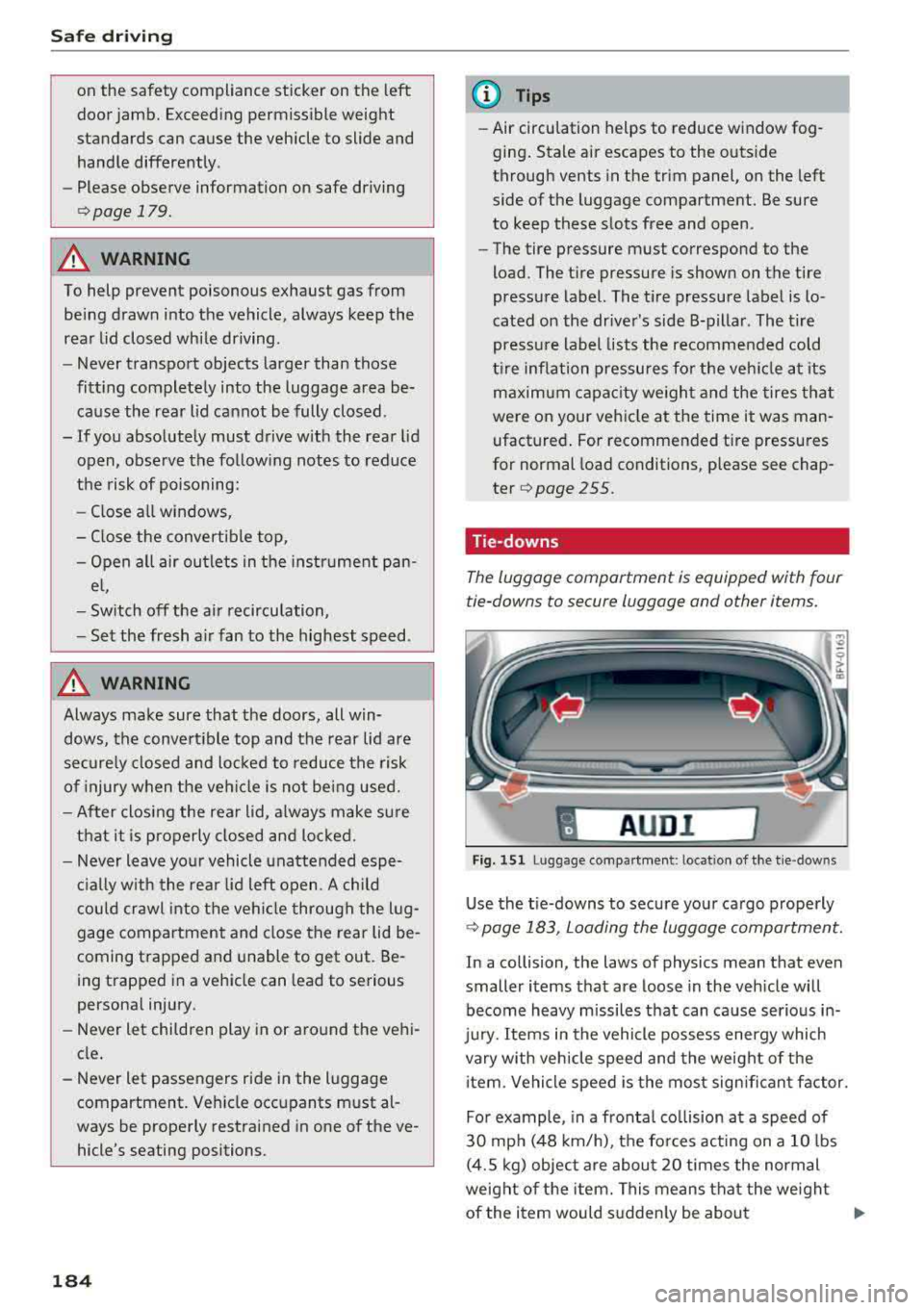
Tie -downs
The luggage compartment is equipped with four
tie-downs to secure luggage and other items.
I A UD I I
Fig. 151 Lu ggage compartmen t: loca tion of the tie -dow ns
Use the tie-downs to secure your cargo properly
9page 183, Loading the luggage compartment.
In a collision, the laws of physics mean that even
smaller items that are loose in the vehicle will
become heavy missiles that can cause serious in
jury. Items in the vehicle possess energy which
vary with vehicle speed and the weight of the
item . Vehicle speed is the most significant factor.
For example , in a frontal collision at a speed of
30 mph (48 km/h), the forces acting on a 10 lbs
(4.5 kg) object are about 20 times the normal
weight of the item. This means that the weight
of the item would suddenly be about
...
Page 198 of 310
Airbag system
The PASSENGER AIR BAG OFF~; light in the
headliner tells you when the front Advanced Air
bag on the passenger side has been turned off by
the electronic control unit.
E ach time you turn on the ignition, the
PASSEN
GER AIR BAG OFF
"1; ON@ light will come on
for a few seconds and:
- PASSENGER AIR BAG OFF ~; will come on if
the front passenger seat is not occupied,
-PASSENGER AIR BAG OFF ~; will come on if
t h e e lectrica l capacitance measured by the ca
pacitive passenger detection system for the
front passenger seat equa ls the combined ca
pacitance of an infant up to about one year of
age and one of the rearward-facing or forward
facing child restraints listed in Federal Motor
Vehicle Safety Standard 208 w ith which the Ad
vanced Airbag System in your vehicle was certi
fied. For a listing of the ch ild restraints that
were used to cert ify your vehicle 's compliance
with the U.S. Safety Standard
¢page 218.
- PASSENGER AIR BAG OFF~; will come on if
there is a small child or ch ild rest raint on the
front passenger seat,
-PASSENGER AIR BAG ON @w ill go off if the
front passenger seat is occupied by an adult as
registered by the capacitive passenger detec
tion system ¢
page 205, Monitoring the Ad
vanced Airbag System .
The PASSENGER AIR BAG OFF~; light comes on
when electrical capacitance registered on t he
front passenger seat is equa l to or less than the
combined capacitance of a typica l 1 year -o ld in
fant and one of the rearward-facing or forward
facing ch ild restraints listed in Federal Motor Ve
h icle Safety Standard 208 with wh ich the Ad
vanced A irbag System in your vehicle was cert i
f ie d.
If the tota l electrical capac itance registered on
the front passenger seat is more than that of a
typical 1 year-old child but less than the we ight
of a small adult, the front a irbag on the passen
ge r side ca n deploy (the
PASSENGER AIR BAG
OFF
"1; light does not come on).
If the
PASSENGER AIR BAG OFF "1; light does
not come on, the front a irbag on the passenger
196
side has not been turned off by the electronic
contro l unit and can deploy if the contro l unit
senses an impact that meets the conditions stor
ed in its memory.
For example , the airbag may deploy
if:
-a small c hild that is heav ier than a typica l 1
year-old child is on the front passenger seat
(regard less of whethe r the child is in one of the
child sa fety seats listed ¢
page 218), or
- a child who has outgrown child restraints is on
the front passenger seat.
If the front passenger a irbag is turned off, the
PASSENGER AIR BAG OFF~; light comes on in
the headliner and stays on.
If the front passenger airbag deploys, the Feder
al Standard requires the airbag to meet the "low
r isk" dep loyment cr iteria to reduce the r isk of in
jury through interaction w ith the airbag. "Low
risk" deployment occurs in those crashes that
take place at lower decelerations as defined in
the e lectronic contro l unit ¢
page 206, PASSEN
GER AIR BAG
OFF~; ON~ light.
A lways remember, a child seat or infant carrier
installed on the front seat may be struck and
knocked out of position by the rapidly inflating
passenger's airbag in a frontal col lision. The air
bag could great ly reduce the effectiveness of the
c hi ld restraint and even ser iously injure the child
during inflat io n.
A WARNING
A child in a rearward-facing child seat instal
led on the front passenger seat will be seri
ously injured and can be killed if the front air
bag inflates
-even with an Advanced Airbag
System.
- The inflat ing airbag will hit the child seat or
infant carrier with great force and will
smash the child seat and child against the
backrest, center armrest, door or roof.
- Forward-facing child seats installed on the
front passenger's seat may interfere with
the deployment of the airbag and cause se
r ious personal injury to the ch ild.
Page 201 of 310
Cl 00 .-< N r-N .-< 0 r-Vl 00
seat backrests; never place them between
these areas and you or any other person in
the vehicle.
- Never attach objects to the windshield
above the passenger front airbag, such as
accessory GPS navigation units or music
players. Such objects could cause serious in
jury in a collision, especially when the air bags inflate .
A WARNING
A person on the front passenger seat, espe
cially infants and small children, will receive
serious injuries and can even be killed by be
ing too close to the airbag when it inflates.
- Although the Advanced Airbag System in
-
your vehicle is designed to turn off the front
passenger airbag if an infant or a small child
is on the front passenger seat, nobody can
absolutely guarantee that deployment un
der these special conditions is impossible in
all conceivable situations that may happen
during the useful life of your vehicle.
- The Advanced Airbag System can deploy in accordance with the "low risk" option under
the U .S . Federal Standard if a child that is
heavier than the typical one-year old child is
on the front passenger seat and the other
conditions for airbag deployment are met.
- For its own safety, a child should always ride
properly restrained for its age and size.
Advanced front airbag system
Your vehicle is equipped with a front Advanced
Airbag System in compliance with United States
Federal Motor Vehicle Safety Standard (FMVSS)
208, as well as Canada Motor Vehicle Safety
Standard (CMVSS) 208 as applicable at the time
your vehicle was manufactured.
The front Advanced Airbag System supplements
the safety belts to provide additional protection
for the driv er's and front passenger's heads and
upper bodies in frontal crashes . The airbags in
flate only in frontal impacts when the vehicle de
celeration is high enough.
Airbag system
The front Advanced Airbag System for the front
seat occupants is not a substitute for your safety
belts. Rather, it is part of the overall occupant re
straint system in your vehicle. Always remember
that the airb ag system can only help to protect
you, if you are sitting upright, wearing your safe
ty belt and wearing it properly . This is why you
and your passengers must always be properly re
strained, not just because the law requires you to
be.
The Advanced Airbag System in your vehicle has
been certified to meet the "low risk" require
ments for 3 and 6 year-old children on the pas
senger side and very small adults on the driver
side. The low risk deployment criteria are intend
ed to help reduce the risk of injury through inter
action with the front airbag that can occur, for
example, by being too close to the steering wheel
and instrument p anel when the airbag inflates.
In addition, the system has been certified to
comply with the "suppression" requirements of
the Safety Standard, to turn off the front airbag
for infants 12 months old and younger who are
res trained on the front passenger seat in child re
straints that are listed in the Standard
~page 218, Child restraints and Advanced front
airbag system .
"Suppression" requires the front airbag on the
passenger side to be turned off if:
- a child up to about one year of age is restrained
on the front passenger seat in one of the rear
facing or forward-facing infant restraints listed in Federal Motor Vehicle Safety Standard 208
with which the Advanced Airbag System in your
vehicle was certified . For a listing of the child
restraints that were used to certify your vehi
cle's compliance with the US Safety Standard
~page 218,
- When a person is detected on the front passen
ger seat that has an electrical capacitance that
is more than the total electrical capacitance of
a child that is about 1 year old restrained in one
of the rear-facing or forward-facing infant re
straints (listed in Federal Motor Vehicle Safety
Standard 208 with which the Advanced Airbag
System in your vehicle was certified), the front
.,,.
199
Page 202 of 310
Airbag syste m
airbag on the passenger side may or may not
deploy.
The
PAS SENGER AIR B AG OFF ~; light comes o n
when the e lectron ic control un it detects a total
e lectrica l capacitance on the front passenger seat
that requires the front airbag to be turned
off . If
the
PASSENGER AIR BAG OFF '1; light does not
come on, the front airbag on the passenger side has not been turned
off by the control unit and
can deploy if the control unit senses an impact
that meets the conditions stored in its memory .
If the tota l electrical capac itance registered on
the front passenger seat is more than that of a
typical 1 year -old, but less than the weight of a
small adult , the front airbag on the passenger
side may deploy (the
PASSENGER AIR BAG OFF
~ ; light does not come on).
For exampl e, th e airbag may d eploy if:
- a small child that is heavier than a typical 1
year-old ch ild is on the front passenger seat
(regardless of whether the child is in one of the
ch ild seats listed
r=;,page 218),
- a chi ld who has outgrown child restraints is on
the front passenger seat .
If the front passenger airbag is turned off , the
P ASS ENGER AIR BA G OFF~; light in the head
liner will come on and stay on .
I f the front passenger airbag dep loys, the Feder
a l Standard requires the airbag to meet the "low
risk" deployment criteria to help reduce the risk
of injury through interaction with the airbag.
"Low risk" deployment occurs in those crashes
that take place at lower decelerations as def ined
i n the electronic control
un it ¢ page 205 .
Alw ays remember: Please be sure to read the im
portant information in the sections that follow
and be sure to heed all of the WARNINGS .
A WARNING
To red uce the risk of inju ry when an a irbag in
flates, a lways wear safety belts p roperly.
- If you are unrestrained, lean ing forward, s it
t ing s ideways or out of pos ition in any way,
yo ur r isk of i njur y is m uch higher.
200
-You will a lso receive serious injuries and
could even be killed if yo u are up against the
airbag or too close to it when it inflates -
eve n with a n Advanced
Airbag ¢ page 194.
A WARNING
A child in a rearward-facing child seat instal
led on t he front passenger seat will be seri
ously injured and ca n be killed if the front air
bag inflates -even with an Advanced Airbag
Sys tem.
- Altho ugh the Advanced Airbag System in
your veh icle is des igned to tur n
off the front
air bag w hen a rearward -fac ing c hild re
s traint has been installed on the front pas
senger seat, nobody can abso lute ly guaran
tee t hat dep loyment is impossib le in all con
ceivab le situat ions that may happen d uring
the useful life of your vehicle.
- The inflating airbag will h it the ch ild seat or
infant carrier with great force and will
smash the child seat and child against the backrest, center armrest, door, or roof .
- If you m ust install a rearward facing child
safety seat on the front passenger seat be
cause of except ional circ umstances and the
PASSENGER AIR BAG OFF ~; light does not
come on and stay on have t he a irbag system
inspected by yo ur Audi dea ler.
A WARNING
I f, in exceptional c ircumstances , you must in
s tall a forward -fa cing ch ild res trai nt on the
front passenger's seat:
- Always make sure the forward -fa cing sea t
has bee n des igned and certified by its man
ufacturer for use on a front seat with a pas
senge r front and side airbag.
- Never put the fo rward -facing chi ld restrain t
up against o r very near the instr ument pan
el.
- Always move the front passenger seat to
the highest position in the up and down ad
justment range and move it bac k to the
rearmost posit io n in the seat's fo re and aft
Page 218 of 310
Child safety
Child safety
Important information
Introduction
The physical princip les of what happens when
your veh icle is in a cras h apply also to childr en
¢ page 188, What happens to occupants not
wearing safety belts?.
But unlike adults and
teenagers, their muscles and bones are not fully
developed. In many respects children are at
greater risk of serious injury in crashes than
adu lts.
Because children's bodies are not fu lly devel
oped, they require restraint systems especially
designed for their size, weight, and body struc
ture. Many countries and all states of the United
States and provinces of Canada have laws requir
ing the use of approved child restraint systems
for infants and small children .
In a frontal crash at a speed of 20-35 mph (30-56 km/h) the forces acting on a 13 lbs (6 kg)
infant will be more than 20 times the we ight of
the child . This means the weight of the child
wou ld suddenly be more than 260 lbs ( 120 k g).
Under th ese conditions, only an appropriate child
rest raint properly used can reduce the r isk of se
rio us injury. Child restraints, like adult safety
be lts, must be used properly to be effective.
Used improperly, they can increase the risk of se
rious inj ury in an accident.
If you must install a child restraint on the front
passenger seat in exceptional circumstances, be
sure to read and heed the important information
and warn ings
¢ page 195. Infants and other ch il
dren who are properly restrained in an appropri
ate child restraint that is for their size and age
can benefit from the protection that supplemen
tal side airbags provide in some kinds of crashes .
For more information please see information
provided by the:
- Nationa l Highway Traffic Safety Administration
(NHTSA), current ly at: http:/ /www .safe
rcar.gov (for the USA)
- Transport Canada Information Centre, current
ly at: http://www.tc .gc.ca (for Canada)
216
Consult the child safety seat manufacturer's in
structions in order to be sure the seat is right for
your ch ild's s ize
¢ page 219, Important safety
instructions for using child safety seats.
Please
be sure to read and heed all of the important in
format ion and WARNINGS about child safety,
Advanced Airbags, and the installation of child
restraints in this chapter.
There is a lot you need to know about the Ad
vanced Airbags in your veh icle and how they work
when infants and children in ch ild restraints are
on the front passenger seat . Because of the large
amount of impo rtant informat ion, we ca nnot re
peat it all he re. We urge you to read the detailed
inf ormation in this owner's manual about airbags
and the Advanced Airbag System in your vehicle
and the very important information about trans
porting children on the front passenger seat.
Please be sure to heed the WARNINGS
-they are
extremely important for your safety and the safe
ty of your passengers, especially infants and
small children .
.&_ WARNING
All vehicle occupants and especially child re n
must be restrained properly whenever riding
in a vehicle. An unrestrained or improperly re
stra ined child could be injured by striking the
interior or by being ejected from the vehicle
during a sudden maneuver or impact . An un
restrained or improperly restrained child is al
so at greater r isk of injury or death through
contact w ith an inflating airbag.
A WARNING
Children on the front seat of any car even with
Advanced Airbags can be seriously injured or
even killed when an airbag inflates. A ch ild in
a rearward-fac ing child safety seat installed
on the front passenger seat will be seriously
in ju red and can be killed if the front airbag in
flates.
- The inflat ing airbag will hit the child safety
seat or infa nt carrier with great force and
will smash the child safety seat and child
against the backrest, center armrest, or
door.