child seat AUDI TT ROADSTER 2018 Owners Manual
[x] Cancel search | Manufacturer: AUDI, Model Year: 2018, Model line: TT ROADSTER, Model: AUDI TT ROADSTER 2018Pages: 310, PDF Size: 46.95 MB
Page 6 of 310
Table of contents
Airbag system . . . . . . . . . . . . . . . . . . . .
194
Important information . . . . . . . . . . . . . . . 194
Front a irbags . . . . . . . . . . . . . . . . . . . . . . . 198
Mon itoring the Advanced Airbag System . 205
Knee airbags .. .. ............. .... .. . 210
Side airbags . . . . . . . . . . . . . . . . . . . . . . . . 212
Child safety . . . . . . . . . . . . . . . . . . . . . . 216
Important information . ....... .. .. .. . 216
C hi ld safety seats . . . . . . . . . . . . . . . . . . . . 221
Secur ing ch ild safety seats . . . . . . . . . . . . 225
Add it io nal info rmation . . . . . . . . . . . . . . . 228
Maintenance and Care . . . . . . . . . . . 229
Checking and Filling . . . . . . . . . . . . . 229
F ue l..... .. .. .. ............. .... .. . 229
Ref ueling . . . . . . . . . . . . . . . . . . . . . . . . . . 230
E m issions cont ro l sys tems . . . . . . . . . . . . 233
On Board Diagnostic System (OB D) . . . . . 233
Engine compartment . . . . . . . . . . . . . . . . . 233
Eng ine oil . . . . . . . . . . . . . . . . . . . . . . . . . . 236
Cooling system . . . . . . . . . . . . . . . . . . . . . . 239
Brake fluid . . . . . . . . . . . . . . . . . . . . . . . . . 241
Battery . . . . . . . . . . . . . . . . . . . . . . . . . . . . 241
W indshield washe r system . . . . . . . . . . . . 243
Service i nterval d isplay 24 3
Wheels ... .. .. ................ ... . 244
Wheels and T ires . . . . . . . . . . . . . . . . . . . . 244
T ire press ure monitor ing system
T ire press ure monitor ing sys tem 26
1
26 2
Care and cleaning . . . . . . . . . . . . . . . . 266
Gene ral informa tion . . . . . . . . . . . . . . . . . 266
Ca r washes . . . . . . . . . . . . . . . . . . . . . . . . . 266
C leaning and care information . . . . . . . . . 267
P lacing your vehicle o ut of service . . . . . . 271
Do It Yourself . . . . . . . . . . . . . . . . . . . . 272
Emergency assistance . . . . . . . . . . . 272
Trun k escape latch . . . . . . . . . . . . . . . . . . . 272
Gene ral information . . . . . . . . . . . . . . . . . 272
Equipment . . . . . . . . . . . . . . . . . . . . . . . . . 272
T ire mob ility k it . . . . . . . . . . . . . . . . . . . . . 273
Replac ing whee ls . . . . . . . . . . . . . . . . . . . . 27S
Spare tire . . . . . . . . . . . . . . . . . . . . . . . . . . 279
4
Fuses and bulbs . . . . . . . . . . . . . . . . . . 280
E lectrica l fuses . . . . . . . . . . . . . . . . . . . . . . 280
B ul bs. . . . . . . . . . . . . . . . . . . . . . . . . . . . . . 282
Emergency situations . . . . . . . . . . . . 283
Genera l . . . . . . . . . . . . . . . . . . . . . . . . . . . . 283
Start ing by push ing or tow ing . . . . . . . . . . 283
Start ing with jumper cables . . . . . . . . . . . 283
U sing the jump start cable . . . . . . . . . . . . 284
T ow ing with a tow truck . . . . . . . . . . . . . . 285
Raising the vehicle . . . . . . . . . . . . . . . . . . . 286
Accessories and technical data . . 288
Technical data . . . . . . . . . . . . . . . . . . . . 288
Vehicle spec ificat ions . . . . . . . . . . . . . . . . 288
Notes abo ut te chnical data . . . . . . . . . . . . 288
D imens io ns . . . . . . . . . . . . . . . . . . . . . . . . . 288
Capacities . . . . . . . . . . . . . . . . . . . . . . . . . . 2 88
Weights . . . . . . . . . . . . . . . . . . . . . . . . . . . 289
Consumer Information . . . . . . . . . . 290
Warranty coverages . . . . . . . . . . . . . . . . . . 290
Operating your vehicle outside t he U.S.A.
or Canada . . . . . . . . . . . . . . . . . . . . . . . . . . 290
Audi Service Repair Manuals and Literature . . . . . . . . . . . . . . . . . . . . . . . . . . 290
Maintenance . . . . . . . . . . . . . . . . . . . . . . . . 290
Accessor ies a nd techn ica l changes . . . . . . 292
De clara tion of compliance for
te lecommunications eq uipment a nd
electron ic sys tems . . . . . . . . . . . . . . . . . . . 293
Index ...... .. .. .. .. ............. .. 294
Page 48 of 310
Seats and stor age
Seats and storage
General information
A WARNING
See c> page 179, Safe driving for important
information, tips, suggestions and warnings
that you should read and follow for your own
safety and the safety of yo ur passengers .
Front seats
Power seat adjustment
Applies to vehicles with power adjustable seats
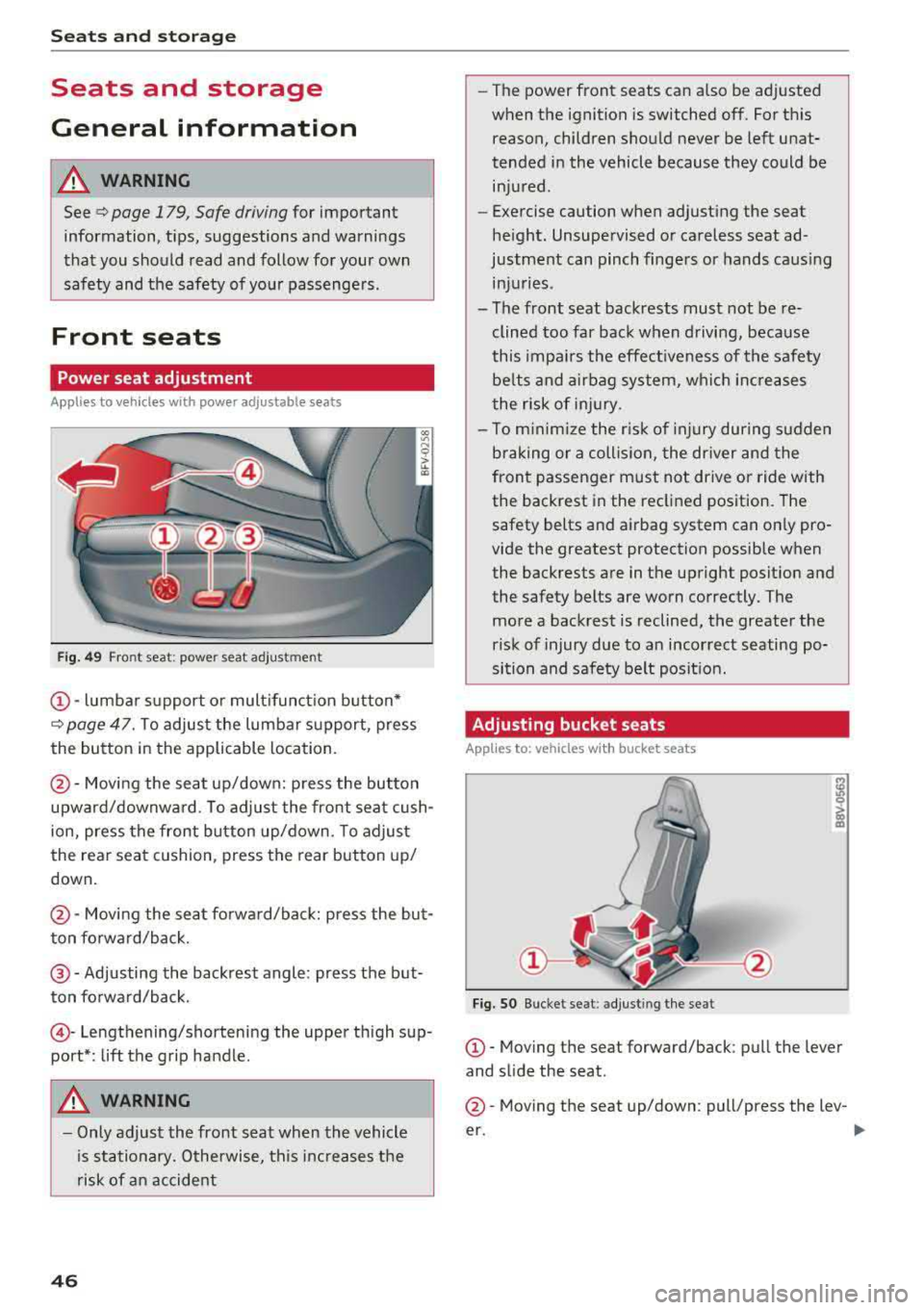
Fig. 49 Fro nt seat: power seat ad jus tm en t
CD -lumbar s upport o r mult ifunct ion button*
c> page 47. T o adjus t the lumbar s upport, press
the button in the applicable location.
@ -Moving the seat up/down: p ress the button
upward/downwa rd . To adjust the front seat cush
ion, press the front button up/down. To adjust
the rear seat cushion, press the rear button up/
down.
@ -Moving the sea t fo rwa rd/back: press the but
ton fo rward/back.
@ -Adjusting the backrest angle : press the but
ton fo rwa rd/back.
© -Lengthening/shortening the upper th igh sup
port* : lift the grip handle.
A WARNING
- Only adjust the front seat when the vehicle
i s sta tionary. Otherwise, this increases the
risk of an accident
46
- The power front seats can also be adjusted
when the ignition is switched off. For this reason, children should never be left unat
tended in the vehicle because they could be injured.
- Exercise caution when adjust ing the seat
he ight. Unsupervised or ca reless seat ad
justment can pinch fingers or hands caus ing
in ju ries .
- The front seat backrests must not be re
clined too far back when d riving, because
this impa irs the effect iveness of the safety
be lts and a irbag sy stem, whi ch in creases
the risk of in jury.
- To m inimi ze the r isk of inj ury dur ing s udden
braking or a collision, the dr iver and the
front passenger must not drive or ride with
the backrest in the reclined position. The
safety belts and a irbag system can o nly pro
vide the greatest protection possible when
the backrests are in the upright posit ion and
the safety belts are worn correctly. The more a backrest is reclined, the greater the
risk of injury due to an incorrect seating po
si tion and safety belt posit ion .
Adjusting bucket seats
App lies to: vehicles with bucket seats
Fig. SO B uck et se at: ad jus tin g the se at
CD-Mov ing the seat forward/back : pull the lever
and s lide the seat .
@-Moving the seat up/down : pull/p ress the lev-
er.
..,_
Page 56 of 310
![AUDI TT ROADSTER 2018 Owners Manual Warm and cold
,.. To switch the seat heating off, press the Q] but-
ton repeatedly until the LED turns off.
The seat heating sw itches automatically from
setting 3 to setting 2](/img/6/57668/w960_57668-55.png "AUDI TT ROADSTER 2018 Owners Manual Warm and cold
,.. To switch the seat heating off, press the Q] but-
ton repeatedly until the LED turns off.
The seat heating sw itches automatically from
setting 3 to setting 2")
Warm and cold
,.. To switch the seat heating off, press the Q] but-
ton repeatedly until the LED turns off.
The seat heating sw itches automatically from
setting 3 to setting 2 after 10 minutes.
When seat h eating should not be switched
on
Do not t ur n the seat heating on under the follow
i n g circumstances :
- The seat is unocc upied.
- The seat is covered with a seat cover.
- The seat is covered with a child seat.
- The seat is damp or wet.
A WARNING
Individua ls with reduced sensitivity to pain or
temperature could develop burns when using
the seat heating function. To reduce the risk
of injury, these individuals should not use
seat heat ing .
«D Note
To avoid damage to the heat ing elements in
the seats, do not kneel o n the seats or place
heavy loads on a small area of the seat.
(D Tips
- The setting for the seat heating on the driv
er's side is ass igned to the key that is in use.
- If the front passenger's seat heating is
turned on, it will not turn on again automat
i ca lly if more than 10 m inutes have passed
between sw itching the ignition off and
switching it on again.
54
Neck heating
App lies to : vehicles wi th neck heating
The neck heating functions when the engine is
running .
Fig. 64 Driver 's seat: neck heating vents
Fig . 65 Cockp it: neck heating
The neck heating has three levels . If you turn the
knob to the right, the neck heating switches on
¢ fig. 65. The LEDs above the seat symbol indi
cate the ventilation level. Turn the knob to the
left to reduce ventilat ion. To switch off the neck
heating, keep turning the knob to the left until
no LEDs are turned on .
When the power top is closed, the neck heating
switches automatically from setting 3 to setting
2 after approx imately six minutes.
A WARNING
- Individuals with reduced sensitiv ity to pain
or temperature could develop burns when
using the neck heat ing . To reduce the risk of
in ju ry, these individuals shou ld no t use neck
heat ing.
- The output from the neck hea ting may be
come very hot temporarily if the air vents in
the seats
qfig . 64 are covered by clothing
or simi lar ob jects when the system is
Page 181 of 310
Cl 00 .-< N r--N .-< 0 r--Vl 00
Safe driving Basics
Safe driving habits
Please remember -safety first!
The individua l safety features of your vehicle can
work together as a system to help protect you
and your passengers in a wide range of accidents.
These features cannot work as a system if they
are not always correctly adjusted and correctly
used .
This chapter contains important informat ion,
tips, instruct ions and warn ings that you need to
read and observe for your own safety, the safety
of your passenge rs and others . We have summar
i zed here w hat you need to know about safety
be lts, a irbags, child restra ints as well as child
safety. Yo ur safety is for us priority number 1. Al
ways observe the information and warnings in
this section - for your own safety as well as that
of your passengers.
The informa tion in t his sect ion app lies to all
model versions of your vehicle. Some of the fea
tures described in t his sections may be standard
eq uipment on some models, or may be optional
equ ipment on others. If you are not sure, ask
your author ized Audi dealer.
A WARNING
-Always make sure that you follow the in
st ruct ions and heed the WAR NINGS in t his
Manua l. It is in your i nterest a nd in the in
t e res t of your passengers .
-
-Always keep the complete Owner's Litera
t ur e in yo ur Audi whe n you lend or se ll yo ur
vehicle so tha t this import ant information
w ill a lways be available to t he d rive r and
passengers.
-Alw ays keep t he Owne r's lite rature h andy so
that you can f ind it easily if yo u have ques
tions .
Safe dri ving
Important things to do before driving
Safety is everybody 's job ! Vehicle and occupant
safety always depends on the informed and care
ful driver .
For your safety and the safety of your passenger,
b efor e driving alw ay s:
.. Make sure that a ll lights and s ignals are operat
ing correctly.
.. Make sure tha t the tire pressure is correct .
.. Make sure that all windows are clean and afford
good vis ibility to the outs ide .
.. Secure all luggage and othe r items ca refully
c::> page 183, c::> page 49.
.. M ak e sure tha t not hing c an in terfere wi th the
peda ls .
.. Adj ust seat and mirrors correctly for your
height .
.. Make sure to use the right child restra int cor
rectly to protect children
c::> page 216, Child
safety.
.. Sit properly in your seat and make sure that
your passenger do the
same ¢ page 46, Front
seats.
.. Fasten yo ur safety belt and wear i t properly. Al
so inst ru ct yo ur passenge r to fas ten his safety
be lt properly
¢ page 187.
What impairs driving safety?
Safe driving is dire ctly related to the condition of
the vehicle, the driver as well as the driver's abili
ty to concentrate on the road without being dis
tracted.
T he dr iver is responsib le for the sa fe ty of the ve
hicle and a ll of its occupants. If your ability to
drive is impai red, safety risks for everybody in the
vehicl e inc rease and you a lso become a hazard to
everyone else on the road
¢ A_ . Therefore:
.. Do not let yourse lf be distracted by passenge r
or by using a ce llular telephone .
.. NEVER drive when your driving ability is im
pa ired (by med ications, alcohol, drugs, etc.) .
.. Observe all traffic laws, rules of the road and
speed lim its and plain common sense .
.. ALWAYS adjust your speed to road, traffic and
weather conditions .
.,.
179
Page 183 of 310
Cl 00 .-< N r-N .-< 0 r-Vl 00
-Never adjust the seats while the vehicle is
moving. Your seat may move unexpectedly
and you could lose control of the vehicle.
- Never drive with the backrest reclined or
tilted far back! The farther the backrests are
tilted back, the greater the risk of injury due
to incorrect positioning of the safety belt
and improper seating position .
- Children must always ride in child seats
¢page 216. Special precautions apply
when installing a child seat on the front
passenger seat ¢
page 194.
Proper seating position for the front
passenger
The proper front passenger seating position is
important for safe, relaxed driving.
For your own safety and to reduce the risk of in
jury in the event of an accident, we recommend
that you adjust the seat for the front passenger
to the following position:
.,. Adjust the angle of the seatback so that it is in
an upright position and your back comes in full
contact with it whenever the vehicle is moving .
.,. Keep both feet flat on the floor in front of the
front passenger seat .
.,. Fasten and wear safety belts correctly
¢ page 190.
For detailed information on how to adjust the
front passenger's seat, see ¢
page 46.
A WARNING
Front seat passengers who are unbelted, out
of position or too close to the airbag can be
seriously injured or killed by the airbag as it
unfolds . To help reduce the risk of serious
personal injury:
- Passengers must always sit in an upright po
sition and never lean against or place any
part of their body too close to the area
where the airbags are located.
- Passengers who are unbelted, out of posi
tion or too close to the airbag can be seri
ously injured by an airbag as it unfolds with
great force in the blink of an eye .
Safe driving
-Always make sure that there are at least
10 in (25 cm) between the front passen
ger's breastbone and the instrument panel.
- Always make sure that there are at least 4 in
(10 cm) between the front passenger's
knees and the lower part of the instrument
panel.
- Each passenger must always sit on a seat of
their own and properly fasten and wear the
safety belt belonging to that seat.
- Before driving, always adjust the front pas
senger seat properly.
- Always keep your feet on the floor in front
of the seat. Never rest them on the seat, in
strument panel, out of the window, etc . The
airbag system and safety belt will not be
able to protect you properly and can even in
crease the risk of injury in a crash .
- Never drive with the backrest reclined or
tilted far back! The farther the backrests are
tilted back, the greater the risk of injury due
to incorrect positioning of the safety belt
and improper seating position .
- Children must always ride in child seats
¢
page 216. Special precautions apply
when installing a child seat on the front
passenger seat ¢
page 194.
Examples of improper seating positions
The occupant restraint system can only reduce
the risk of injury if vehicle occupants are properly
seated.
Improper seating positions can cause serious in
jury or death. Safety belts can only work when
they are properly positioned on the body. Im
proper seating positions reduce the effectiveness
of safety belts and will even increase the risk of
injury and death by moving the safety belt to crit
ical areas of the body . Improper seating positions
also increase the risk of serious injury and death
when an airbag deploys and strikes an occupant
who is not in the proper seating position. A driver
is responsible for the safety of all vehicle occu-
pants and especially for children. Therefore:
IJJ,,
181
Page 186 of 310
Safe driving
on the safety compliance sticker on the left
door jamb. Exceeding permissible weight
standards can cause the vehicle to slide and handle differently .
- Please observe information on safe driving
9 page 179.
A WARNING
To help prevent poisonous exhaust gas from
being drawn into the vehicle, always keep the
rear lid closed while driving.
- Never transport objects larger than those
fitting completely into the luggage area be cause the rear lid cannot be fully closed .
- If you absolutely must drive with the rear lid open, observe the following notes to reduce
the risk of poisoning:
- Close all windows,
- Close the convertible top,
- Open all air outlets in the instrument pan-
el,
- Switch off the air recirculation,
- Set the fresh air fan to the highest speed .
A WARNING
.
-
Always make sure that the doors, all win
dows, the convertible top and the rear lid are
securely closed and locked to reduce the risk
of injury when the vehicle is not being used.
- After closing the rear lid , always make sure
that it is properly closed and locked.
- Never leave your vehicle unattended espe
cially with the rear lid left open . A child
could crawl into the vehicle through the lug
gage compartment and close the rear lid be
coming trapped and unable to get out. Be
ing trapped in a vehicle can lead to serious
personal injury.
- Never let children play in or around the vehi
cle.
- Never let passengers ride in the luggage compartment. Vehicle occupants must al
ways be properly restrained in one of the ve
hicle's seating positions.
184
@ Tips
- Air circulation helps to reduce window fog
ging. Stale air escapes to the outside
through vents in the trim panel, on the left
side of the luggage compartment. Be sure
to keep these slots free and open.
- The tire pressure must correspond to the
load. The tire pressure is shown on the tire
pressure label. The tire pressure label is lo
cated on the driver's side B-pillar . The tire
pressure label lists the recommended cold
tire inflation pressures for the vehicle at its
maximum capacity weight and the tires that
were on your vehicle at the time it was man
ufactured. For recommended tire pressures
for normal load conditions , please see chap
ter ¢page255.
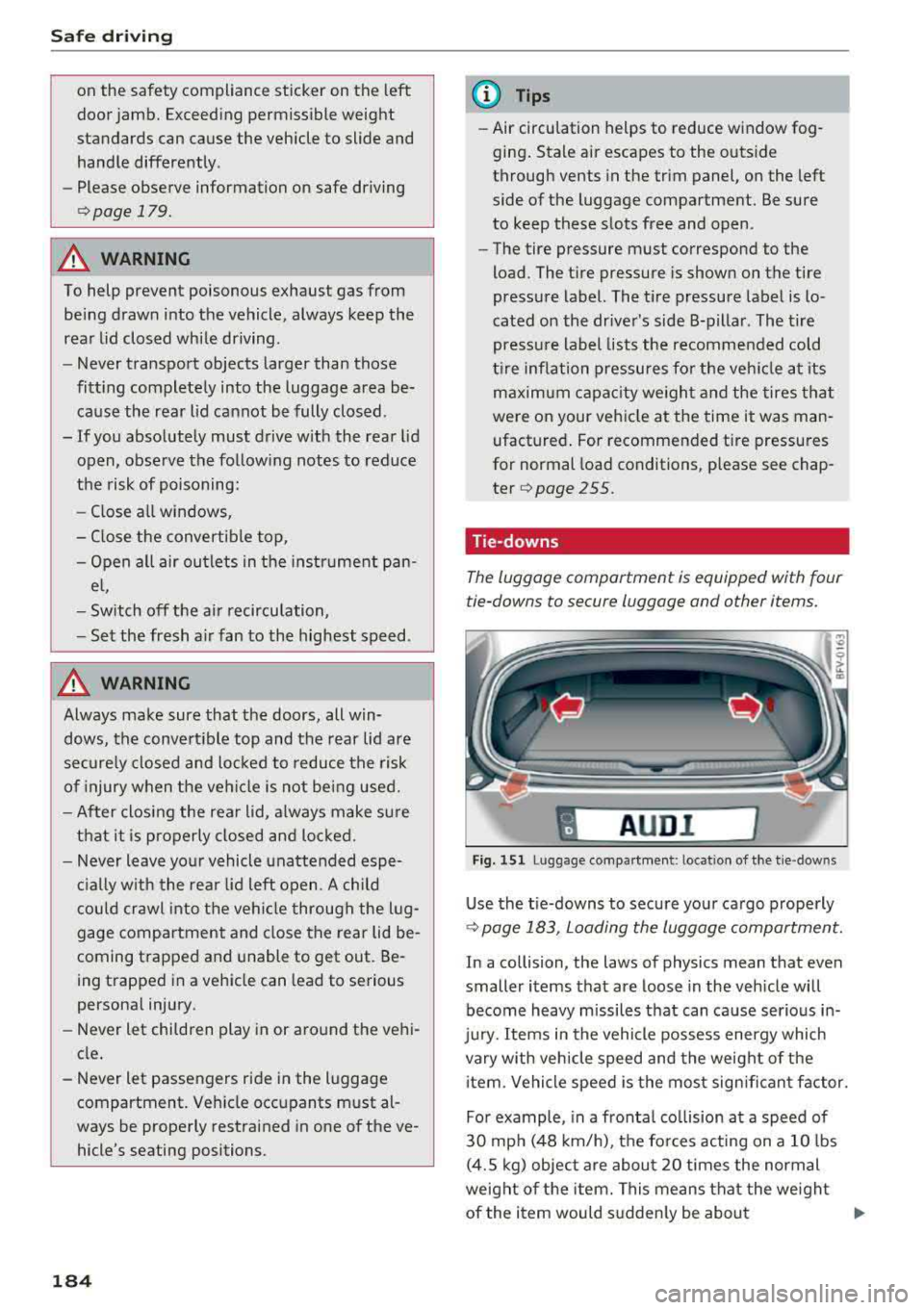
Tie -downs
The luggage compartment is equipped with four
tie-downs to secure luggage and other items.
I A UD I I
Fig. 151 Lu ggage compartmen t: loca tion of the tie -dow ns
Use the tie-downs to secure your cargo properly
9page 183, Loading the luggage compartment.
In a collision, the laws of physics mean that even
smaller items that are loose in the vehicle will
become heavy missiles that can cause serious in
jury. Items in the vehicle possess energy which
vary with vehicle speed and the weight of the
item . Vehicle speed is the most significant factor.
For example , in a frontal collision at a speed of
30 mph (48 km/h), the forces acting on a 10 lbs
(4.5 kg) object are about 20 times the normal
weight of the item. This means that the weight
of the item would suddenly be about
...
Page 187 of 310
Cl 00 .-< N r-N .-< 0 r-Vl 00
200 lbs (90 kg). You can imagine the injuries that
a 200 lbs (90 kg) item flying freely through the
passenger compartment could cause in a colli
sion like this.
A WARNING
Weak, damaged or improper straps used to
secure items to tie -downs can fail during hard
braking or in a collision and cause serious per
sonal injury.
- Always use suitable mounting straps and properly secure items to the tie-downs in
the luggage compartment to help prevent
items from shifting or flying forward as dan
gerous missiles .
- Never attach a child safety seat tether strap
to a tie-down.
-
Reporting Safety Defects
Applicable to U.S.A.
If you believe that your vehicle
has a defect which could cause a
crash or could cause injury or
death, you should immediately in
form the National Highway Traffic
Safety Administration (NHTSA) in
addition to notifying Audi of
America, Inc.
If NHTSA receives similar com
plaints, it may open an investiga
tion, and if it finds that a safety
defects exists in a group of
vehicles, it may order a recall and
remedy campaign. However,
NHTSA cannot become involved in
individual problems between you,
your dealer, or Audi of America,
Inc.
Safe driving
To contact NHTSA, you may call
the Vehicle Safety Hotline toll
free at:
Tel.: 1-888-327-4236 (TTY:
1-800-424-9153) or
1-800-424-9393
or you may write to:
Administrator NHTSA
1200 New Jersey Avenue, SE
Washington, D.C. 20590
You can also obtain other infor mation about motor vehicle safe
ty from:
http:/ /www.safercar.gov
Applicable to Canada
If you live in Canada and you be
lieve that your vehicle has a de
fect that could cause a crash, in
jury or death, you should immedi
ately inform Transport Canada,
Defect Investigations and Recalls.
You should also notify Volkswa
gen Group Canada, Inc.
Canadian customers who wish to
report a safety-related defect to
Transport Canada, Defect Investi gations and Recalls, may either
call Transport Canada toll-free at:
..,
185
Page 189 of 310
Cl 00 .-< N r-N .-< 0 r-Vl 00
Safety belts
General notes
Always wear safety belts!
Wearing safety belts correctly saves lives!
This chapter exp lains why safety be lts are neces
sary, how they work and how to adjust and wear
them correctly.
• Read all the information that follows and heed
all of the instructions and WARNINGS.
A WARNING
Not wearing safety belts or wearing them im
properly increases the risk of serious personal
injury and death.
- Safety belts are the s ingle most effective
means ava ilable to reduce the risk of serious
injury and death in automobile accidents.
For your protection and that of your passen
gers, always correctly wear safety belts
when the vehicle is moving.
- Pregnant women, injured, or physically im
paired persons must also use safety belts.
Like all vehicle occupants, they are more
likely to be seriously injured if th ey do not
wear safety belts. The best way to protect a
fetus is to protect the mother -throughout
the entire pregnancy.
Number of seats
Your veh icle has two seating positions. Each seat
ing position has a safety belt.
A WARNING
Not wearing safety belts or wearing them im
properly increases the risk of serious personal
injury and death.
- Never strap more than one person, includ
ing sma ll ch ildren, into any belt.
It is espe
ci ally da ngerous to place a safety belt over a
ch ild sitting on your lap.
- Never let more people ride in the vehicle
than there are safety belts available.
Safety belts
-Be sure everyone riding in the vehicle is
properly restrained with a separate safety
belt or child restraint.
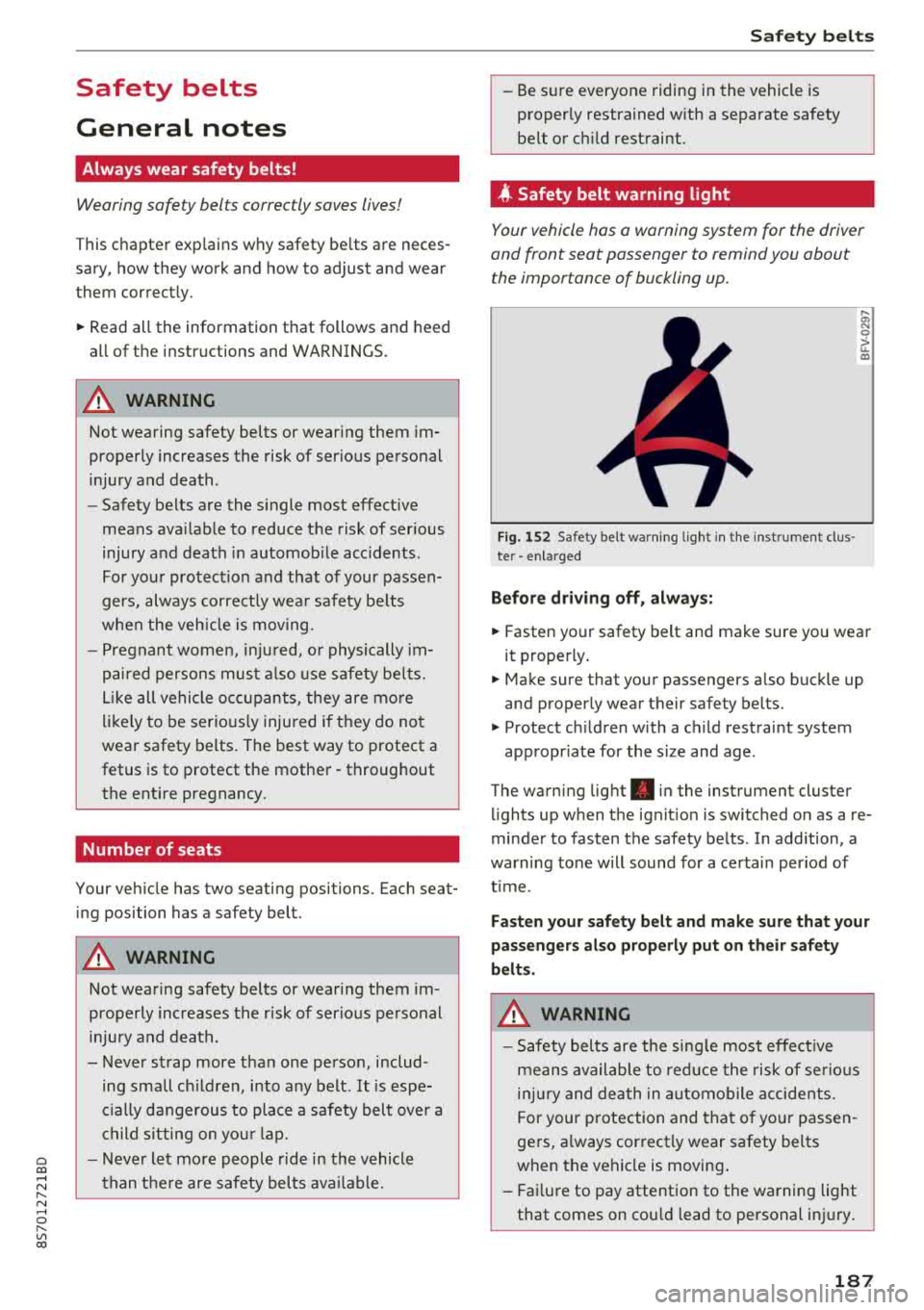
4 Safety belt warning light
Your vehicle has a warning system for the driver
and front seat passenger to remind you about the importance of buckling up.
Fig. 152 Safety belt warn ing ligh t in the instrument clus
ter -en larged
Before driving off, always:
l,; N 0
> ... m
• Fasten your safety belt and make sure you wear
it properly.
• Make sure that your passengers also buckle up
and properly wear their safety belts.
• Protect ch ildren with a child restraint system
appropr iate for the size and age .
The warning light . in the instrument cluster
lights up when the ignit ion is switched on as a re
minder to fasten the safety belts . In add ition, a
warning tone will sound for a certain period of
time .
Fasten your safety belt and make sure that your
passengers also properly put on their safety
belts.
A WARNING
-
- Safety belts are the single most effect ive
means available to red uce the risk of serious
i njur y and death in automobile accidents.
Fo r your protection and that of yo ur passen
gers, always correctly wear safety belts
when the vehicle is moving .
- Fail ure to pay attention to the warning light
that comes on cou ld lead to personal injury.
187
Page 191 of 310
Cl co .... N ,....
N ...... 0 ,....
Vl co
to offer protection in those accidents in which
airbags are not supposed to deploy or when they
have a lready deployed. Unbelted occupants can
also be thrown out of the vehicle where even
more severe or fatal injuries can occur.
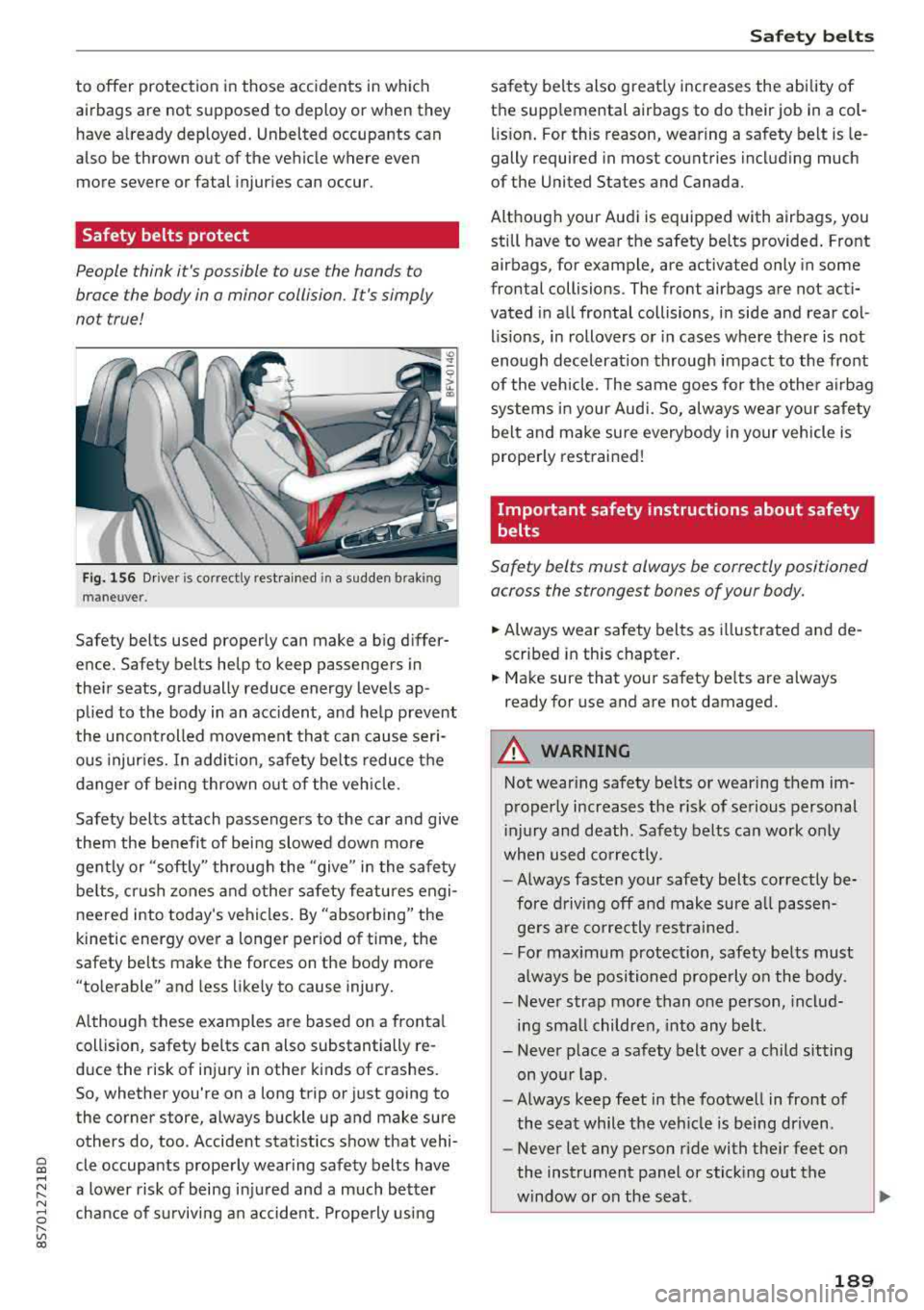
Safety belts protect
People think it's possible to use the hands to
brace the body in a minor collision. It's simply
no t true!
Fig. 156 Drive r is correctly restra ined in a s udde n brak ing
ma neuver .
Safety belts used properly can make a big differ
ence. Safety belts help to keep passengers in
their seats, gradually reduce energy levels ap
p lied to the body in an accident , and he lp prevent
the uncon trolled movement tha t can cause seri
ous injur ies. In addi tion , safety belts reduce the
danger of being thrown out of the veh icle.
Safety belts attach passengers to the car and give
them the benefi t of bei ng slowed down more
gent ly or "softly" through the "give" i n the safe ty
be lts, crush zones and other safety features engi
neered into today's vehicles . By "absorbing" the
kinetic energy ove r a longer period of time, the
safety belts make the forces on the body more
"to lerable" and less likely to cause injury.
Although these examples are based on a fronta l
coll is ion, safety belts can also substantially re
duce th e risk of inj ury in other kinds of crashes.
So, whether you're on a long trip or just going to
the corner store, always buckle up and make sure
others do, too . Accident stat istics s how that vehi
cle occupants properly wearing safety belts have
a lower risk of being in ju red and a much better
chance of s urviv ing a n accide nt. Prope rly us ing
Safet y bel ts
sa fety belts also great ly increases the ability of
the supp lemental airbags to do their job in a col
li sion . For this reason, wearing a safety belt is le
gally required in most countries including much
of the United States and Canada.
Although your Audi is equipped with airbags, you still have to wear the safety belts p rovided . Front
airbags, for example, are activated only in some
frontal collisions. The front airbags are not acti
vated in a ll frontal collisions, i n side and rear col
lis ions, in rollovers o r in cases where there is not
enough decelerat ion through impact to the front
of the veh icle. The same goes for the othe r air bag
systems in your Aud i. So, always wear yo ur safe ty
belt an d make sure everybody in your vehicle is
prope rly restrained!
Important safety instructions about safety
belts
Safety belts must always be correctly positioned
across the strongest bones of your body.
.,. Always wear safety belts as i llustrated and de
scribed in this chapter.
.,. Make sure that your saf ety be lts are always
ready for use and are not damaged.
A WARNING
Not wear ing safety be lts o r wearing t hem im
p roperly increases the r is k of serious personal
i njury and death . Safety belts can work only
when used correctly.
- Always fasten your safety belts co rrectly be
fore d riving off and make sure a ll passen
ge rs a re co rrectly res trained.
- For maximum protection, safety belts must
always be positioned properly o n the body .
- Never strap more than one person, includ
ing smal l children , into any belt .
- Never p lace a safety belt over a child sitting
on yo ur lap .
- Always keep feet in the footwe ll in front of
the seat while the veh icle is being driven .
- Never let any person ride with the ir feet on
the instrument panel or stick ing out the
window or on the seat.
189
Page 192 of 310
Safe ty belts
-Never remove a safety be lt while the vehicle
is mov ing . Doing so will increase your r isk of
being injured or killed.
-Never wear belts twisted.
-Never wear belts over rigid or breakable ob -
jects in or on your cloth ing, such as eye
glasses , pens, keys, etc ., as these may cause
injury.
-Never allow safety be lts to become dam
aged by being caught in door or seat hard
ware .
-Do not wear the shoulder part of the belt
under your arm or otherwise out of position.
-Severa l layers of heavy clothing may inter
fere with correct positioning of belts and re duce the overall effectiveness of t he system.
-Always keep belt buckles free of anything
that may prevent the buckle from latching
securely .
-Never use comfort clips or devices that cre
ate slack in the shoulder belt. However, spe
c ial clips may be requ ired for the proper use
of some child restraint systems.
-Torn or frayed safety belts can tear and damaged belt hardware can break in an acc i
dent. Inspect belts regularly .
If webbing,
bind ings, buckles, or retrac to rs are dam
aged, have belts replaced by an auth orized
Audi dealer or quali fied workshop .
-Safety belts that have been wo rn and loaded
in an accident m ust be rep lace d wi th the
c orrect replacemen t sa fety be lt by an au
tho rized Aud i dea le r. Replacement may be
necessary even if damage cannot be clear ly
seen . Anchorages that were loaded m ust al
so be inspected.
-Never remove, modify, disassemble, or try
to repair the safety belts yourself .
- Always keep the belts clean . Di rty be lts may
not work proper ly and can impai r the f unc
t ion of the inertia ree l ¢
table Interior
cleaning on page 268.
190
Safety belts
Fastening safety belts
Safety first -everybody buckle up!
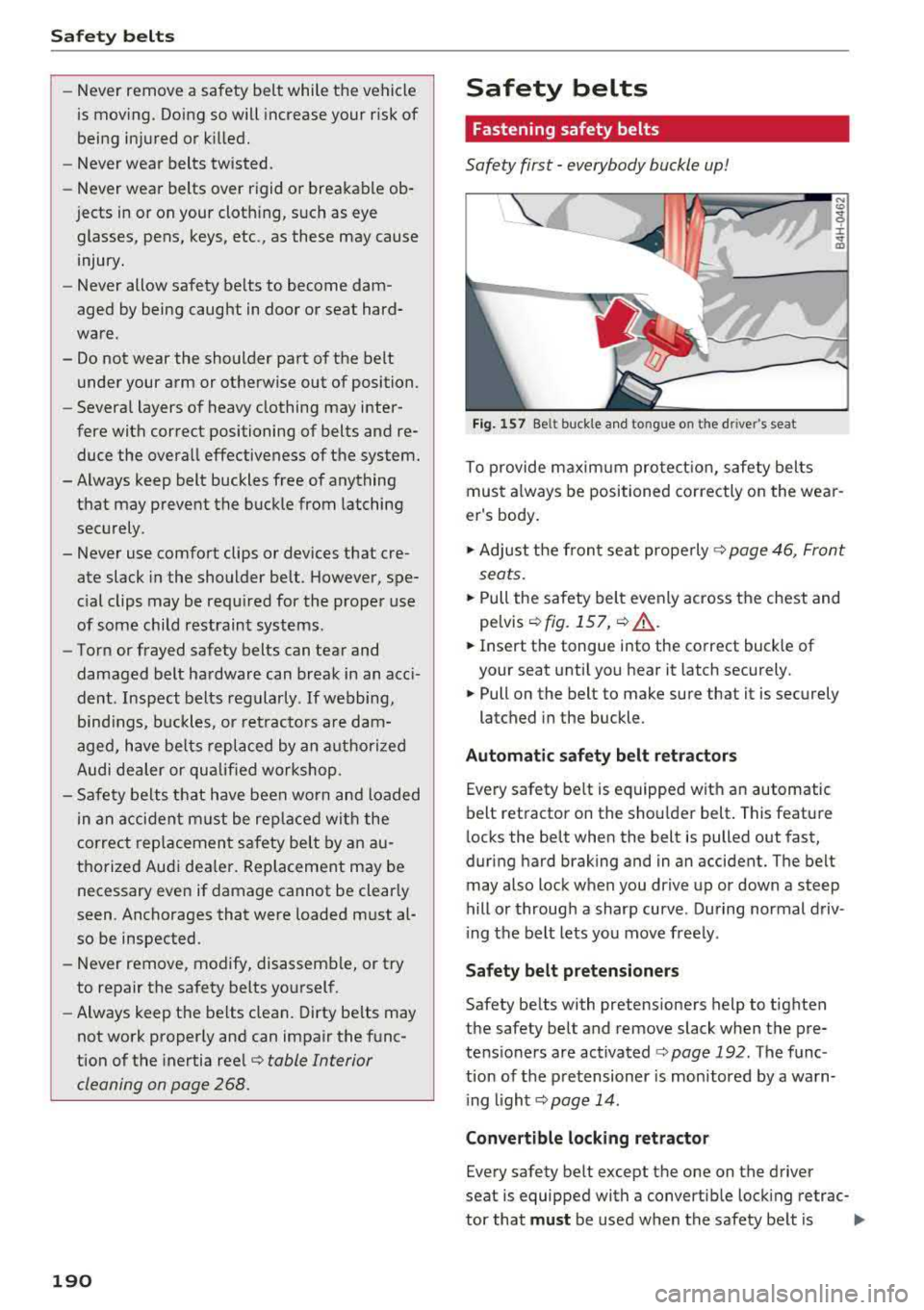
Fig. 1 57 Belt buck le a nd to ngue on t he drive r's seat
To p rovide m axim um pro tect ion , safety belts
must a lways be positioned correctly on the wear
er 's body .
.,. Adjust the fron t se at prope rly ¢ page 46 , Front
sea ts .
.,. Pull the safety belt evenly across the chest and
pe lvis
¢ fig. 157 , ¢ .&,.
.,. Insert the tongue into the correct buck le of
your seat until you hear it latch securely.
.,. Pull on the belt to m ake sure that it is sec urely
latched in the buckle .
Automatic safety belt ret ractors
Eve ry safety belt is equipped with an automatic
b elt ret ractor on th e shou lder belt . This feature
locks the belt when the belt is pulled out fast,
during hard brak ing and in an accident. The belt
may also lock when you dr ive up or down a steep
hill or through a sharp curve . During normal driv
i ng t he belt lets you move free ly .
Safety belt pretensioners
Safety be lts with pretensioners help to tighten
the safety belt and remove slack when the pre
te ns ioners are activated
¢ page 192 . The f u nc
tion of the p re tensioner is mon itored by a warn
i ng
li ght ¢ page 14 .
Convertible locking retractor
Every safety belt except the one on the driver
seat is equipped with a convertib le lock ing retrac-
tor that
must be used when t he safety be lt is .,..