check engine light AUDI TT ROADSTER 2019 User Guide
[x] Cancel search | Manufacturer: AUDI, Model Year: 2019, Model line: TT ROADSTER, Model: AUDI TT ROADSTER 2019Pages: 304, PDF Size: 80.77 MB
Page 231 of 304
8S58012721BA
Checking and Filling
® Note
When filling fluids, be sure not to add any flu-
ids to the wrong reservoirs. Otherwise severe
malfunctions and engine damage will occur.
@) For the sake of the environment
You should regularly check the ground under
your vehicle in order to detect leaks quickly. If
there are visible spots from oil or other fluids,
bring your vehicle to an authorized Audi deal-
er or authorized Audi Service Facility to be
checked.
Opening and closing the hood
The hood is released from inside the vehicle.
fa i i \
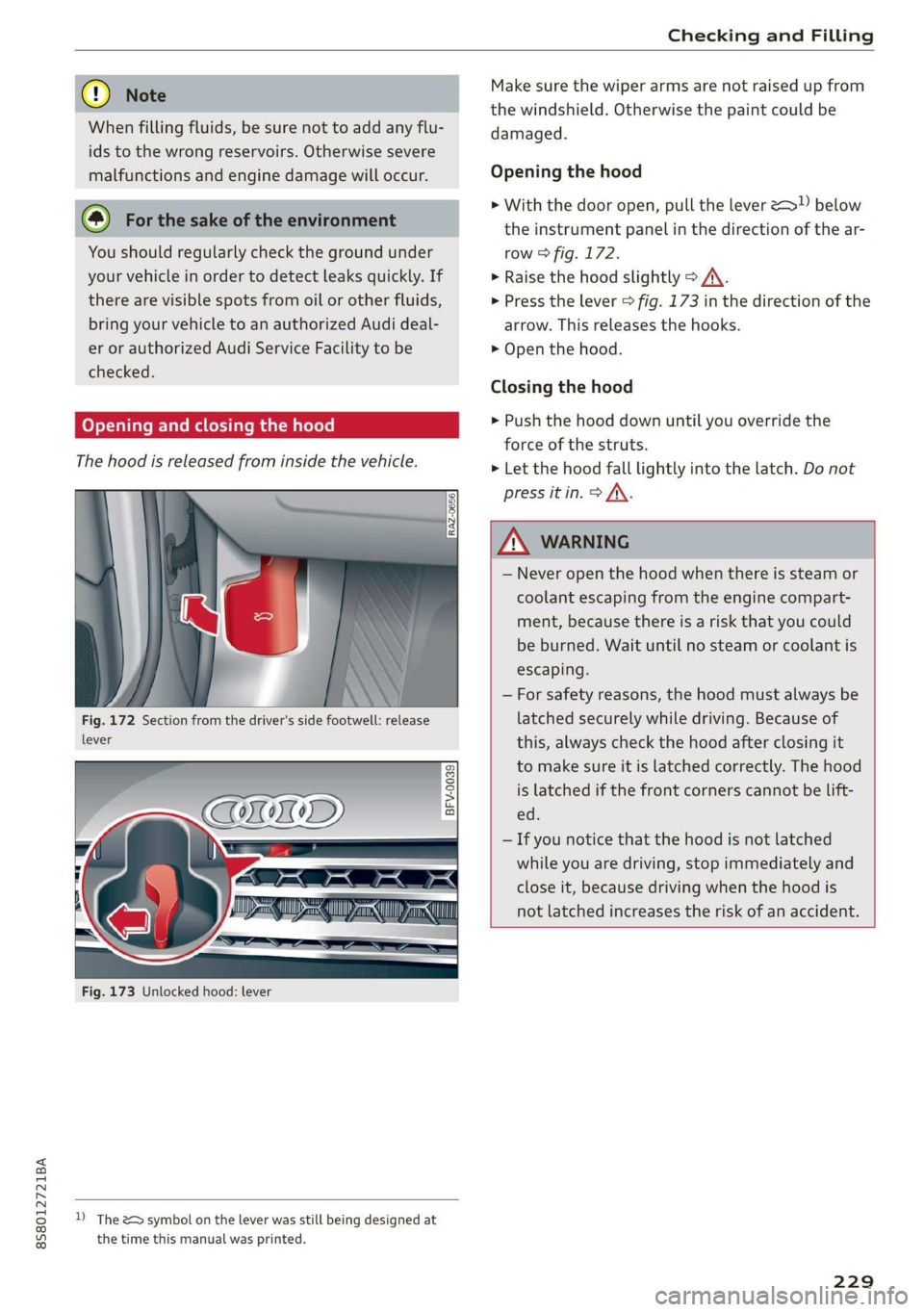
Fig. 172 Section from the driver's side footwell: release
lever
Q 3
Ss
2 = a
ao
Fig. 173 Unlocked hood: lever
D) The &> symbol on the lever was still being designed at
the time this manual was printed.
Make sure the wiper arms are not raised up from
the windshield. Otherwise the paint could be
damaged.
Opening the hood
> With the door open, pull the lever <>”) below
the instrument panel in the direction of the ar-
row > fig. 172.
> Raise the hood slightly > /A\.
> Press the lever > fig. 173 in the direction of the
arrow. This releases the hooks.
> Open the hood.
Closing the hood
> Push the hood down until you override the
force of the struts.
> Let the hood fall lightly into the latch. Do not
press it in. > /\.
ZA WARNING
— Never open the hood when there is steam or
coolant escaping from the engine compart-
ment, because there is a risk that you could
be burned. Wait until no steam or coolant is
escaping.
— For safety reasons, the hood must always be
latched securely while driving. Because of
this, always check the hood after closing it
to make sure it is latched correctly. The hood
is latched if the front corners cannot be lift-
ed.
— If you notice that the hood is not latched
while you are driving, stop immediately and
close it, because driving when the hood is
not latched increases the risk of an accident.
229
Page 233 of 304
8S8012721BA
Checking and Filling
Audi recommends
Sbastrol | ZIDIGE Prarzssional
Audi recommends using the LongLife high-per-
formance engine oil from Audi Genuine Parts.
I Tet
Engine oil pressure
i Turn off engine! Oil pressure too low
Stop driving and switch the engine off. Check the
engine oil level > page 231.
— If the engine oil level is too low, add engine oil
=> page 232. Only continue driving once the in-
dicator light turns off.
— If the engine oil level is correct and the indica-
tor light still turns on, turn the engine off and
do not continue driving. See an authorized Audi
dealer or authorized Audi Service Facility for as-
sistance.
Engine oil level
Applies to: vehicles with oil level warning
3 Please check oil level
— You may continue driving for the time being.
Check the engine oil level as soon as possible
=> page 231, Checking the engine oil level.
—If the engine oil level is correct and the indica-
tor light still turns on, drive at low engine
speed to an authorized Audi dealer or author-
ized Audi Service Facility.
Engine oil sensor
Bs Oil level sensor: oil change necessary. Please
contact Service
Fuel has entered the engine oil. This will cause
the engine oil level to rise slowly and the engine
oil quality to decrease. Do not extract engine oil
to reduce the level, because this will increase the
risk of engine damage. Drive to an authorized Au-
di dealer or authorized Audi Service Facility im-
mediately to have engine oil extracted.
3 Oil level system: malfunction! Please con-
tact Service
The sensor that checks the engine oil level has
malfunctioned. Drive to an authorized Audi deal-
er or authorized Audi Service Facility immediately
to have the malfunction corrected.
& Oil pressure sensor: malfunction! Please
contact Service
The sensor that checks the engine oil pressure
has malfunctioned. Drive to an authorized Audi
dealer or authorized Audi Service Facility immedi-
ately to have the malfunction corrected.
Engine warm-up request*
i Please drive to warm up engine
Fuel has entered the engine oil, either due to low
outside temperatures or frequent short drives.
Drive until the engine is warm so that the fuel in
the engine oil will evaporate. Avoid high engine
speeds, full accelerating, and heavy engine loads
when doing this.
@ Tips
The oil pressure warning EZ is not an oil level
indicator. Always check the oil level regularly.
Checking the engine oil level
Q
BsVv-0588
&
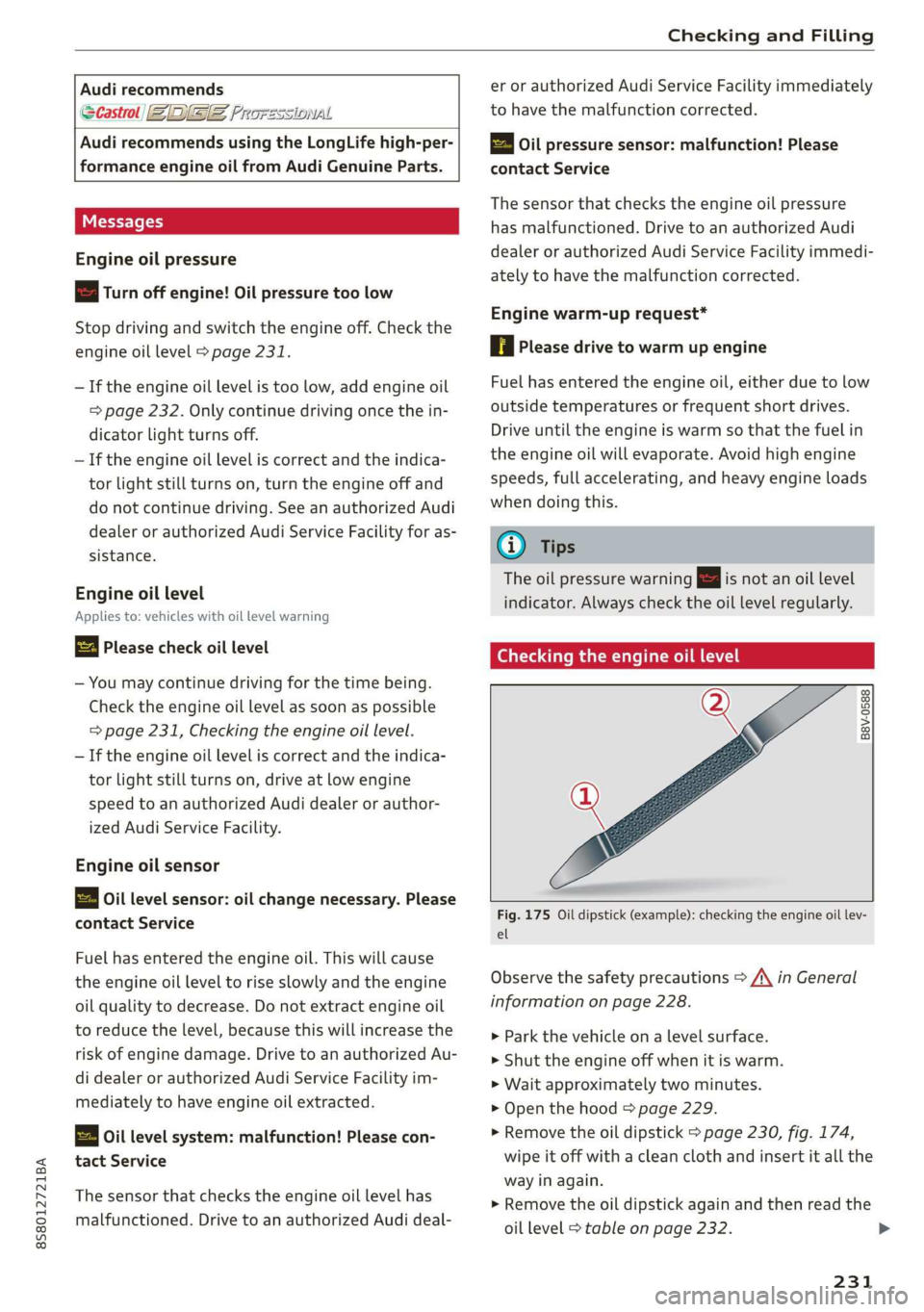
Fig. 175 Oil dipstick (example): checking the engine oil lev-
el
Observe the safety precautions > A\ in General
information on page 228.
>» Park the vehicle on a level surface.
> Shut the engine off when it is warm.
> Wait approximately two minutes.
> Open the hood > page 229.
> Remove the oil dipstick > page 230, fig. 174,
wipe it off with a clean cloth and insert it all the
way in again.
> Remove the oil dipstick again and then read the
oil level > table on page 232.
231
>
Page 236 of 304
Checking and Filling
— Drain the oil into a container designed for
this purpose that is large enough to hold the
full amount of oil in your engine.
— Engine oil is poisonous. Always store out of
reach of children.
— Prolonged contact of used engine oil with
the skin may cause skin damage. Always
wash oil off immediately with soap and wa-
ter to protect your skin.
@ Note
Do not mix any additives with the engine oil.
Additives may cause engine damage that is
not covered by your New Vehicle Limited War-
ranty.
@ For the sake of the environment
— Before changing the engine oil, make sure
you can dispose of the used engine oil cor-
rectly.
— Engine oil must always be disposed of cor-
rectly. Do not dump it in the yard, in the for-
est, or in open water, river channels, or sew-
ers.
— Have your used engine oil recycled by bring-
ing it to a used oil collection site or contact
a gas station.
Cooling system
The engine cooling system is filled with a mixture
of purified water and coolant additive at the fac-
tory. This coolant must not be not changed.
The coolant level is monitored through the B in-
dicator light > page 17. However, occasionally
checking the coolant level manually is recom-
mended.
Coolant additive
The coolant additive is made of anti-freezing and
corrosion protection agents. Only use the follow-
ing coolant additives. These additives may be
mixed with each other.
234
Coolant additive Specification
G12++ TL774G
G13 TL774)
The amount of coolant additive that needs to be
mixed with water depends on the climate where
the vehicle will be operated. If the coolant addi-
tive percentage is too low, the coolant can freeze
and damage the engine.
Coolant Freeze protec-
additive tion
Warm min. 40% min. -13 °F
regions max. 45% (-25 °C)
Cold min. 50% max. -40 °F
regions max. 55% (-40 °C)
(1) Note
— Before the start of winter, have an author-
ized Audi dealer or authorized Audi Service
Facility check if the coolant additive in your
vehicle matches the percentage appropriate
for the climate. This is especially important
when driving in colder climates.
—If the appropriate coolant additive is not
available in an emergency, do not add any
other additive. You could damage the en-
gine. If this happens, only use water and re-
store the correct mixture ratio with the
specified coolant additive as soon as possi-
ble.
— Only refill with new coolant.
— Radiator sealant must not be mixed with
the coolant.
Adding coolant
RAZ-0539
MIN
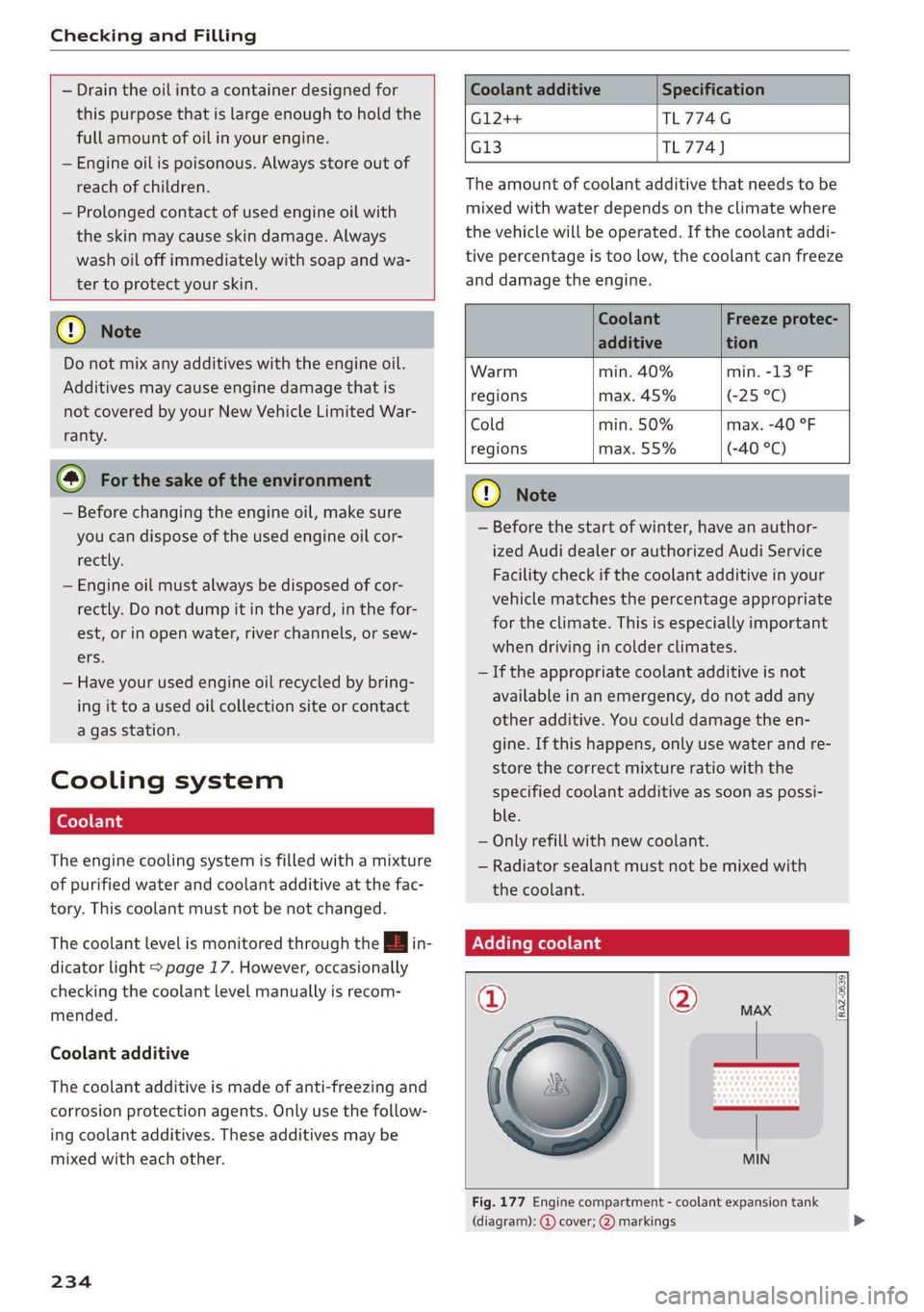
Fig. 177 Engine compartment - coolant expansion tank
(diagram): @ cover; @) markings
Page 237 of 304
8S58012721BA
Checking and Filling
Observe the safety precautions > page 227, Gen-
eral information.
Checking the engine coolant level
>» Park the vehicle on a level surface.
> Switch the ignition off.
> Read the coolant level on the coolant expansion
tank > page 230, fig. 174. The coolant level
must be between the markings @) 9 fig. 177
when the engine is cold. When the engine is
warm it can be slightly above the upper mark-
ing.
Adding coolant
Requirement: there must be a residual amount of
coolant in the expansion tank >@.
If you must add coolant, use a mixture of water
and coolant additive. Mixing the coolant additive
with distilled water is recommended.
> Allow the engine to cool.
>» Place a large, thick towel on the coolant expan-
sion tank cover.
> Remove the cover (@) 9 fig. 177 carefully to the
left > AX.
> Add the correct mixture ratio of coolant
> page 234 up to the upper marking @)
> fig. 177.
> Make sure that the fluid level remains stable.
Add more coolant if necessary.
> Close the cap securely.
Coolant loss usually indicates that there is a leak.
Immediately drive your vehicle to an authorized
Audi dealer or authorized Audi Service Facility
and have the cooling system inspected. If the
cooling system is not leaking, coolant loss can re-
sult from the coolant boiling due overheating
and then being forced out of the cooling system.
compartment. This increases the risk of
burns. The cooling system is under pressure.
When you no longer see or hear steam or
coolant escaping, you may open the engine
compartment with caution.
— When working in the engine compartment,
remember that the radiator fan can switch
on even if the ignition is switched off, which
increases the risk of injury.
— Coolant additive and coolant can be danger-
ous to your health. For this reason, store the
coolant in the original container and away
from children. There is a risk of poisoning.
@) Note
Do not add coolant if the expansion tank is
empty. Air could enter the cooling system and
damage the engine. If this is the case, do not
continue driving. See an authorized Audi deal-
er or authorized Audi Service Facility for assis-
tance.
Brake fluid
BFV-0229)
Z\ WARNING
— The engine compartment in any vehicle can
be a dangerous area. Stop the engine and al-
low it to cool before working in the engine
compartment. Always follow the informa-
tion found in > page 227, General informa-
tion.
— Never open the hood if you can see or hear
steam or coolant escaping from the engine
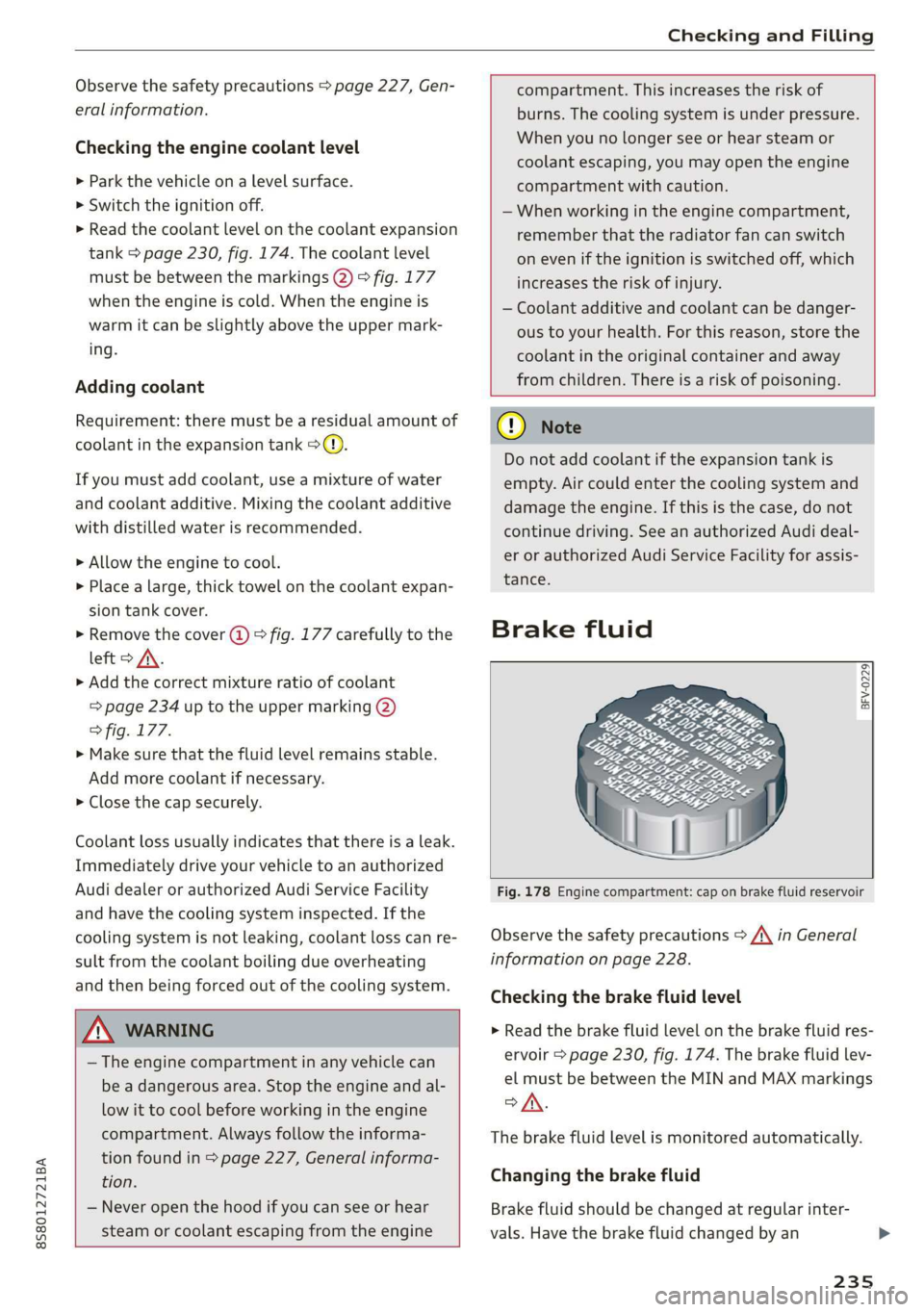
Fig. 178 Engine compartment: cap on brake fluid reservoir
Observe the safety precautions > /A\ in General
information on page 228.
Checking the brake fluid level
> Read the brake fluid level on the brake fluid res-
ervoir > page 230, fig. 174. The brake fluid lev-
el must be between the MIN and MAX markings
oA.
The brake fluid level is monitored automatically.
Changing the brake fluid
Brake fluid should be changed at regular inter-
vals. Have the brake fluid changed by an
235
Page 238 of 304
Checking and Filling
authorized Audi dealer or authorized Audi Service
Facility. The authorized Audi dealer or authorized
Audi Service Facility will inform you of the re-
placement intervals.
ZA\ WARNING
— If the brake fluid level is below the MIN
marking, it can impair the braking effect and
driving safety, which increase the risk of an
accident. Do not continue driving. See an au-
thorized Audi dealer or authorized Audi
Service Facility for assistance.
— If the brake fluid is old, bubbles may form in
the brake system during heavy braking. This
could impair braking performance and driv-
ing safety, which increases the risk of an ac-
cident.
— The brake fluid in your vehicle must meet
the standard VW 501 14 and is available at
an authorized Audi dealer or authorized Au-
di Service Facility. If this brake fluid is not
available, another high-grade brake fluid of
equivalent quality may be used, and it must
meet the U.S. Federal Motor Vehicle Stand-
ard (FMVSS) 116 DOT 4, Class 6.
@) Note
— If the brake fluid level is above the MAX
marking, brake fluid may leak out over the
edge of the reservoir and result in damage
to the vehicle.
— Do not allow any brake fluid to come into
contact with the vehicle paint, because it
will corrode the paint.
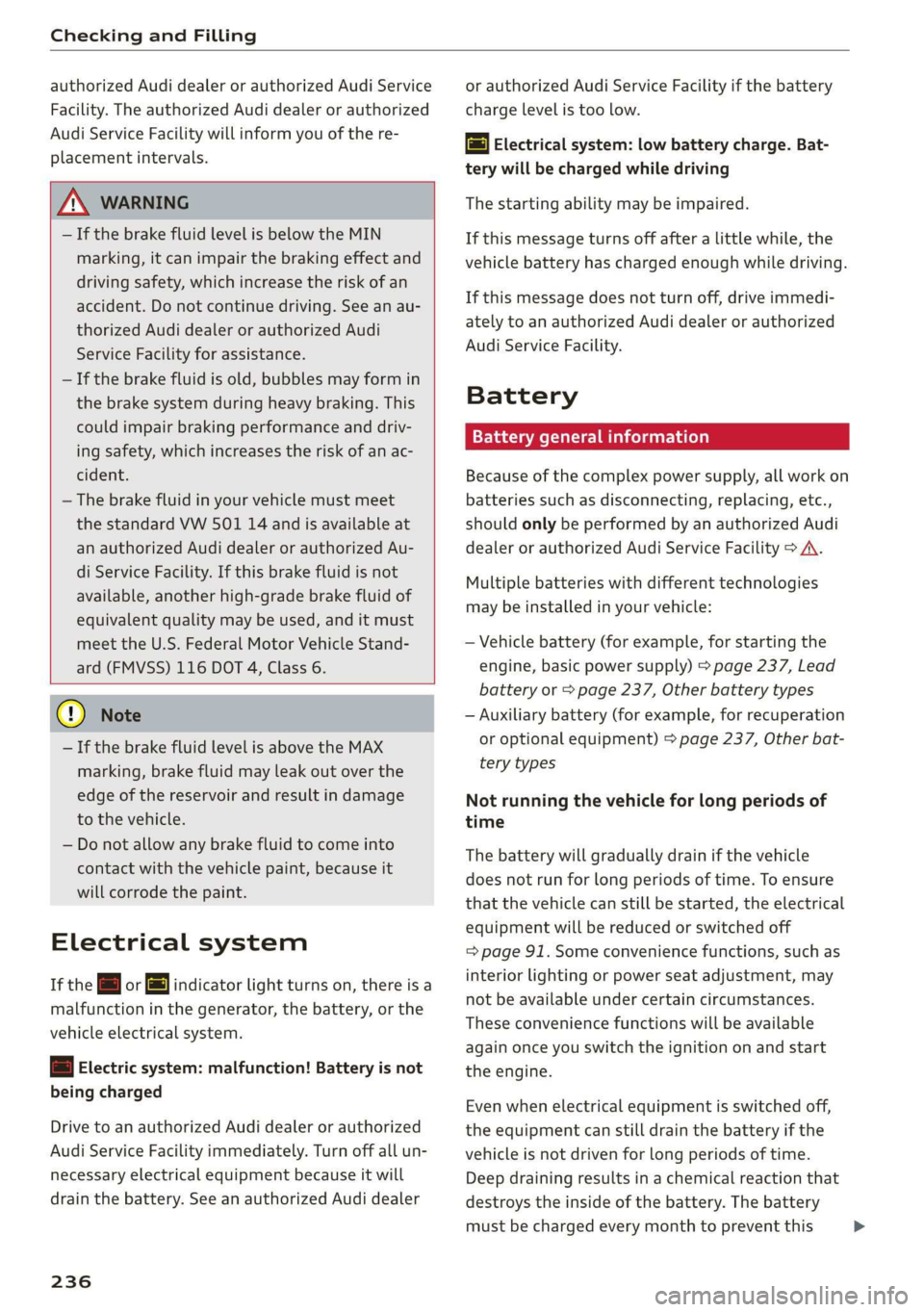
Electrical system
If the = or fm] indicator light turns on, there is a
malfunction in the generator, the battery, or the
vehicle electrical system.
zi Electric system: malfunction! Battery is not
being charged
Drive to an authorized Audi dealer or authorized
Audi Service Facility immediately. Turn off all un-
necessary electrical equipment because it will
drain the battery. See an authorized Audi dealer
236
or authorized Audi Service Facility if the battery
charge level is too low.
= Electrical system: low battery charge. Bat-
tery
will be charged while driving
The starting ability may be impaired.
If this message turns off after a little while, the
vehicle battery has charged enough while driving.
If this message does not turn off, drive immedi-
ately to an authorized Audi dealer or authorized
Audi Service Facility.
Battery
Battery general information
Because of the complex power supply, all work on
batteries such as disconnecting, replacing, etc.,
should only be performed by an authorized Audi
dealer or authorized Audi Service Facility > A\.
Multiple batteries with different technologies
may be installed in your vehicle:
— Vehicle battery (for example, for starting the
engine, basic power supply) > page 237, Lead
battery or > page 237, Other battery types
— Auxiliary battery (for example, for recuperation
or optional equipment) > page 237, Other bat-
tery types
Not running the vehicle for long periods of
time
The battery will gradually drain if the vehicle
does not run for long periods of time. To ensure
that the vehicle can still be started, the electrical
equipment will be reduced or switched off
=> page 91. Some convenience functions, such as
interior lighting or power seat adjustment, may
not be available under certain circumstances.
These convenience functions will be available
again once you switch the ignition on and start
the
engine.
Even when electrical equipment is switched off,
the equipment can still drain the battery if the
vehicle is not driven for long periods of time.
Deep draining results in a chemical reaction that
destroys the inside of the battery. The battery
must be charged every month to prevent this >
Page 240 of 304
Checking and Filling
@ For the sake of the environment
XE Do not dispose of these types of batter-
ies in household trash. They contain harmful
substances
and recyclable raw materials. Con-
tact an authorized Audi dealer or authorized
Audi Service Facility for more information.
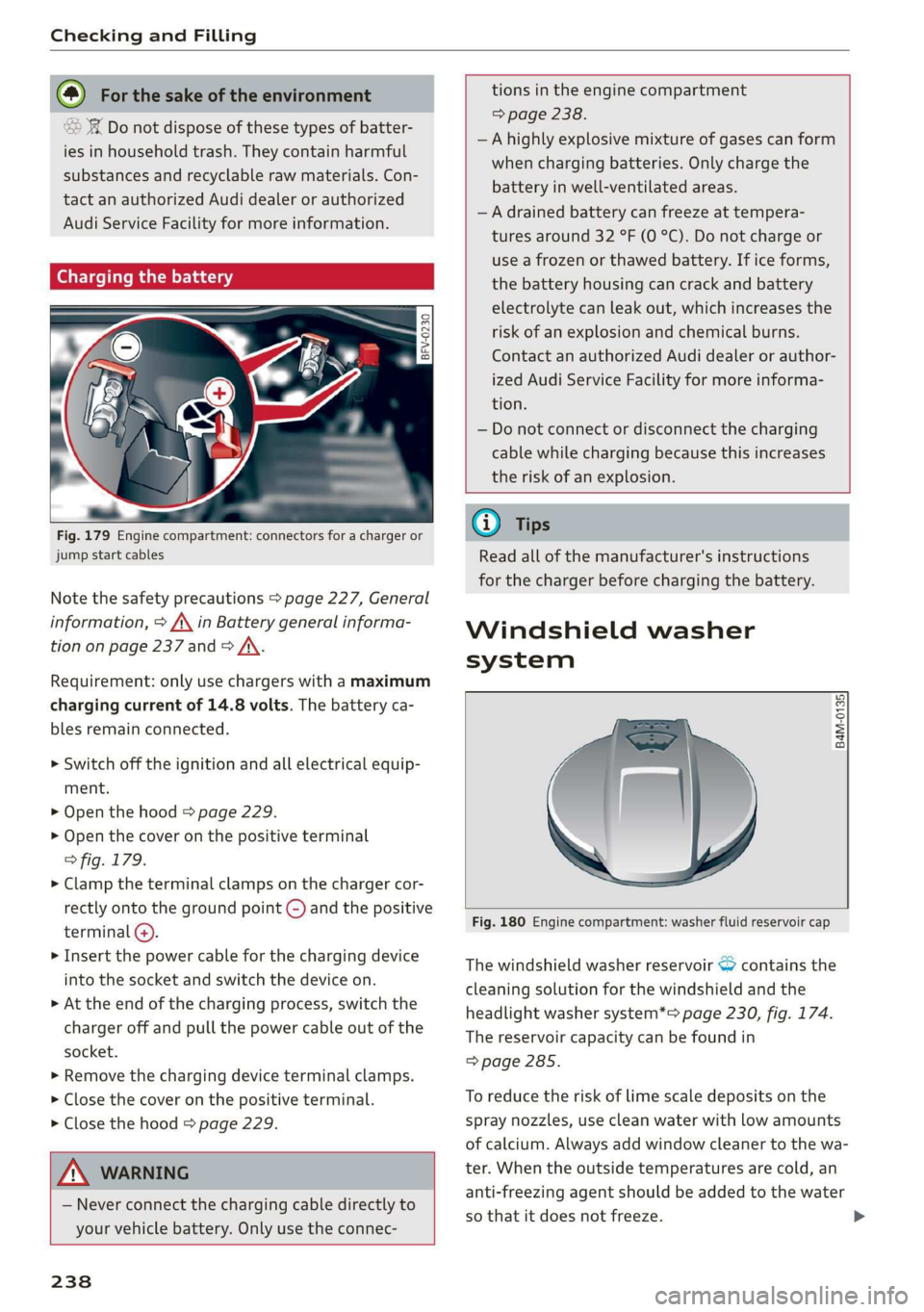
Charging the battery
Fig. 179 Engine compartment: connectors for a charger or
jump start cables
Note the safety precautions > page 227, General
information, > /\ in Battery general informa-
tion on page 237 and > /\.
Requirement: only use chargers with a maximum
charging current of 14.8 volts. The battery ca-
bles remain connected.
> Switch off the ignition and all electrical equip-
ment.
> Open the hood > page 229.
> Open the cover on the positive terminal
> fig. 179.
> Clamp the terminal clamps on the charger cor-
rectly onto the ground point ©) and the positive
terminal @.
> Insert the power cable for the charging device
into the socket and switch the device on.
> At the end of the charging process, switch the
charger off and pull the power cable out of the
socket.
> Remove the charging device terminal clamps.
> Close the cover on the positive terminal.
> Close the hood > page 229.
ZX WARNING
— Never connect the charging cable directly to
your vehicle battery. Only use the connec-
238
tions in the engine compartment
> page 238.
— A highly explosive mixture of gases can form
when charging batteries. Only charge the
battery in well-ventilated areas.
— A drained battery can freeze at tempera-
tures around 32 °F (0 °C). Do not charge or
use a frozen or thawed battery. If ice forms,
the battery housing can crack and battery
electrolyte can leak out, which increases the
risk of an explosion and chemical burns.
Contact an authorized Audi dealer or author-
ized Audi Service Facility for more informa-
tion.
— Do not connect or disconnect the charging
cable while charging because this increases
the risk of an explosion.
G) Tips
Read all of the manufacturer's instructions
for the charger before charging the battery.
Windshield washer
system
B4M-0135}
Fig. 180 Engine compartment: washer fluid reservoir cap
The windshield washer reservoir © contains the
cleaning solution for the windshield and the
headlight washer system*> page 230, fig. 174.
The reservoir capacity can be found in
=> page 285.
To reduce the risk of lime scale deposits on the
spray nozzles, use clean water with low amounts
of calcium. Always add window cleaner to the wa-
ter. When the outside temperatures are cold, an
anti-freezing agent should be added to the water
so that it does not freeze.
Page 279 of 304
8S58012721BA
Fuses and bulbs
Fuses and bulbs
Fuses
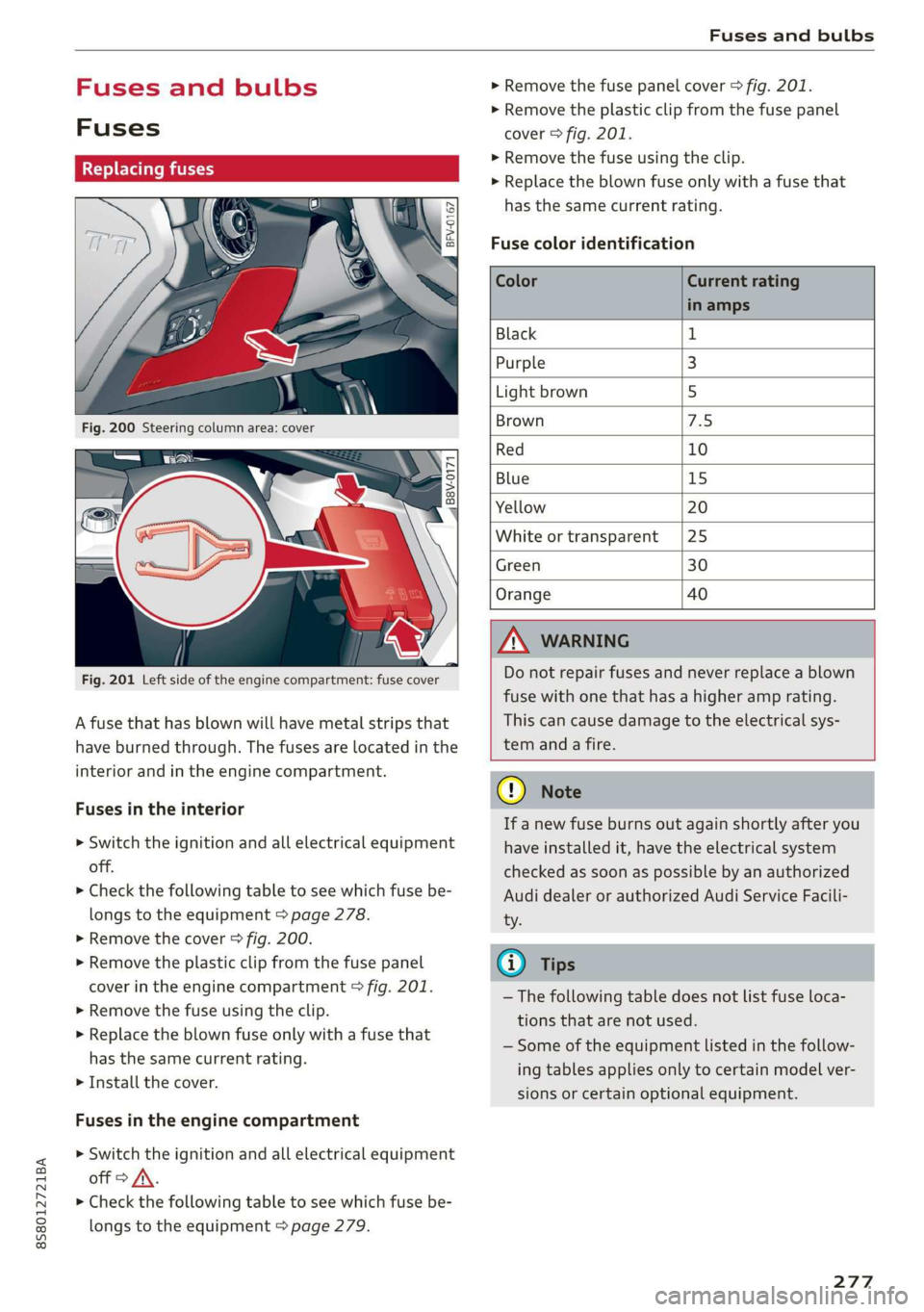
Replacing fuses
S 6
= o
q
= 2 % a.
Fig. 201 Left side of the engine compartment: fuse cover
A fuse that has blown will have metal strips that
have burned through. The fuses are located in the
interior and in the engine compartment.
Fuses in the interior
> Switch the ignition and all electrical equipment
off.
> Check the following table to see which fuse be-
longs to the equipment > page 278.
» Remove the cover > fig. 200.
> Remove the plastic clip from the fuse panel
cover in the engine compartment © fig. 201.
> Remove the fuse using the clip.
> Replace the blown fuse only with a fuse that
has the same current rating.
> Install the cover.
Fuses in the engine compartment
> Switch the ignition and all electrical equipment
off > A\.
> Check the following table to see which fuse be-
longs to the equipment > page 279.
> Remove the fuse panel cover > fig. 201.
> Remove the plastic clip from the fuse panel
cover > fig. 201.
> Remove the fuse using the clip.
> Replace the blown fuse only with a fuse that
has the same current rating.
Fuse color identification
Color Current rating
in amps
Black 1
Purple 3
Light brown 5
Brown 1d
Red 10
Blue 15
Yellow 20
White or transparent [25
Green 30
Orange 40
Z\ WARNING
Do not repair fuses and never replace a blown
fuse with one that has a higher amp rating.
This can cause damage to the electrical sys-
tem and a fire.
CG) Note
If a new fuse burns out again shortly after you
have installed it, have the electrical system
checked as soon as possible by an authorized
Audi dealer or authorized Audi Service Facili-
ty.
@) Tips
— The following table does not list fuse loca-
tions that are not used.
— Some of the equipment listed in the follow-
ing tables applies only to certain model ver-
sions or certain optional equipment.
277
Page 287 of 304
8S58012721BA
Technical data
Technical data
Identification data
Vehicle identification label
3 8
ao 8
XXXXX XX -X-XXXX XXX XX z
(D> ge -ser-me 00x KX x XXXXXXKK
TUTE XXX XXX
XX XK XX KK AK
L XXX KW XXX
Sar mmaism. KOK HK HK
LACKNR. / INNENAUSST.
(@)— Mates a XXXX XXX XXX 1 XX
M.- AUST. / OPTIONS:
EOA 7D5 4UB 6XM 5SG 5RW
2EH JOZ 1LB AS 1BA
3FC 5MU 7X1
FOA 963 0G7 OYH OJF
GI TL6 3KA 8EH U1A X9B QZ7
1xW 803 908 824 D2D
716 CV7 7KO 4X3. 2K2
3L4 4KC 3Y0 413 5D2
1SA 7GB Q1A 4GQ
XX. X XX. XXX. X_—XXXK
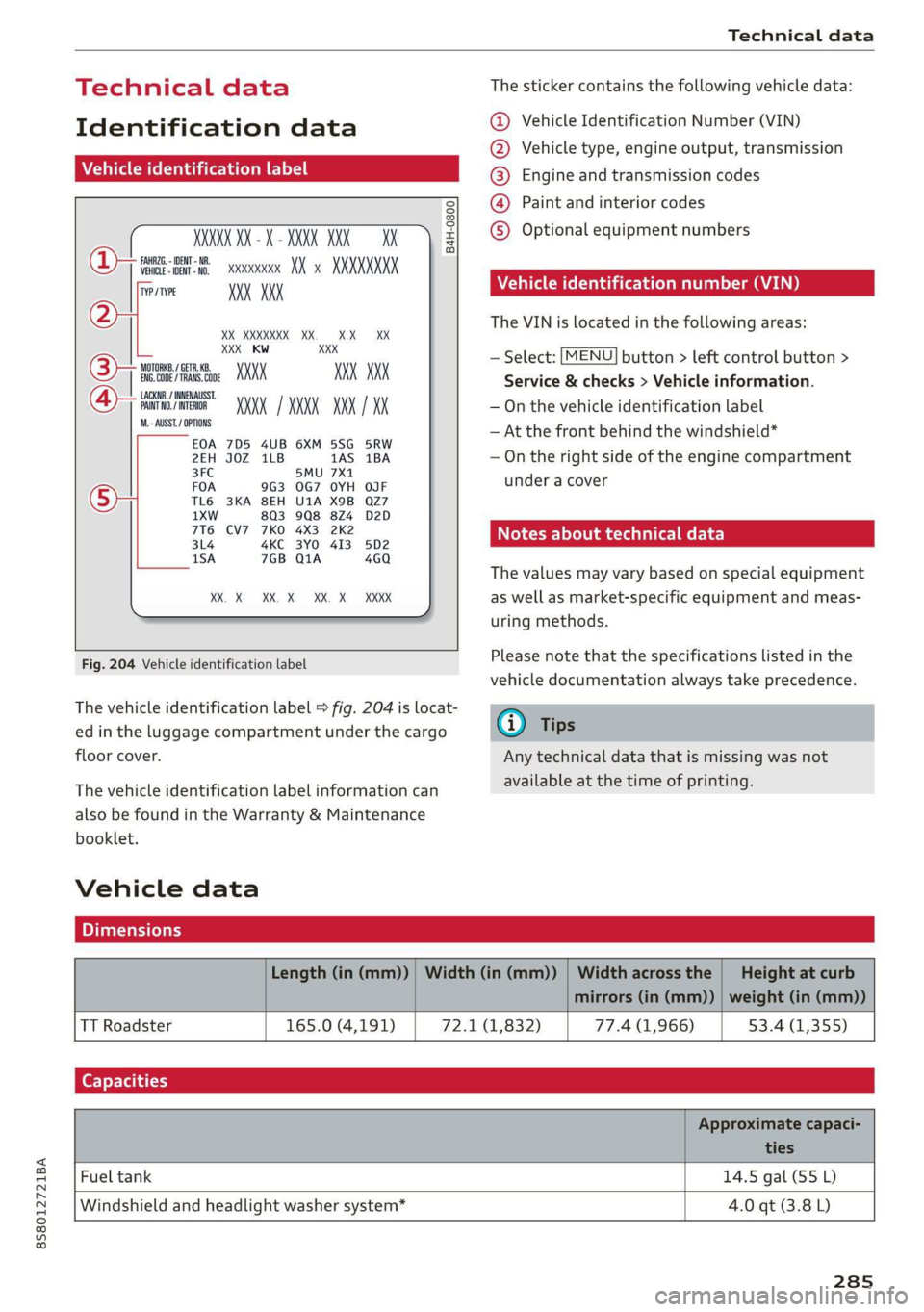
Fig. 204 Vehicle identification label
The vehicle identification label > fig. 204 is locat-
ed in the luggage compartment under the cargo
floor cover.
The vehicle identification label information can
also be found in the Warranty & Maintenance
booklet.
Vehicle data
The sticker contains the following vehicle data:
@® Vehicle Identification Number (VIN)
@ Vehicle type, engine output, transmission
® Engine and transmission codes
@) Paint and interior codes
© Optional equipment numbers
Vehicle identification number (VIN)
The VIN is located in the following areas:
— Select: [MENU] button > left control button >
Service & checks > Vehicle information.
— On the vehicle identification label
— At the front behind the windshield*
— On the right side of the engine compartment
under a cover
Notes about technical data
The values may vary based on special equipment
as well as market-specific equipment and meas-
uring methods.
Please note that the specifications listed in the
vehicle documentation always take precedence.
Any technical data that is missing was not
available at the time of printing.
TT Roadster 165.0 (4,191) 72.1 (1,832)
77.4 (1,966) 53.4 (1,355)
Fuel tank 14.5 gal (55 L)
Windshield and headlight washer system*
4.0 qt 3.8L)
285
Page 293 of 304
8S58012721BA
Index
Engine
Breakingin..... 2... cece cece 56
GOolaiitevwes: « 2 waem « 2 wees gz eeNeE Ee EE EE 234
StAGEING ia = canes co memes oo memes vo ereees © 57,58
Starting and stopping................05 58
Engine compartment
Opening and closing the hood.......... 229
OVEN OWias « + wang sy wane 5 ¥ een x e eR 230
Safety precautions.................-0. 227
Engine control (indicator light)............ 19
Engine data
refer to Sport displays.................. 15
Engine oil
Adding... 06... cece eee eens 230
Changing’: = = aesu = 2 mews ce eps s sawn 233
Checkingioiblevelss scssss x 6 cminis « sevusse oo 230
Consumption...................-000- 230
Indicator Wight swe. » = sews + » eewe « o ewes 231
Replacement interval................. 239
Temperature display.............-...-. 15
Enhanced view...............0e0 eee e eee 13)
Entering characters/numbers (speller)...... 98
Entering letters (speller) ................4 98
Environment
Unleaded gasoline.................... 223
ESC
refer to Electronic Stabilization
Control(ESE) « « sear: 2 says oo sete Fx Rees 2 86
ESP
refer to Electronic Stabilization
Control (ESC) ..... 6.6... cece eee eee eee 86
Exterior lighting. ...............0e eee eee 38
Exterior mirrors
Adjusting. ......... 0... cee ee eee eee 41
DIMMING « sacs s & saves & & aes + ¥ Hee < Hee 42
Folding settingSte:: + «comes + 2 sews ve mes ow 26
Heating... 0.6... cece eee Al
External voice operation...............5 109
F
Factory default settings (MMI) ........... 172
Fader Gourd) bss: 2 o swsine = a1 asoweins w wecuses 6 weir 175
Fastening
Booster seats .......... 0.0 eee ee eee 217
Convertible child safety seats........... 216
Infantis@ats:. «2 onnsne xo seine © 2 secsnin 2 2 seaman 215
Fast forwarding and rewinding (audio/video
File) eee 160
Fast forwarding (audio/video file)......... 160
FASEMOULC « ccc x x commer 5 2 meee 9 x orate 6 o Hens 139
Favorites
Media... ... cece eee eee eee eee 163
NaVidatioticc: s = saw 3s geen se meee s pee E 134
Telephone rsisxi + aaa « + aise «eames sv eee 117
Federal Communications Commission (FCC) . 283
File formats (media drives) .............. 166
FlOOr Mats = esas ¢ ews g ewes go wee ee oe 181
Fog lights/rear fog light(s)............... 38
Foot pedals.......... 0. cece eee ee eee 180
Footwell lighting...............0.-.0 eee 40
For the sake of the environment
Disposing of engine oil................ 233
FUCLING!s s & sree 2 ¢ nemne & 2 coos & s eauae @ oe 224
Leaks... 2... eee eee eee ee 229
Free: textsSe@arely ces < werersin ¥ esemene we esenene © 100
Media... ... cece eee 162
NAVIGStIOl in: « + anew 2 = cea 4 x eoee 2 Rae 133
RAG iis < aru wv cette a a cmnemes a a amo Wo 148
Telephone ........... eee eee eee eee 121
Freeze protection
Coolant...... 2... eee eee eee eee 234
Frequency band................... 147,149
also refer to Frequency band........... 147
Front airbags
Deseriptioniins = wisn 4 6 ween 6 + waa © + wae 193
How they work. ...........00000 eee eee 198
Frontal collisions and the laws of physics... 183
Front seats
Adjusting .......... 6.6 c cee eee eee eee 179
Child restraints in the front seat......... 190
alsocreferto. Seats oscaa sx woe se ewan se ees 46
Fd@bs 2 cena oo swam oo wens 0 enews 2 maceme © i 223
TAGGIGIVESr « succens «0 snerein oo seamen © stcenoae co 6 wae 224
Current fuel consumption............... 15
Fuel gauge sis ss esos si shies x aeons vee 10, 12
Fuel tank capacity................00-. 285
Gasoline... 1... 2... eee eee eee 223
Indicator light « aes ¢ = ceca se news se pees « 19
Sawing Fitel ccs a x wos 2 ence a ene oc 78
Saving fuel consumption................ 56
Fueling
Fuel filler door emergency release....... 226
Fueligaugeieiin « + acne so mam 6 + comme ve waves 12