tow AUDI TT ROADSTER 2019 Owner's Guide
[x] Cancel search | Manufacturer: AUDI, Model Year: 2019, Model line: TT ROADSTER, Model: AUDI TT ROADSTER 2019Pages: 304, PDF Size: 80.77 MB
Page 217 of 304
8S58012721BA
Child safety
— If a seat heater has been retrofitted or
otherwise added to the front passenger
seat, never install any child restraint sys-
tem on this seat.
— Make sure that there are no wet objects
(such as a wet towel) and no water or oth-
er liquids on the front passenger seat
cushion.
— Never place objects on the seat (such as a
laptop, CD player, electronic games device,
power inverter or seat heater for child
seats). These may influence the electrical
capacitance measured by the capacitive
passenger detection system and can also
fly around in an accident and cause serious
personal injury.
— Always buckle the child safety seat firmly in
place even if a child is not sitting in it. A
loose child safety seat can fly around during
a sudden stop or ina collision.
— Always read and heed all WARNINGS when-
ever using a child restrained in a vehicle is
being used > page 182, Safety belts,
=> page 189, Airbag system and > page 210,
Child safety.
ZA WARNING
To reduce the risk of serious injury, make sure
that the PASSENGER AIR BAG OFF 3%; light
comes on and stays on whenever a child re-
straint is installed on the front passenger seat
and the ignition is switched on.
— Never install a reward facing child safety
seat on the front passenger seat if the PAS-
SENGER AIR BAG OFF %; light does not
turn on and stay on.
— Have the airbag system inspected by your
authorized Audi dealer immediately.
Child safety seats
Tat h
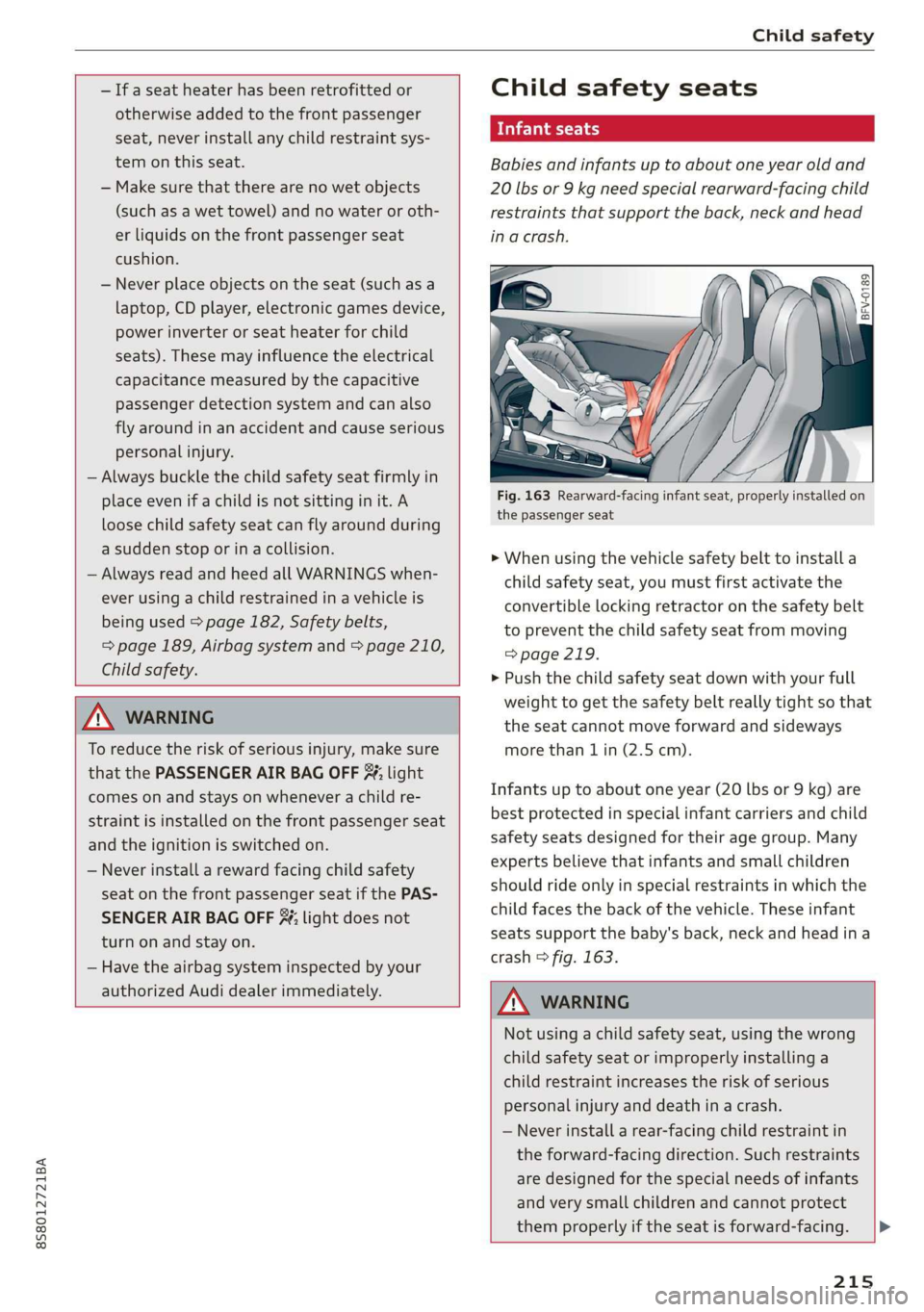
Babies and infants up to about one year old and
20 lbs or 9 kg need special rearward-facing child
restraints that support the back, neck and head
in a crash.
2 ©
S
> c a
the passenger seat
> When using the vehicle safety belt to install a
child safety seat, you must first activate the
convertible locking retractor on the safety belt
to prevent the child safety seat from moving
=> page 219.
» Push the child safety seat down with your full
weight to get the safety belt really tight so that
the seat cannot move forward and sideways
more than 1 in (2.5 cm).
Infants up to about one year (20 lbs or 9 kg) are
best protected in special infant carriers and child
safety seats designed for their age group. Many
experts believe that infants and small children
should ride only in special restraints in which the
child faces the back of the vehicle. These infant
seats support the baby's back, neck and head ina
crash > fig. 163.
ZA\ WARNING
Not using a child safety seat, using the wrong
child safety seat or improperly installing a
child restraint increases the risk of serious
personal injury and death in a crash.
— Never install a rear-facing child restraint in
the forward-facing direction. Such restraints
are designed for the special needs of infants
and
very small children and cannot protect
them properly if the seat is forward-facing.
215
Page 218 of 304
Child safety
— Never install a rearward facing child safety
seat on the front passenger seat unless the
PASSENGER AIR BAG OFF 3%; light comes
on and stays on. If the PASSENGER AIR
BAG OFF #¥; light does not come on and stay
on the inflating airbag will hit the child safe-
ty seat or infant carrier with great force and
will smash the child safety seat and child
against the backrest, center armrest, door
or roof. Have the airbag system inspected
immediately by your Audi dealer.
— Never place or use any electrical device
(such as a laptop, CD player, electronic
games device, power inverter or seat heater
for child seats) on the front passenger seat
if the device is connected to the 12-volt
socket or the cigarette lighter socket.
— If a seat heater has been retrofitted or oth-
erwise added to the front passenger seat,
never install any child restraint system on
this seat.
— Make sure that there are no wet objects
(such as a wet towel) and no water or other
liquids on the front passenger seat cushion.
— Never place objects on the seat (such as a
laptop, CD player, electronic games device,
power inverter or seat heater for child
seats). These may influence the electrical
capacitance measured by the capacitive pas-
senger detection system and can also fly
around in an accident and cause serious per-
sonal injury.
— Always read and heed all WARNINGS when-
ever using a child restrained in a vehicle is
being used > page 182, Safety belts,
=> page 189, Airbag system and > page 210,
Important information.
216
Convertible child safety seats
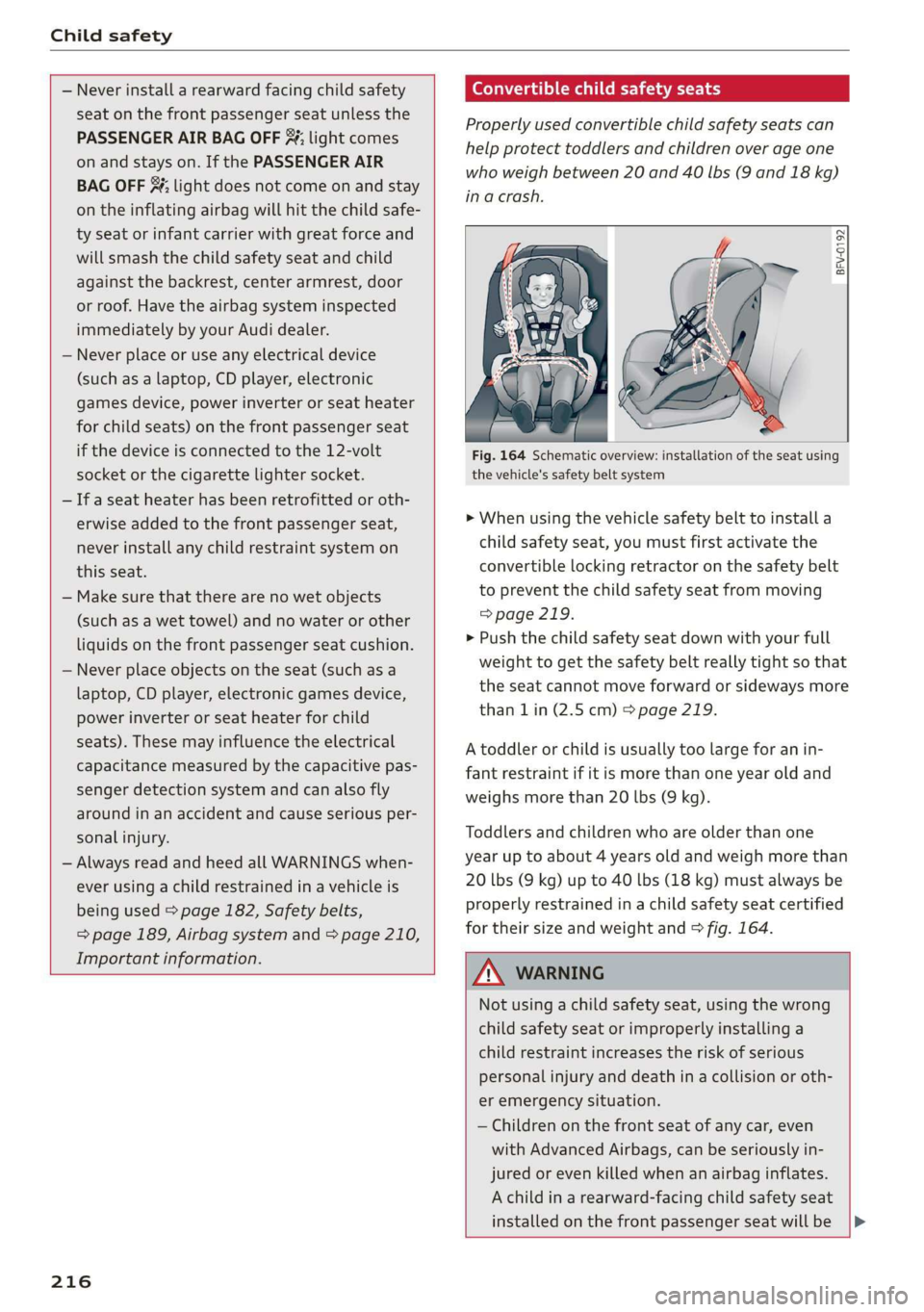
Properly used convertible child safety seats can
help protect toddlers and children over age one
who weigh between 20 and 40 lbs (9 and 18 kg)
inacrash.
BFV-0192
Fig. 164 Schematic overview: installation of the seat using
the vehicle's safety belt system
> When using the vehicle safety belt to install a
child safety seat, you must first activate the
convertible locking retractor on the safety belt
to prevent the child safety seat from moving
> page 219.
> Push the child safety seat down with your full
weight to get the safety belt really tight so that
the seat cannot move forward or sideways more
than 1 in (2.5 cm) > page 219.
A toddler or child is usually too large for an in-
fant restraint if it is more than one year old and
weighs more than 20 lbs (9 kg).
Toddlers and children who are older than one
year up to about 4 years old and weigh more than
20 lbs (9 kg) up to 40 Lbs (18 kg) must always be
properly restrained in a child safety seat certified
for their size and weight and > fig. 164.
Z\ WARNING
Not using a child safety seat, using the wrong
child safety seat or improperly installing a
child restraint increases the risk of serious
personal injury and death in a collision or oth-
er emergency situation.
— Children on the front seat of any car, even
with Advanced Airbags, can be seriously in-
jured or even killed when an airbag inflates.
A child in a rearward-facing child safety seat
installed on the front passenger seat willbe |>
Page 219 of 304
8S8012721BA
Child safety
seriously injured and can be killed if the
front airbag inflates - even with an Ad-
vanced Airbag System.
— The inflating airbag will hit the child safety
seat or infant carrier with great force and
will smash the child safety seat and child
against the backrest, center arm rest, door
or roof.
— Never install a rearward facing child safety
seat on the front passenger seat unless the
PASSENGER AIR BAG OFF %; light comes
on and stays on. If the PASSENGER AIR
BAG OFF $¥; light does not come on and stay
on have the airbag system inspected imme-
diately by your Audi dealer.
— The rear side of the child safety seat should
be positioned as close as possible to the
backrest on the vehicle seat.
— Always read and heed all WARNINGS when-
ever using a child restrained in a vehicle is
being used > page 182, Safety belts,
=> page 189, Airbag system and > page 210,
Important information.
Z\ WARNING
If exceptional circumstances require the use
of a forward-facing child restraint on the front
passenger's seat, the child's safety and well-
being require that the following special pre-
cautions be taken:
— Make sure the forward-facing seat has been
designed and certified by its manufacturer
for use ona front seat with a passenger
front and side airbag.
— Always follow the manufacturer's instruc-
tions provided with the child safety seat or
infant carrier.
— Always move the front passenger seat into
the rearmost position of the passenger
seat's fore and aft adjustment range, and as
far away from the airbag as possible before
installing the child restraint.
— Always make sure that nothing prevents the
front passenger's seat from being moved to
the rearmost position in its fore and aft ad-
justment range.
— Always make sure the backrest is in an up-
right position.
— Never place or use any electrical device
(such as a laptop, CD player, electronic
games device, power inverter or seat heater
for child seats) on the front passenger seat
if the device is connected to the 12-volt
socket or the cigarette lighter socket.
— If a seat heater has been retrofitted or oth-
erwise added to the front passenger seat,
never install any child restraint system on
this seat.
— Make sure that there are no wet objects
(such as a wet towel) and no water or other
liquids on the front passenger seat cushion.
— Never place objects on the seat (such as a
laptop, CD player, electronic games device,
power inverter or seat heater for child
seats). These may influence the electrical
capacitance measured by the capacitive pas-
senger detection system and can also fly
around in an accident and cause serious per-
sonal injury.
— Make sure that the PASSENGER AIR BAG
OFF 3; light comes on and stays on all the
time whenever the ignition is switched on.
— If the PASSENGER AIR BAG OFF #; light
does not come on and stay on have the air-
bag system inspected by your authorized
Audi dealer.
Booster seats and safety belts
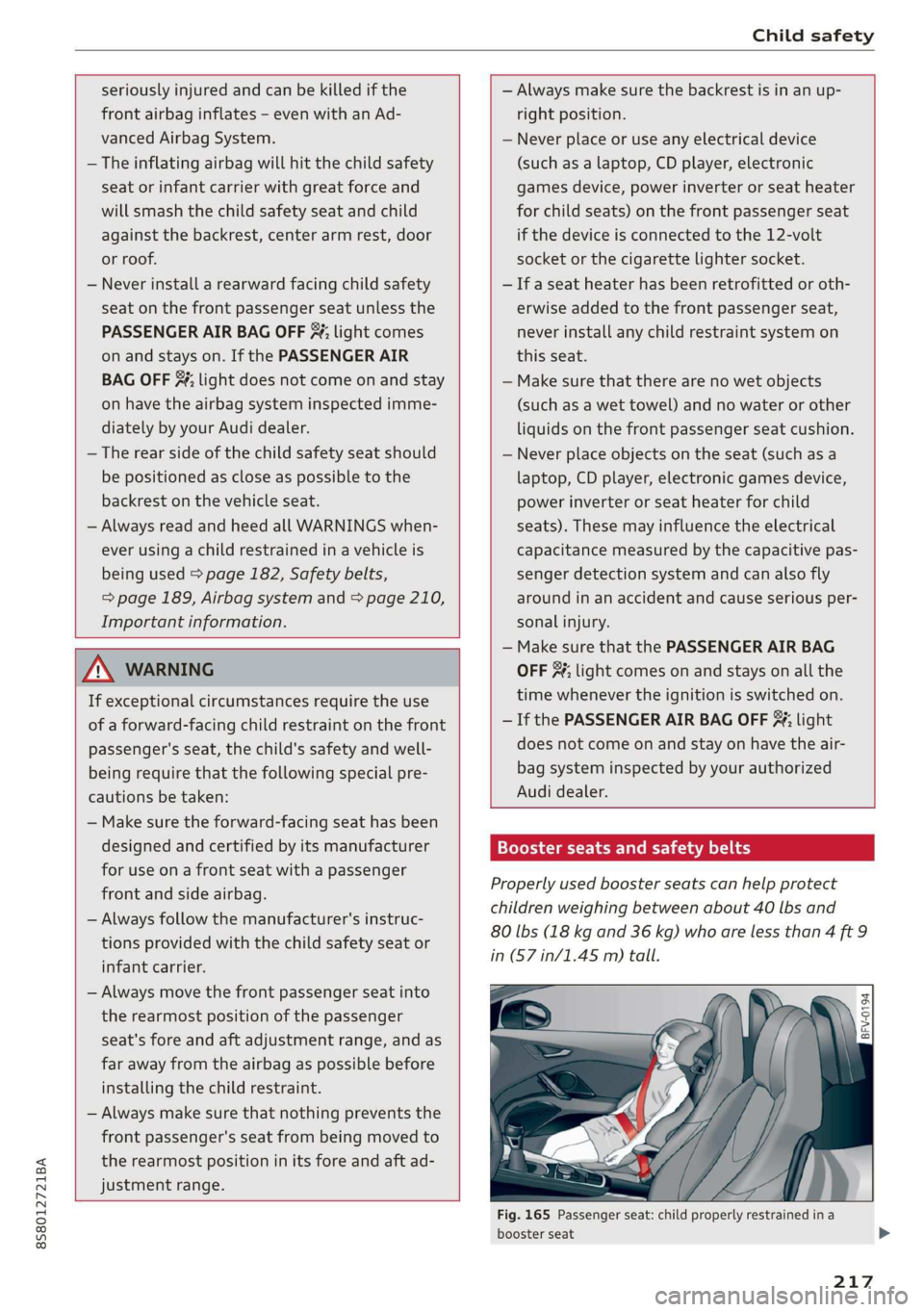
Properly used booster seats can help protect
children weighing between about 40 lbs and
80 lbs (18 kg and 36 kg) who are less than 4 ft 9
in (57 in/1.45 m) tall.
x a
¥
z o
Fig. 165 Passenger seat: child properly restrained ina
booster seat
217
Page 223 of 304
8S8012721BA
Child safety
> Route it around or through the child restraint
belt path > A\.
> Push the child safety seat down with your full
weight to get the safety belt really tight.
> Insert the belt tongue into the buckle for that
seating position.
> Guide the safety belt back into the retractor un-
til the belt lies flat and snug on the child safety
seat.
> You should hear a “clicking” noise as the belt
winds back into the inertia reel. Test the con-
vertible locking retractor by pulling on the belt.
You should no longer be able to pull the belt
out of the retractor. The convertible locking re-
tractor is now activated.
> Make sure that the red release button is facing
away from the child restraint so that it can be
unbuckled quickly.
> Pull on the belt to make sure the safety belt is
properly tight and fastened so that the seat
cannot move forward and sideways more than
lin (2.5 cm).
ZA WARNING
Using the wrong child restraint or an improp-
erly installed child restraint can cause serious
personal injury or death in a crash.
— Always make sure that the safety belt retrac-
tor is locked when installing a child safety
seat. An unlocked safety belt retractor can-
not hold the child safety seat in place during
normal driving or in a crash.
— Always buckle the child safety seat firmly in
place even if a child is not sitting in it. A
loose child safety seat can fly around during
a sudden stop or ina crash.
— Always make sure the seat backrest to which
the child restraint is installed is in an up-
right position. Otherwise, the seatback with
the child safety seat attached to it could fly
forward in the event of an accident or other
emergency situation.
— Always read and heed all WARNINGS when-
ever using a child restrained in a vehicle is
being used > page 210. Special precautions
apply when installing a child safety seat on
the front passenger seat > page 190, Child
restraints on the front seat - some impor-
tant things to know.
Deactivating the convertible locking
dela te] gy
The convertible locking retractor for child re-
straints will be deactivated automatically when
the belt is wound all the way back into the re-
tractor.
> Press the red button on the safety belt buckle.
The belt tongue will pop out of the buckle.
> Guide the safety belt all the way back into its
stowed position.
Always let the safety belt retract completely into
its stowed position. The safety belt can now be
used as an ordinary safety belt without the con-
vertible locking retractor for child restraints.
If the convertible locking retractor should be ac-
tivated inadvertently, the safety belt must be un-
fastened and guided completely back into its
stowed position to deactivate this feature. If the
convertible locking retractor is not deactivated,
the safety belt will gradually become tighter and
uncomfortable to wear.
A WARNING
Improperly installed child safety seats in-
crease the risk of serious personal injury and
death in a collision.
— Never unfasten the safety belt to deactivate
the convertible locking retractor for child re-
straints while the vehicle is moving. You
would not be restrained and could be seri-
ously injured in an accident.
— Always read and heed all WARNINGS when-
ever using a child restrained in a vehicle is
being used > page 210. Special precautions
apply when installing a child safety seat on
the front passenger seat > page 190, Child
restraints on the front seat - some impor-
tant things to know.
221
Page 237 of 304
8S58012721BA
Checking and Filling
Observe the safety precautions > page 227, Gen-
eral information.
Checking the engine coolant level
>» Park the vehicle on a level surface.
> Switch the ignition off.
> Read the coolant level on the coolant expansion
tank > page 230, fig. 174. The coolant level
must be between the markings @) 9 fig. 177
when the engine is cold. When the engine is
warm it can be slightly above the upper mark-
ing.
Adding coolant
Requirement: there must be a residual amount of
coolant in the expansion tank >@.
If you must add coolant, use a mixture of water
and coolant additive. Mixing the coolant additive
with distilled water is recommended.
> Allow the engine to cool.
>» Place a large, thick towel on the coolant expan-
sion tank cover.
> Remove the cover (@) 9 fig. 177 carefully to the
left > AX.
> Add the correct mixture ratio of coolant
> page 234 up to the upper marking @)
> fig. 177.
> Make sure that the fluid level remains stable.
Add more coolant if necessary.
> Close the cap securely.
Coolant loss usually indicates that there is a leak.
Immediately drive your vehicle to an authorized
Audi dealer or authorized Audi Service Facility
and have the cooling system inspected. If the
cooling system is not leaking, coolant loss can re-
sult from the coolant boiling due overheating
and then being forced out of the cooling system.
compartment. This increases the risk of
burns. The cooling system is under pressure.
When you no longer see or hear steam or
coolant escaping, you may open the engine
compartment with caution.
— When working in the engine compartment,
remember that the radiator fan can switch
on even if the ignition is switched off, which
increases the risk of injury.
— Coolant additive and coolant can be danger-
ous to your health. For this reason, store the
coolant in the original container and away
from children. There is a risk of poisoning.
@) Note
Do not add coolant if the expansion tank is
empty. Air could enter the cooling system and
damage the engine. If this is the case, do not
continue driving. See an authorized Audi deal-
er or authorized Audi Service Facility for assis-
tance.
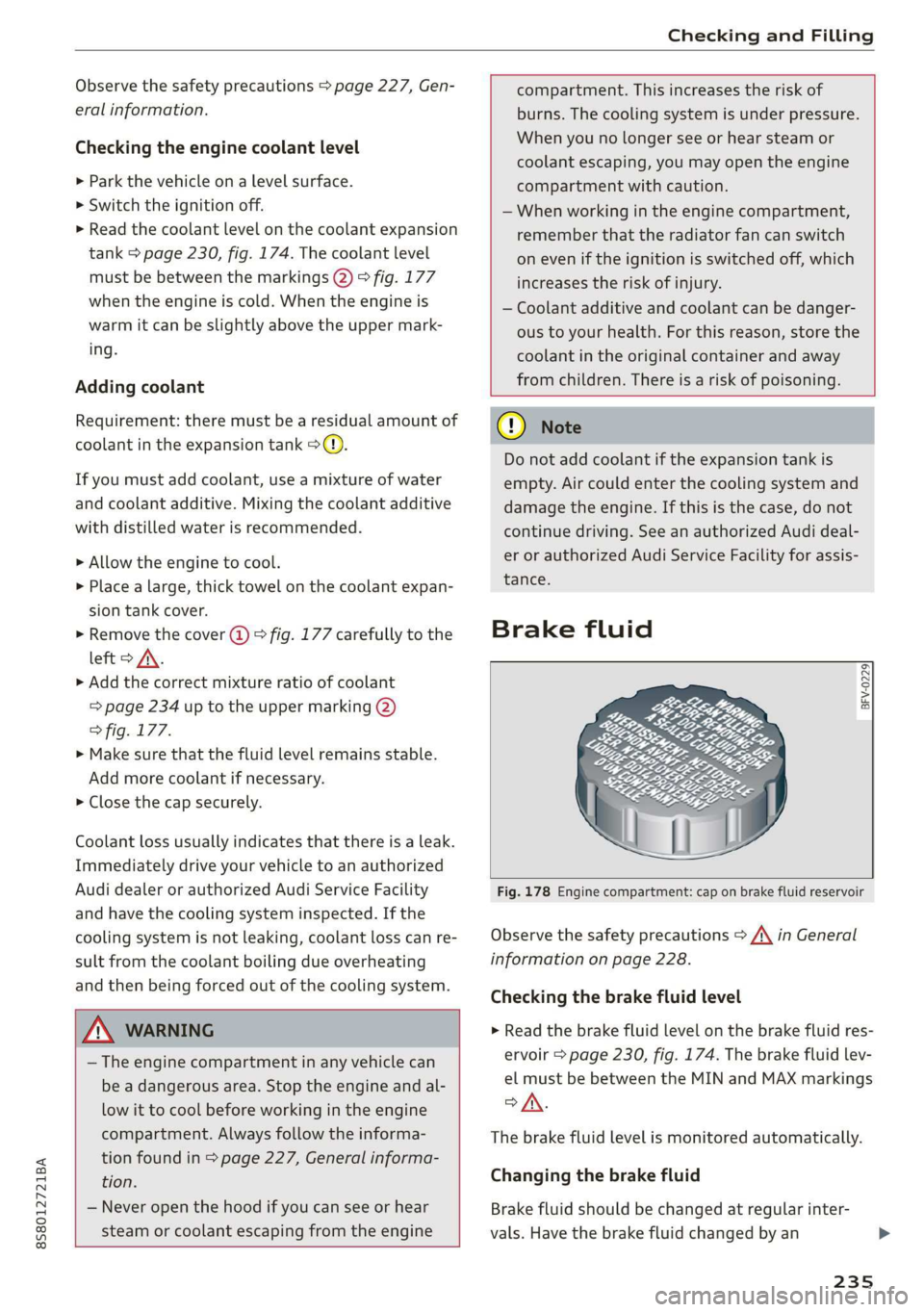
Brake fluid
BFV-0229)
Z\ WARNING
— The engine compartment in any vehicle can
be a dangerous area. Stop the engine and al-
low it to cool before working in the engine
compartment. Always follow the informa-
tion found in > page 227, General informa-
tion.
— Never open the hood if you can see or hear
steam or coolant escaping from the engine
Fig. 178 Engine compartment: cap on brake fluid reservoir
Observe the safety precautions > /A\ in General
information on page 228.
Checking the brake fluid level
> Read the brake fluid level on the brake fluid res-
ervoir > page 230, fig. 174. The brake fluid lev-
el must be between the MIN and MAX markings
oA.
The brake fluid level is monitored automatically.
Changing the brake fluid
Brake fluid should be changed at regular inter-
vals. Have the brake fluid changed by an
235
Page 256 of 304
Wheels
pounds shown on the sticker Wheel bolts and rims
=> page 250, fig. 183. Wheel bolts
4. The resulting figure equals the Wheel bolts must be clean and loosen/tighten
. ily.
available amount of cargoand =“
luggage load capacity. For ex-
ample if the “XXX” amount Rims with a bolted rim ring* or with bolted wheel
, . covers* consist of multiple pieces. These compo-
equals 1400 lbs and there will nents were bolted together using special bolts
be five 150 lbs passengers in and a special procedure. You must not repair or
. disassemble them > A.
your vehicle, the amount of .
available cargo and luggage ZX WARNING
tee Wheel bolts that are tightened or repaired in-
load capacity is 650 lbs correctly can become loose and result in loss
(1400-750 (5 X 150) = 650 lbs) of vehicle control, which increases the risk of
5. Determine the combined an accident. For the correct tightening specifi-
, cation, see > page 273, Finishing.
Rims
weight of luggage and cargo — Always keep the wheel bolts and the threads
being loaded on the vehicle. in the wheel hub clean and free of grease.
3 — Only use wheel bolts that fit the rim.
That weight may not safely ex: — Always have damaged rims repaired by an
ceed the available cargo and authorized Audi dealer or authorized Audi
. Service Facility. Never repair or disassemble
luggage load capacity calculat- rims yourself, because this increases the risk
edin Step 4. of an accident.
6. If your vehicle will be towing a
. . Winter ti trailer, load from your trailer
will be transferred to your vehi- Winter tires significantly improve the vehicle's
handling when driving in winter conditions. Be-
cle. Consult this manual to de- cause of their construction (width, compound,
termine how this reduces the tread pattern), summer tires provide less traction
: on ice and snow.
available cargo and luggage
i 5 >» Use winter tires on all four wheels.
load capacity of your vehicle. > Only use winter tires that are approved for your
>Check the tire sidewall vehicle.
. > Please note that the maximum permitted
(> page 241, fig. 181) to deter- speed may be lower with winter tires > A\ in
mine the designated load rating General information on page 240. An author-
ized Audi dealer or authorized Audi Service Fa-
cility can inform you about the maximum per-
mitted speed for your tires.
> Check the tire pressure after installing wheels
=> page 250.
for a specific tire.
254
Page 276 of 304
Emergency assistance
> The wheel bolt tightening specification must be
90 ft lbs (120 Nm). Have it checked as soon as
possible with a torque wrench. Drive carefully
until then.
> Have the faulty wheel replaced as quickly as
possible.
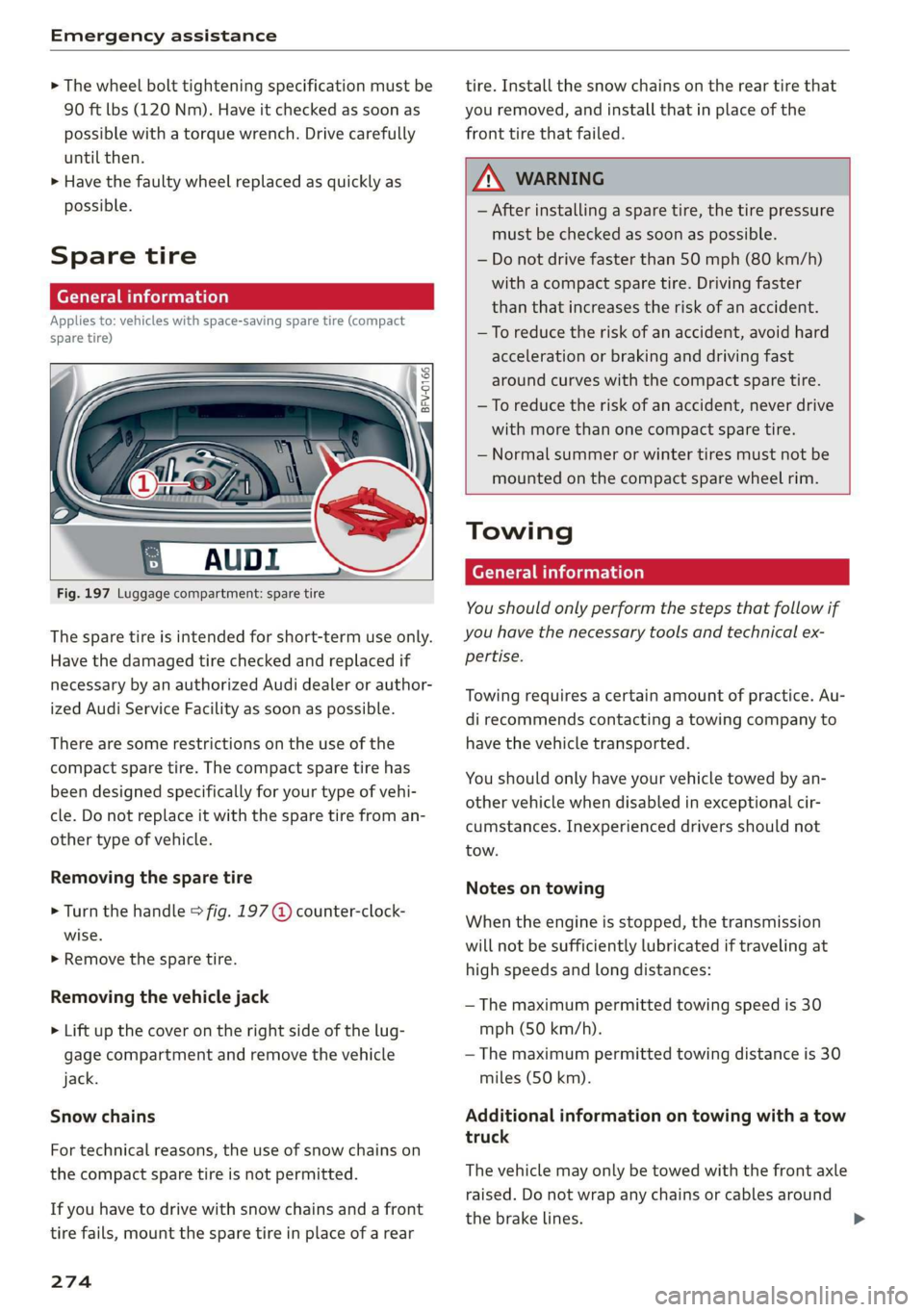
Spare tire
General information
Applies to: vehicles with space-saving spare tire (compact
spare tire)
—maa
BFV-0166
The spare tire is intended for short-term use only.
Have the damaged tire checked and replaced if
necessary by an authorized Audi dealer or author-
ized Audi Service Facility as soon as possible.
There are some restrictions on the use of the
compact spare tire. The compact spare tire has
been designed specifically for your type of vehi-
cle. Do not replace it with the spare tire from an-
other type of vehicle.
Removing the spare tire
> Turn the handle > fig. 197 @ counter-clock-
wise.
>» Remove the spare tire.
Removing the vehicle jack
> Lift up the cover on the right side of the lug-
gage compartment and remove the vehicle
jack.
Snow chains
For technical reasons, the use of snow chains on
the
compact spare tire is not permitted.
If you have to drive with snow chains and a front
tire fails, mount the spare tire in place of a rear
274
tire. Install the snow chains on the rear tire that
you removed, and install that in place of the
front tire that failed.
Z\ WARNING
— After installing a spare tire, the tire pressure
must be checked as soon as possible.
— Do not drive faster than SO mph (80 km/h)
with a compact spare tire. Driving faster
than that increases the risk of an accident.
— To reduce the risk of an accident, avoid hard
acceleration or braking and driving fast
around curves with the compact spare tire.
— To reduce the risk of an accident, never drive
with more than one compact spare tire.
— Normal summer or winter tires must not be
mounted on the compact spare wheel rim.
Towing
General information
You should only perform the steps that follow if
you have the necessary tools and technical ex-
pertise.
Towing requires a certain amount of practice. Au-
di recommends contacting a towing company to
have the vehicle transported.
You should only have your vehicle towed by an-
other vehicle when disabled in exceptional cir-
cumstances. Inexperienced drivers should not
tow.
Notes on towing
When the engine is stopped, the transmission
will not be sufficiently lubricated if traveling at
high speeds and long distances:
— The maximum permitted towing speed is 30
mph (50 km/h).
— The maximum permitted towing distance is 30
miles (50 km).
Additional information on towing with a tow
truck
The vehicle may only be towed with the front axle
raised. Do not wrap any chains or cables around
the brake lines.
Page 277 of 304
8S8012721BA
Emergency assistance
If the vehicle should be towed with the axle
raised, then the ignition must be switched off to
reduce the risk of damage to the drivetrain.
Tow bar and towing cable
The vehicle can be towed with a tow bar or tow-
ing cable. Both drivers should be familiar with
the special considerations when towing, especial-
ly when using a towing cable.
Always make sure the traction force does not ex-
ceed the permitted level and there are no shock
loading conditions. There is always the risk of the
coupling becoming overloaded when driving off-
road.
For the most safety and security, drive with a tow
bar. You should use a towing cable only if a tow
bar is not available. Use a towing cable made of
synthetic elastic cable similar elastic material.
ZA\ WARNING
— Towing highly increases the risk of an acci-
dent, for example from colliding with the
towing vehicle.
— To reduce the risk of an accident, do not al-
low anyone to remain inside the vehicle
when it is being transported by a tow truck
or a special transporter.
@) Note
— If normal towing is not possible, for exam-
ple if the transmission is faulty or if the
towing distance is greater than 30 miles
(50 km), then transport the vehicle on a
special carrier.
— If the vehicle is towed by a tow truck at the
axle that is not permitted, this can cause se-
vere damage to the transmission.
— The vehicle must not be tow started for
technical reasons.
@) Tips
—If there is a power failure, the selector lever
will not move out of the "P" position. The
parking lock must be released using the
D_ Requirement: the vehicle battery must have a sufficient
charge level.
emergency release before towing the vehi-
cle > page 68.
— Follow the local legal regulations for tow-
ing.
Read and follow the important information under
=> page 274.
Preparations
> Only secure the towing cable or tow bar at the
designated towing loops > page 276,
=> page 276.
> Make sure the towing cable is not twisted. Oth-
erwise it could disconnect from the towing loop
while towing.
» Switch the emergency flashers on in both vehi-
cles > page 40. However, do not do this if it
prohibited by law.
Towing vehicle (front)
> Only start to drive when the towing cable is
taut.
> Be especially careful when accelerating.
> Avoid sudden braking or driving maneuvers.
Vehicle being towed (rear)
» Make sure the ignition is switched on so that
the steering wheel is not locked and so that you
can use the turn signals, the horn, and the
windshield wipers if needed > A\.
> The brake booster only works when the engine
is running. Power steering only works when the
ignition is switched on and the vehicle is roll-
ing )). If the brake booster and power steering
are not functioning, you must press the brake
pedal much harder and use more force to steer.
> Release the parking brake > page 59.
> Select the "N" selector lever position.
> Make sure the towing cable is always taut.
275
>
Page 278 of 304
Emergency assistance
Z\ WARNING
Never tow a vehicle using a tow bar or towing
cable if the vehicle does not have electrical
power.
Front towing loop
———
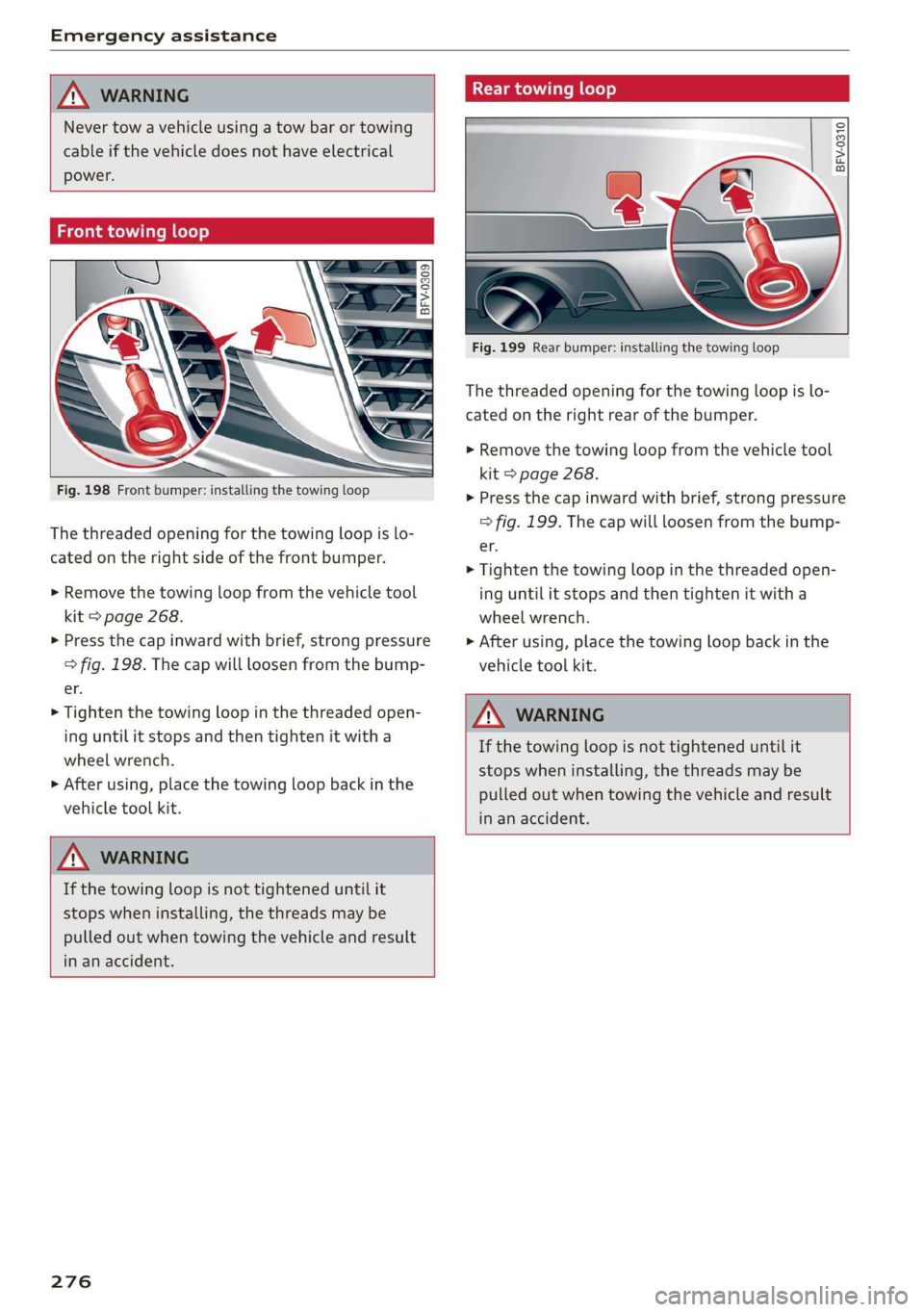
Fig. 198 Front bumper: installing the towing loop
The threaded opening for the towing loop is lo-
cated on the right side of the front bumper.
> Remove the towing loop from the vehicle tool
kit > page 268.
> Press the cap inward with brief, strong pressure
> fig. 198. The cap will loosen from the bump-
er.
> Tighten the towing loop in the threaded open-
ing until it stops and then tighten it with a
wheel wrench.
> After using, place the towing loop back in the
vehicle tool kit.
ZX WARNING
If the towing loop is not tightened until it
stops when installing, the threads may be
pulled out when towing the vehicle and result
in an accident.
276
Rear towing loop
BFV-0310
Fig. 199 Rear bumper: installing the towing loop
The threaded opening for the towing loop is lo-
cated on the right rear of the bumper.
> Remove the towing loop from the vehicle tool
kit > page 268.
> Press the cap inward with brief, strong pressure
> fig. 199. The cap will loosen from the bump-
er.
> Tighten the towing loop in the threaded open-
ing until it stops and then tighten it with a
wheel wrench.
» After using, place the towing loop back in the
vehicle tool kit.
Z\ WARNING
If the towing loop is not tightened until it
stops when installing, the threads may be
pulled out when towing the vehicle and result
in an accident.
Page 300 of 304
Index
SyMbol Stereo x sess ae cueceee oo comes vo ooeee woo 101
Navigation ..... 0.0... ccc eee eee eee 140
UtathiGwuss + aun x eeu a 2 Wome aE oem Bod ee 145
also refer to Indicator lights.............. 7
System settings (MMI)................. 171
System update (MM) «. s «ces cs cows ss es 174
SYStENi VOLUME weme 2 v eens = eee s = BeeR Ge 175
T
Tachonmeterca's « same ¢ 2 maau § 2 wane a 2 ae 10, 11
Technical data...........00. sce ee eee 285
Technical modifications................. 280
Telephone........... 0... eee ee eee eee 110
Audi phone box...........2 seen eres 113
GONNSCEING « x wow & & womens 9 0 sae ooo oo 110
Dialing anumber............0e eee ane 115
Options during a phone call............ 116
SELtiINGS cus « woes o s sem 4 & ee o 2 eNOS 122
Temperature display
COOLAME wussass a: annwans 4 & amnwans ov soauias 4 u aeaxar & 10
Temperature display (outside temperature) .. 11
Tethering
refer to Personal hotspot.............. 126
Text MeSSAQGES cic se secre 2 x ese vo ees wo 117
also refer to Text messages............ 117
Tie-dOWNS 2... eee eee eee 51
Tightening specification (wheel bolts) ..... 273
THIM GS. 6 cscs = saonare ao mamas ww eee vw tes vo 171
tiptronic (automatic transmission) ......... 66
Tire Mobility System (tire repair set)....... 268
TINGS sawssa = mean # e Mee ae HOw a 2 ew Bee 240
Allawheel. drives. «a cows se enim ee eens ws onan 89
Low-profile tires. ......... 0.000. .000 255
R@PaihS@t's ; xcesu « : ous & 5 ewes ¢ 2 eee eg 268
Replacing s ssivs + wei x 6 wens wo warm e+ eon 270
Service life.................00.0.0005 248
Tir€ Preéssré-<.< : seca ss vase s ¢ wees sb Os 250
Tire pressure monitoring sys-
TEM eee ee 256, 257, 258
Tire pressure table.................00. 251
Treadwear indicators...............04. 248
Unidinectional.. . . c.cesse 0 0 ssenare 0 0 aserace 242, 273
Uniform tire quality grading............ 255
Tires and wheels
Glossary of tire and loading terminology.. 242
Tires and vehicle load limits............ 252
298
TMC
refer to Traffic information............. 145
Tone (sound)
refer to Adjusting the sound............ 175
oo) 268
Touch
refertoMMI touch..............+-+4-- 94
TOWINGse. 3 « maces @ & men & = BGR 4 FE BGR 4 Em 274
TPMS
Tire Pressure Monitoring System........ 257
TPMS (tire pressure monitoring system)
TNAIeatOr lights. 5 saw 6 same. @ 6 wavens ae © sonwess 260
Tire pressure monitoring system........ 258
Traffic information............ 143,144,145
Traffie@reports.: « sci © ¢ ewan a 6 sean 2 6 ween « 141
Transmission malfunction (indicator light)... 67
Treéble:(SoUNG) i: « & aces ss wean s & wee so oe 175
Trunk lid
Trunkescape lath: « © wiw 2 wien ee ween 2 « 28
Turnesignalls « siioi os wea 2 2 wenn 2 eee ¥ 4 os 39
U
Unfastening safety belts................ 187
Uniform tire quality grading............. 255
Unlocking and locking
By remote control... 0.6... ese c eee eee 24
Using the lock cylinder................. 26
With the central locking switch.......... 25
With the convenience key............... 24
Updating stations (radio)................ 147
USB Chargitig port's < + ssag 2 yawn x 2 news se me 48
USB stick
refer to Audi music interface....... 158,159
V
VanityimittOliaos » x esas a 2 mewn 4 eeuee 3 ¢ cee 42
Vehicle
Gare/cleaning « sco s 2 wv 2 2 owns ov eine o 262
Dimensions ........... cece eee eee 285
Identification dataje:: « « sew = y ewe 2 wey 285
QUBOFISERVICE « sees 6 & seamecs oe ews ¥ 0 een 267
Raising... 12.02... . 0. ec eee eee ee 272
Vehicle battery
Charge level............ 0.0002 e ee eee 91
Vehicle care... 2.2.2... eee 262