bar BMW 3 SERIES 1991 E30 Owner's Manual
[x] Cancel search | Manufacturer: BMW, Model Year: 1991, Model line: 3 SERIES, Model: BMW 3 SERIES 1991 E30Pages: 228, PDF Size: 7.04 MB
Page 104 of 228
17 Throttle body- check,
removal and refitting
2
Check
1Detach the air intake duct from the throttle
body (see Section 8) and move the duct out of
the way.
2Have an assistant depress the throttle
pedal while you watch the throttle valve.
Check that the throttle valve moves smoothly
when the throttle is moved from closed (idle
position) to fully-open (wide-open throttle).
3If the throttle valve is not working properly,
renew the throttle body unit.
Warning: Wait until the engine is
completely cool before beginning
this procedure.
Caution: If the radio in your
vehicle is equipped with an anti-
theft system, make sure you
have the correct activation code
before disconnecting the battery. Refer to
the information on page 0-7 at the front of
this manual before detaching the cable.
Note: If, after connecting the battery, the
wrong language appears on the instrument
panel display, refer to page 0-7 for the
language resetting procedure.
Removal and refitting
4Detach the battery negative cable.
5Detach the air intake duct from the throttle
body, and place to one side.
6Detach the accelerator cable from the
throttle body (see Section 9).
7Detach the cruise control cable, if applicable.
8Clearly label all electrical connectors
(throttle position sensor, cold start injector,
idle air stabiliser, etc), then unplug them.
9Clearly label all vacuum hoses, then detach
them.
10Unscrew the radiator or expansion tank
cap to relieve any residual pressure in the
cooling system, then refit it. Clamp shut the
coolant hoses, then loosen the hose clamps
and detach the hoses. Be prepared for some
coolant leakage.11Remove the throttle body mounting nuts
(upper) and bolts (lower), and detach the
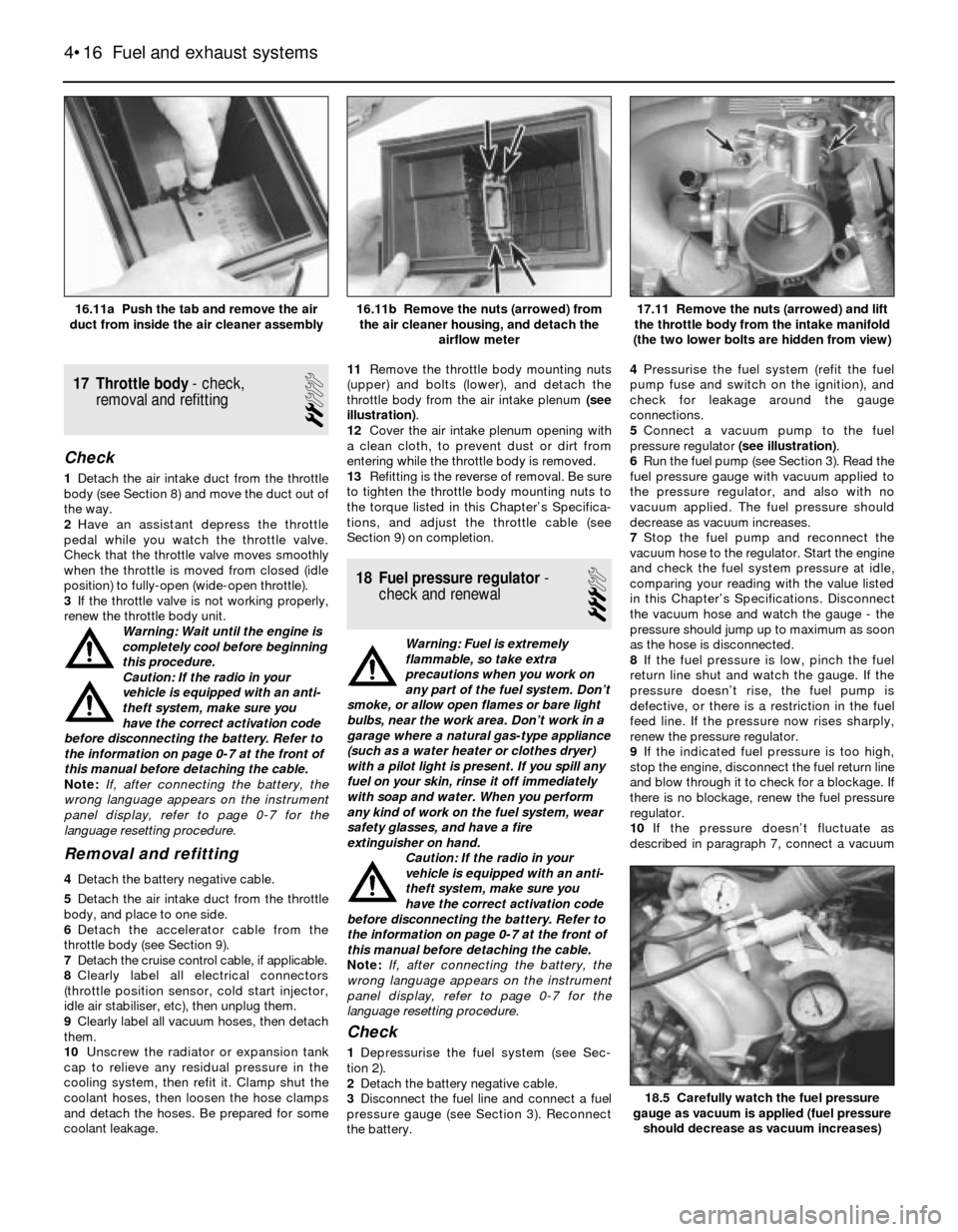
throttle body from the air intake plenum (see
illustration).
12Cover the air intake plenum opening with
a clean cloth, to prevent dust or dirt from
entering while the throttle body is removed.
13Refitting is the reverse of removal. Be sure
to tighten the throttle body mounting nuts to
the torque listed in this Chapter’s Specifica-
tions, and adjust the throttle cable (see
Section 9) on completion.
18 Fuel pressure regulator-
check and renewal
3
Warning: Fuel is extremely
flammable, so take extra
precautions when you work on
any part of the fuel system. Don’t
smoke, or allow open flames or bare light
bulbs, near the work area. Don’t work in a
garage where a natural gas-type appliance
(such as a water heater or clothes dryer)
with a pilot light is present. If you spill any
fuel on your skin, rinse it off immediately
with soap and water. When you perform
any kind of work on the fuel system, wear
safety glasses, and have a fire
extinguisher on hand.
Caution: If the radio in your
vehicle is equipped with an anti-
theft system, make sure you
have the correct activation code
before disconnecting the battery. Refer to
the information on page 0-7 at the front of
this manual before detaching the cable.
Note: If, after connecting the battery, the
wrong language appears on the instrument
panel display, refer to page 0-7 for the
language resetting procedure.
Check
1Depressurise the fuel system (see Sec-
tion 2).
2Detach the battery negative cable.
3Disconnect the fuel line and connect a fuel
pressure gauge (see Section 3). Reconnect
the battery.4Pressurise the fuel system (refit the fuel
pump fuse and switch on the ignition), and
check for leakage around the gauge
connections.
5Connect a vacuum pump to the fuel
pressure regulator (see illustration).
6Run the fuel pump (see Section 3). Read the
fuel pressure gauge with vacuum applied to
the pressure regulator, and also with no
vacuum applied. The fuel pressure should
decrease as vacuum increases.
7Stop the fuel pump and reconnect the
vacuum hose to the regulator. Start the engine
and check the fuel system pressure at idle,
comparing your reading with the value listed
in this Chapter’s Specifications. Disconnect
the vacuum hose and watch the gauge - the
pressure should jump up to maximum as soon
as the hose is disconnected.
8If the fuel pressure is low, pinch the fuel
return line shut and watch the gauge. If the
pressure doesn’t rise, the fuel pump is
defective, or there is a restriction in the fuel
feed line. If the pressure now rises sharply,
renew the pressure regulator.
9If the indicated fuel pressure is too high,
stop the engine, disconnect the fuel return line
and blow through it to check for a blockage. If
there is no blockage, renew the fuel pressure
regulator.
10If the pressure doesn’t fluctuate as
described in paragraph 7, connect a vacuum
4•16 Fuel and exhaust systems
18.5 Carefully watch the fuel pressure
gauge as vacuum is applied (fuel pressure
should decrease as vacuum increases)
17.11 Remove the nuts (arrowed) and lift
the throttle body from the intake manifold
(the two lower bolts are hidden from view)16.11b Remove the nuts (arrowed) from
the air cleaner housing, and detach the
airflow meter16.11a Push the tab and remove the air
duct from inside the air cleaner assembly
Page 105 of 228
gauge to the pressure regulator vacuum hose,
and check for vacuum (engine idling).
11If there is vacuum present, renew the fuel
pressure regulator.
12If there isn’t any reading on the gauge,
check the hose and its port for a leak or a
restriction.
Renewal
13Depressurise the fuel system (see Sec-
tion 2).
14Detach the battery negative cable.
Caution: If the radio in your
vehicle is equipped with an anti-
theft system, make sure you
have the correct activation code
before disconnecting the battery. Refer to
the information on page 0-7 at the front of
this manual before detaching the cable.
Note: If, after connecting the battery, the
wrong language appears on the instrument
panel display, refer to page 0-7 for the
language resetting procedure.
15Detach the vacuum hose and fuel return
hose from the pressure regulator, then
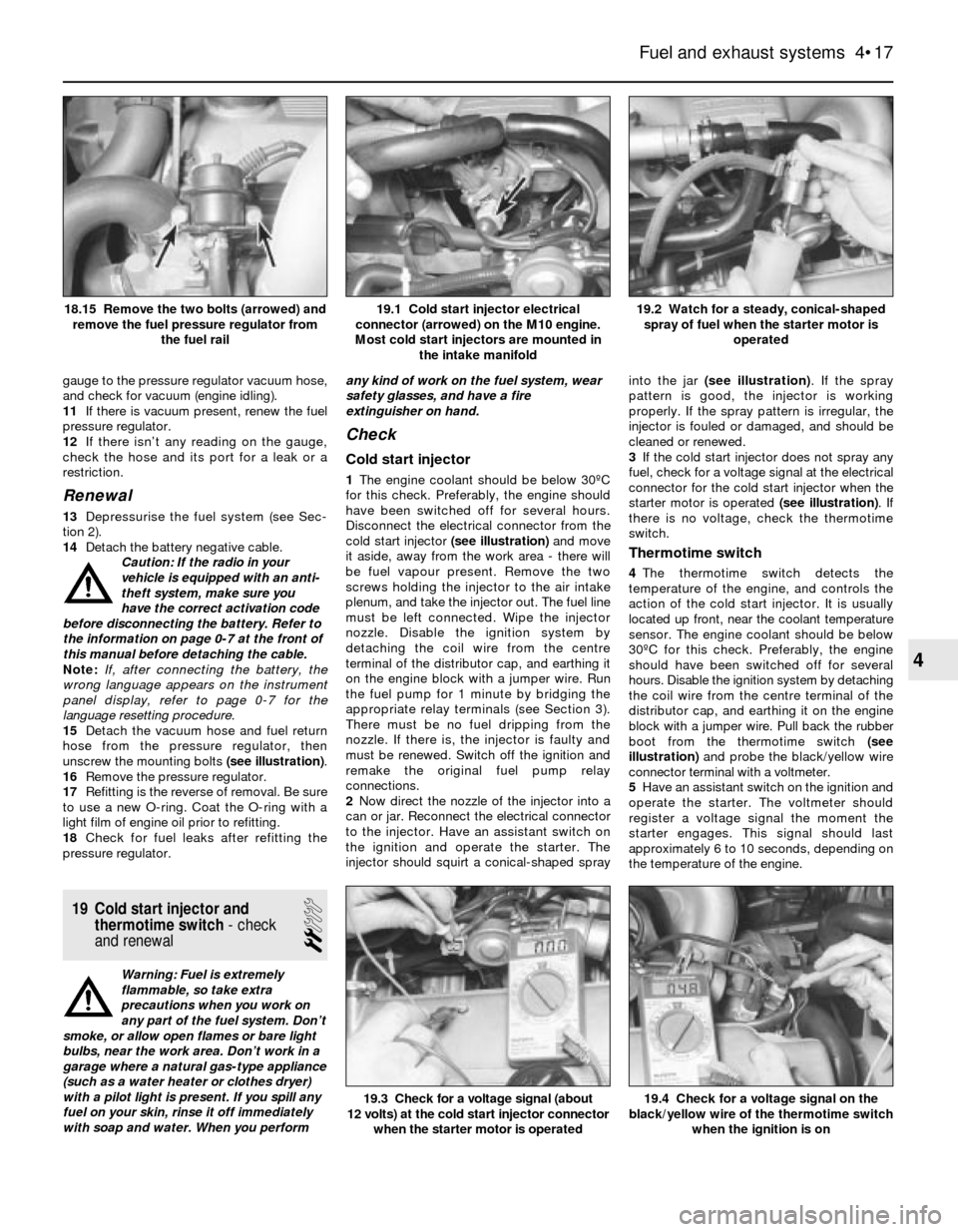
unscrew the mounting bolts (see illustration).
16Remove the pressure regulator.
17Refitting is the reverse of removal. Be sure
to use a new O-ring. Coat the O-ring with a
light film of engine oil prior to refitting.
18Check for fuel leaks after refitting the
pressure regulator.
19 Cold start injector and
thermotime switch- check
and renewal
2
Warning: Fuel is extremely
flammable, so take extra
precautions when you work on
any part of the fuel system. Don’t
smoke, or allow open flames or bare light
bulbs, near the work area. Don’t work in a
garage where a natural gas-type appliance
(such as a water heater or clothes dryer)
with a pilot light is present. If you spill any
fuel on your skin, rinse it off immediately
with soap and water. When you performany kind of work on the fuel system, wear
safety glasses, and have a fire
extinguisher on hand.
Check
Cold start injector
1The engine coolant should be below 30ºC
for this check. Preferably, the engine should
have been switched off for several hours.
Disconnect the electrical connector from the
cold start injector (see illustration)and move
it aside, away from the work area - there will
be fuel vapour present. Remove the two
screws holding the injector to the air intake
plenum, and take the injector out. The fuel line
must be left connected. Wipe the injector
nozzle. Disable the ignition system by
detaching the coil wire from the centre
terminal of the distributor cap, and earthing it
on the engine block with a jumper wire. Run
the fuel pump for 1 minute by bridging the
appropriate relay terminals (see Section 3).
There must be no fuel dripping from the
nozzle. If there is, the injector is faulty and
must be renewed. Switch off the ignition and
remake the original fuel pump relay
connections.
2Now direct the nozzle of the injector into a
can or jar. Reconnect the electrical connector
to the injector. Have an assistant switch on
the ignition and operate the starter. The
injector should squirt a conical-shaped sprayinto the jar (see illustration). If the spray
pattern is good, the injector is working
properly. If the spray pattern is irregular, the
injector is fouled or damaged, and should be
cleaned or renewed.
3If the cold start injector does not spray any
fuel, check for a voltage signal at the electrical
connector for the cold start injector when the
starter motor is operated (see illustration). If
there is no voltage, check the thermotime
switch.
Thermotime switch
4The thermotime switch detects the
temperature of the engine, and controls the
action of the cold start injector. It is usually
located up front, near the coolant temperature
sensor. The engine coolant should be below
30ºC for this check. Preferably, the engine
should have been switched off for several
hours. Disable the ignition system by detaching
the coil wire from the centre terminal of the
distributor cap, and earthing it on the engine
block with a jumper wire. Pull back the rubber
boot from the thermotime switch (see
illustration)and probe the black/yellow wire
connector terminal with a voltmeter.
5Have an assistant switch on the ignition and
operate the starter. The voltmeter should
register a voltage signal the moment the
starter engages. This signal should last
approximately 6 to 10 seconds, depending on
the temperature of the engine.
Fuel and exhaust systems 4•17
19.2 Watch for a steady, conical-shaped
spray of fuel when the starter motor is
operated19.1 Cold start injector electrical
connector (arrowed) on the M10 engine.
Most cold start injectors are mounted in
the intake manifold18.15 Remove the two bolts (arrowed) and
remove the fuel pressure regulator from
the fuel rail
19.4 Check for a voltage signal on the
black/yellow wire of the thermotime switch
when the ignition is on19.3 Check for a voltage signal (about
12 volts) at the cold start injector connector
when the starter motor is operated
4
Page 106 of 228
6If the voltage is correct, unplug the
electrical connector and, using an ohmmeter,
check for continuity between the terminals of
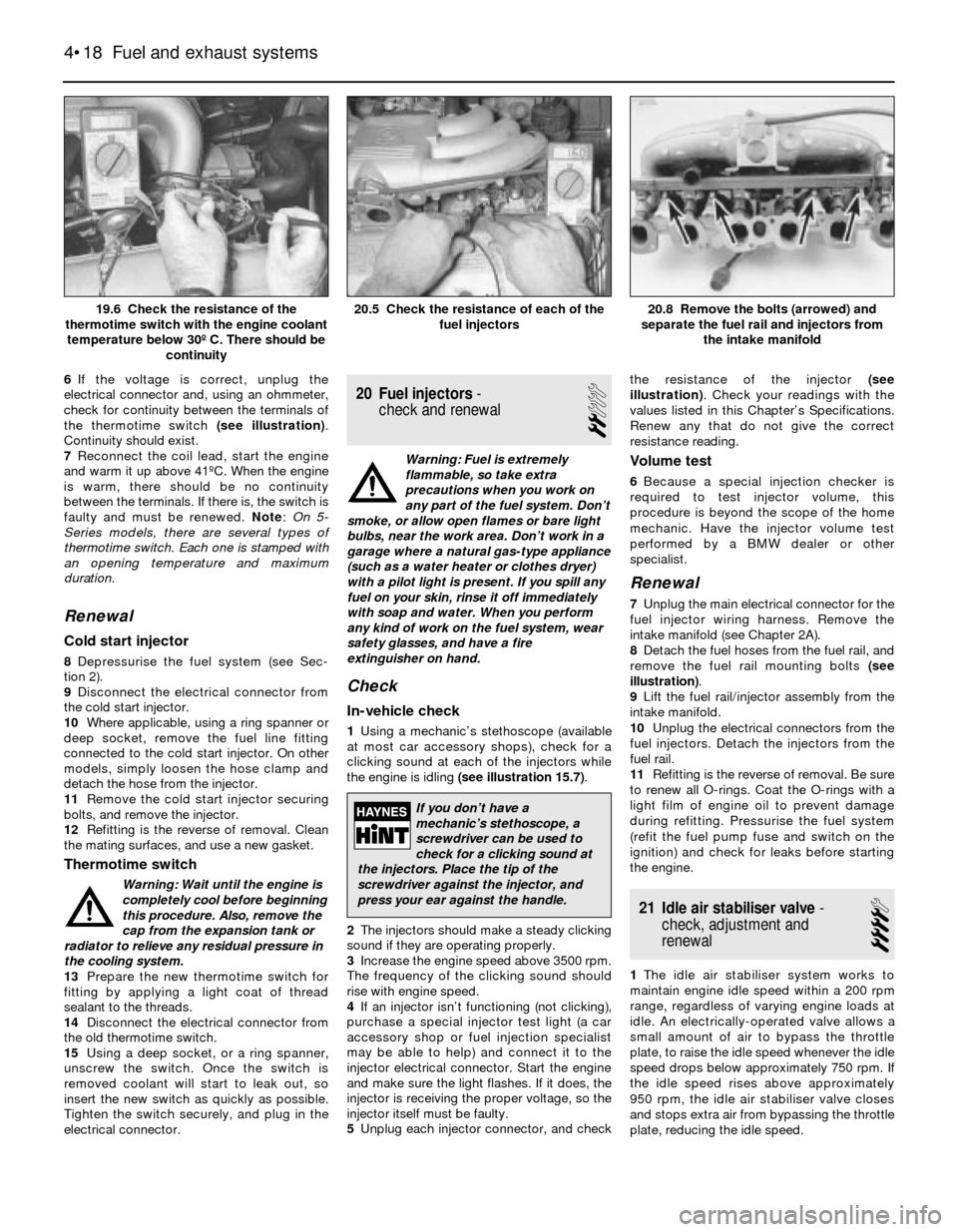
the thermotime switch (see illustration).
Continuity should exist.
7Reconnect the coil lead, start the engine
and warm it up above 41ºC. When the engine
is warm, there should be no continuity
between the terminals. If there is, the switch is
faulty and must be renewed. Note: On 5-
Series models, there are several types of
thermotime switch. Each one is stamped with
an opening temperature and maximum
duration.
Renewal
Cold start injector
8Depressurise the fuel system (see Sec-
tion 2).
9Disconnect the electrical connector from
the cold start injector.
10Where applicable, using a ring spanner or
deep socket, remove the fuel line fitting
connected to the cold start injector. On other
models, simply loosen the hose clamp and
detach the hose from the injector.
11Remove the cold start injector securing
bolts, and remove the injector.
12Refitting is the reverse of removal. Clean
the mating surfaces, and use a new gasket.
Thermotime switch
Warning: Wait until the engine is
completely cool before beginning
this procedure. Also, remove the
cap from the expansion tank or
radiator to relieve any residual pressure in
the cooling system.
13Prepare the new thermotime switch for
fitting by applying a light coat of thread
sealant to the threads.
14Disconnect the electrical connector from
the old thermotime switch.
15Using a deep socket, or a ring spanner,
unscrew the switch. Once the switch is
removed coolant will start to leak out, so
insert the new switch as quickly as possible.
Tighten the switch securely, and plug in the
electrical connector.
20 Fuel injectors-
check and renewal
2
Warning: Fuel is extremely
flammable, so take extra
precautions when you work on
any part of the fuel system. Don’t
smoke, or allow open flames or bare light
bulbs, near the work area. Don’t work in a
garage where a natural gas-type appliance
(such as a water heater or clothes dryer)
with a pilot light is present. If you spill any
fuel on your skin, rinse it off immediately
with soap and water. When you perform
any kind of work on the fuel system, wear
safety glasses, and have a fire
extinguisher on hand.
Check
In-vehicle check
1Using a mechanic’s stethoscope (available
at most car accessory shops), check for a
clicking sound at each of the injectors while
the engine is idling (see illustration 15.7).
2The injectors should make a steady clicking
sound if they are operating properly.
3Increase the engine speed above 3500 rpm.
The frequency of the clicking sound should
rise with engine speed.
4If an injector isn’t functioning (not clicking),
purchase a special injector test light (a car
accessory shop or fuel injection specialist
may be able to help) and connect it to the
injector electrical connector. Start the engine
and make sure the light flashes. If it does, the
injector is receiving the proper voltage, so the
injector itself must be faulty.
5Unplug each injector connector, and checkthe resistance of the injector (see
illustration). Check your readings with the
values listed in this Chapter’s Specifications.
Renew any that do not give the correct
resistance reading.
Volume test
6Because a special injection checker is
required to test injector volume, this
procedure is beyond the scope of the home
mechanic. Have the injector volume test
performed by a BMW dealer or other
specialist.
Renewal
7Unplug the main electrical connector for the
fuel injector wiring harness. Remove the
intake manifold (see Chapter 2A).
8Detach the fuel hoses from the fuel rail, and
remove the fuel rail mounting bolts (see
illustration).
9Lift the fuel rail/injector assembly from the
intake manifold.
10Unplug the electrical connectors from the
fuel injectors. Detach the injectors from the
fuel rail.
11Refitting is the reverse of removal. Be sure
to renew all O-rings. Coat the O-rings with a
light film of engine oil to prevent damage
during refitting. Pressurise the fuel system
(refit the fuel pump fuse and switch on the
ignition) and check for leaks before starting
the engine.
21 Idle air stabiliser valve-
check, adjustment and
renewal
4
1The idle air stabiliser system works to
maintain engine idle speed within a 200 rpm
range, regardless of varying engine loads at
idle. An electrically-operated valve allows a
small amount of air to bypass the throttle
plate, to raise the idle speed whenever the idle
speed drops below approximately 750 rpm. If
the idle speed rises above approximately
950 rpm, the idle air stabiliser valve closes
and stops extra air from bypassing the throttle
plate, reducing the idle speed.
4•18 Fuel and exhaust systems
20.8 Remove the bolts (arrowed) and
separate the fuel rail and injectors from
the intake manifold20.5 Check the resistance of each of the
fuel injectors19.6 Check the resistance of the
thermotime switch with the engine coolant
temperature below 30º C. There should be
continuity
If you don’t have a
mechanic’s stethoscope, a
screwdriver can be used to
check for a clicking sound at
the injectors. Place the tip of the
screwdriver against the injector, and
press your ear against the handle.
Page 143 of 228

10
General
Power steering fluid type . . . . . . . . . . . . . . . . . . . . . . . . . . . . . . . . . . . . See Chapter 1
Tyres
Tyre sizes
3-Series, E30
316 . . . . . . . . . . . . . . . . . . . . . . . . . . . . . . . . . . . . . . . . . . . . . . . . . 175/70x14
316i . . . . . . . . . . . . . . . . . . . . . . . . . . . . . . . . . . . . . . . . . . . . . . . . . 175/70x14, 195/65x14
318i . . . . . . . . . . . . . . . . . . . . . . . . . . . . . . . . . . . . . . . . . . . . . . . . . 175/70x14
320i . . . . . . . . . . . . . . . . . . . . . . . . . . . . . . . . . . . . . . . . . . . . . . . . . 195/65x14
325i . . . . . . . . . . . . . . . . . . . . . . . . . . . . . . . . . . . . . . . . . . . . . . . . . 195/65x14, 200/60x356, 205/55x15
5-Series, E28 (“old-shape”)
518 . . . . . . . . . . . . . . . . . . . . . . . . . . . . . . . . . . . . . . . . . . . . . . . . . 175x14
518i . . . . . . . . . . . . . . . . . . . . . . . . . . . . . . . . . . . . . . . . . . . . . . . . . 175x14
525i . . . . . . . . . . . . . . . . . . . . . . . . . . . . . . . . . . . . . . . . . . . . . . . . . 175x14, 195/70x14
528i . . . . . . . . . . . . . . . . . . . . . . . . . . . . . . . . . . . . . . . . . . . . . . . . . 195/70x14
535i and M535i . . . . . . . . . . . . . . . . . . . . . . . . . . . . . . . . . . . . . . . . 220/55x390
5-Series, E34 (“new-shape”)
518i . . . . . . . . . . . . . . . . . . . . . . . . . . . . . . . . . . . . . . . . . . . . . . . . . 195/65x15
520i . . . . . . . . . . . . . . . . . . . . . . . . . . . . . . . . . . . . . . . . . . . . . . . . . 195/65x15, 225/60x15
525i . . . . . . . . . . . . . . . . . . . . . . . . . . . . . . . . . . . . . . . . . . . . . . . . . 195/65x15, 205/65x15, 225/65x15
530i . . . . . . . . . . . . . . . . . . . . . . . . . . . . . . . . . . . . . . . . . . . . . . . . . 205/65x15, 225/60x15
535i . . . . . . . . . . . . . . . . . . . . . . . . . . . . . . . . . . . . . . . . . . . . . . . . . 225/60x15, 240/45x415
Tyre pressures . . . . . . . . . . . . . . . . . . . . . . . . . . . . . . . . . . . . . . . . . . . . See Chapter 1 Specifications
Chapter 10 Suspension and steering systems
Balljoints - check and renewal . . . . . . . . . . . . . . . . . . . . . . . . . . . . . 7
Control arm (3-Series) - inspection, removal and refitting,
and bush renewal . . . . . . . . . . . . . . . . . . . . . . . . . . . . . . . . . . . . . 3
Control and thrust arms (5-Series) - inspection, removal and
refitting, and bush renewal . . . . . . . . . . . . . . . . . . . . . . . . . . . . . . 4
Front anti-roll bar - removal and refitting . . . . . . . . . . . . . . . . . . . . . 2
Front hub and wheel bearing assembly - removal and refitting . . . . 8
Front strut assembly - removal and refitting . . . . . . . . . . . . . . . . . . . 5
General information . . . . . . . . . . . . . . . . . . . . . . . . . . . . . . . . . . . . . . 1
Power steering fluid level check . . . . . . . . . . . . . . . . See Chapter 1
Power steering pump - removal and refitting . . . . . . . . . . . . . . . . . . 22
Power steering system - bleeding . . . . . . . . . . . . . . . . . . . . . . . . . . . 23
Rack-and-pinion steering gear (3-Series) - removal and refitting . . . 19
Rear anti-roll bar - removal and refitting . . . . . . . . . . . . . . . . . . . . . . 12
Rear coil springs (3-Series) - removal and refitting . . . . . . . . . . . . . . 10
Rear shock absorbers (3-Series) - removal and refitting . . . . . . . . . 9
Rear shock absorber/coil spring assembly (5-Series) - removal
and refitting . . . . . . . . . . . . . . . . . . . . . . . . . . . . . . . . . . . . . . . . . . 11Rear trailing arms (3-Series) - removal and refitting . . . . . . . . . . . . . 13
Rear trailing arms (5-Series) - removal and refitting . . . . . . . . . . . . . 14
Rear wheel bearings - renewal . . . . . . . . . . . . . . . . . . . . . . . . . . . . . 15
Steering and suspension check . . . . . . . . . . . . . . . . . See Chapter 1
Steering box (5-Series) - removal and refitting . . . . . . . . . . . . . . . . . 21
Steering gear boots (3-Series) - renewal . . . . . . . . . . . . . . . . . . . . . . 18
Steering linkage (5-Series) - inspection, removal and
refitting . . . . . . . . . . . . . . . . . . . . . . . . . . . . . . . . . . . . . . . . . . . . . . 20
Steering system - general information . . . . . . . . . . . . . . . . . . . . . . . 16
Steering wheel - removal and refitting . . . . . . . . . . . . . . . . . . . . . . . 24
Strut or shock absorber/coil spring - renewal . . . . . . . . . . . . . . . . . . 6
Suspension and steering checks . . . . . . . . . . . . . . . . See Chapter 1
Track rod ends - removal and refitting . . . . . . . . . . . . . . . . . . . . . . . 17
Tyre and tyre pressure checks . . . . . . . . . . . . . . . . . See Chapter 1
Tyre rotation . . . . . . . . . . . . . . . . . . . . . . . . . . . . . . . . See Chapter 1
Wheel alignment - general information . . . . . . . . . . . . . . . . . . . . . . . 26
Wheels and tyres - general information . . . . . . . . . . . . . . . . . . . . . . 25
10•1
Easy,suitable for
novice with little
experienceFairly easy,suitable
for beginner with
some experienceFairly difficult,
suitable for competent
DIY mechanic
Difficult,suitable for
experienced DIY
mechanicVery difficult,
suitable for expert
DIY or professional
Degrees of difficulty
Specifications Contents
Page 144 of 228
Torque wrench settingsNm
Front suspension
Strut damper rod nut
Rod with external hexagon . . . . . . . . . . . . . . . . . . . . . . 65
Rod with internal hexagon . . . . . . . . . . . . . . . . . . . . . . 44
Strut cartridge threaded collar . . . . . . . . . . . . . . . . . . . . . . . 130
Strut upper mounting nuts . . . . . . . . . . . . . . . . . . . . . . . . . . 22
Front control arm (3-Series)
Control arm-to-steering knuckle balljoint nut . . . . . . . . . . 64
Control arm-to-subframe balljoint nut . . . . . . . . . . . . . . . 83
Control arm bush bracket bolts . . . . . . . . . . . . . . . . . . . . 41
Lower control arm (5-Series)
Control arm-to-steering arm balljoint stud nut . . . . . . . . . 85
Control arm pivot bolt . . . . . . . . . . . . . . . . . . . . . . . . . . . . 77
Thrust arm (5-Series)
Thrust arm-to-steering arm balljoint stud nut . . . . . . . . . . 85
Thrust arm through-bolt . . . . . . . . . . . . . . . . . . . . . . . . . . 130
Front hub (wheel bearing) nut . . . . . . . . . . . . . . . . . . . . . . . . 290
Steering arm-to-strut bolts (5-Series) . . . . . . . . . . . . . . . . . . 65
Anti-roll bar (3-Series)
Anti-roll bar-to-connecting link bolt . . . . . . . . . . . . . . . . . 41
Anti-roll bar mounting brackets-to-subframe . . . . . . . . . . 22
Connecting link-to-bracket . . . . . . . . . . . . . . . . . . . . . . . . 22
Connecting link bracket-to-control arm . . . . . . . . . . . . . . 41
Anti-roll bar (5-Series)
Anti-roll bar mounting brackets . . . . . . . . . . . . . . . . . . . . 22
Anti-roll bar link-to-strut housing locknut
Yellow chrome . . . . . . . . . . . . . . . . . . . . . . . . . . . . . . . 20
White chrome . . . . . . . . . . . . . . . . . . . . . . . . . . . . . . . . 33
Yellow . . . . . . . . . . . . . . . . . . . . . . . . . . . . . . . . . . . . . . 58
10•2 Suspension and steering systems
Torque wrench settingsNm
Rear suspension
Rear shock absorber (3-Series)
Shock absorber-to-upper mounting bracket . . . . . . . . . . 12 to 15
Shock absorber-to-trailing arm . . . . . . . . . . . . . . . . . . . . 71 to 85
Rear shock absorber (5-Series)
Lower mounting bolt . . . . . . . . . . . . . . . . . . . . . . . . . . . . . 125 to 142
Upper mounting nut . . . . . . . . . . . . . . . . . . . . . . . . . . . . . 22 to 24
Upper spring mounting-to-shock absorber locknut . . . . . 22 to 24
Trailing arms (3-Series)
Trailing arm-to-lower mounting . . . . . . . . . . . . . . . . . . . . 71 to 85
Trailing arm-to-anti-roll bar . . . . . . . . . . . . . . . . . . . . . . . . 22 to 23
Trailing arms (5-Series)
Trailing arm-to-rear axle carrier (rubber bush
through-bolt and nut) . . . . . . . . . . . . . . . . . . . . . . . . . . 66
Trailing arm-to-axle carrier connecting link (1983-on) . . . 126
Rear wheel bearing drive flange axle nut (5-Series)
M22 . . . . . . . . . . . . . . . . . . . . . . . . . . . . . . . . . . . . . . . . 175 to 210
M27 . . . . . . . . . . . . . . . . . . . . . . . . . . . . . . . . . . . . . . . . 235 to 260
Steering system
Steering wheel retaining nut . . . . . . . . . . . . . . . . . . . . . . . . . 79
Steering column universal joint pinch-bolt . . . . . . . . . . . . . . 22
Steering gear-to-subframe mounting bolts (3-Series) . . . . . 41
Steering box-to-front suspension subframe bolts (5-Series) 42
Track rod end-to-steering arm nut . . . . . . . . . . . . . . . . . . . . 37
Track rod end clamping bolt . . . . . . . . . . . . . . . . . . . . . . . . . 14
Pitman arm-to-steering box (5-Series) . . . . . . . . . . . . . . . . . 140
Steering linkage balljoints (all) . . . . . . . . . . . . . . . . . . . . . . . 37
1 General information
Warning: Whenever any of the
suspension or steering fasteners
are loosened or removed, they
must be inspected and if
necessary, new ones fitted, of the same
part number or of original-equipment
quality and design. Torque specifications
must be followed for proper reassembly
and component retention. Never attempt
to heat, straighten or weld any suspension
or steering component. Any bent or
damaged parts must be renewed.
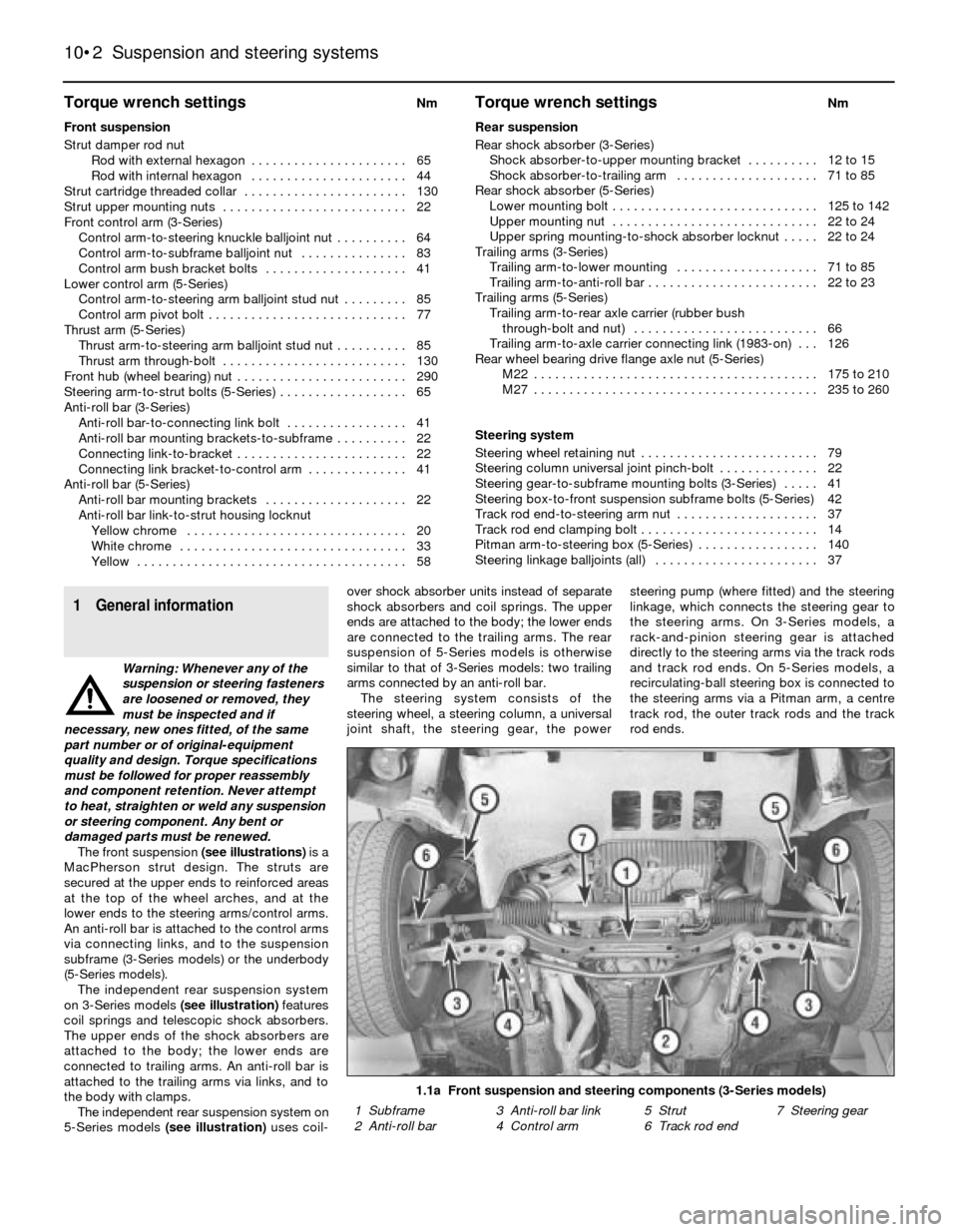
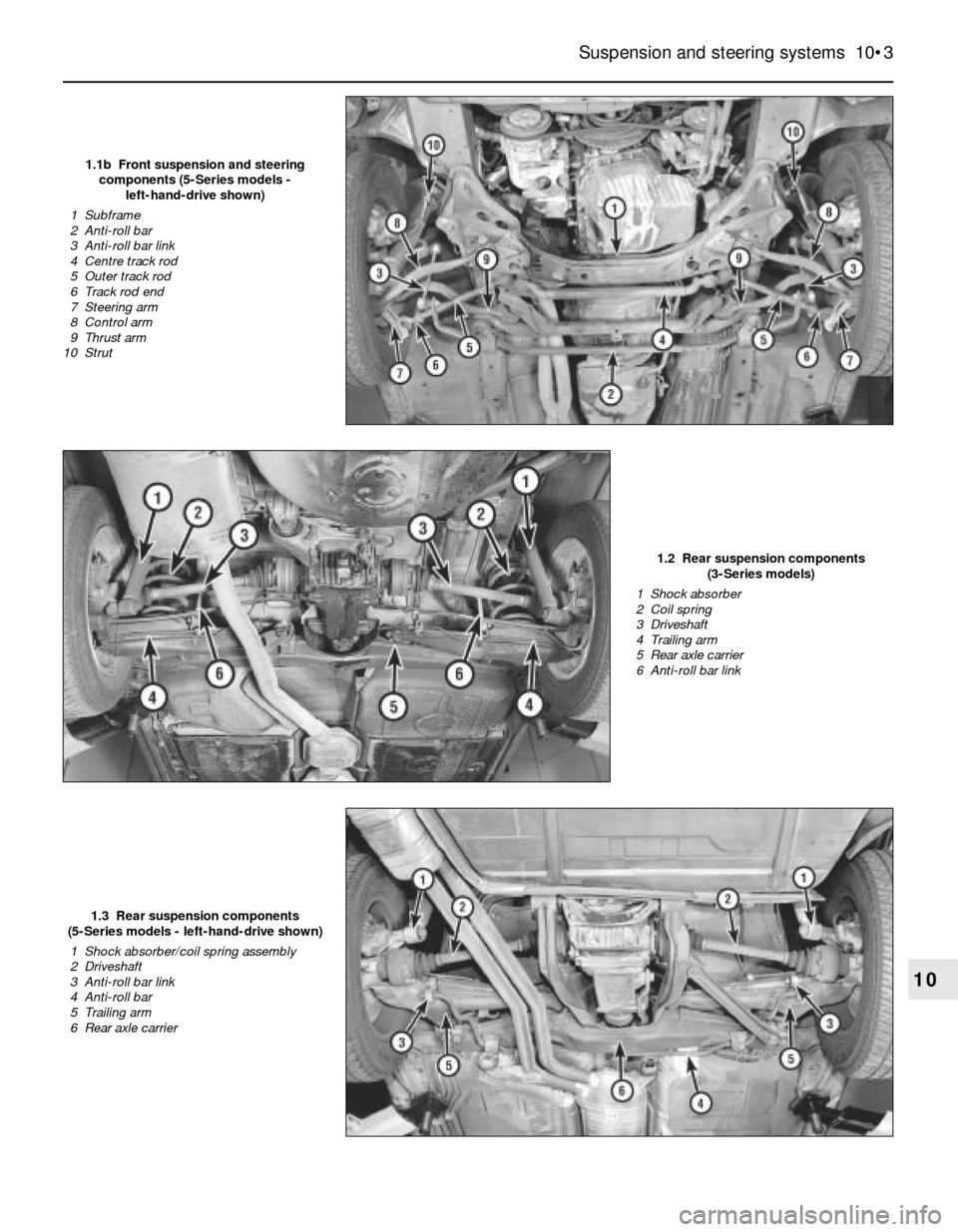
The front suspension (see illustrations)is a
MacPherson strut design. The struts are
secured at the upper ends to reinforced areas
at the top of the wheel arches, and at the
lower ends to the steering arms/control arms.
An anti-roll bar is attached to the control arms
via connecting links, and to the suspension
subframe (3-Series models) or the underbody
(5-Series models).
The independent rear suspension system
on 3-Series models (see illustration)features
coil springs and telescopic shock absorbers.
The upper ends of the shock absorbers are
attached to the body; the lower ends are
connected to trailing arms. An anti-roll bar is
attached to the trailing arms via links, and to
the body with clamps.
The independent rear suspension system on
5-Series models (see illustration)uses coil-over shock absorber units instead of separate
shock absorbers and coil springs. The upper
ends are attached to the body; the lower ends
are connected to the trailing arms. The rear
suspension of 5-Series models is otherwise
similar to that of 3-Series models: two trailing
arms connected by an anti-roll bar.
The steering system consists of the
steering wheel, a steering column, a universal
joint shaft, the steering gear, the powersteering pump (where fitted) and the steering
linkage, which connects the steering gear to
the steering arms. On 3-Series models, a
rack-and-pinion steering gear is attached
directly to the steering arms via the track rods
and track rod ends. On 5-Series models, a
recirculating-ball steering box is connected to
the steering arms via a Pitman arm, a centre
track rod, the outer track rods and the track
rod ends.
1.1a Front suspension and steering components (3-Series models)
1 Subframe 3 Anti-roll bar link 5 Strut 7 Steering gear
2 Anti-roll bar 4 Control arm 6 Track rod end
Page 145 of 228
Suspension and steering systems 10•3
1.1b Front suspension and steering
components (5-Series models -
left-hand-drive shown)
1 Subframe
2 Anti-roll bar
3 Anti-roll bar link
4 Centre track rod
5 Outer track rod
6 Track rod end
7 Steering arm
8 Control arm
9 Thrust arm
10 Strut
1.2 Rear suspension components
(3-Series models)
1 Shock absorber
2 Coil spring
3 Driveshaft
4 Trailing arm
5 Rear axle carrier
6 Anti-roll bar link
1.3 Rear suspension components
(5-Series models - left-hand-drive shown)
1 Shock absorber/coil spring assembly
2 Driveshaft
3 Anti-roll bar link
4 Anti-roll bar
5 Trailing arm
6 Rear axle carrier
10
Page 146 of 228
2 Front anti-roll bar-
removal and refitting
2
Removal
1Raise the front of the vehicle, and support it
securely on axle stands.
2If you’re removing or renewing the anti-roll
bar itself, or disconnecting the bar to renew
the strut assembly on a 3-Series model,
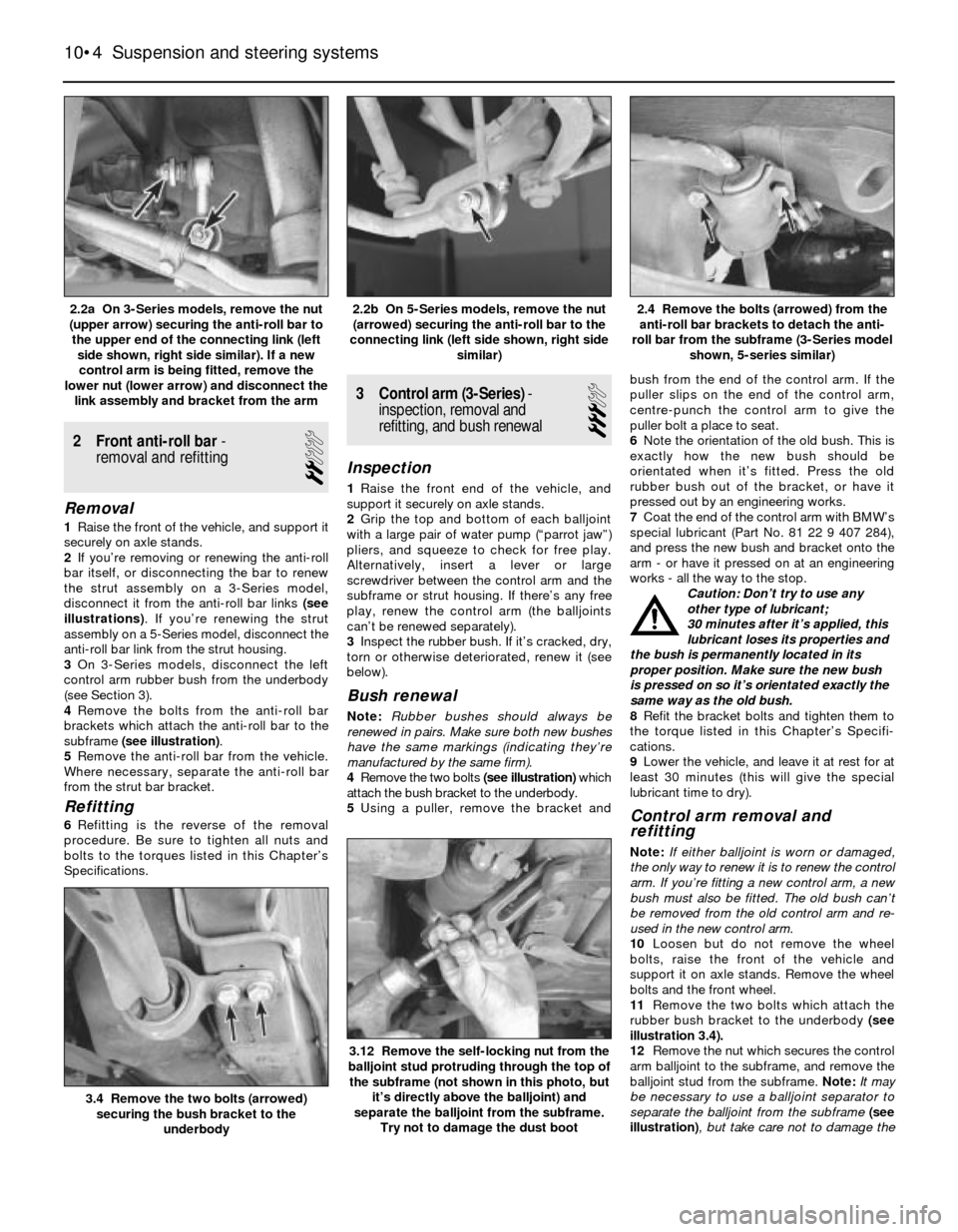
disconnect it from the anti-roll bar links (see
illustrations). If you’re renewing the strut
assembly on a 5-Series model, disconnect the
anti-roll bar link from the strut housing.
3On 3-Series models, disconnect the left
control arm rubber bush from the underbody
(see Section 3).
4Remove the bolts from the anti-roll bar
brackets which attach the anti-roll bar to the
subframe (see illustration).
5Remove the anti-roll bar from the vehicle.
Where necessary, separate the anti-roll bar
from the strut bar bracket.
Refitting
6Refitting is the reverse of the removal
procedure. Be sure to tighten all nuts and
bolts to the torques listed in this Chapter’s
Specifications.
3 Control arm (3-Series)-
inspection, removal and
refitting, and bush renewal
3
Inspection
1Raise the front end of the vehicle, and
support it securely on axle stands.
2Grip the top and bottom of each balljoint
with a large pair of water pump (“parrot jaw”)
pliers, and squeeze to check for free play.
Alternatively, insert a lever or large
screwdriver between the control arm and the
subframe or strut housing. If there’s any free
play, renew the control arm (the balljoints
can’t be renewed separately).
3Inspect the rubber bush. If it’s cracked, dry,
torn or otherwise deteriorated, renew it (see
below).
Bush renewal
Note:Rubber bushes should always be
renewed in pairs. Make sure both new bushes
have the same markings (indicating they’re
manufactured by the same firm).
4Remove the two bolts (see illustration)which
attach the bush bracket to the underbody.
5Using a puller, remove the bracket andbush from the end of the control arm. If the
puller slips on the end of the control arm,
centre-punch the control arm to give the
puller bolt a place to seat.
6Note the orientation of the old bush. This is
exactly how the new bush should be
orientated when it’s fitted. Press the old
rubber bush out of the bracket, or have it
pressed out by an engineering works.
7Coat the end of the control arm with BMW’s
special lubricant (Part No. 81 22 9 407 284),
and press the new bush and bracket onto the
arm - or have it pressed on at an engineering
works - all the way to the stop.
Caution: Don’t try to use any
other type of lubricant;
30 minutes after it’s applied, this
lubricant loses its properties and
the bush is permanently located in its
proper position. Make sure the new bush
is pressed on so it’s orientated exactly the
same way as the old bush.
8Refit the bracket bolts and tighten them to
the torque listed in this Chapter’s Specifi-
cations.
9Lower the vehicle, and leave it at rest for at
least 30 minutes (this will give the special
lubricant time to dry).
Control arm removal and
refitting
Note:If either balljoint is worn or damaged,
the only way to renew it is to renew the control
arm. If you’re fitting a new control arm, a new
bush must also be fitted. The old bush can’t
be removed from the old control arm and re-
used in the new control arm.
10Loosen but do not remove the wheel
bolts, raise the front of the vehicle and
support it on axle stands. Remove the wheel
bolts and the front wheel.
11Remove the two bolts which attach the
rubber bush bracket to the underbody (see
illustration 3.4).
12Remove the nut which secures the control
arm balljoint to the subframe, and remove the
balljoint stud from the subframe. Note:It may
be necessary to use a balljoint separator to
separate the balljoint from the subframe (see
illustration), but take care not to damage the
10•4 Suspension and steering systems
3.12 Remove the self-locking nut from the
balljoint stud protruding through the top of
the subframe (not shown in this photo, but
it’s directly above the balljoint) and
separate the balljoint from the subframe.
Try not to damage the dust boot
3.4 Remove the two bolts (arrowed)
securing the bush bracket to the
underbody
2.4 Remove the bolts (arrowed) from the
anti-roll bar brackets to detach the anti-
roll bar from the subframe (3-Series model
shown, 5-series similar)2.2b On 5-Series models, remove the nut
(arrowed) securing the anti-roll bar to the
connecting link (left side shown, right side
similar)2.2a On 3-Series models, remove the nut
(upper arrow) securing the anti-roll bar to
the upper end of the connecting link (left
side shown, right side similar). If a new
control arm is being fitted, remove the
lower nut (lower arrow) and disconnect the
link assembly and bracket from the arm
Page 148 of 228
Bush inspection and renewal
8If the bush is cracked, torn or otherwise
deteriorated, take the arm to a BMW dealer
service department or an engineering works,
and have it pressed out and a new bush
pressed in. Bushes should always be renewed
in pairs (a new bush should be fitted in each
arm, and both bushes should have the same
manufacturer markings). If you’re fitting a new
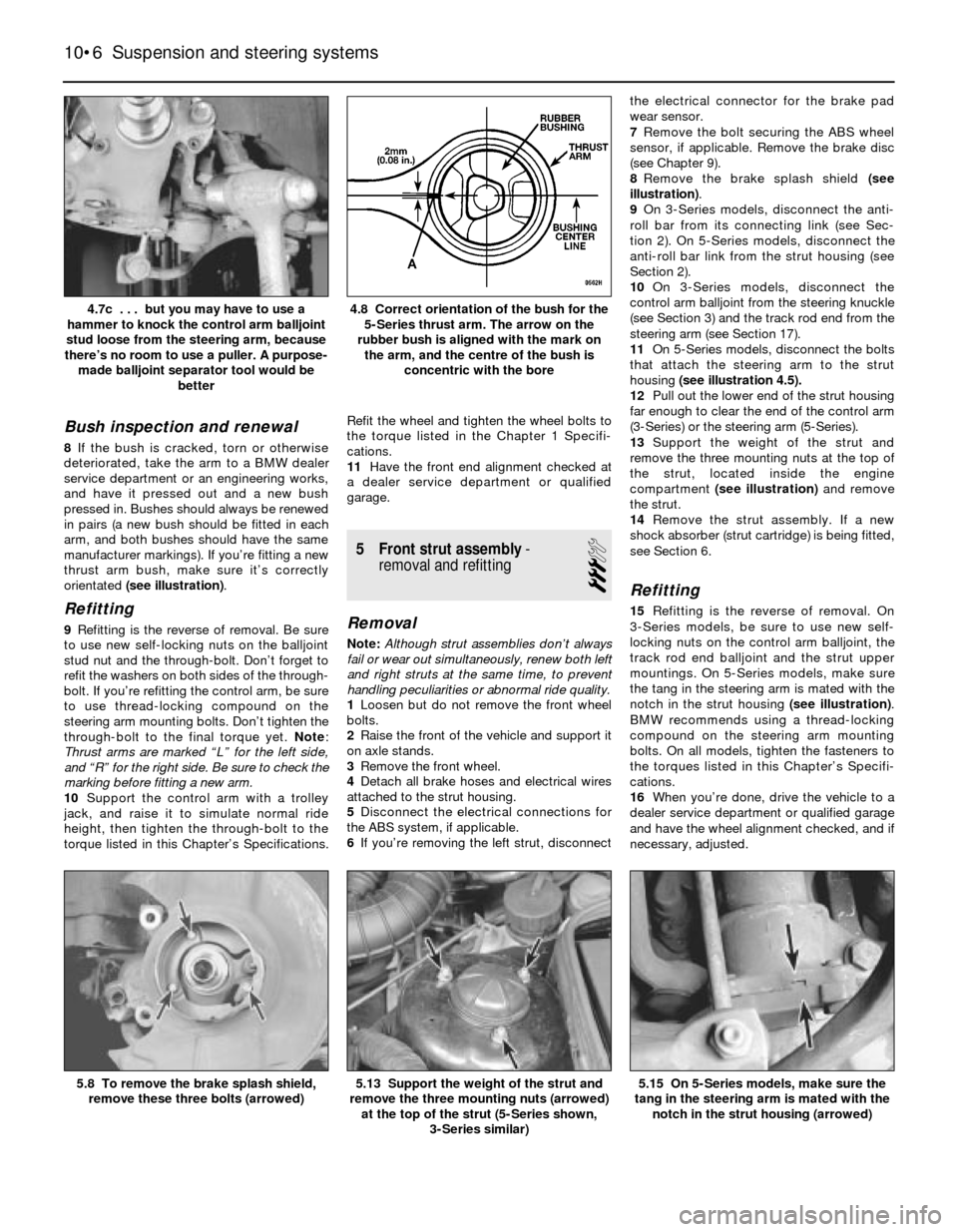
thrust arm bush, make sure it’s correctly
orientated (see illustration).
Refitting
9Refitting is the reverse of removal. Be sure
to use new self-locking nuts on the balljoint
stud nut and the through-bolt. Don’t forget to
refit the washers on both sides of the through-
bolt. If you’re refitting the control arm, be sure
to use thread-locking compound on the
steering arm mounting bolts. Don’t tighten the
through-bolt to the final torque yet. Note:
Thrust arms are marked “L” for the left side,
and “R” for the right side. Be sure to check the
marking before fitting a new arm.
10Support the control arm with a trolley
jack, and raise it to simulate normal ride
height, then tighten the through-bolt to the
torque listed in this Chapter’s Specifications.Refit the wheel and tighten the wheel bolts to
the torque listed in the Chapter 1 Specifi-
cations.
11Have the front end alignment checked at
a dealer service department or qualified
garage.
5 Front strut assembly-
removal and refitting
3
Removal
Note:Although strut assemblies don’t always
fail or wear out simultaneously, renew both left
and right struts at the same time, to prevent
handling peculiarities or abnormal ride quality.
1Loosen but do not remove the front wheel
bolts.
2Raise the front of the vehicle and support it
on axle stands.
3Remove the front wheel.
4Detach all brake hoses and electrical wires
attached to the strut housing.
5Disconnect the electrical connections for
the ABS system, if applicable.
6If you’re removing the left strut, disconnectthe electrical connector for the brake pad
wear sensor.
7Remove the bolt securing the ABS wheel
sensor, if applicable. Remove the brake disc
(see Chapter 9).
8Remove the brake splash shield (see
illustration).
9On 3-Series models, disconnect the anti-
roll bar from its connecting link (see Sec-
tion 2). On 5-Series models, disconnect the
anti-roll bar link from the strut housing (see
Section 2).
10On 3-Series models, disconnect the
control arm balljoint from the steering knuckle
(see Section 3) and the track rod end from the
steering arm (see Section 17).
11On 5-Series models, disconnect the bolts
that attach the steering arm to the strut
housing (see illustration 4.5).
12Pull out the lower end of the strut housing
far enough to clear the end of the control arm
(3-Series) or the steering arm (5-Series).
13Support the weight of the strut and
remove the three mounting nuts at the top of
the strut, located inside the engine
compartment (see illustration)and remove
the strut.
14Remove the strut assembly. If a new
shock absorber (strut cartridge) is being fitted,
see Section 6.
Refitting
15Refitting is the reverse of removal. On
3-Series models, be sure to use new self-
locking nuts on the control arm balljoint, the
track rod end balljoint and the strut upper
mountings. On 5-Series models, make sure
the tang in the steering arm is mated with the
notch in the strut housing (see illustration).
BMW recommends using a thread-locking
compound on the steering arm mounting
bolts. On all models, tighten the fasteners to
the torques listed in this Chapter’s Specifi-
cations.
16When you’re done, drive the vehicle to a
dealer service department or qualified garage
and have the wheel alignment checked, and if
necessary, adjusted.
10•6 Suspension and steering systems
5.15 On 5-Series models, make sure the
tang in the steering arm is mated with the
notch in the strut housing (arrowed)5.13 Support the weight of the strut and
remove the three mounting nuts (arrowed)
at the top of the strut (5-Series shown,
3-Series similar)5.8 To remove the brake splash shield,
remove these three bolts (arrowed)
4.8 Correct orientation of the bush for the
5-Series thrust arm. The arrow on the
rubber bush is aligned with the mark on
the arm, and the centre of the bush is
concentric with the bore4.7c . . . but you may have to use a
hammer to knock the control arm balljoint
stud loose from the steering arm, because
there’s no room to use a puller. A purpose-
made balljoint separator tool would be
better
Page 151 of 228
4On some models, working inside the boot,
you can remove the trim to access the upper
mounting nuts; on later models, you’ll have to
remove the rear seat back to get at the upper
mounting nuts. On Touring (Estate) models,
remove the side backrest and rear seat belt
reels, and unscrew the centring shell on the
wheel arch. On Convertibles, simply remove
the top from the recessed well behind the
passenger compartment, and remove the
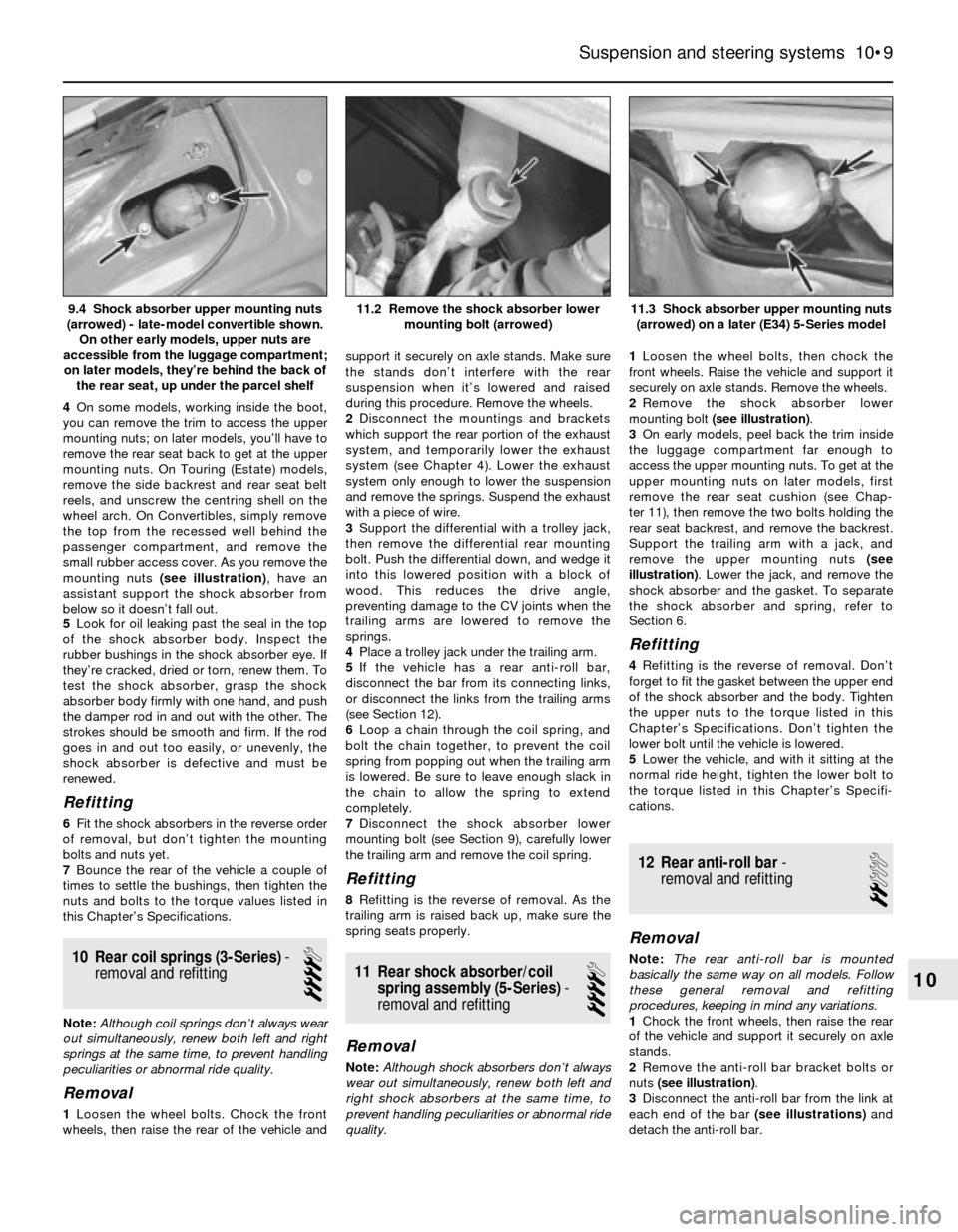
small rubber access cover. As you remove the
mounting nuts (see illustration), have an
assistant support the shock absorber from
below so it doesn’t fall out.
5Look for oil leaking past the seal in the top
of the shock absorber body. Inspect the
rubber bushings in the shock absorber eye. If
they’re cracked, dried or torn, renew them. To
test the shock absorber, grasp the shock
absorber body firmly with one hand, and push
the damper rod in and out with the other. The
strokes should be smooth and firm. If the rod
goes in and out too easily, or unevenly, the
shock absorber is defective and must be
renewed.
Refitting
6Fit the shock absorbers in the reverse order
of removal, but don’t tighten the mounting
bolts and nuts yet.
7Bounce the rear of the vehicle a couple of
times to settle the bushings, then tighten the
nuts and bolts to the torque values listed in
this Chapter’s Specifications.
10 Rear coil springs (3-Series)-
removal and refitting
4
Note: Although coil springs don’t always wear
out simultaneously, renew both left and right
springs at the same time, to prevent handling
peculiarities or abnormal ride quality.
Removal
1Loosen the wheel bolts. Chock the front
wheels, then raise the rear of the vehicle andsupport it securely on axle stands. Make sure
the stands don’t interfere with the rear
suspension when it’s lowered and raised
during this procedure. Remove the wheels.
2Disconnect the mountings and brackets
which support the rear portion of the exhaust
system, and temporarily lower the exhaust
system (see Chapter 4). Lower the exhaust
system only enough to lower the suspension
and remove the springs. Suspend the exhaust
with a piece of wire.
3Support the differential with a trolley jack,
then remove the differential rear mounting
bolt. Push the differential down, and wedge it
into this lowered position with a block of
wood. This reduces the drive angle,
preventing damage to the CV joints when the
trailing arms are lowered to remove the
springs.
4Place a trolley jack under the trailing arm.
5If the vehicle has a rear anti-roll bar,
disconnect the bar from its connecting links,
or disconnect the links from the trailing arms
(see Section 12).
6Loop a chain through the coil spring, and
bolt the chain together, to prevent the coil
spring from popping out when the trailing arm
is lowered. Be sure to leave enough slack in
the chain to allow the spring to extend
completely.
7Disconnect the shock absorber lower
mounting bolt (see Section 9), carefully lower
the trailing arm and remove the coil spring.
Refitting
8Refitting is the reverse of removal. As the
trailing arm is raised back up, make sure the
spring seats properly.
11 Rear shock absorber/coil
spring assembly (5-Series)-
removal and refitting
4
Removal
Note:Although shock absorbers don’t always
wear out simultaneously, renew both left and
right shock absorbers at the same time, to
prevent handling peculiarities or abnormal ride
quality.1Loosen the wheel bolts, then chock the
front wheels. Raise the vehicle and support it
securely on axle stands. Remove the wheels.
2Remove the shock absorber lower
mounting bolt (see illustration).
3On early models, peel back the trim inside
the luggage compartment far enough to
access the upper mounting nuts. To get at the
upper mounting nuts on later models, first
remove the rear seat cushion (see Chap-
ter 11), then remove the two bolts holding the
rear seat backrest, and remove the backrest.
Support the trailing arm with a jack, and
remove the upper mounting nuts (see
illustration). Lower the jack, and remove the
shock absorber and the gasket. To separate
the shock absorber and spring, refer to
Section 6.
Refitting
4Refitting is the reverse of removal. Don’t
forget to fit the gasket between the upper end
of the shock absorber and the body. Tighten
the upper nuts to the torque listed in this
Chapter’s Specifications. Don’t tighten the
lower bolt until the vehicle is lowered.
5Lower the vehicle, and with it sitting at the
normal ride height, tighten the lower bolt to
the torque listed in this Chapter’s Specifi-
cations.
12 Rear anti-roll bar-
removal and refitting
2
Removal
Note:The rear anti-roll bar is mounted
basically the same way on all models. Follow
these general removal and refitting
procedures, keeping in mind any variations.
1Chock the front wheels, then raise the rear
of the vehicle and support it securely on axle
stands.
2Remove the anti-roll bar bracket bolts or
nuts (see illustration).
3Disconnect the anti-roll bar from the link at
each end of the bar (see illustrations)and
detach the anti-roll bar.
Suspension and steering systems 10•9
11.3 Shock absorber upper mounting nuts
(arrowed) on a later (E34) 5-Series model11.2 Remove the shock absorber lower
mounting bolt (arrowed)9.4 Shock absorber upper mounting nuts
(arrowed) - late-model convertible shown.
On other early models, upper nuts are
accessible from the luggage compartment;
on later models, they’re behind the back of
the rear seat, up under the parcel shelf
10
Page 152 of 228
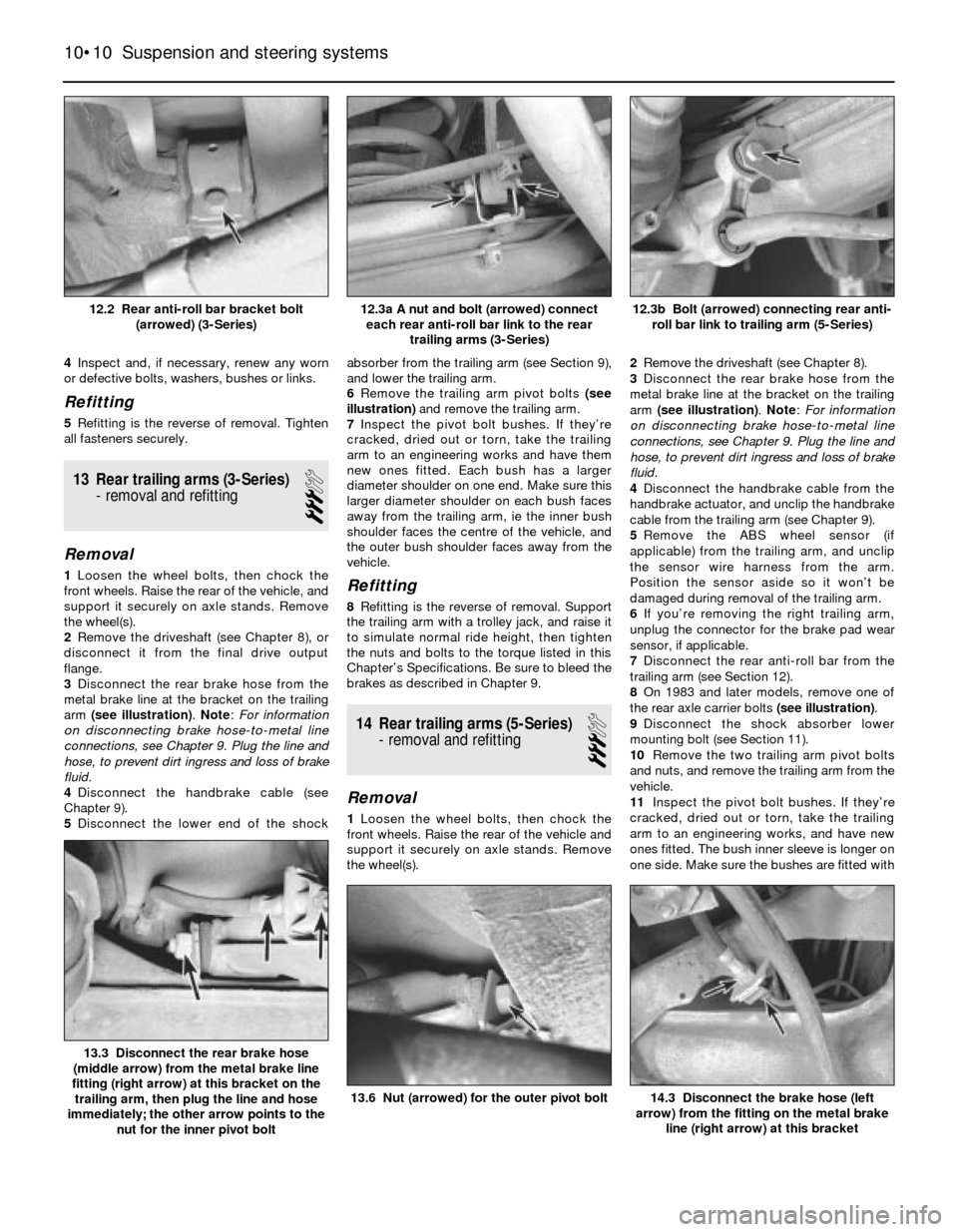
4Inspect and, if necessary, renew any worn
or defective bolts, washers, bushes or links.
Refitting
5Refitting is the reverse of removal. Tighten
all fasteners securely.
13 Rear trailing arms (3-Series)
- removal and refitting
3
Removal
1Loosen the wheel bolts, then chock the
front wheels. Raise the rear of the vehicle, and
support it securely on axle stands. Remove
the wheel(s).
2Remove the driveshaft (see Chapter 8), or
disconnect it from the final drive output
flange.
3Disconnect the rear brake hose from the
metal brake line at the bracket on the trailing
arm (see illustration). Note: For information
on disconnecting brake hose-to-metal line
connections, see Chapter 9. Plug the line and
hose, to prevent dirt ingress and loss of brake
fluid.
4Disconnect the handbrake cable (see
Chapter 9).
5Disconnect the lower end of the shockabsorber from the trailing arm (see Section 9),
and lower the trailing arm.
6Remove the trailing arm pivot bolts (see
illustration)and remove the trailing arm.
7Inspect the pivot bolt bushes. If they’re
cracked, dried out or torn, take the trailing
arm to an engineering works and have them
new ones fitted. Each bush has a larger
diameter shoulder on one end. Make sure this
larger diameter shoulder on each bush faces
away from the trailing arm, ie the inner bush
shoulder faces the centre of the vehicle, and
the outer bush shoulder faces away from the
vehicle.Refitting
8Refitting is the reverse of removal. Support
the trailing arm with a trolley jack, and raise it
to simulate normal ride height, then tighten
the nuts and bolts to the torque listed in this
Chapter’s Specifications. Be sure to bleed the
brakes as described in Chapter 9.
14 Rear trailing arms (5-Series)
- removal and refitting
3
Removal
1Loosen the wheel bolts, then chock the
front wheels. Raise the rear of the vehicle and
support it securely on axle stands. Remove
the wheel(s).2Remove the driveshaft (see Chapter 8).
3Disconnect the rear brake hose from the
metal brake line at the bracket on the trailing
arm (see illustration). Note: For information
on disconnecting brake hose-to-metal line
connections, see Chapter 9. Plug the line and
hose, to prevent dirt ingress and loss of brake
fluid.
4Disconnect the handbrake cable from the
handbrake actuator, and unclip the handbrake
cable from the trailing arm (see Chapter 9).
5Remove the ABS wheel sensor (if
applicable) from the trailing arm, and unclip
the sensor wire harness from the arm.
Position the sensor aside so it won’t be
damaged during removal of the trailing arm.
6If you’re removing the right trailing arm,
unplug the connector for the brake pad wear
sensor, if applicable.
7Disconnect the rear anti-roll bar from the
trailing arm (see Section 12).
8On 1983 and later models, remove one of
the rear axle carrier bolts (see illustration).
9Disconnect the shock absorber lower
mounting bolt (see Section 11).
10Remove the two trailing arm pivot bolts
and nuts, and remove the trailing arm from the
vehicle.
11Inspect the pivot bolt bushes. If they’re
cracked, dried out or torn, take the trailing
arm to an engineering works, and have new
ones fitted. The bush inner sleeve is longer on
one side. Make sure the bushes are fitted with
10•10 Suspension and steering systems
14.3 Disconnect the brake hose (left
arrow) from the fitting on the metal brake
line (right arrow) at this bracket13.6 Nut (arrowed) for the outer pivot bolt
13.3 Disconnect the rear brake hose
(middle arrow) from the metal brake line
fitting (right arrow) at this bracket on the
trailing arm, then plug the line and hose
immediately; the other arrow points to the
nut for the inner pivot bolt
12.3b Bolt (arrowed) connecting rear anti-
roll bar link to trailing arm (5-Series)12.3a A nut and bolt (arrowed) connect
each rear anti-roll bar link to the rear
trailing arms (3-Series)12.2 Rear anti-roll bar bracket bolt
(arrowed) (3-Series)