maintenance BMW 320i 2002 User Guide
[x] Cancel search | Manufacturer: BMW, Model Year: 2002, Model line: 320i, Model: BMW 320i 2002Pages: 155, PDF Size: 2.24 MB
Page 23 of 155
23n
OverviewControlsMaintenanceRepairsDataIndex
Refueling Fuel specificationsSimple and environmentally
friendly
Open the filler cap carefully to
prevent fuel from spraying out.
Fuel spray may cause injury.<
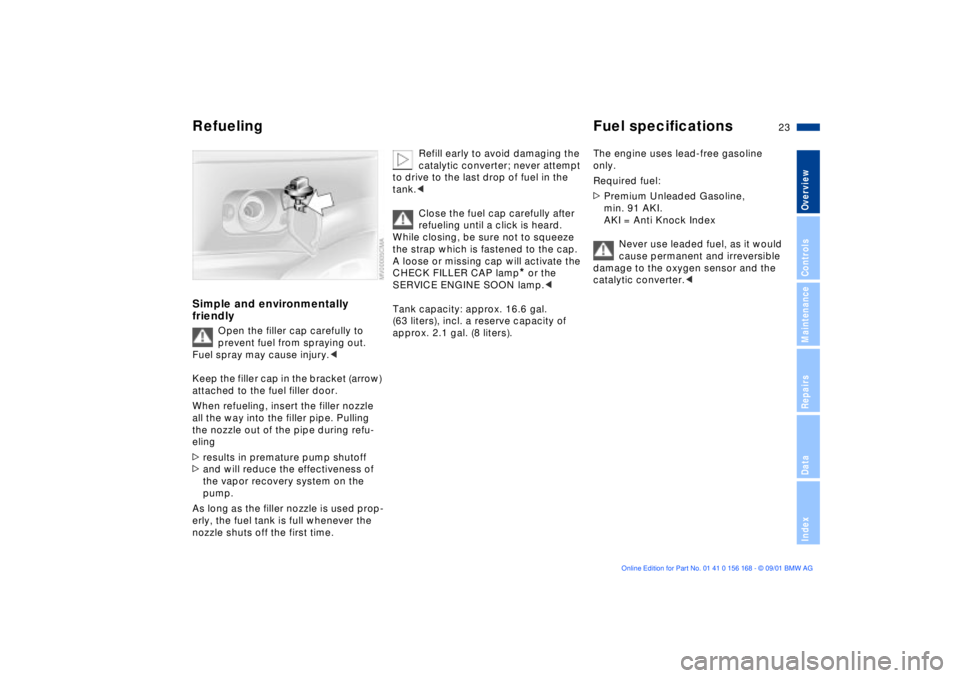
Keep the filler cap in the bracket (arrow)
attached to the fuel filler door.
When refueling, insert the filler nozzle
all the way into the filler pipe. Pulling
the nozzle out of the pipe during refu-
eling
>results in premature pump shutoff
>and will reduce the effectiveness of
the vapor recovery system on the
pump.
As long as the filler nozzle is used prop-
erly, the fuel tank is full whenever the
nozzle shuts off the first time.
Refill early to avoid damaging the
catalytic converter; never attempt
to drive to the last drop of fuel in the
tank.<
Close the fuel cap carefully after
refueling until a click is heard.
While closing, be sure not to squeeze
the strap which is fastened to the cap.
A loose or missing cap will activate the
CHECK FILLER CAP lamp
* or the
SERVICE ENGINE SOON lamp.<
Tank capacity: approx. 16.6 gal.
(63 liters), incl. a reserve capacity of
approx. 2.1 gal. (8 liters).
The engine uses lead-free gasoline
only.
Required fuel:
>Premium Unleaded Gasoline,
min. 91 AKI.
AKI = Anti Knock Index
Never use leaded fuel, as it would
cause permanent and irreversible
damage to the oxygen sensor and the
catalytic converter.<
Page 25 of 155
25n
OverviewControlsMaintenanceRepairsDataIndex
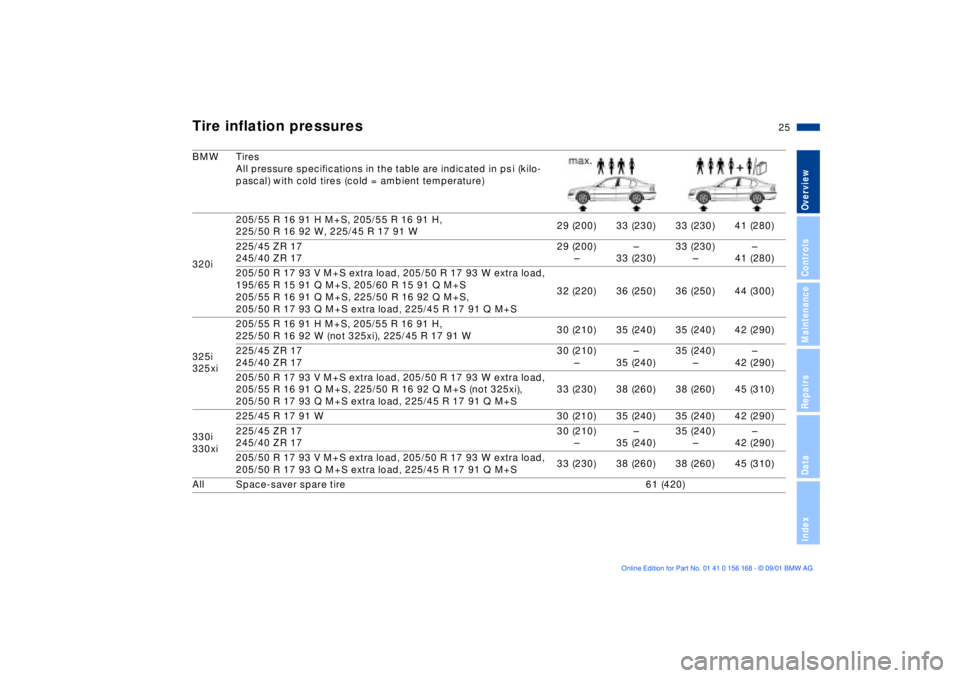
Tire inflation pressuresBMW Tires
All pressure specifications in the table are indicated in ps i (kilo-
pascal) with cold tires (cold = ambient temperature)
320i205/55 R 16 91 H M+S, 205/55 R 16 91 H,
225/50 R 16 92 W, 225/45 R 17 91 W29 (200) 33 (230) 33 (230) 41 (280)
225/45 ZR 17
245/40 ZR 1729 (200)
ÐÐ
33 (230)33 (230)
ÐÐ
41 (280)
205/50 R 17 93 V M+S extra load, 205/50 R 17 93 W extra load,
195/65 R 15 91 Q M+S, 205/60 R 15 91 Q M+S
205/55 R 16 91 Q M+S, 225/50 R 16 92 Q M+S,
205/50 R 17 93 Q M+S extra load, 225/45 R 17 91 Q M+S32 (220) 36 (250) 36 (250) 44 (300)
325i
325xi205/55 R 16 91 H M+S, 205/55 R 16 91 H,
225/50 R 16 92 W (not 325xi), 225/45 R 17 91 W30 (210) 35 (240) 35 (240) 42 (290)
225/45 ZR 17
245/40 ZR 1730 (210)
ÐÐ
35 (240)35 (240)
ÐÐ
42 (290)
205/50 R 17 93 V M+S extra load, 205/50 R 17 93 W extra load,
205/55 R 16 91 Q M+S, 225/50 R 16 92 Q M+S (not 325xi),
205/50 R 17 93 Q M+S extra load, 225/45 R 17 91 Q M+S33 (230) 38 (260) 38 (260) 45 (310)
330i
330xi225/45 R 17 91 W 30 (210) 35 (240) 35 (240) 42 (290)
225/45 ZR 17
245/40 ZR 1730 (210)
ÐÐ
35 (240)35 (240)
ÐÐ
42 (290)
205/50 R 17 93 V M+S extra load, 205/50 R 17 93 W extra load,
205/50 R 17 93 Q M+S extra load, 225/45 R 17 91 Q M+S33 (230) 38 (260) 38 (260) 45 (310)
All Space-saver spare tire 61 (420)
Page 27 of 155

27n
Overview
Controls
Maintenance
Repairs
Data
Index
Overview
Controls and features
Operation, maintenance
Owner service procedures
Index
Technical data
Page 29 of 155
29n
OverviewControlsMaintenanceRepairsDataIndex
Opening and closing Ð via the remote controlThe conceptThe remote control gives you an excep-
tionally convenient method for
unlocking and locking your vehicle.
Furthermore, it provides two additional
functions which you can only execute
via the remote control:
>To switch on interior lamps, refer to
page 30.
With this function, you can also
search for the vehicle, when parked
in an underground garage, for
instance
>To open the luggage compartment
lid, refer to page 30.
The luggage compartment lid will
open slightly, regardless of whether it
was previously locked or unlocked.
Whenever you unlock (lock) the vehicle,
you simultaneously deactivate (activate)
the anti-theft system, disarm (arm) the
alarm system and switch the interior
lamps on (off).
You can have a signal set to
confirm that the vehicle's locks
have engaged securely.<
Since children might be able to
lock the doors from the inside,
always take the vehicle keys with you
so that the vehicle can be opened again
from the outside at any time.<
If it is no longer possible to lock
the vehicle via the remote control,
the battery is discharged. Use this key
while driving for an extended period in
order to recharge the battery.
To prevent unauthorized use of the
remote control, surrender only the door
and ignition key or the spare key, for
example when leaving the vehicle for
valet parking, refer to page 28.
In the event of a system malfunction,
please contact your BMW center. You
can also obtain replacement keys
there.<
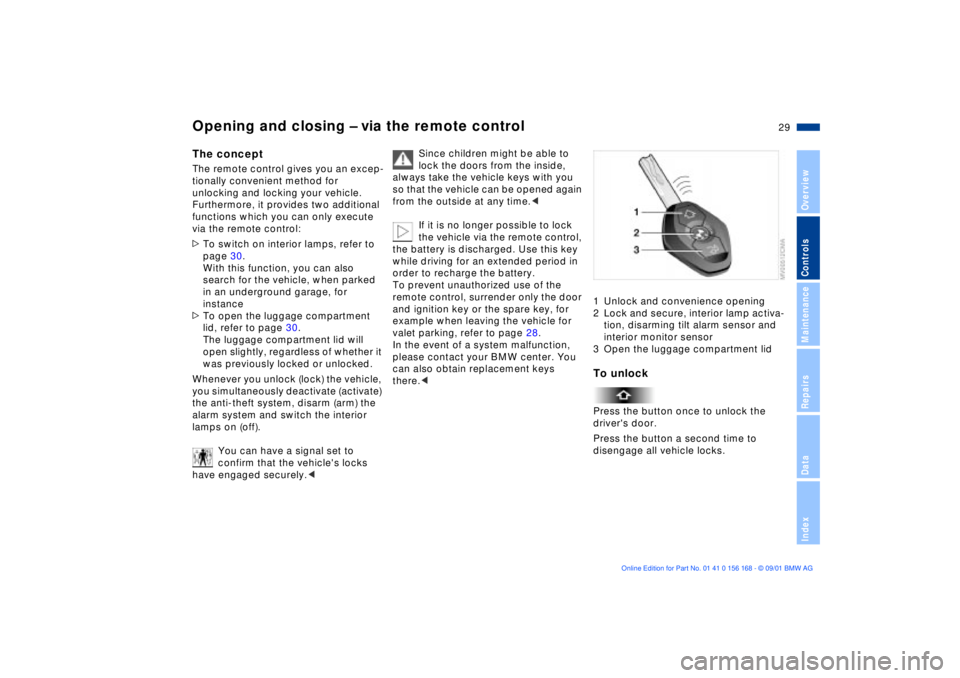
1 Unlock and convenience opening
2 Lock and secure, interior lamp activa-
tion, disarming tilt alarm sensor and
interior monitor sensor
3 Open the luggage compartment lidTo unlockPress the button once to unlock the
driver's door.
Press the button a second time to
disengage all vehicle locks.
Page 31 of 155
31n
OverviewControlsMaintenanceRepairsDataIndex
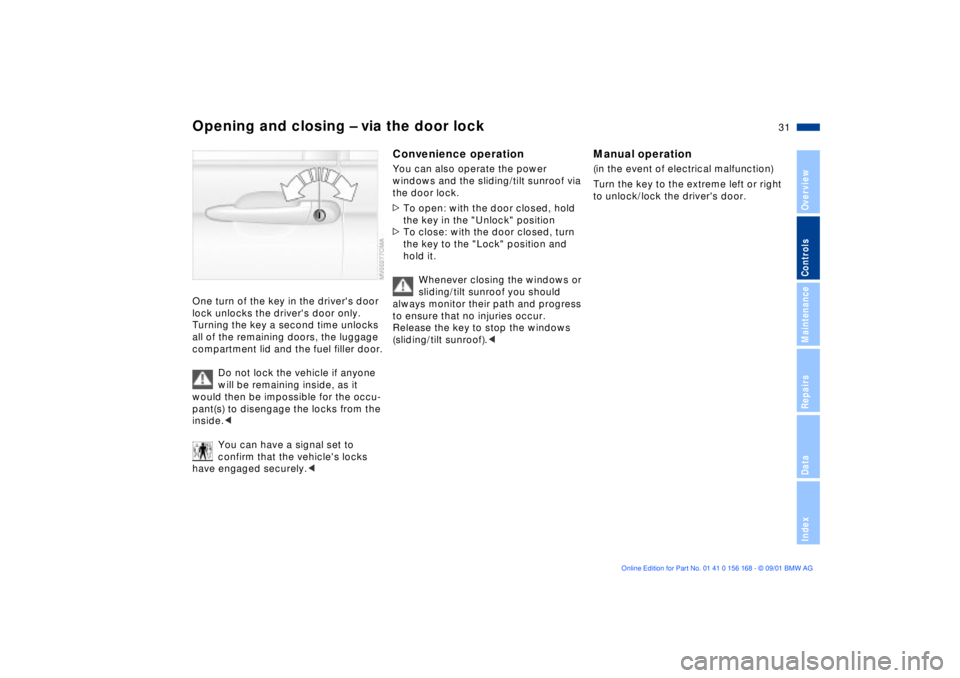
Opening and closing Ð via the door lockOne turn of the key in the driver's door
lock unlocks the driver's door only.
Turning the key a second time unlocks
all of the remaining doors, the luggage
compartment lid and the fuel filler door.
Do not lock the vehicle if anyone
will be remaining inside, as it
would then be impossible for the occu-
pant(s) to disengage the locks from the
inside.<
You can have a signal set to
confirm that the vehicle's locks
have engaged securely.<
Convenience operationYou can also operate the power
windows and the sliding/tilt sunroof via
the door lock.
>To open: with the door closed, hold
the key in the "Unlock" position
>To close: with the door closed, turn
the key to the "Lock" position and
hold it.
Whenever closing the windows or
sliding/tilt sunroof you should
always monitor their path and progress
to ensure that no injuries occur.
Release the key to stop the windows
(sliding/tilt sunroof).<
Manual operation (in the event of electrical malfunction)
Turn the key to the extreme left or right
to unlock/lock the driver's door.
Page 33 of 155
33n
OverviewControlsMaintenanceRepairsDataIndex
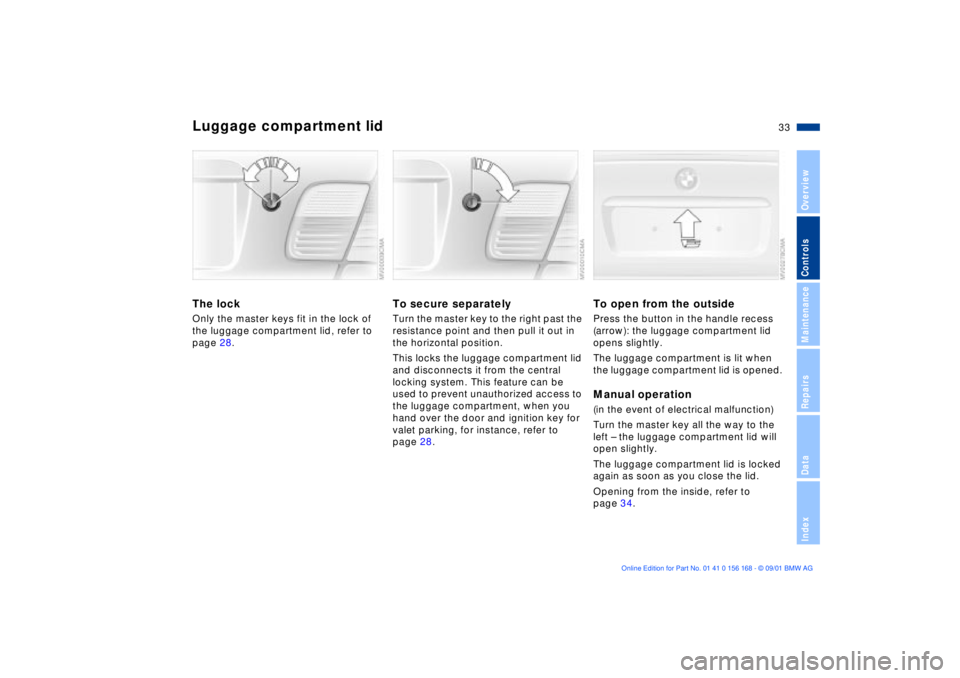
Luggage compartment lid The lockOnly the master keys fit in the lock of
the luggage compartment lid, refer to
page 28.
To secure separatelyTurn the master key to the right past the
resistance point and then pull it out in
the horizontal position.
This locks the luggage compartment lid
and disconnects it from the central
locking system. This feature can be
used to prevent unauthorized access to
the luggage compartment, when you
hand over the door and ignition key for
valet parking, for instance, refer to
page 28.
To open from the outsidePress the button in the handle recess
(arrow): the luggage compartment lid
opens slightly.
The luggage compartment is lit when
the luggage compartment lid is opened. Manual operation(in the event of electrical malfunction)
Turn the master key all the way to the
left Ð the luggage compartment lid will
open slightly.
The luggage compartment lid is locked
again as soon as you close the lid.
Opening from the inside, refer to
page 34.
Page 35 of 155
35n
OverviewControlsMaintenanceRepairsDataIndex
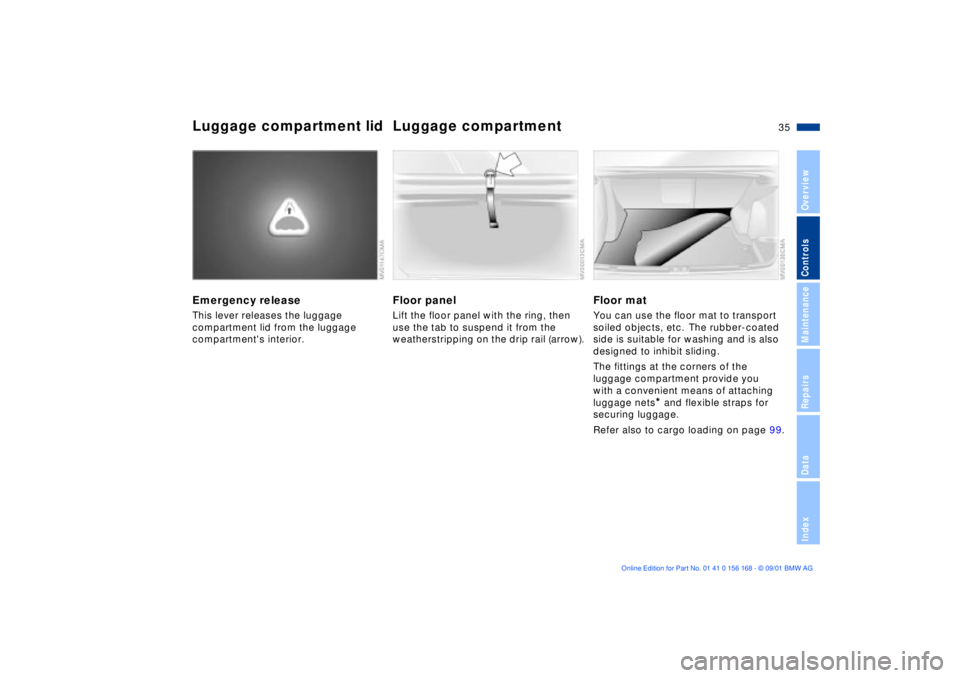
Luggage compartment lid Luggage compartment Emergency releaseThis lever releases the luggage
compartment lid from the luggage
compartment's interior.
Floor panelLift the floor panel with the ring, then
use the tab to suspend it from the
weatherstripping on the drip rail (arrow).
Floor matYou can use the floor mat to transport
soiled objects, etc. The rubber-coated
side is suitable for washing and is also
designed to inhibit sliding.
The fittings at the corners of the
luggage compartment provide you
with a convenient means of attaching
luggage nets
* and flexible straps for
securing luggage.
Refer also to cargo loading on page 99.
Page 37 of 155
37n
OverviewControlsMaintenanceRepairsDataIndex
Alarm system
*
Electric power windows
>If the indicator lamp goes out when
the system is disarmed: no manipula-
tion or attempted intrusions have
been detected in the period since the
system was armed
>If the indicator lamp flashes for
10 seconds when the system is
disarmed: an attempted entry has
been detected in the period since the
system was armed.
Following triggering of an alarm, the
indicator lamp will flash continuously.Avoiding unintentional alarmsThe tilt alarm sensor and interior motion
sensor may be switched off at the same
time. You can do this to prevent a false
alarm from being triggered in garages
with elevator ramps, for instance, or
when the vehicle is transported by
trailer or train:
Lock the vehicle twice (= arm the
system). Press button on the remote
control twice in succession or lock the
vehicle twice with the key.
The indicator lamp lights up briefly and
then flashes continuously. The tilt alarm
sensor and interior motion sensor are
deactivated for as long as the system
remains armed.
Interior motion sensorIn order for the interior motion sensor to
function properly, the windows and the
sliding/tilt sunroof must be completely
closed.
Nevertheless, you should deactivate
the interior motion sensor (refer to
previous column) if
>children or animals are left in the
vehicle
>the windows or the sliding/tilt sunroof
are being left open.
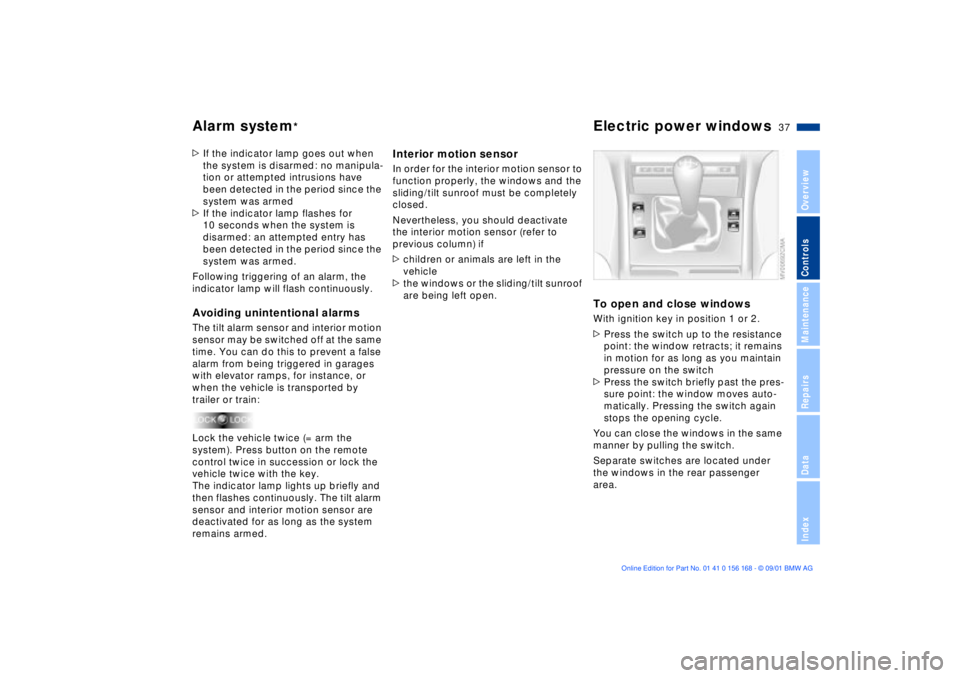
To open and close windowsWith ignition key in position 1 or 2.
>Press the switch up to the resistance
point: the window retracts; it remains
in motion for as long as you maintain
pressure on the switch
>Press the switch briefly past the pres-
sure point: the window moves auto-
matically. Pressing the switch again
stops the opening cycle.
You can close the windows in the same
manner by pulling the switch.
Separate switches are located under
the windows in the rear passenger
area.
Page 39 of 155
39n
OverviewControlsMaintenanceRepairsDataIndex
Sliding/tilt sunroof
*
To prevent injuries, exercise care
when closing the sliding/tilt
sunroof and keep it in your field of
vision until it is shut.
When leaving the vehicle, always
extract the ignition key from the lock
and remember to close the doors to
prevent children from operating the
sliding/tilt sunroof and injuring them-
selves, etc.<
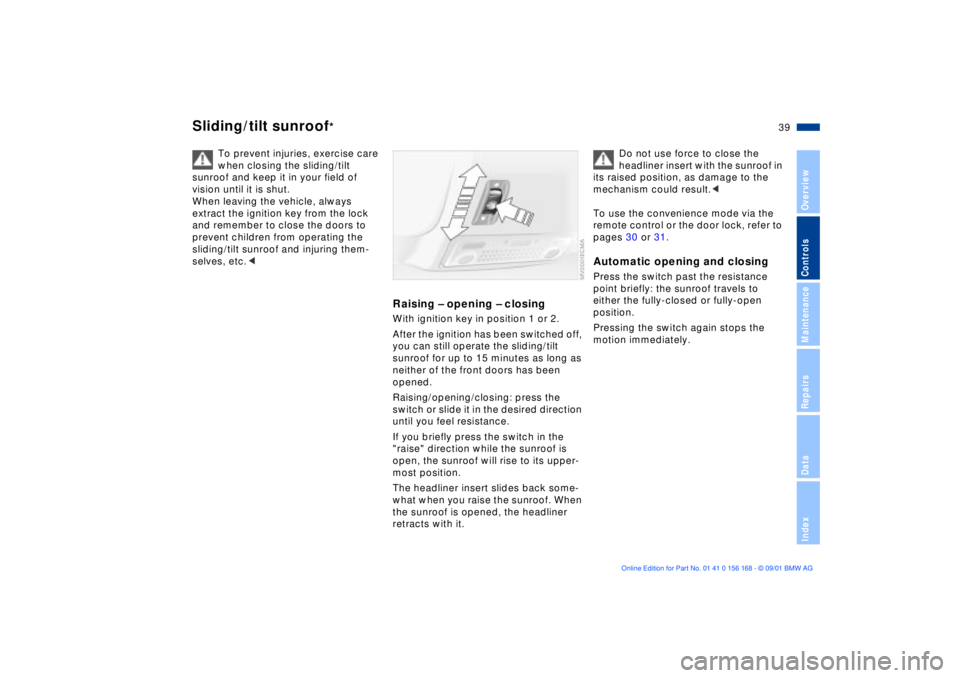
Raising Ð opening Ð closingWith ignition key in position 1 or 2.
After the ignition has been switched off,
you can still operate the sliding/tilt
sunroof for up to 15 minutes as long as
neither of the front doors has been
opened.
Raising/opening/closing: press the
switch or slide it in the desired direction
until you feel resistance.
If you briefly press the switch in the
"raise" direction while the sunroof is
open, the sunroof will rise to its upper-
most position.
The headliner insert slides back some-
what when you raise the sunroof. When
the sunroof is opened, the headliner
retracts with it.
Do not use force to close the
headliner insert with the sunroof in
its raised position, as damage to the
mechanism could result.<
To use the convenience mode via the
remote control or the door lock, refer to
pages 30 or 31.
Automatic opening and closingPress the switch past the resistance
point briefly: the sunroof travels to
either the fully-closed or fully-open
position.
Pressing the switch again stops the
motion immediately.
Page 41 of 155

41n
OverviewControlsMaintenanceRepairsDataIndex
Correct sitting posture SeatsFor relaxed and fatigue-free driving you
should select a sitting position that
reflects your personal requirements.
Correct posture combines with safety
belts and airbags to enhance occupant
safety in the event of an accident. To
ensure that the vehicle's safety systems
provide you with optimal protection, we
request that you direct your careful
attention to the following section.
For supplementary information on
transporting children, refer to page 52. Sitting correctly with airbags
Always maintain an adequate
distance between yourself and the
airbags. Always hold the steering wheel
by the rim to keep any chance of injury
to hands or arms to an absolute
minimum should the airbag be
deployed. Never allow any objects,
individuals or animals to obstruct the
areas between passengers and airbags.
Never use the front airbag's cover as a
storage tray or support for objects of
any kind. Never allow front passengers
to rest their feet or legs on the airbag
cover.<
For airbag locations and additional
information on airbags refer to page 49.
Safe with safety belts
Never allow more than one person
to wear a single safety belt. Never
allow infants or small children to ride in
a passenger's lap. Avoid twisting the
belt while routing it firmly across the
hips and shoulder, wear it as snugly
against your body as possible. Do not
allow the belt to rest against hard or
fragile objects. Do not route the belt
across your neck, or run it across sharp
edges. Be sure that the belt does not
become caught or jammed. Avoid
wearing bulky clothing and pull on the
lap belt periodically to retension it over
your shoulders. In the event of a frontal
impact, a loose lap belt could slide over
your hips, leading to abdominal
injury. In addition, the safety belt's
restraint effectiveness is reduced if it is
worn loosely. Expectant mothers
should always wear their safety belts,
taking care to position the lap belt
against the lower hips, where it will not
exert pressure against the abdominal
area.<
For information on using the safety
belts refer to page 45.
When adjusting your seat, always
observe the following precautions
Never try to adjust your seat while
operating the vehicle. The seat
could respond with unexpected move-
ment, and the ensuing loss of vehicle
control could lead to an accident. Never
ride with the backrest reclined to an
extreme horizontal angle (important for
front passengers to remember). Keep
the backrest relatively upright to mini-
mize the risk of sliding under the safety
belt and sustaining injury in an acci-
dent.<
Seat adjustment>Manual seat adjustment, refer to
page 42
>Power seat adjustment, refer to
page 43
>Head restraint, refer to page 44