maintenance BMW 320i 2002 Workshop Manual
[x] Cancel search | Manufacturer: BMW, Model Year: 2002, Model line: 320i, Model: BMW 320i 2002Pages: 155, PDF Size: 2.24 MB
Page 103 of 155
103n
Overview
Controls
Maintenance
Repairs
Data
Index
Overview
Controls and features
Operation, maintenance
Owner service procedures
Index
Technical data
Page 105 of 155

105n
OverviewControlsMaintenanceRepairsDataIndex
Driving notes Antilock Brake System
Brakes: do not drive with your foot
resting on the brake pedal. Even
light but consistent pedal pressure can
lead to high temperatures, brake wear
and possibly even brake failure.
Aquaplaning: when driving on wet or
slushy roads, reduce vehicle speed. If
you do not, a wedge of water may form
between the tires and the road surface.
This phenomenon can lead to partial or
complete loss of contact between the
tires and road surface, vehicle control
and braking ability.
Driving through water: do not drive
through water on the road if it is deeper
than 1 ft (30 cm), and then only at
walking speed. Otherwise, the vehicle's
engine, the electrical systems and the
transmission may be damaged.
Rear tray: never use it to store heavy or
hard objects, as otherwise occupants
could be injured during braking maneu-
vers.
Clothes hooks: when hanging clothing
from the hooks, be sure that they will
not obstruct the driver's vision. Do not
hang heavy objects on the hooks. If you
do so, they could cause personal injury
during braking or evasive maneuvers.<
The conceptThe Antilock Brake System (ABS) keeps
the wheels from locking during braking,
thereby enhancing active driving safety.Braking with ABSIf you are in a situation that requires full
braking, you will exploit the full benefits
of the ABS system if you apply
maximum pedal pressure ("panic stop").
Since the vehicle maintains steering
responsiveness, you can avoid possible
obstacles with a minimum of steering
effort, despite the full brake application.
Pulsation at the brake pedal combined
with sounds from the hydraulic circuits
indicates to the driver that ABS is in its
active mode.
Page 107 of 155

107n
OverviewControlsMaintenanceRepairsDataIndex
Information for your safetyThe factory-approved radial tires are
matched to the vehicle and have been
selected to provide optimum safety and
driving comfort.
It is not merely the tire's service life, but
also driving comfort and Ð above all else
Ð driving safety that depend on the
condition of the tires and the mainte-
nance of the specified tire pressure.
Incorrect tire inflation pressure is
a frequent cause of tire damage.
Tire pressure also has a major effect on
your BMW's handling response. Be
sure to check the tire inflation pressure,
including the space-saver spare tire or
the spare tire, on a regular basis, at
least twice a month and before every
extended journey, refer to page 24.
Otherwise, incorrect tire pressure can
lead to poor handling, to tire damage
and accidents.<
Tire tread Ð tire damageInspect your tires frequently for tread
wear, signs of damage and for foreign
objects lodged in the tread. Check the
tread depth.
Tread depth should not be allowed to go
below 0.12 in (3 mm), even though the
legally specified minimum tread depth is
0.063 in (1.6 mm). Tread wear indicators
(arrow) are embedded in the base of the
tire's tread. Their locations are indicated
by the legend TWI Ð Tread Wear Indicator
Ð at various points on the tire's shoulder.
When the tread reaches a depth of
0.063 in (1.6 mm), these indicators
appear to signal that the tires have worn
to the minimum legal level. Below 0.12 in
(3 mm) tread depth, there is an increased
risk of aquaplaning, even at relatively
moderate speeds and with only small
amounts of water on the road.
Do not drive on a deflated (flat)
tire. A flat tire greatly impairs
steering and braking response, and can
lead to complete loss of control over
the vehicle.
Avoid overloading the vehicle so that
the permitted load on the tires is not
exceeded. Overloading leads to over-
heating and causes damage inside the
tires. The ultimate result can assume
the form of a sudden air loss.
Unusual vibrations encountered during
normal vehicle operation can indicate a
flat tire or some other vehicle malfunc-
tion. The type of problem can be
caused by contact with curbs, etc. This
is also true for irregularities in the
vehicle's handling characteristics, such
as a pronounced tendency to pull to the
left or right. Should this occur, respond
by immediately reducing your speed.
Proceed carefully to the nearest BMW
center or professional tire center, or
have the vehicle towed in to have it, its
wheels and tires inspected.
Tire inflation pressures
Tire condition
Page 109 of 155

109n
OverviewControlsMaintenanceRepairsDataIndex
Tire replacementunder the Federal Motor Vehicle Safety
Standard No. 109. Grades B and A
represent higher levels of performance
on the laboratory test wheel than the
minimum required by law.
The temperature grade for this tire
is established for a tire that is
properly inflated and not overloaded.
Excessive speed, underinflation, or
excessive loading, either separately or
in combination, can cause heat buildup
and possible tire failure.< Uniform Tire Quality Grading Quality grades can be found where
applicable on the tire sidewall between
tread shoulder and maximum section
width. For example:
Tread wear 200
Traction AA
Temperature A
Do not use retreaded tires, since
driving safety may be impaired.
This is due to the possible variations in
casing structures and, in some cases,
to their extreme age, which can lead to
a decrease in their durability.<
Tire ageThe date on which the tire was manu-
factured is indicated by the code on the
sidewall:
DOT ... 4101 indicates that the tire was
manufactured in week 41 of the year
2001.
Although tires may have a theoretical
service life of up to 10 years, BMW
strongly recommends that you replace
all tires after an absolute maximum of
6 years.
Safety tires
*
Safety tires consists of self-contained
tires and special rims. The tire rein-
forcement ensures that the tire retains
some residual safety in the event of
pressure drop and driving remains
possible to a restricted degree. The
vehicle is equipped with Tire Pressure
Monitor (RDC) or Flat Tire Monitor,
which indicate a flat tire.
For additional information on Tire Pres-
sure Monitor (RDC) or Flat Tire Monitor
refer to pages 78 or 80.
Safety tires are only possible in
conjunction with Tire Pressure
Monitor (RDC) or Flat Tire Monitor.<
Page 111 of 155

111n
OverviewControlsMaintenanceRepairsDataIndex
Winter tiresChoosing the right tireBMW recommends winter tires (M+S
radial tires) for operation under
inclement winter driving conditions.
While all-season tires (M+S designa-
tion) provide better winter traction than
summer tires with the load ratings H, V,
W, Y and ZR, they generally do not
achieve the performance of winter tires.
In the interest of safe tracking and
steering response, install winter tires
made by the same manufacturer having
the same tread configuration on all four
wheels.
Never exceed the maximum
speed for which the winter tires
are rated.
Unprofessional attempts by laymen to
service tires can lead to damage and
accidents.
Have this work performed by trained
professionals only. Any BMW center
has the required technical knowledge
and the proper equipment and will be
happy to assist you.<
Tire condition, tire pressureOnce the tire wears to below 0.16 in
(4 mm), winter tires display a percep-
tible decrease in their ability to cope
with winter driving conditions, and
should be replaced in the interest of
safety.
Comply with the specified tire inflation
pressures Ñ and be sure to have the
wheel and tire assemblies balanced
every time you change the tires.StorageStore tires in a cool, dry place,
protecting them against light whenever
possible. Protect the tires against
contact with oil, grease and fuel.
Snow chains
*
BMW narrow-link snow chains are
intended for mounting on summer or
winter tires in pairs at the rear wheels
only.
BMW 325xi, 330xi: in an extreme emer-
gency Ð for instance, with the vehicle
stuck on one side, or when obstruc-
tions make it impossible to reach one
tire Ð a chain may also be mounted on
just one tire for the limited period
needed to resolve the problem.
Comply with all manufacturer's safety
precautions when mounting the chains.
You cannot mount snow chains on the
following tires:
225/50 R 16 92
225/45 R 17 91
245/40 ZR 17
Page 113 of 155
113n
OverviewControlsMaintenanceRepairsDataIndex
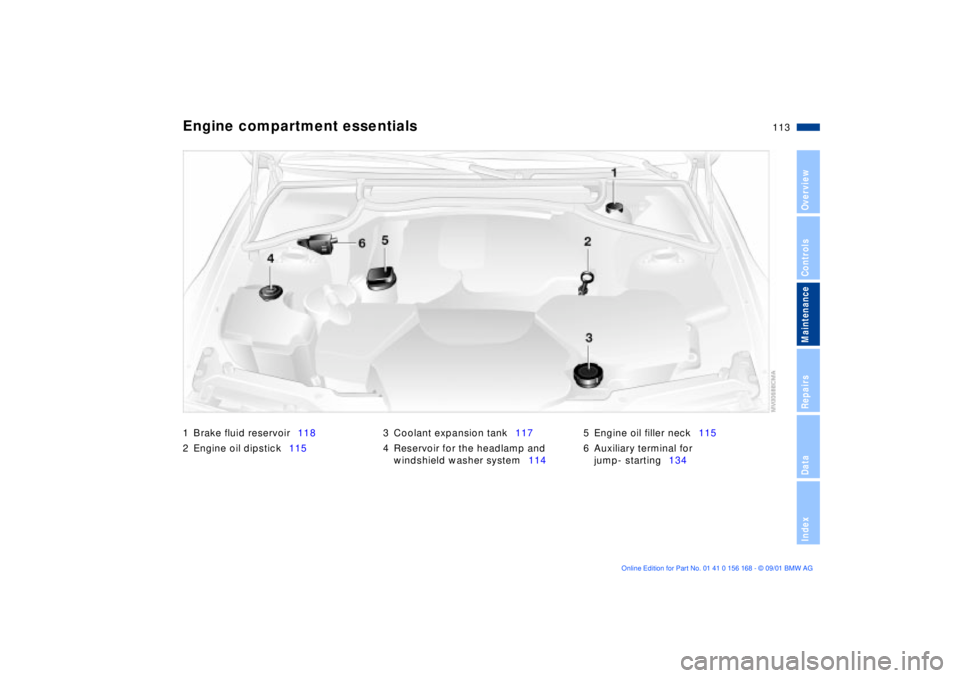
Engine compartment essentials1 Brake fluid reservoir118
2 Engine oil dipstick1153 Coolant expansion tank117
4 Reservoir for the headlamp and
windshield washer system1145 Engine oil filler neck115
6 Auxiliary terminal for
jump- starting134
Page 115 of 155
115n
OverviewControlsMaintenanceRepairsDataIndex
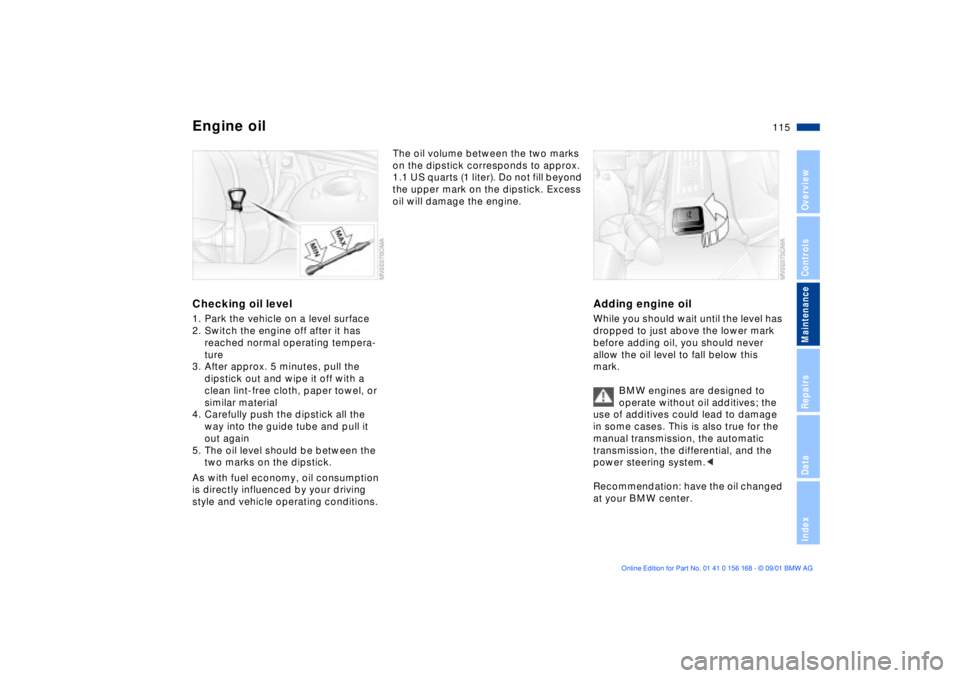
Engine oilChecking oil level1. Park the vehicle on a level surface
2. Switch the engine off after it has
reached normal operating tempera-
ture
3. After approx. 5 minutes, pull the
dipstick out and wipe it off with a
clean lint-free cloth, paper towel, or
similar material
4. Carefully push the dipstick all the
way into the guide tube and pull it
out again
5. The oil level should be between the
two marks on the dipstick.
As with fuel economy, oil consumption
is directly influenced by your driving
style and vehicle operating conditions.
The oil volume between the two marks
on the dipstick corresponds to approx.
1.1 US quarts (1 liter). Do not fill beyond
the upper mark on the dipstick. Excess
oil will damage the engine.
Adding engine oilWhile you should wait until the level has
dropped to just above the lower mark
before adding oil, you should never
allow the oil level to fall below this
mark.
BMW engines are designed to
operate without oil additives; the
use of additives could lead to damage
in some cases. This is also true for the
manual transmission, the automatic
transmission, the differential, and the
power steering system.<
Recommendation: have the oil changed
at your BMW center.
Page 117 of 155
117n
OverviewControlsMaintenanceRepairsDataIndex
Coolant
Do not add coolant to the cooling
system when the engine is hot. If
you attempt to do so, escaping coolant
can cause burns.
To avoid the possibility of damage later
on, never use anything other than
factory-approved, nitrite and amino-
free extended-duty antifreeze with
corrosion inhibitor. Your BMW center is
familiar with the official specifications.
Antifreeze and anti-corrosion agents
are hazardous to health. You should
always store them in their original
container and in a location which is out
of reach of children.
Extended-duty antifreeze with corro-
sion inhibitor contains the flammable
substance ethylene glycol. For this
reason, do not spill extended-duty anti-
freeze with corrosion inhibitor on hot
engine parts. It could ignite and cause
serious burns.<
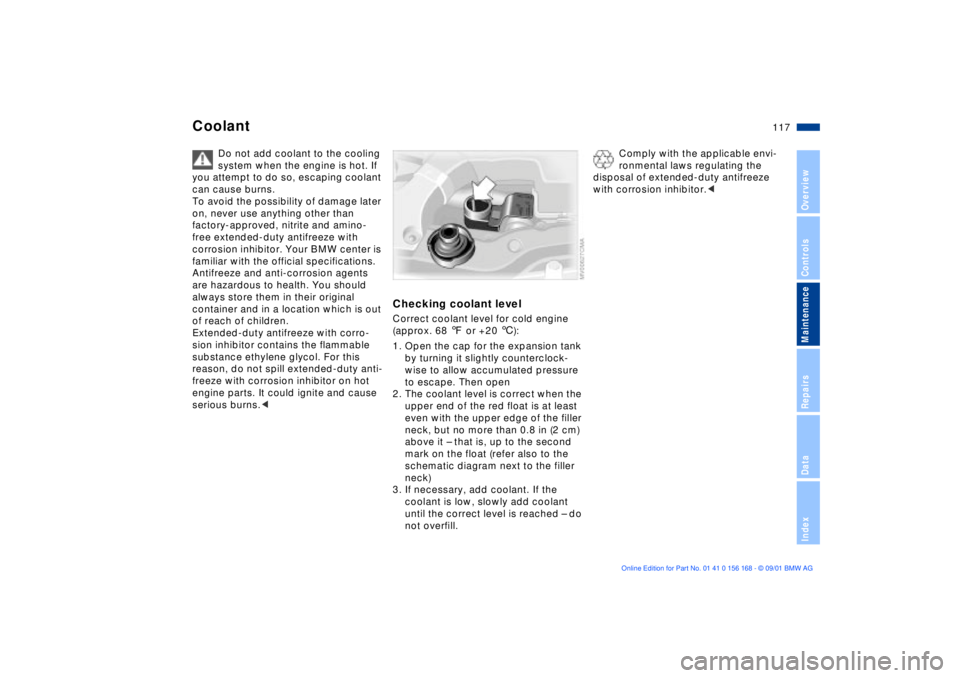
Checking coolant levelCorrect coolant level for cold engine
(approx. 68 7 or +20 6):
1. Open the cap for the expansion tank
by turning it slightly counterclock-
wise to allow accumulated pressure
to escape. Then open
2. The coolant level is correct when the
upper end of the red float is at least
even with the upper edge of the filler
neck, but no more than 0.8 in (2 cm)
above it Ð that is, up to the second
mark on the float (refer also to the
schematic diagram next to the filler
neck)
3. If necessary, add coolant. If the
coolant is low, slowly add coolant
until the correct level is reached Ð do
not overfill.
Comply with the applicable envi-
ronmental laws regulating the
disposal of extended-duty antifreeze
with corrosion inhibitor.<
Page 119 of 155
119n
OverviewControlsMaintenanceRepairsDataIndex
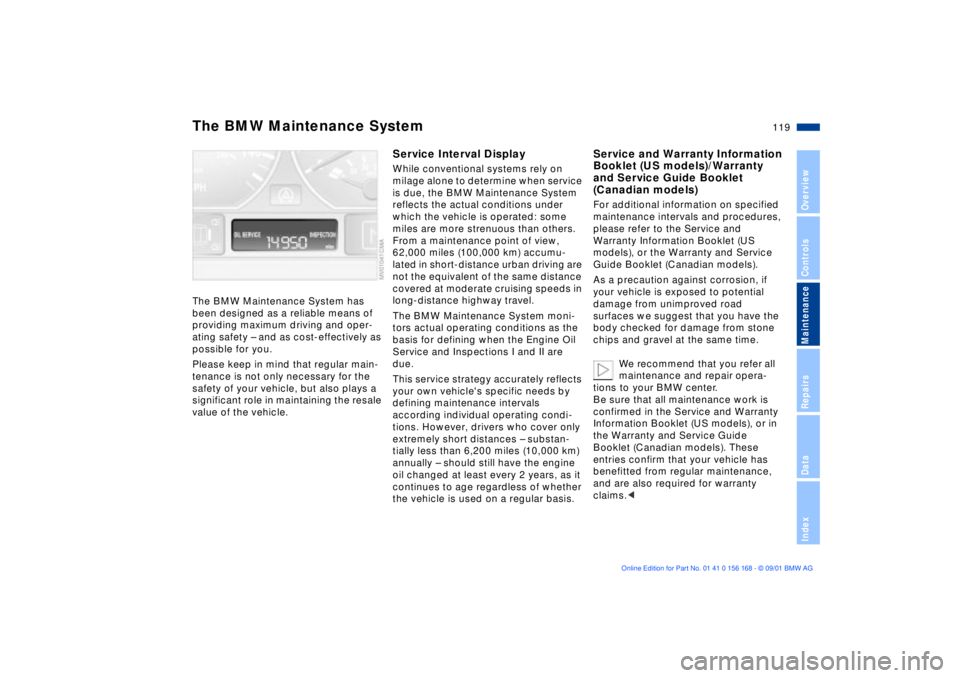
The BMW Maintenance System has
been designed as a reliable means of
providing maximum driving and oper-
ating safety Ð and as cost-effectively as
possible for you.
Please keep in mind that regular main-
tenance is not only necessary for the
safety of your vehicle, but also plays a
significant role in maintaining the resale
value of the vehicle.
Service Interval Display
While conventional systems rely on
milage alone to determine when service
is due, the BMW Maintenance System
reflects the actual conditions under
which the vehicle is operated: some
miles are more strenuous than others.
From a maintenance point of view,
62,000 miles (100,000 km) accumu-
lated in short-distance urban driving are
not the equivalent of the same distance
covered at moderate cruising speeds in
long-distance highway travel.
The BMW Maintenance System moni-
tors actual operating conditions as the
basis for defining when the Engine Oil
Service and Inspections I and II are
due.
This service strategy accurately reflects
your own vehicle's specific needs by
defining maintenance intervals
according individual operating condi-
tions. However, drivers who cover only
extremely short distances Ð substan-
tially less than 6,200 miles (10,000 km)
annually Ð should still have the engine
oil changed at least every 2 years, as it
continues to age regardless of whether
the vehicle is used on a regular basis.
Service and Warranty Information
Booklet (US models)/Warranty
and Service Guide Booklet
(Canadian models)
For additional information on specified
maintenance intervals and procedures,
please refer to the Service and
Warranty Information Booklet (US
models), or the Warranty and Service
Guide Booklet (Canadian models).
As a precaution against corrosion, if
your vehicle is exposed to potential
damage from unimproved road
surfaces we suggest that you have the
body checked for damage from stone
chips and gravel at the same time.
We recommend that you refer all
maintenance and repair opera-
tions to your BMW center.
Be sure that all maintenance work is
confirmed in the Service and Warranty
Information Booklet (US models), or in
the Warranty and Service Guide
Booklet (Canadian models). These
entries confirm that your vehicle has
benefitted from regular maintenance,
and are also required for warranty
claims.
<
The BMW Maintenance System
Page 121 of 155
121n
OverviewControlsMaintenanceRepairsDataIndex
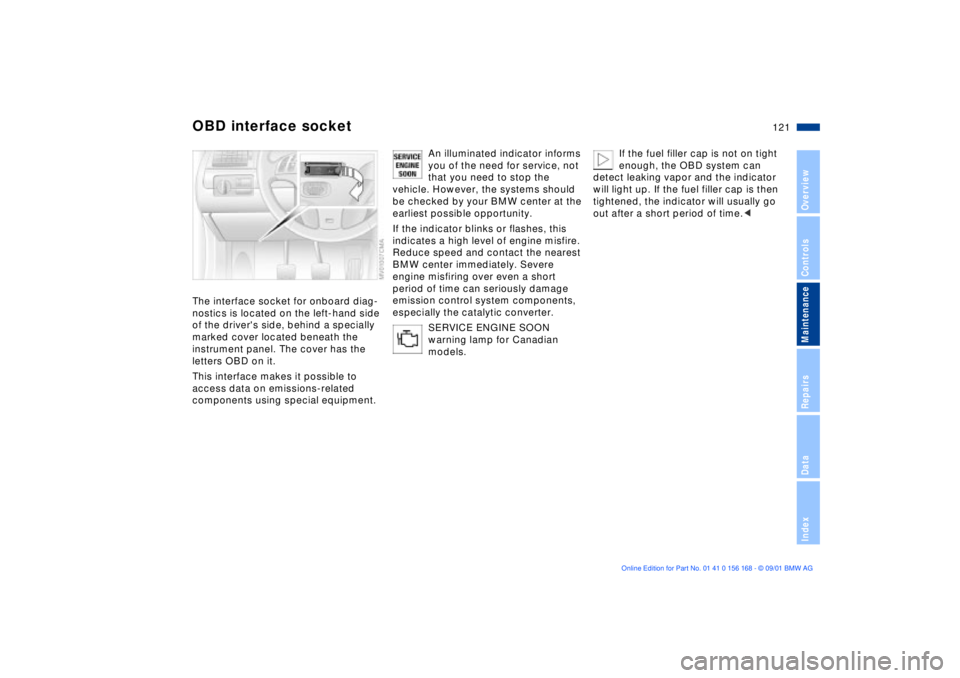
OBD interface socketThe interface socket for onboard diag-
nostics is located on the left-hand side
of the driver's side, behind a specially
marked cover located beneath the
instrument panel. The cover has the
letters OBD on it.
This interface makes it possible to
access data on emissions-related
components using special equipment.
An illuminated indicator informs
you of the need for service, not
that you need to stop the
vehicle. However, the systems should
be checked by your BMW center at the
earliest possible opportunity.
If the indicator blinks or flashes, this
indicates a high level of engine misfire.
Reduce speed and contact the nearest
BMW center immediately. Severe
engine misfiring over even a short
period of time can seriously damage
emission control system components,
especially the catalytic converter.
SERVICE ENGINE SOON
warning lamp for Canadian
models.
If the fuel filler cap is not on tight
enough, the OBD system can
detect leaking vapor and the indicator
will light up. If the fuel filler cap is then
tightened, the indicator will usually go
out after a short period of time.<