ignition BMW 320i 2002 Owner's Manual
[x] Cancel search | Manufacturer: BMW, Model Year: 2002, Model line: 320i, Model: BMW 320i 2002Pages: 155, PDF Size: 2.24 MB
Page 66 of 155
66n
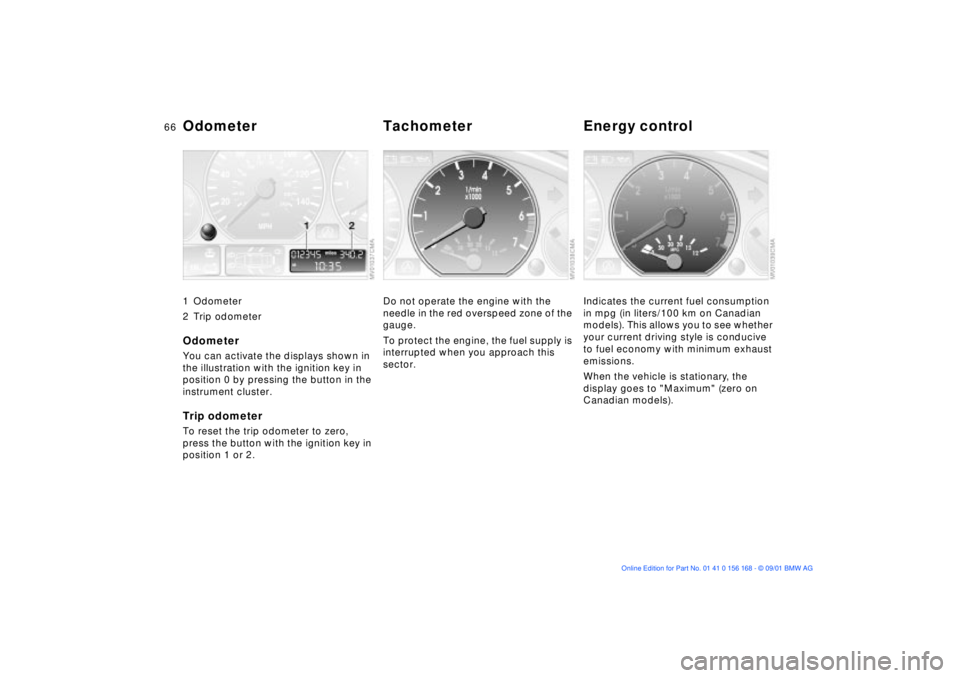
Odometer Tachometer Energy control 1 Odometer
2 Trip odometerOdometer You can activate the displays shown in
the illustration with the ignition key in
position 0 by pressing the button in the
instrument cluster.Trip odometerTo reset the trip odometer to zero,
press the button with the ignition key in
position 1 or 2.
Do not operate the engine with the
needle in the red overspeed zone of the
gauge.
To protect the engine, the fuel supply is
interrupted when you approach this
sector.
Indicates the current fuel consumption
in mpg (in liters/100 km on Canadian
models). This allows you to see whether
your current driving style is conducive
to fuel economy with minimum exhaust
emissions.
When the vehicle is stationary, the
display goes to "Maximum" (zero on
Canadian models).
Page 67 of 155
67n
OverviewControlsMaintenanceRepairsDataIndex
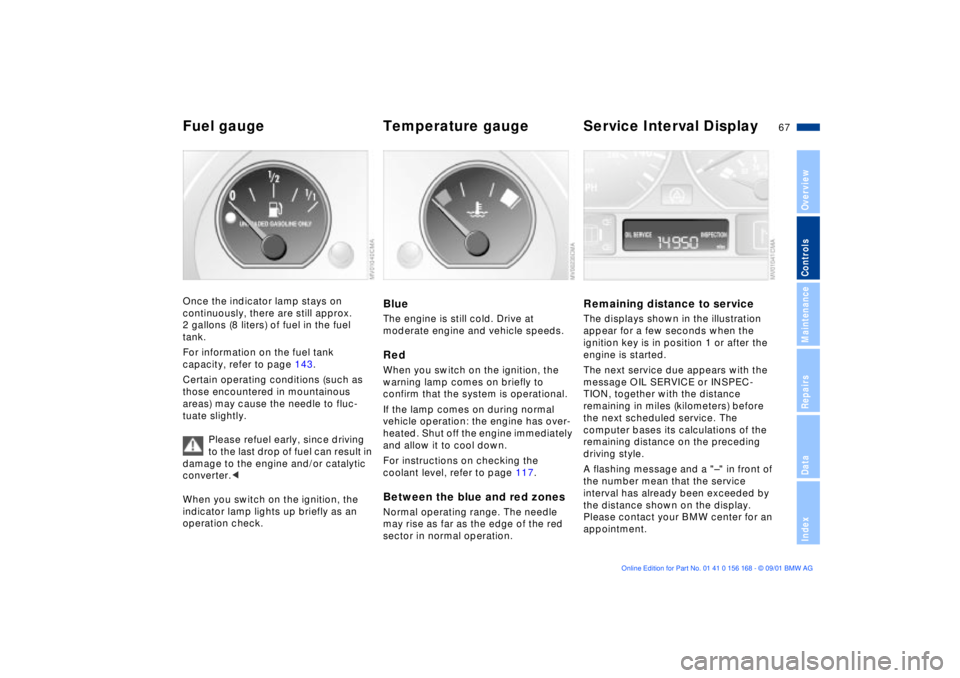
Fuel gauge Temperature gauge Service Interval DisplayOnce the indicator lamp stays on
continuously, there are still approx.
2 gallons (8 liters) of fuel in the fuel
tank.
For information on the fuel tank
capacity, refer to page 143.
Certain operating conditions (such as
those encountered in mountainous
areas) may cause the needle to fluc-
tuate slightly.
Please refuel early, since driving
to the last drop of fuel can result in
damage to the engine and/or catalytic
converter.<
When you switch on the ignition, the
indicator lamp lights up briefly as an
operation check.
BlueThe engine is still cold. Drive at
moderate engine and vehicle speeds.RedWhen you switch on the ignition, the
warning lamp comes on briefly to
confirm that the system is operational.
If the lamp comes on during normal
vehicle operation: the engine has over-
heated. Shut off the engine immediately
and allow it to cool down.
For instructions on checking the
coolant level, refer to page 117.Between the blue and red zonesNormal operating range. The needle
may rise as far as the edge of the red
sector in normal operation.
Remaining distance to serviceThe displays shown in the illustration
appear for a few seconds when the
ignition key is in position 1 or after the
engine is started.
The next service due appears with the
message OIL SERVICE or INSPEC-
TION, together with the distance
remaining in miles (kilometers) before
the next scheduled service. The
computer bases its calculations of the
remaining distance on the preceding
driving style.
A flashing message and a "Ð" in front of
the number mean that the service
interval has already been exceeded by
the distance shown on the display.
Please contact your BMW center for an
appointment.
Page 68 of 155

68n
Check Control ClockWhen you turn the ignition key to posi-
tion 2, any of the following symbols may
appear to call your attention to problem
areas; the symbols remain in the
display panel until the problem is
corrected:
1 Check the low beam and high beam
headlamps, as well as the parking
lamps
2 Door open
3 Luggage compartment lid open
4 Check brake and tail lamps
When you open the driver's door after
completing a journey, an acoustic
warning signal will sound if you have
forgotten to turn off the headlamps.
If you wish to have a permanent time
display, you can make this adjustment
in the radio display (refer to the Radio
Owner's Manual).
You can adjust the clock and the time
display in the car radio as follows.
AdjustmentsWith ignition key in position 1or 2 and
time displayed in the instrument cluster.
To set ahead: turn the button to the
right.
To set back: turn the button to the left.
The adjustment speed will increase the
longer you continue to hold the button.
To change the display mode: press the
button briefly.
Every time you press the button, the
clock display alternates between the
12-hour or 24-hour mode.
In ignition key position 0: the time is
displayed for a few seconds after you
press the left button, refer to Odometer
on page 66.
Page 69 of 155
69n
OverviewControlsMaintenanceRepairsDataIndex
Computer
*
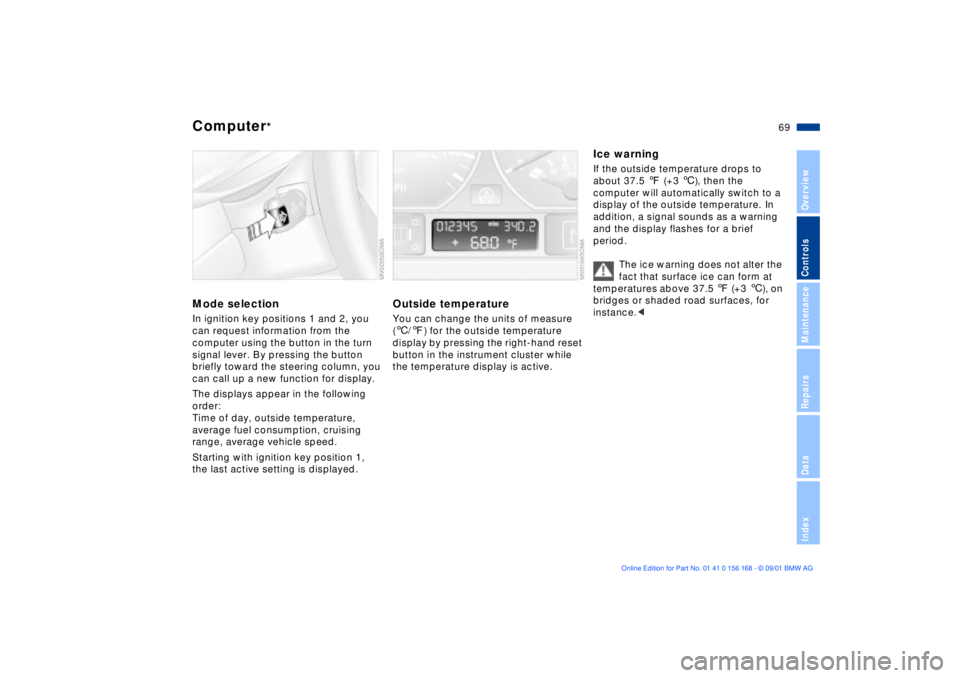
Mode selectionIn ignition key positions 1 and 2, you
can request information from the
computer using the button in the turn
signal lever. By pressing the button
briefly toward the steering column, you
can call up a new function for display.
The displays appear in the following
order:
Time of day, outside temperature,
average fuel consumption, cruising
range, average vehicle speed.
Starting with ignition key position 1,
the last active setting is displayed.
Outside temperatureYou can change the units of measure
(6/7) for the outside temperature
display by pressing the right-hand reset
button in the instrument cluster while
the temperature display is active.
Ice warningIf the outside temperature drops to
about 37.5 7 (+3 6), then the
computer will automatically switch to a
display of the outside temperature. In
addition, a signal sounds as a warning
and the display flashes for a brief
period.
The ice warning does not alter the
fact that surface ice can form at
temperatures above 37.5 7 (+3 6), on
bridges or shaded road surfaces, for
instance.<
Page 72 of 155
72n
Automatic Stability Control plus Traction (ASC+T)
The conceptThis system optimizes vehicle stability
and traction, especially when just
starting off, when accelerating or when
going through curves.
ASC+T recognizes the danger present
in traction loss and will increase driving
stability and traction by reducing the
engine's output, and if necessary, by
applying the brakes to the rear wheels.
ASC+T is ready each time you start the
engine.
Indicator lamp
The indicator lamp in the instru-
ment cluster goes out shortly
after you switch on the ignition,
refer to pages 18, 19.
If the indicator lamp flashes:
ASC+T is actively controlling drive
torque and braking intervention.
If the indicator lamp fails to go out
after the engine is started, or if it
comes on during normal driving:
There is a system malfunction or the
system was deactivated with the
button. Consequently, interventions to
increase driving stability (as described
in the preceding column) are no longer
available. You can still drive the vehicle
perfectly well without ASC+T.
In the event of a fault, please consult
your BMW center, refer to
pages 18, 19.<
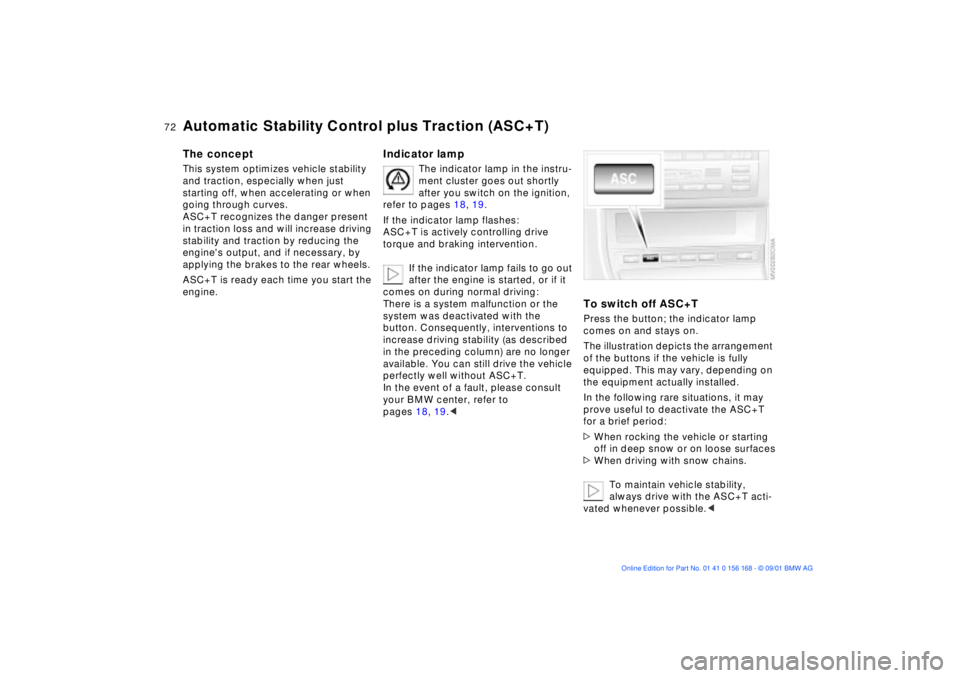
To switch off ASC+TPress the button; the indicator lamp
comes on and stays on.
The illustration depicts the arrangement
of the buttons if the vehicle is fully
equipped. This may vary, depending on
the equipment actually installed.
In the following rare situations, it may
prove useful to deactivate the ASC+T
for a brief period:
>When rocking the vehicle or starting
off in deep snow or on loose surfaces
>When driving with snow chains.
To maintain vehicle stability,
always drive with the ASC+T acti-
vated whenever possible.<
Page 73 of 155
73n
OverviewControlsMaintenanceRepairsDataIndex
ASC+T DSC
* Ð BMW 320i, 325i, 330i
To switch ASC+T back onPress the button again; the indicator
lamp goes out.
The laws of physics cannot be
repealed, even with ASC+T. An
appropriate driving style always
remains the responsibility of the driver.
We therefore urge you to avoid using
the additional safety margin of the
system as an excuse for taking risks.<
The conceptThe Dynamic Stability Control (DSC)
maintains vehicle stability, even in crit-
ical driving situations.
The system optimizes vehicle stability
during acceleration and when starting
from a full stop, as well as optimizing
traction. In addition, it recognizes
unstable vehicle conditions, such as
under- or oversteering, and, as far as is
possible within the laws of physics,
helps keeping the vehicle on a steady
course by reducing the rpms and brake
applications to the individual wheels.
DSC is operational every time you start
the engine. DSC incorporates the func-
tionality of the Automatic Differential
Brake (ADB) and the Cornering Brake
Control (CBC).
ADB relies on selective braking applica-
tions at the drive wheels to furnish the
functionality of a conventional limited-
slip differential for enhanced traction in
critical driving conditions such as those
encountered on snow-covered road
surfaces, etc.
The ADB is operational when DSC is
switched off.
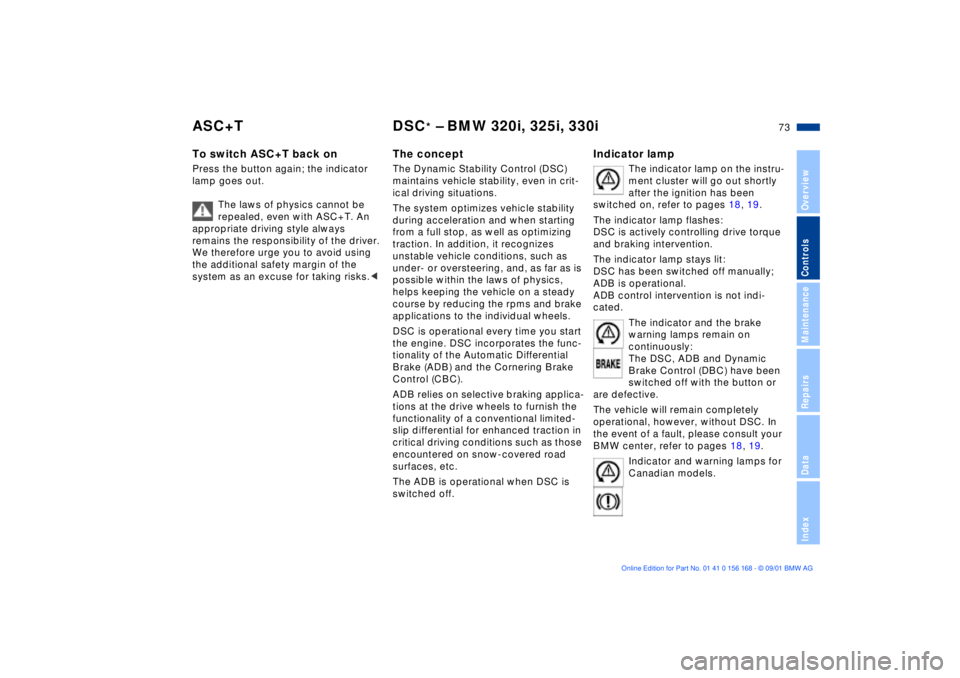
Indicator lamp
The indicator lamp on the instru-
ment cluster will go out shortly
after the ignition has been
switched on, refer to pages 18, 19.
The indicator lamp flashes:
DSC is actively controlling drive torque
and braking intervention.
The indicator lamp stays lit:
DSC has been switched off manually;
ADB is operational.
ADB control intervention is not indi-
cated.
The indicator and the brake
warning lamps remain on
continuously:
The DSC, ADB and Dynamic
Brake Control (DBC) have been
switched off with the button or
are defective.
The vehicle will remain completely
operational, however, without DSC. In
the event of a fault, please consult your
BMW center, refer to pages 18, 19.
Indicator and warning lamps for
Canadian models.
Page 75 of 155
75n
OverviewControlsMaintenanceRepairsDataIndex
DSC Ð BMW 325xi, 330xiThe conceptThe Dynamic Stability Control (DSC)
maintains vehicle stability, even in crit-
ical driving situations.
The system optimizes vehicle stability
during acceleration and when starting
from a full stop, as well as optimizing
traction. In addition, it recognizes
unstable vehicle conditions, such as
under- or oversteering, and, as far as is
possible within the laws of physics,
helps keeping the vehicle on a steady
course by reducing the rpms and brake
applications to the individual wheels.
The DSC is operational every time you
start the engine. DSC includes the
functions of ADB-X and CBC.
The Automatic Differential Brake
(ADB-X) enhances traction in critical
situations (such as those encountered
on snow-covered roads) by using
selective braking intervention to replace
the limited-slip functions executed by
the differential and transfer case in
conventional drivetrains.
Indicator lamp
The indicator lamp on the instru-
ment cluster will go out shortly
after the ignition has been
switched on, refer to pages 18, 19.
The indicator lamp flashes:
DSC is actively controlling drive torque
and braking intervention.
The indicator lamp stays lit:
DSC has been switched off manually;
ADB-X is operational.
ADB-X control intervention is not indi-
cated.
If the indicator lamp fails to go out
when you press the DSC button,
this indicates a malfunction in the DSC
and ADB-X systems; the system is
deactivated, and the stability enhance-
ment functions described on the left are
no longer available.<
The vehicle will remain completely
operational, however, without DSC. In
the event of a fault, please consult your
BMW center, refer to pages 18, 19.
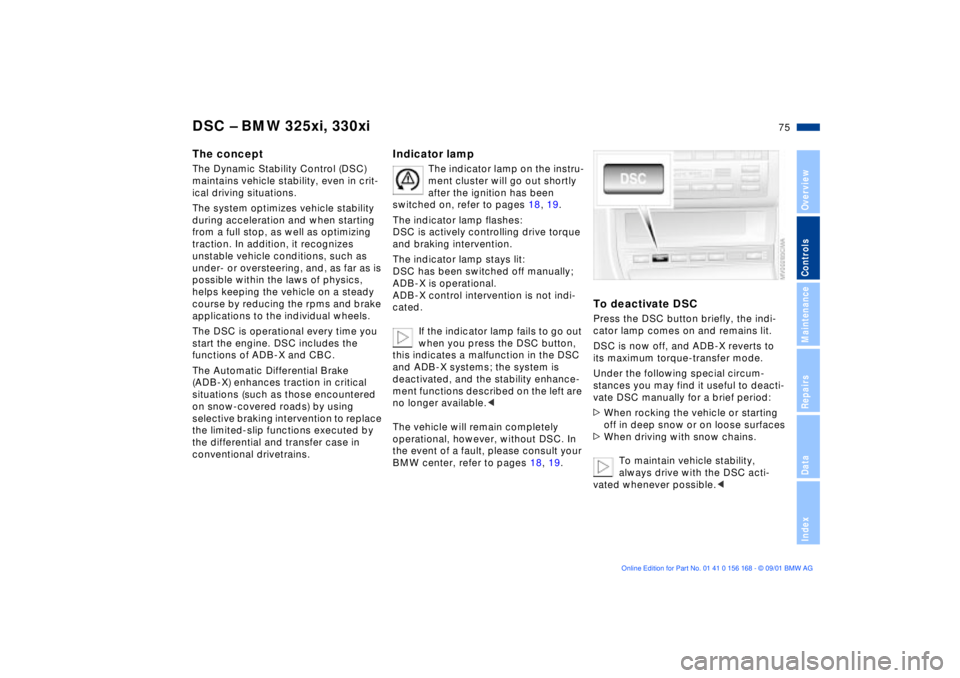
To deactivate DSCPress the DSC button briefly, the indi-
cator lamp comes on and remains lit.
DSC is now off, and ADB-X reverts to
its maximum torque-transfer mode.
Under the following special circum-
stances you may find it useful to deacti-
vate DSC manually for a brief period:
>When rocking the vehicle or starting
off in deep snow or on loose surfaces
>When driving with snow chains.
To maintain vehicle stability,
always drive with the DSC acti-
vated whenever possible.<
Page 77 of 155
77n
OverviewControlsMaintenanceRepairsDataIndex
Hill Descent Control (HDC)* Ð BMW 325xi, 330xiThe conceptBy reducing the vehicle's speed on
steep downhill stretches, HDC main-
tains predictable vehicle handling
response to provide you with even
greater control of your BMW during
extreme descents.
The vehicle slows to a pace just slightly
faster than walking speed.
HDC is available for activation at
vehicle speeds below approx. 22 mph
(35 km/h). When driving down steep
hills, the vehicle reduces speed auto-
matically down to slightly more than
double walking speed (approx. 8 mph/
12 km/h) and then maintains this speed
at a constant.
You can use the accelerator or brakes
to vary this automatically controlled
speed within a range extending from
approx. 3 mph (5 km/h) to 15 mph
(25 km/h).
In conjunction with the multifunction
steering wheel, you can use the
+/Ð button to set the cruise control to a
target speed in the range from approx.
3 mph (5 km/h) to 15 mph (25 km/h).
HDC is automatically deactivated once
vehicle speed again exceeds approx.
35 mph (60 km/h).
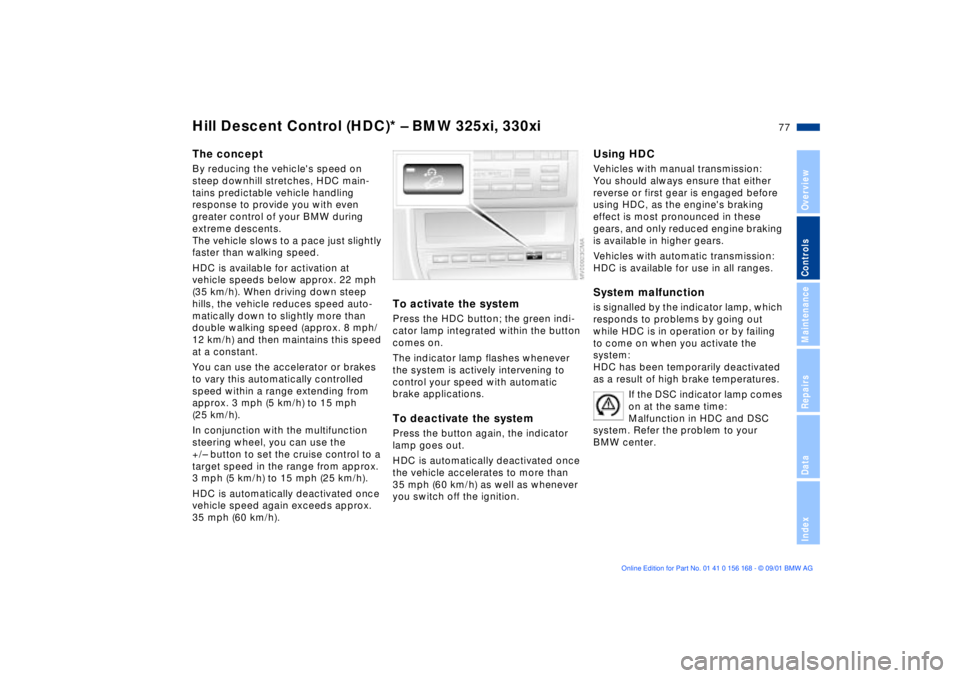
To activate the systemPress the HDC button; the green indi-
cator lamp integrated within the button
comes on.
The indicator lamp flashes whenever
the system is actively intervening to
control your speed with automatic
brake applications.To deactivate the systemPress the button again, the indicator
lamp goes out.
HDC is automatically deactivated once
the vehicle accelerates to more than
35 mph (60 km/h) as well as whenever
you switch off the ignition.
Using HDCVehicles with manual transmission:
You should always ensure that either
reverse or first gear is engaged before
using HDC, as the engine's braking
effect is most pronounced in these
gears, and only reduced engine braking
is available in higher gears.
Vehicles with automatic transmission:
HDC is available for use in all ranges.System malfunctionis signalled by the indicator lamp, which
responds to problems by going out
while HDC is in operation or by failing
to come on when you activate the
system:
HDC has been temporarily deactivated
as a result of high brake temperatures.
If the DSC indicator lamp comes
on at the same time:
Malfunction in HDC and DSC
system. Refer the problem to your
BMW center.
Page 78 of 155
78n
Tire Pressure Monitor (RDC)
*
The conceptRDC monitors the tire pressures at all
four wheels while the vehicle is moving.
The system provides an alert whenever
the inflation pressure drops significantly
below the specified pressure in one or
more tires.
In order for the system to "learn" the
correct tire inflation pressure, check the
inflation pressure in all tires according
to the inflation pressures table on
page 25 and make corrections as
necessary. Then activate the system.
This indicator lamp in the instru-
ment cluster will inform you if
the tire pressure is not correct.
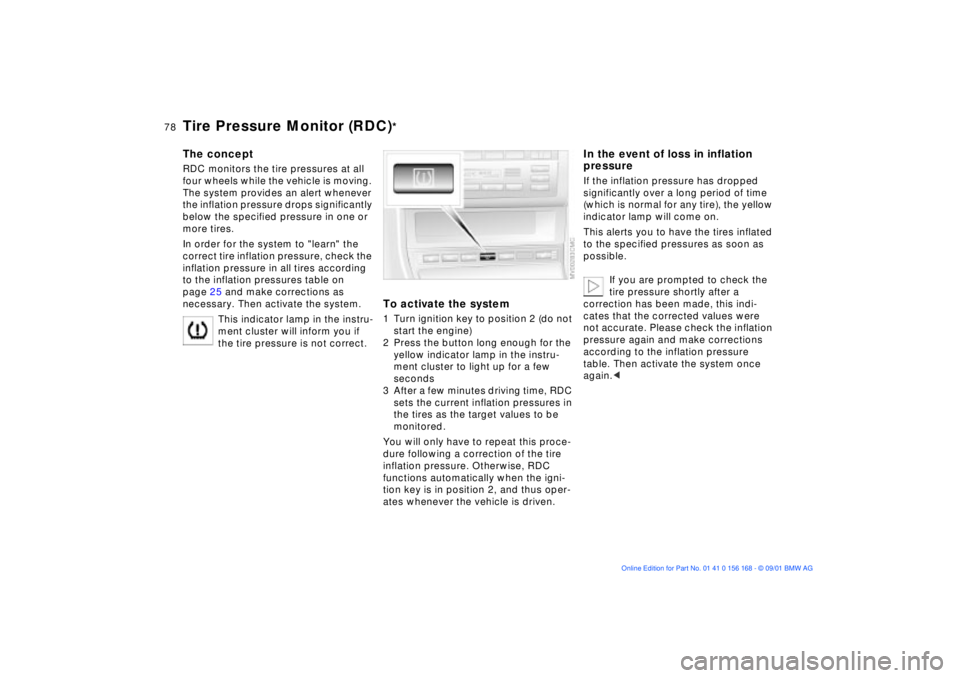
To activate the system1 Turn ignition key to position 2 (do not
start the engine)
2 Press the button long enough for the
yellow indicator lamp in the instru-
ment cluster to light up for a few
seconds
3 After a few minutes driving time, RDC
sets the current inflation pressures in
the tires as the target values to be
monitored.
You will only have to repeat this proce-
dure following a correction of the tire
inflation pressure. Otherwise, RDC
functions automatically when the igni-
tion key is in position 2, and thus oper-
ates whenever the vehicle is driven.
In the event of loss in inflation
pressureIf the inflation pressure has dropped
significantly over a long period of time
(which is normal for any tire), the yellow
indicator lamp will come on.
This alerts you to have the tires inflated
to the specified pressures as soon as
possible.
If you are prompted to check the
tire pressure shortly after a
correction has been made, this indi-
cates that the corrected values were
not accurate. Please check the inflation
pressure again and make corrections
according to the inflation pressure
table. Then activate the system once
again.<
Page 80 of 155
80n
Flat Tire Monitor
*
The conceptAs you drive, the Flat Tire Monitor
keeps track of pressure levels in all four
tires in order to detect and warn of any
substantial pressure loss.
The system actually detects pressure
loss by monitoring differences in the
relative speeds of the four wheels. It
interprets variations outside specified
limits as severe pressure loss, and then
responds by generating a warning.
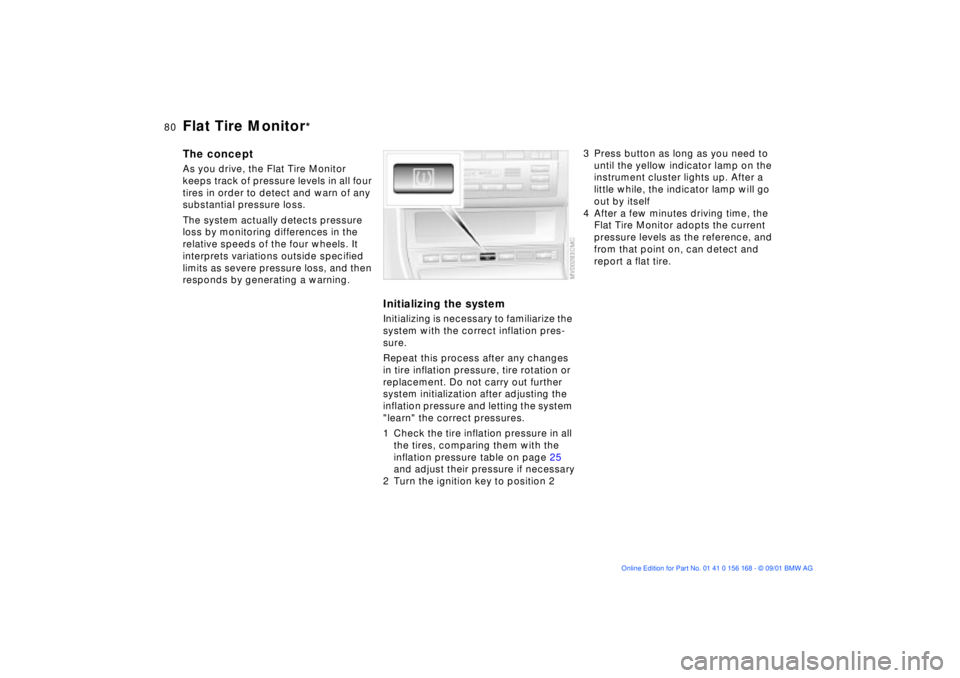
Initializing the systemInitializing is necessary to familiarize the
system with the correct inflation pres-
sure.
Repeat this process after any changes
in tire inflation pressure, tire rotation or
replacement. Do not carry out further
system initialization after adjusting the
inflation pressure and letting the system
"learn" the correct pressures.
1 Check the tire inflation pressure in all
the tires, comparing them with the
inflation pressure table on page 25
and adjust their pressure if necessary
2 Turn the ignition key to position 2
3 Press button as long as you need to
until the yellow indicator lamp on the
instrument cluster lights up. After a
little while, the indicator lamp will go
out by itself
4 After a few minutes driving time, the
Flat Tire Monitor adopts the current
pressure levels as the reference, and
from that point on, can detect and
report a flat tire.