steering wheel BMW 325CI COUPE 2005 E46 User Guide
[x] Cancel search | Manufacturer: BMW, Model Year: 2005, Model line: 325CI COUPE, Model: BMW 325CI COUPE 2005 E46Pages: 190, PDF Size: 2.79 MB
Page 74 of 190
74
RReverseSelect only when the vehicle is station-
ary.NNeutralAlways engage before starting the
engine, refer to Starting the engine on
page 70.Sequential modeEach time the engine is started, the
sequential mode is activated as soon as
you move the selector lever into the for-
ward driving position while the brake is
depressed.
The gears are shifted via the shift pad-
dles or the selector lever.
It is also possible to drive off in second
gear, e.g. on snow-covered roads.DDrive modeIn the drive mode all forward gears are
shifted automatically.
To switch from sequential to drive
mode: tap the selector lever to the right
toward D.
For rapid acceleration, e.g. during
passing, depress the accelerator pedal
completely: kickdown.To switch back to sequential mode: tap
the selector lever again to the right
toward D or change the current gear via
the shift paddles or the selector lever.
KickdownYou can achieve maximum acceleration
using kickdown.
Depress the accelerator pedal past the
increased resistance point at the full-
throttle position.
Shifting gearsWith the selector lever:
>To upshift, tap the selector lever
toward +
>To downshift, tap the lever toward —.
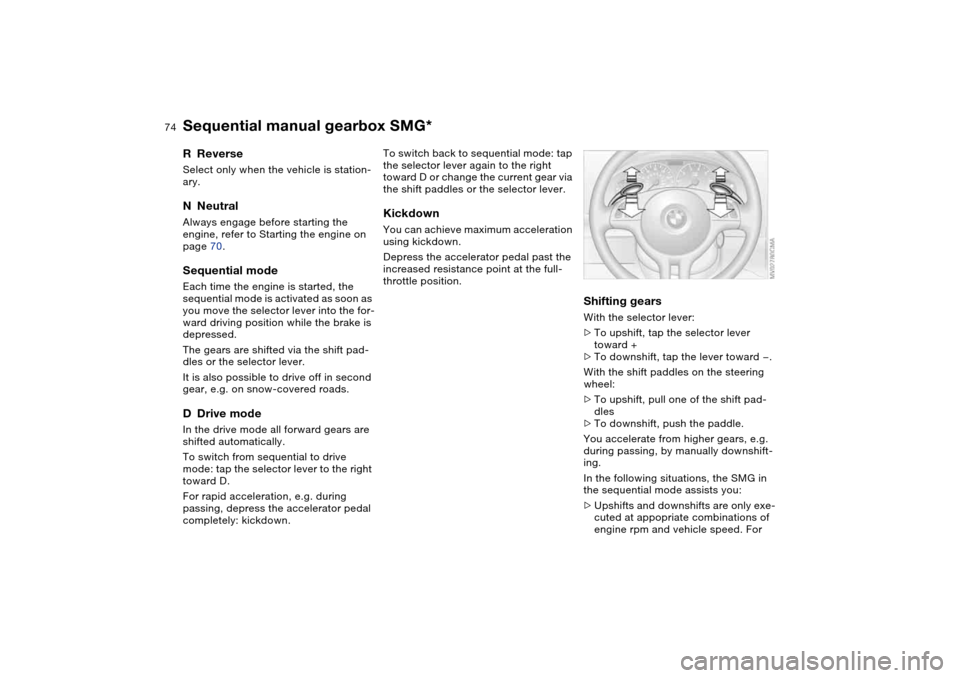
With the shift paddles on the steering
wheel:
>To upshift, pull one of the shift pad-
dles
>To downshift, push the paddle.
You accelerate from higher gears, e.g.
during passing, by manually downshift-
ing.
In the following situations, the SMG in
the sequential mode assists you:
>Upshifts and downshifts are only exe-
cuted at appopriate combinations of
engine rpm and vehicle speed. For
Sequential manual gearbox SMG*
Page 82 of 190
82
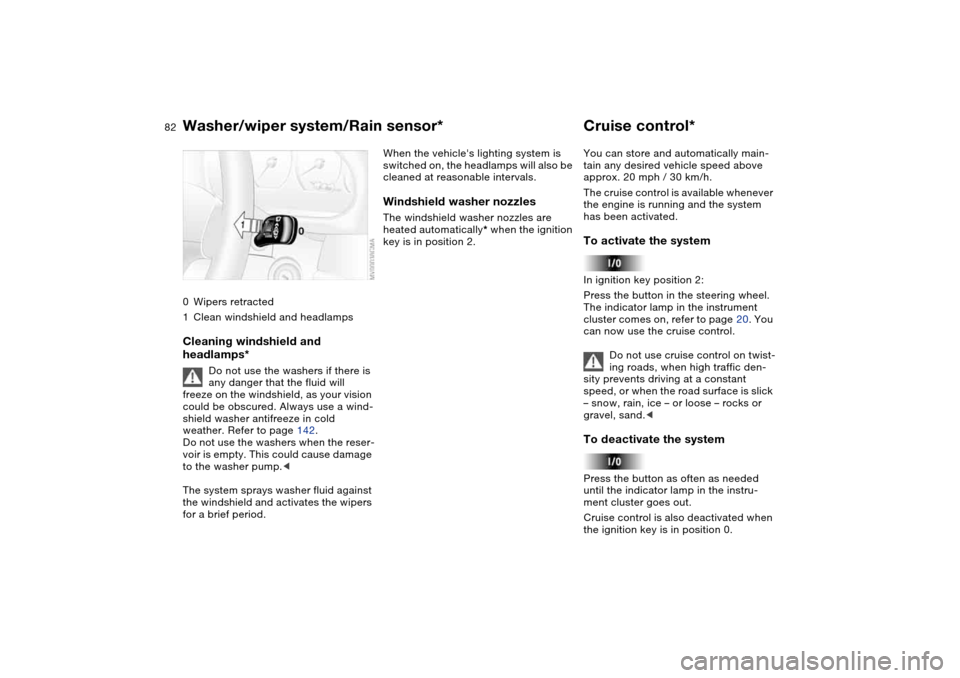
0Wipers retracted
1Clean windshield and headlampsCleaning windshield and
headlamps*
Do not use the washers if there is
any danger that the fluid will
freeze on the windshield, as your vision
could be obscured. Always use a wind-
shield washer antifreeze in cold
weather. Refer to page 142.
Do not use the washers when the reser-
voir is empty. This could cause damage
to the washer pump.<
The system sprays washer fluid against
the windshield and activates the wipers
for a brief period.
When the vehicle's lighting system is
switched on, the headlamps will also be
cleaned at reasonable intervals.Windshield washer nozzlesThe windshield washer nozzles are
heated automatically* when the ignition
key is in position 2.
Cruise control*You can store and automatically main-
tain any desired vehicle speed above
approx. 20 mph / 30 km/h.
The cruise control is available whenever
the engine is running and the system
has been activated.To activate the systemIn ignition key position 2:
Press the button in the steering wheel.
The indicator lamp in the instrument
cluster comes on, refer to page 20. You
can now use the cruise control.
Do not use cruise control on twist-
ing roads, when high traffic den-
sity prevents driving at a constant
speed, or when the road surface is slick
– snow, rain, ice – or loose – rocks or
gravel, sand.
ment cluster goes out.
Cruise control is also deactivated when
the ignition key is in position 0.
Washer/wiper system/Rain sensor*
Page 93 of 190
93
System limitations
The Flat Tire Monitor cannot pro-
vide you with advance warning of
sudden and severe tire damage caused
by external factors and does not detect
the balanced and very gradual pressure
loss that takes place in all four tires
over an extended period of time.<
On the other hand, the following situa-
tions can lead to a delayed detection of
pressure loss and even to the system
not functioning:
>Driving on snow-covered or slippery
roads
>Performance-oriented driving: slip at
the drive wheels, high levels of lateral
acceleration
>When driving with snow chains, false
warnings and undetected pressure
losses may occur
>When driving with a space-saver
spare tire, the Flat Tire Monitor can-
not function.
Initializing the system
Each time you correct the pres-
sure in a tire, or change a wheel or
tire, reinitialize the system immediately
afterwards. This requires a bit of driv-
ing.<
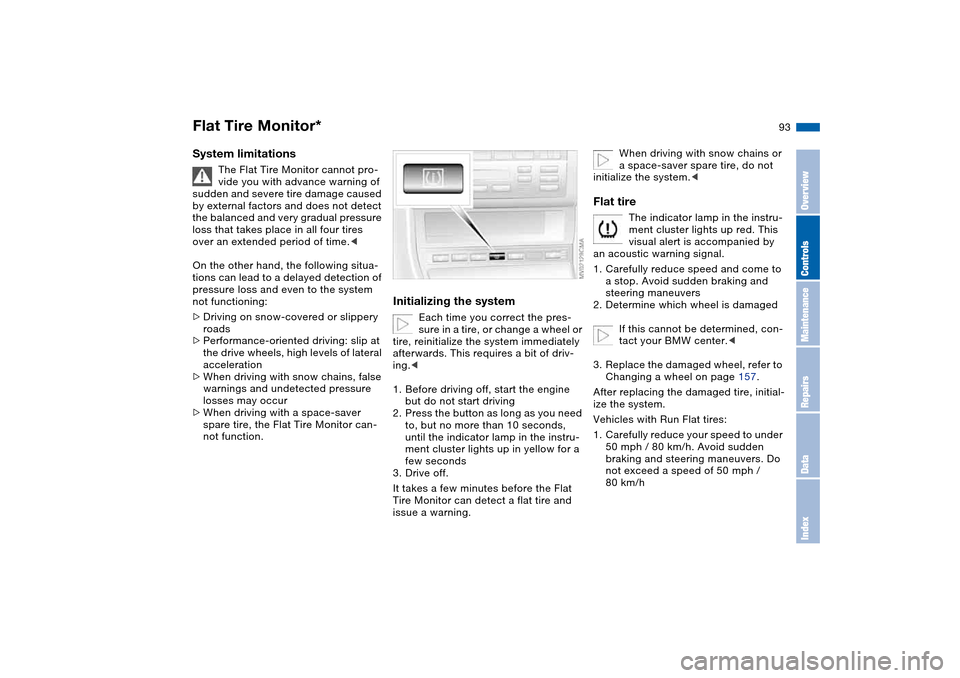
1. Before driving off, start the engine
but do not start driving
2. Press the button as long as you need
to, but no more than 10 seconds,
until the indicator lamp in the instru-
ment cluster lights up in yellow for a
few seconds
3. Drive off.
It takes a few minutes before the Flat
Tire Monitor can detect a flat tire and
issue a warning.
When driving with snow chains or
a space-saver spare tire, do not
initialize the system.<
Flat tire
The indicator lamp in the instru-
ment cluster lights up red. This
visual alert is accompanied by
an acoustic warning signal.
1. Carefully reduce speed and come to
a stop. Avoid sudden braking and
steering maneuvers
2. Determine which wheel is damaged
If this cannot be determined, con-
tact your BMW center.<
3. Replace the damaged wheel, refer to
Changing a wheel on page 157.
After replacing the damaged tire, initial-
ize the system.
Vehicles with Run Flat tires:
1. Carefully reduce your speed to under
50 mph / 80 km/h. Avoid sudden
braking and steering maneuvers. Do
not exceed a speed of 50 mph /
80 km/h
Flat Tire Monitor*
OverviewControlsMaintenanceRepairsDataIndex
Page 127 of 190
127
Antilock Brake System (ABS)The conceptABS keeps the wheels from locking
during braking, thereby enhancing
active driving safety.Braking with ABSIf you are in a situation that requires full
braking, you will exploit the full benefits
of ABS system if you apply maximum
pedal pressure: panic stop.
Since the vehicle maintains steering
responsiveness, you can avoid possible
obstacles with a minimum of steering
effort, despite the full brake application.
Pulsation at the brake pedal combined
with sounds from the hydraulic circuits
indicates to the driver that ABS is in its
active mode.Dynamic Brake Control (DBC)DBC is included in the DSC, refer to
page 91. The system responds to sud-
den, high-intensity applications of force
to the brake pedal by automatically
braking the vehicle with maximum
boost to achieve the shortest possible
braking distances during panic stops.
This system also exploits the benefits of
ABS. Do not reduce the pressure exerted against the brake pedal until
the braking maneuver has been com-
pleted. DBC is deactivated when you
release the brake pedal.
Cornering Brake Control (CBC)CBC is an advanced engineering devel-
opment of ABS. When braking during
cornering with high lateral accelera-
tion, or when braking during a lane
change, vehicle stability is improved
and the steering response is enhanced.
Hardtop*It is not necessary to remove the fabric
top even in the winter, when the hard-
top is generally in constant use. But you
can also remove it easily at any time.
Before the fabric top is stored in the
convertible top compartment, it must
be absolutely dry in order to avoid
water spots and mildew from forming.
The hardtop offers reading lamps and
clothes hooks that can be used just by
pressing. It is also possible to mount a
luggage rack on the roof. Please con-
sult your BMW center.
When hanging clothing from the
hooks, be sure that they will not
obstruct the driver's vision. Do not hang
heavy objects on the hooks. If you do
so, they could cause personal injury
during braking or evasive maneuvers.<
Two people are required for installation
or removal. Work with extreme caution
in order to avoid paint damage and
damage to the body or hardtop.
To facilitate hardtop installation or
removal, you can obtain a specially
designed hardtop lift* or hardtop rack*
at your BMW center.
OverviewControlsMaintenanceRepairsDataIndex
Page 130 of 190
130Wheels and tires
Tire inflation pressureInformation for your safetyIt is not merely the tire's service life, but
also driving comfort and, above all else,
driving safety that depend on the condi-
tion of the tires and the maintenance of
the specified tire inflation pressure.
Check tire inflation pressures on a
regular basis and correct them, if
necessary, including the compact
wheel: at least twice a month and
before beginning a longer trip. If this is
not done, incorrect tire pressures can
cause driving instability and tire dam-
age, ultimately resulting in accidents.
Do not drive with a pressureless, i.e.
flat, tire, unless your vehicle is
equipped with Run Flat tires. A flat tire
greatly impairs steering and braking
response, and can lead to complete
loss of control over the vehicle.
maximum of 1.25 miles/2 km or after
the vehicle has been parked for at least
2 hours. Warm tires have higher infla-
tion pressures.
After correcting the tire inflation pres-
sure, reinitialize the Flat Tire Monitor,
refer to page 93.
Inflation pressures for original
tiresTire pressures for the standard tires of
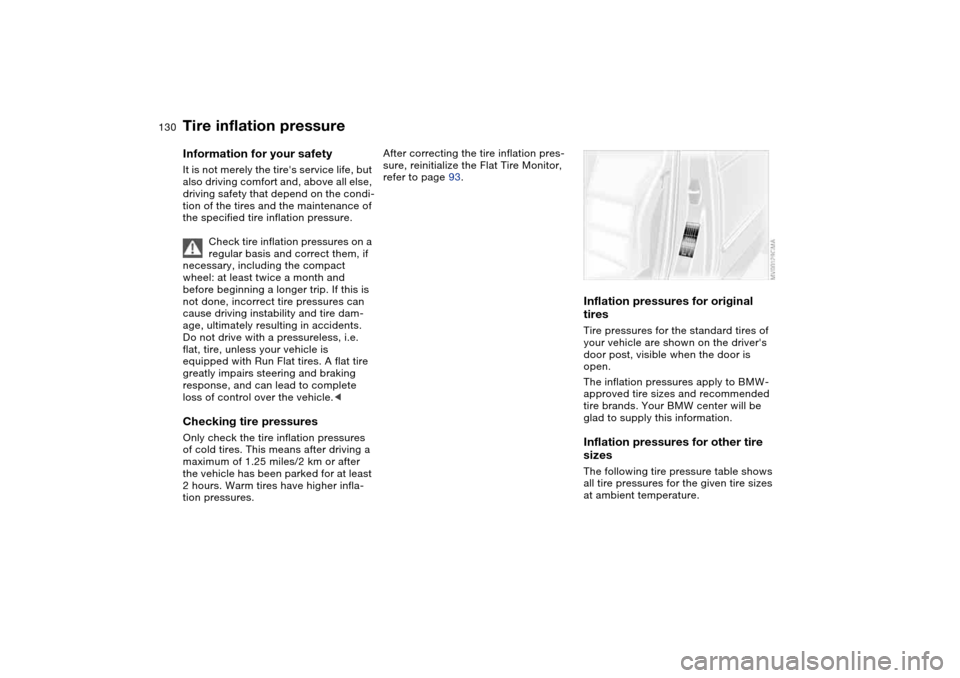
your vehicle are shown on the driver's
door post, visible when the door is
open.
The inflation pressures apply to BMW-
approved tire sizes and recommended
tire brands. Your BMW center will be
glad to supply this information.Inflation pressures for other tire
sizesThe following tire pressure table shows
all tire pressures for the given tire sizes
at ambient temperature.
Page 136 of 190
136
If there is a total loss of tire inflation
pressure, 0 psi/0 kPa, or obvious tire
damage, you can determine the dis-
tance you may continue driving based
on the following values:
>With a light load:
1 to 2 persons without luggage:
approx. 155 miles/250 km
>With a medium load:
2 persons, luggage compartment full;
or 4 persons without luggage:
approx. 90 miles/150 km
>With a full load:
4 persons or more, luggage compart-
ment full:
approx. 30 miles/50 km
Drive cautiously. Do not exceed a
speed of 50 mph / 80 km/h. Be
aware that vehicle handling will be
altered when there is a loss in inflation
pressure. Anticipate, e.g., reduced
tracking during braking, longer braking
distances and changed steering char-
acteristics.
For safety reasons, BMW recommends
not having damaged Run Flat tires
repaired. In this case, consult your
BMW center.<
New wheels and tires
Have new wheels and tires
mounted only by a skilled profes-
sional. Work that is improperly carried
out could result in consequential dam-
age and pose safety hazards.<
Ask your BMW center for details con-
cerning the correct wheel and tire com-
bination. Have the wheels balanced
each time a wheel or tire has been
replaced.
The correct wheel and tire combination
also affects different systems such as
ABS or DSC. The function of these sys-
tems is impaired if improper wheel and
tire combinations are used.
BMW advises against using
retreaded tires, as driving safety
could otherwise be impaired. This is
due to the possible variations in casing
structures and, in some cases, to their
extreme age, which can lead to a
decrease in their durability.<
The correct wheels and tires
BMW recommends using only
wheels and tires that have been
tested and approved by BMW for the
particular vehicle model, as otherwise
body contact and serious accidents can
result despite the use of the same nom-
inal size, e.g. due to manufacturing tol-
erances. BMW cannot evaluate all tires
and wheels on the market, and is thus
unable to guarantee that the vehicle will
continue to perform safely if unap-
proved tires and/or wheels are
mounted.<
To maintain good handling and vehicle
response, use only tires of a single
brand and tread configuration. After a
flat tire, have the previous wheel and
tire combination restored as soon as
possible.
Recommended tire sizes and
brandsFor each tire size, certain tire brands
have been tested, classified as road-
safe and approved by BMW. You can
find out about these from a professional
Run Flat tires*
Page 157 of 190
157
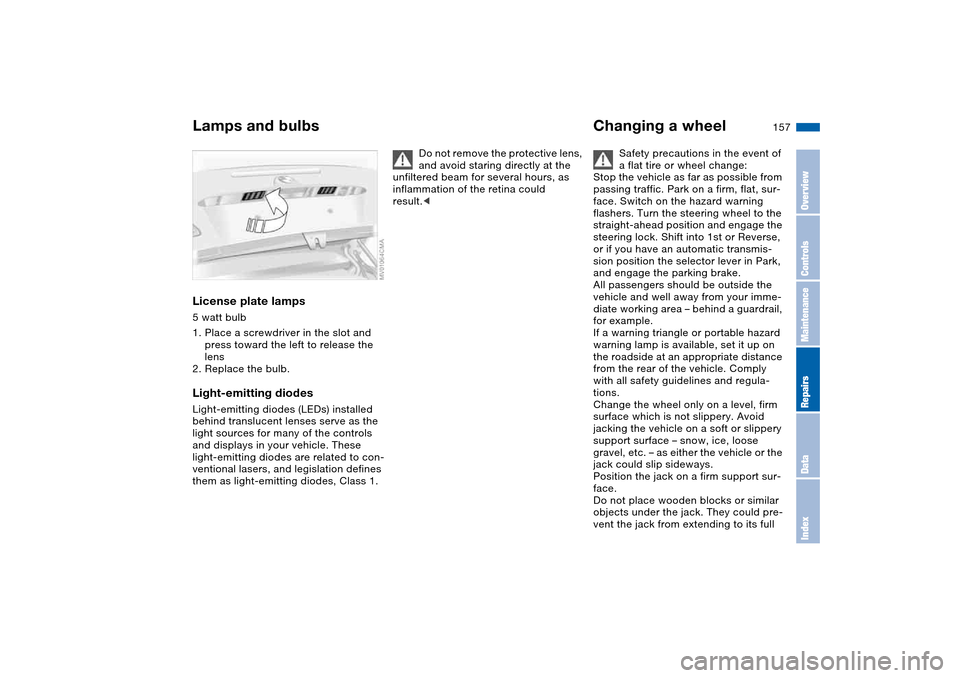
License plate lamps5 watt bulb
1. Place a screwdriver in the slot and
press toward the left to release the
lens
2. Replace the bulb.Light-emitting diodesLight-emitting diodes (LEDs) installed
behind translucent lenses serve as the
light sources for many of the controls
and displays in your vehicle. These
light-emitting diodes are related to con-
ventional lasers, and legislation defines
them as light-emitting diodes, Class 1.
Do not remove the protective lens,
and avoid staring directly at the
unfiltered beam for several hours, as
inflammation of the retina could
result.<
Changing a wheel
Safety precautions in the event of
a flat tire or wheel change:
Stop the vehicle as far as possible from
passing traffic. Park on a firm, flat, sur-
face. Switch on the hazard warning
flashers. Turn the steering wheel to the
straight-ahead position and engage the
steering lock. Shift into 1st or Reverse,
or if you have an automatic transmis-
sion position the selector lever in Park,
and engage the parking brake.
All passengers should be outside the
vehicle and well away from your imme-
diate working area – behind a guardrail,
for example.
If a warning triangle or portable hazard
warning lamp is available, set it up on
the roadside at an appropriate distance
from the rear of the vehicle. Comply
with all safety guidelines and regula-
tions.
Change the wheel only on a level, firm
surface which is not slippery. Avoid
jacking the vehicle on a soft or slippery
support surface – snow, ice, loose
gravel, etc. – as either the vehicle or the
jack could slip sideways.
Position the jack on a firm support sur-
face.
Do not place wooden blocks or similar
objects under the jack. They could pre-
vent the jack from extending to its full
Lamps and bulbs
OverviewControlsMaintenanceRepairsDataIndex
Page 160 of 190
160
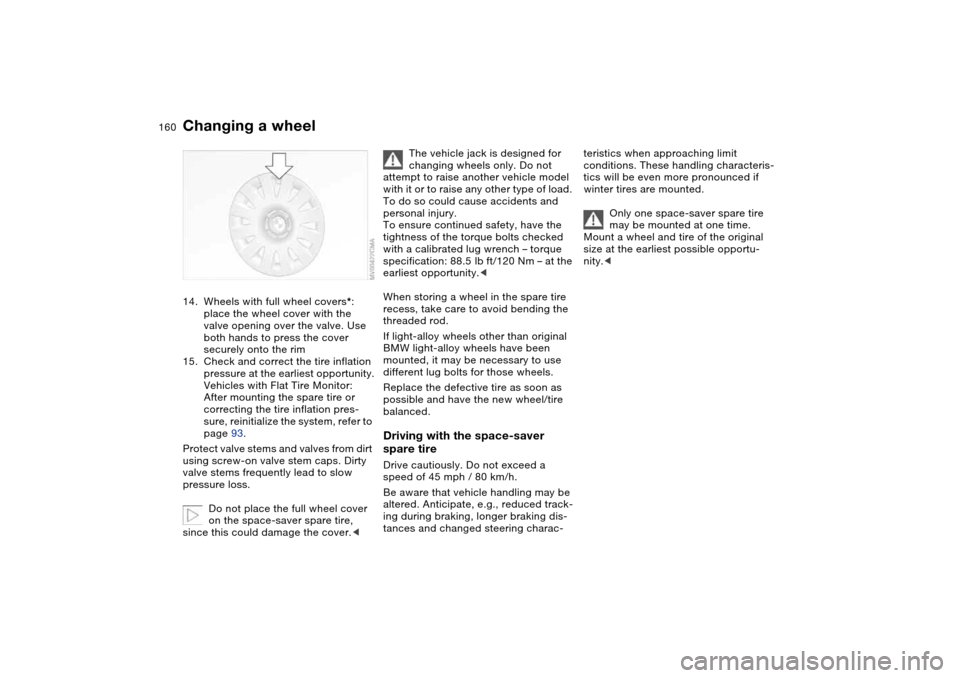
14. Wheels with full wheel covers*:
place the wheel cover with the
valve opening over the valve. Use
both hands to press the cover
securely onto the rim
15. Check and correct the tire inflation
pressure at the earliest opportunity.
Vehicles with Flat Tire Monitor:
After mounting the spare tire or
correcting the tire inflation pres-
sure, reinitialize the system, refer to
page 93.
Protect valve stems and valves from dirt
using screw-on valve stem caps. Dirty
valve stems frequently lead to slow
pressure loss.
Do not place the full wheel cover
on the space-saver spare tire,
since this could damage the cover.<
The vehicle jack is designed for
changing wheels only. Do not
attempt to raise another vehicle model
with it or to raise any other type of load.
To do so could cause accidents and
personal injury.
To ensure continued safety, have the
tightness of the torque bolts checked
with a calibrated lug wrench – torque
specification: 88.5 lb ft/120 Nm – at the
earliest opportunity.<
When storing a wheel in the spare tire
recess, take care to avoid bending the
threaded rod.
If light-alloy wheels other than original
BMW light-alloy wheels have been
mounted, it may be necessary to use
different lug bolts for those wheels.
Replace the defective tire as soon as
possible and have the new wheel/tire
balanced.
Driving with the space-saver
spare tireDrive cautiously. Do not exceed a
speed of 45 mph / 80 km/h.
Be aware that vehicle handling may be
altered. Anticipate, e.g., reduced track-
ing during braking, longer braking dis-
tances and changed steering charac-
teristics when approaching limit
conditions. These handling characteris-
tics will be even more pronounced if
winter tires are mounted.
Only one space-saver spare tire
may be mounted at one time.
Mount a wheel and tire of the original
size at the earliest possible opportu-
nity.<
Changing a wheel
Page 177 of 190
Everything from A to Z
177
Battery 161
charge 161
disposal 161
indicator lamp 18
jump-starting 163
remote control 28, 29
Battery charge current 18
Belts, refer to Safety
belts 54
Beverage holders 113
Blower
air conditioning 102
automatic climate
control 106
BMW High Performance
Synthetic Oils 143
BMW Maintenance
System 146
BMW sports seat 51
Bottle holders, see Bever-
age holders 113
Brake fluid 145
indicator lamp 18, 145
level 145
Brake force display 94
Brake lamps
bulb replacement 155
indicator lamp, defective
lamp 86
Brake lamps, refer to Brake
force display 94Brake pads
brake fluid level 18, 145
breaking in 124
indicator lamp 19
Brake rotors
breaking in 124
Brake wear warning
indicator lamp 19
Brakes
ABS 127
brake fluid 145
brake force display 94
brake pads 126
breaking in 124
driving notes 125
indicator/warning lamp
18, 19
parking brake 71
Break-in procedures 124
Bulb replacement, refer to
Lamps and bulbs 153
Bulb, replacing 153
Buttons in steering wheel 21
C
California laws
event data recorders 148
Proposition 65
warning 148
Can holders, see Beverage
holders 113
Capacities 173Car battery 161
Car care, refer to the Caring
for your vehicle brochure
Car keys, refer to Keys 28
Car radio, refer to the
Owner's Manual for Radio
Car telephone
preparation 113
Car telephone, refer to the
separate Owner's Manual
Car vacuum cleaner, con-
necting 114
Car wash, refer to the Caring
for your vehicle brochure
Carpet care, refer to the
Caring for your vehicle
brochure
Cassette operation, refer to
the Owner's Manual for
Radio/Onboard Computer
CBC Cornering Brake Con-
trol 127
warning lamp 18
CD changer, refer to the
Owner's Manual for
Radio/Onboard Computer
CD operation, refer to the
Owner's Manual for
Radio/Onboard Computer
Center armrest
front 112Center high-mount brake
lamp
bulb replacement 156
Central locking system 28
button 32
passenger
compartment 32
Changing a wheel 157
Charge indicator lamp 18
Check Control 86
Check Gas Cap
indicator lamp 19
Child seats, refer to Child-
restraint systems 62
Child-restraint mounting
system (LATCH) 64
Child-restraint system 62
Chock 158
Cigarette lighter 113
Cleaning chrome parts, refer
to the Caring for your vehi-
cle brochure
Cleaning light alloy wheels,
refer to the Caring for your
vehicle brochure
Cleaning position, convert-
ible top 43, 48
Cleaning the vehicle, refer to
the Caring for your vehicle
brochure
Cleaning windshield 82
OverviewControlsMaintenanceRepairsDataIndex
Page 180 of 190
Everything from A to ZFlat tire 157
Flat Tire Monitor 92
space-saver spare tire 157
Flat Tire Monitor 92
indicator lamp 18, 19, 93
Fluid reservoir for washer
systems 142
Fog lamps
indicator lamp 20
Follow me home lamps 95
Footbrake, refer to Braking
safely 125
Front airbags 59
Front fog lamps 97
Front seat adjustment 51
Fuel
display 85
quality 24
volume 173
Fuel consumption
display 89
Fuel display, refer to Fuel
gauge 85
Fuel economy, refer to
Energy control 84
Fuel filler door 23
release following an elec-
trical malfunction 23
Fuel level indicator, refer to
Fuel gauge 85
Fuel reserve indicator, refer
to Fuel gauge 85Fuel tank capacity 173
Fully-automatic convertible
top 44
activation 44
convenience operation
30, 31
opening, closing 45
remote control 30
Fuses 161
G
Garage door opener, refer to
Integrated universal
remote control 110
Gasoline consumption, refer
to Average fuel consump-
tion 89
Gasoline, refer to Fuel spec-
ifications 24
Gear indicator 75, 79
Gear lever
automatic transmission
with Steptronic 77
sequential manual gear-
box SMG 73
Gearbox
manual transmission 72
Gearshift lever
manual transmission 72
General driving notes 125
Glove compartment 109Grills, refer to Ventilation
100, 104
Gross weight, refer to
Weights 172
H
Handbrake, refer to Parking
brake 71
Hands-free system 113
Hardtop 127
Hardtop preparation 127
Hardtop, refer to the sepa-
rate Owner's Manual 127
Hazard warning flashers 14
Hazard warning triangle 22
Head restraints 52
Headlamp cleaning system
cleaning headlamps 82
washer fluid 142, 173
Headlamp control, auto-
matic 95
Headlamp flasher 97
indicator lamp 20
Headlamps
bulb replacement 153
care, refer to the Caring
for your vehicle brochure
Heated mirrors 57
Heated rear window
air conditioning 102
automatic climate
control 107Heated seats 57
Heating
exterior mirrors 57
rear window 102, 107
seats 57
Heating and ventilation
100, 104
Heavy loads, refer to Cargo
loading 118
Height adjustment
seats 51
steering wheel 58
Height, refer to
Dimensions 171
High beams 80, 81, 97
bulb replacement 154
headlamp flasher 97
indicator lamp 20
Holder for beverages 113
Hood release 138
Horn 14
Hub cap 158
Hydraulic brake assistant,
refer to DBC 127
Hydroplaning 125
I
Ice warning 88
Ignition 69
Ignition key 28
positions 69
Ignition lock 69