Iat BMW 325i 1993 E36 Manual Online
[x] Cancel search | Manufacturer: BMW, Model Year: 1993, Model line: 325i, Model: BMW 325i 1993 E36Pages: 759
Page 261 of 759
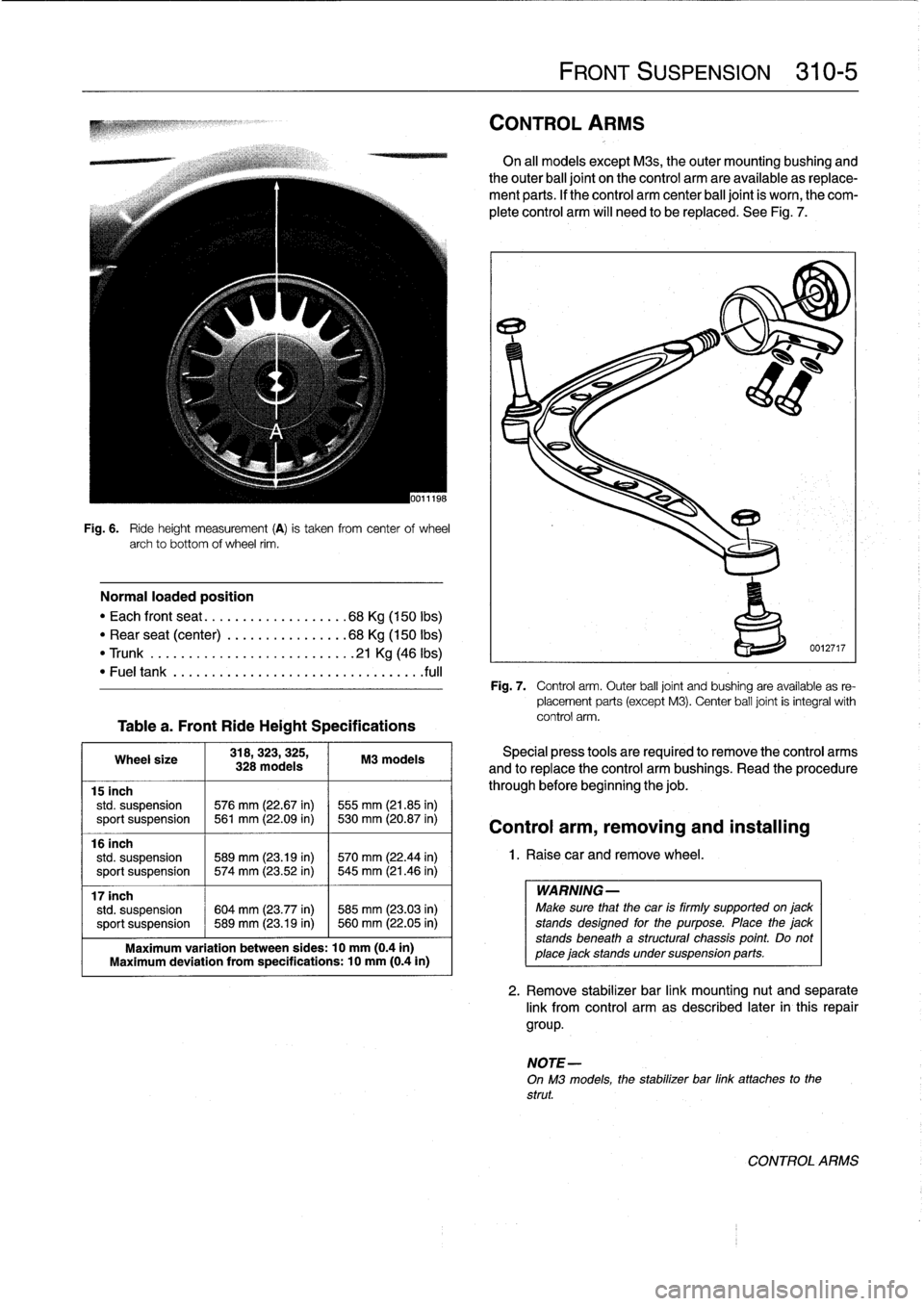
Fig
.
6
.
Ride
height
measurement
(A)
is
taken
from
centerof
wheel
archto
bottom
of
wheel
rim
.
Normal
loaded
position
"
Each
front
seat
...
...
.
..
..........
68Kg
(150
Ibs)
"
Rear
seat
(center)
...
.
.
...........
68Kg
(150
Ibs)
"
Trunk
..........
...
.
.
...........
.21
Kg
(46
lbs)
"
Fuel
tank
...
.
..
....
.
.
....................
.fuf
Tablea
.
Front
RideHeight
Specifications
318,323,325,
Wheel
size
M3
models
328
models
15
inch
std
.
suspension
576
mm
(22.67
in)
1555
mm
(21.85
in)
sport
suspension
~
561
mm
(22.09
in)
530
mm
(20
.87
in)
16
inch
std
.
suspension
589
mm
(23.19
in)
1570
mm
(22
.44
in)
sport
suspensíon
~
574
mm
(23.52
in)
545
mm
(21.46
in)
17
inch
std
.
suspension
604
mm
(23.77
in)
585
mm
(23
.03
in)
sport
suspension
~
589
mm
(23.19
in)
~
560
mm
(22
.05
in)
Maximum
variation
between
sides
:
10
mm
(0.4in)
Maximum
deviation
from
specifications
:
10
mm
(0
.4in)
FRONT
SUSPENSION
310-
5
CONTROL
ARMS
On
al¡
models
except
Mas,
theouter
mounting
bushing
and
theouter
ball
joint
on
the
control
arm
are
available
as
replace-
ment
parts
.
If
the
control
arm
center
ball
joint
is
worn,
the
com-
plete
control
arm
will
need
to
be
replaced
.
See
Fig
.
7
.
Fig
.
7
.
Control
arm
.
Outer
ball
joint
and
bushing
are
available
as
re-
placement
parts
(except
M3)
.
Center
ball
joint
is
integral
with
control
arm
.
Special
press
tools
are
requiredto
remove
the
control
arms
and
to
replace
the
control
arm
bushings
.
Read
the
procedure
through
before
beginning
the
job
.
Control
arm,
removing
and
installing
1
.
Raise
car
and
remove
wheel
.
WARNING-
Make
sure
that
thecar
is
firmly
supportedon
jack
standsdesigned
for
the
purpose
.
Place
the
jack
stands
beneath
a
structural
chassis
point
.
Do
not
place
jack
stands
undersuspension
parts
.
2
.
Remove
stabilizer
bar
link
mounting
nut
and
separate
link
from
control
arm
as
described
later
in
this
repair
group
.
NOTE-
On
M3
models,
the
stabilizer
bar
link
attaches
to
the
strut
.
CONTROL
ARMS
Page 263 of 759
6
.
Installation
is
reverse
of
removal
.
"
Make
sure
control
arm
ball
joint
taper
bore
is
clean
and
free
of
any
corrosion
.
"
Press
new
balljoint
into
position,
making
sure
to
align
balljoint
guide
with
mark
made
earlier
.
"
Verify
that
locking
clip
on
new
ball
joint
faces
towards
center
of
vehicle
.
Tightening
Torques
"
Control
arm
ball
jointto
steering
arm
.
65
Nm
(48
ft-Ib)
"
Stabilizer
bar
link
to
control
arm
(M8)
42
Nm
(31
ft-Ib)
"
Road
wheel
to
hub
.
...
...
.
.
100±10
Nm
(74t7
ft-lb)
Control
arm
bushing,
replacing
Control
arm
bushings
should
aiways
be
replaced
in
pairs
and
the
two
bushings
and
bushing
carriers
should
have
the
same
markings,
indicating
same
manufacturer
.
1
.
Raisecar
.
WARNING-
Make
sure
that
the
car
is
firmly
supportedonjackstandsdesigned
for
the
purpose
.
Place
the
jackstands
beneath
a
structural
chassis
point
.
Do
not
place
jack
stands
undersuspension
parts
.
2
.
Unbolt
control
arm
bushing
carrier
from
body
.
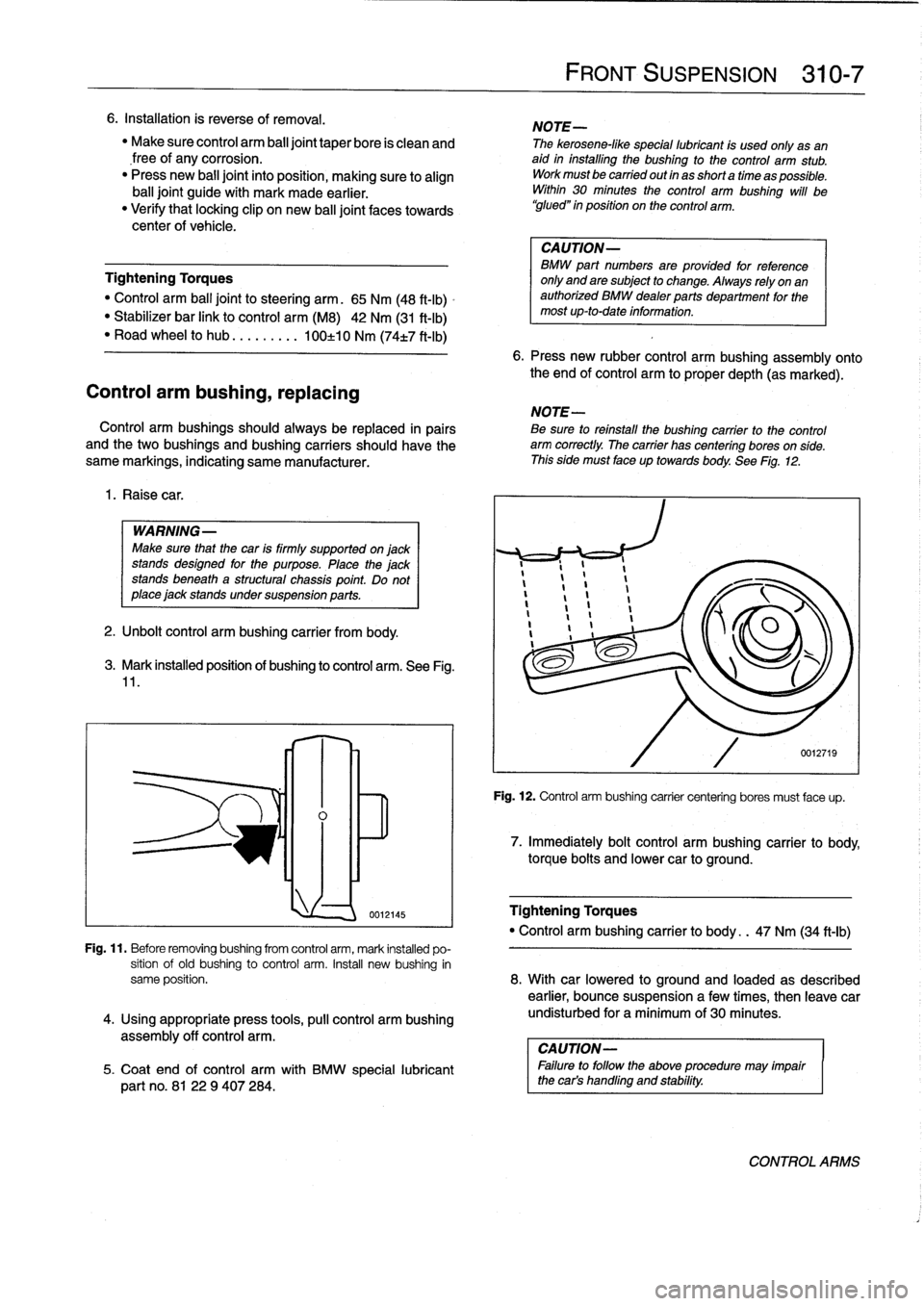
3
.
Mark
installed
position
of
bushing
to
control
arm
.
See
Fig
.
11
.
assembly
off
control
arm
.
lnl~
0012145
FRONT
SUSPENSION
310-
7
NOTE-
The
kerosene-like
special
lubricant
is
used
only
asan
aid
in
installing
the
bushing
to
the
control
arm
stub
.
Workmustbe
carried
out
in
as
short
a
time
as
possible
.
Within
30
minutes
the
control
arm
bushing
will
be
`glued"
in
position
on
the
control
arm
.
CAUTION-
BMW
part
numbers
areprovided
for
reference
only
and
are
subject
to
change
.
Always
rely
on
an
authorized
BMW
dealerparts
department
for
the
most
up-to-date
information
.
6
.
Press
new
rubber
control
arm
bushing
assembly
onto
the
end
of
control
arm
to
proper
depth
(as
marked)
.
NOTE-
Be
sure
toreinstall
the
bushing
carrier
to
the
control
arm
correctly
.
The
carrier
has
centering
bores
on
side
.
This
side
must
face
up
towards
body
.
See
Fig
.
12
.
Fig
.
12
.
Control
arm
bushing
carrier
centering
bores
must
face
up
.
7
.
Immediately
bolt
control
arm
bushing
carrier
to
body,
torque
boits
and
lower
car
to
ground
.
Tightening
Torques
"
Control
arm
bushing
carrier
to
body
.
.
47
Nm
(34
ft-ib)
Fig
.
11
.
Before
removingbushing
from
control
arm,
mark
installed
po-
sition
of
old
bushing
to
control
arm
.
Insta¡¡
new
bushing
in
same
position
.
8
.
With
car
lowered
to
ground
and
loaded
as
described
earlier,
bounce
suspensiona
few
times,
then
leave
car
4
.
Using
appropriate
press
tools,
pull
control
arm
bushing
undisturbed
for
a
minimum
of
30
minutes
.
CAUTION-
5
.
Coat
end
of
control
arm
with
BMW
special
lubricant
I
Failure
to
follow
the
above
procedure
may
impair
part
no
.
8122
9
407284
.
the
car's
handling
and
stability
.
CONTROLARMS
Page 264 of 759
310-
8
FRONT
SUSPENSION
FRONT
WHEEL
BEARINGS
The
front
wheel
bearings
are
permanently
sealed
and
re-
quire
no
maintenance
.
The
bearing
is
integral
with
the
wheel
hub
and
pressed
onto
the
steering
arm
stub
axle
.
Special
press
tools
are
requiredto
replace
the
front
wheel
bearings
.
Read
the
procedure
through
before
beginning
the
job
.
Front
wheel
bearing,
replacing
1
.
Raise
car
and
remove
wheel
.
WARNING-
Make
sure
that
the
car
is
firmly
supportedon
jack
stands
designed
for
the
purpose
.
Place
the
jack
stands
beneatha
structural
chassis
point
.
Do
not
place
jack
stands
under
suspension
parts
.
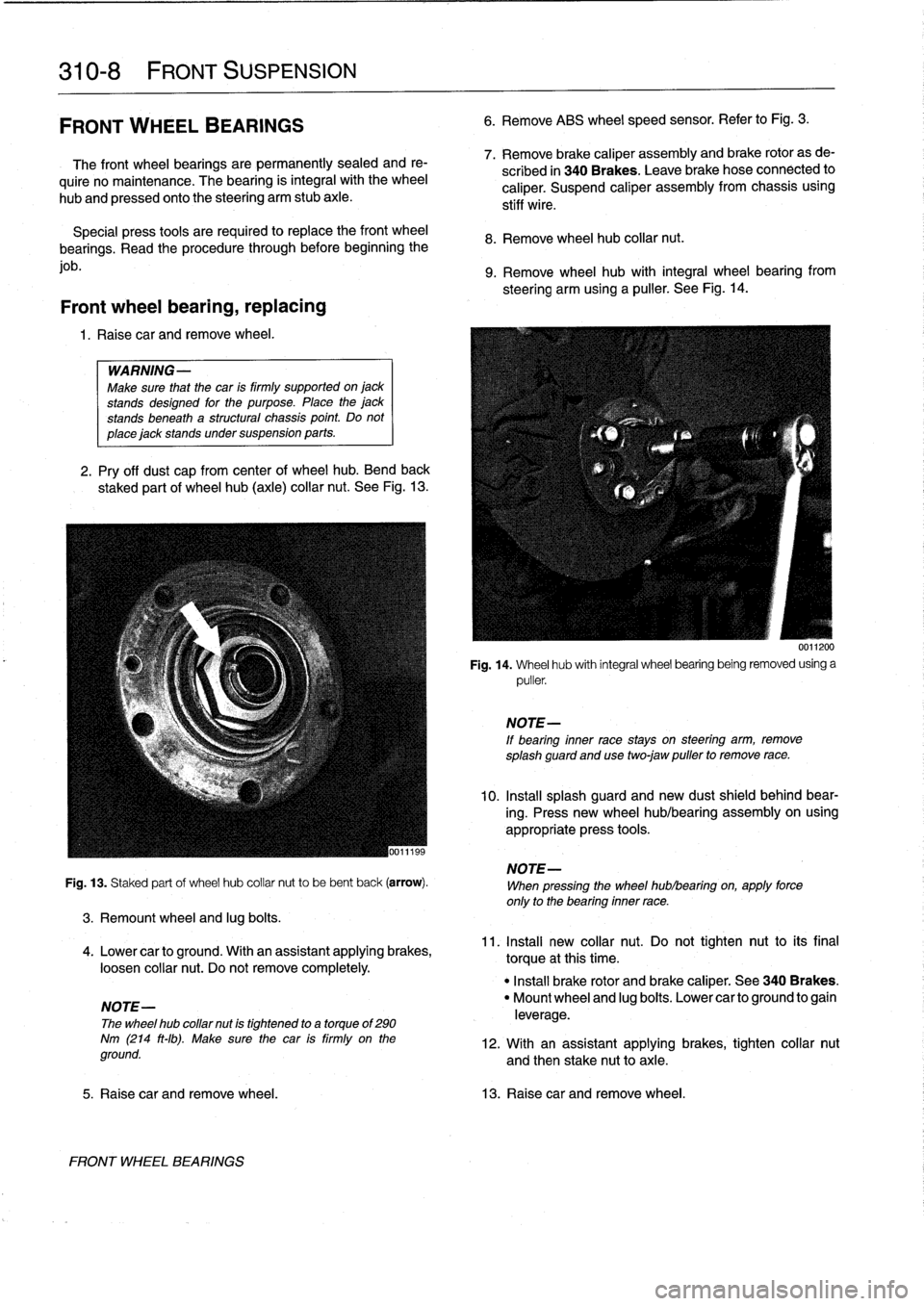
2
.
Pry
off
dust
cap
from
centerof
wheel
hub
.
Bend
back
staked
part
of
wheel
hub
(axle)
collar
nut
.
See
Fig
.
13
.
Fig
.
13
.
Staked
part
of
wheel
hub
collar
nut
to
be
bent
back
(arrow)
.
3
.
Remount
wheel
and
lug
bolts
.
4
.
Lower
canto
ground
.
With
an
assistant
applying
brakes,
loosen
collar
nut
.
Do
not
remove
completely
.
NOTE-
The
wheel
hub
collar
nut
is
tightened
to
a
torque
of
290
Nm
(214
ft-Ib)
.
Make
sure
the
car
is
firmly
on
the
ground
.
FRONT
WHEEL
BEARINGS
6
.
Remove
ABS
wheel
speed
sensor
.
Refer
to
Fig
.
3
.
7
.
Remove
brake
caliper
assembly
and
brake
rotor
as
de-
scribed
in
340
Brakes
.
Leave
brakehose
connected
to
caliper
.
Suspend
caliper
assembly
from
chassis
using
stiff
wire
.
8
.
Remove
wheel
hub
collar
nut
.
9
.
Remove
wheel
hub
with
integral
wheel
bearing
from
steering
arm
using
a
puller
.
See
Fig
.
14
.
0011200
Fig
.
14
.
Wheel
hub
with
integral
wheel
bearing
being
removed
using
a
puller
.
NOTE-
If
bearing
inner
race
stays
on
steering
arm,
remove
splash
guard
and
usetwo
jaw
puller
to
remove
race
.
10
.
Insta¡¡
splash
guard
and
new
dust
shield
behind
bear-
ing
.
Press
new
wheel
hub/bearing
assembly
on
using
appropriate
press
tools
.
NOTE-
When
pressing
the
wheel
hublbearing
on,
apply
force
only
to
the
bearing
inner
race
.
11
.
Install
new
collar
nut
.
Do
not
tighten
nut
to
its
final
torque
atthis
time
.
"
Install
brake
rotor
and
brake
caliper
.
See
340
Brakes
.
"
Mount
wheel
and
lug
boits
.
Lower
canto
ground
to
gain
leverage
.
12
.
With
an
assistant
applying
brakes,
tighten
collar
nut
and
then
stake
nut
toaxle
.
5
.
Raise
car
and
remove
wheel
.
13
.
Raisecar
and
remove
wheel
.
Page 265 of 759
STABILIZER
BAR
Stabilizer
bar,
removing
and
installing
Stabilizer
bar
link
arrangements
differ
slightly
among
mod-
els
.
In
most
models
the
links
attach
lo
the
control
arms
near
the
outboard
end
.
OnM3
models
the
links
attach
lo
the
strut
assemblies
.
1
.
Raise
car
and
remove
both
front
wheels
.
WARNING
-
Make
sure
that
the
car
is
firmly
supported
on
jack
stands
desígned
for
the
purpose
.
Place
the
jack
stands
beneath
a
structural
chassís
point
.
Do
not
place
jack
stands
under
suspension
parts
.
uul
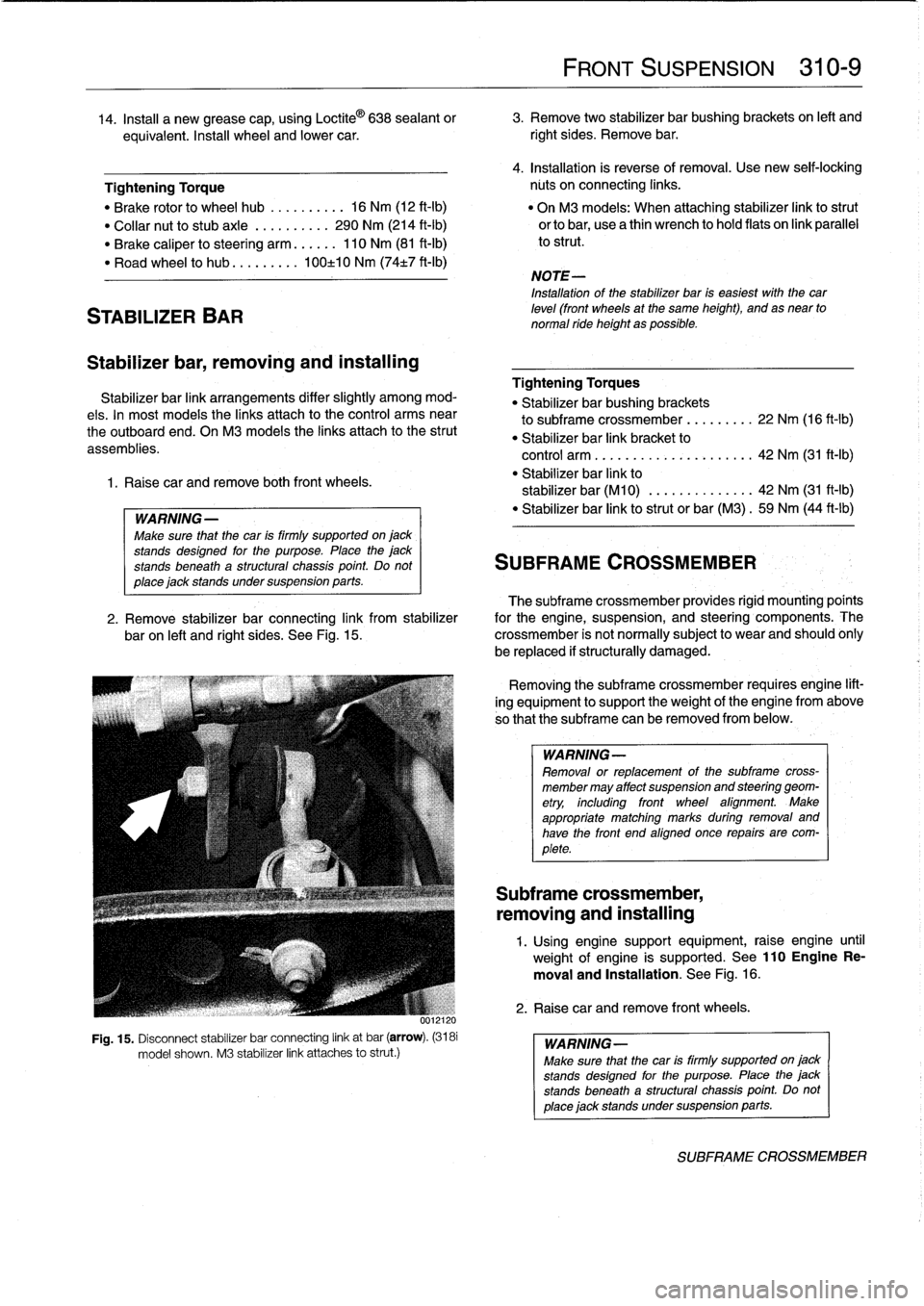
Fig
.
15
.
Disconnect
stabilizer
bar
connecting
link
at
bar
(arrow)
.
(3181
model
shown
.
M3
stabilizer
link
attaches
lo
strut
.)
FRONT
SUSPENSION
310-
9
14
.
Insta¡¡
a
new
grease
cap,
using
Loctite
©
638
sealant
or
3
.
Remove
two
stabilizer
bar
bushing
brackets
on
left
and
equivalent
.
Insta¡¡
wheel
and
lower
car
.
right
sides
.
Remove
bar
.
4
.
Installation
is
reverse
of
removal
.
Use
new
seif-lockíng
Tightening
Torque
núts
on
connecting
links
.
"
Brake
rotor
lo
wheel
hub
..........
16
Nm
(12
ft-Ib)
"
On
M3
models
:
When
attaching
stabilizer
link
lostrut
"
Collar
nut
lo
stubaxle
.
.........
290
Nm
(214
ft-Ib)
orlobar,
usea
thin
wrench
lo
hold
flats
on
link
parallel
"
Brake
caliper
losteering
arm
......
110
Nm
(81
ft-Ib)
lo
strut
.
"
Road
wheel
lo
hub
...
...
.
.
.
100±10
Nm
(74t7
ft-Ib)
NOTE-
Installation
of
the
stabilizer
bar
is
easiest
with
thecar
leve¡
(front
wheels
at
the
same
height),
and
as
near
to
normal
ride
height
as
possible
.
Tightening
Torques
"
Stabilizer
bar
bushing
brackets
lo
subframe
crossmember
...
..
.
..
.
22
Nm
(16
ft-Ib)
"
Stabilizer
bar
link
bracket
lo
control
arm
................
.
.
.
.
.
42
Nm
(31
ft-1b)
"
Stabilizer
bar
link
lo
stabilizer
bar
(M10)
.............
.
42
Nm
(31
ft-Ib)
"
Stabilizer
bar
link
lostrut
or
bar
(M3)
.
59
Nm
(44
ft-Ib)
SUBFRAME
CROSSMEMBER
The
subframe
crossmember
provides
rigid
mounting'poínts
2
.
Remove
stabilizer
bar
connecting
link
from
stabilizer
for
the
engine,
suspension,
and
steering
components
.
The
baron
left
and
right
sides
.
See
Fig
.
15
.
crossmember
is
not
normally
subject
lo
wear
and
should
ohly
be
replaced
if
structurally
damaged
.
Removing
the
subframe
crossmember
requires
engine
lift-
ing
equipment
lo
support
theweight
of
tfhe
engine
from
above
so
that
the
subframe
can
be
removed
from
below
.
WARNING-
Removal
or
replacement
of
the
subframe
cross-
member
may
affect
suspension
and
steering
geom-
etry,
including
front
wheel
afignment
.
Make
appropriate
matching
marks
during
removal
and
have
the
front
end
aligned
once
repairs
are
com-
plete
.
Subframe
crossmember,
removing
and
installing
1
.
Using
enginesupport
equipment,
raise
engine
until
weight
of
engine
is
supported
.
See
110EngineRe-
moval
and
Installation
.
See
Fig
.
16
.
2
.
Raise
car
andremove
front
wheels
.
WARNING-
Make
sure
that
the
car
is
firmly
supportedon
jack
stands
desígned
for
the
purpose
.
Place
the
jack
stands
beneatha
structural
chassís
point
Do
not
place
jack
standsundersuspension
parts
.
SUBFRAME
CROSSMEMBER
Page 269 of 759
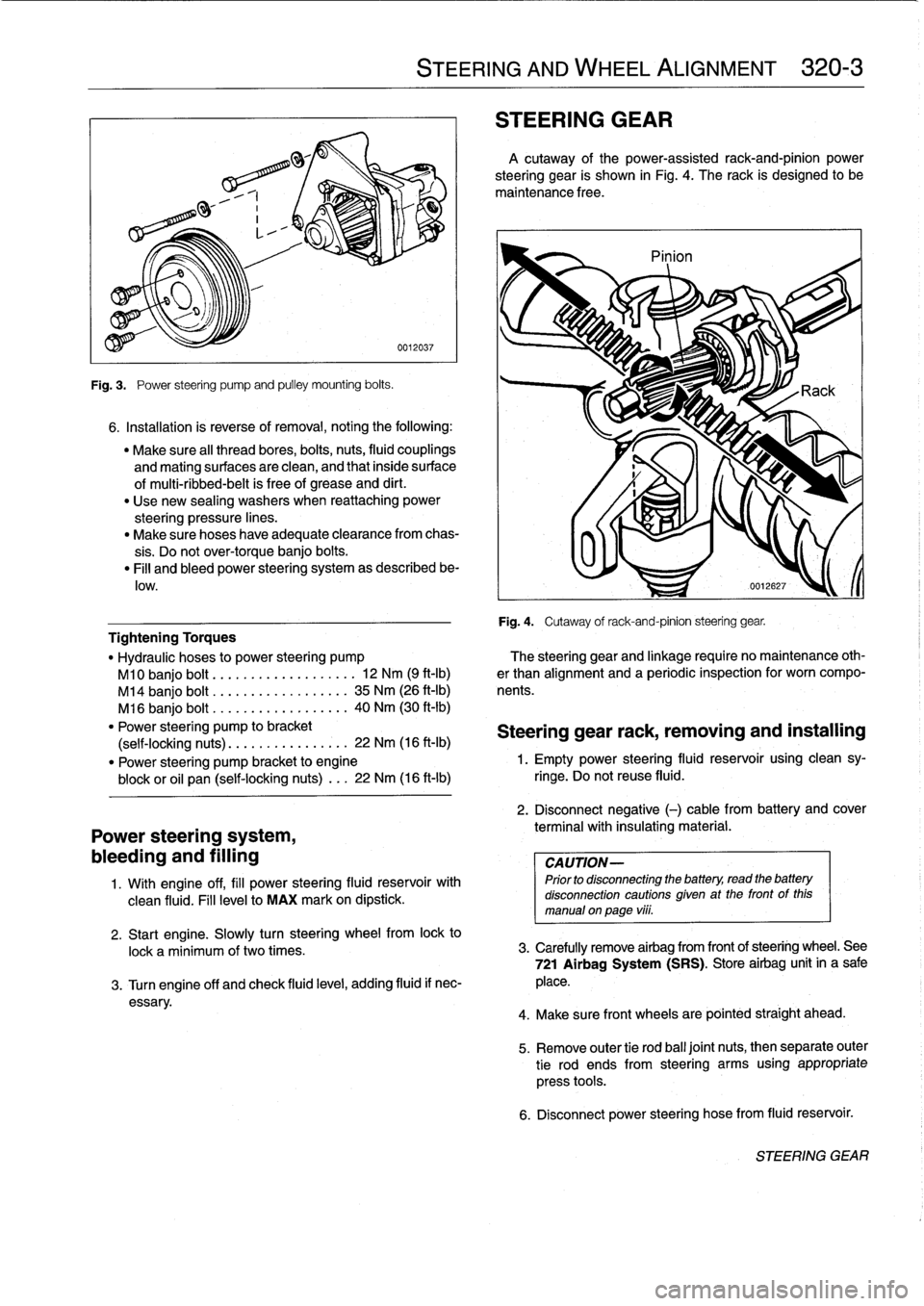
Fig
.
3
.
Power
steering
pump
and
pulley
mounting
bolts
.
6
.
Installation
is
reverse
of
removal,
noting
the
following
:
"
Make
sure
al¡
thread
bores,
bolts,
nuts,
fluid
couplings
and
mating
surfaces
are
clean,
and
that
inside
surface
of
multi-ribbed-belt
is
free
of
grease
and
dirt
.
"
Use
new
sealing
washers
when
reattaching
power
steering
pressure
lines
.
"
Make
sure
hoses
have
adequate
clearance
from
chas-
sis
.
Do
not
over-torque
banjo
bolts
.
"
Fill
and
bleed
power
steering
system
as
described
be-
low
.
Power
steering
system,
bleeding
and
filling
1
.
Wíth
engine
off,
fill
power
steering
fluid
reservoir
with
clean
fluid
.
Fill
levelto
MAX
mark
on
dipstick
.
STEERING
AND
WHEEL
ALIGNMENT
320-
3
STEERING
GEAR
A
cutaway
of
the
power-assisted
rack-and-pinion
power
steering
gear
is
shown
in
Fig
.
4
.
The
rack
is
designed
to
be
maintenance
free
.
Pinion
Fig
.
4
.
Cutaway
of
rack-and-pinion
steering
gear
.
Tightening
Torques
"
Hydraulic
hoses
to
power
steering
pump
?he
steering
gear
and
linkage
require
no
maintenance
oth-
M10
banjo
bolt
.........
..
.
...
...
.
12
Nm
(9
ft-Ib)
er
than
alignment
and
a
periodic
inspection
for
worn
compo
M14
banjo
bolt
..............
..
..
35
Nm
(26
ft-Ib)
nents
.
M16
banjo
bolt
..............
...
.
40
Nm
(30
ft-Ib)
"
Power
steering
pump
to
bracket
Steering
gear
rack,
removing
and
installing
(self-locking
nuts)
.............
..
.
22
Nm
(16
ft-Ib)
"
Power
steering
pump
bracket
to
engine
1
.
Empty
power
steering
fluid
reservoir
using
clean
sy-
block
or
oil
pan
(self-locking
nuts)
...
22
Nm
(16
ft-lb)
ringe
.
Do
not
reuse
fluid
.
2
.
Disconnect
negative
(-)
cable
from
battery
and
cover
terminal
with
insulating
material
.
CAUTION-
Prior
to
disconnectiog
the
battery,
read
the
battery
disconnection
cautions
given
at
the
front
of
this
manual
on
page
viii
.
2
.
Start
engine
.
Slowly
turn
steering
wheelfrom
lock
to
lock
a
minimum
of
two
times
.
3
.
Carefully
remove
airbag
from
frontof
steering
wheel
.
See
721
Airbag
System
(SRS)
.
Store
airbag
unit
in
a
sale
3
.
Turn
engine
off
and
check
fluid
leve¡,
adding
fluid
if
nec-
place
.
essary
.
4
.
Make
sure
front
wheelsare
pointed
straight
ahead
.
5
.
Remove
outer
tie
rod
ball
joínt
nuts,
thenseparate
outer
tie
rod
ends
from
steering
arms
using
appropriate
press
tools
.
6
.
Disconnect
power
steering
hose
from
fluid
reservoir
.
STEERING
GEAR
Page 271 of 759
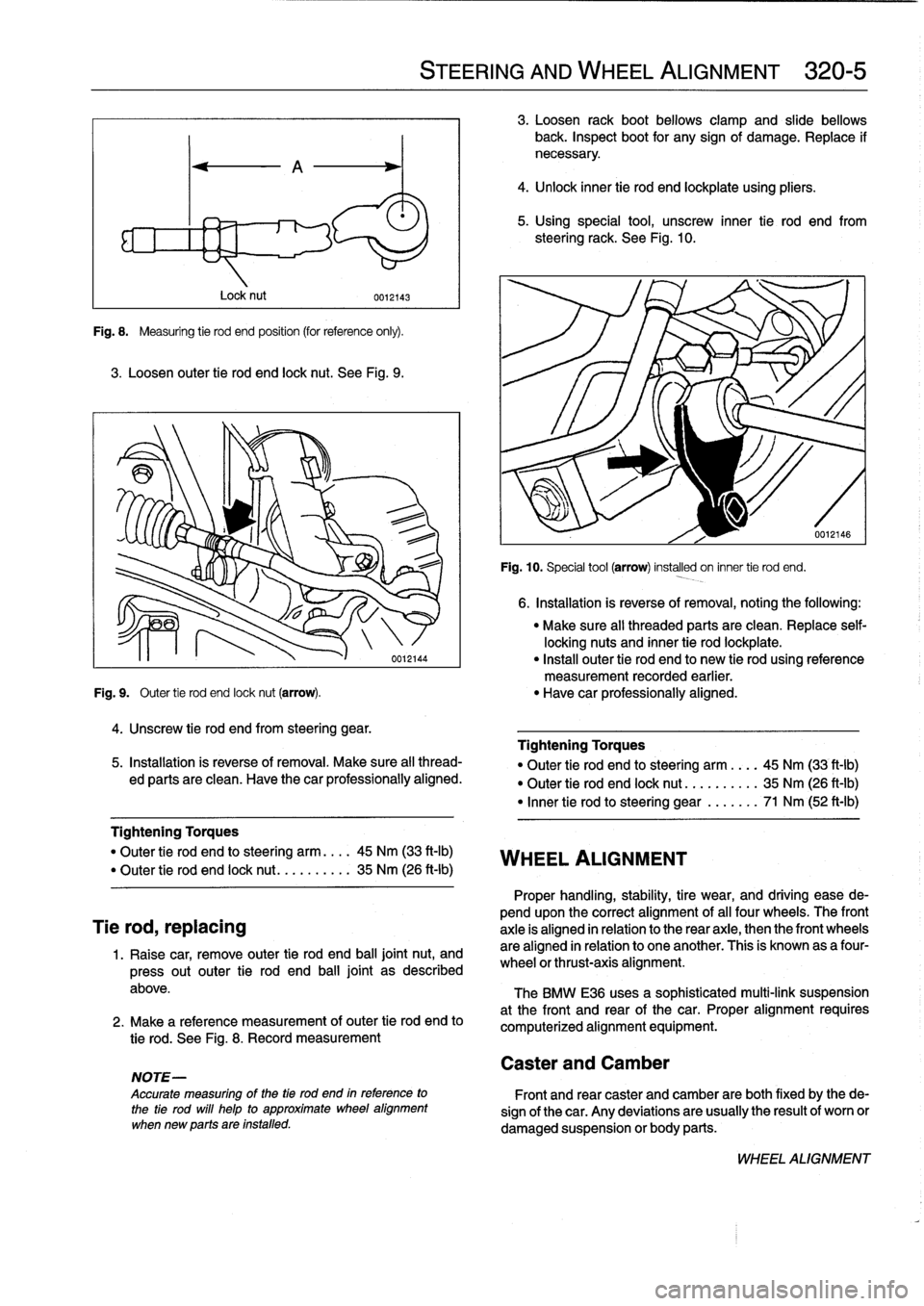
Fig
.
8
.
Measuring
tie
rod
end
position
(for
reference
only)
.
3
.
Loosen
outer
tie
rod
end
lock
nut
.
See
Fig
.
9
.
Lock
nut
4
.
Unscrew
tie
rod
end
from
steering
gear
.
0012143
"
Make
sure
all
threaded
parts
are
clean
.
Replace
self-
locking
nuts
and
inner
tie
rod
lockplate
.
"
Install
outer
tie
rod
end
to
new
tie
rod
using
reference
measurement
recorded
earlier
.
Fig
.
9
.
Outer
tie
rod
end
lock
nut
(arrow)
.
"
Have
car
professionally
aligned
.
5
.
Installation
is
reverse
of
removal
.
Make
sure
all
thread-
ed
parts
are
clean
.
Have
thecar
professionally
aligned
.
Tightening
Torques
"
Outer
tie
rod
end
losteering
arm
....
45
Nm
(33
ft-Ib)
"
Outer
tie
rod
end
lock
nut
..
.......
.
35
Nm
(26
ft-Ib)
Tie
rod,
replacing
1
.
Raise
car,
remove
outer
tie
rod
end
ball
jointnut,
and
press
out
outer
tie
rod
end
ball
joint
as
described
above
.
2
.
Make
a
reference
measurement
of
outer
tie
rod
end
to
tie
rod
.
See
Fig
.
8
.
Record
measurement
NOTE-
Accurate
measuring
of
the
tía
rod
end
in
reference
to
the
tie
rod
will
help
to
approximate
wheel
alignment
when
new
parts
are
installed
.
STEERING
AND
WHEEL
ALIGNMENT
320-
5
3
.
Loosen
rack
boot
bellows
clamp
and
slide
bellows
back
.
Inspect
boot
for
any
signof
damage
.
Replace
if
necessary
.
4
.
Unlock
inner
tie
rod
end
lockplate
using
pliers
.
5
.
Using
special
tool,
unscrew
inner
tie
rod
end
from
steeringrack
.
See
Fig
.
10
.
WHEEL
ALIGNMENT
Caster
and
Camber
Fig
.
10
.
Special
tool
(arrow)
installed
on
inner
tie
rod
end
.
6
.
Installation
is
reverse
of
removal,
noting
the
following
:
Tightening
Torques
"
Outer
tie
rod
end
to
steering
arm
..
.
.
45
Nm
(33
ft-Ib)
"
Outer
tie
rod
end
lock
nut
..........
35
Nm
(26
ft-Ib)
"
Inner
tie
rod
to
steering
gear
.......
71
Nm
(52
ft-Ib)
Proper
handling,
stability,
tire
wear,
and
driving
ease
de-
pendupon
the
correct
alignment
of
al¡
four
wheels
.
The
front
axle
is
aligned
in
relation
to
the
rear
axie,
then
the
front
wheels
are
aligned
in
relation
to
one
another
.
This
is
known
as
a
four-
wheel
or
thrust-axis
alignment
.
The
BMW
E36
uses
a
sophisticated
multi-link
suspension
at
the
front
and
rear
of
the
car
.
Proper
alignment
requires
computerized
alignment
equipment
.
Front
and
rear
caster
and
Camber
are
both
fixed
by
the
de-
sign
of
the
car
.
Any
deviations
are
usually
the
result
of
worn
or
damaged
suspension
or
body
parts
.
WHEEL
ALIGNMENT
Page 272 of 759
320-
6
STEERING
AND
WHEEL
ALIGNMENT
Front
Toe-in
andToe
Difference
Angle
Wheel
Alignment
Specifications
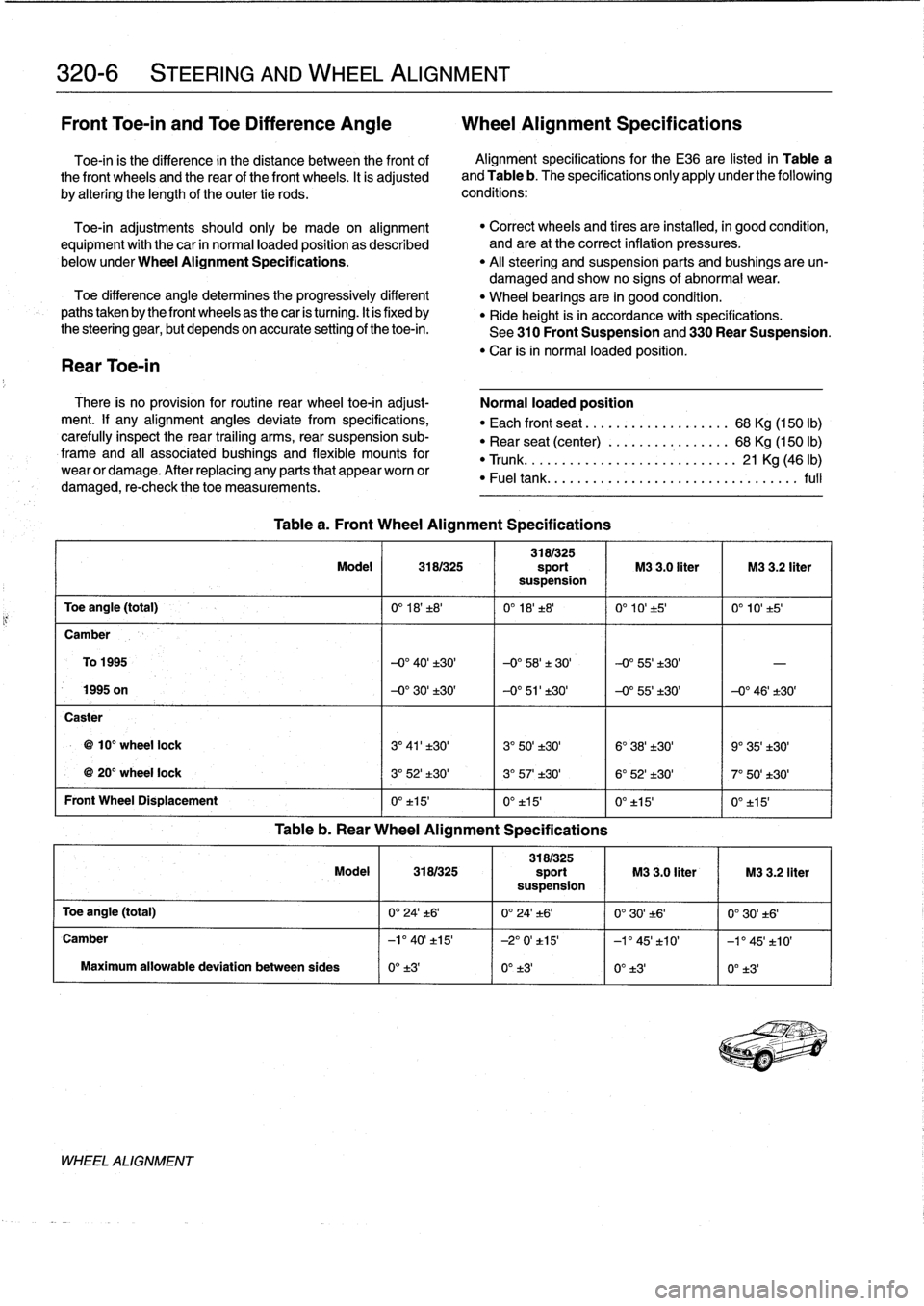
Toe-in
is
the
difference
in
the
distance
between
the
front
of
Alignment
specificationsfor
the
E36
are
listed
in
Table
a
the
front
wheels
and
the
rear
of
the
front
wheels
.
It
is
adjusted
and
Table
b
.
The
specifications
only
apply
under
the
following
by
altering
the
length
of
the
outer
tie
rods
.
conditions
:
Toe-in
adjustments
should
only
be
made
on
alignment
equipment
with
the
car
in
normalloaded
position
as
described
below
under
Wheel
Alignment
Specifications
.
Toe
difference
angledetermines
the
progressively
different
pathstaken
by
the
front
wheelsas
the
car
is
turning
.
It
is
fixed
by
the
steering
gear,
but
depends
on
accurate
setting
of
the
toe-in
.
Rear
Toe-in
There
is
no
provision
for
routinerear
wheel
toe-in
adjust-
ment
.
If
any
alignment
angles
deviate
from
specifications,
carefully
inspect
the
rear
trailing
arms,
rear
suspension
sub-
frame
and
al¡
associated
bushings
and
flexible
mounts
for
wear
or
damage
.
After
replacing
any
parts
that
appear
worn
or
damaged,
re-check
thetoe
measurements
.
WHEEL
ALIGNMENT
Table
a
.
Front
Wheel
Alignment
Specifications
"
Correct
wheels
and
tires
are
installed,
in
good
condition,
and
are
at
the
correct
inflation
pressures
.
"
Al¡
steering
and
suspension
parts
and
bushings
areun-
damaged
and
show
no
signs
of
abnormal
wear
.
"
Wheel
bearings
are
in
good
condition
.
"
Ride
height
is
in
accordance
with
specifications
.
See
310
Front
Suspension
and330
Rear
suspension
.
"
Car
isin
normal
loaded
position
.
Normal
loaded
position
"
Each
front
seat
.....:.............
68
Kg
(150
lb)
"
Rear
seat
(center)
................
68
Kg
(150
lb)
"
Trunk
.
.
.
..
.......................
21
Kg
(46
lb)
"
Fueltank
.
........................
...
.
..
..
full
3181325
Model
3181325
sport
M3
3
.0
liter
M3
3
.2
liter
suspension
Toe
angle
(total)
0°
18'±8'
0°
18'±8'
0°
10'
±5'
0°
10't5'
Camber
To
1995
-0°
40'±30'
-0°
58'±
30'
-0°55'±30'
-
1995
on
-0°
30'
±30'
-0°
51'±30'
-0°55'±30'
-0°
46'±30'
Caster
10°
wheel
lock
3°
41'±30'
3°
50'±30'
6°
38'±30'
9°
35'±30'
20°
wheel
lock
3°
52'±30'
3°
57'
t30'
6°
52'±30'
7°
50'±30'
Front
Wheel
Displacement
0°
t15'
0°t15'
0°
±15
0°
±15'
Table
b
.
Rear
Wheel
Alignment
Specifications
3181325
Model
3181325
sport
M3
3
.0
liter
M3
3
.2
liter
suspension
Toe
angle
(total)
0°
24't6'
0°
24'±6'
0'30'
.-t6'
0°
30't6'
Camber
-l'
40'
t15'
-2°
0'
t15'
-1
°
45'
t10'
-1'45'±10'
Maximum
allowabledeviation
between
sides
0°
±3'
0°
±3'
0°
t3'
0°
t3'
Page 274 of 759
330-2
REAR
SUSPENSION
Table
a
.
Rear
RideHeight
Specifications
Wheel
size
318,323,
325,
M3
modeis
328
modeis
17inch
std
.
suspension
546
mm
(21.69
in)
sport
suspension
~
535
mm
(21.06
in)
1
540
mm
(21
.26
in)
Maximum
variation
between
sides
:
10
mm
(0
.4in)
Maximum
deviation
from
specifications
:
10
mm
(0
.4in)
SHOCK
ABSORBERS
AND
SPRINGS
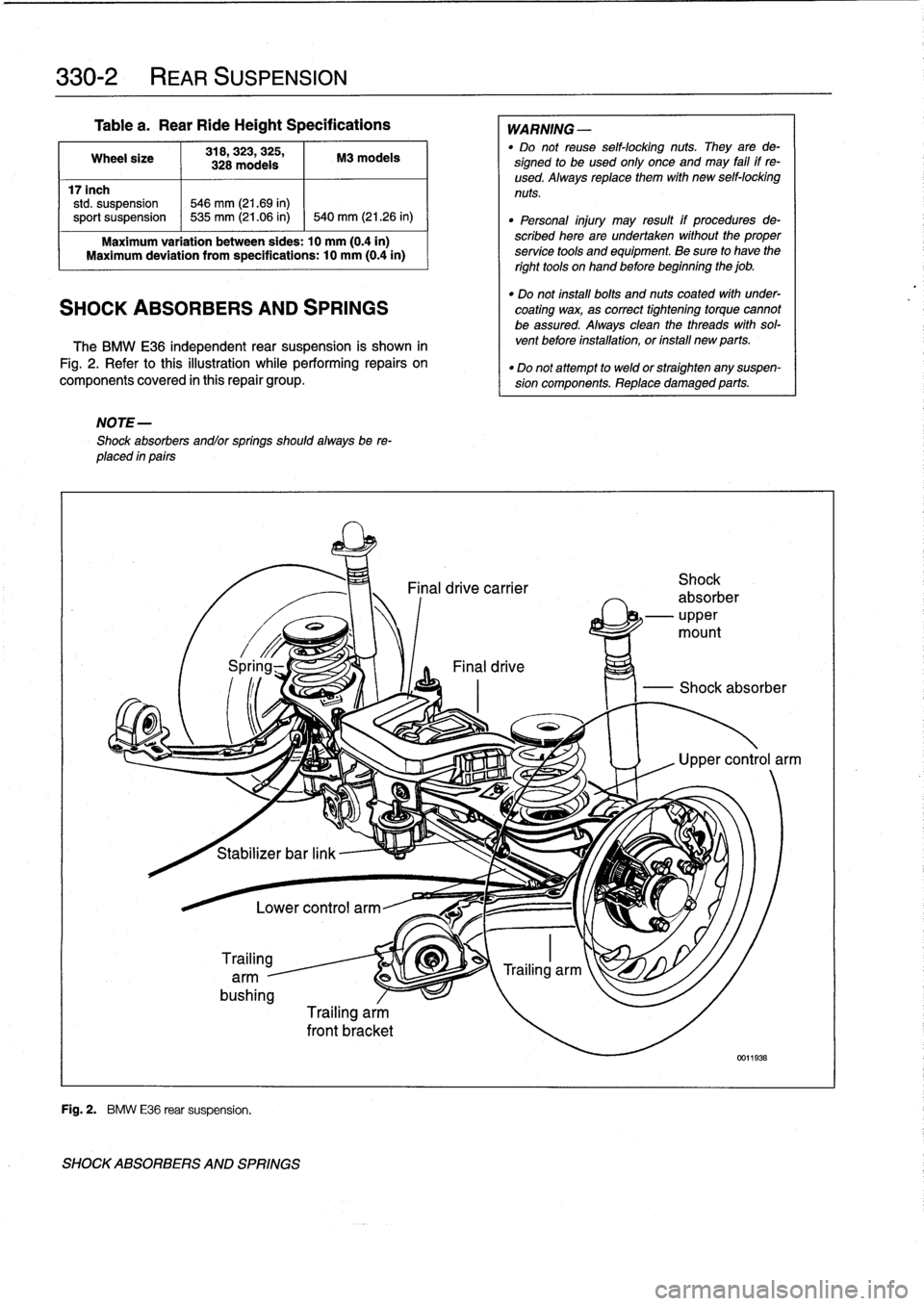
The
BMW
E36
independent
rear
suspension
is
shown
in
Fig
.
2
.
Refer
tothis
illustration
while
performing
repairs
on
components
covered
in
this
repair
group
.
NOTE-
Shock
absorbers
andlor
springs
shouldalways
be
re-
placed
in
pairs
i
Stabilizer
bar
link
Trailing
arm
-
bushing
Fig
.
2
.
BMW
E36
rear
suspension
.
SHOCK
ABSORBERS
AND
SPRINGS
Lower
control
arm
Trailing
arm
front
bracket
WARNING
-
"
Do
not
reuse
self-locking
nuts
.
They
arede-
signed
to
beused
only
once
and
may
fail
if
re-
used
.
Always
replace
them
with
new
self-locking
nuts
.
"
Personal
injury
may
result
if
procedures
de-
scribed
here
are
undertaken
without
the
proper
service
tools
and
equipment
.
Be
sure
to
have
the
right
tools
onhand
before
beginning
the
job
.
"
Do
not
install
bolts
and
nuts
coated
with
under-
coating
wax,
as
correct
tightening
torque
cannot
be
assured
.
Always
clean
the
threads
with
sol-
vent
before
installation,
or
ínstall
new
parts
.
"
Do
not
attempt
to
weld
or
straighten
any
suspen-
sion
components
.
Replace
damaged
parts
.
Page 277 of 759
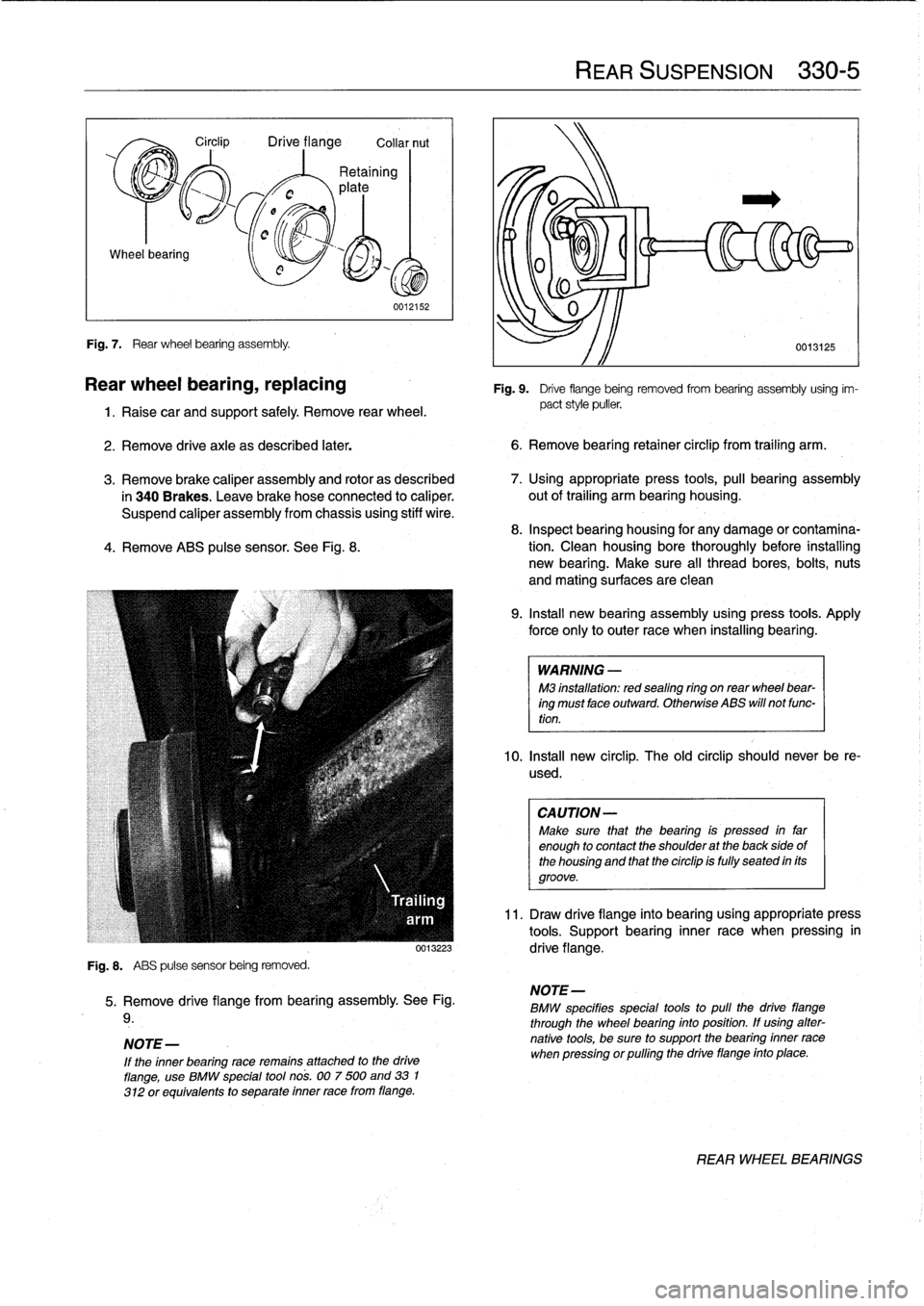
Wheel
bearing
Fig
.
7
.
Rear
wheel
bearing
assembly
.
Circlip
Drive
flange
Collar
nut
0012152
Rear
wheel
bearing,
replacing
1
.
Raise
car
and
support
safely
.
Remove
rear
wheel
.
2
.
Remove
drive
axle
as
described
later
.
6
.
Remove
bearíng
retainer
circlip
from
trailing
arm
.
3
.
Remove
brake
caliper
assembly
and
rotor
as
described
7
.
Using
appropriate
press
tools,
pull
bearing
assembly
in
340
Brakes
.
Leave
brake
hose
connected
to
caliper
.
out
of
trailing
arm
bearing
housing
.
Suspend
caliper
assembly
from
chassís
using
stiff
wire
.
8
.
Inspect
bearing
housing
for
any
damage
or
contamina
4
.
Remove
ABS
pulse
sensor
.
See
Fig
.
8
.
tion
.
Clean
housing
bore
thoroughly
before
installing
new
bearing
.
Make
sure
al¡
thread
bores,
bolts,
nuts
and
mating
surfaces
are
clean
Fig
.
8
.
ABS
pulse
sensor
being
removed
.
5
.
Remove
drive
flange
from
bearing
assembly
.
See
Fig
.
9
.
NOTE-
If
the
inner
bearing
race
remains
attached
to
the
drive
flange,
use
BMW
special
tool
nos
.
007
500
and
33
1
312
or
equivalents
to
separate
inner
race
from
flange
.
REAR
SUSPENSION
330-
5
0013125
Fig
.
9
.
Drive
flange
being
removed
from
bearing
assembly
using
im-
pact
style
puller
.
9
.
Install
new
bearing
assembly
using
press
tools
.
Apply
force
only
to
outer
race
when
installing
bearing
.
WARNING
-
M3
installation
:
redsealing
ríng
on
rear
wheel
bear-
ing
must
face
outward
.
Otherwíse
ABS
will
not
func-
tion
.
10
.
Insta¡¡
new
circlip
.
The
old
circlip
should
never
be
re-
used
.
CAUTION-
Make
sure
that
the
bearing
is
pressed
in
far
enough
to
contact
the
shoulder
at
the
back
sideof
the
housing
and
that
the
circlip
is
fully
seated
in
its
groove
.
11
.
Draw
drive
flange
into
bearing
using
appropriate
press
tools
.
Support
bearing
inner
race
when
pressing
in
0013223
drive
flange
.
NOTE-
BMW
specifies
special
tools
to
pull
the
drive
fiange
through
the
wheel
bearing
into
position
.
If
using
alter-
native
tools,
be
sure
to
support
the
bearing
inner
race
when
pressing
orpulling
the
drive
flange
finto
place
.
REARWHEEL
BEARINGS
Page 279 of 759
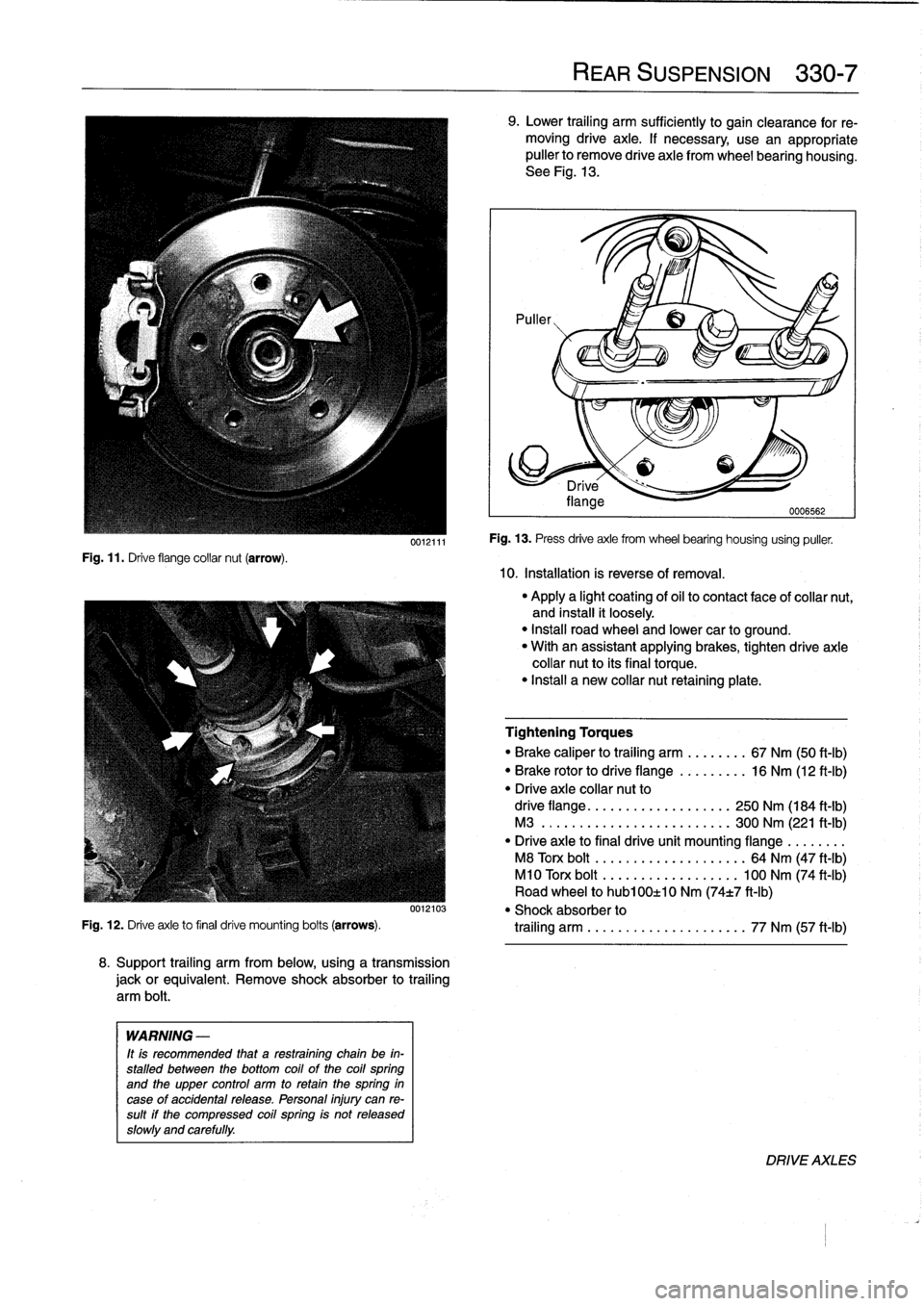
Fig
.
11
.
Drive
flange
collar
nut
(arrow)
.
0012111
8
.
Support
trailing
arm
from
below,
using
a
transmission
jackorequivalent
.
Remove
shock
absorber
to
trailing
arm
bolt
.
WARNING
-
It
is
recommended
that
a
restraining
chain
be
in-
stalled
between
the
bottom
coil
of
the
coil
spring
and
the
upper
control
arm
to
retain
thespring
in
case
of
accidental
release
.
Personal
injury
can
re-
sult
if
the
compressed
coil
spring
is
not
released
slowly
and
carefully
.
REAR
SUSPENSION
330-
7
9
.
Lower
trailing
arm
sufficiently
to
gain
clearance
for
re-
moving
drive
axle
.
If
necessary
use
an
appropriate
puller
to
Rmove
drive
axle
from
wheel
bearing
housing
.
See
Fig
.
13
.
10
.
Installation
is
reverse
of
removal
.
Fig
.
13
.
Press
drive
axle
from
wheel
bearing
housing
using
puller
.
"
Apply
a
light
coating
of
oil
to
contact
face
of
collar
nut,
and
install
it
loosely
.
"
Install
road
wheel
and
lower
car
to
ground
.
"
With
an
assistant
applying
brakes,
tighten
drive
axle
collar
nut
to
its
final
torque
.
"
Install
a
new
collar
nut
retaining
plate
.
Tightening
Torques
"
Brake
caliper
to
trailing
arm
........
67
Nm
(50
ft-Ib)
"
Brake
rotor
to
drive
flange
.........
16
Nm
(12
ft-Ib)
"
Drive
axle
collar
nut
to
drive
flange
.
.
....
..
.
..........
250
Nm
(184
ft-Ib)
M3
......
.
.
.....
.
.
..........
300
Nm
(221
ft-Ib)
"
Drive
axie
to
final
drive
unit
mounting
flange
.
.
.
.....
M8
Torx
bolt
.
...
...
.
............
64
Nm
(47
ft-Ib)
M10
Torx
bolt
...
...............
100
Nm
(74
ft-Ib)
Road
wheel
to
hub100±10
Nm
(74t7
ft-Ib)
0012103
"
Shock
absorber
to
Fig
.
12
.
Drive
axle
to
final
drive
mounting
bolts
(arrows)
.
trailing
arm
.
.
...
...
.
............
77
Nm
(57
ft-Ib)
DRIVE
AXLES