Iat BMW 325i 1993 E36 Owners Manual
[x] Cancel search | Manufacturer: BMW, Model Year: 1993, Model line: 325i, Model: BMW 325i 1993 E36Pages: 759
Page 283 of 759
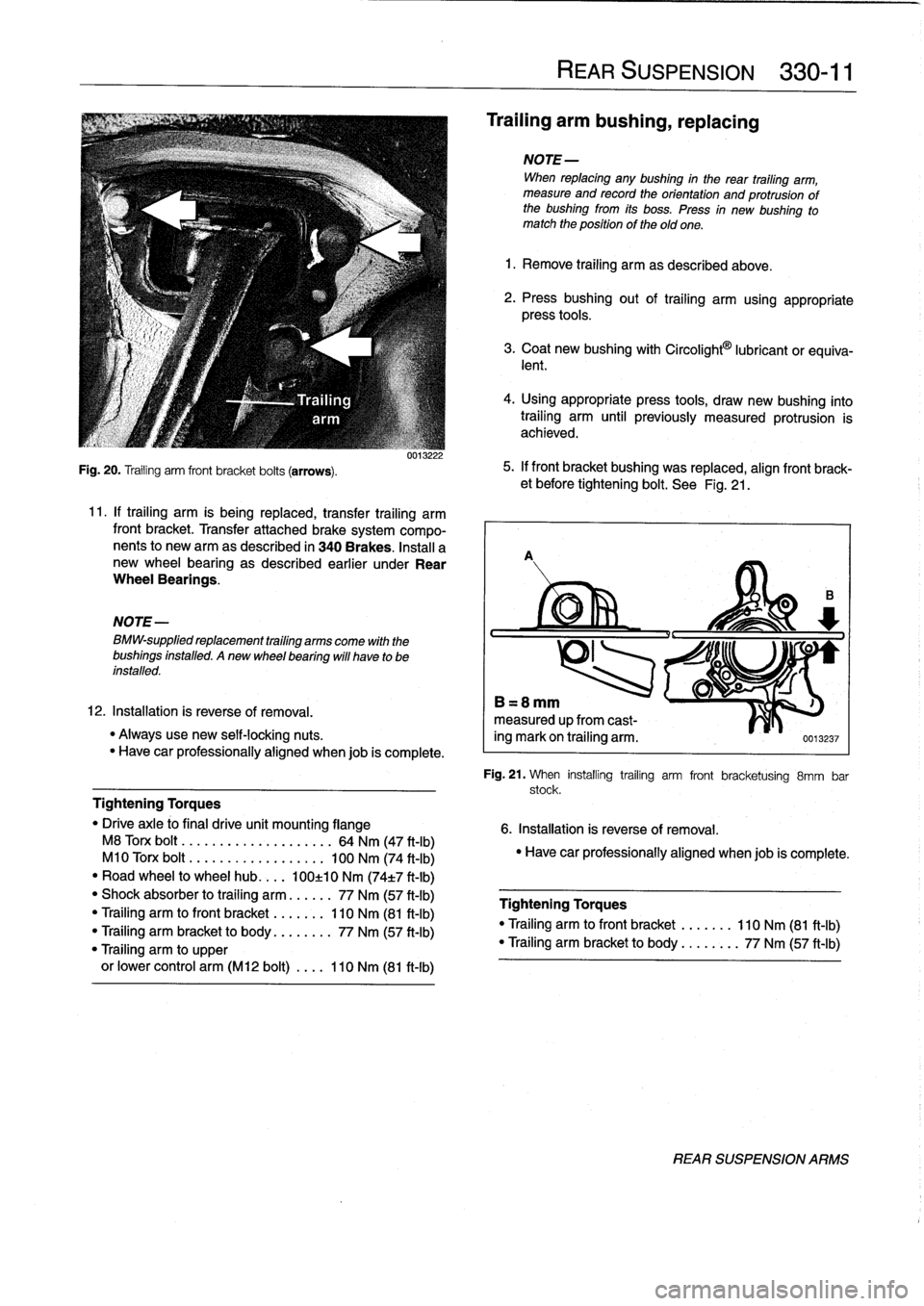
Fig
.
20
.
Trailing
arm
front
bracket
bolts
(arrows)
.
NOTE-
BMW-supplied
replacement
trailing
arms
come
with
the
bushings
installed
.
Anew
wheel
bearing
will
have
to
be
installed
.
0013222
11
.
If
trailing
arm
is
being
replaced,
transfer
trailing
arm
front
bracket
.
Transfer
attached
brake
system
compo-
nents
to
newarm
as
described
in
340Brakes
.
Insta¡¡
a
new
wheel
bearing
as
described
earlier
under
Rear
Wheel
Bearings
.
12
.
Installation
is
reverse
of
removal
.
"
Alwaysuse
new
self-locking
nuts
.
"
Have
car
professionally
aligned
when
job
is
complete
.
Tightening
Torques
"
Drive
axle
#o
final
drive
unit
mounting
flange
M8
Torx
bolt
......
.
...
.....
.
..
..
64
Nm
(47
ft-Ib)
M10
Torx
bolt
.....
...
.
....
.....
100
Nm
(74
ft-Ib)
"
Road
wheel
to
wheel
hub
.
...
100±10
Nm
(74t7
ft-Ib)
"
Shock
absorber
to
trailing
arm
......
77
Nm
(57
ft-Ib)
"
Trailing
arm
tofront
bracket
.......
110
Nm
(81
ft-Ib)
"
Trailing
arm
bracket
to
body
........
77
Nm
(57
ft-Ib)
"Trailing
arm
to
upper
or
lower
control
arm
(M12
bolt)
....
110
Nm
(81
ft-Ib)
REAR
SUSPENSION
330-
1
1
Trailing
arm
bushing,
replacing
NOTE-
When
replacing
any
bushing
in
the
rear
trailing
arm,
measure
and
recordthe
orientation
and
protrusion
of
the
bushing
from
its
boss
.
Press
in
new
bushing
to
match
the
positionof
theold
one
.
1
.
Remove
trailing
arm
as
described
above
.
2
.
Pressbushing
out
of
trailing
arm
using
appropriate
press
tools
.
3
.
Coat
new
bushing
with
Circolight
9
lubricant
or
equiva-
lent
.
4
.
Using
appropriate
press
tools,
draw
new
bushing
into
trailing
arm
until
previously
measured
protrusion
is
achieved
.
5
.
If
front
bracket
bushing
was
replaced,
alignfront
brack-
et
before
tightening
bolt
.
See
Fig
.
21
.
A
B=8mm
measured
upfrom
cast-
ing
mark
on
trailing
arm
.
0013237
Fig
.
21
.
When
installing
trailing
arm
front
bracketuising
8mm
bar
stock
.
6
.
Installation
is
reverse
of
removal
.
"
Have
car
professionally
aligned
when
job
is
complete
.
Tightening
Torques
"
Trailing
arm
tofront
bracket
.......
110
Nm
(81
ft-Ib)
"Trailing
arm
bracket
to
body
......
.
.
77
Nm
(57
ft-Ib)
REAR
SUSPENSION
ARMS
Page 287 of 759
GENERAL
......
.
.
.
.
.
.
.
.....
.
.
.
.
.
.
.
.
.
.
331-1
Final
Drive
Oil
Seals
.
.
...
.
.
.
.......
.
.
.
.
.
331-1
Finaldrive
flange
oil
sea¡,
replacing
....
.
.
.
..
331-2
FINAL
DRIVE
SERVICE
.
.....
.
.
.
.
.
.
.
.
.
.
331-1
Finaldrive
inputshaft
oil
seal,
replacing
.
.
.
.
.
331-3
Final
drive
oí¡,
draining
and
filling
.
.
.
.
.
.
.
.
.
.
331-1
Finaldrive
unit,
removíng
and
installing
.
.
.
.
.
.
331-3
GENERAL
This
repa¡r
group
covers
repair
operations
that
do
not
re-
quire
complicated
disassembly
of
the
final
drive
.
Internal
re-
pairs
and
final
drive
disassembly
are
not
covered
in
this
manual
.
FINAL
DRIVE
SERVICE
Al¡
final
drive
work
requires
some
method
of
raising
thecar
and
supporting
it
securely
while
the
work
is
performed
.
Jack
stands
and
a
floor
jack
can
easily
be
used,
but
use
extreme
caution
when
working
beneath
the
car
.
See010
Fundamen-
tais
for
the
Do-It-Yourself
Owner
.
NOTE-
Removal
of
final
drive
carrier
is
covered
in
330
Rear
Suspension
.
Final
drive
oil,
draining
and
filling
1
.
Drive
car
to
warm
final
drive
fluid
.
2
.
Raise
car
and
support
safely
.
WARNING
-
Make
sure
that
thecar
is
firmly
supported
on
jack
standsdesigned
for
the
purpose
.
Place
the
jack
standsbeneatha
structural
chassis
point
.
Do
not
place
jack
stands
under
suspension
parts
.
5
.
Fill
final
drive
with
appropriate
type
and
quantity
of
lu-
bricant
.
Insta¡¡
and
tighten
fill
plug
.
331
Final
Drive
0
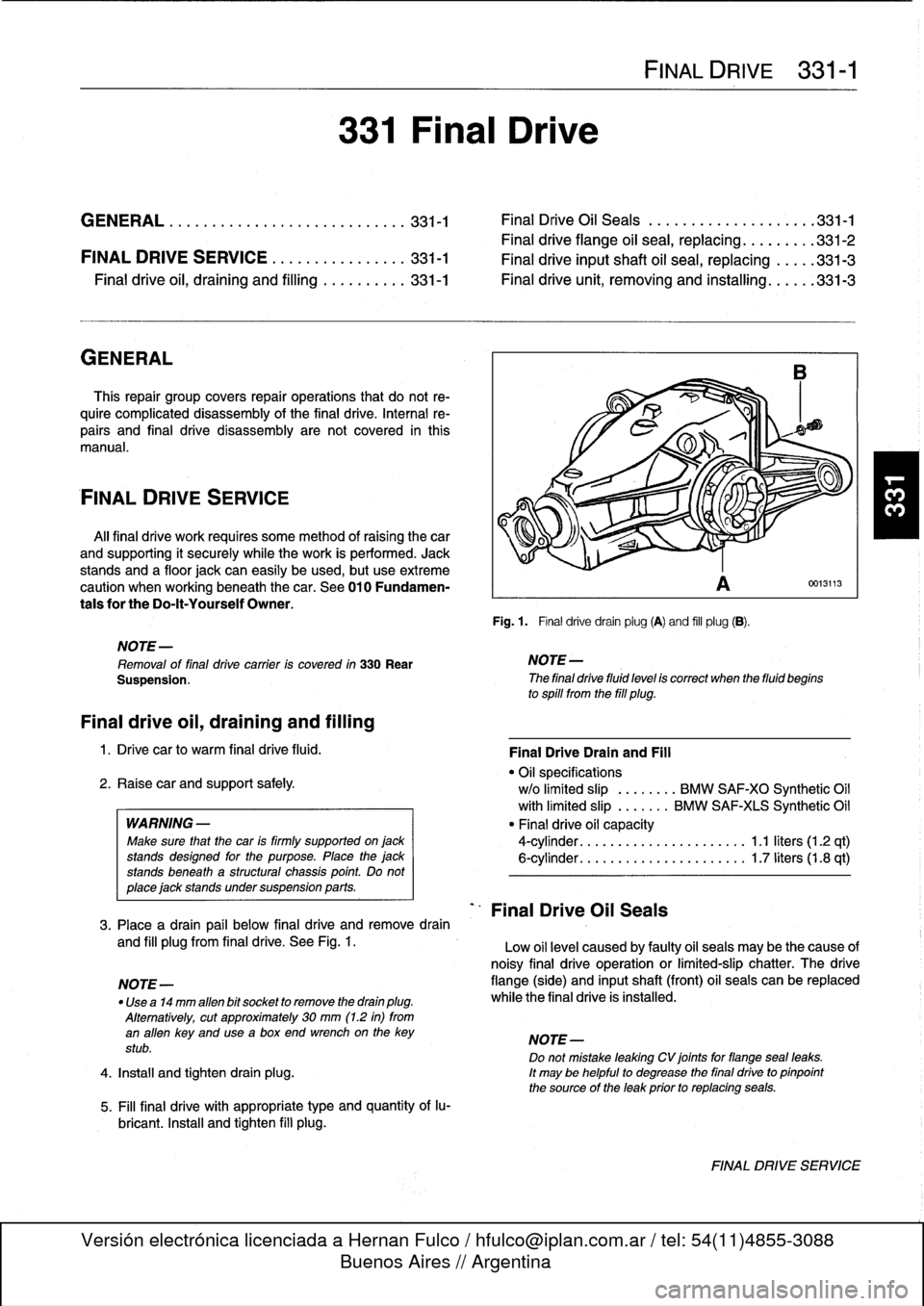
Fig
.
1
.
Final
drivedrain
plug
(A)
and
fill
plug
(B)
.
D
NOTE-
The
final
drive
fluid
level
is
correct
when
the
fluid
begins
to
spill
from
the
fill
plug
.
Final
Drive
Oil
Seals
FINAL
DRIVE
331-1
0013113
Final
DriveDrain
and
Fill
"
Oil
specifications
w/o
limited
slip
.
.......
BMW
SAF-XO
Synthetic
Oil
with
limited
slip
.
......
BMW
SAF-XIS
Synthetic
Oil
"
Final
drive
oil
capacity
4-cylinder
.
.
.
...
................
1
.1
liters
(1
.2
qt)
6-cylinder
.
.
.
...
................
1
.7liters(1.8
qt)
3
.
Place
a
drain
pail
below
final
drive
andremove
drain
and
fill
plugfrom
final
drive
.
See
Fig
.
1
.
Low
oil
level
caused
by
faulty
oil
seals
may
be
the
cause
of
noisy
final
drive
operation
or
limited-slip
chatter
.
The
drive
NOTE-
flange
(side)
and
inputshaft
(front)
oil
seals
can
be
replaced
"
Use
a14
mm
alíen
bit
socket
to
remove
the
drain
plug
.
while
the
final
drive
is
installed
.
Alternatively,
cut
approximately
30
mm
(1
.2
in)
from
an
alíen
key
and
usea
box
end
wrenchon
the
key
NOTE-
stub
.
Do
not
mistake
leaking
CV
joints
for
flangeseal
leaks
.
4
.
Install
and
tighten
drain
plug
.
It
may
be
helpful
to
degrease
the
final
drive
to
pinpoint
the
source
of
the
leak
prior
to
replacing
seals
.
FINAL
DRIVE
SERVICE
Page 291 of 759
Brake
rotor,
removing
and
installing
.
.
.
.
.
.
.
.
340-7
MASTER
CYLINDER
............
.
.
.
.
.
.
.340-7
Master
cylinder,
removing
and
installing
.
...
.
340-7
GENERAL
TROUBLESHOOTING
WARNING
-
"
Although
semi-metallic
and
metallic
Brake
friction
materials
in
Brake
pads
or
shoes
no
longer
con-
tain
asbestos,
they
produce
dangerous
dust
.
"
Brake
fluid
is
poisonous,
highly
corrosive
and
dangerous
to
the
environment
Wear
safety
glasses
and
rubber
gloves
when
working
with
Brake
fluid
.
Do
not
siphonBrake
fluid
with
your
mouth
.
Immediately
clean
away
any
fluid
spilled
on
painted
surfaces
and
wash
with
water,
asBrake
fluid
will
remove
paint
.
"
Always
use
new
Brake
fluid
froma
fresh,
un-
opened
container
.
Brake
fluid
will
absorb
mois-
ture
from
the
air
.
This
canlead
to
corrosion
problems
in
the
brakingsystem,
and
will
also
low-
er
the
Brake
fluid's
boiling
point
.
Dispose
of
Brake
fluid
properly
.
"
Do
notreuse
self-locking
nuts,bolts
or
fasteners
.
They
are
designed
to
be
used
only
once
and
may
failif
reused
.
Always
replace
them
with
new
self-
locking
fasteners
.
BMW
E36
models
areequipped
with
vacuum
power-assist-
ed
four-wheel
disc
brakes
with
an
integral
Antilock
Brake
Sys-
tem
(ABS)
.
Single-pistoncalipers
act
on
solid
or
vented
front
rotors
and
solid
rear
rotors
.
A
brake
pad
wear
sensor
for
each
axle
indicates
when
brake
padsneed
replacement
.
The
dual
drum-type
parking
brakesystem
is
integrated
with
the
rear
brake
rotors
.
NOTE-
M3
models
havevented
directional
Brake
rotors
on
the
rearaxle
as
well
ason
the
front
.
340
Brakes
BRAKES
340-1
GENERAL
.
.
.
.
.
.
.........
.
.
.
..........
340-1
BRAKE
BOOSTER
.........
.
.
.
.
.
...
.
.
.
.
340-8
TROUBLESHOOTING
.......
.
......
.
...
340-1
Brake
booster,
removing
and
installing
....
.
.
340-8
PARKING
BRAKE
.
.....
.
...
.
.
.
.....
.
.
.
340-10
BLEEDING
BRAKES
.
.
.
.
.
.
.
.
..........
340-3
Parking
brake,adjusting
.
.
.
.
.
.
.
.
.
.
.....
.
340-10
Pressure
bleeding
brakes
Parking
brake
shoes,
removing
and
installing
.
340-11(except
cars
with
AST)
.
.
.
.
.
.
.
.
.
...
.
.
.
.
.340-3
Parking
Brake
cable,
replacing
.
.
.
.
.
.
.
.
.
.
.
.
340-11
BRAKE
PADS,
CALIPERS,
ANTILOCK
BRAKE
SYSTEM
(ABS)
.
.
.
.340-11
AND
ROTORS
..........
.
.......
.
.
.
.
.
.
.
340-3
ABS
System
Inspection
.
...
.
.......
.
.
.
..
340-12
Brake
pads,
replacing
............
.
.
.
.
.
.
.
340-4
ABS
wheel
speed
sensors,
replacing
.
.
.
.
..
340-12
Brake
caliper,
removing
and
installing
.
..
..
.
340-6
TABLES
a
.
Brake
System
Troubleshooting
.....
...
.
.
.....
.340-2
b
.
Brake
Rotor
Reconditioning
Specifications
.
.....
.340-7
Brakeperformance
is
mainly
affected
by
three
things
:
the
leve¡
and
condition
of
the
brake
fluid,
the
system's
abilíty
to
create
and
maintain
hydraulic
pressure,
and
the
condition
of
the
friction
components
.
Air
in
the
Brake
fluid
will
make
the
Brake
pedal
feel
spongy
during
braking
or
will
increase
the
Brake
pedalforce
required
to
stop
.
Fluid
contaminated
by
moisture
or
dirt
can
corrode
the
system
.
Inspect
the
Brake
fluid
inside
the
reservoir
.
Ifit
is
dirty
or
murky,
or
is
over
a
year
old,
the
fluid
should
be
replaced
.
Visually
check
the
hydraulic
system
startingat
the
master
cylinder
.
To
check
the
function
of
the
master
cylinder
hold
the
brake
pedal
down
hard
with
the
engine
running
.
The
pedal
should
feelsolid
and
stay
solid
.
If
the
pedal
slowly
falls
to
the
floor,
either
the
master
cylinder
is
leaking
internally,
or
fluid
is
leaking
externally
.
If
no
leaks
canbe
found,
the
master
cylin-
der
is
faulty
and
should
be
replaced
.
Check
all
Brake
fluid
lines
and
couplings
for
leaks,
kinks,
chafing
and
corrosion
.
Check
the
Brake
booster
by
pumping
the
Brake
pedal
ap-
proximately
10
times
with
the
engine
off
.
Hold
the
pedal
down
and
start
the
engine
.
The
pedal
should
fa¡¡
slightly
.
If
not,
check
for
any
visiblefaults
before
suspecting
a
faulty
brake
booster
.
Check
for
strong
vacuum
at
the
vacuum
hose
fitting
at
the
booster,
and
check
the
non-retum
valve
for
one-way
flow
.
Worn
or
contaminated
brake
pads
will
cause
poor
braking
performance
.
Oil-contaminated
or
glazed
pads
will
cause
stopping
distances
to
increase
.
Inspect
the
rotors
for
glazing,
discoloration
and
scoring
.
Steering
wheel
vibration
while
braking
at
speed
is
often
caused
by
warped
rotors,
but
can
also
be
caused
byworn
suspension
components
.
TROUBLESHOOTING
Page 295 of 759
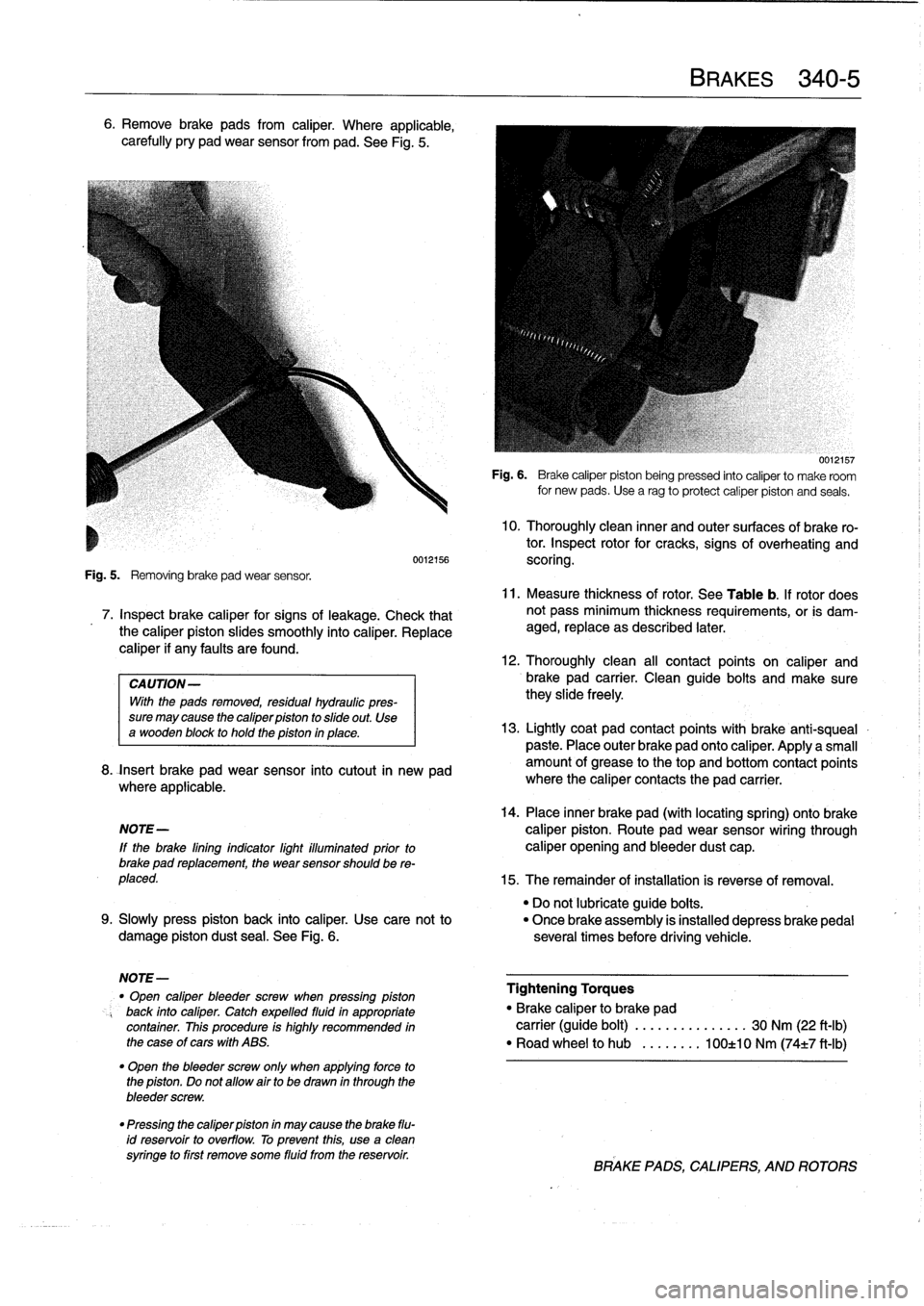
6
.
Remove
brake
pads
from
caliper
.
Where
applicable,
carefully
pry
pad
wear
sensor
from
pad
.
See
Fig
.
5
.
Fig
.
5
.
Removing
brake
pad
wear
sensor
.
7
.
Inspect
brake
caliper
for
signs
of
leakage
.
Check
that
the
caliper
piston
slides
smoothly
into
caliper
.
Replace
caliper
if
any
faults
are
found
.
CAUTION-
With
the
pads
removed,
residual
hydreulic
pres-
sure
may
cause
the
caliper
piston
to
slide
out
.
Use
a
wooden
block
to
hold
the
piston
in
place
.
8
.
fnsert
brake
pad
wear
sensor
into
cutout
in
new
pad
where
applicable
.
14
.
Place
inner
brake
pad
(with
locating
spring)
ontobrake
NOTE-
caliper
piston
.
Route
pad
wear
sensor
wiring
through
lf
the
brake
lining
indicator
light
illuminated
prior
to
caliper
opening
and
bleeder
dust
cap
.
brake
pad
replacement,
the
wear
sensor
should
be
re-
placed
.
15
.
The
remainder
of
installation
is
reverse
of
removal
.
"
Do
not
lubricate
guide
boits
.
9
.
Slowly
press
piston
back
into
caliper
.
Use
cace
not
to
"
Once
brake
assembly
is
installed
depress
brakepedal
damage
piston
dust
sea¡
.
See
Fig
.
6
.
severa¡
times
before
driving
vehicle
.
NOTE-
"
Open
caliper
bleeder
screw
when
pressing
piston
Tightening
Torques
back
into
caliper
.
Catch
expelled
fluidin
appropriate
"
Brake
caliper
to
brake
pad
container
.
This
procedure
is
highly
recommended
in
carrier
(guide
bolt)
..........
...
.
.
30
Nm
(22
ft-Ib)
the
case
of
cars
with
ABS
.
"
Road
wheel
to
hub
.....
.
..
100±10
Nm
(74±7
ft-Ib)
"
Open
the
bleeder
screw
only
when
applying
force
to
the
piston
.
Do
not
allow
airto
be
drawn
in
through
the
bleeder
screw
.
"
Pressing
the
caliper
piston
in
may
cause
the
brake
flu-
id
reservoir
to
overflow
.
To
prevent
this,
use
a
clean
syringe
to
first
remove
some
fluid
from
the
reservoir
.
BRAKES
340-
5
0012157
Fig
.
6
.
Brake
caliper
piston
being
pressed
into
caliper
to
make
room
for
new
pads
.
Usea
rag
toprotect
caliper
piston
and
seals
.
10
.
Thoroughly
clean
inner
and
outer
surfaces
of
brake
ro-
tor
.
Inspect
rotor
for
cracks,
signs
of
overheating
and
0012156
scoring
.
11
.
Measure
thickness
of
rotor
.
See
Table
b
.
If
rotor
does
not
pass
minimum
thickness
requirements,
or
is
dam-
aged,
replace
as
described
later
.
12
.
Thoroughly
clean
all
contact
points
on
caliper
and
brake
pad
carrier
.
Clean
guide
bolts
and
make
surethey
slide
freely
13
.
Lightly
coat
pad
contact
points
with
brake
anti-squeal
paste
.
Place
outer
brake
pad
onto
caliper
.
Applya
small
amount
of
grease
to
thetop
and
bottom
contact
points
where
the
caliper
contacts
the
pad
carrier
.
BRAKE
PADS,CALIPERS,
ANDROTORS
Page 304 of 759
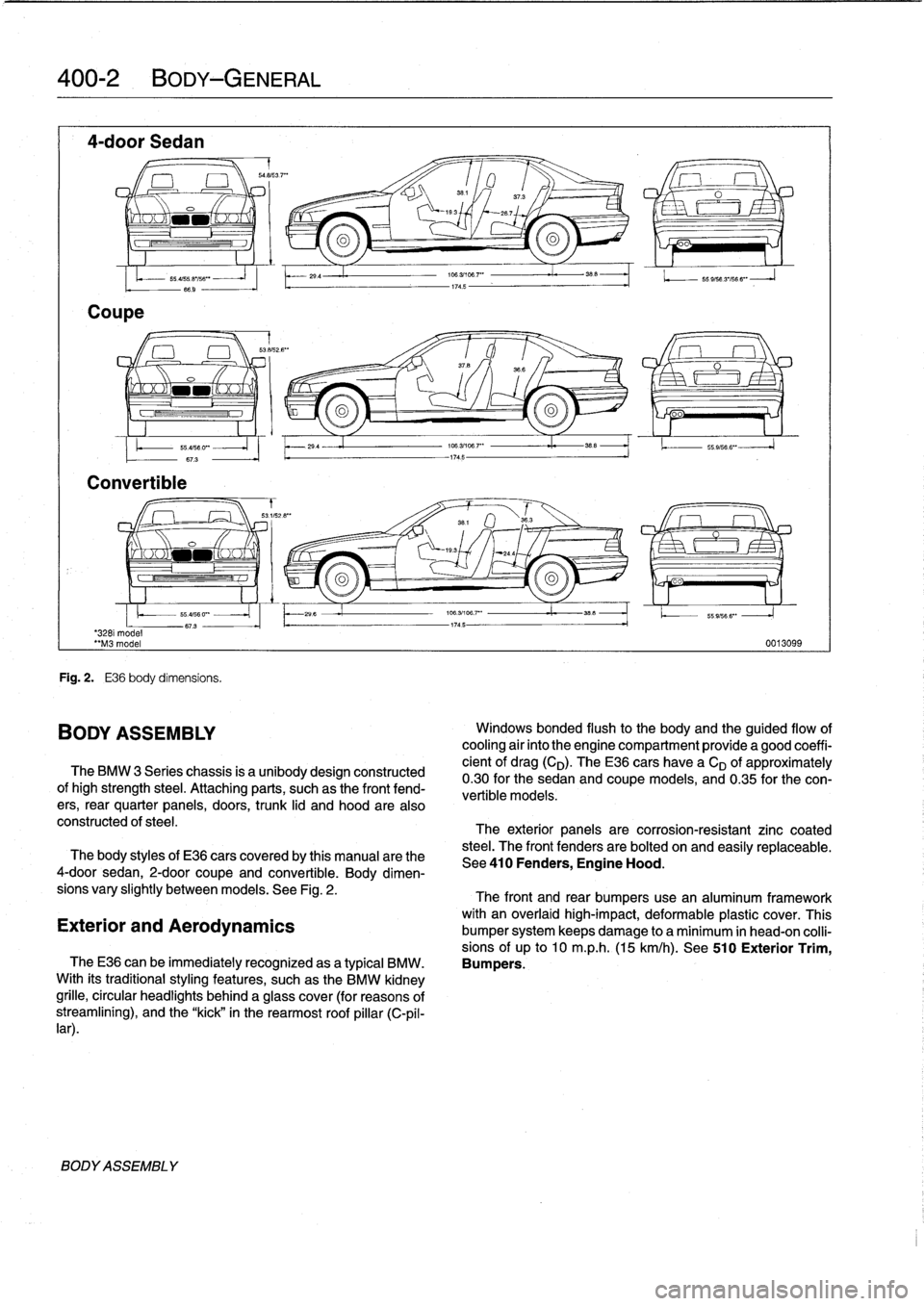
400-2
BODY-GENERAL
4-door
Sedan
Coupe
-
saas3
.7""
351
/
37
.3
O
I
x
`-193
267
o
oa
'3281
model
"M3
model
Convertible
BODYASSEMBLY
55
ass
.e
iss
""
-
66
.9
-
Fig
.
2
.
E36
body
dimensíons
.
BODY
ASSEMBLY
29
.4
29
4
The
BMW
3
Series
chassis
is
a
unibodydesign
constructed
ofhigh
strength
steel
.
Attaching
parts,
suchas
the
front
fend-
ers,
rear
quarter
panels,
doors,
trunk
lid
and
hood
are
also
constructed
of
steel
.
706
.31108
.7"
I
38
.5
174
.5
174
.5
O
oo
196
.3/106
.7'
"
35_5
1.
.
55
.9,566
".
106
.3/196
.7""
i.
358
-1745-
55
9/56
3'/56
6"
-
J
0013099
Windows
bonded
flush
to
the
body
and
the
guided
flow
of
cooling
air
into
the
engine
compartment
provide
a
good
coeffi-
cient
of
drag(CD)
.
TheE36
cars
have
a
CD
of
approximately
0
.30for
the
sedan
and
coupe
models,
and
0
.35
for
the
con-
vertible
models
:
The
exterior
panels
are
corrosion-resistant
zinc
coated
steel
.
The
front
fenders
are
bolted
on
and
easily
replaceabie
.
The
body
styles
of
E36
cars
coveredby
this
manual
arethe
See410
Fenders,
Engine
Hood
.
4-door
sedan,
2-door
coupe
and
convertible
.
Body
dimen-
sions
vary
slightly
betweenmodels
.
See
Fig
.
2
.
The
front
and
rear
bumpers
use
an
aluminum
framework
with
an
overlaid
high-impact,
deformable
plastic
cover
.
This
Exterior
and
Aerodynamics
bumper
system
keeps
damage
to
a
minimum
in
head-on
colli-
sions
of
up
to
10
m
.p
.h
.
(15
km/h)
.
See
510
Exterior
Trim,
TheE36
can
be
immediatelyrecognized
asa
typical
BMW
.
Bumpers
.
With
its
traditionalstyling
features,
suchas
the
BMW
kidney
grille,
circular
headlights
behind
a
glass
cover
(for
reasons
of
streamliníng),
and
the
"kick"
in
the
rearmost
roof
pillar
(C-pil-
lar)
.
Page 312 of 759
410-4
FENDERS,
ENGINE
HOOD
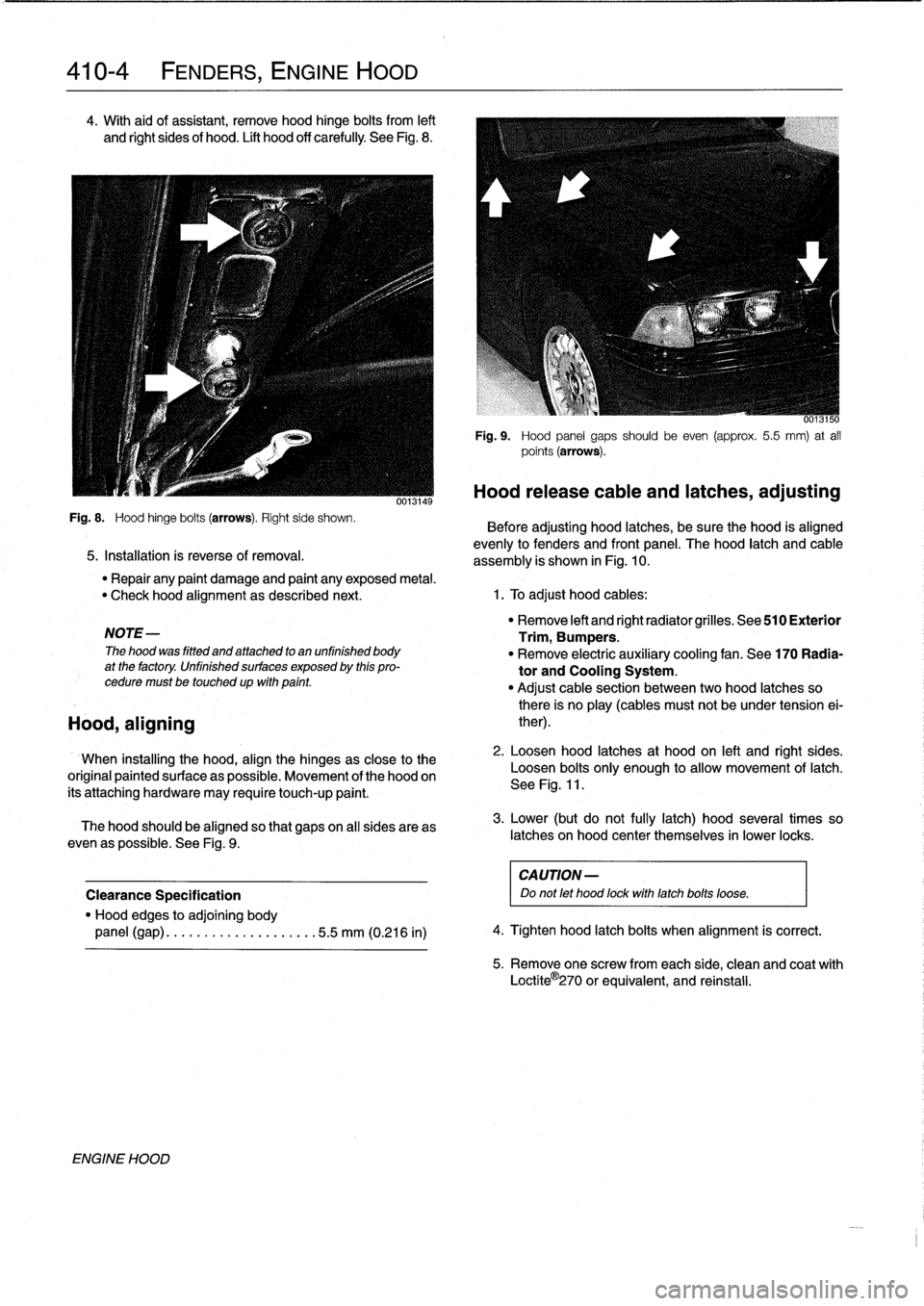
4
.
With
aid
of
assistant,
remove
hood
hinge
bolts
from
left
and
Rght
sides
of
hood
.
Lift
hood
off
carefully
See
Fig
.
8
.
Fig
.
8
.
Hood
hinge
bolts
(arrows)
.
Right
side
shown
.
5
.
Installation
is
reverse
of
removal
.
NOTE-
The
hood
was
fitted
and
attached
to
an
unfinished
body
at
the
factory
.
Unfinished
surfaces
exposed
by
this
pro-
cedure
must
betouchedup
wfth
pafnt
.
Hood,
aligning
ENGINE
HOOD
0013149
6013150
Fig
.
9
.
Hood
panel
gaps
should
be
even
(approx
.
5
.5
mm)
at
all
points
(arrows)
.
Hood
release
cable
and
latches,
adjusting
Before
adjusting
hood
latches,
be
sure
the
hood
is
aligned
evenly
to
fenders
and
front
panel
.
The
hood
latch
and
cable
assembly
is
shown
in
Fig
.
10
.
"
Repair
any
paint
damage
and
paint
any
exposed
metal
.
"
Check
hood
alignment
as
described
next
.
1
.
To
adjust
hood
cables
:
When
installing
the
hood,
align
the
hinges
as
close
to
the
original
paintedsurface
as
possible
.
Movement
of
the
hood
on
its'attaching
hardware
may
require
touch-up
paint
.
The
hood
should
be
aligned
so
that
gapson
all
sides
areas
even
as
possible
.
See
Fig
.
9
.
Clearance
Specification
"
Hood
edges
to
adjoining
body
panel
(gap)
........
..
..
..
.....
.5
.5
mm
(0.216
in)
"
Remove
left
and
right
radiator
grilles
.
See
510
Exterior
Trim,
Bumpers
.
"
Remove
electric
auxíliary
cooling
fan
.
See
170
Radia-
tor
and
Cooling
System
.
"
Adjust
cable
section
between
two
hood
latches
so
there
is
no
play
(cables
must
not
be
under
tension
ei-
ther)
.
2
.
Loosen
hood
latches
at
hood
on
left
and
right
sides
.
Loosen
bolts
only
enough
to
allow
movement
of
latch
.
See
Fig
.
11
.
3
.
Lower
(but
do
not
fully
latch)
hood
severa¡
times
so
latches
on
hood
center
themselves
in
lower
locks
.
CA
UTION-
Do
not
let
hood
fockwith
latchbolts
loose
.
4
.
Tighten
hood
latch
bolts
when
alignment
is
correct
.
5
.
Remove
one
screw
fromeach
side,
clean
and
coat
with
Loctite
O
270
or
equivalent,
and
reinstall
.
Page 316 of 759
411-2
DOORS
4
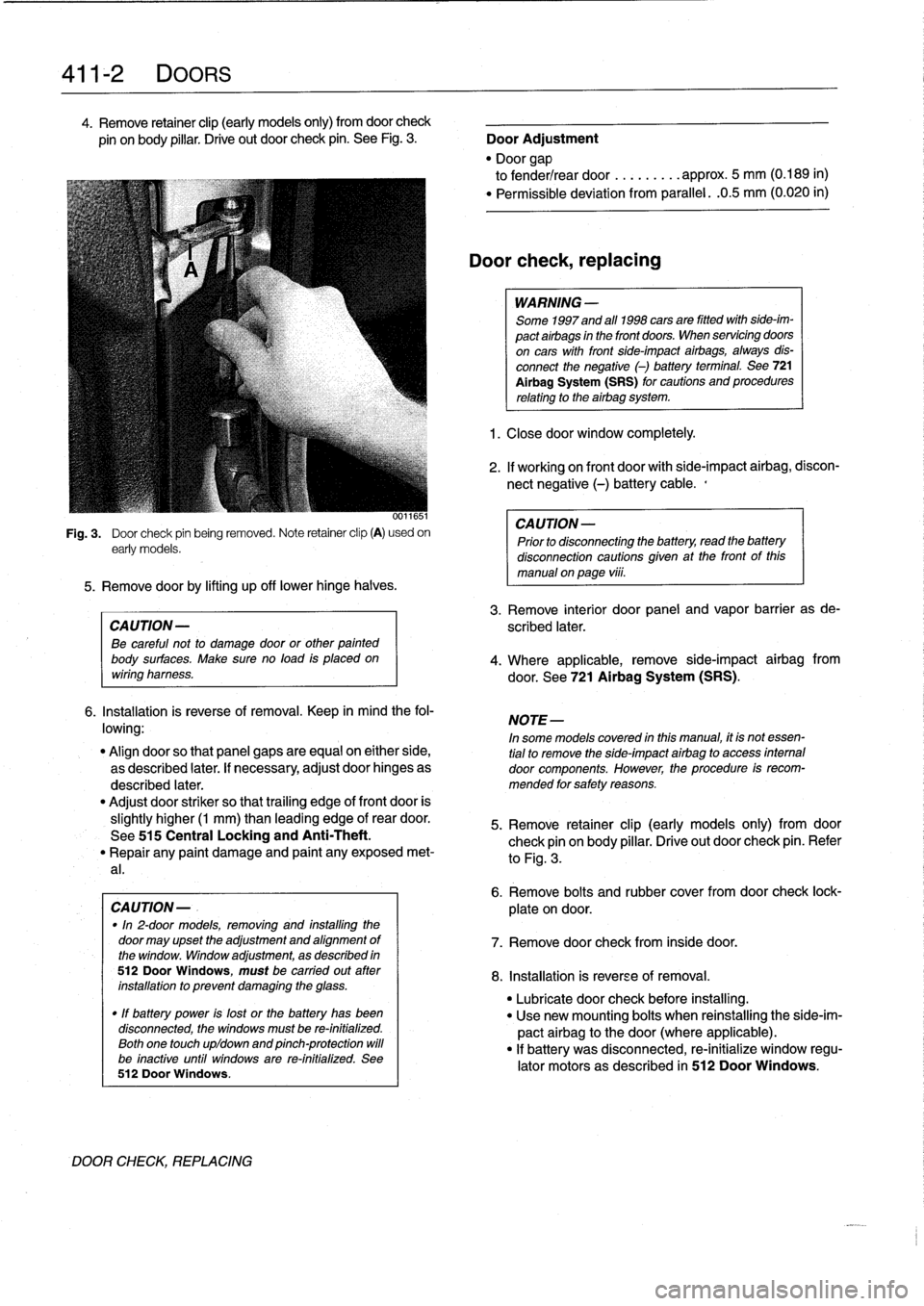
.
Remove
retainer
clip
(early
models
only)
from
doorcheck
pin
onbody
pillar
.
Drive
out
door
check
pin
.
See
Fig
.
3
.
Door
Adjustment
"
Door
gap
to
fender/rear
door
.........
approx
.
5
mm
(0
.189
in)
"
Permíssible
deviation
from
parallel
.
.0
.5
mm
(0
.020
in)
0011651
Fig
.
3
.
Door
check
pin
being
removed
.
Note
retainer
clip
(A)
usedon
early
models
.
5
.
Remove
doorby
lifting
up
off
lowerhinge
halves
.
CAUTION-
Be
careful
not
to
damage
door
or
other
painted
body
surfaces
.
Make
sure
no
load
is
placedon
wiring
harness
.
6
.
Installation
is
reverse
of
removal
.
Keep
in
mind
the
fol-
lowing
:
"
Align
doorso
that
panel
gaps
are
equal
on
either
side,
as
described
later
.
If
necessary,
adjust
door
hinges
as
described
later
.
"
Adjust
door
striker
so
that
trailing
edge
of
front
door
is
slightly
higher
(1
mm)
than
leading
edge
of
rear
door
.
See
515
Central
Locking
and
Anti-Theft
.
"
Repair
any
paint
damage
and
paínt
any
exposed
met-
al
.
CAUTION-
.
"In
2-door
models,
removing
and
installing
the
door
may
upset
the
adjustment
and
alignment
of
the
window
.
Window
adjustment,
as
described
in
512DoorWindows,
must
be
carried
out
ater
installation
to
prevent
damaging
the
glass
.
"
If
battery
power
is
lost
or
the
battery
has
been
disconnected,
the
windows
must
be
re-initialized
.
Both
one
touch
upldown
and
pinch-protection
will
be
inactive
until
windows
are
re-initialized
.
See
512
Door
Windows
.
DOOR
CHECK,
REPLACING
Door
check,replacing
WARNING
-
Some
1997
and
all
1998
cars
are
fitted
with
side-im-
pact
airbags
in
the
front
doors
.
When
servicing
doors
on
cars
with
front
side-impact
airbags,
always
dis-
connect
the
negative
(-)
battery
terminal
.
See
721
Al
rbag
System
(SRS)
for
cautions
and
procedures
relating
to
the
airbag
system
.
1
.
Closedoor
window
completely
.
2
.
If
working
on
front
door
with
side-impact
airbag,
discon-
nect
negative
(-)
battery
cable
.,
CAUTION-
Prior
to
disconnectiog
the
battery,
read
the
battery
disconnection
cautions
gíven
at
the
front
of
this
manual
on
page
viii
.
3
.
Remove
interior
door
panel
and
vapor
barrier
as
de-
scribed
later
.
4
.
Where
applicable,
remove
side-impact
airbag
from
door
.
See
721
Airbag
System
(SRS)
.
NOTE-
In
some
models
covered
inthis
manual,
ít
is
not
essen-
tial
to
remove
the
side-ímpact
airbag
to
access
internal
door
components
.
However,
the
procedure
is
recom-
mended
for
safety
reasons
.
5
.
Remove
retainer
clip
(early
models
only)
from
door
check
pin
on
body
pillar
.
Drive
out
door
check
pin
.
Refer
to
Fig
.
3
.
6
.
Remove
bolts
and
rubber
cover
fromdoor
check
lock-
plate
ondoor
.
7
.
Remove
door
check
from
inside
door
.
8
.
Installation
is
reverse
of
removal
.
"
Lubricate
door
check
before
installing
.
"
Use
new
mounting
bolts
when
reinstalling
the
side-im-
pact
airbag
to
thedoor(where
applicable)
.
"
If
battery
was
disconnected,
re-initialize
window
regu-
lator
motors
as
described
in
512
Door
Windows
.
Page 322 of 759
412-2
TRUNK
LID
Trunk
lid,
aligning
1.
Raise
trunk
lid
.
2
.
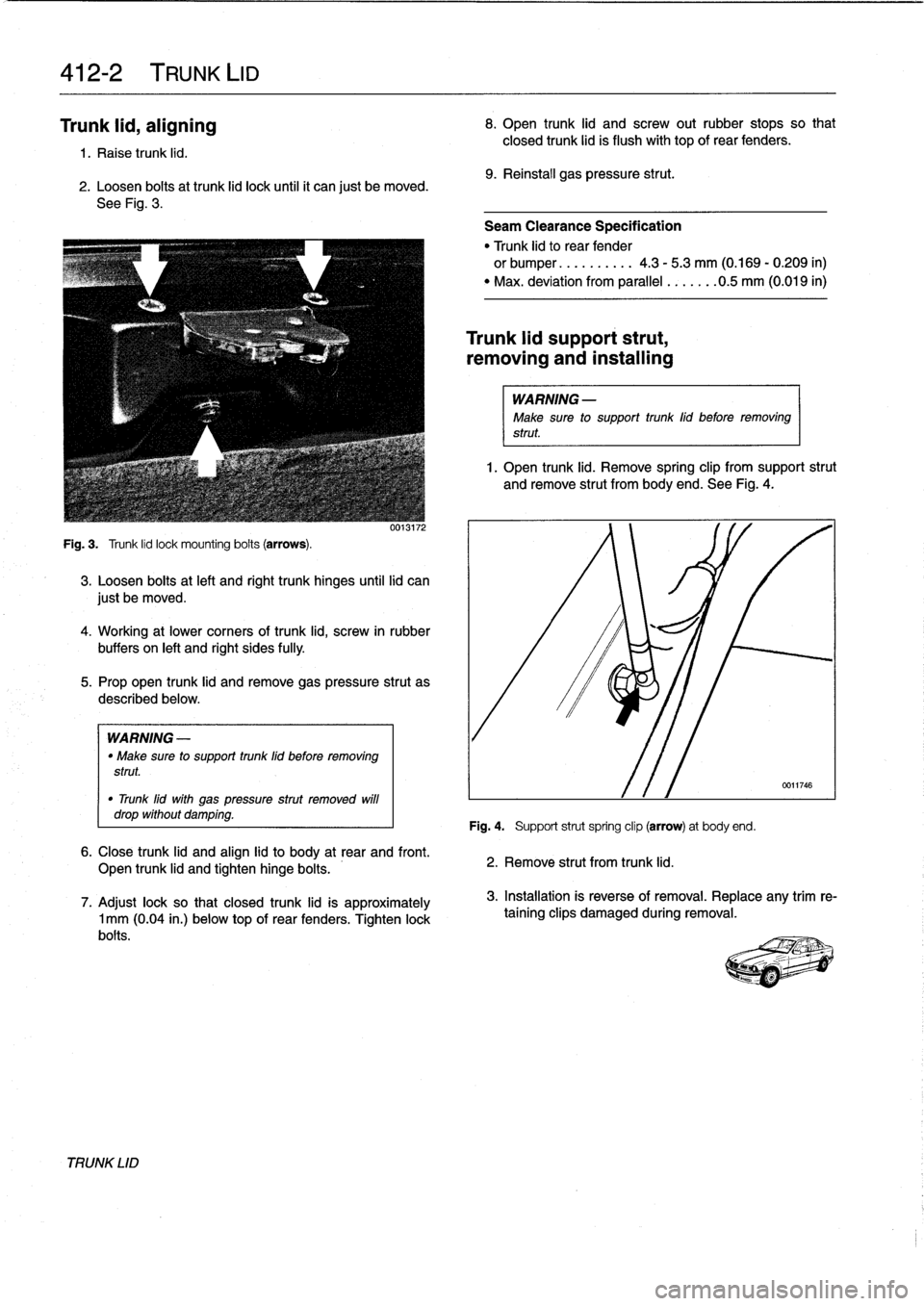
Loosen
boits
at
trunk
lid
lock
until
it
can
just
be
moved
.
See
Fig
.
3
.
Fig
.
3
.
Trunk
lid
lock
mounting
boits
(arrows)
.
0013172
3
.
Loosen
bolis
at
left
and
right
trunk
hinges
until
lid
can
just
be
moved
.
4
.
Working
at
lower
comers
of
trunk
lid,
screw
in
rubber
buffers
on
left
and
right
sides
fully
.
5
.
Prop
open
trunk
lid
and
remove
gas
pressure
strut
as
described
below
.
WARNING
-
"
Make
sure
to
support
trunk
lid
before
removing
strut
.
"
Trunk
lid
with
gas
pressure
strut
removed
will
drop
without
damping
.
6
.
Close
trunk
lid
and
align
lid
to
body
at
rear
and
front
.
Open
trunk
lid
and
tighten
hinge
bolis
.
7
.
Adjust
lock
so
that
closed
trunk
lid
is
approximately
1
mm
(0
.04
in
.)
belowtop
of
rear
fenders
.
Tighten
lock
bolts
.
TRUNK
LID
8
.
Open
trunk
lid
and
screw
outrubber
stops
so
that
closed
trunk
lid
is
flush
with
top
of
rear
fenders
.
9
.
Reinstall
gas
pressure
strut
.
Seam
Clearance
Specification
"
Trunk
lid
to
rear
fender
or
bumper
..........
4
.3
-
5
.3
mm
(0
.169
-
0
.209
in)
"
Max
.
deviation
from
parallel
.......
0
.5
mm
(0
.019
in)
Trunk
lid
support
strut,
removing
and
installing
WARNING
-
Make
sure
to
support
trunk
lid
before
removing
strut
1
.
Open
trunk
lid
.
Remove
spring
clip
from
support
strut
and
remove
strut
from
body
end
.
See
Fig
.
4
.
Fig
.
4
.
Support
strut
spring
clip
(arrow)
at
body
end
.
2
.
Remove
strut
from
trunk
lid
.
3
.
Installation
is
reverse
of
removal
.
Replace
any
trim
re-
taining
clips
damaged
during
removal
.
Page 323 of 759
GENERAL
.
.
.
.
.
.
.
.
.
...
.
..
.
...
.
.........
510-1
Front
bumper
impact
absorber,
replacing
....
510-4
Rear
bumper,
removing
and
installing
.....
.510-4
OUTSIDE
REAR
VIEW
MIRRORS
.
...
.
.....
510-1
Rear
bumper
impact
absorber,
replacing
...
.
510-6
Outside
mirrorglass,
replacing
.
.
.........
510-1
Bumper
height,
adjusting
...
.
...
.
...
.
.
.
.
.
510-6
Outside
mirror
housing,
removing
and
installing
....
.
.....
.
.
.
.
.
.
510-1
EXTERIOR
TRIM
...
.
.
.
.
.
.
.
.
.
.
.
...
.
.
.
.
.
510-6
Outside
mirror,
removing
and
installing
.
.
.
.
.
510-2
BMW
embiem,
removing
and
installing
.
.
.
.
.
.
510-7
Body
side
molding,
replacing
.
.
.
.
.
.
.
.
.
.
.
.
.
510-7
BUMPERS
.
.
.
.
.
....
.
.....
.
.....
.
.
.
.
.
.
510-3
Radiator
grille,
removing
and
installing
.
.
.
.
.
.510-7
Front
bumper,
removing
and
installing
.
.
.
.
.
.
510-3
Front
panel,
removing
and
installing
...
.
.
.
.
.
510-7
GENERAL
510
Exterior
Trim,
Bumpers
This
repair
group
includes
repair
information
for
the
outside
rear
view
mirror,
front
and
rear
bumpers,
and
the
easily
re-
movable
exterior
trim
parts
.
OUTSIDE
REAR
VIEW
MIRRORS
The
remove
controlled
mirrors
come
in
two
styles
:
heated
and
unheated
.
Many
of
the
mirror
components
are
separately
available
from
an
authorized
BMW
dealer,
including
the
glass
and
outside
plastic
housing
.
Outside
mirror
glass,
replacing
CAUTION-
Mirror
shouldbe
ator
above
room
temperature
before
removal
.
Otherwise,
small
plastic
parts
or
glass
will
break
.
1
.
Insert
thin
pry
tool
(wooden
or
tape-wrapped
screwdriv-
er)
between
bottom
mirror
edge
and
mirror
housing
and
carefully
pry
out
mirror
glass
from
housing
.
See
Fig
.
1
.
2
.
Heated
mirror
:
remove
heating
element
harness
con-
nectors
from
back
of
mirror
glass
.
3
.
Install
new
glass
into
position
by
pressing
firmly
until
it
snaps
into
place
.
EXTERIOR
TRIM,
BUMPERS
510-1
00130
..
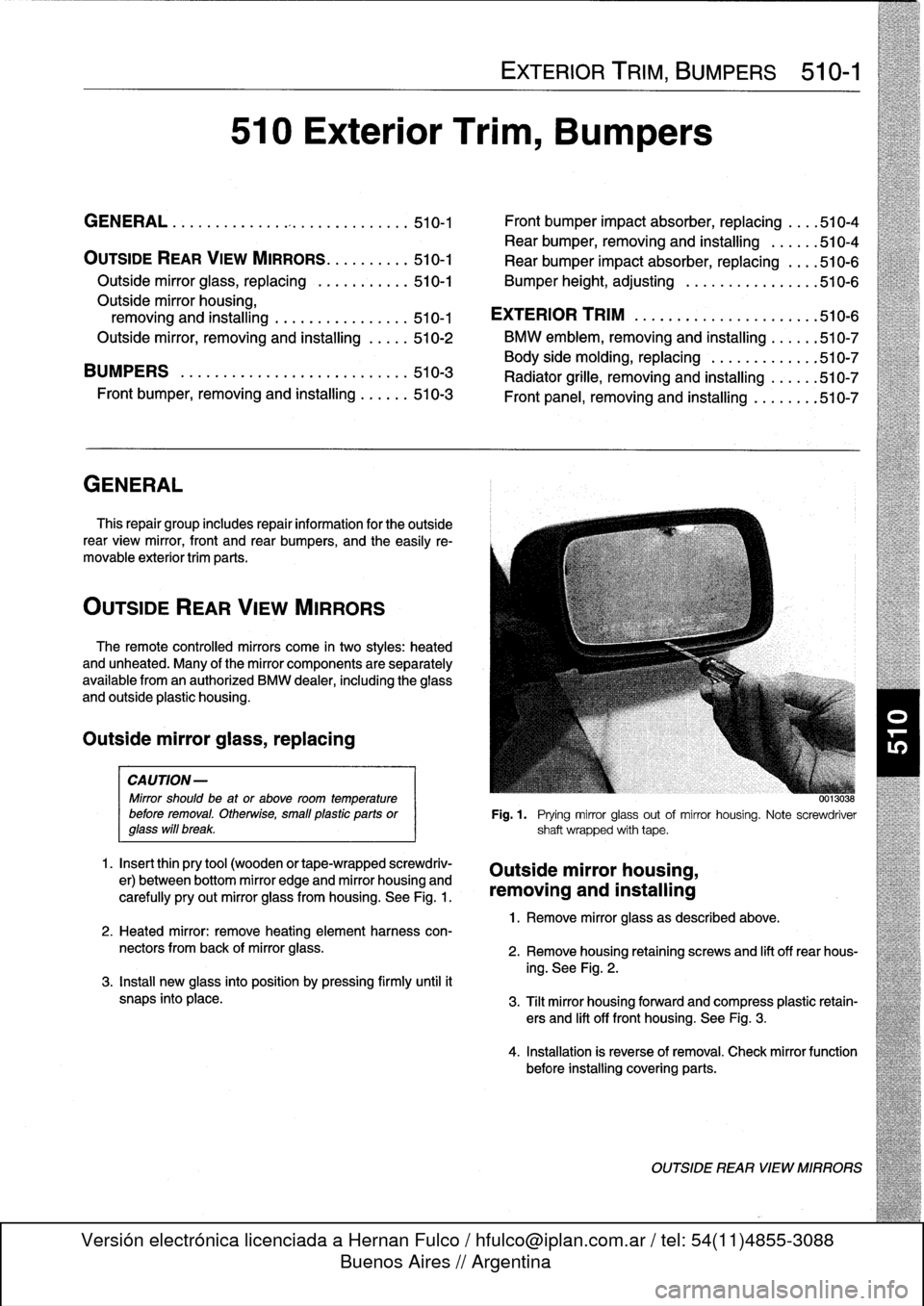
Fig
.1
.
Prying
mirror
glass
out
of
mirror
housing
.
Note
screwdriver
shaft
wrapped
with
tape
.
Outside
mirror
housing,
removing
and
installing
1
.
Remove
mirror
glass
as
described
above
.
2
.
Remove
housing
retaining
screws
and
lift
off
rear
hous-
ing
.
See
Fig
.
2
.
3
.
Tilt
mirror
housing
forward
and
compress
plastic
retain-
ers
and
lift
off
front
housing
.
See
Fig
.
3
.
4
.
Installation
is
reverse
of
removal
.
Check
mirror
function
before
installing
covering
parts
.
OUTSIDE
REAR
VIEW
MIRRORS
Page 324 of 759
510-2
EXTERIOR
TRIIVI,
BUMPERS
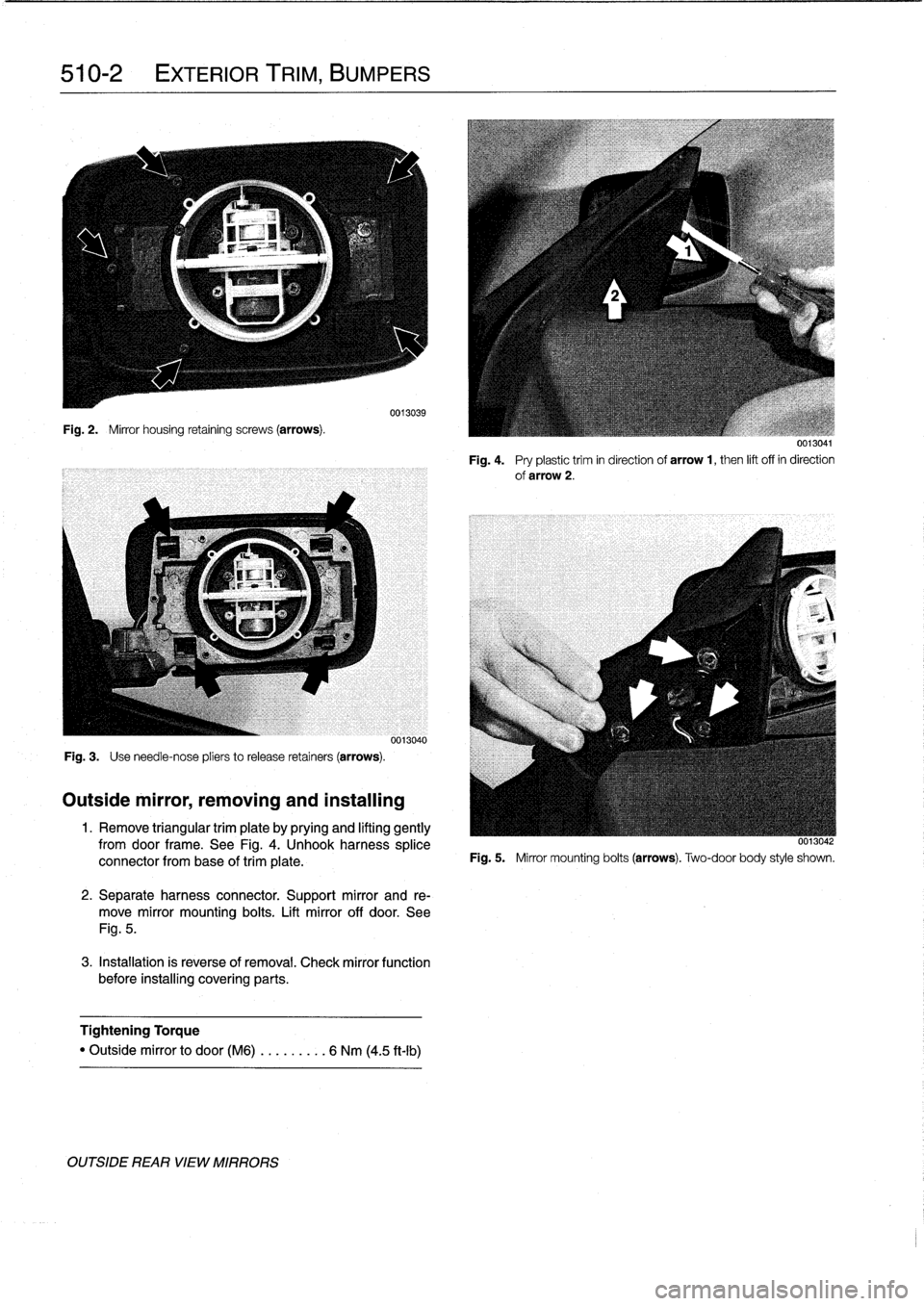
Fig
.
2
.
Mirror
housing
retaining
screws
(arrows)
.
Fig
.
3
.
Use
need1e-nose
pliers
to
release
retainers
(arrows)
.
Outside
mirror,
removing
and
installing
0013039
0013040
1
.
Remove
triangular
trim
plate
by
prying
and
lifting
gently
fromdoor
frame
.
See
Fig
.
4
.
Unhook
harness
splice
connector
from
base
of
trim
píate
.
2
.
Separate
harness
connector
.
Support
mirror
and
re-
move
mirror
mounting
bolts
.
Lift
mirror
off
door
.
See
Fig
.
5
.
3
.
Installation
is
reverse
of
removal
.
Check
mirror
function
before
installing
covering
parts
.
Tightening
Torque
"
Outside
mirror
to
door(M6)
..
.
..
.
..
.
6
Nm
(4
.5
ft-Ib)
OUTSIDE
REAR
VIEW
MIRRORS
0013041
Fig
.
4
.
Pry
plastictrim
in
direction
of
arrow
1,
then
lift
off
in
direction
of
arrow
2
.
0013042
Fig
.
5
.
Mirror
mounting
bolts
(arrows)
.
Two-door
body
style
shown
.