light BMW 325I 2001 Owner's Manual
[x] Cancel search | Manufacturer: BMW, Model Year: 2001, Model line: 325I, Model: BMW 325I 2001Pages: 203, PDF Size: 2.07 MB
Page 81 of 203
81n
IndexDataTechnologyRepairsCar careControlsOverview
DSC
* Ð BMW 325i
The concept DSC helps maintain vehicle stability,
even in critical driving situations.
The system optimizes vehicle stability
during acceleration and when starting
from a full stop, as well as optimizing
traction. In addition, the system recog-
nizes unstable vehicle conditions
(understeering or oversteering, for
example) and helps hold the vehicle on
a sure course by intervening via the
engine and by braking intervention at
the individual wheels.
The DSC is operational every time you
start the engine. DSC contains the
functions of ADB and CBC, refer to
page 117.
The ADB (Automatic Differential
Braking) copies the function of conven-
tional differential and transverse lock
through brake intervention, and
increases traction whenever conditions
merit, e. g. when driving on snow-
covered roads.
If the DSC is switched off the ADB will
still be in ready mode.
Indicator lamp
The indicator lamp in the instru-
ment cluster goes out shortly
after you switch on the ignition.
Refer to pages 21 and 22.
Indicator lamp flashes:
DSC is active and governs the drive
force and braking force.
The indicator lamp lights up continu-
ously:
The DSC has been turned off via the
switch; ADB is ready to use.
ADB intervention is not indicated.
The indicator lamp and the
brake warning lamp lights up
continuously:
The DSC, ADB and DBC have
been switched off via the button
or are defective.
Indicator and warning lamps for
Canadian models.
You can continue to drive the vehicle
normally, but without DSC. Please
consult your BMW center in the event
of a malfunction, refer to pages 21
and 22.
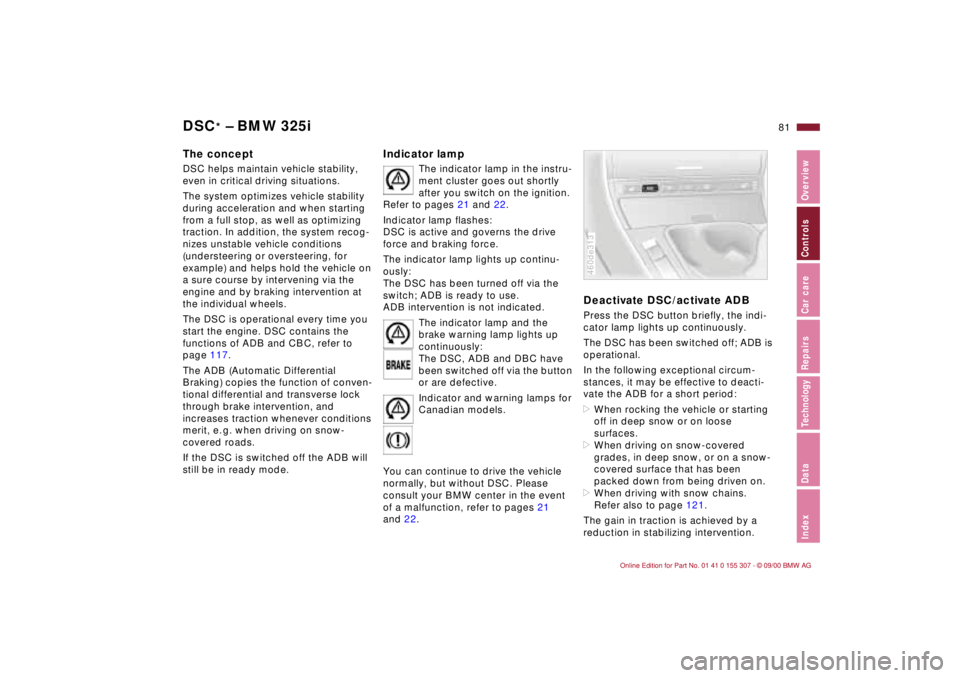
Deactivate DSC/activate ADBPress the DSC button briefly, the indi-
cator lamp lights up continuously.
The DSC has been switched off; ADB is
operational.
In the following exceptional circum-
stances, it may be effective to deacti-
vate the ADB for a short period:
>When rocking the vehicle or starting
off in deep snow or on loose
surfaces.
>When driving on snow-covered
grades, in deep snow, or on a snow-
covered surface that has been
packed down from being driven on.
>When driving with snow chains.
Refer also to page 121.
The gain in traction is achieved by a
reduction in stabilizing intervention.460de313
Page 85 of 203
85n
IndexDataTechnologyRepairsCar careControlsOverview
Tire Pressure Control (RDC)
*
The conceptThe RDC monitors the tire pressures at
all four wheels, even when the vehicle
is moving. The system provides an alert
whenever the inflation pressure drops
significantly below the specified pres-
sure in one or more tires.
In order for the RDC system to "learn"
the correct tire inflation pressure, first
check the tire inflation pressure in all
tires. Then compare these pressures
with the tire inflation pressure chart
(page 29) and adjust if necessary. Then
activate the system.
This indicator lamp in the instru-
ment cluster informs you when-
ever the tire pressure is not
normal.
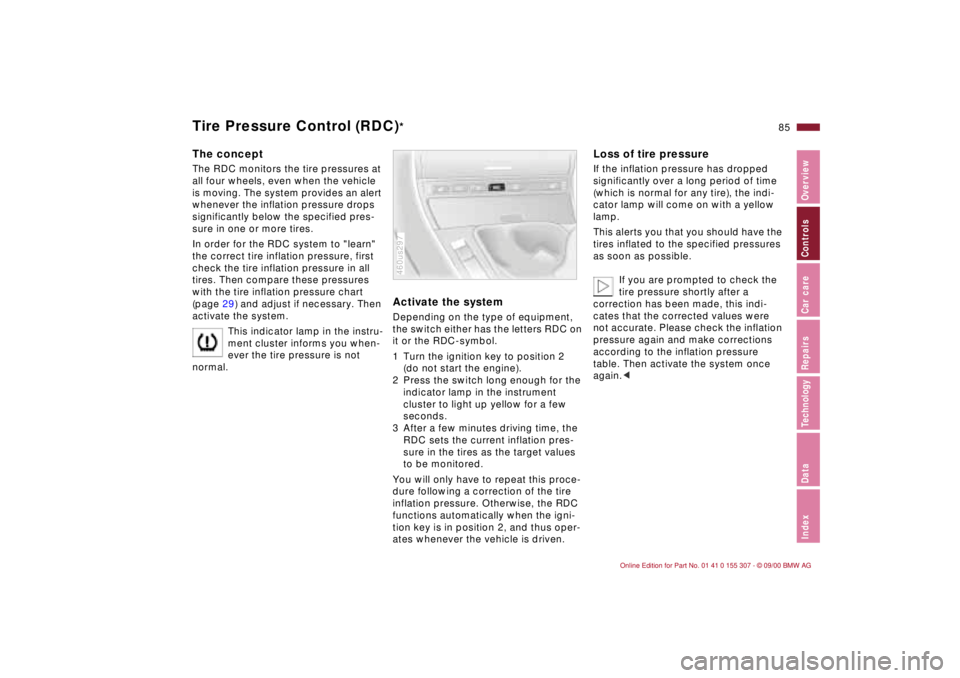
Activate the system Depending on the type of equipment,
the switch either has the letters RDC on
it or the RDC-symbol.
1 Turn the ignition key to position 2
(do not start the engine).
2 Press the switch long enough for the
indicator lamp in the instrument
cluster to light up yellow for a few
seconds.
3 After a few minutes driving time, the
RDC sets the current inflation pres-
sure in the tires as the target values
to be monitored.
You will only have to repeat this proce-
dure following a correction of the tire
inflation pressure. Otherwise, the RDC
functions automatically when the igni-
tion key is in position 2, and thus oper-
ates whenever the vehicle is driven.460us297
Loss of tire pressureIf the inflation pressure has dropped
significantly over a long period of time
(which is normal for any tire), the indi-
cator lamp will come on with a yellow
lamp.
This alerts you that you should have the
tires inflated to the specified pressures
as soon as possible.
If you are prompted to check the
tire pressure shortly after a
correction has been made, this indi-
cates that the corrected values were
not accurate. Please check the inflation
pressure again and make corrections
according to the inflation pressure
table. Then activate the system once
again.<
Page 87 of 203
87n
IndexDataTechnologyRepairsCar careControlsOverview
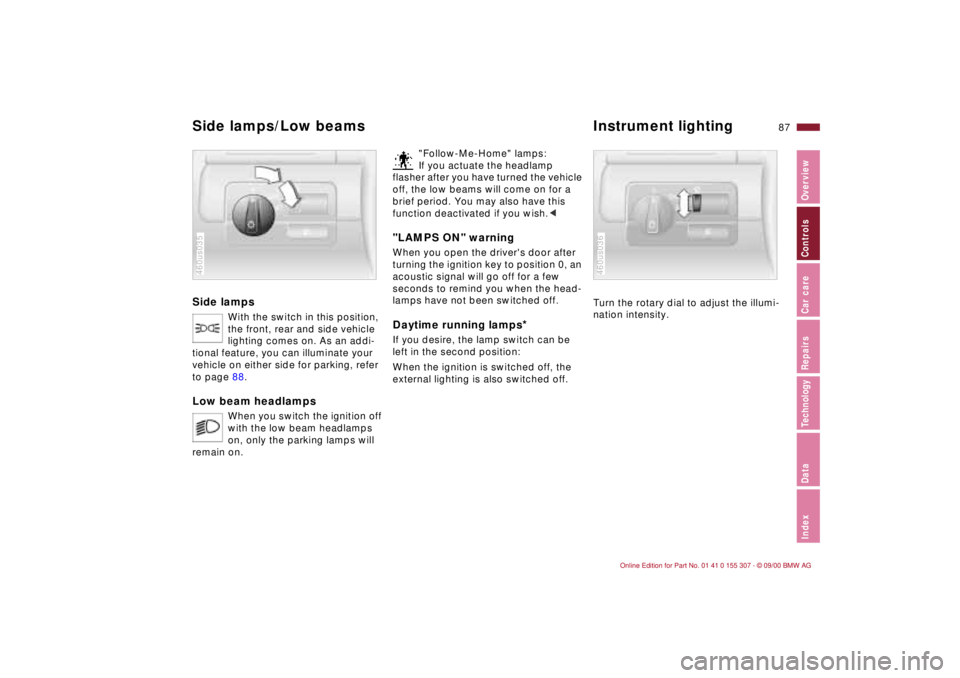
Side lamps
With the switch in this position,
the front, rear and side vehicle
lighting comes on. As an addi-
tional feature, you can illuminate your
vehicle on either side for parking, refer
to page 88.
Low beam headlamps
When you switch the ignition off
with the low beam headlamps
on, only the parking lamps will
remain on.
460us035
"Follow-Me-Home" lamps:
If you actuate the headlamp
flasher after you have turned the vehicle
off, the low beams will come on for a
brief period. You may also have this
function deactivated if you wish.<
"LAMPS ON" warningWhen you open the driver's door after
turning the ignition key to position 0, an
acoustic signal will go off for a few
seconds to remind you when the head-
lamps have not been switched off
.
Daytime running lamps
*
If you desire, the lamp switch can be
left in the second position:
When the ignition is switched off, the
external lighting is also switched off.
Turn the rotary dial to adjust the illumi-
nation intensity.460us036
Side lamps/Low beams Instrument lighting
Page 100 of 203
100n
Automatic climate control
*
Seat heating
*
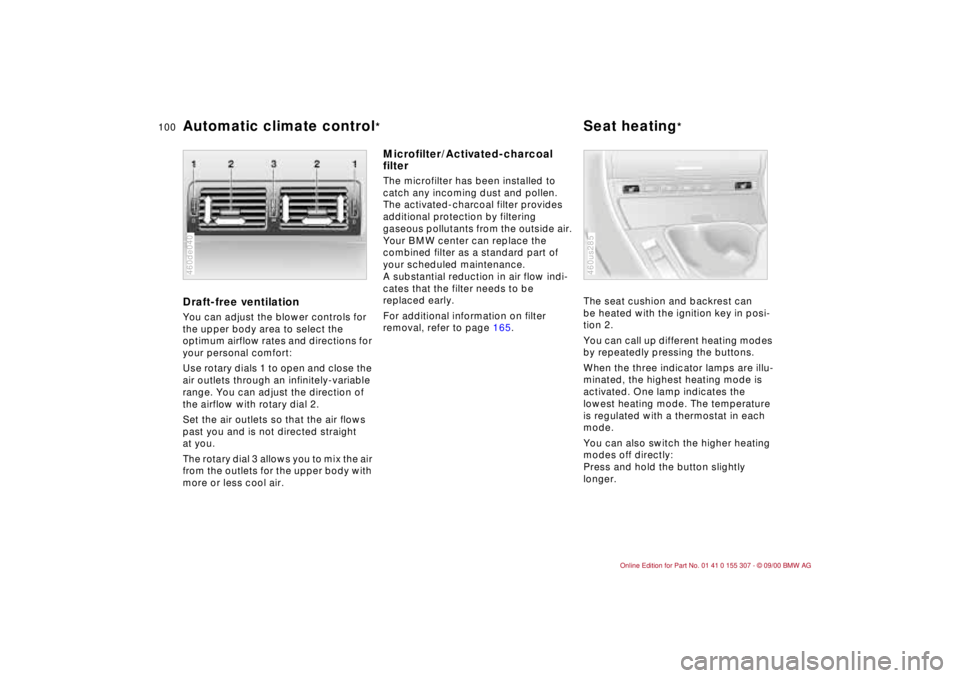
Draft-free ventilation You can adjust the blower controls for
the upper body area to select the
optimum airflow rates and directions for
your personal comfort:
Use rotary dials 1 to open and close the
air outlets through an infinitely-variable
range. You can adjust the direction of
the airflow with rotary dial 2.
Set the air outlets so that the air flows
past you and is not directed straight
at you.
The rotary dial 3 allows you to mix the air
from the outlets for the upper body with
more or less cool air.460de040
Microfilter/Activated-charcoal
filterThe microfilter has been installed to
catch any incoming dust and pollen.
The activated-charcoal filter provides
additional protection by filtering
gaseous pollutants from the outside air.
Your BMW center can replace the
combined filter as a standard part of
your scheduled maintenance.
A substantial reduction in air flow indi-
cates that the filter needs to be
replaced early.
For additional information on filter
removal, refer to page 165.The seat cushion and backrest can
be heated with the ignition key in posi-
tion 2.
You can call up different heating modes
by repeatedly pressing the buttons.
When the three indicator lamps are illu-
minated, the highest heating mode is
activated. One lamp indicates the
lowest heating mode. The temperature
is regulated with a thermostat in each
mode.
You can also switch the higher heating
modes off directly:
Press and hold the button slightly
longer.
460us285
Page 101 of 203
101n
IndexDataTechnologyRepairsCar careControlsOverview
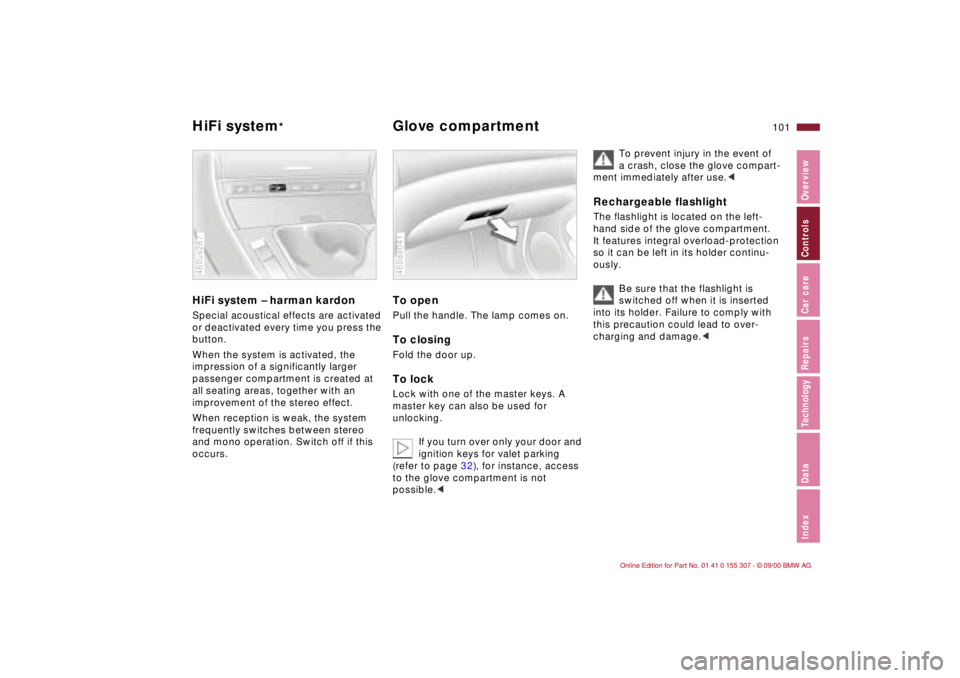
HiFi system Ð harman kardonSpecial acoustical effects are activated
or deactivated every time you press the
button.
When the system is activated, the
impression of a significantly larger
passenger compartment is created at
all seating areas, together with an
improvement of the stereo effect.
When reception is weak, the system
frequently switches between stereo
and mono operation. Switch off if this
occurs.460us287
To open Pull the handle. The lamp comes on.To closingFold the door up.To lockLock with one of the master keys. A
master key can also be used for
unlocking.
If you turn over only your door and
ignition keys for valet parking
(refer to page 32), for instance, access
to the glove compartment is not
possible.<460de041
To prevent injury in the event of
a crash, close the glove compart-
ment immediately after use.<
Rechargeable flashlightThe flashlight is located on the left-
hand side of the glove compartment.
It features integral overload-protection
so it can be left in its holder continu-
ously.
Be sure that the flashlight is
switched off when it is inserted
into its holder. Failure to comply with
this precaution could lead to over-
charging and damage.<
HiFi system
*
Glove compartment
Page 104 of 203
104n
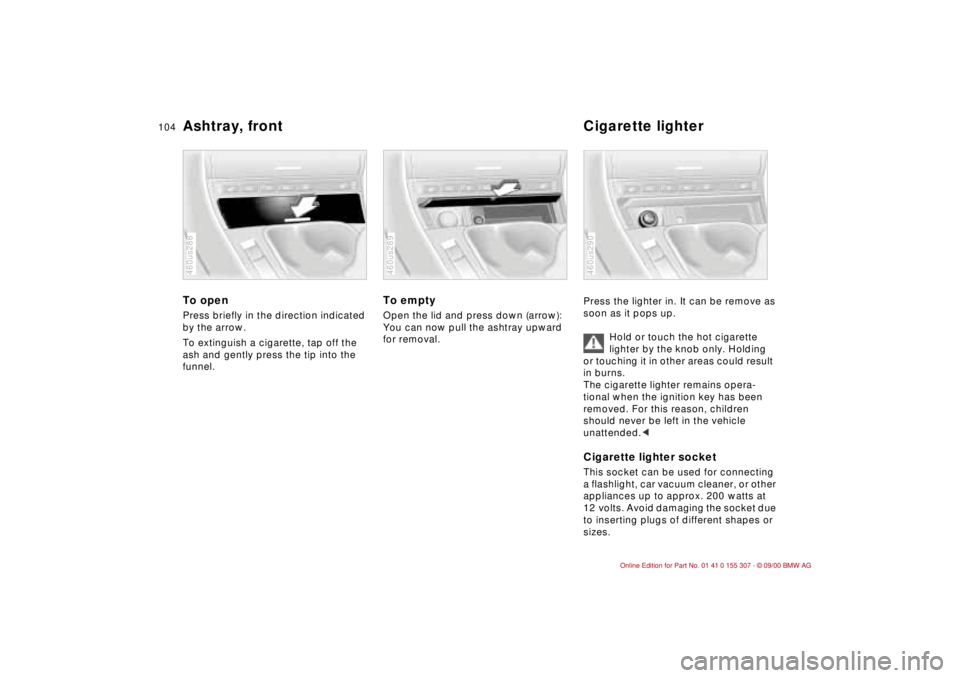
Ashtray, front Cigarette lighterTo open Press briefly in the direction indicated
by the arrow.
To extinguish a cigarette, tap off the
ash and gently press the tip into the
funnel.460us288
To emptyOpen the lid and press down (arrow):
You can now pull the ashtray upward
for removal.460us289
Press the lighter in. It can be remove as
soon as it pops up.
Hold or touch the hot cigarette
lighter by the knob only. Holding
or touching it in other areas could result
in burns.
The cigarette lighter remains opera-
tional when the ignition key has been
removed. For this reason, children
should never be left in the vehicle
unattended.
appliances up to approx. 200 watts at
12 volts. Avoid damaging the socket due
to inserting plugs of different shapes or
sizes.460us290
Page 107 of 203
107n
IndexDataTechnologyRepairsCar careControlsOverview
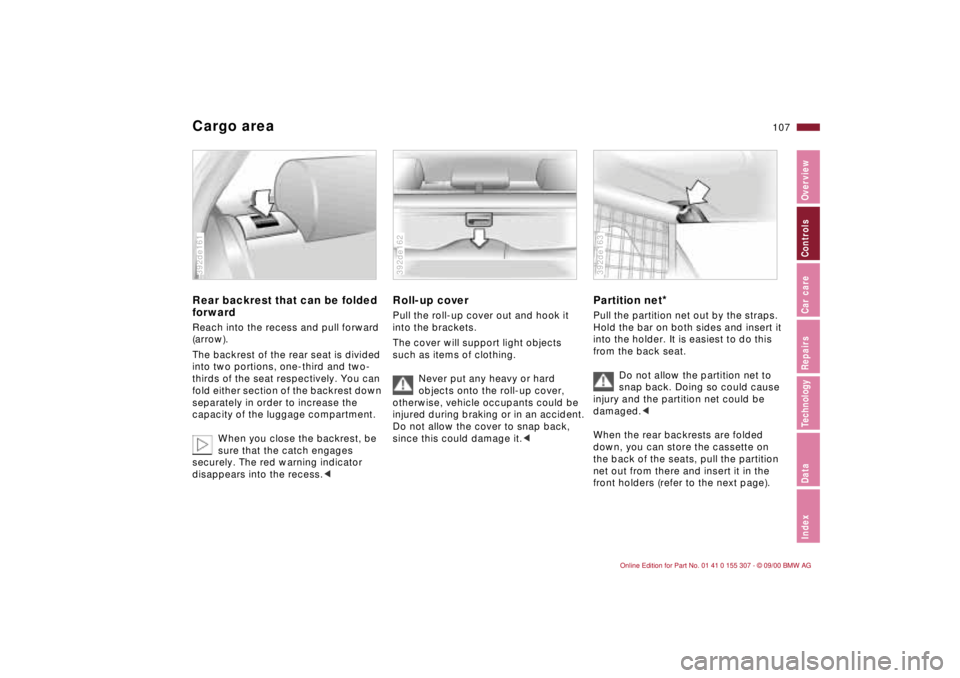
Cargo areaRear backrest that can be folded
forwardReach into the recess and pull forward
(arrow).
The backrest of the rear seat is divided
into two portions, one-third and two-
thirds of the seat respectively. You can
fold either section of the backrest down
separately in order to increase the
capacity of the luggage compartment.
When you close the backrest, be
sure that the catch engages
securely. The red warning indicator
disappears into the recess.<392de161
Roll-up coverPull the roll-up cover out and hook it
into the brackets.
The cover will support light objects
such as items of clothing.
Never put any heavy or hard
objects onto the roll-up cover,
otherwise, vehicle occupants could be
injured during braking or in an accident.
Do not allow the cover to snap back,
since this could damage it.<392de162
Partition net
*
Pull the partition net out by the straps.
Hold the bar on both sides and insert it
into the holder. It is easiest to do this
from the back seat.
Do not allow the partition net to
snap back. Doing so could cause
injury and the partition net could be
damaged.<
When the rear backrests are folded
down, you can store the cassette on
the back of the seats, pull the partition
net out from there and insert it in the
front holders (refer to the next page).392de163
Page 110 of 203
110n
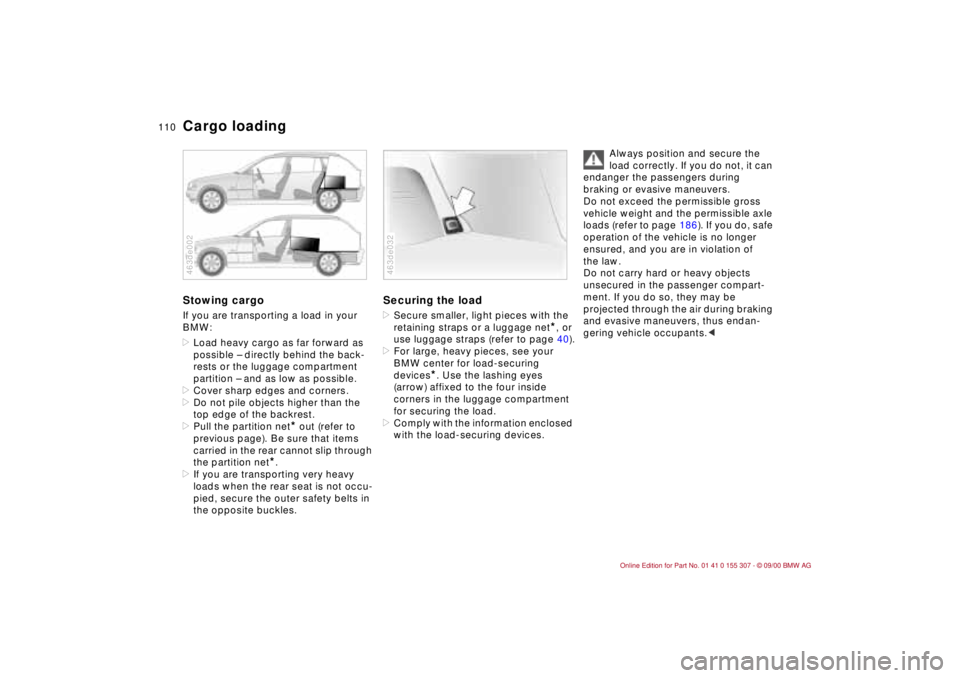
Cargo loadingStowing cargo If you are transporting a load in your
BMW:
>Load heavy cargo as far forward as
possible Ð directly behind the back-
rests or the luggage compartment
partition Ð and as low as possible.
>Cover sharp edges and corners.
>Do not pile objects higher than the
top edge of the backrest.
>Pull the partition net
* out (refer to
previous page). Be sure that items
carried in the rear cannot slip through
the partition net
*.
>If you are transporting very heavy
loads when the rear seat is not occu-
pied, secure the outer safety belts in
the opposite buckles.
463de002
Securing the load >Secure smaller, light pieces with the
retaining straps or a luggage net
*, or
use luggage straps (refer to page 40).
>For large, heavy pieces, see your
BMW center for load-securing
devices
*. Use the lashing eyes
(arrow) affixed to the four inside
corners in the luggage compartment
for securing the load.
>Comply with the information enclosed
with the load-securing devices.
463de032
Always position and secure the
load correctly. If you do not, it can
endanger the passengers during
braking or evasive maneuvers.
Do not exceed the permissible gross
vehicle weight and the permissible axle
loads (refer to page 186). If you do, safe
operation of the vehicle is no longer
ensured, and you are in violation of
the law.
Do not carry hard or heavy objects
unsecured in the passenger compart-
ment. If you do so, they may be
projected through the air during braking
and evasive maneuvers, thus endan-
gering vehicle occupants.<
Page 114 of 203

114n
To ensure maximum economy and a
long service life, we request that you
observe the following suggestions.
Engine and differentialUp to 1,200 miles (2,000 km):
Drive at varying engine speeds and road
speeds, but do not exceed the following
engine or road speeds during this time:
4,500 rpm or 100 mph (160 km/h).
Obey your local and state maximum
speed limits.
Refrain from using full throttle and avoid
pressing the accelerator beyond the
"kickdown" point.
After you have driven 1,200 miles
(2,000 km), you can gradually increase
the engine and road speeds.
You should also comply with these
break-in procedures if the engine or
differential is replaced at a later point.
TiresDue to technical factors associated
with their manufacture, tires do not
achieve their full traction potential until
an initial break-in period has elapsed.
Thus drive with extra care during the
initial 200 miles (300 km).
Obey your local and state maximum
speed limits.
When the vehicle is operated on
wet or slushy roads, a wedge of
water may form between the tire and
the road surface. This phenomenon is
referred to as aquaplaning, or hydropla-
ning, and can lead to partial or
complete loss of traction, vehicle
control and braking effectiveness.
Reduce your speed on wet roads.<
Brake systemAfter approximately 300 miles (500 km),
the brake pads and discs achieve the
optimal pad surface and wear patterns
required for trouble-free operation and
long service life.
To break in the separate parking brake
drums, apply the parking brake lightly
when coasting to a standstill (at a traffic
signal, for instance), provided that
traffic conditions allow you to do so.
To avoid corrosion, repeat this proce-
dure from time to time.
The brake lamps do not come on
when the parking brake is applied.
Vacuum for the brake system servo unit
on your BMW is available only when the
engine is running. When you move the
vehicle with the engine off Ð when
towing, for example Ð substantially
higher levels of pedal force will be
required to brake the vehicle.
(500 km). Engage the gears carefully
during the break-in period.
Break-in procedures
Page 115 of 203

115n
IndexDataTechnologyRepairsCar careControlsOverview
Brakes:
Do not drive with your foot resting
on the brake pedal. Even light but
consistent pedal pressure can lead to
high temperatures, brake wear, and
possibly to brake failure.
Aquaplaning:
When driving on wet or slushy roads,
reduce vehicle speed. If you do not, a
wedge of water may form between the
tires and the road surface. This
phenomenon is referred to as aqua-
planing or hydroplaning. It is character-
ized by a partial or complete loss of
contact between the tires and the road
surface. The ultimate results are loss of
steering and braking control.
Driving through water:
When there is water on the roads, do
not drive in it if it is deeper than 1 ft
(30 cm), and then only at walking speed
at the most, otherwise the vehicle can
sustain damage to the engine, the elec-
trical systems and the transmission.
Roll-up cover:
Never use the rear window shelf to
store heavy or bulky objects. If you do
so, such objects could injure vehicle
occupants during braking or evasive
maneuvers or in a crash.
Clothes hooks:
When suspending clothing from the
hooks, ensure that they will not obstruct
the driver's vision. Do not hang heavy
objects on the hooks. If you do, such
objects could pose the risk of personal
injury during braking or evasive maneu-
vers.
use with unleaded fuel only.
Even minute quantities of lead would be
enough to permanently damage both
the catalytic converter and the system
oxygen sensor.
To ensure efficient, trouble-free engine
operation and to avoid potential
damage:
>Be sure to comply with the scheduled
maintenance requirements.
>Fill the fuel tank well before it is
empty.
>Tow-start only when the engine is
cold. If you attempt to tow-start with
a warm engine, unburned residual
fuel in the catalytic converter could
ignite and cause damage. It is better
to start the vehicle with an outside
starting aid.
>Avoid other situations in which the
fuel is not burned, or burns incom-
pletely, such as engaging the starter
frequently or for extended periods, or
repeated start attempts in which the
engine does not start (stopping and
restarting an engine which is running
properly does not present a problem).
Never allow the engine to run with
any of the spark plug cables
disconnected.
Driving notes Catalytic converter