Check control BMW 325i SEDAN 2001 E46 User Guide
[x] Cancel search | Manufacturer: BMW, Model Year: 2001, Model line: 325i SEDAN, Model: BMW 325i SEDAN 2001 E46Pages: 211, PDF Size: 2.1 MB
Page 76 of 211
76n
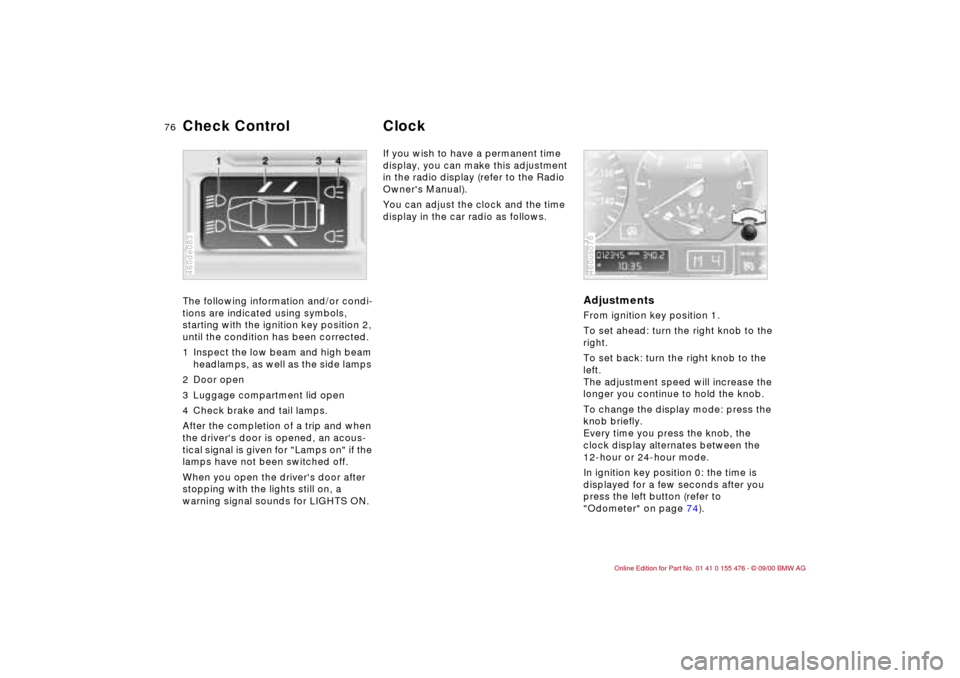
The following information and/or condi-
tions are indicated using symbols,
starting with the ignition key position 2,
until the condition has been corrected.
1 Inspect the low beam and high beam
headlamps, as well as the side lamps
2 Door open
3 Luggage compartment lid open
4 Check brake and tail lamps.
After the completion of a trip and when
the driver's door is opened, an acous-
tical signal is given for "Lamps on" if the
lamps have not been switched off.
When you open the driver's door after
stopping with the lights still on, a
warning signal sounds for LIGHTS ON.
460de083
If you wish to have a permanent time
display, you can make this adjustment
in the radio display (refer to the Radio
Owner's Manual).
You can adjust the clock and the time
display in the car radio as follows.
AdjustmentsFrom ignition key position 1.
To set ahead: turn the right knob to the
right.
To set back: turn the right knob to the
left.
The adjustment speed will increase the
longer you continue to hold the knob.
To change the display mode: press the
knob briefly.
Every time you press the knob, the
clock display alternates between the
12-hour or 24-hour mode.
In ignition key position 0: the time is
displayed for a few seconds after you
press the left button (refer to
"Odometer" on page 74).460us078
Check Control Clock
Page 86 of 211
86n
Tire Pressure Control (RDC)
*
The conceptRDC monitors the tire pressures at all
four wheels, even when the vehicle is
moving. The system provides an alert
whenever the inflation pressure drops
significantly below the specified pres-
sure in one or more tires.
In order for the system to "learn" the
correct tire inflation pressure, check the
inflation pressure in all tires. Refer to
the table of "Tire inflation pressures"
(page 28) and correct the pressures if
necessary. Then activate the system.
This indicator lamp in the instru-
ment cluster will inform you if
the tire pressure is not correct.
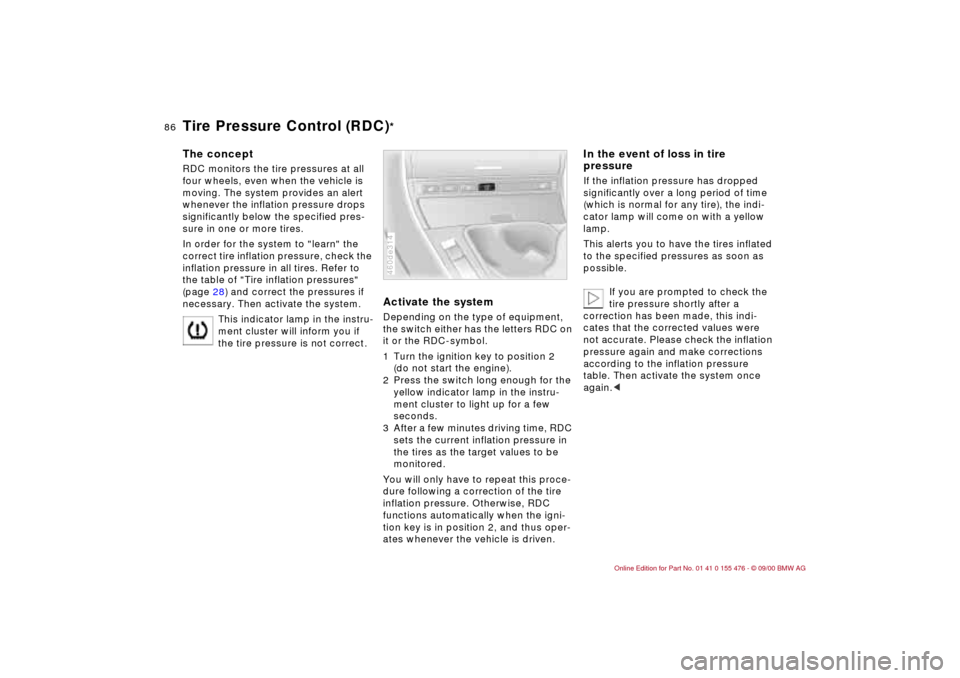
Activate the systemDepending on the type of equipment,
the switch either has the letters RDC on
it or the RDC-symbol.
1 Turn the ignition key to position 2
(do not start the engine).
2 Press the switch long enough for the
yellow indicator lamp in the instru-
ment cluster to light up for a few
seconds.
3 After a few minutes driving time, RDC
sets the current inflation pressure in
the tires as the target values to be
monitored.
You will only have to repeat this proce-
dure following a correction of the tire
inflation pressure. Otherwise, RDC
functions automatically when the igni-
tion key is in position 2, and thus oper-
ates whenever the vehicle is driven.460de314
In the event of loss in tire
pressureIf the inflation pressure has dropped
significantly over a long period of time
(which is normal for any tire), the indi-
cator lamp will come on with a yellow
lamp.
This alerts you to have the tires inflated
to the specified pressures as soon as
possible.
If you are prompted to check the
tire pressure shortly after a
correction has been made, this indi-
cates that the corrected values were
not accurate. Please check the inflation
pressure again and make corrections
according to the inflation pressure
table. Then activate the system once
again.<
Page 119 of 211
119n
IndexDataTechnologyRepairsCar careControlsOverview
Antilock Brake System (ABS)consequences of brake applications
with inadequate clearances for safety
between vehicles, when exceeding the
speed limit, or the risks involved when
aquaplaning occurs. Responsibility for
these types of situations remains in the
hands (and at the feet) of the driver. You
should never allow the added safety of
ABS to mislead you into taking
increased risks.
Do not make any modifications to
the ABS system. Service proce-
dures on ABS are to be performed by
authorized technicians only.
opment of ABS. When braking during
cornering with high lateral accelera-
tion, or when braking during a lane
change, vehicle stability is improved
and the steering response is enhanced.In the event of a fault
If the ABS in the instrument
cluster lights up, refer to
page 22. The brake system then
reverts to conventional operation as on
vehicles without ABS. However, have
the brake system checked by your
BMW center as soon as possible. To
prevent undetected defects and cumu-
lative faults from adversely affecting the
brake system, refer any problems to
your BMW center at the earliest oppor-
tunity.
ABS warning lamp for Canadian
models.
If the brake warning lamp
comes on together with the indi-
cator lamps for ABS and
ASC+T/DSC, refer to page 21,
the entire ABS, CBC and
ASC+T/DSC control system has
failed. Continue driving
cautiously and defensively.
Avoid full brake applications. This could
cause the vehicle to lose stability and
you might no longer be able to control
it.
Have the system checked as soon as
possible by your BMW center.
CBC, ABS and ASC+T/DSC
and
ADB/ADB-X/DBC indicator and
warning lamps for Canadian
models.
Dynamic Brake Control (DBC)*DBC is included in the DSC, refer to
information beginning on page 84.
If you step on the brake rapidly, this
system automatically produces
maximum braking force boost and thus
helps to achieve the shortest possible
braking distance during "panic stops."
All of the benefits of the ABS system
are exploited under these circum-
stances.
Do not reduce the pressure on the
brake pedal for the duration of the
brake application. When the brake
pedal is released, the DBC is deacti-
vated.
In the event of a malfunction,
the yellow brake warning lamp
comes on. Normal braking effi-
ciency and ABS are still fully available.
Have the system checked and repaired
at your BMW center as soon as
possible.
Please observe the section "Infor-
mation for your safety" concerning
the ABS system, which also applies to
the DSC system.<
Page 125 of 211
125n
IndexDataTechnologyRepairsCar careControlsOverview
Information for your safetyThe factory-approved radial tires are
matched to the vehicle and have been
selected to provide optimum safety and
driving comfort on your vehicle.
It is not merely the tire's service life, but
also driving comfort and Ð above all else
Ð driving safety that depend on the
condition of the tires and the mainte-
nance of the specified tire pressure.
Incorrect inflation pressure is a frequent
cause of tire damage. It also signifi-
cantly influences the roadholding ability
of your BMW.
Check tire inflation pressures
regularly Ð include the space-
saver spare tire or spare tire Ð at least
twice a month and before beginning a
longer trip (refer to page 29). If this is
not done, incorrect tire pressures can
cause driving instability and tire
damage, ultimately resulting in an acci-
dent.<
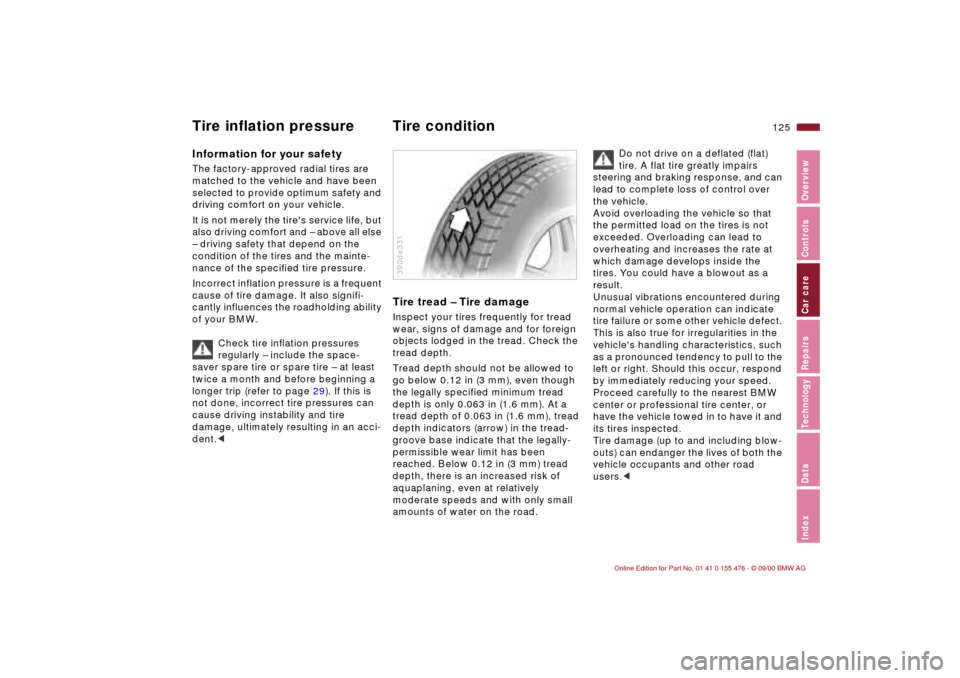
Tire tread Ð Tire damageInspect your tires frequently for tread
wear, signs of damage and for foreign
objects lodged in the tread. Check the
tread depth.
Tread depth should not be allowed to
go below 0.12 in (3 mm), even though
the legally specified minimum tread
depth is only 0.063 in (1.6 mm). At a
tread depth of 0.063 in (1.6 mm), tread
depth indicators (arrow) in the tread-
groove base indicate that the legally-
permissible wear limit has been
reached. Below 0.12 in (3 mm) tread
depth, there is an increased risk of
aquaplaning, even at relatively
moderate speeds and with only small
amounts of water on the road.390de331
Do not drive on a deflated (flat)
tire. A flat tire greatly impairs
steering and braking response, and can
lead to complete loss of control over
the vehicle.
Avoid overloading the vehicle so that
the permitted load on the tires is not
exceeded. Overloading can lead to
overheating and increases the rate at
which damage develops inside the
tires. You could have a blowout as a
result.
Unusual vibrations encountered during
normal vehicle operation can indicate
tire failure or some other vehicle defect.
This is also true for irregularities in the
vehicle's handling characteristics, such
as a pronounced tendency to pull to the
left or right. Should this occur, respond
by immediately reducing your speed.
Proceed carefully to the nearest BMW
center or professional tire center, or
have the vehicle towed in to have it and
its tires inspected.
Tire damage (up to and including blow-
outs) can endanger the lives of both the
vehicle occupants and other road
users.<
Tire inflation pressure Tire condition
Page 139 of 211
139n
IndexDataTechnologyRepairsCar careControlsOverview
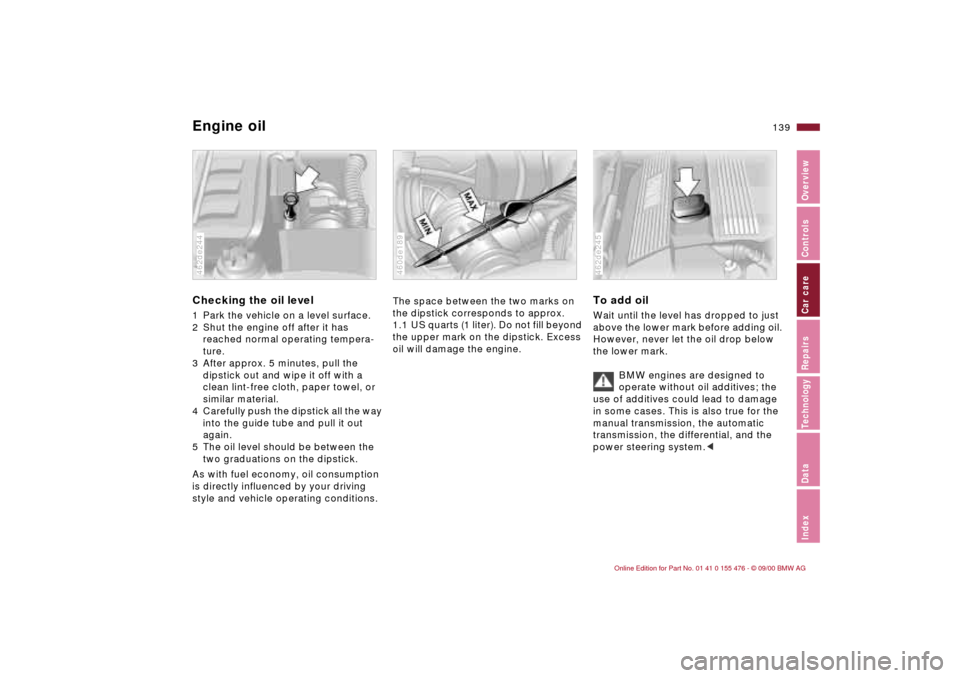
Engine oilChecking the oil level 1 Park the vehicle on a level surface.
2 Shut the engine off after it has
reached normal operating tempera-
ture.
3 After approx. 5 minutes, pull the
dipstick out and wipe it off with a
clean lint-free cloth, paper towel, or
similar material.
4 Carefully push the dipstick all the way
into the guide tube and pull it out
again.
5 The oil level should be between the
two graduations on the dipstick.
As with fuel economy, oil consumption
is directly influenced by your driving
style and vehicle operating conditions.462de244
The space between the two marks on
the dipstick corresponds to approx.
1.1 US quarts (1 liter). Do not fill beyond
the upper mark on the dipstick. Excess
oil will damage the engine.460de189
To add oil Wait until the level has dropped to just
above the lower mark before adding oil.
However, never let the oil drop below
the lower mark.
BMW engines are designed to
operate without oil additives; the
use of additives could lead to damage
in some cases. This is also true for the
manual transmission, the automatic
transmission, the differential, and the
power steering system.<462de245
Page 143 of 211
143n
IndexDataTechnologyRepairsCar careControlsOverview
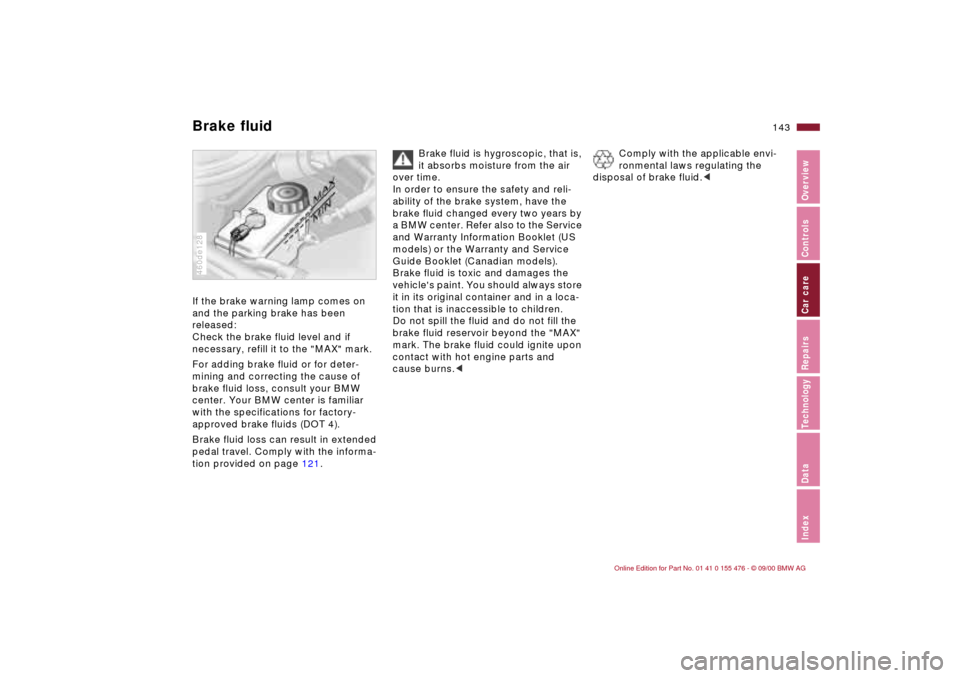
Brake fluidIf the brake warning lamp comes on
and the parking brake has been
released:
Check the brake fluid level and if
necessary, refill it to the "MAX" mark.
For adding brake fluid or for deter-
mining and correcting the cause of
brake fluid loss, consult your BMW
center. Your BMW center is familiar
with the specifications for factory-
approved brake fluids (DOT 4).
Brake fluid loss can result in extended
pedal travel. Comply with the informa-
tion provided on page 121.460de128
Brake fluid is hygroscopic, that is,
it absorbs moisture from the air
over time.
In order to ensure the safety and reli-
ability of the brake system, have the
brake fluid changed every two years by
a BMW center. Refer also to the Service
and Warranty Information Booklet (US
models) or the Warranty and Service
Guide Booklet (Canadian models).
Brake fluid is toxic and damages the
vehicle's paint. You should always store
it in its original container and in a loca-
tion that is inaccessible to children.
Do not spill the fluid and do not fill the
brake fluid reservoir beyond the "MAX"
mark. The brake fluid could ignite upon
contact with hot engine parts and
cause burns.<
Comply with the applicable envi-
ronmental laws regulating the
disposal of brake fluid.<
Page 145 of 211
145n
IndexDataTechnologyRepairsCar careControlsOverview
The BMW Maintenance System has
been designed as a reliable means of
providing maximum driving and operat-
ing safety Ð and as cost-effectively as
possible for you.
Please keep in mind that regular main-
tenance is not only necessary for the
safety of your vehicle, but also plays a
significant role in maintaining the resale
value of the vehicle. Service Interval DisplayAdvanced technology is employed to
calculate the optimal maintenance
intervals. These are then indicated in
the Service Interval Display. While
conventional systems rely on distance
traveled alone to determine when
service is due, the BMW Maintenance
System has for years considered the 460us112
actual conditions under which the vehi-
cle operates, because miles can be
traveled in many different ways:
From the point of view of maintenance,
62,000 miles (100,000 km) accumulated
in short-distance urban driving are not
the equivalent of the same distance
covered at moderate speeds in long-
distance highway travel.
The BMW Maintenance System
includes the Engine Oil Service and
Inspections I and II.
Determining the maintenance intervals
according to the actual use of the vehi-
cle covers every kind of operating situa-
tion. Minimal use drivers Ð those who
drive significantly less than 6,000 miles
(10,000 km) per year Ð should neverthe-
less have the oil changed at least every
two years, since engine oil ages regard-
less of use.Service and Warranty Information
Booklet (US models)/Warranty
and Service Guide Booklet
(Canadian models) Please refer to the Service and
Warranty Information Booklet (US mod-
els) or the Warranty and Service Guide
Booklet (Canadian models) for addi-
tional information on maintenance inter-
vals and procedures.As a precaution against rust, it might be
a good idea to have the body checked
for damage from rocks or gravel at the
same time, depending upon operating
conditions.
Have your BMW center perform
maintenance and repair.
Your BMW center is always informed on
the latest maintenance work and repair
techniques and equipped with the
required special tools. In addition,
checking parts known from experience
to be subject to wear is a permanent
part of the maintenance specifications.
Be sure that all maintenance work is
confirmed in the Service and Warranty
Information Booklet (US models) or the
Warranty and Service Guide Booklet
(Canadian models). These entries are
your verification for the regular mainte-
nance of your vehicle and are required
for the performance of warranty
repairs.<
The BMW Maintenance System
Page 154 of 211
154n
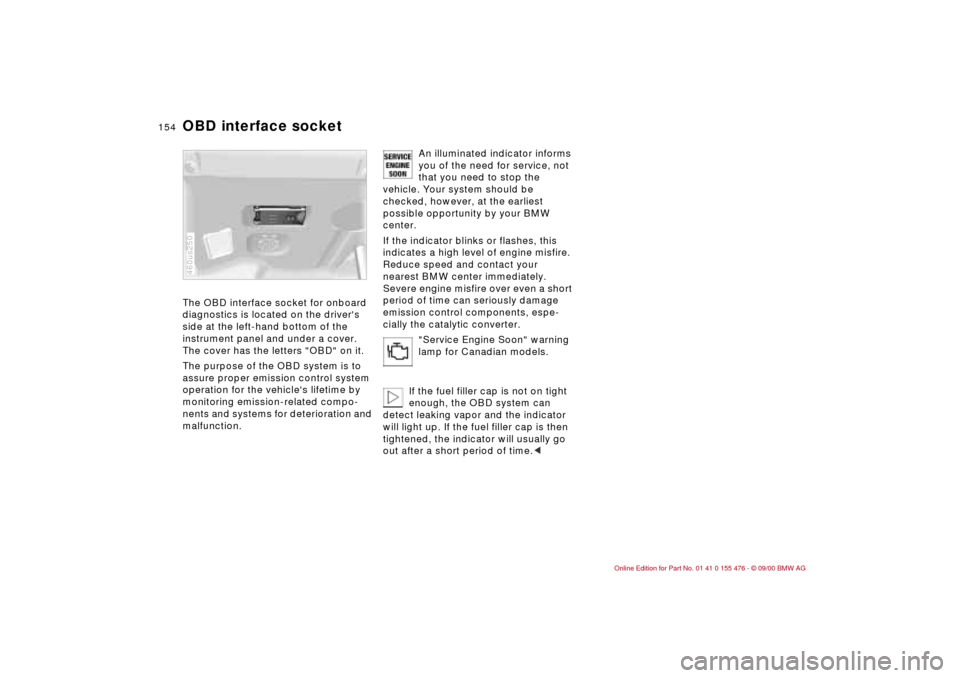
OBD interface socket The OBD interface socket for onboard
diagnostics is located on the driver's
side at the left-hand bottom of the
instrument panel and under a cover.
The cover has the letters "OBD" on it.
The purpose of the OBD system is to
assure proper emission control system
operation for the vehicle's lifetime by
monitoring emission-related compo-
nents and systems for deterioration and
malfunction.460us250
An illuminated indicator informs
you of the need for service, not
that you need to stop the
vehicle. Your system should be
checked, however, at the earliest
possible opportunity by your BMW
center.
If the indicator blinks or flashes, this
indicates a high level of engine misfire.
Reduce speed and contact your
nearest BMW center immediately.
Severe engine misfire over even a short
period of time can seriously damage
emission control components, espe-
cially the catalytic converter.
"Service Engine Soon" warning
lamp for Canadian models.
If the fuel filler cap is not on tight
enough, the OBD system can
detect leaking vapor and the indicator
will light up. If the fuel filler cap is then
tightened, the indicator will usually go
out after a short period of time.<
Page 167 of 211
167n
IndexDataTechnologyRepairsCar careControlsOverview
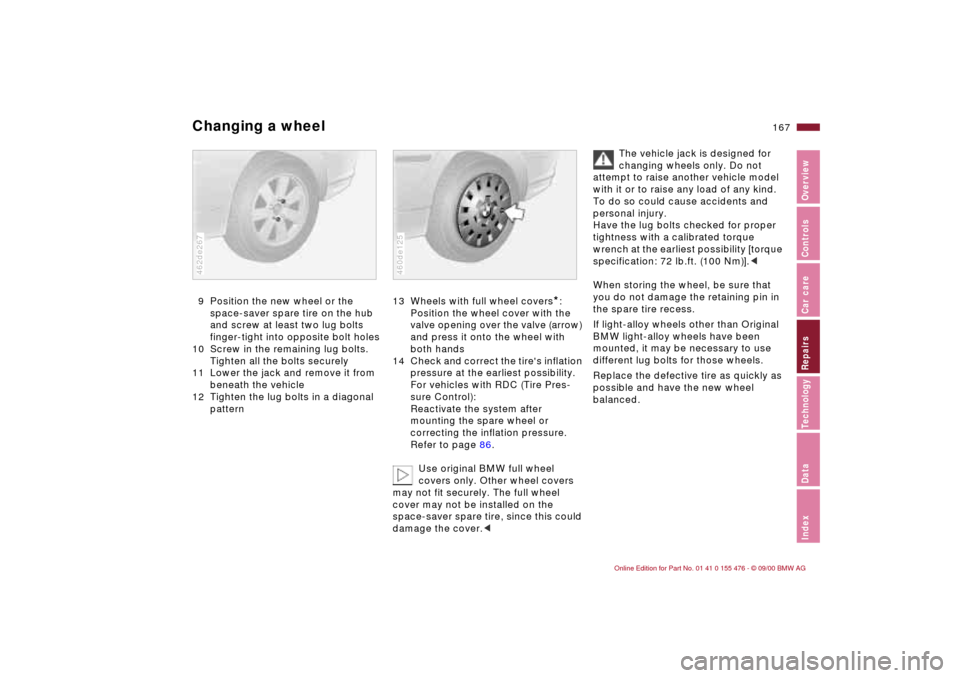
Changing a wheel9 Position the new wheel or the
space-saver spare tire on the hub
and screw at least two lug bolts
finger-tight into opposite bolt holes
10 Screw in the remaining lug bolts.
Tighten all the bolts securely
11 Lower the jack and remove it from
beneath the vehicle
12 Tighten the lug bolts in a diagonal
pattern462de267
13 Wheels with full wheel covers
*:
Position the wheel cover with the
valve opening over the valve (arrow)
and press it onto the wheel with
both hands
14 Check and correct the tire's inflation
pressure at the earliest possibility.
For vehicles with RDC (Tire Pres-
sure Control):
Reactivate the system after
mounting the spare wheel or
correcting the inflation pressure.
Refer to page 86.
Use original BMW full wheel
covers only. Other wheel covers
may not fit securely. The full wheel
cover may not be installed on the
space-saver spare tire, since this could
damage the cover.<
460de125
The vehicle jack is designed for
changing wheels only. Do not
attempt to raise another vehicle model
with it or to raise any load of any kind.
To do so could cause accidents and
personal injury.
Have the lug bolts checked for proper
tightness with a calibrated torque
wrench at the earliest possibility [torque
specification: 72 lb.ft. (100 Nm)].<
When storing the wheel, be sure that
you do not damage the retaining pin in
the spare tire recess.
If light-alloy wheels other than Original
BMW light-alloy wheels have been
mounted, it may be necessary to use
different lug bolts for those wheels.
Replace the defective tire as quickly as
possible and have the new wheel
balanced.
Page 186 of 211
186n
Tire Pressure Control (RDC)
*
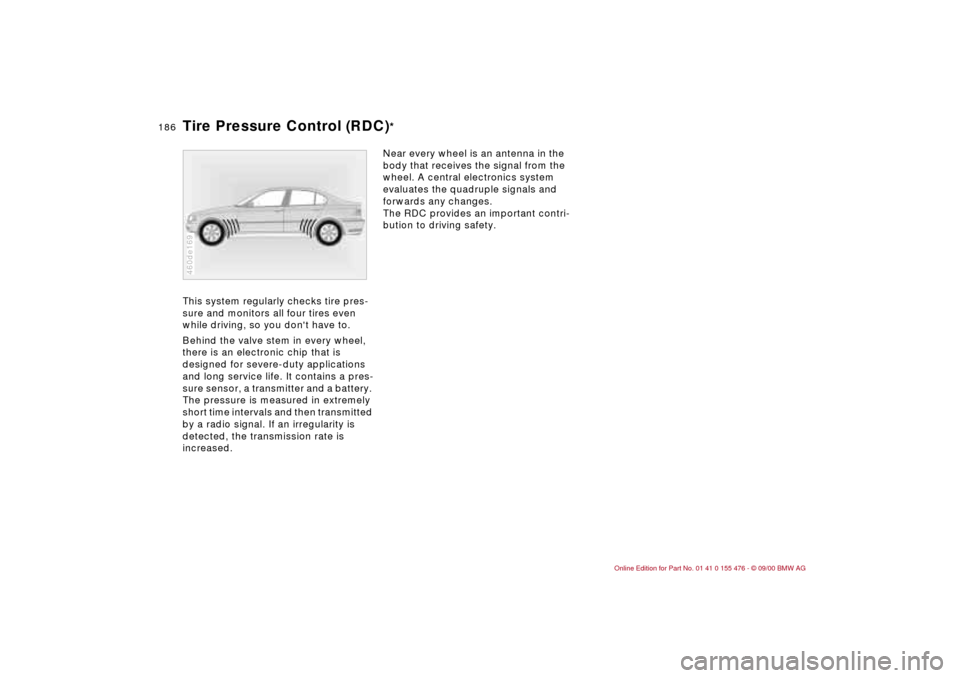
This system regularly checks tire pres-
sure and monitors all four tires even
while driving, so you don't have to.
Behind the valve stem in every wheel,
there is an electronic chip that is
designed for severe-duty applications
and long service life. It contains a pres-
sure sensor, a transmitter and a battery.
The pressure is measured in extremely
short time intervals and then transmitted
by a radio signal. If an irregularity is
detected, the transmission rate is
increased. 460de169
Near every wheel is an antenna in the
body that receives the signal from the
wheel. A central electronics system
evaluates the quadruple signals and
forwards any changes.
The RDC provides an important contri-
bution to driving safety.