engine BMW 330Ci CONVERTIBLE 2001 E46 User Guide
[x] Cancel search | Manufacturer: BMW, Model Year: 2001, Model line: 330Ci CONVERTIBLE, Model: BMW 330Ci CONVERTIBLE 2001 E46Pages: 215, PDF Size: 2.1 MB
Page 33 of 215
33n
IndexDataTechnologyRepairsCar careControlsOverview
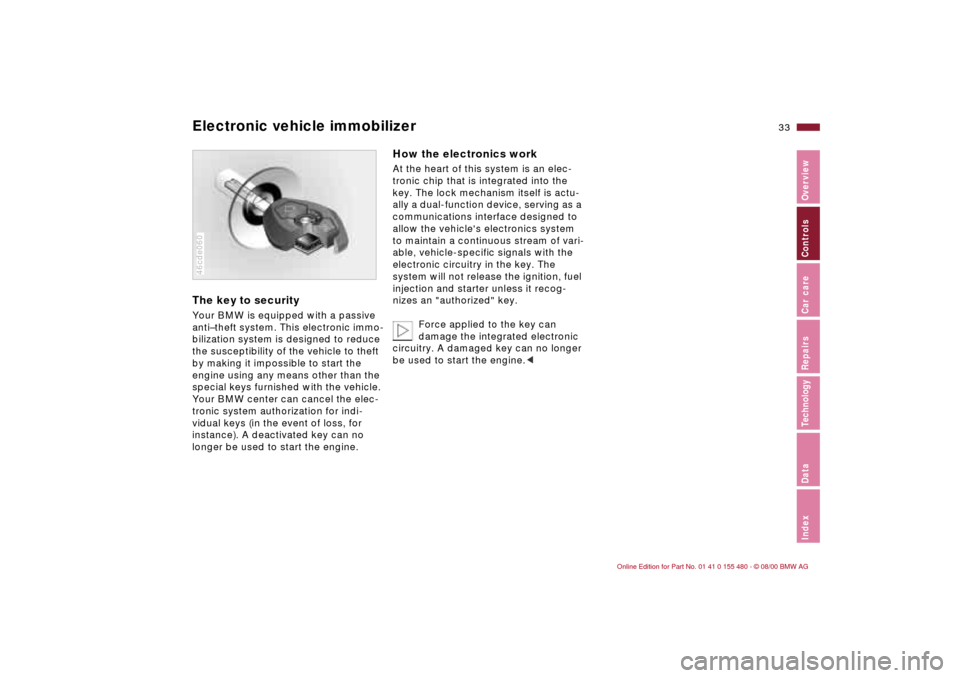
Electronic vehicle immobilizer The key to securityYour BMW is equipped with a passive
antiÐtheft system. This electronic immo-
bilization system is designed to reduce
the susceptibility of the vehicle to theft
by making it impossible to start the
engine using any means other than the
special keys furnished with the vehicle.
Your BMW center can cancel the elec-
tronic system authorization for indi-
vidual keys (in the event of loss, for
instance). A deactivated key can no
longer be used to start the engine.46cde060
How the electronics workAt the heart of this system is an elec-
tronic chip that is integrated into the
key. The lock mechanism itself is actu-
ally a dual-function device, serving as a
communications interface designed to
allow the vehicle's electronics system
to maintain a continuous stream of vari-
able, vehicle-specific signals with the
electronic circuitry in the key. The
system will not release the ignition, fuel
injection and starter unless it recog-
nizes an "authorized" key.
Force applied to the key can
damage the integrated electronic
circuitry. A damaged key can no longer
be used to start the engine.<
Page 48 of 215

48n
The manual convertible top
The fully automatic convertible top
*
At higher speeds, the ensuing
vacuum in the passenger
compartment can cause the convertible
top to begin fluttering. Increase the air
supply via the ventilation controls so
that a vacuum does not occur in the
vehicle.<
The completely automatically operated
convertible top combines assured
protection against the elements
together with simple, convenient
handling. So that you will get the most
out of enjoying your convertible, here
are a few tips:
It is advisable to close the convertible
top when the vehicle is parked. The
closed convertible top not only protects
the passenger compartment from
unforeseeable damage from the
weather, it also provides a certain
degree of theft protection. In addition,
keep valuables only in the locked
luggage compartment, even with the
convertible top closed.
Never mount a roof-mounted luggage
rack on the convertible top.
To prevent damage, do not operate the
convertible top at temperatures below
Ð 10 6.
To conserve the battery, only operate
the top with the engine running if
possible.
The convertible top operation is
completely automatic. You will hardly
ever need to support it by hand, refer to
page 49.
Operate the convertible top only if
the vehicle is parked and do not
start driving while the convertible top is
in motion, because at certain points,
this could possibly interrupt the
process. A partially open convertible
top can possibly lead to damage or
injury.
If you initiated convertible top operation
while the vehicle was standing still, and
then start to drive off, you can complete
the process at a traffic light, for
example, while traveling at a moderate
rate of speed. To do this, keep pressing
the proper switch.
Traffic laws applicable in your area take
precedence when you operate the
convertible top, otherwise you may be
breaking the law.
Before closing the convertible top,
remove any objects from the windshield
frame that could keep the convertible
top from closing properly.
Do not lay objects on the convertible
top, since they will fall off when the
convertible top is in motion and cause
damage or injuries.
To close the electric power windows
while driving, always be sure to close
either the rear windows first, or all
four windows at the same time, other-
wise, at high speeds, the windows may
not close tightly.
Page 69 of 215
69n
IndexDataTechnologyRepairsCar careControlsOverview
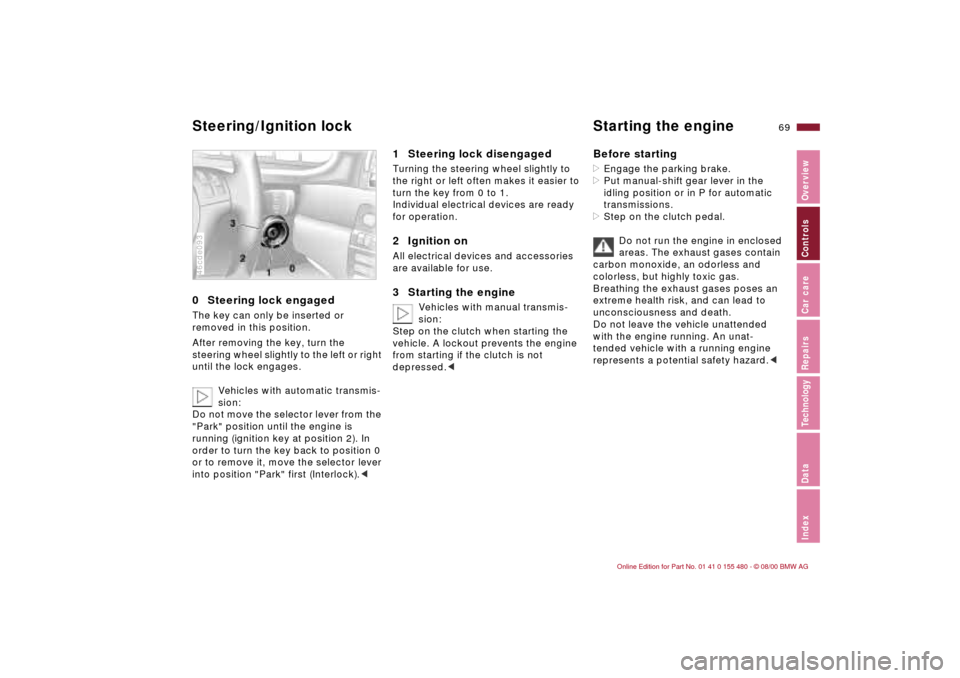
0 Steering lock engaged The key can only be inserted or
removed in this position.
After removing the key, turn the
steering wheel slightly to the left or right
until the lock engages.
Vehicles with automatic transmis-
sion:
Do not move the selector lever from the
"Park" position until the engine is
running (ignition key at position 2). In
order to turn the key back to position 0
or to remove it, move the selector lever
into position "Park" first (Interlock).<46cde093
1 Steering lock disengaged Turning the steering wheel slightly to
the right or left often makes it easier to
turn the key from 0 to 1.
Individual electrical devices are ready
for operation.2 Ignition onAll electrical devices and accessories
are available for use.3 Starting the engine
Vehicles with manual transmis-
sion:
Step on the clutch when starting the
vehicle. A lockout prevents the engine
from starting if the clutch is not
depressed.<
Before starting>Engage the parking brake.
>Put manual-shift gear lever in the
idling position or in P for automatic
transmissions.
>Step on the clutch pedal.
Do not run the engine in enclosed
areas. The exhaust gases contain
carbon monoxide, an odorless and
colorless, but highly toxic gas.
Breathing the exhaust gases poses an
extreme health risk, and can lead to
unconsciousness and death.
Do not leave the vehicle unattended
with the engine running. An unat-
tended vehicle with a running engine
represents a potential safety hazard.<
Steering/Ignition lock Starting the engine
Page 70 of 215

70n
Starting the engine Switching off the engine Do not press the accelerator pedal
while starting the engine.
Do not actuate the starter for too
short a time, but do not actuate it
for more than approx. 20 seconds.
Release the ignition key immediately
when the engine starts.
Do not allow the engine to warm up by
leaving it running while the vehicle
remains stationary. Instead, begin
driving immediately at a moderate
engine speed.<
If the engine does not start on the first
attempt (if it is very hot or cold, for
instance):
>Press the accelerator pedal halfway
down while engaging the starter.
Cold starts at very low temperatures,
starting at about +57 (Ð156) and
at high altitudes over 3,300 ft
(1,000 meters):
>On the first start attempt, engage the
starter for a longer period (approx.
10 seconds).
>Press the accelerator pedal halfway
down while engaging the starter.
Engine idle speed is controlled by the
engine computer system. Increased
speeds at start-up are normal and
should decrease as the engine warms
up. If engine speed does not decrease,
service is required.
To prevent the battery from
discharging, always deactivate elec-
trical devices that are not in use. Switch
the ignition off when the vehicle is not
being driven.Turn the ignition key to position 1 or 0.
Do not remove the ignition key
while the vehicle is still moving.
If you did so, the steering lock would
engage when the steering wheel is
turned.
Whenever you leave the vehicle, always
remove the ignition key and lock the
steering wheel.
Vehicles with manual transmission:
Always apply the parking brake
when parking on slopes and inclined
surfaces, since placing the shift lever
in 1st gear or reverse may not provide
adequate resistance to rolling.
Vehicles with automatic transmission:
Place the selector lever in "Park."<
Page 72 of 215
72n
Manual transmission Press the clutch pedal all the way down
each time you shift, pressing the
manual-shift gear lever into its proper
end position.
Depress the clutch when starting the
vehicle, too, otherwise, lockout will
prevent the engine from starting.
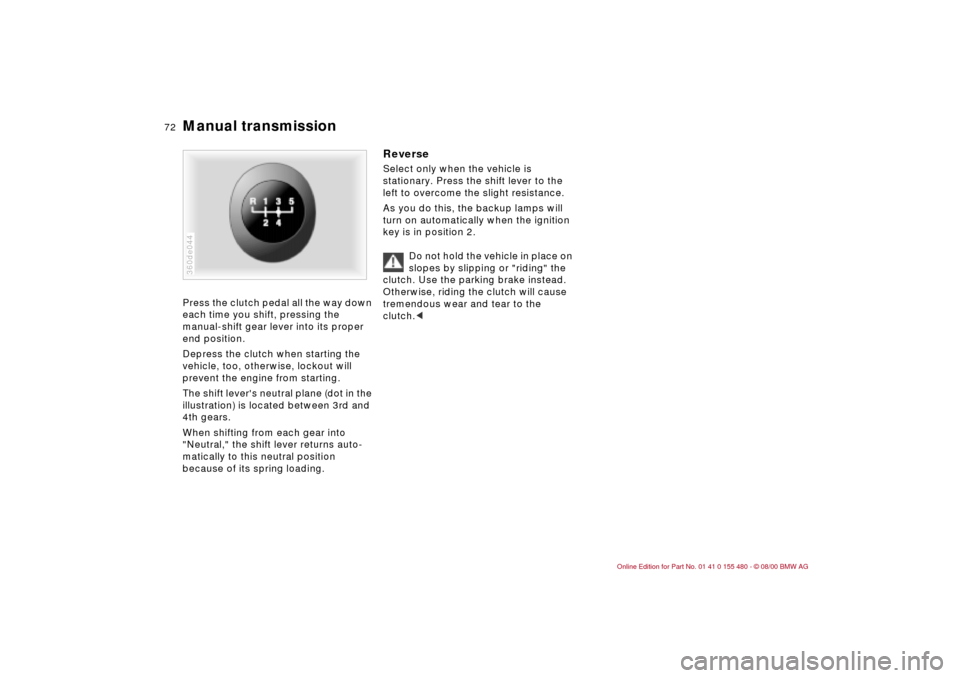
The shift lever's neutral plane (dot in the
illustration) is located between 3rd and
4th gears.
When shifting from each gear into
"Neutral," the shift lever returns auto-
matically to this neutral position
because of its spring loading.360de044
Reverse Select only when the vehicle is
stationary. Press the shift lever to the
left to overcome the slight resistance.
As you do this, the backup lamps will
turn on automatically when the ignition
key is in position 2.
Do not hold the vehicle in place on
slopes by slipping or "riding" the
clutch. Use the parking brake instead.
Otherwise, riding the clutch will cause
tremendous wear and tear to the
clutch.<
Page 73 of 215
73n
IndexDataTechnologyRepairsCar careControlsOverview
Automatic transmission with Steptronic
*
You have the option of driving with a
normal automatic transmission or
switching to manual.
When you move the selector lever from
the "D" position to the left into the M/S
range, the performance-oriented shift
programs of the automatic transmission
are engaged. As soon as you briefly
touch the selector lever in the "+" or "Ð"
direction, Steptronic shifts gears and
manual operation becomes active.
Whenever you want to use the auto-
matic mode again, move the selector
lever to the right into position "D."
The automatic transmission with Step-
tronic is equipped with Adaptive Trans-
mission Control (ATC). ATC reacts with
precision to your individual driving style
and the current driving conditions. It is
for this reason that various shift
programs are used.
You will find additional information
about ATC in the chapter called
"Advanced Technology" on page 188.
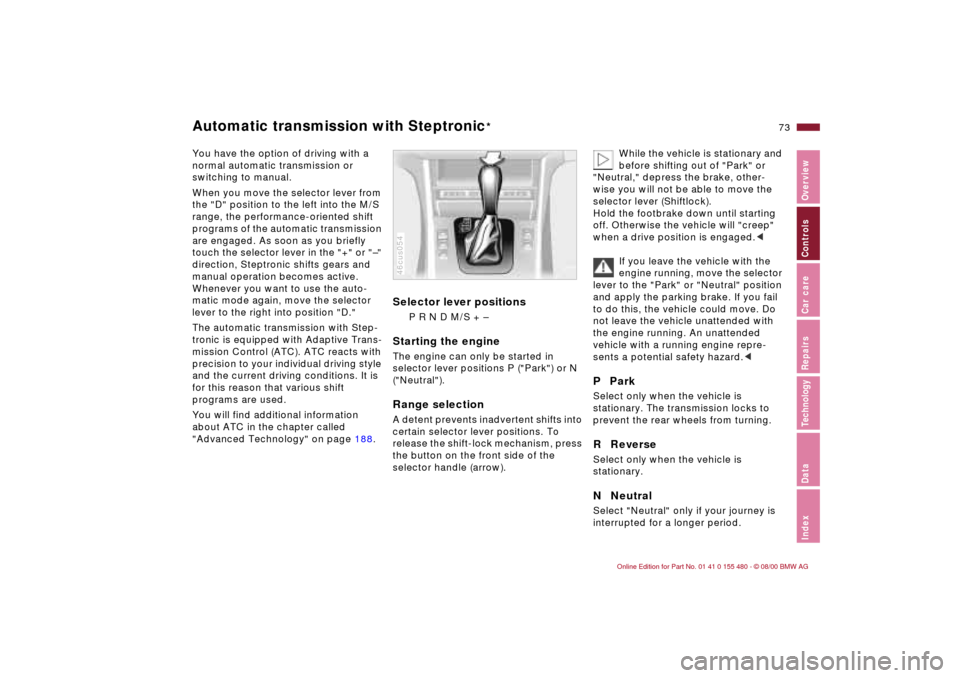
Selector lever positions
P R N D M/S + Ð
Starting the engineThe engine can only be started in
selector lever positions P ("Park") or N
("Neutral").Range selectionA detent prevents inadvertent shifts into
certain selector lever positions. To
release the shift-lock mechanism, press
the button on the front side of the
selector handle (arrow).46cus054
While the vehicle is stationary and
before shifting out of "Park" or
"Neutral," depress the brake, other-
wise you will not be able to move the
selector lever (Shiftlock).
Hold the footbrake down until starting
off. Otherwise the vehicle will "creep"
when a drive position is engaged.<
If you leave the vehicle with the
engine running, move the selector
lever to the "Park" or "Neutral" position
and apply the parking brake. If you fail
to do this, the vehicle could move. Do
not leave the vehicle unattended with
the engine running. An unattended
vehicle with a running engine repre-
sents a potential safety hazard.<
P ParkSelect only when the vehicle is
stationary. The transmission locks to
prevent the rear wheels from turning.R ReverseSelect only when the vehicle is
stationary.N NeutralSelect "Neutral" only if your journey is
interrupted for a longer period.
Page 74 of 215
74n
Automatic transmission with Steptronic
*
D Drive (automatic shift program)This position is designed for driving
under all normal operating conditions.
All forward gears are available and the
ATC is fully operational."Kickdown"In the "kickdown" mode, you achieve
maximum performance. To activate this
mode, depress the accelerator pedal
beyond the full-throttle position, at
which a resistance point must be over-
come.
M/S Manual mode and
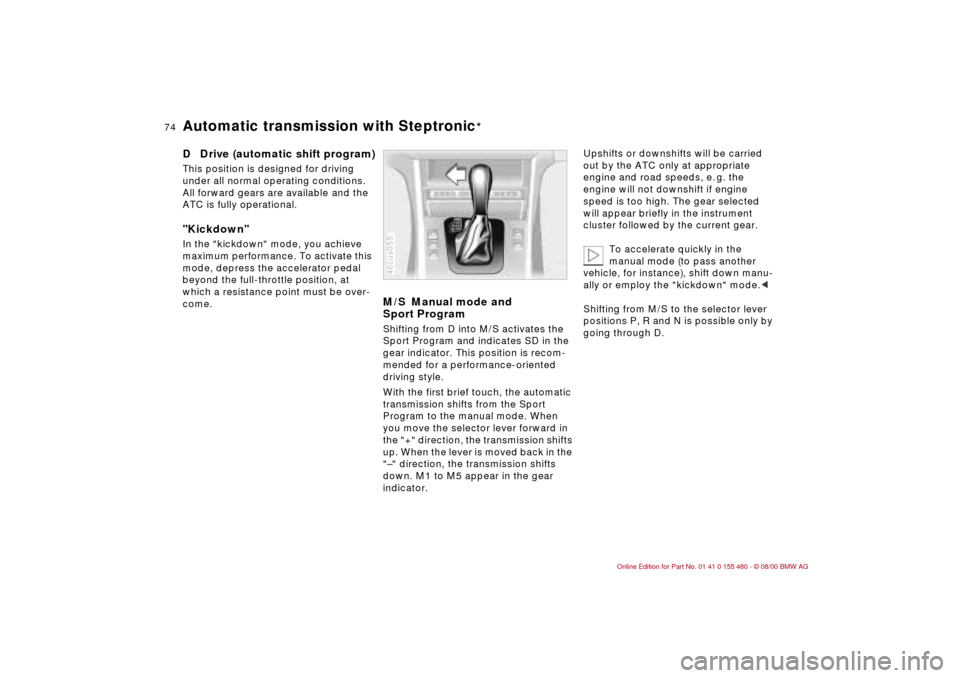
Sport ProgramShifting from D into M/S activates the
Sport Program and indicates SD in the
gear indicator. This position is recom-
mended for a performance-oriented
driving style.
With the first brief touch, the automatic
transmission shifts from the Sport
Program to the manual mode. When
you move the selector lever forward in
the "+" direction, the transmission shifts
up. When the lever is moved back in the
"Ð" direction, the transmission shifts
down. M1 to M5 appear in the gear
indicator.46cus055
Upshifts or downshifts will be carried
out by the ATC only at appropriate
engine and road speeds, e. g. the
engine will not downshift if engine
speed is too high. The gear selected
will appear briefly in the instrument
cluster followed by the current gear.
To accelerate quickly in the
manual mode (to pass another
vehicle, for instance), shift down manu-
ally or employ the "kickdown" mode.<
Shifting from M/S to the selector lever
positions P, R and N is possible only by
going through D.
Page 75 of 215
75n
IndexDataTechnologyRepairsCar careControlsOverview
Automatic transmission with Steptronic
*
In the following situations, the Step-
tronic "thinks" for you in the manual
mode:
>In order to prevent the engine from
overrevving, the transmission shifts
automatically to the next higher gear
just before the RPM cutoff point.
>At low speeds, the transmission
shifts down automatically and you do
not have to act
>In the "kickdown" mode, the trans-
mission shifts down to the lowest
gear which is possible, depending on
the engine speed.
>Depending on the situation Ñ when
driving in adverse winter conditions,
for example Ñ you may also start out
in 2nd or 3rd gear.
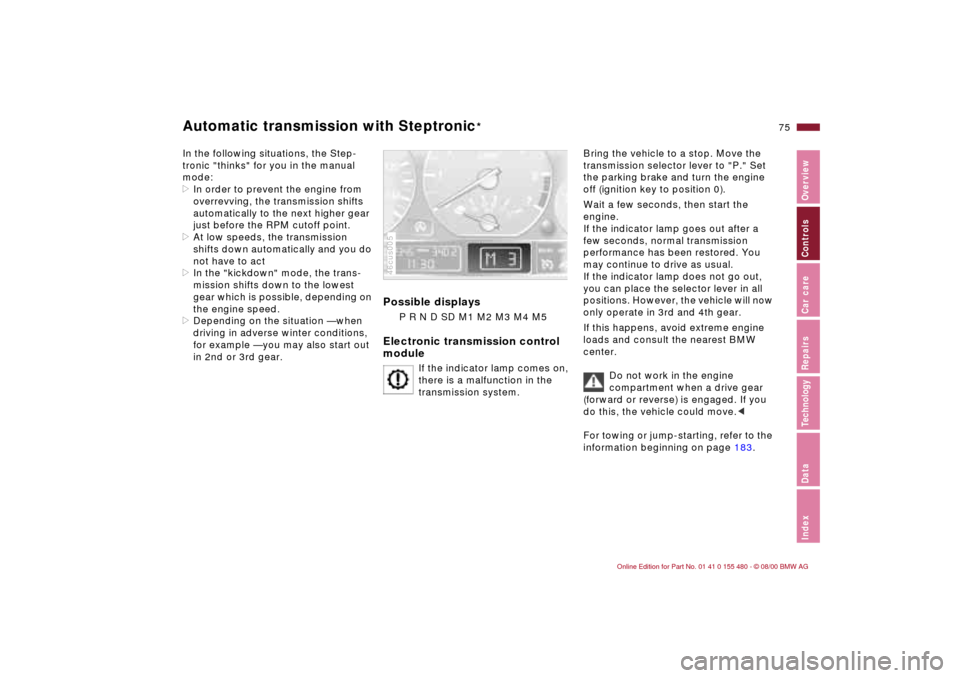
Possible displays
P R N D SD M1 M2 M3 M4 M5
Electronic transmission control
module
If the indicator lamp comes on,
there is a malfunction in the
transmission system.
46cus005
Bring the vehicle to a stop. Move the
transmission selector lever to "P." Set
the parking brake and turn the engine
off (ignition key to position 0).
Wait a few seconds, then start the
engine.
If the indicator lamp goes out after a
few seconds, normal transmission
performance has been restored. You
may continue to drive as usual.
If the indicator lamp does not go out,
you can place the selector lever in all
positions. However, the vehicle will now
only operate in 3rd and 4th gear.
If this happens, avoid extreme engine
loads and consult the nearest BMW
center.
Do not work in the engine
compartment when a drive gear
(forward or reverse) is engaged. If you
do this, the vehicle could move.<
For towing or jump-starting, refer to the
information beginning on page 183.
Page 79 of 215
79n
IndexDataTechnologyRepairsCar careControlsOverview
Cruise controlStarting at about 20 mph (30 km/h), you
can maintain and store any vehicle
speed that you specify.
Do not use the cruise control on
winding roads, when high traffic
density prevents driving at a constant
speed, when the road surface is slick
(snow, rain, ice), or when the road
surface is loose (rocks, sand).
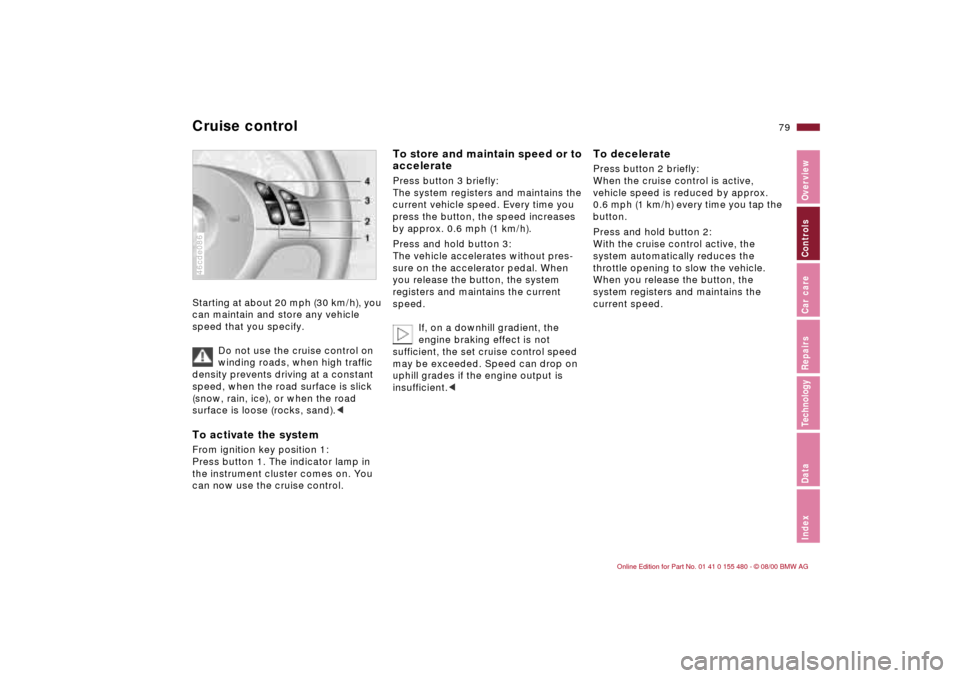
the instrument cluster comes on. You
can now use the cruise control.46cde086
To store and maintain speed or to
acceleratePress button 3 briefly:
The system registers and maintains the
current vehicle speed. Every time you
press the button, the speed increases
by approx. 0.6 mph (1 km/h).
Press and hold button 3:
The vehicle accelerates without pres-
sure on the accelerator pedal. When
you release the button, the system
registers and maintains the current
speed.
If, on a downhill gradient, the
engine braking effect is not
sufficient, the set cruise control speed
may be exceeded. Speed can drop on
uphill grades if the engine output is
insufficient.<
To deceleratePress button 2 briefly:
When the cruise control is active,
vehicle speed is reduced by approx.
0.6 mph (1 km/h) every time you tap the
button.
Press and hold button 2:
With the cruise control active, the
system automatically reduces the
throttle opening to slow the vehicle.
When you release the button, the
system registers and maintains the
current speed.
Page 81 of 215
81n
IndexDataTechnologyRepairsCar careControlsOverview
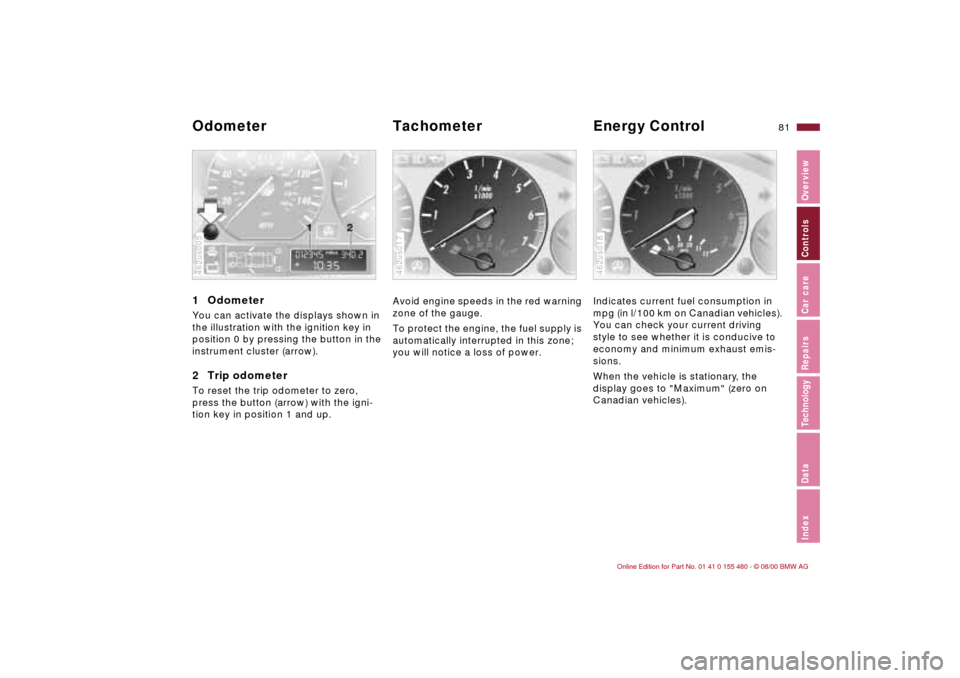
1 Odometer You can activate the displays shown in
the illustration with the ignition key in
position 0 by pressing the button in the
instrument cluster (arrow).2 Trip odometerTo reset the trip odometer to zero,
press the button (arrow) with the igni-
tion key in position 1 and up.462us005
Avoid engine speeds in the red warning
zone of the gauge.
To protect the engine, the fuel supply is
automatically interrupted in this zone;
you will notice a loss of power.462us017
Indicates current fuel consumption in
mpg (in l/100 km on Canadian vehicles).
You can check your current driving
style to see whether it is conducive to
economy and minimum exhaust emis-
sions.
When the vehicle is stationary, the
display goes to "Maximum" (zero on
Canadian vehicles).462us018
Odometer Tachometer Energy Control