engine BMW 330Ci CONVERTIBLE 2001 E46 Owner's Guide
[x] Cancel search | Manufacturer: BMW, Model Year: 2001, Model line: 330Ci CONVERTIBLE, Model: BMW 330Ci CONVERTIBLE 2001 E46Pages: 215, PDF Size: 2.1 MB
Page 82 of 215
82n
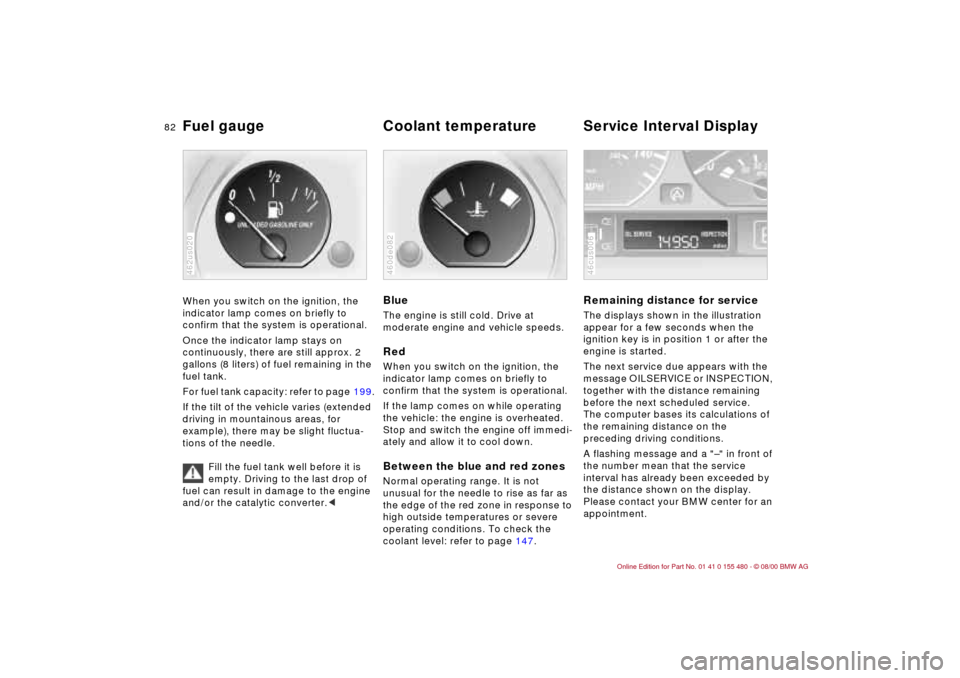
Fuel gauge Coolant temperature Service Interval Display When you switch on the ignition, the
indicator lamp comes on briefly to
confirm that the system is operational.
Once the indicator lamp stays on
continuously, there are still approx. 2
gallons (8 liters) of fuel remaining in the
fuel tank.
For fuel tank capacity: refer to page 199.
If the tilt of the vehicle varies (extended
driving in mountainous areas, for
example), there may be slight fluctua-
tions of the needle.
Fill the fuel tank well before it is
empty. Driving to the last drop of
fuel can result in damage to the engine
and/or the catalytic converter.<462us020
BlueThe engine is still cold. Drive at
moderate engine and vehicle speeds.RedWhen you switch on the ignition, the
indicator lamp comes on briefly to
confirm that the system is operational.
If the lamp comes on while operating
the vehicle: the engine is overheated.
Stop and switch the engine off immedi-
ately and allow it to cool down.Between the blue and red zonesNormal operating range. It is not
unusual for the needle to rise as far as
the edge of the red zone in response to
high outside temperatures or severe
operating conditions. To check the
coolant level: refer to page 147.460de082
Remaining distance for serviceThe displays shown in the illustration
appear for a few seconds when the
ignition key is in position 1 or after the
engine is started.
The next service due appears with the
message OILSERVICE or INSPECTION,
together with the distance remaining
before the next scheduled service.
The computer bases its calculations of
the remaining distance on the
preceding driving conditions.
A flashing message and a "Ð" in front of
the number mean that the service
interval has already been exceeded by
the distance shown on the display.
Please contact your BMW center for an
appointment.46cus006
Page 86 of 215
86n
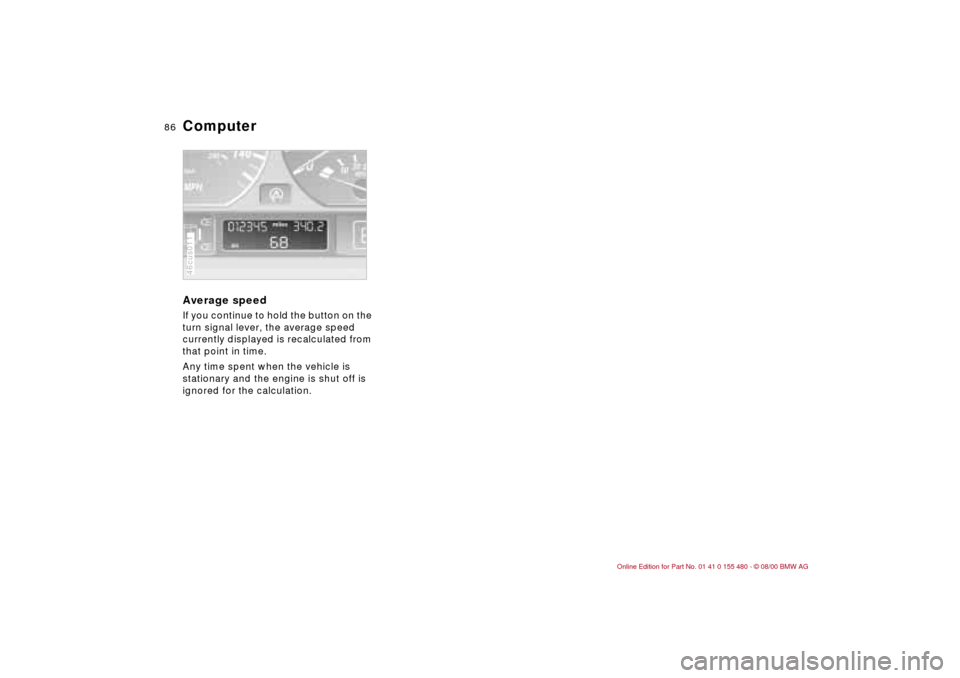
ComputerAverage speed If you continue to hold the button on the
turn signal lever, the average speed
currently displayed is recalculated from
that point in time.
Any time spent when the vehicle is
stationary and the engine is shut off is
ignored for the calculation.46cus011
Page 88 of 215
88n
ASC+TThe conceptThese systems enhance driving stability
and traction, especially when you are
just starting off, accelerating or in
curves.
ASC+T recognizes the danger present
in traction loss and will increase driving
stability and traction by reducing the
engine's output, and if necessary, by
applying the brakes to the rear wheels.
ASC+T is available as soon as the
engine starts up.
Indicator lamp
The indicator lamp in the instru-
ment cluster goes out shortly
after you switch on the ignition.
Refer to pages 21 and 22.
Indicator lamp flashes:
ASC+T controls the drive and braking
forces.
If the indicator lamp fails to go out after
the engine is started, or if it comes on
during normal driving and stays on:
There is a system malfunction or the
system was deactivated with the
button. Consequently, interventions to
increase driving stability (as described
in the preceding column) are not avail-
able. You can still drive the vehicle
normally without ASC+T.
Please consult your BMW center in the
event of a malfunction. Refer to
pages 21 and 22.
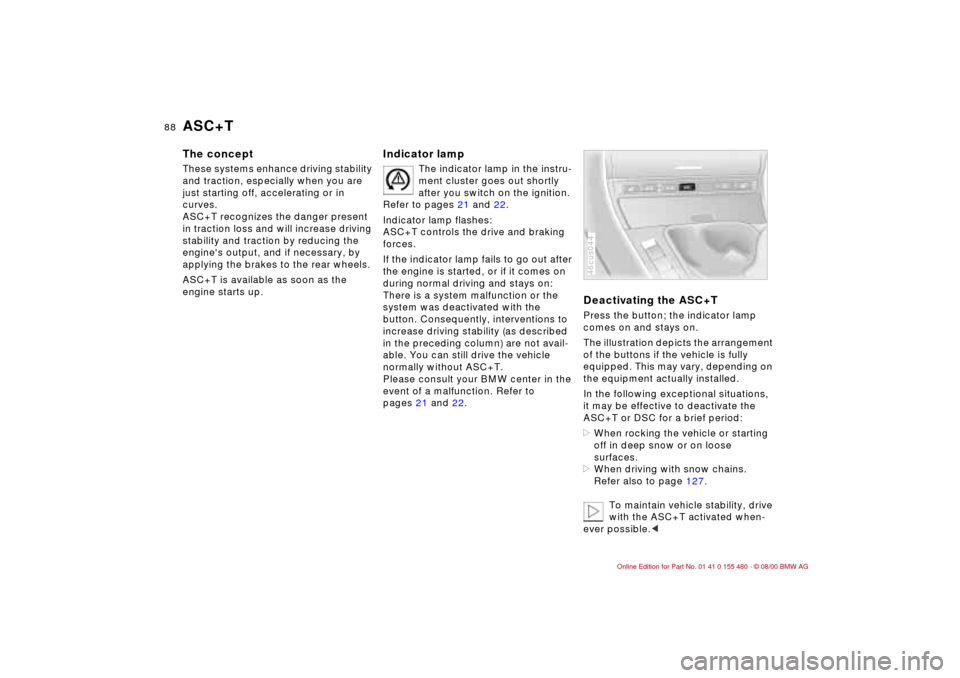
Deactivating the ASC+T Press the button; the indicator lamp
comes on and stays on.
The illustration depicts the arrangement
of the buttons if the vehicle is fully
equipped. This may vary, depending on
the equipment actually installed.
In the following exceptional situations,
it may be effective to deactivate the
ASC+T or DSC for a brief period:
>When rocking the vehicle or starting
off in deep snow or on loose
surfaces.
>When driving with snow chains.
Refer also to page 127.
To maintain vehicle stability, drive
with the ASC+T activated when-
ever possible.<46cus044
Page 89 of 215
89n
IndexDataTechnologyRepairsCar careControlsOverview
ASC+T DSC*Reactivating ASC+TPress the button again; the indicator
lamp goes out.
The laws of physics cannot be
repealed, even with ASC+T. It will
always be the driver's responsibility to
drive in a manner that matches road
conditions. This is why you should not
use the additional safety margin the
system provides as an excuse to take
risks.<
For additional details concerning
ASC+T, please refer to the chapter
"Advanced Technology" on page 189.
The conceptDSC maintains vehicle stability, even in
critical driving situations.
The system optimizes vehicle stability
during acceleration and when starting
from a full stop, as well as optimizing
traction. In addition, it recognizes
unstable vehicle conditions, such as
understeering or oversteering, and, as
far as is possible within the laws of
physics, helps keeping the car on a
steady course by reducing the RPMs
and brake applications to the individual
wheels.
The DSC is operational every time you
start the engine. DSC includes the
functions of ADB and CBC, refer to
page 123.
The ADB (Automatic Differential
Braking) copies the function of conven-
tional differential and transverse lock
through brake intervention, and
increases traction whenever conditions
merit, e. g. when driving on snow-
covered roads.
If the DSC is switched off the ADB will
still be in ready mode.
Indicator lamp
The indicator lamp in the instru-
ment cluster goes out shortly
after you switch on the ignition.
Refer to page 21, 22.
Indicator lamp flashes:
DSC controls the drive and braking
forces.
The indicator lamp stays lit:
DSC has been switched off via the
button; ADB is operational.
ADB control intervention is not indi-
cated.
The indicator and the brake
warning lamps will remain on
the continuously:
The DSC, ADB and DBC have
been switched off via the button
or are defective.
The vehicle will remain completely
operational, however, without DSC. In
the event of a fault, please see your
BMW center. Refer to page 21, 22.
Indicator and warning lamps for
Canadian models.
Page 90 of 215
90n
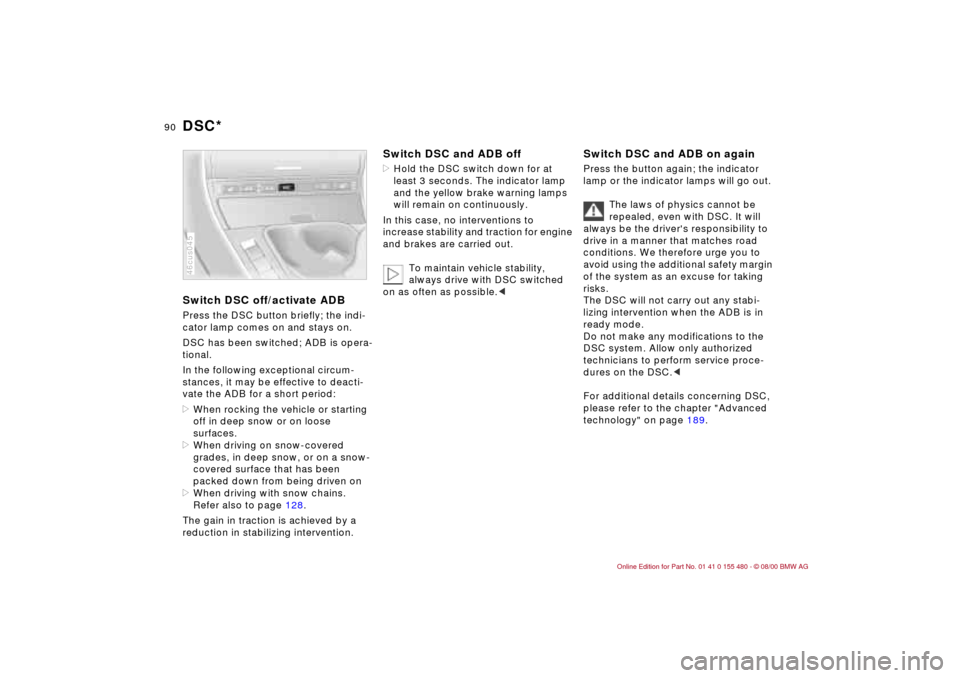
DSC*Switch DSC off/activate ADBPress the DSC button briefly; the indi-
cator lamp comes on and stays on.
DSC has been switched; ADB is opera-
tional.
In the following exceptional circum-
stances, it may be effective to deacti-
vate the ADB for a short period:
>When rocking the vehicle or starting
off in deep snow or on loose
surfaces.
>When driving on snow-covered
grades, in deep snow, or on a snow-
covered surface that has been
packed down from being driven on
>When driving with snow chains.
Refer also to page 128.
The gain in traction is achieved by a
reduction in stabilizing intervention.46cus045
Switch DSC and ADB off>Hold the DSC switch down for at
least 3 seconds. The indicator lamp
and the yellow brake warning lamps
will remain on continuously.
In this case, no interventions to
increase stability and traction for engine
and brakes are carried out.
To maintain vehicle stability,
always drive with DSC switched
on as often as possible.<
Switch DSC and ADB on againPress the button again; the indicator
lamp or the indicator lamps will go out.
The laws of physics cannot be
repealed, even with DSC. It will
always be the driver's responsibility to
drive in a manner that matches road
conditions. We therefore urge you to
avoid using the additional safety margin
of the system as an excuse for taking
risks.
The DSC will not carry out any stabi-
lizing intervention when the ADB is in
ready mode.
Do not make any modifications to the
DSC system. Allow only authorized
technicians to perform service proce-
dures on the DSC.<
For additional details concerning DSC,
please refer to the chapter "Advanced
technology" on page 189.
Page 91 of 215
91n
IndexDataTechnologyRepairsCar careControlsOverview
Tire Pressure Control (RDC)
*
The conceptRDC monitors the tire pressures at all
four wheels, even when the vehicle is
moving. The system provides an alert
whenever the inflation pressure drops
significantly below the specified pres-
sure in one or more tires.
In order for the system to "learn" the
correct tire inflation pressure, check the
inflation pressure in all tires according
to the inflation pressure table (page 28)
and make corrections if necessary.
Then activate the system.
This indicator lamp in the instru-
ment cluster will inform you if
the tire pressure is not correct.
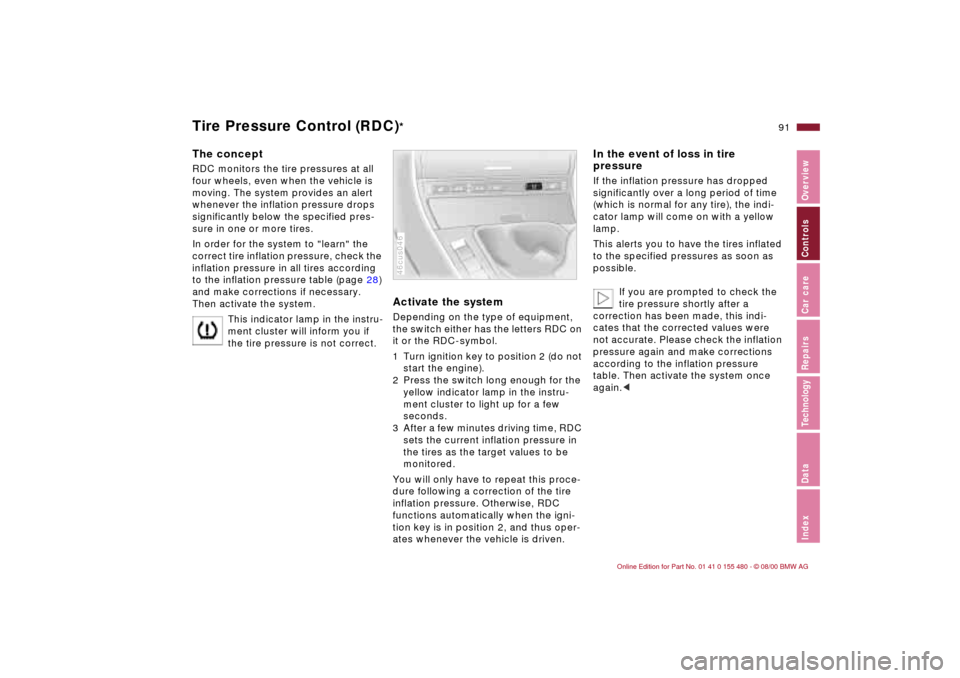
Activate the systemDepending on the type of equipment,
the switch either has the letters RDC on
it or the RDC-symbol.
1 Turn ignition key to position 2 (do not
start the engine).
2 Press the switch long enough for the
yellow indicator lamp in the instru-
ment cluster to light up for a few
seconds.
3 After a few minutes driving time, RDC
sets the current inflation pressure in
the tires as the target values to be
monitored.
You will only have to repeat this proce-
dure following a correction of the tire
inflation pressure. Otherwise, RDC
functions automatically when the igni-
tion key is in position 2, and thus oper-
ates whenever the vehicle is driven.46cus046
In the event of loss in tire
pressureIf the inflation pressure has dropped
significantly over a long period of time
(which is normal for any tire), the indi-
cator lamp will come on with a yellow
lamp.
This alerts you to have the tires inflated
to the specified pressures as soon as
possible.
If you are prompted to check the
tire pressure shortly after a
correction has been made, this indi-
cates that the corrected values were
not accurate. Please check the inflation
pressure again and make corrections
according to the inflation pressure
table. Then activate the system once
again.<
Page 98 of 215

98n
Air conditionerAir supply
You can select blower speeds
from 1 to 4. The heating and
ventilation become more and
more effective as the air
supply settings are increased. In posi-
tion 0, the blower and the heater are
switched off. By using position 0, you
can totally block the interior ventilation
outlets by pressing the button for the
recirculated-air mode.
Temperature
In order to increase the
temperature of the passenger
compartment, turn it to the
right (red). Temperature regu-
lation will keep the interior temperature
you have selected constant.
Air distribution
You can direct air to flow onto
the windows , toward the
upper body and into the
footwell . All intermediate
settings are possible. In the setting,
there is a low flow of air onto the
windows to keep them free of conden-
sation. The "6 o'clock" setting is recom-
mended as a normal setting (refer also
to the illustration and overview on
page 96).
Rear window defroster
When the rear window defroster
is activated, the indicator lamp
comes on. The rear window defroster
switches off automatically. Refer to
page 78.
Air conditioner
The air is cooled and dehumidi-
fied and Ð depending on the
temperature setting Ð rewarmed when
the air conditioner is switched on.
Depending on the weather, the wind-
shield may fog over briefly when the
engine is started.
Use the button to switch the air condi-
tioner off at outside temperatures
below approx. 41 7 (+5 6). This will
help to prevent the windows from
fogging up.
If the windows fog over after switching
the air conditioner off, switch it back
on.
Condensation forms in the air
conditioner system during opera-
tion, which then exits under the vehicle.
Traces of condensed water of this kind
are thus normal.
<< < <
Recirculated-air mode
You can respond to unpleasant
external odors by temporarily
blocking the outside air. The system
then recirculates the air already within
the vehicle.
If the windows fog over in the
recirculated air mode, switch this
mode off and increase the air supply as
required.<< < <
Page 105 of 215
105n
IndexDataTechnologyRepairsCar careControlsOverview
Automatic climate control
*
Air supply
By pressing the left or right half
of the button, you can vary the
air supply. By doing this, you switch off
the automatic control of the air supply.
Nevertheless, the automatic air distri-
bution remains unchanged.
When you set the lowest blower speed
by pressing the left half of the button,
all of the displays are canceled: the
blower, heating and air conditioner are
switched off, and the air supply is
stopped. You can reactivate the system
by pressing any button for the auto-
matic climate control.
To defrost the windows and to
remove condensation
This program quickly removes
ice and condensation from the
windshield and side windows.
Air conditioner
The air is cooled and dehumidi-
fied and Ð depending on the
temperature setting Ð rewarmed when
the air conditioner is switched on.
Depending on the weather, the wind-
shield may fog over briefly when the
engine is started.
Use the button to switch the air condi-
tioner off at outside temperatures
below approx. 41 7 (+5 6). This will
help to prevent the windows from
fogging up.
If the windows fog over after switching
the air conditioner off, switch it back
on.
Condensation forms in the air
conditioner system during opera-
tion, that then exits under the vehicle.
Traces of condensed water of this kind
are thus normal.<
Automatic recirculated air control
(AUC)
If there are unpleasant odors or
pollutants in the outside air, you
can temporarily block the air supply
from the outside. The system then
recirculates the air already within the
vehicle. By repeated actuation of the
button, you can select one of three
different operation modes.
>Indicator lamps off: fresh air flows
into the vehicle.
>Left-hand indicator lamp on Ð AUC
mode: the system detects pollutants
in the outside air and responds by
deactivating the outside air supply as
required. The system then recircu-
lates the air already within the vehicle.
Depending on the air quality, the
automatic system then switches back
and forth between outside air supply
and recirculation of the air within the
vehicle.
>Right-hand indicator lamp on: the
supply of outside air is permanently
blocked. The system recirculates the
air already within the vehicle.
If the windows fog over in the
recirculated air mode, switch this
mode off and increase the air supply as
required.<
Page 119 of 215
Overview
Controls and features
Operation, care
and maintenance
Owner service procedures
Technical data
Index Advanced technology
119n
IndexDataTechnologyRepairsCar careControlsOverview
Special operating instructions:
Break-in procedures120
Driving notes121
Catalytic converter121
Antilock Brake System
(ABS)122
Disc brakes125
Brake system126
Winter operation127
Power steering129
Cellular phones129
Radio reception129
Hardtop130
Wheels and tires:
Tire inflation pressure132
Tire condition132
Tire replacement133
Tire rotation134
Wheel and tire
combinations135
Winter tires136
Snow chains136
Approved wheel and tire
specifications137Under the hood:
Hood140
Engine compartment142
Washer fluids144
Washer nozzles144
Engine oil145
Coolant147
Brake fluid148
Vehicle Identification
Number149
Care and maintenance:
The BMW Maintenance
System150
Caring for your vehicle151
Cleaning and care of the
convertible top157
Airbags159
Vehicle storage160
Laws and regulations:
Technical modifications161
California Proposition
65 Warning161
OBD interface socket162
Car care
Page 120 of 215

120n
To ensure that your vehicle provides
maximum economy throughout a long
service life, we request that you comply
with the following recommendations:
Engine and differentialUp to 1,200 miles (2,000 km):
Drive at varying engine and road
speeds, but do not exceed 4,500 rpm
or a speed of 100 mph (160 km/h):
Obey your local and state maximum
speed limits.
Always avoid using the full throttle or
"kickdown" position for the accelerator.
Once you have driven 1,200 miles
(2,000 km), engine speed and vehicle
speed can be gradually increased.
Follow the same break-in procedure if
either the engine or the differential is
replaced in the future.
TiresDue to technical factors associated
with their manufacture, tires do not
achieve their full traction potential until
an initial break-in period has elapsed.
For this reason drive cautiously during
the initial 200 miles (300 km).
Obey your local and state maximum
speed limits.
When the vehicle is operated on
wet or slushy roads, a wedge of
water may form between the tire and
the road surface. This phenomenon is
referred to as aquaplaning, or hydro-
planing, and can lead to partial or
complete loss of traction, vehicle
control and braking effectiveness.
Reduce your speed on wet roads.<
Brake systemApproximately 300 miles (500 km) must
elapse before the brake pads and discs
achieve the optimal pad-surface and
wear patterns required for trouble-free
operation and long service life later on.
To break-in the separate parking brake
drums, apply the parking brake lightly
when coasting to a standstill (at a traffic
signal, for instance), provided that
traffic conditions allow you to do so.
To avoid corrosion, repeat this proce-
dure from time to time.
The brake lamps do not come on
when the parking brake is set.
Vacuum for the brake system servo unit
on your BMW is available only when the
engine is running. When you move the
vehicle with the engine off Ð when
towing, for example Ð substantially
higher levels of pedal force will be
required to brake the vehicle.
(500 km). Engage the gears carefully
during the break-in period.
Break-in procedures