engine BMW 330Ci CONVERTIBLE 2001 E46 Workshop Manual
[x] Cancel search | Manufacturer: BMW, Model Year: 2001, Model line: 330Ci CONVERTIBLE, Model: BMW 330Ci CONVERTIBLE 2001 E46Pages: 215, PDF Size: 2.1 MB
Page 183 of 215
183n
IndexDataTechnologyRepairsCar careControlsOverview
Do not use spray starter fluids.
If the battery is discharged, the engine
can be started with the use of two
jumper cables and the battery of
another vehicle. Use only jumper cables
with fully insulated grips on the terminal
clamps.
Do not touch the parts conducting
electrical current while the engine
is running. Failure to comply with this
creates a risk of fatal injury.<
Carefully comply with the following
instructions to avoid personal injury or
damage to one or both vehicles:
1 Be sure that the battery on the
support vehicle is also rated at
12 volts, and that the capacities of
the two batteries (Ah) are roughly
comparable (printed on casing).
2 Leave the drained battery connected
to the vehicle's electrical system.
3 Make sure that there is no contact
between the bodywork of the two
vehicles Ð this creates a risk of short
circuits.
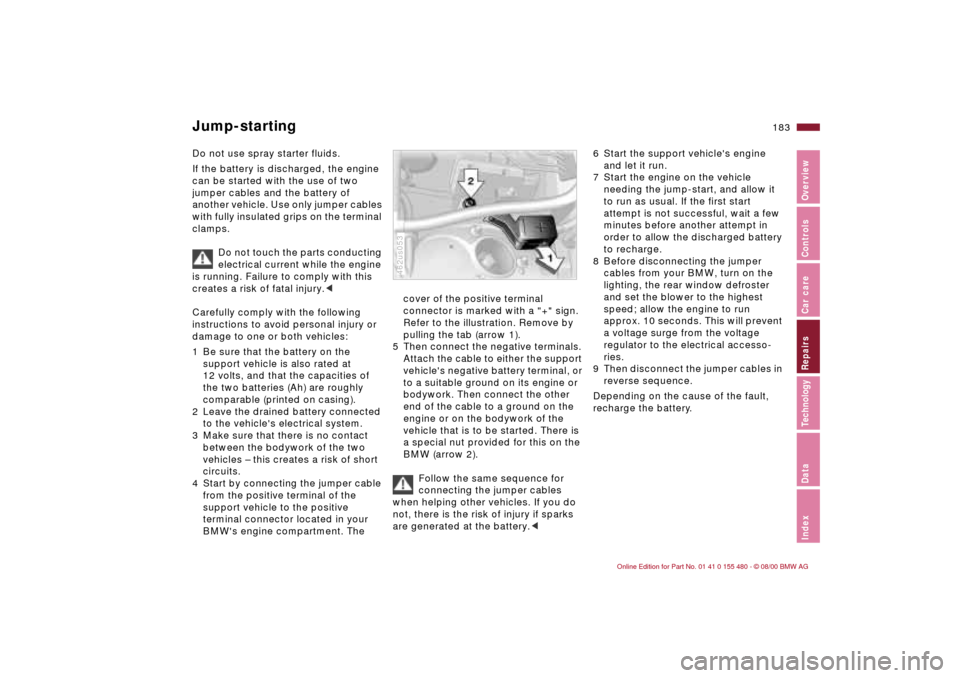
4 Start by connecting the jumper cable
from the positive terminal of the
support vehicle to the positive
terminal connector located in your
BMW's engine compartment. The
cover of the positive terminal
connector is marked with a "+" sign.
Refer to the illustration. Remove by
pulling the tab (arrow 1).
5 Then connect the negative terminals.
Attach the cable to either the support
vehicle's negative battery terminal, or
to a suitable ground on its engine or
bodywork. Then connect the other
end of the cable to a ground on the
engine or on the bodywork of the
vehicle that is to be started. There is
a special nut provided for this on the
BMW (arrow 2).
Follow the same sequence for
connecting the jumper cables
when helping other vehicles. If you do
not, there is the risk of injury if sparks
are generated at the battery.<462us053
6 Start the support vehicle's engine
and let it run.
7 Start the engine on the vehicle
needing the jump-start, and allow it
to run as usual. If the first start
attempt is not successful, wait a few
minutes before another attempt in
order to allow the discharged battery
to recharge.
8 Before disconnecting the jumper
cables from your BMW, turn on the
lighting, the rear window defroster
and set the blower to the highest
speed; allow the engine to run
approx. 10 seconds. This will prevent
a voltage surge from the voltage
regulator to the electrical accesso-
ries.
9 Then disconnect the jumper cables in
reverse sequence.
Depending on the cause of the fault,
recharge the battery.
Jump-starting
Page 188 of 215
188n
On vehicles with automatic transmis-
sion, the Adaptive Transmission Control
(ATC) uses a number of factors to
calculate the most efficient gear. In this
process, it considers your individual
driving style as well as current driving
conditions.
ATC recognizes your personal driving
style from the positions and movements
of the accelerator pedal, deceleration
when braking, and lateral acceleration
through curves. Based on different shift
characteristics Ð from comfort-oriented
to performance-oriented Ð ATC will
select the appropriate gear.
46cus020
In order to include driving conditions in
its calculations, ATC registers curves
and both uphill and downhill grades.
For example, if you maintain speed
through a curve, the transmission does
not shift up. On uphill grades, it shifts
up only when the engine speed
increases in order to make more effi-
cient use of power reserves. On down-
hill grades, ATC shifts down when the
speed of the vehicle increases and the
driver must apply the brakes.
ATC
*
Page 189 of 215
189n
IndexDataTechnologyRepairsCar careControlsOverview
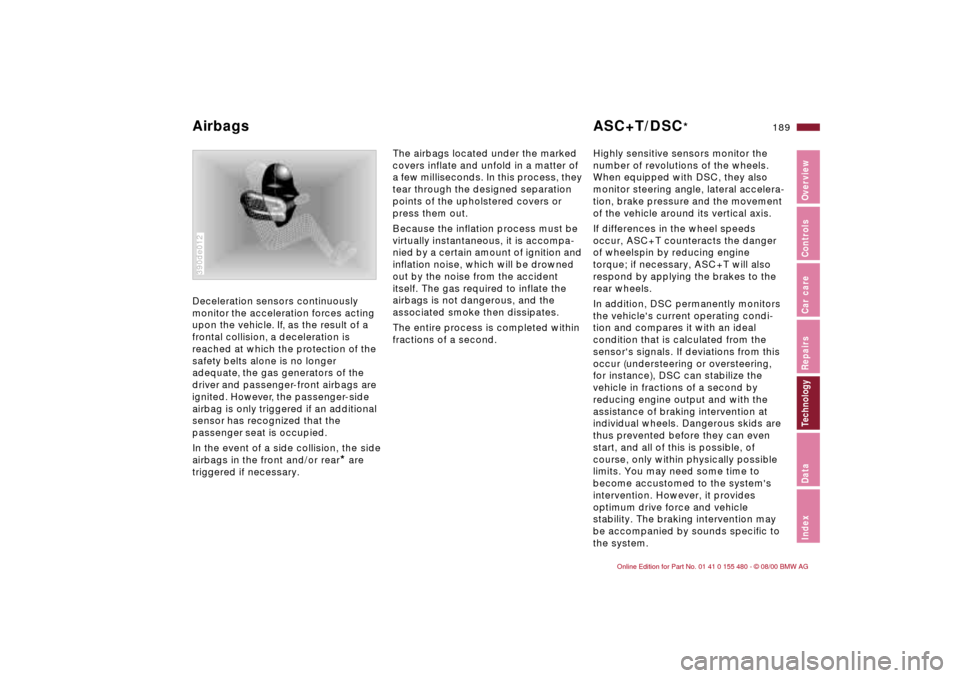
Deceleration sensors continuously
monitor the acceleration forces acting
upon the vehicle. If, as the result of a
frontal collision, a deceleration is
reached at which the protection of the
safety belts alone is no longer
adequate, the gas generators of the
driver and passenger-front airbags are
ignited. However, the passenger-side
airbag is only triggered if an additional
sensor has recognized that the
passenger seat is occupied.
In the event of a side collision, the side
airbags in the front and/or rear
* are
triggered if necessary.
390de012
The airbags located under the marked
covers inflate and unfold in a matter of
a few milliseconds. In this process, they
tear through the designed separation
points of the upholstered covers or
press them out.
Because the inflation process must be
virtually instantaneous, it is accompa-
nied by a certain amount of ignition and
inflation noise, which will be drowned
out by the noise from the accident
itself. The gas required to inflate the
airbags is not dangerous, and the
associated smoke then dissipates.
The entire process is completed within
fractions of a second.Highly sensitive sensors monitor the
number of revolutions of the wheels.
When equipped with DSC, they also
monitor steering angle, lateral accelera-
tion, brake pressure and the movement
of the vehicle around its vertical axis.
If differences in the wheel speeds
occur, ASC+T counteracts the danger
of wheelspin by reducing engine
torque; if necessary, ASC+T will also
respond by applying the brakes to the
rear wheels.
In addition, DSC permanently monitors
the vehicle's current operating condi-
tion and compares it with an ideal
condition that is calculated from the
sensor's signals. If deviations from this
occur (understeering or oversteering,
for instance), DSC can stabilize the
vehicle in fractions of a second by
reducing engine output and with the
assistance of braking intervention at
individual wheels. Dangerous skids are
thus prevented before they can even
start, and all of this is possible, of
course, only within physically possible
limits. You may need some time to
become accustomed to the system's
intervention. However, it provides
optimum drive force and vehicle
stability. The braking intervention may
be accompanied by sounds specific to
the system.
Airbags ASC+T/DSC
*
Page 192 of 215
192n
Tire Pressure Control* Self-diagnostics This system regularly checks tire pres-
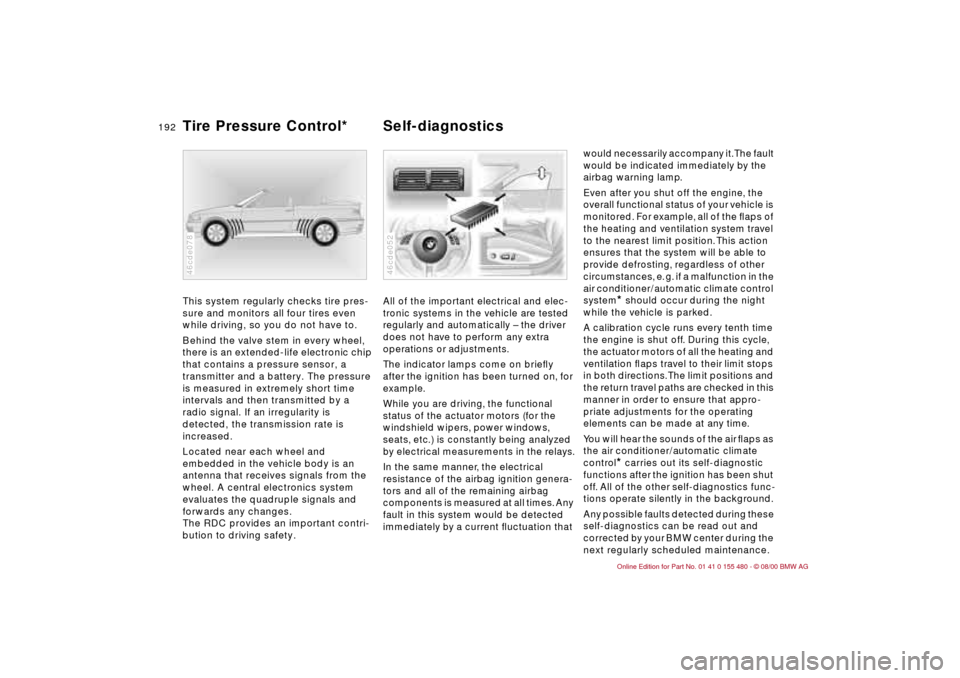
sure and monitors all four tires even
while driving, so you do not have to.
Behind the valve stem in every wheel,
there is an extended-life electronic chip
that contains a pressure sensor, a
transmitter and a battery. The pressure
is measured in extremely short time
intervals and then transmitted by a
radio signal. If an irregularity is
detected, the transmission rate is
increased.
Located near each wheel and
embedded in the vehicle body is an
antenna that receives signals from the
wheel. A central electronics system
evaluates the quadruple signals and
forwards any changes.
The RDC provides an important contri-
bution to driving safety.46cde078
All
of the important electrical and elec-
tronic systems in the vehicle are tested
regularly and automatically Ð the driver
does not have to perform any extra
operations or adjustments.
The indicator lamps come on brießy
after the ignition has been turned on, for
example.
While you are driving, the functional
status of the actuator motors (for the
windshield wipers, power windows,
seats, etc.) is constantly being analyzed
by electrical measurements in the relays.
In the same manner, the electrical
resistance of the airbag ignition genera-
tors and all of the remaining airbag
components is measured at all times. Any
fault in this system would be detected
immediately by a current ßuctuation that 46cde052
would necessarily accompany it.
The fault
would be indicated immediately by the
airbag warning lamp.
Even after you shut off the engine, the
overall functional status of your vehicle is
monitored. For example, all of the ßaps of
the heating and ventilation system travel
to the nearest limit position. This action
ensures that the system will be able to
provide defrosting, regardless of other
circumstances, e. g. if a malfunction in the
air conditioner/automatic climate control
system
* should occur during the night
while the vehicle is parked.
A calibration cycle runs every tenth time
the engine is shut off. During this cycle,
the actuator motors of all the heating and
ventilation ßaps travel to their limit stops
in both directions. The limit positions and
the return travel paths are checked in this
manner in order to ensure that appro-
priate adjustments for the operating
elements can be made at any time.
You will hear the sounds of the air ßaps as
the air conditioner/automatic climate
control* carries out its self-diagnostic
functions after the ignition has been shut
off. All of the other self-diagnostics func-
tions operate silently in the background.
Any possible faults detected during these
self-diagnostics can be read out and
corrected by your BMW center
during the
next regularly scheduled maintenance.
Page 195 of 215
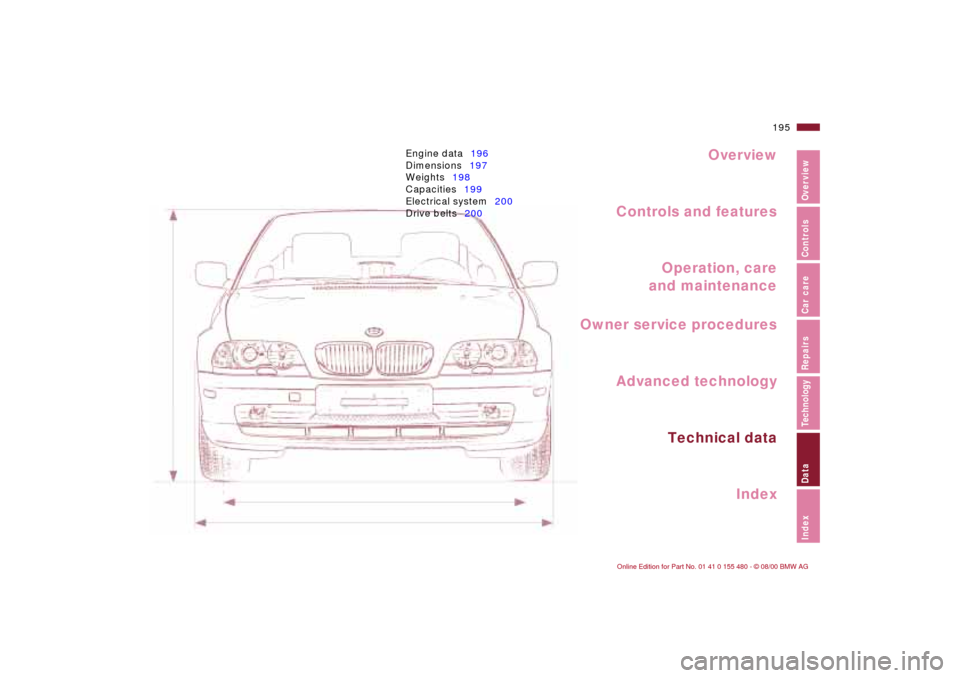
Overview
Controls and features
Operation, care
and maintenance
Owner service procedures
Technical data
Index Advanced technology
195n
IndexDataTechnologyRepairsCar careControlsOverview
Engine data196
Dimensions197
Weights198
Capacities199
Electrical system200
Drive belts200
Data
Page 196 of 215

196n
BMW 325Ci BMW 330Ci
Displacement
Number of cylinderscu in (cmm) 152.2 (2,494)
6181.8 (2,979)
6
Maximum output
at engine speedhp
rpm184 (135)
6,000225 (165)
5,900
Maximum torque
at engine speedlb-ft (Nm)
rpm175 (237)
3,500214 (290)
3,500
Compression ratioe
10.5 10.2
Stroke
Borein (mm)
in (mm)2.95 (75)
3.31 (84)3.53 (89.6)
3.31 (84)
Fuel-injection system Digital-electronic engine-management system
Engine data
Page 199 of 215

199n
IndexDataTechnologyRepairsCar careControlsOverview
Capacities
Notes
Fuel tank
Reserve gal. (liters)
gal. (liters)approx. 16.6 (approx. 63)
approx. 2.1 (approx. 8)Fuel specification: page 27
Windshield/headlamp washer system quarts (liters) approx. 5.6 (approx. 5.3) Specifications: page 144
Cooling system including heater circuit quarts (liters) approx. 8.9 (approx. 8.4) Specifications: page 147
Engine oil filter change quarts (liters) approx. 6.9 (approx. 6.5) BMW High Performance
Synthetic Oil
Specifications: page 146
Manual and automatic transmission, transfer box
and differentialÐ Lifetime fluid, no fluid
change required
Page 204 of 215

Everything from A to Z
A
ABS (Antilock Brake System) 22,122
Accessories 6
Activated-charcoal filter 106,180
Adaptive Transmission Control (ATC) 73,188
Adding engine oil 145
Adding washer fluid 144,199
Adjusting backrest 52
Adjusting headrests 53
Adjusting the steering wheel 57
Adjusting the temperature 98,104
Adjusting thigh support 54
Air conditioner 96
Air distribution 98,104
Air nozzles 96,102
Air outlets 96,102
ventilation 96,102
Air pressure, tires 27,132
Air supply 98,105
Airbags 21,61 ,159 ,189
sitting properly with 62
Alarm system 42
Antenna 129
Antenna, Diversity 190 Antifreeze
147
radiator 127
Antilock Brake System (ABS) 22,122
Anti-theft alarm system 42
Aquaplaning 121,132
Armrest 110
ASC+T (Automatic Stability Control plus
Traction) 22,88
Ashtray front 111
rear 112
ATC (Adaptive Transmission Control) 73,188
Attach vacuum cleaner 112
AUC (Automatic recirculated-air
control) 105
Automatic car washes 151
Automatic climate control 102
remove window
condensation 105
Automatic cruise control 79
Automatic dimming, interior rearview mirror 58
Automatic recirculated-air control (AUC) 105
Automatic Stability Control plus Traction
(ASC+T) 22,88 Automatic transmission with
Steptronic 21,73
Automatic windshield washer 77
Average consumption 85
Average speed 86
Avoiding unwanted alarm 43
Axle loads 198
B
Backrest adjusting 52
locking 21,55
releasing 55
Backup lamps 72
bulb replacement 169
Battery 176,200
capacity 200
charge current 20,176
charging 178
discharged 183
removal and
installation 178
Belts 60
Beverage holder 111
Blower 98,105
BMW High Performance Synthetic Oils 146
BMW Maintenance System 150 BMW sports seat
54
Bore 196
Brake fluid 148
Brake hydraulic system 20
Brake lamps, bulb replacement 169
Brake pads 22,126
Brake system 126
Brakes 125
malfunctions 126
Break-in procedures 120
Bulb replacement 166
C
California Proposition 65 Warning 161
Capacities 199
Car Memory 59
Car radio 129
reception 129,190
refer also to the Radio
Owner's Manual
Car washes 151
Care convertible top 157
exterior 152
interior 154
leather upholstery 155
rubber seals and
components 127
Page 205 of 215

Everything from A to Z
205n
IndexDataTechnologyRepairsCar careControlsOverview
upholstery155
vinyl upholstery154
wool velour155
Cargo
loading114
securing114
Caring for the vehicle's
finish153
Cassette operation, refer
also to the Radio Owner's
Manual
Catalytic converter121
CBC (Cornering Brake
Control)21,123
CD operation, refer also to
the Radio Owner's Manual
Cellular phone111,129
refer to also the separate
Owner's Manual
Center (high-mount) brake
lamp171
Center armrest110
Central locking system34
button38
Changing a tire173
Changing a wheel173
Check Control83
Child restraints64
Child restraint
systems61,64
Child seat security65
Child's seat61,64
Cigarette lighter112 Cleaning headlamps78
Cleaning windshield77
Clock84
Cockpit16
Code, refer to the radio
Owner's Manual
Coin box, cup holder111
Combination switch76
Compression196
Computer83
refer also to the separate
Owner's Manual
Configure settings59
Consumption85
Contents10
Convertible top45
cleaning and care157
closing following an
electrical malfunction181
compartment panel41
convenience operation34
electrical fault181
emergency closure181
Coolant127,147,199
antifreeze127
Cooling system199
Copyright4
Cornering Brake Control
(CBC)21,123
Cruise control79
Cruising range85
Curb weight198
Current check indicator20
D
Data
dimensions197
engine196
technical196
weights198
Daytime-driving lamp
switch93
DBC (Dynamic Brake
Control)124
Deep water121
Defrost setting100,105
Defrostable rear
window98,106
Defrosting the
windows100,105
Digital clock84
Dimensions197
Dipstick145
Disc brakes125
Displacement196
Display lighting93
Displays18
Disposal
batteries178
engine oil147
Distance warning87
Diversity Antenna190
Door key32
Door locks, care127 Doors
emergency operation34
remote control35
unlocking and locking34
DOT Quality Grades133
Draft-free
ventilation99,106
Drive belts200
Driving hints121
Driving in winter127
Driving lamps93
DSC (Dynamic Stability
Control)22,88,189
Dynamic Brake Control
(DBC)124
Dynamic Stability Control
(DSC)22,88,189
E
Electric power windows44
Electrical accessories,
failure179
Electrical system200
Electronic vehicle
immobilizer33
Elements of operation16
Emergency closure181
Emergency operation
convertible top181
doors34
fuel filler door180
Energy Control81
Page 206 of 215

Everything from A to ZEngine
compartment142,143
Engine coolant147,199
Engine data196
Engine oil145
adding145
capacity199
consumption145
disposal147
level check145
pressure20
quality146
specifications146
viscosity146
Engine speed196
Engine, starting69
Engine, switching off70
Enlarging the luggage
compartment41
Enter the rear55
Entry to the rear55
Exterior mirrors57
Eyelets, towing184 F
Failure messages83
Fault, ABS123
Filler cap cover26
Filling capacities199
Filling the washer
reservoir199
First-aid kit25 Fittings, towing and tow
starting184
Flashlight107
Flat tire132,173
Fog lamps94
bulb replacement169
Follow-Me-Home lamps93
Footbrake125
Footwell lamps94
bulb replacement172
Front seat adjusting52
Frost protection,
radiator147
Fuel27
consumption85
gauge82
preparation196
quality27
reserve indicator85
specifications27
tank capacity199
Fuel filler door
unlock in case of electrical
fault180
Functional status of
electrical and electronic
systems192
Fuses179
replacing179
G
Garage-door opener108
Gasoline27
Gasoline gauge82
Glove compartment107
Glove compartment lamp,
bulb replacement172
Gross vehicle weight198 H
Handbrake71
Handsfree system111
Hazard warning flashers25
Hazard warning triangle25
Head restraints53
Headlamp cover,
care151,167
Headlamp flasher76,94
Headlamp washer
system78,144,199
Heated seats107
Heating, rapid100
Heavy loads114
Height197
High beams23,76,94
bulb replacement167
High Performance Synthetic
Oils146
High-mount brake lamp171
Hood, release140
Horn17 Hubcap174
Hydraulic Brake assistant,
refer to DBC
I
Ice warning85
Identification, tires135
Ignition key32
Ignition lock69
Imprint4
Indicator lamps20
Inflation pressure27,132
monitoring91,192
INSPECTION82
Instrument cluster18
Instrument panel16,18
lighting93
Interaxle tire rotation134
Interface socket for Onboard
Diagnostics162
Interference
cellular phones129
Interior lamps36,94
bulb replacement171
remote control36
Interior motion
sensor36,43
Interior rearview mirror58
automatic dimming
feature58,191