maintenance BMW 330Ci CONVERTIBLE 2002 E46 Owner's Guide
[x] Cancel search | Manufacturer: BMW, Model Year: 2002, Model line: 330Ci CONVERTIBLE, Model: BMW 330Ci CONVERTIBLE 2002 E46Pages: 159, PDF Size: 2.28 MB
Page 43 of 159
43n
OverviewControlsMaintenanceRepairsDataIndex
Fully-automatic convertible top
*
When closing the electric power
windows while underway, always
remember to either start by closing the
rear windows or to close all of them at
once. Failure to adhere to this
sequence can prevent the windows
from sealing tightly at high speeds.<
At higher speeds, the ensuing
vacuum in the passenger
compartment can cause the convertible
top to begin fluttering. Increase the air
supply via the ventilation controls so
that a vacuum does not occur in the
vehicle.<
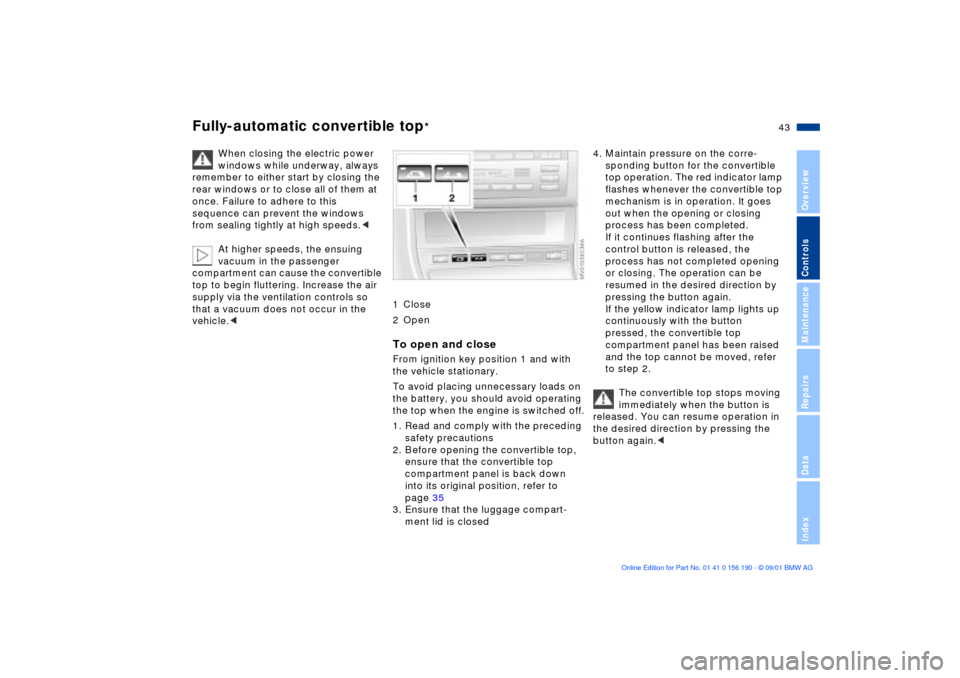
1 Close
2 OpenTo open and closeFrom ignition key position 1 and with
the vehicle stationary.
To avoid placing unnecessary loads on
the battery, you should avoid operating
the top when the engine is switched off.
1. Read and comply with the preceding
safety precautions
2. Before opening the convertible top,
ensure that the convertible top
compartment panel is back down
into its original position, refer to
page 35
3. Ensure that the luggage compart-
ment lid is closed
4. Maintain pressure on the corre-
sponding button for the convertible
top operation. The red indicator lamp
flashes whenever the convertible top
mechanism is in operation. It goes
out when the opening or closing
process has been completed.
If it continues flashing after the
control button is released, the
process has not completed opening
or closing. The operation can be
resumed in the desired direction by
pressing the button again.
If the yellow indicator lamp lights up
continuously with the button
pressed, the convertible top
compartment panel has been raised
and the top cannot be moved, refer
to step 2.
The convertible top stops moving
immediately when the button is
released. You can resume operation in
the desired direction by pressing the
button again.<
Page 45 of 159
45n
OverviewControlsMaintenanceRepairsDataIndex
Fully-automatic convertible top
*
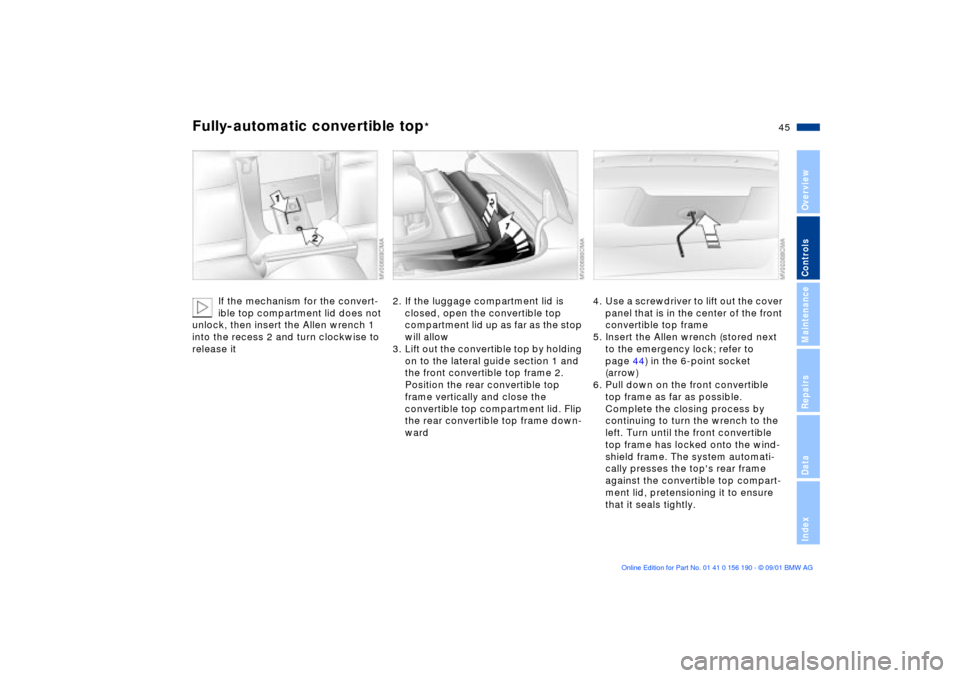
If the mechanism for the convert-
ible top compartment lid does not
unlock, then insert the Allen wrench 1
into the recess 2 and turn clockwise to
release it
2. If the luggage compartment lid is
closed, open the convertible top
compartment lid up as far as the stop
will allow
3. Lift out the convertible top by holding
on to the lateral guide section 1 and
the front convertible top frame 2.
Position the rear convertible top
frame vertically and close the
convertible top compartment lid. Flip
the rear convertible top frame down-
ward
4. Use a screwdriver to lift out the cover
panel that is in the center of the front
convertible top frame
5. Insert the Allen wrench (stored next
to the emergency lock; refer to
page 44) in the 6-point socket
(arrow)
6. Pull down on the front convertible
top frame as far as possible.
Complete the closing process by
continuing to turn the wrench to the
left. Turn until the front convertible
top frame has locked onto the wind-
shield frame. The system automati-
cally presses the top's rear frame
against the convertible top compart-
ment lid, pretensioning it to ensure
that it seals tightly.
Page 47 of 159
47n
OverviewControlsMaintenanceRepairsDataIndex
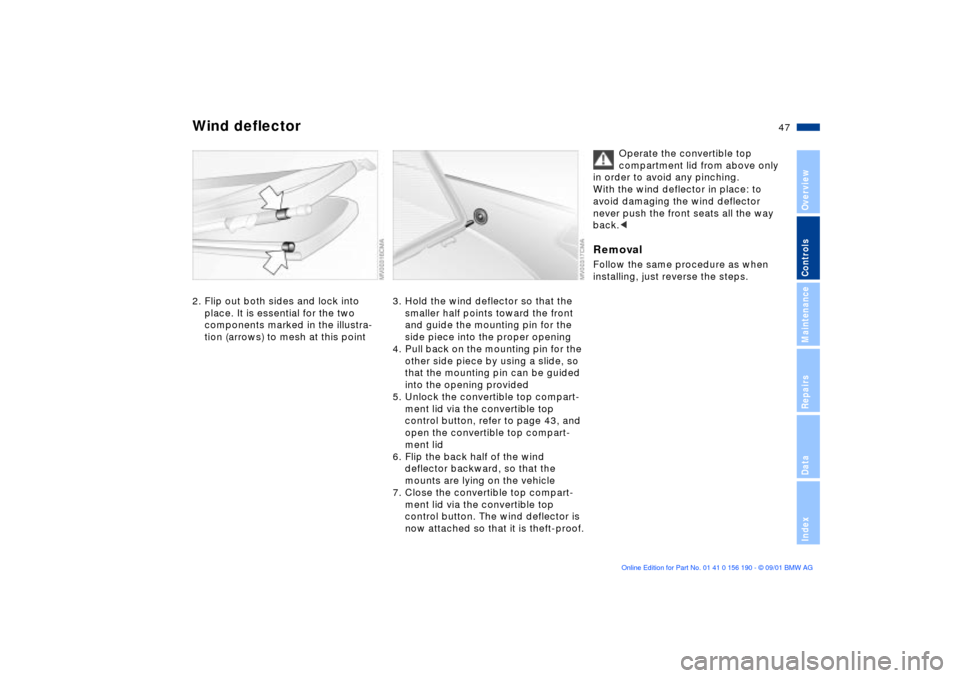
Wind deflector2. Flip out both sides and lock into
place. It is essential for the two
components marked in the illustra-
tion (arrows) to mesh at this point
3. Hold the wind deflector so that the
smaller half points toward the front
and guide the mounting pin for the
side piece into the proper opening
4. Pull back on the mounting pin for the
other side piece by using a slide, so
that the mounting pin can be guided
into the opening provided
5. Unlock the convertible top compart-
ment lid via the convertible top
control button, refer to page 43, and
open the convertible top compart-
ment lid
6. Flip the back half of the wind
deflector backward, so that the
mounts are lying on the vehicle
7. Close the convertible top compart-
ment lid via the convertible top
control button. The wind deflector is
now attached so that it is theft-proof.
Operate the convertible top
compartment lid from above only
in order to avoid any pinching.
With the wind deflector in place: to
avoid damaging the wind deflector
never push the front seats all the way
back.<
RemovalFollow the same procedure as when
installing, just reverse the steps.
Page 49 of 159
49n
OverviewControlsMaintenanceRepairsDataIndex
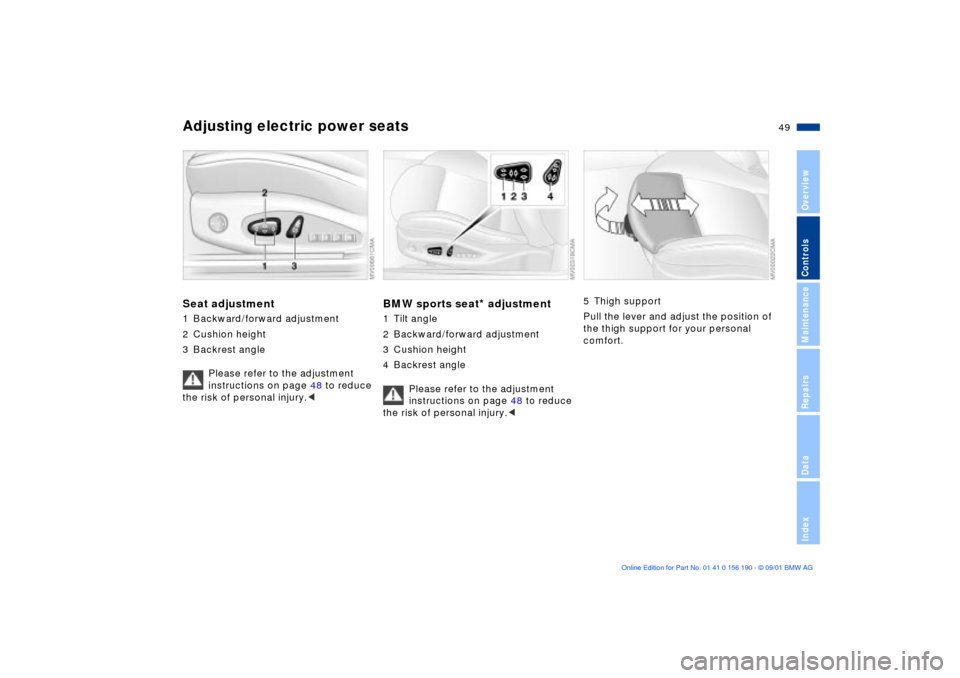
Adjusting electric power seatsSeat adjustment1 Backward/forward adjustment
2 Cushion height
3 Backrest angle
Please refer to the adjustment
instructions on page 48 to reduce
the risk of personal injury.<
BMW sports seat
* adjustment
1 Tilt angle
2 Backward/forward adjustment
3 Cushion height
4 Backrest angle
Please refer to the adjustment
instructions on page 48 to reduce
the risk of personal injury.<
5 Thigh support
Pull the lever and adjust the position of
the thigh support for your personal
comfort.
Page 51 of 159
51n
OverviewControlsMaintenanceRepairsDataIndex
Head restraints Entering the rearRear head restraints
To avoid possible violation of
traffic laws, never retract the head
restraints unless the rear seats are
empty. Always ensure that the head
restraints are raised before transporting
passengers in the rear seat.<
To completely lower the rear head
restraints:
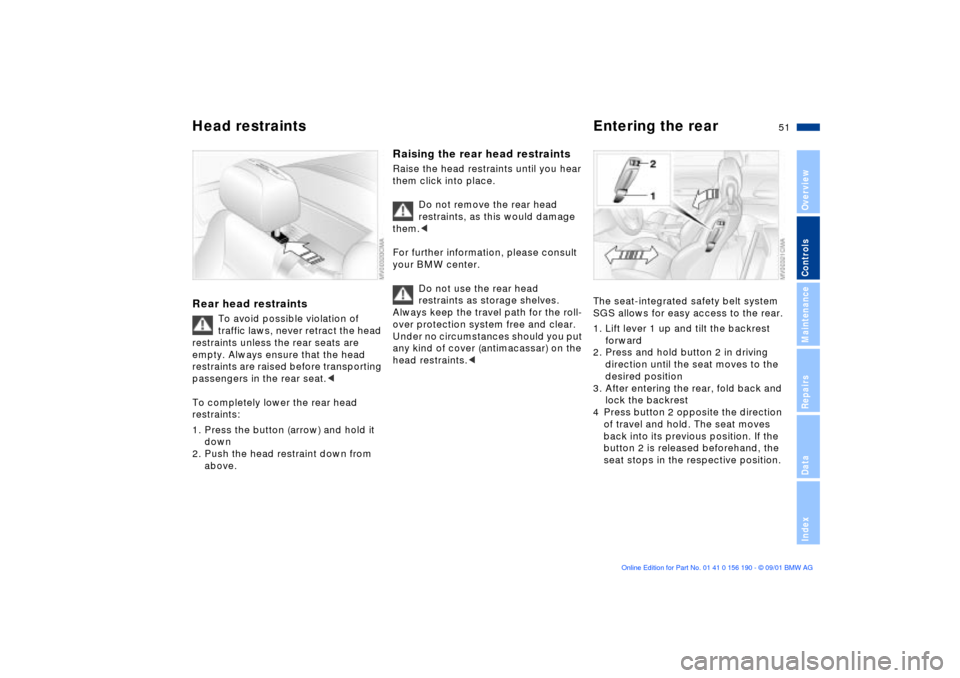
1. Press the button (arrow) and hold it
down
2. Push the head restraint down from
above.
Raising the rear head restraintsRaise the head restraints until you hear
them click into place.
Do not remove the rear head
restraints, as this would damage
them.<
For further information, please consult
your BMW center.
Do not use the rear head
restraints as storage shelves.
Always keep the travel path for the roll-
over protection system free and clear.
Under no circumstances should you put
any kind of cover (antimacassar) on the
head restraints.<
The seat-integrated safety belt system
SGS allows for easy access to the rear.
1. Lift lever 1 up and tilt the backrest
forward
2. Press and hold button 2 in driving
direction until the seat moves to the
desired position
3. After entering the rear, fold back and
lock the backrest
4 Press button 2 opposite the direction
of travel and hold. The seat moves
back into its previous position. If the
button 2 is released beforehand, the
seat stops in the respective position.
Page 53 of 159
53n
OverviewControlsMaintenanceRepairsDataIndex
Seat and mirror memory
*
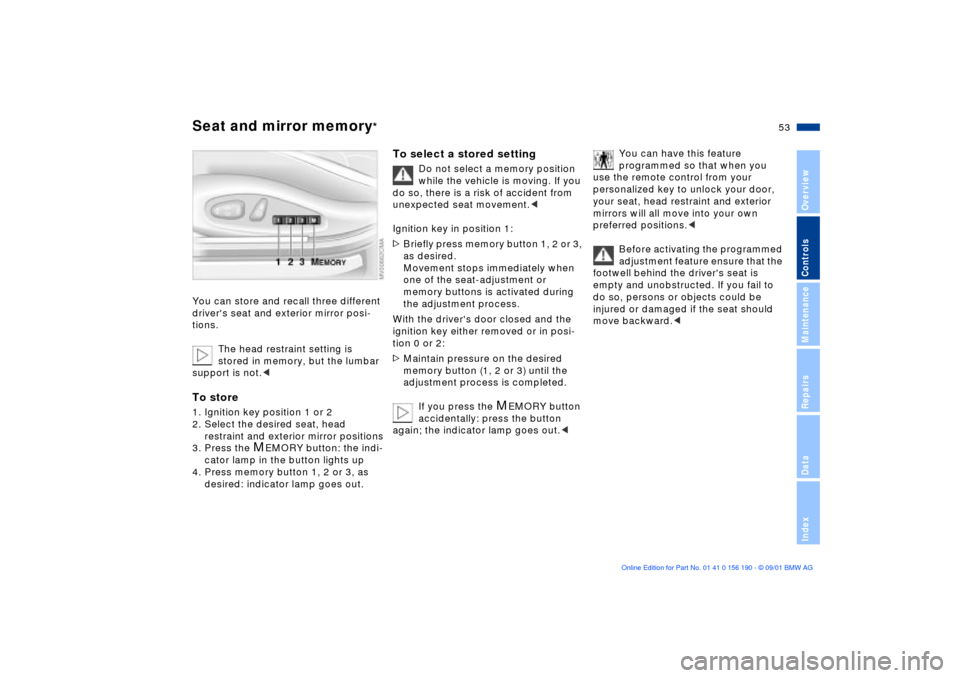
You can store and recall three different
driver's seat and exterior mirror posi-
tions.
The head restraint setting is
stored in memory, but the lumbar
support is not.
restraint and exterior mirror positions
3. Press the
M
EMORY button: the indi-
cator lamp in the button lights up
4. Press memory button 1, 2 or 3, as
desired: indicator lamp goes out.
To select a stored setting
Do not select a memory position
while the vehicle is moving. If you
do so, there is a risk of accident from
unexpected seat movement.<
Ignition key in position 1:
>Briefly press memory button 1, 2 or 3,
as desired.
Movement stops immediately when
one of the seat-adjustment or
memory buttons is activated during
the adjustment process.
With the driver's door closed and the
ignition key either removed or in posi-
tion 0 or 2:
>Maintain pressure on the desired
memory button (1, 2 or 3) until the
adjustment process is completed.
If you press the
M
EMORY button
accidentally: press the button
again; the indicator lamp goes out.<
You can have this feature
programmed so that when you
use the remote control from your
personalized key to unlock your door,
your seat, head restraint and exterior
mirrors will all move into your own
preferred positions.<
Before activating the programmed
adjustment feature ensure that the
footwell behind the driver's seat is
empty and unobstructed. If you fail to
do so, persons or objects could be
injured or damaged if the seat should
move backward.<
Page 55 of 159
55n
OverviewControlsMaintenanceRepairsDataIndex
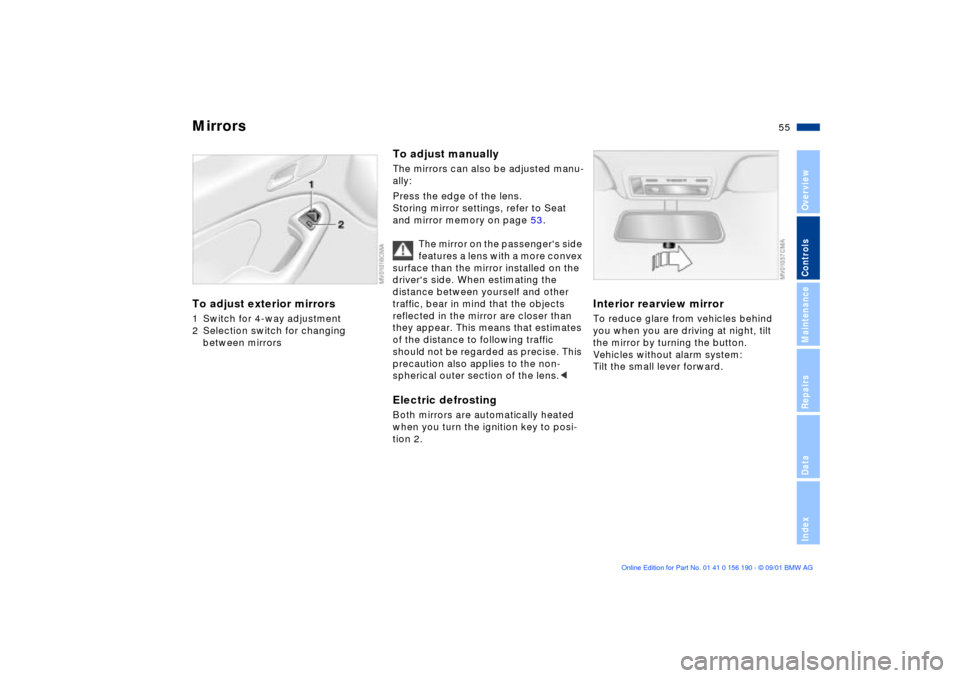
Mirrors To adjust exterior mirrors1 Switch for 4-way adjustment
2 Selection switch for changing
between mirrors
To adjust manuallyThe mirrors can also be adjusted manu-
ally:
Press the edge of the lens.
Storing mirror settings, refer to Seat
and mirror memory on page 53.
The mirror on the passenger's side
features a lens with a more convex
surface than the mirror installed on the
driver's side. When estimating the
distance between yourself and other
traffic, bear in mind that the objects
reflected in the mirror are closer than
they appear. This means that estimates
of the distance to following traffic
should not be regarded as precise. This
precaution also applies to the non-
spherical outer section of the lens.
tion 2.
Interior rearview mirror To reduce glare from vehicles behind
you when you are driving at night, tilt
the mirror by turning the button.
Vehicles without alarm system:
Tilt the small lever forward.
Page 57 of 159
57n
OverviewControlsMaintenanceRepairsDataIndex
Airbags
The airbags do not deploy in
response to minor collisions, rear
impacts and certain kinds of vehicle
rollover.<
For your safety, comply with the
following instructions for the
airbags. If you do not, the airbags may
not be able to provide their maximum
protection. All passengers in the vehicle
should be aware of and comply with
these directions:
The airbags are supplemental restraint
devices designed to provide extra
protection; they are not a substitute for
safety belts. Wear your safety belt at all
times. The airbags will not be triggered
in the event of a minor accident, a
vehicle rollover, or collisions from the
rear. In these instances, the safety belt
provides optimal protection.
Airbags are located under cover panels
in the steering wheel, in the instrument
panel, in the side trim panels in the
front and rear
*, in the roof panels, and
in the sides of the inside roof lining.
Adjust your seat to a position that
provides maximum distance between
you and the steering wheel, the instru-
ment panel and the door while still
allowing comfortable and safe access
to all vehicle controls.
To avoid sustaining hand and arm inju-
ries, always grasp the steering wheel
on the rim with the hands at the 9 and
3 o'clock positions. Do not place your
hands on the center pad.
Never allow any objects to obstruct the
area between the airbag and an occu-
pant.
Do not use the cover panel above the
passenger-side airbag as a storage
area.
Do not apply adhesive materials to the
cover panels of the airbags, cover them
or modify them in any other way.
Do not install a rear-facing child-
restraint system in the front passenger
seat of this vehicle.
Children under 13 years of age and less
than 5 ft (150 cm) tall should ride only in
the rear seat.
Infants or small children should never
be held on the lap of a passenger.
If your vehicle is equipped with side
airbags in the rear passenger area
*, be
sure that child restraints are mounted
correctly with the greatest-possible
distance between them and the airbags
in the side trim panels. Do not allow
children to lean out of the child's seat in
the direction of the side trim panels. If
they do so, serious injuries can occur if
the airbag is triggered.
(infants and small children in appro-
priate child-restraint systems; larger
children and adults using the safety
belts). Never let an occupant's head
rest near or on a side airbag, as the
inflating airbag could cause a serious or
fatal injury. Please note that the word
Airbag imprinted on the door trim panel
indicates the airbag's location.
Accident research shows that the
safest place for children in an auto-
mobile is in the rear seat. However, a
child sitting in the rear seat and not
properly restrained may place his or her
head on or near the airbag, if so
equipped. For example, a child Ñ even
though belted Ñ may fall asleep with his
or her head against the side airbag. It
may be difficult for a driver to ensure
that children in the rear seat will remain
properly positioned at all times and not
place their heads on or near the side
airbag.
Therefore, we recommend that the
rear-seat side airbags, if installed in the
vehicle, be deactivated if children will
travel in the rear seat.
The rear-seat side airbags may already
have been deactivated, either at the
time of manufacture or by a BMW
Page 59 of 159
59n
OverviewControlsMaintenanceRepairsDataIndex
Transporting children safelyLATCH child-restraint mounting
system
*
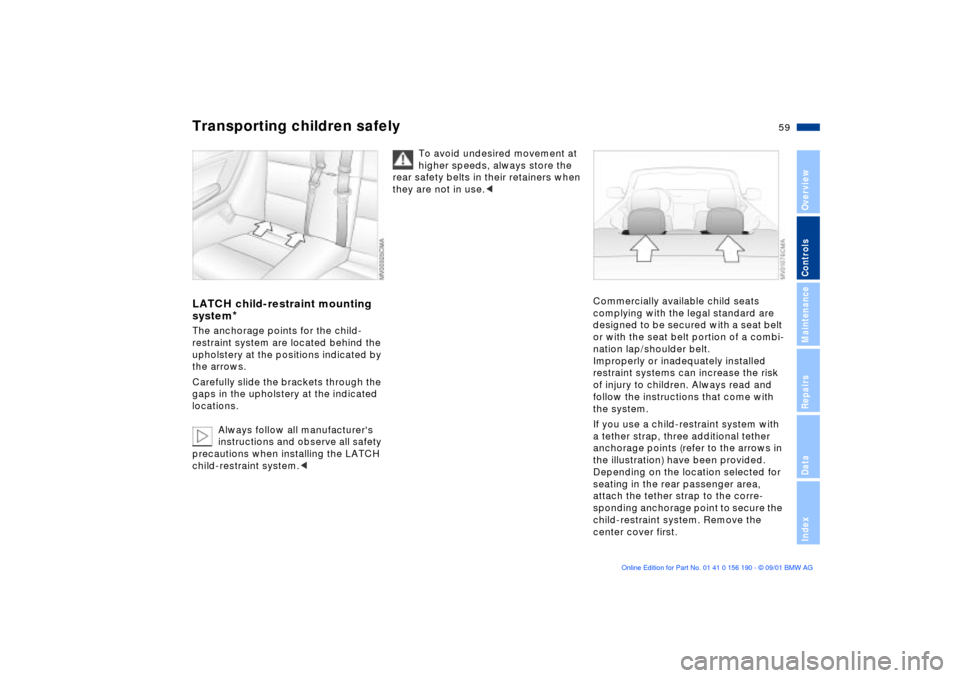
The anchorage points for the child-
restraint system are located behind the
upholstery at the positions indicated by
the arrows.
Carefully slide the brackets through the
gaps in the upholstery at the indicated
locations.
Always follow all manufacturer's
instructions and observe all safety
precautions when installing the LATCH
child-restraint system.<
To avoid undesired movement at
higher speeds, always store the
rear safety belts in their retainers when
they are not in use.<
Commercially available child seats
complying with the legal standard are
designed to be secured with a seat belt
or with the seat belt portion of a combi-
nation lap/shoulder belt.
Improperly or inadequately installed
restraint systems can increase the risk
of injury to children. Always read and
follow the instructions that come with
the system.
If you use a child-restraint system with
a tether strap, three additional tether
anchorage points (refer to the arrows in
the illustration) have been provided.
Depending on the location selected for
seating in the rear passenger area,
attach the tether strap to the corre-
sponding anchorage point to secure the
child-restraint system. Remove the
center cover first.
Page 61 of 159
61n
OverviewControlsMaintenanceRepairsDataIndex
Transporting children safelyRollover protection systemTo lock the safety beltExtract the entire length of the belt from
the inertia reel mechanism. Allow the
reel to retract the belt somewhat and
engage the buckle, then tighten the belt
against the child-restraint system. The
retraction mechanism is now locked.
The belt cannot be extracted further.
Always observe the installation instruc-
tions provided by the manufacturer of
the child-restraint system.To release the safety beltRelease the safety belt, remove the
child's seat and retract the safety belt to
its end position on the belt retractor.In the event of an accident or some
other critical driving situation (extreme
tilting in the longitudinal or transverse
axis, loss of contact with the ground),
the rollover protection system will be
automatically activated. The protective
bars located in the rear head restraints
extend within fractions of a second.
In addition to the integrated rollover bar
in the windshield frame, the rollover
protection system affords all the vehicle
occupants necessary headroom.
Always keep the travel path for the
rollover protection system free
and clear. Under no circumstances
should you cover the head restraints.
In the event of less serious accidents,
the safety belt will protect you and,
depending on the severity of the acci-
dent, so will the safety belt tensioner
and the multi-stage airbag restraint
system as well.<
If, after being automatically triggered,
its protective function is not needed,
then the rollover protection system can
be lowered back into place. No special
tool is needed for this.
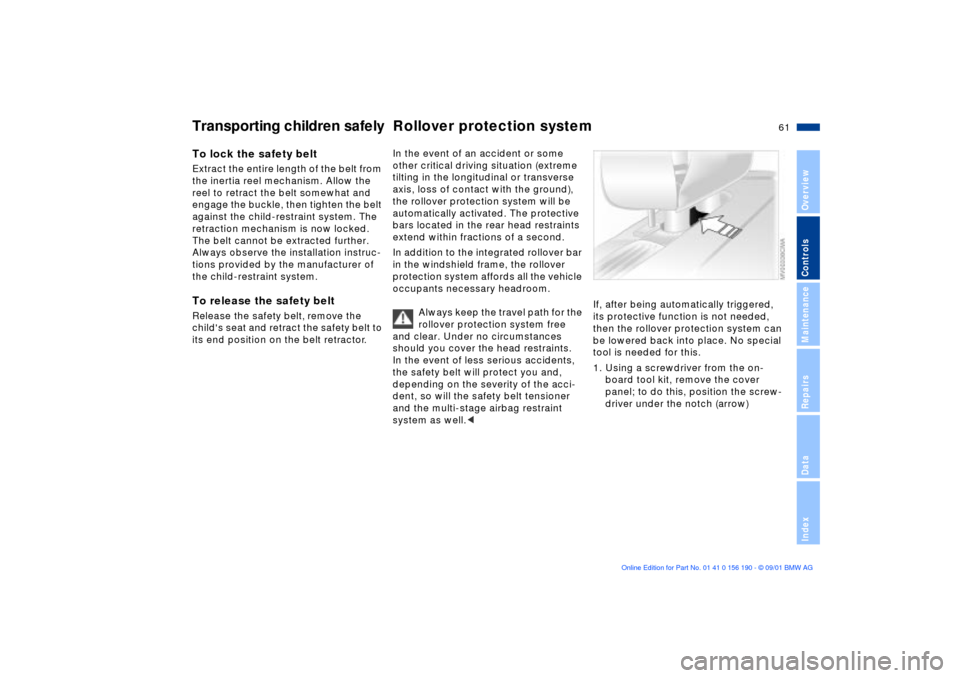
1. Using a screwdriver from the on-
board tool kit, remove the cover
panel; to do this, position the screw-
driver under the notch (arrow)