300 BMW 525i 2001 E39 Repair Manual
[x] Cancel search | Manufacturer: BMW, Model Year: 2001, Model line: 525i, Model: BMW 525i 2001 E39Pages: 1002
Page 630 of 1002
Downloaded from www.Manualslib.com manuals search engine
300-1 0
/Suspension, Steering and Brakes - General
The steering system features variable power assist provided
by an engine-driven hydraulic pump.
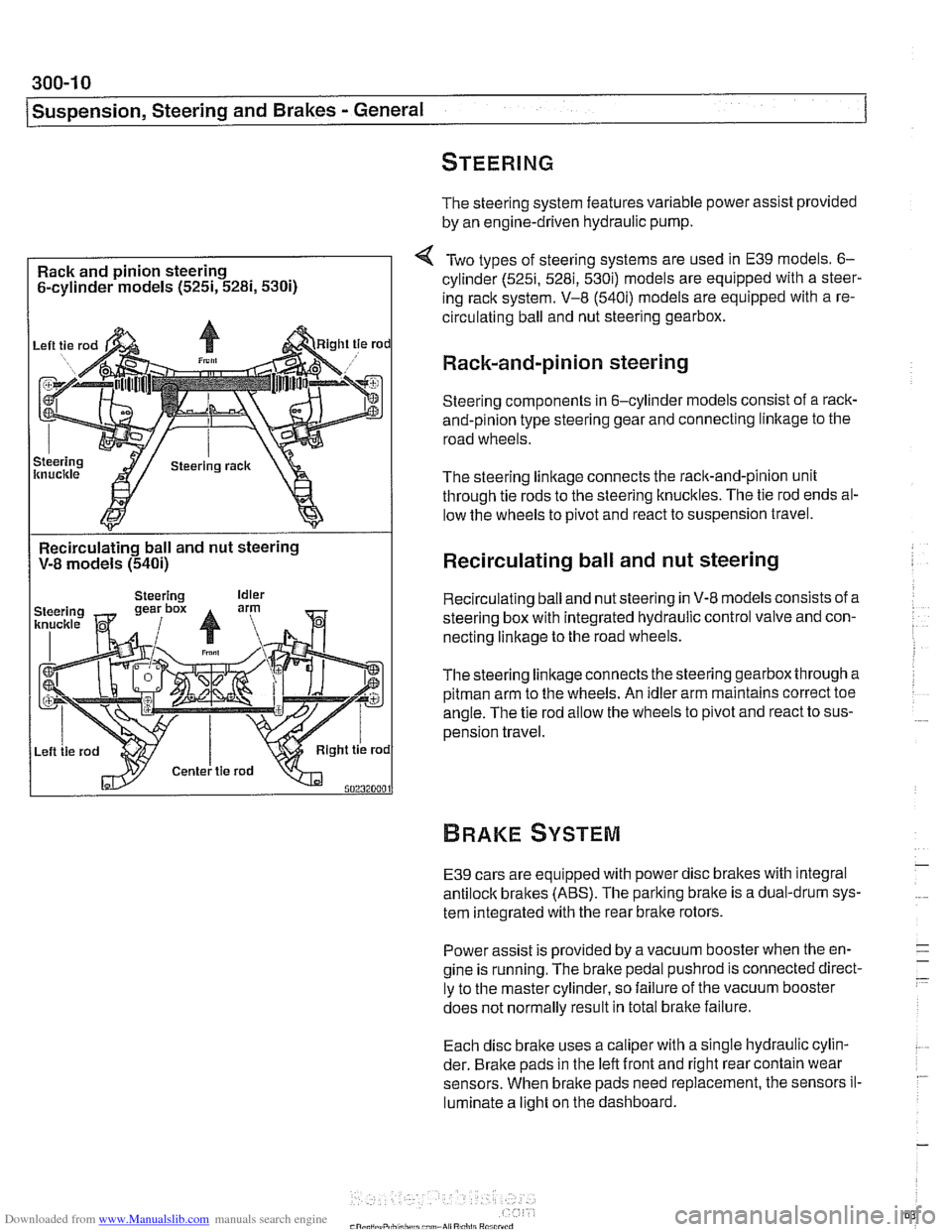
Rack and pinion steering
6-cylinder models
(525i, 5281, 5300
Two types of steering systems are used in E39 models. 6-
cylinder (525i, 5281, 530i) models are equipped with a steer-
ing rack system. V-8
(540i) models are equipped with a re-
circulating ball and nut steering gearbox.
Rack-and-pinion steering
Steering components in 6-cylinder models consist of a rack-
and-pinion type steering gear and connecting linltage to the
road wheels.
The steering linkage connects the rack-and-pinion unit
through tie rods to the steering knucltles. The tie rod ends al-
low the wheels to pivot and react to suspension travel.
Recirculating ball and nut steering
V-8 models
(540i)
I
Recirculating ball and nut steering
Recirculating ball and nut steering in V-8 models consists of a
steering box with integrated hydraulic control valve and con-
necting linkage to the road wheels.
Thesteering linkageconnects the steering gearbox through a
pitman arm to the wheels. An idler arm maintains correct toe
angle. The tie rod allow the wheels to pivot and react to sus-
pension travel.
E39 cars are equipped with power disc brakes with integral
antilock brakes (ABS). The parking bralte is a dual-drum sys-
tem integrated with the rear brake rotors.
Power assist is provided by a vacuum booster when the en-
gine is running. The brake pedal
pushrod is connected direct-
ly to the master cylinder, so failure of the vacuum booster
does not normally result in total
bralte failure.
Each disc bralte uses a caliper with a single hydraulic cylin-
der. Brake pads in the left front and right rear contain wear
sensors. When brake pads need replacement, the sensors il-
luminate a light on the dashboard.
Page 632 of 1002
Downloaded from www.Manualslib.com manuals search engine
300-1 2
I Sus~ension, Steerincl and Brakes - General
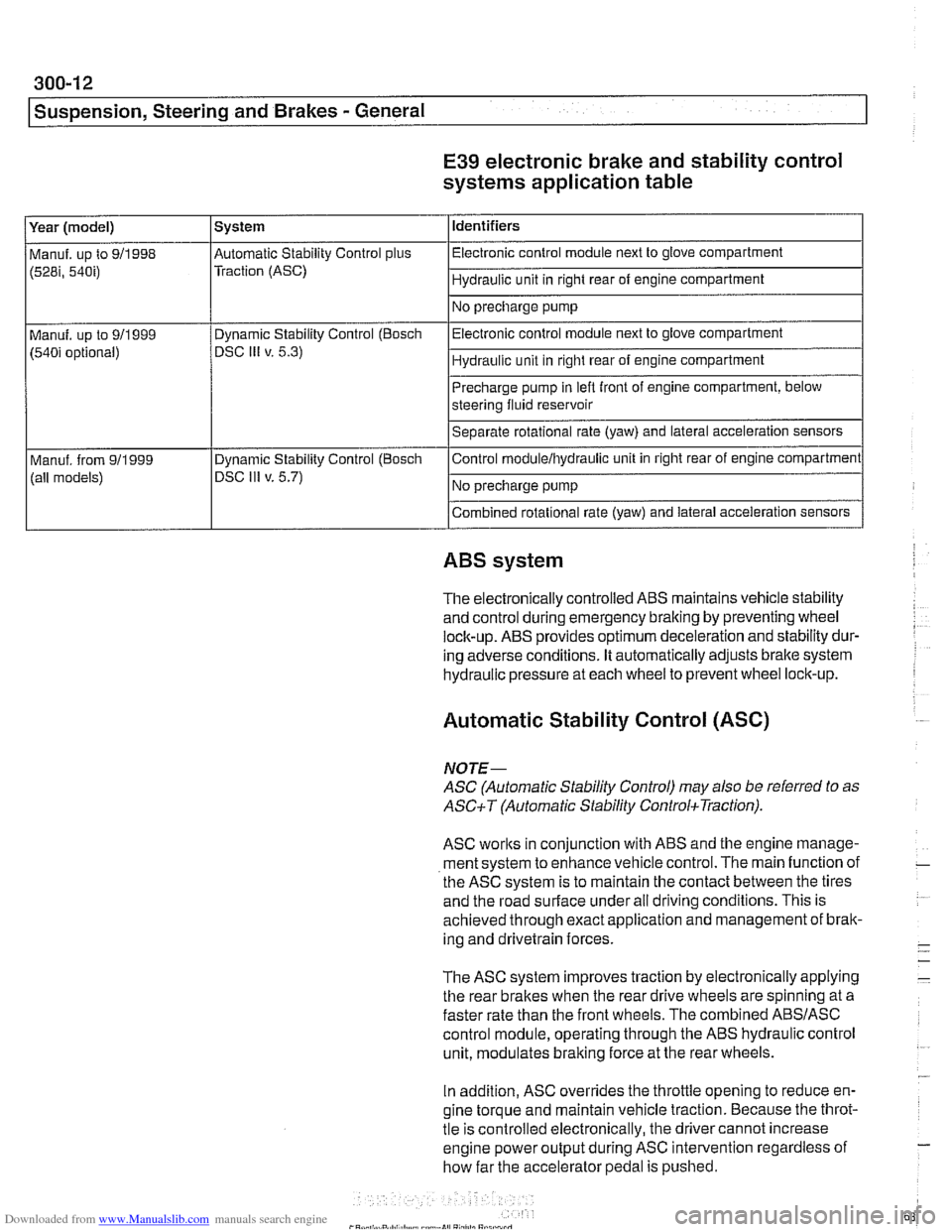
E39 electronic brake and stability control
systems application table
(528i, 54bi) Traction (ASC) I Hydraulic unit in right rear of engine compartment 1
Identifiers
Year (model)
I No precharge pump 1
Manuf. up to 911998 l~utomatic Stability Control plus I Electronic control module next to glove compartment
System
Precharge pump in
lefl front of engine compartment, below
steering fluid reservoir
Separate rotational rate (yaw) and lateral acceleration sensors
I I
Combined rotational rate (yaw) and lateral acceleration sensors
Electronic control
module next to glove compartment
Hydraulic unit in right rear of engine compartment
Manuf. up to 911999
(540i optional)
I I
ABS system
Dynamic Stability Control (Bosch
DSC
Ill v. 5.3)
The electronically controlled
ABS maintains vehicle stability
and control during emergency braking by preventing wheel
lock-up.
ABS provides optimum deceleration and stability dur-
ing adverse conditions. It automatically adjusts brake system
hydraulic pressure at each wheel to prevent wheel lock-up.
Control
moduleihydraulic unit
in right rear of engine compartment
No precharge pump
Manuf. from
911999
(all models)
Automatic Stability Control (ASC)
Dynamic Stability Control (Boscli
DSC Ill v. 5.7)
NOJE-
ASC (Automatic Stability Control) may also be referred to as
ASCiT (Automatic Stability ControkTraction).
ASC works in conjunction with ABS and the engine manage-
ment system to enhance vehicle control. The main function of
the
ASC system is to maintain the contact between the tires
and the road surface under all driving conditions. This is
achieved through exact application and management of brak-
ing and drivetrain forces.
The
ASC system improves traction by electronically applying
the rear brakes when the rear drive wheels are spinning at a
faster rate than the front wheels. The combined
ABSIASC
control module, operating through the ABS hydraulic control
unit, modulates braking force at the rear wheels.
In addition,
ASC overrides the throttle opening to reduce en-
gine torque and maintain vehicle traction. Because the throt-
tle is controlled electronically, the driver cannot increase
engine power output during
ASC intervention regardless of
how far the accelerator pedal is pushed.
Page 634 of 1002
Downloaded from www.Manualslib.com manuals search engine
300-1 4
I Susoension. Steerina and Brakes - General
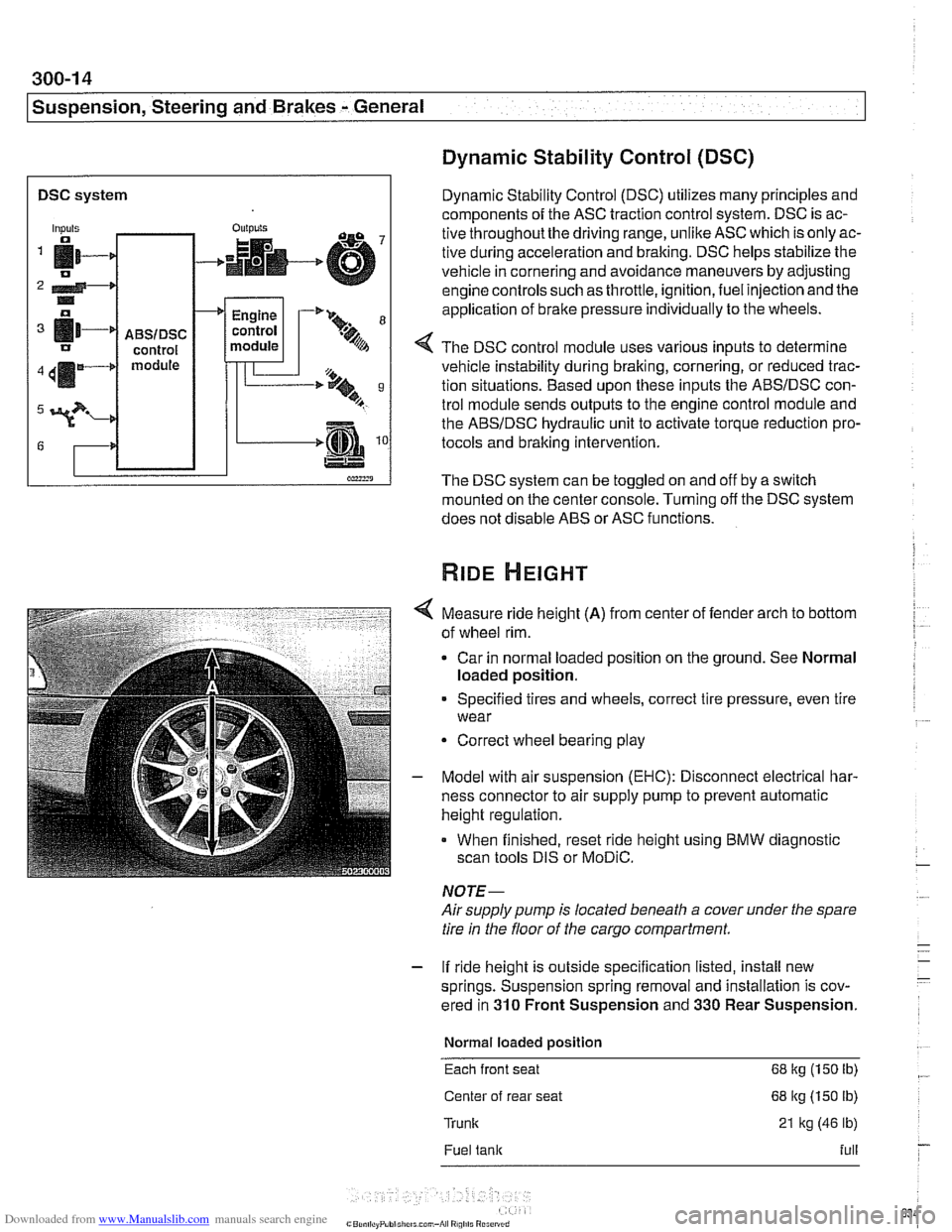
DSC system I
Dynamic Stability Control (DSC)
Dynamic Stability Control (DSC) utilizes many principles and
components of the ASC traction control system. DSC is ac-
tive throughoutthe driving range, unlike ASC which is only ac-
tive during acceleration and braking. DSC helps stabilize the
vehicle in cornering and avoidance maneuvers by adjusting
engine controls such as throttle, ignition, fuel injection and the
application of
brake pressure individually to the wheels.
Inputs
fi- 0
2 4-* .. o
[11-' IJ
411m4
3?-
G
4 The DSC control module uses various inputs to determine
vehicle instability during braking, cornering, or reduced trac-
tion situations. Based upon these inputs the ABSIDSC con-
trol module sends outputs to the engine control module and
the ABSIDSC hydraulic unit to activate torque reduction pro-
tocols and braking intervention.
-
ABSIDSC control module
OUI~YIS
4
The DSC system can be toggled on and off by a switch
mounted on the center console. Turning off the DSC system
does not disable ABS or ASC functions.
+
Measure ride height (A) from center of fender arch to bottom
of wheel rim.
Car in normal loaded position on the ground. See Normal
loaded position.
Engine
control
module
Specified tires and wheels, correct tire pressure, even tire
wear
-'* 9-
.%A
Correct wheel bearing play
T'== ..t, 9 B
-.m
Model with air suspension (EHC): Disconnect electrical har-
ness connector to air supply pump to prevent automatic
height regulation.
When finished, reset ride height using BMW diagnostic
scan tools DIS or
MoDiC.
NOTE-
Airsupply pump is located beneath a cover under the spare
tire in the floor of the cargo compartment.
- If ride height is outside specification listed, install new
springs. Suspension spring removal and installation is cov-
ered in
310 Front Suspension and 330 Rear Suspension.
Normal loaded position
Each front seat 68 kg (150 Ib)
Center of rear seat 68 kg (150 lb)
Trunk 21 kg (46 lb)
Fuel tank full
Page 636 of 1002
Downloaded from www.Manualslib.com manuals search engine
300-1 6
I Suspension, Steering and Brakes - General
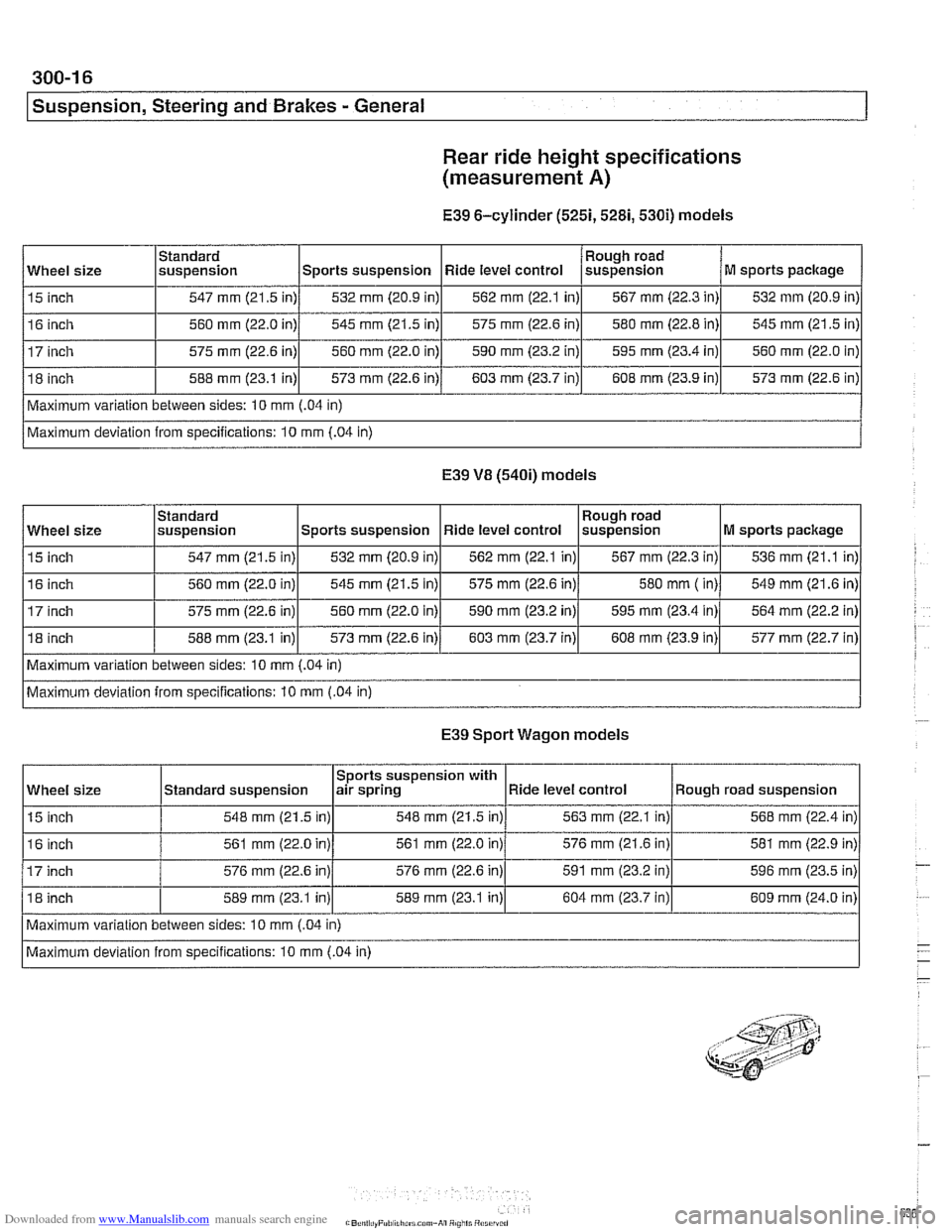
Rear
ride height specifications
(measurement
A)
E39 6-cylinder (5251,5281,530i) models
E39 VB (540i) models
Wheel size
15 inch
16 inch
17 inch
18 inch
Maximum variation between sides: 10
mm (.04 in)
Maximum deviation from specifications: 10
mm (.04 in)
Standard
suspension
547 mm (21.5 in)
560
mm (22.0 in)
575 mm (22.6 in)
588 mm (23.1 in)
I I I I I
Maximum variation between sides: 10 mm (.04 in)
Wheel
size
15 inch
16 inch
575 mm (22.6 in)
Maximum deviation from specifications: 10 mm
(.04 in)
Sports suspension
532 mm (20.9 in)
545 mm (21.5 in)
560 mm (22.0 in)
573
mm (22.6 in)
Rough road
suspension
567
mm (22.3 in)
580 mm
( in)
E39 Sport Wagon models
M sports package
536
mm (21.1 in)
549 mm (21.6 in)
Standard
suspension
547 mm (21.5 in)
560 mm (22.0 in)
588 mm (23.1
in)l 573 mm (22.6 in)/ 603 mm (23.7 in)l 608 mm (23.9 in)l 577 mm (22.7 in)
560
mm (22.0
in) Ride level
control
562
mm (22.1 in)
575 mm (22.6 in)
590 mm (23.2 in)
603 mm (23.7 in)
Sports suspension 532
mm (20.9 in)
545 mm (21.5 in)
590
mm (23.2 in) Rough
road
suspension
567
mm (22.3 in)
580 mm (22.8 in)
595 mm (23.4 in)
608 mm (23.9 in)
Ride level control
562
mm (22.1 in)
575 mm (22.6 in)
Wheel size
15 inch
M sports package
532
mm (20.9 in)
545
mm (21.5 in)
560 mm (22.0 in)
573 mm (22.6 in)
595
mm (23.4 in)
Sports suspension with
air spring
548 mm (21.5 in)
Standard
suspension
548
mm (21.5 in)
16 inch
17 inch
18 inch 564
mm (22.2
in)
Maximum variation between sides: 10 mm
(.04 in)
Maximum deviation from specifications: 10 mm
(.04 in) 561
mm (22.0 in)
576
mm (22.6 in)
589
mrn (23.1 in)
561
mm (22.0 in)
576 mm (22.6 in)
589 mm (23.1 in) Ride level
control
563
mm (22.1 in) Rough road suspension
568 mm (22.4 in)
576 mm (21.6 in)
591 mm (23.2 in)
604 mm (23.7 in) 581
mm (22.9
in)
596
mm (23.5 in)
609 mm (24.0 in)
Page 638 of 1002
Downloaded from www.Manualslib.com manuals search engine
31 0-2
I Front Suspension
This repair group covers the repair and replacement of com-
ponents that make up the front suspension of E39 cars.
Two different types of steering systems are used in the E39
series. 6-cylinder
(5251,5281 and 530i) models are equipped
with a rack and pinion type steering system mounted to an
aluminum subframe.
V-8 (540i) models use a steering gear-
box type system mounted to a steel subframe.
See
300 Suspension, Steering and Brakes-General for a
description of the front suspension and components, as well
as specifications for setting ride height.
CAUTION-
Some E39 models are equipped with aluminum suspen-
sion components. The foiiowing cautions apply:
Due to the chemical and corrosion characteristics of
aluminum, do not bring into contact with battery acid.
* Do not clean with wire brushes with brass or iron bris-
ties. Only use brushes with stainless steei bristles.
Do not expose to flying sparks from grinding/cutting op-
erations.
* Do not subject to steei welding splashes.
Do not expose to temperatures over 80°C (176°F).
even for short periods. Temperatures in painting faciii-
ties are not a problem.
Special tools
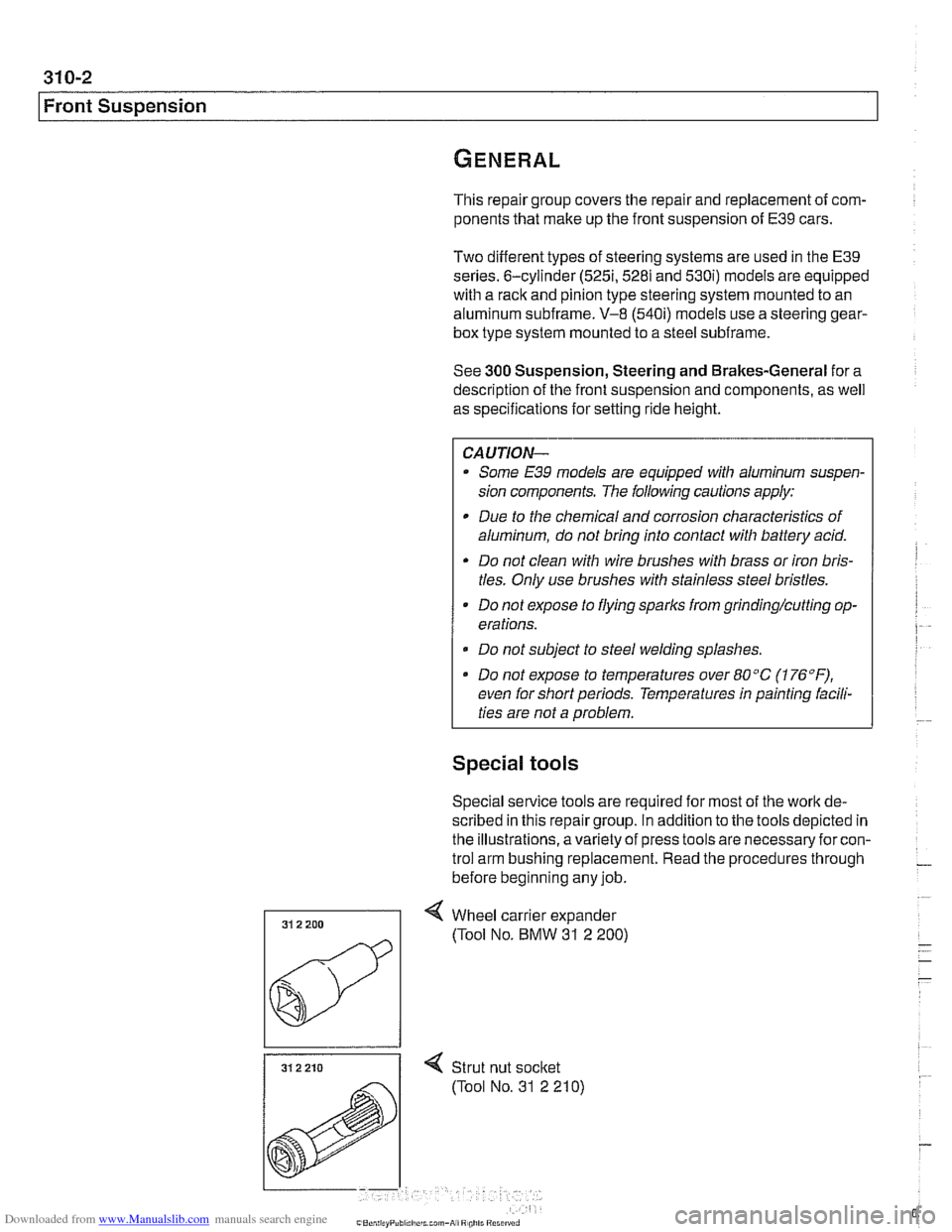
Special service tools are required for most of the work de-
scribed in this repair group. In addition to the tools depicted in
the illustrations, avariety of press tools are necessaryfor con-
trol arm bushing replacement. Read the procedures through
before beginning any job.
31 2 210 I < Strut nut socket
(Tool No. 31 2 210)
Page 647 of 1002
Downloaded from www.Manualslib.com manuals search engine
Front Suspension
/ Front strut top mount assembly
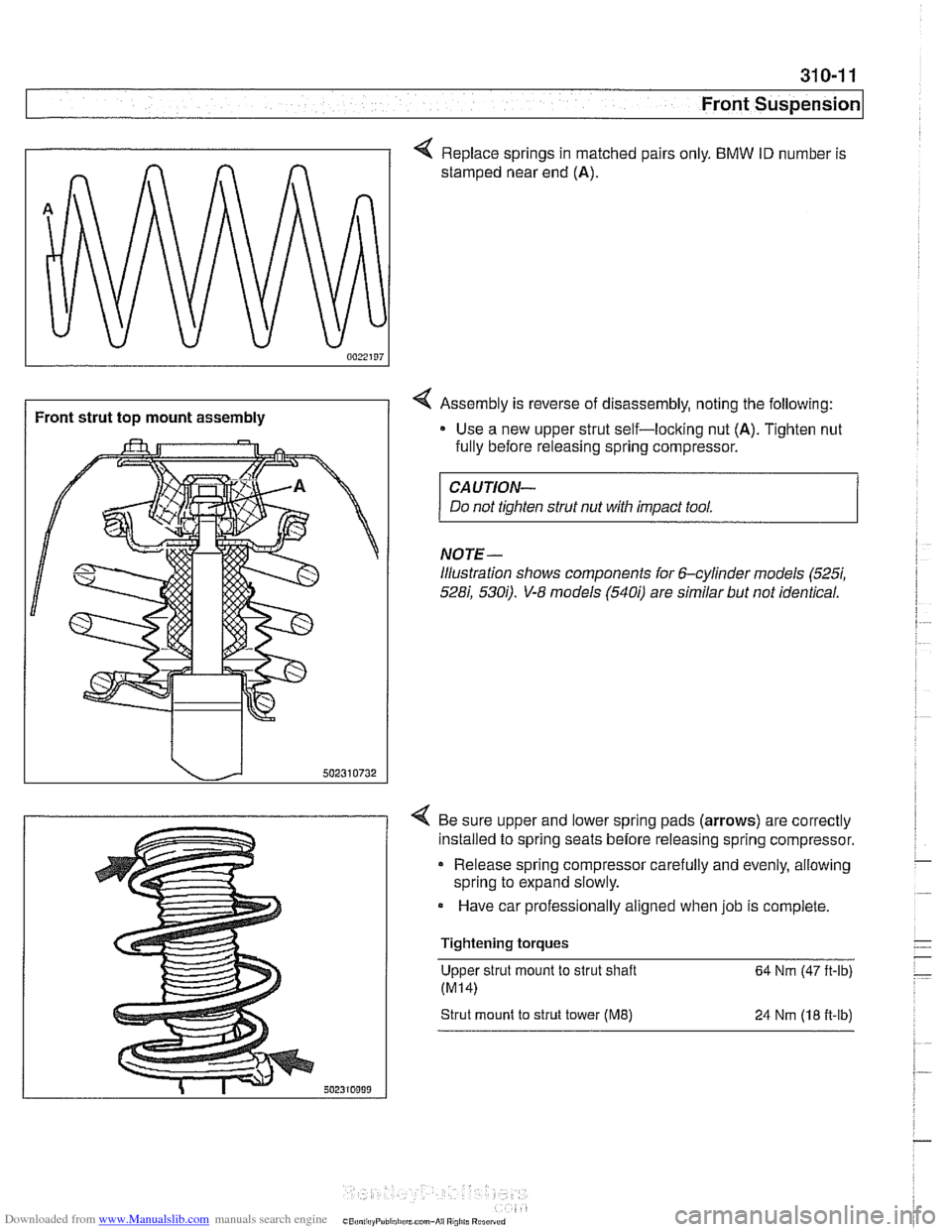
< Replace springs in matched pairs only. BMW ID number is
stamped near end
(A).
4 Assembly is reverse of disassembly, noting the following:
Use a new upper strut self-loclting nut
(A). Tighten nut
fully before releasing spring compressor.
CAUTION-
Do not tighten strut nut with impact tool.
NOTE-
illustration shows components for 6-cylinder models (5257,
528i, 5300. V-8 models (5400 are similar but not identical.
4 Be sure upper and lower spring pads (arrows) are correctly
installed to spring seats before releasing spring compressor.
Release spring compressor carefully and evenly, allowing
spring to expand slowly.
Have car professionally aligned when job is complete.
Tightening torques Upper strut mount to strut shaft
64 Nm (47 ft-lb)
Strut mount to strut tower (ME) 24 Nrn (18 fi-lb)
Page 649 of 1002
Downloaded from www.Manualslib.com manuals search engine
Front Suspension
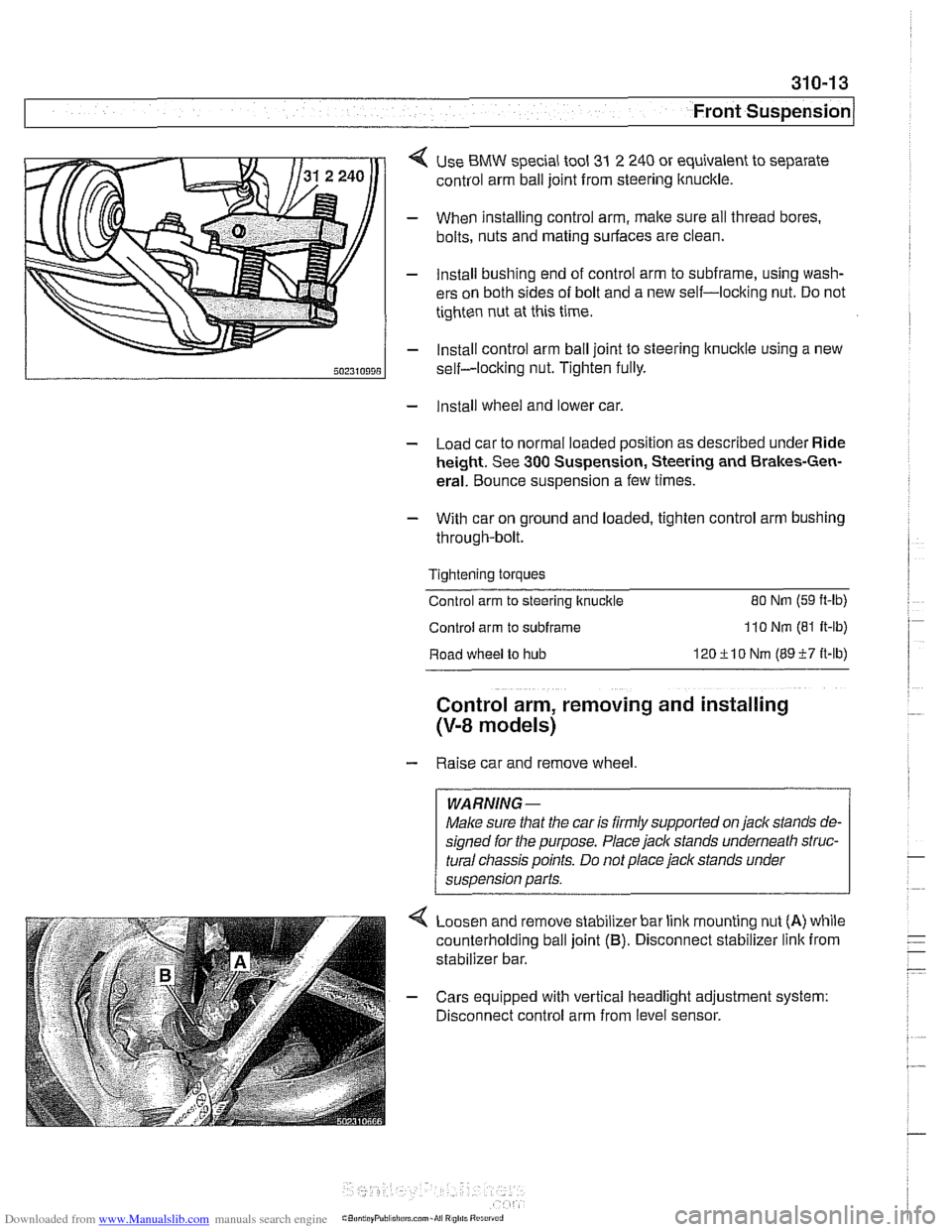
< Use BMW special tool 31 2 240 or equivalent to separate
control arm ball joint from steering ltnuckle.
- When installing control arm, make sure all thread bores.
bolts, nuts and mating surfaces are clean.
- Install bushing end of control arm to subframe, using wash-
ers on both sides of bolt and a new self-locking nut. Do not
tighten nut at this time.
- Install control arm ball joint to steering lknucltle using a new
self-locking nut. Tighten fully.
- Install wheel and lower car.
- Load car to normal loaded position as described under Ride
height. See
300 Suspension, Steering and Brakes-Gen-
eral. Bounce suspension a few times.
- With car on ground and loaded, tighten control arm bushing
through-bolt.
Tightening torques
Control arm to steering ltnuckle
80 Nm (59 ft-lb)
Control arm to subframe 110 Nm (81 It-lb)
Road wheel to hub 120ilO Nm (8957 it-lb)
Control arm, removing and installing
(V-8 models)
- Raise car and remove wheel
WARNING-
Make sure that the car is firmly supported on jack stands de-
signed for the purpose. Place jack stands underneath struc-
tural
cliassis points. Do not place jack stands under
suspension parts.
Loosen and remove stabilizer bar link mounting nut
(A) while
counterholding ball joint
(B). Disconnect stabilizer link from
stabilizer bar.
- Cars equipped with vertical headlight adjustment system:
Disconnect control arm from level sensor.
Page 651 of 1002
Downloaded from www.Manualslib.com manuals search engine
310-1 5
Front ~us~ension/
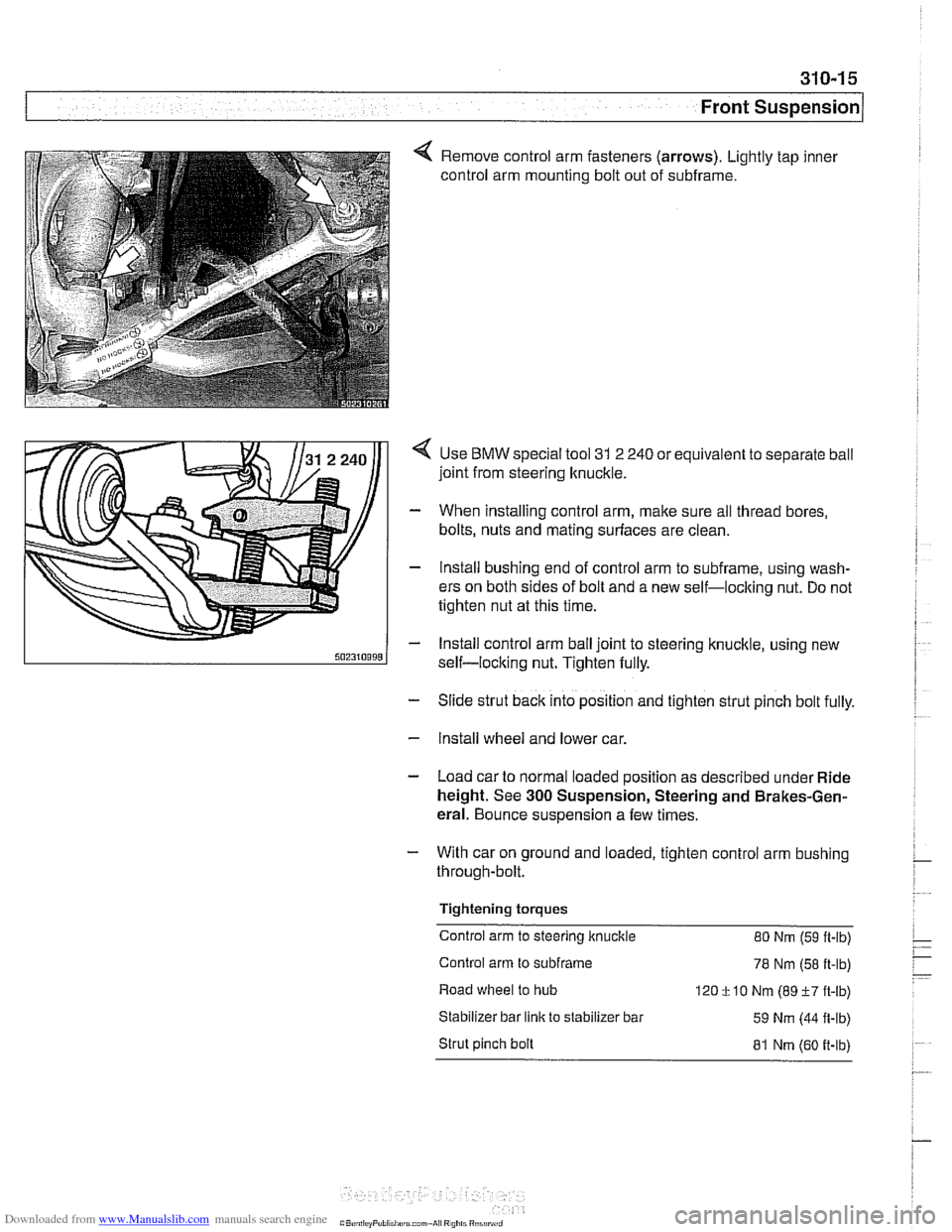
4 Remove control arm fasteners (arrows). Lightly tap inner
control arm mounting bolt out of subframe.
Use
BMW special tool 31 2 240 or equivalent to separate ball
joint from steering knuckle.
When installing control arm, make sure all thread bores,
bolts, nuts and mating surfaces are clean.
lnstall bushing end of control arm to subframe, using wash-
ers on both sides of bolt and a new self-loclting nut. Do not
tighten nut at this time.
lnstall control arm ball joint to steering knuckle, using new
self-locking nut. Tighten fully.
- Slide strut back into position and tighten strut pinch bolt fully.
- Install wheel and lower car.
- Load car to normal loaded position as described under Ride
height. See
300 Suspension, Steering and Brakes-Gen-
eral. Bounce suspension a few times.
- With car on ground and loaded, tighten control arm bushing
through-bolt.
Tightening torques
Control arm to steering knuckle 80 Nm
(59 ft-lb)
Control arm to
subframe 78 Nm (58 ft-lb)
Road wheel to hub
120
f 10 Nm (89 +7 ft-lb)
Stabilizer bar
link to stabilizer bar
59 Nm (44 fl-lb)
Strut pinch bolt
81 Nm (60 it-lb)
Page 653 of 1002
Downloaded from www.Manualslib.com manuals search engine
31 0-1 7
Front ~uspensionl
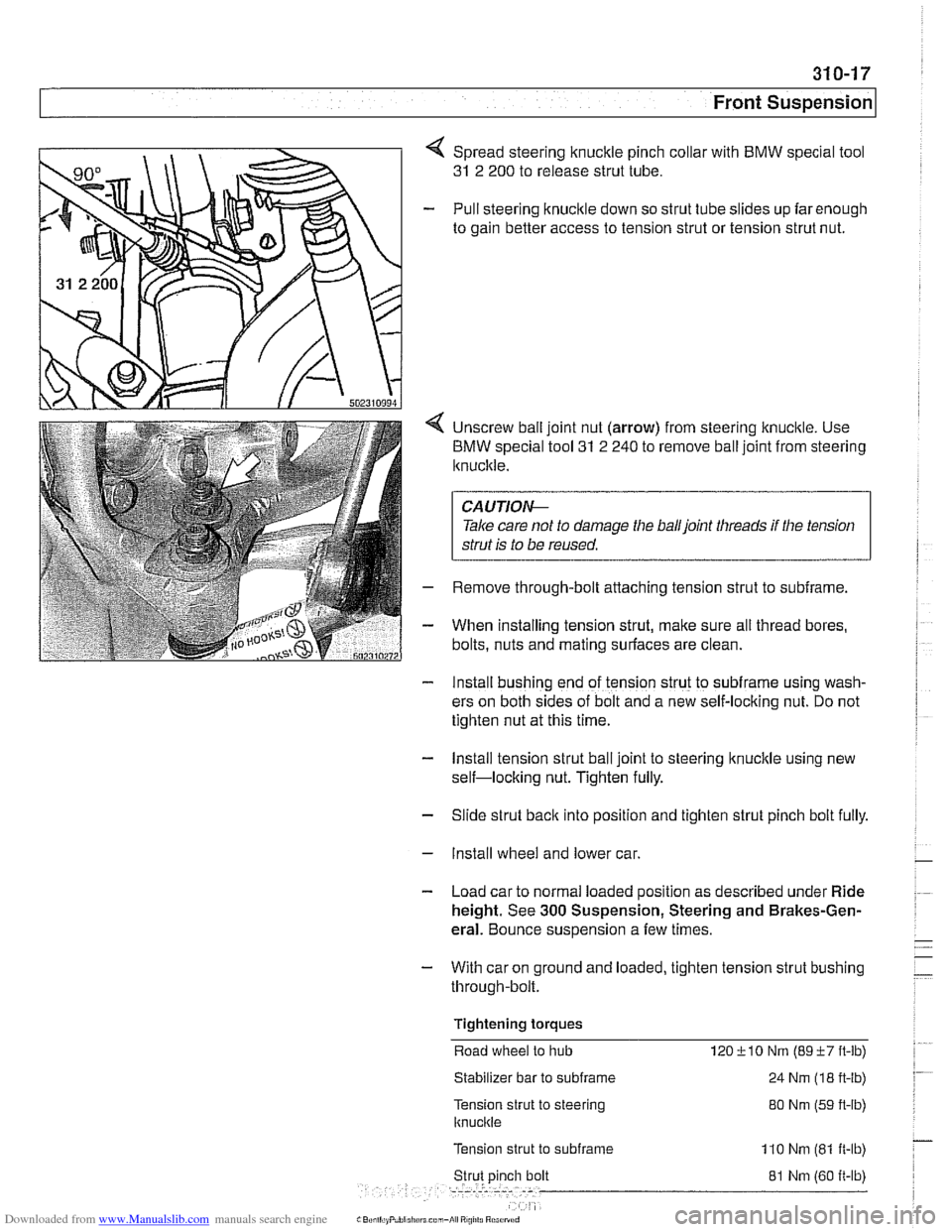
< Spread steering knuckle pinch collar with BMW special tool
31 2 200 to release strut tube.
- Pull steering knuckle down so strut tube slides up farenough
to gain better access to tension strut or tension strut nut.
4 Unscrew ball joint nut (arrow) from steering knuckle. Use
BMW special tool
31 2 240 to remove ball joint from steering
Iknucltle.
CAUTION--
Tale care not to damage the balljoint threads if the tension
strut
is to be reused.
- Remove through-bolt attaching tension strut to subframe.
- When installing tension strut, make sure all thread bores,
bolts, nuts and mating
suriaces are clean.
- Install bushing end of tension strut to subframe using wash-
ers on both sides of bolt and a new self-locking nut. Do not
tighten nut at this time.
- Install tension strut ball joint to steering knuckle using new
self-locking nut. Tighten fully.
- Slide strut back into position and tighten strut pinch bolt fully.
- Install wheel and lower car.
- Load car to normal loaded position as described under Ride
height. See
300 Suspension, Steering and Brakes-Gen-
eral. Bounce suspension a few times.
- With car on ground and loaded, tighten tension strut bushing
through-bolt.
Tightening torques Road
wheel to hub 120-i-10 Nm (89+7ft-lb)
Stabilizer bar to subframe 24 Nm (1 8 ft-lb)
Tension strut to steering
knucltle
80 Nm (59 ft-lb)
Tension strut
to subframe 110 Nm (81 ft-lb)
81 Nm (60 it-lb)
L BcniliiyFlrblrillirn con,-*I R!,illJ Rci,:n>d
Page 661 of 1002
Downloaded from www.Manualslib.com manuals search engine
320-3
Steering and Wheel ~li~nmentl
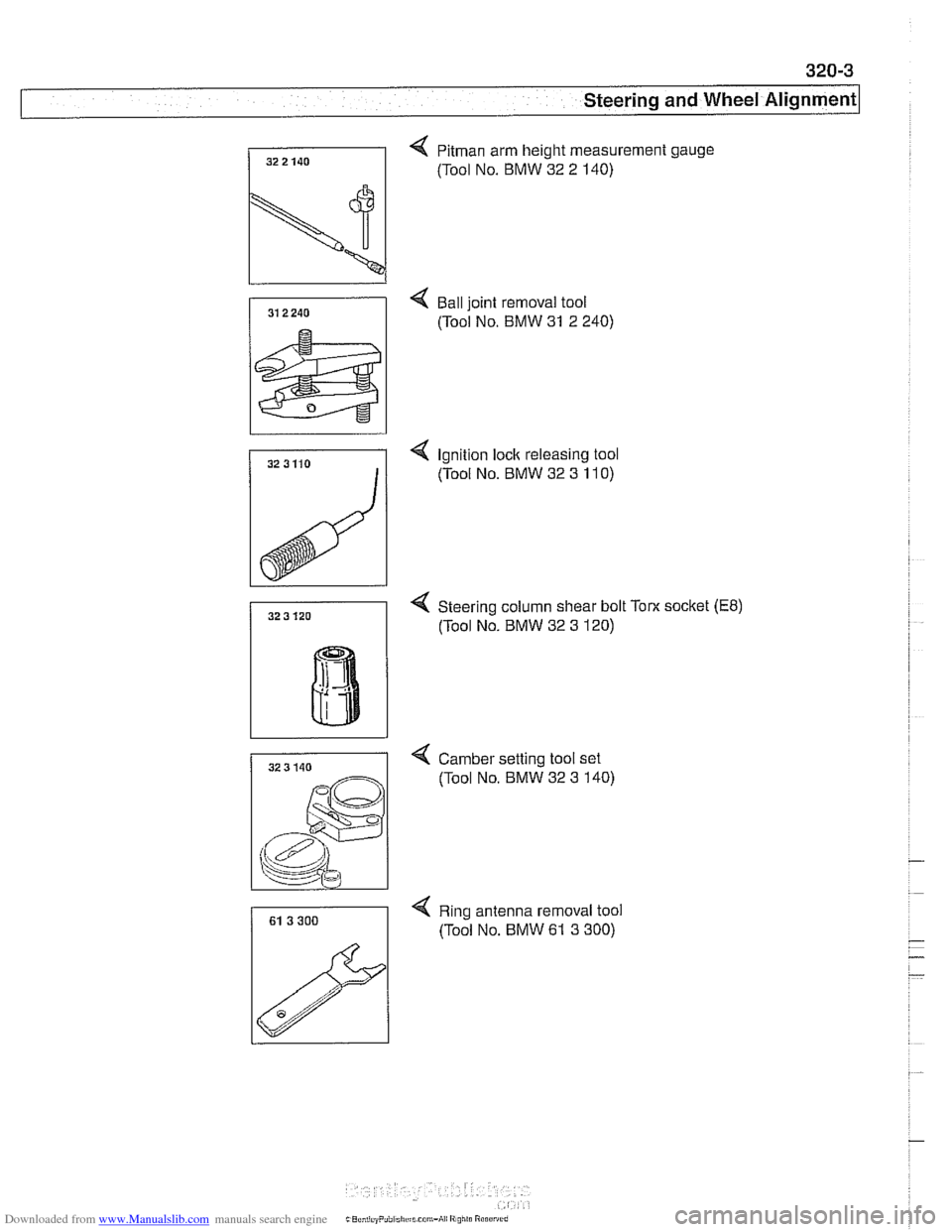
4 Pitman arm height measurement gauge
/I (Tool NO. BMW 32 2 140)
-
4 Ball joint removal tool
(Tool No. BMW 31 2 240)
4 Ignition lock releasing tool
(Tool No. BMW 32 3
11 0)
4 Steering column shear bolt Toot socket (E8)
(Tool No. BMW 32 3 120)
4 Camber setting tool set
(Tool No. BMW 32 3 140)
4 Ring antenna removal tool
(Tool No. BMW
61 3 300)