HEAD LIGHT BMW 540i 1997 E39 User Guide
[x] Cancel search | Manufacturer: BMW, Model Year: 1997, Model line: 540i, Model: BMW 540i 1997 E39Pages: 1002
Page 138 of 1002
Downloaded from www.Manualslib.com manuals search engine
11 3-44
I Cylinder Head Removal and Installation
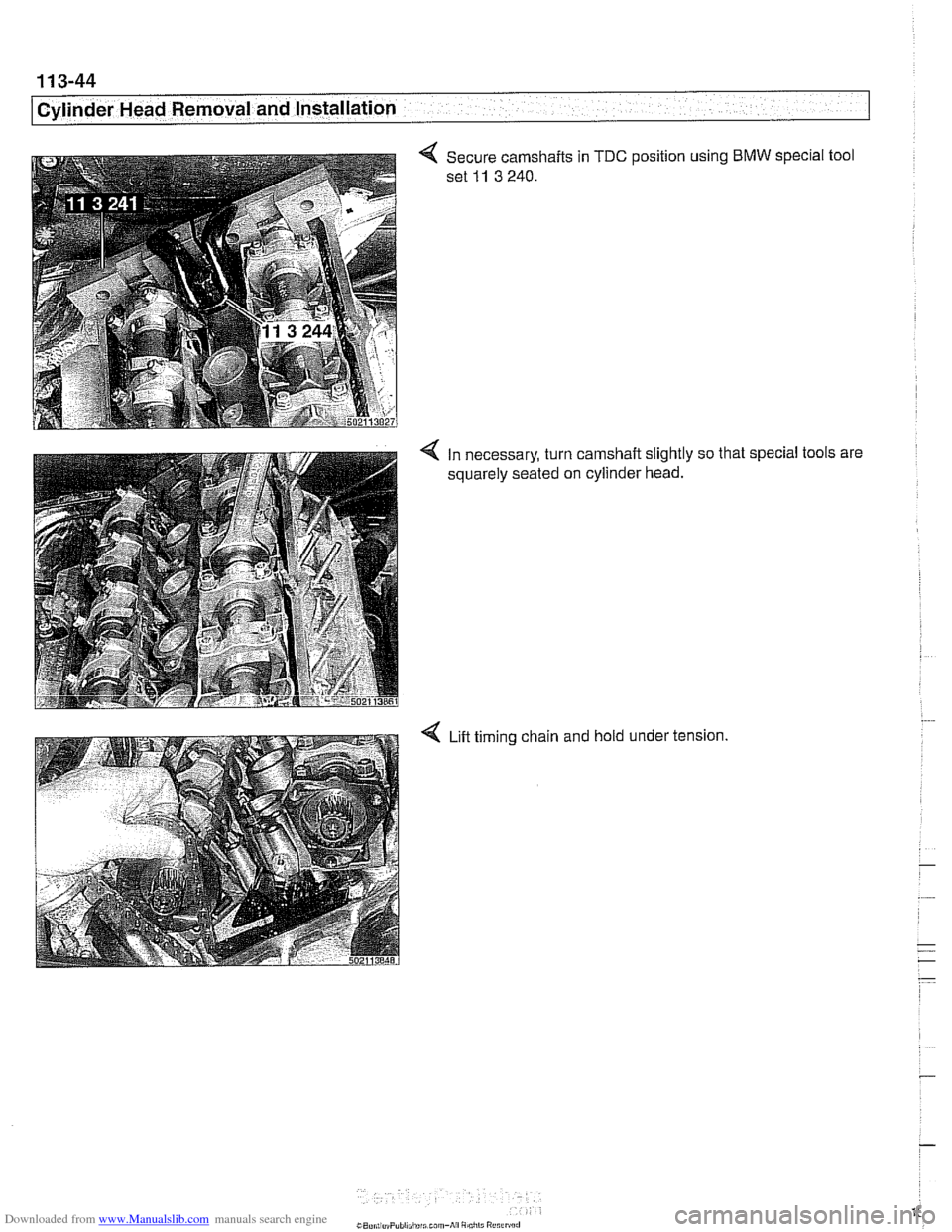
4 Secure camshafts in TDC position using BMW special tool
set
11 3 240.
4 In necessary, turn camshaft slightly so that special tools are
squarely seated on cylinder head.
4 Lift timing chain and hold under tension.
Page 151 of 1002
Downloaded from www.Manualslib.com manuals search engine
Cylinder Head Removal and Installation /
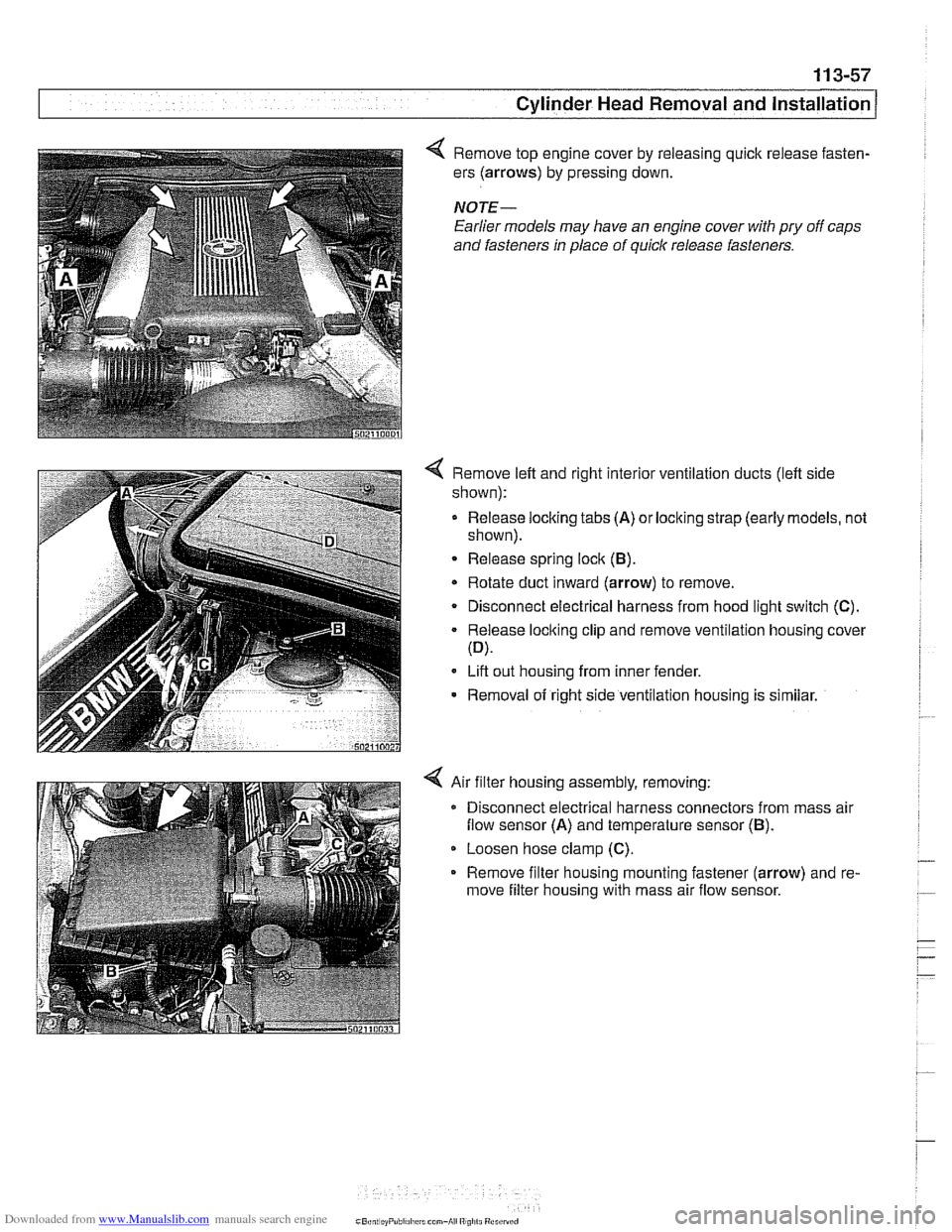
4 Remove top engine cover by releasing quick release fasten-
ers (arrows) by pressing down.
NOTE-
Earlier models may have an engine cover with pry off caps
and fasteners
In place of quick release fasteners.
4 Remove left and right interior ventilation ducts (left side
shown):
- Release locking tabs (A) or locking strap (early models, not
shown).
Release spring lock (B).
* Rotate duct inward (arrow) to remove.
Disconnect electrical harness from hood light switch (C).
Release locking clip and remove ventilation housing cover
(D).
Lift out housing from inner fender.
- Removal of right side ventilation housing is similar.
4 Air filter housing assembly, removing:
Disconnect electrical harness connectors from mass air
flow sensor (A) and temperature sensor (B).
Loosen hose clamp (C).
Remove filter housing mounting fastener (arrow) and re-
move filter housing with mass air flow sensor.
Page 186 of 1002
Downloaded from www.Manualslib.com manuals search engine
Cylinder Head and Valvetrain
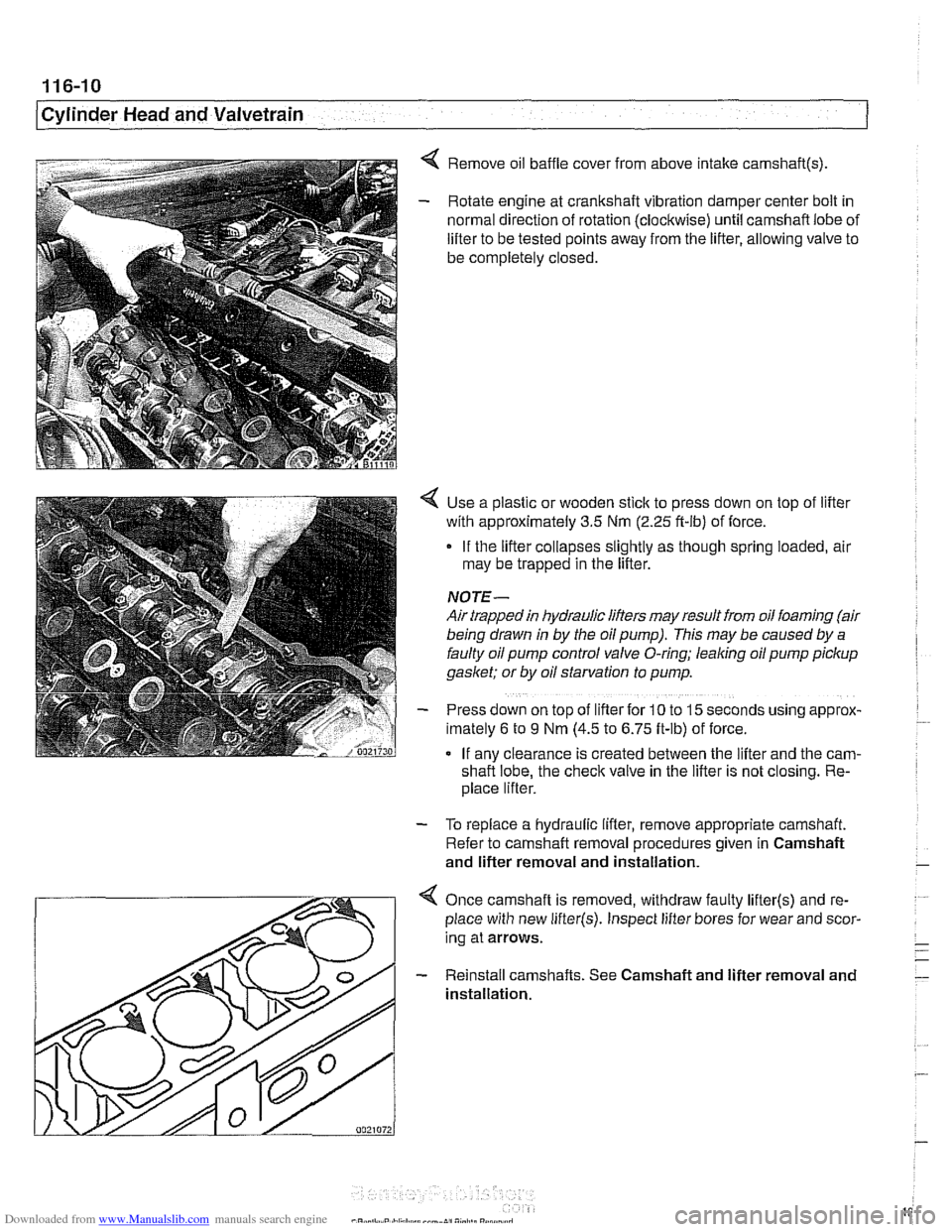
< Remove oil baffle cover from above intake camshaft(s)
- Rotate engine at crankshaft vibration damper center bolt in
normal direction of rotation (clockwise) until camshaft lobe of
lifter to be tested points away from the lifter, allowing valve to
be completely closed.
Use a plastic or wooden stick to press down on top of lifter
with approximately 3.5 Nm
(2.25 ft-ib) of force.
If the lifter collapses slightly as though spring loaded, air
may be trapped in the lifter.
NOTE-
Air trapped in hydraulic lifters may result from oil foaming (air
being drawn
in by the oil pump). This may be caused by a
faulty oil pump control valve O-ring; leaking oil pump pickup
gaslcet; or by oil starvation to pump.
Press down on top of lifter for
10 to 15 seconds uslng approx-
lmately 6 to 9 Nm (4.5 to 6.75 ft-lb) of force.
If anv clearance is created between the lifter and the
cam-
shafi lobe, the check valve in the lifter is not closing. Re-
place lifter.
- To replace a hydraulic lifter, remove appropriate camshaft.
Refer to camshaft removal procedures given in Camshaft
and lifter removal and installation.
Once camshaft is removed, withdraw faulty
lifter(s) and re-
place with new
lifter(s). Inspect lifter bores for wear and scor-
ing at arrows.
- Reinstall camshafts. See Camshaft and lifter removal and
installation.
Page 294 of 1002
Downloaded from www.Manualslib.com manuals search engine
(camshaft Timing Chain
- To install lower timing case cover:
- Clean cover and cylinder block sealing surfaces
Use new
gaskets and coolant pipe O-ring.
Remove timing chain cover dowel pins from engine block.
Drive timing cover dowels in until they just protrude slightly
from sealing surface.
Apply a small bead of silicon sealer (Three Bond 1209
63
or equivalent) to corners of cylinder head where timing
cover meets cylinder head and engine block.
Tap cover into position until firmly seated.
lnstall all bolts hand tight, including two Torx bolts from
above.
Install secondary chain lower guide.
Tighten cover mounting bolts alternately and in stages.
Tightening torque
Lower timing cover to cylinder
bloclc (M6) 10 Nrn (89 in-lb)
- Install oil pan with new gasket. See 119 Lubrication Sys-
tem.
Tightening torque
Oil pan
to engine bloclc (M6)
8.8 grade
10.9 grade 10 Nrn (89 in-lb)
12 Nm
(9 ft-lb)
- Align damper assembly with lteyway and tap into place. In-
sert new center bolt with washer.
CAUTION-
Inspect woodruff key for damage before installing hub
assembly.
- Attach special tools 11 8 20011 1 8 190 to damper assembly.
Counterhold damper with
11 8 190 while tightening center
bolt.
CAUTION-
Do not use BMW special tool 1 I 2 300 to hold crankshaft
stationary to tighten cranl(shaft hub center bolt. Use only
the special tools specified, or equivalent hub holding tool.
Have a second person hold special tool
11 8 190 while
tightening center crankshaft bolt.
Tightening torque Crankshaft hub to crankshaft 410 Nrn
(300
ft-lb)
Page 371 of 1002
Downloaded from www.Manualslib.com manuals search engine
Battery, Starter, ~iternatorl
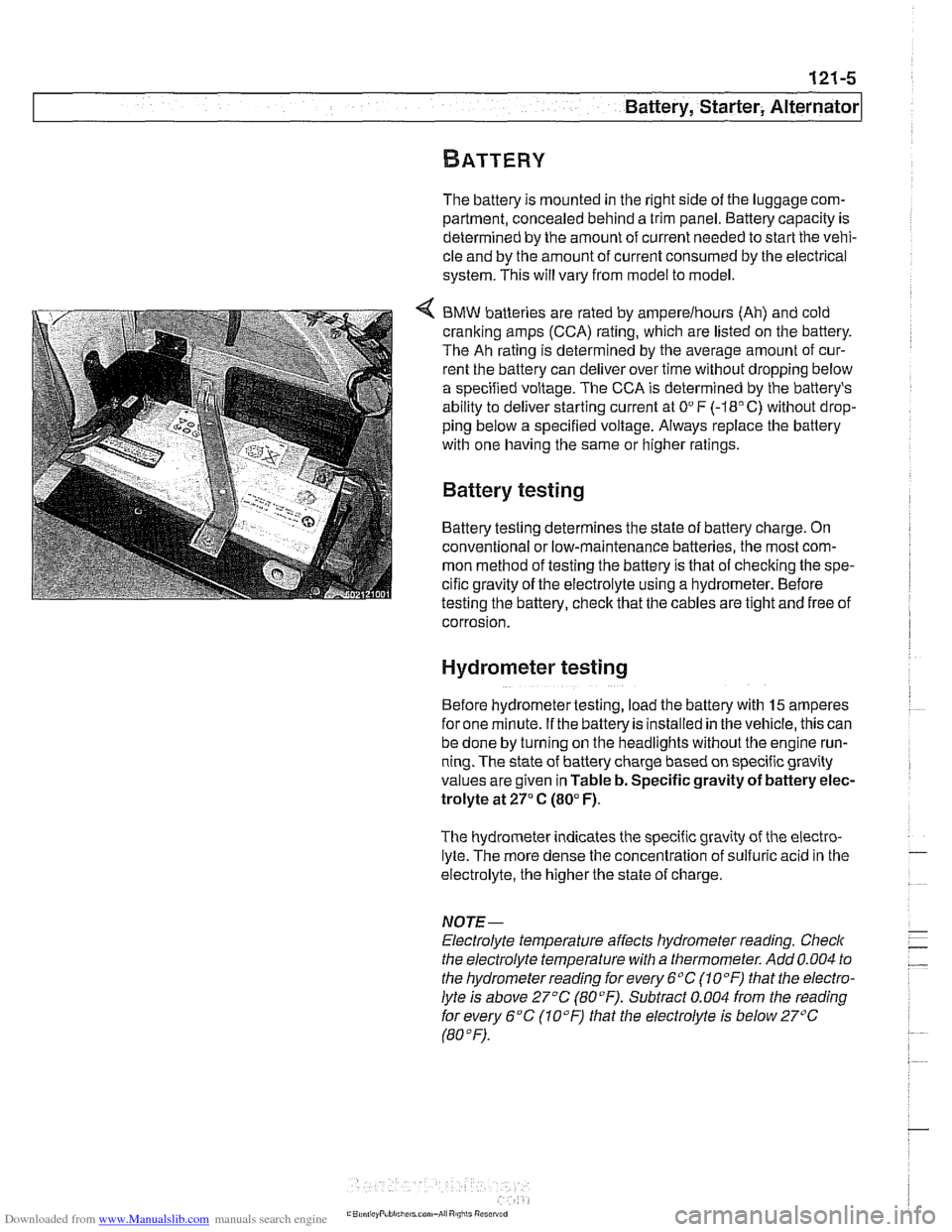
The battery is mounted in the right side of the luggage com-
partment, concealed behind a trim panel. Battery capacity is
determined by the amount of current needed to start the vehi-
cle and by the amount of current consumed by the electrical
system. This will vary from model to model.
BMW batteries are rated by
amperelhours (Ah) and cold
cranking amps (CCA) rating, which are listed on the battery.
The Ah rating is determined by the average amount of cur-
rent the battery can deliver over time without dropping below
a specified voltage. The CCA is determined by the battery's
ability to deliver starting current at
On F (-18" C) without drop-
ping below a specified voltage. Always replace the battery
with one having the same or higher ratings.
Battery testing
Battery testing determines the state of battery charge. On
conventional or low-maintenance batteries. the most com-
mon method of testing the battery is that
ofchecking the spe-
cific gravity of the electrolyte using a hydrometer. Before
testing the battery, check that the cables are tight and free of
- corrosion.
Hydrometer testing
Before hydrometertesting, load the battery with 15 amperes
for one minute. If the battery is installed in the vehicle, this can
be done by turning on the headlights without the engine run-
ning. The state of battery charge based on specific gravity
values are given in Table
b. Specific gravity of battery elec-
trolyte at
27" C (80°F).
The hydrometer indicates the specific gravity of the electro-
lyte. The more dense the concentration of sulfuric acid in the
electrolyte, the higher the state of charge
NOTE-
Electrolyte temperature affects hydrometer reading. Checlc
the electrolyte temperature with a thermometer. Add 0.004 to
the hydrometerreading
forevery 6°C (10°F) that the electro-
lyte is above 27°C
(80°F). Subtract 0.004 from the reading
forevery 6°C (10°F) that the electrolyte is below27"C
(80°F).
Page 372 of 1002
Downloaded from www.Manualslib.com manuals search engine
.
Battery, Starter, Alternator
Table b. Specific gravity of battery electrolyte at 27°C (80°F)
Specific gravity State of charge
1.265 Fully charged
1.225 75% charged
1.190 50% charged
1.155 25% charged
1.120 Fully discharged
if the specific gravity is at
orabove 1.225, butthe battery lacks
Dower for
startinq, determine the battew's service condition
with a load volta& test. if the average specific gravity of the
six cells is below 1.225, remove the battery from the luggage
compartment and recharge.
Battery open-circuit voltage test
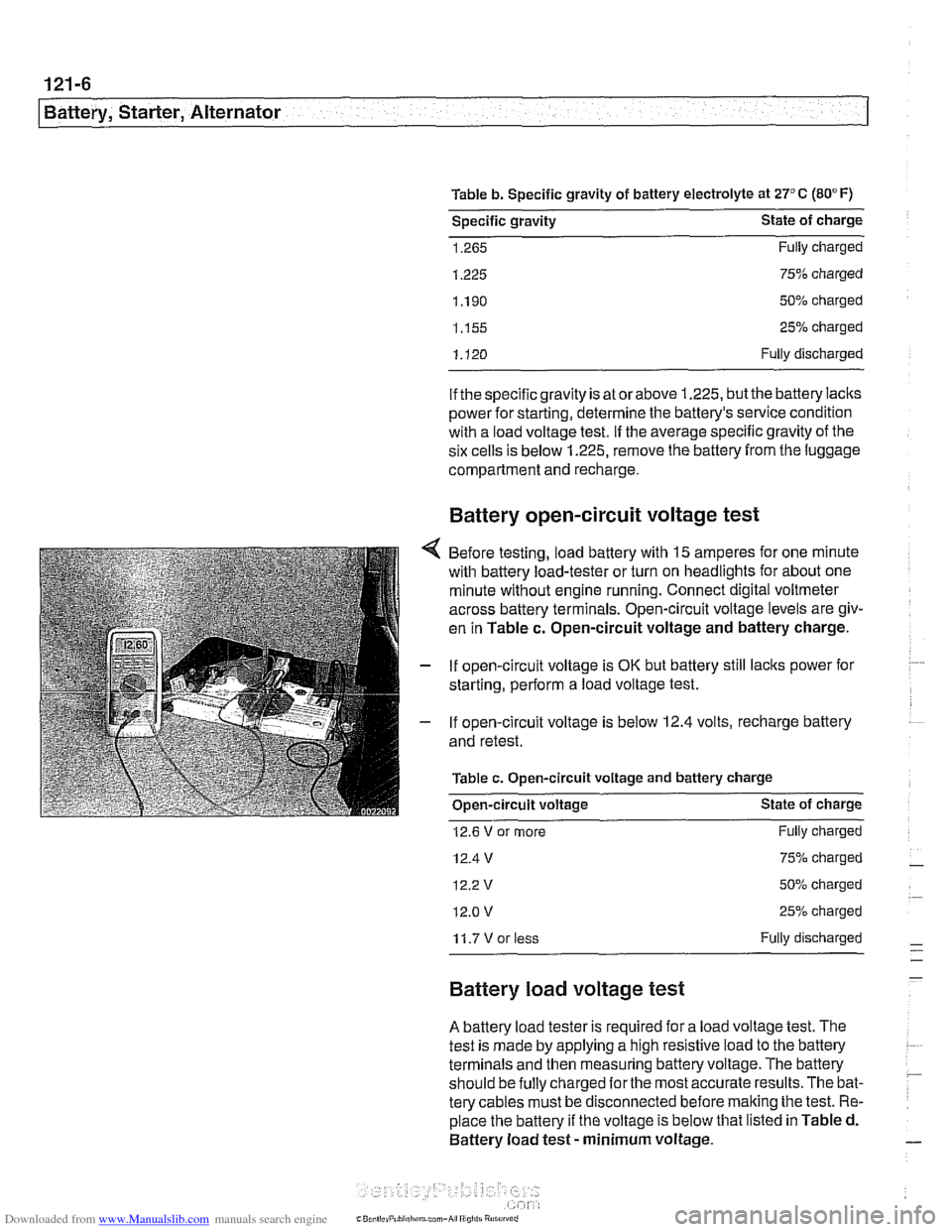
Before testing, load battery with 15 amperes for one minute
with battery load-tester or turn on headlights for about one
minute without engine running. Connect digital voltmeter
across battery terminals. Open-circuit voltage levels are giv-
en in Table
c. Open-circuit voltage and battery charge.
If open-circuit voltage is
OK but battery still lacks power for
starting, perform a load voltage test.
If open-circuit voltage is
below 12.4 volts, recharge battery
and retest.
Table c. Open-circuit voltage and battery charge
Open-circuit voltage State of charge
12.6 V or more
12.4 V
12.2v
12.0 v
Fully charged
75% charged
50% charged
25% charged
11.7Vorless Fully discharged
Battery load voltage test
A battery load tester is required for a load voltage test. The
test is made by applying a high resistive load to the battery
terminals and then measuring battery voltage. The battery
should be
fully charged forthe most accurate results. The bat-
tery cables must be disconnected before
malting the test. Re-
place the battery if the voltage is below that listed in Table d.
Battery load test
- minimum voltage.
Page 378 of 1002
Downloaded from www.Manualslib.com manuals search engine
Battery, Starter, Alternator
Water-cooled alternator
The water-cooled alternator, used on 1999 and later M62 TU
engines, is a sealed unit housed inside the engine block wa-
ter jacket. It is cooled via the engine cooling system. It is a
"brushless" sealed unit that cannot be serviced. Maintaining
consistent alternator temperatures increases the life span of
the alternator, and elimination of the alternator cooling fan re-
duces alternator noise
significantly.
The M62 TU water-cooled alternator incorporates load start
reduction. This function is intended to shorten the duration of
engine starting, particularly at low ambienttemperatures. The
current load is limited to
20 amps during starting in order to re-
duce alternator braking torque on the engine. Following the
current limiting phase, full power output is then progressively
reached.
Charging system diagnostics requires special test equip-
ment. If the test equipment is not available, charging system
fault diagnosis can be performed by an authorized
BMW
dealer or other qualified repair shop. See Table a. Battery,
alternator and starter troubleshooting for general electri-
cal component troubleshooting.
Before checking the alternator, make sure the battery is fully
charged and capable of holding a charge. Check that the bat-
tery terminals are clean and tight and the alternator drive belt
is properly tensioned and not severely worn.
NOTE-
Some model require up to 15 second to reacli full alternator
output.
CA UTIOG
If the charge indicator light in the instrument cluster remains
on, the charge warning circuit in the instrument cluster may
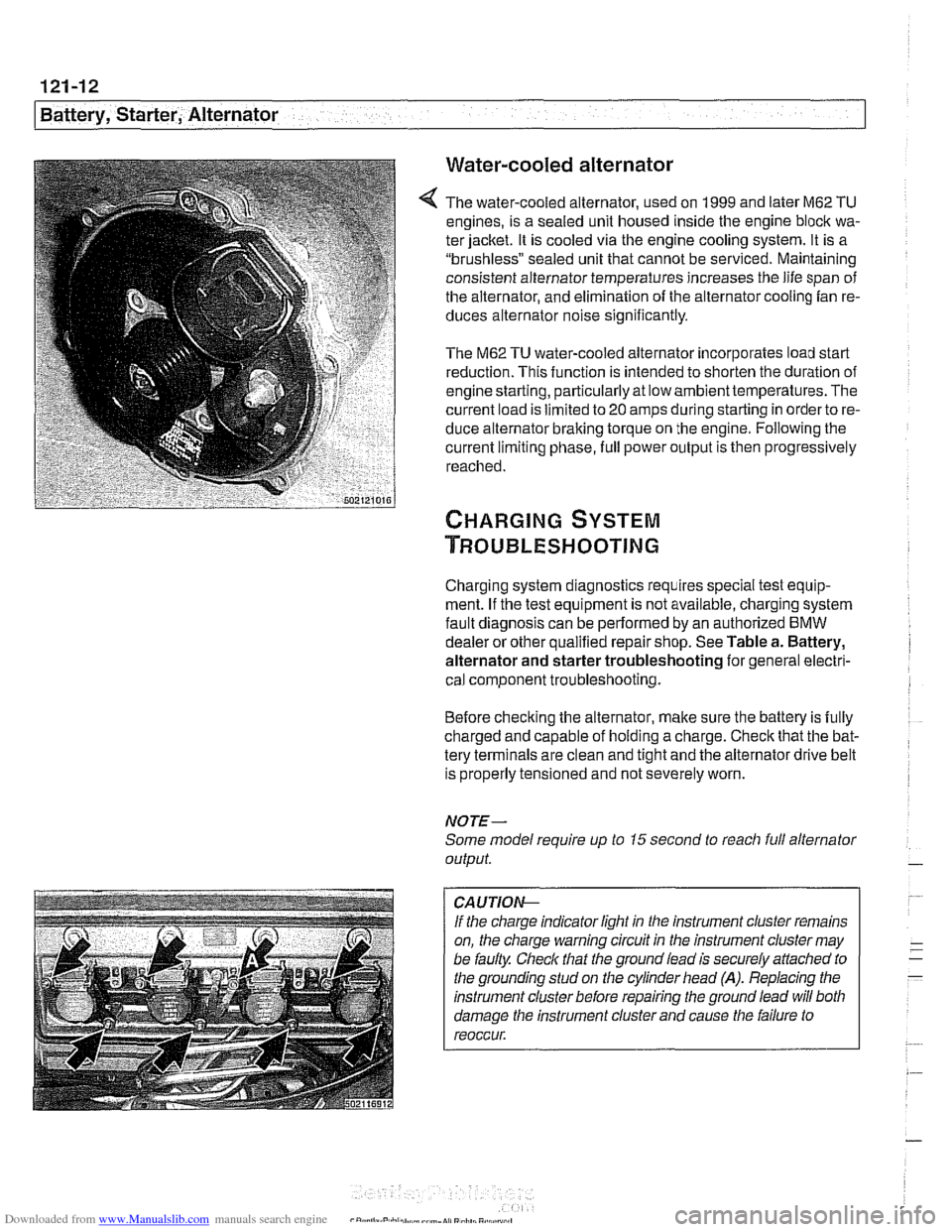
be faulty. Check that the ground lead is securely
affached to
the grounding stud on the cylinder head
(A). Replacing the
instrument cluster before repairing the ground lead will both
damage the instrument cluster and cause the failure to
reoccur.
Page 380 of 1002
Downloaded from www.Manualslib.com manuals search engine
- -
/Battery, Starter, Alternator -- - -. - --I
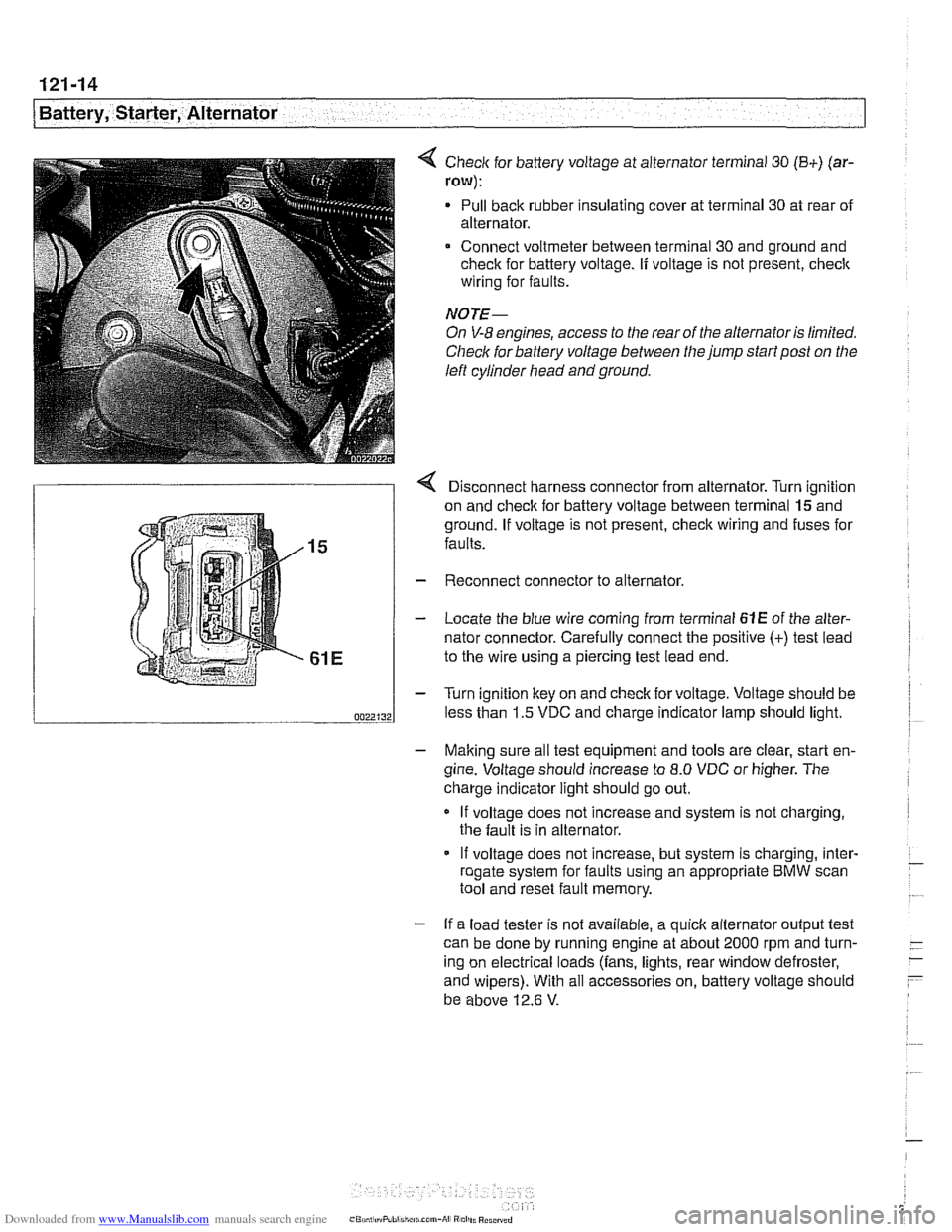
< Check for battery voltage at alternator terminal 30 (B+) (ar-
row):
Pull back rubber insulating cover at terminal 30 at rear of
alternator.
Connect voltmeter between terminal 30 and ground and
check for battery voltage.
If voltage is not present, check
wiring for faults.
NOTE-
On V-8 engines, access to the rear of the alternator is limited.
Check for battery voltage between the jump start post on the
left cylinder head and ground.
r Disconnect harness connector from alternator. Turn ianition
on and check for battery voltage between terminal
lgand
ground. If voltage is not present, check wiring and fuses for
faults.
Reconnect connector to alternator.
Locate the blue wire coming from terminal
61E of the alter-
nator connector. Carefully connect the positive
(+) test lead
to the wire using a piercing test lead end.
Turn ignition key on and check for voltage. Voltage should be
less than 1.5 VDC and charge indicator lamp should light.
- Making sure all test equipment and tools are clear, start en-
gine. Voltage should increase to
8.0 VDC or higher. The
charge indicator light should go out.
If voltage does not increase and system is not charging,
the fault is in alternator.
- If voltage does not increase, but system is charging, inter- - roaate svstem for faults usina an appropriate BMW scan - .. . tool and'reset fault memory.
- If a load tester is not available, a quick alternator output test
can be done by running engine at about 2000 rpm and turn-
- -
ing on electrical loads (fans, lights, rear window defroster, -
- and wipers). With all accessories on, battery voltage should
be above 12.6
V.
Page 511 of 1002
Downloaded from www.Manualslib.com manuals search engine
Radiator and Cooling System
Remove rubber trim strip between top of shroud and radiator.
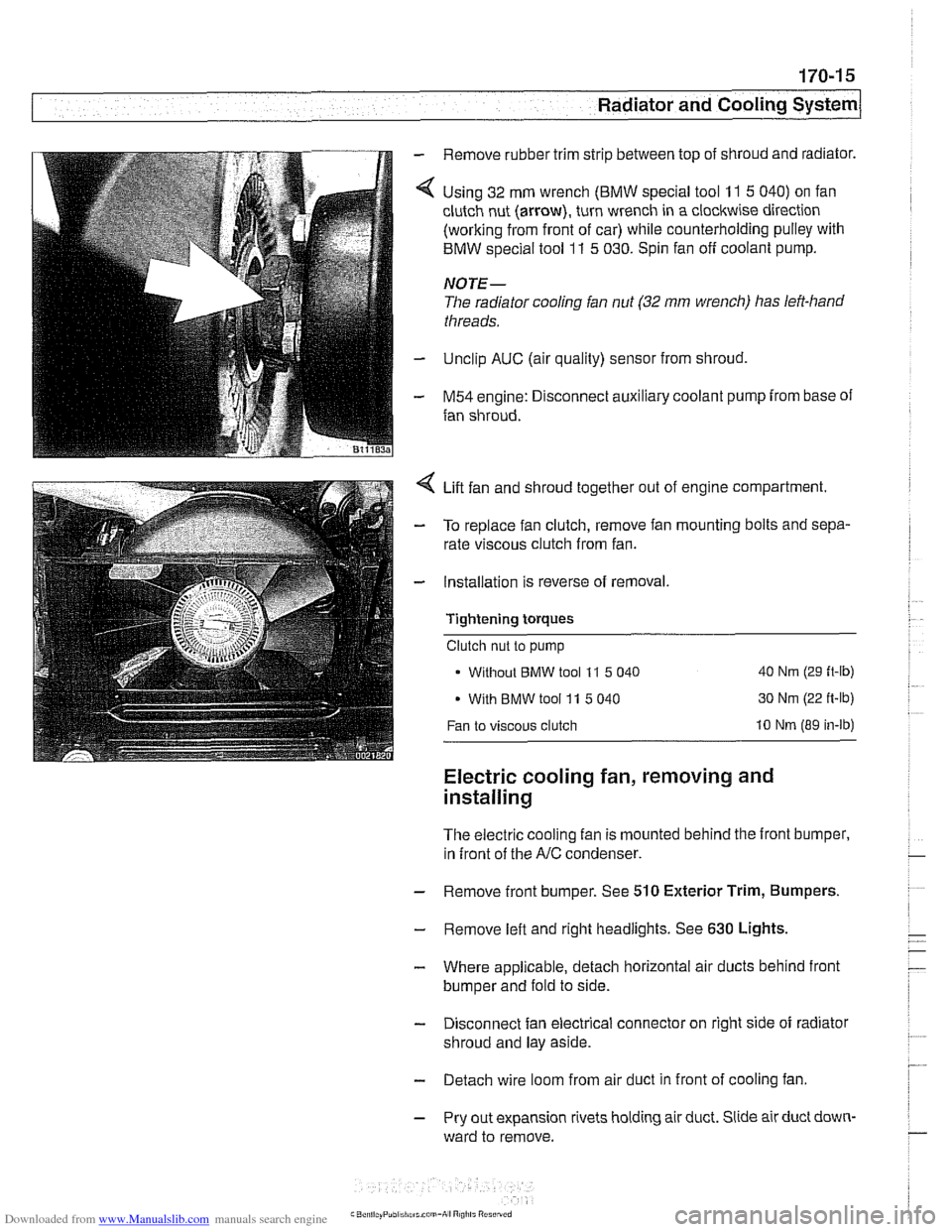
Using 32 mm wrench
(BMW special tool 11 5 040) on fan
clutch nut (arrow), turn wrench in a clockwise direction
(working from front of car) while counterholding pulley with
BMW special tool
11 5 030. Spin fan off coolant pump.
NOTE-
The radiator cooling fan nut (32 mm wrench) has left-hand
threads.
Unclip AUC (air quality) sensor from shroud,
M54 engine: Disconnect auxiliary coolant pump from base of
fan shroud.
Lift fan and shroud together out of engine compartment.
To replace fan clutch, remove fan mounting bolts and sepa-
rate viscous clutch from fan.
Installation is reverse of removal.
Tightening
torques
Clutch nut to pump
Without
BMW tool 11 5 040 40 Nm (29 ft-lb)
With BMW tool 11 5 040 30 Nm
(22 ft-lb)
Fan to viscous clutch 10 Nm (89 in-lb)
Electric cooling fan, removing and
installing
The electric cooling fan is mounted behind the front bumper,
in front of the
A/C condenser.
- Remove front bumper. See 510 Exterior Trim, Bumpers.
- Remove left and right headlights. See 630 Lights,
- Where applicable, detach horizontal air ducts behind front
bumper and fold to side.
- Disconnect fan electrical connector on right side of radiator
shroud and lay aside.
- Detach wire loom from air duct in front of cooling fan
- Pry out expansion rivets holding air duct. Slide air duct down-
ward to remove.
Page 525 of 1002
Downloaded from www.Manualslib.com manuals search engine
... .
Exhaust System
- With exhaust system fully cold, raise and support car for ac-
cess to exhaust system.
WARNING -
Do not worlc under a lifted car unless it is solidly supported on
jack stands designed for that purpose. Never work under a
car that is supported solely by a
jack.
- Disconnect oxygen sensor connector(s).
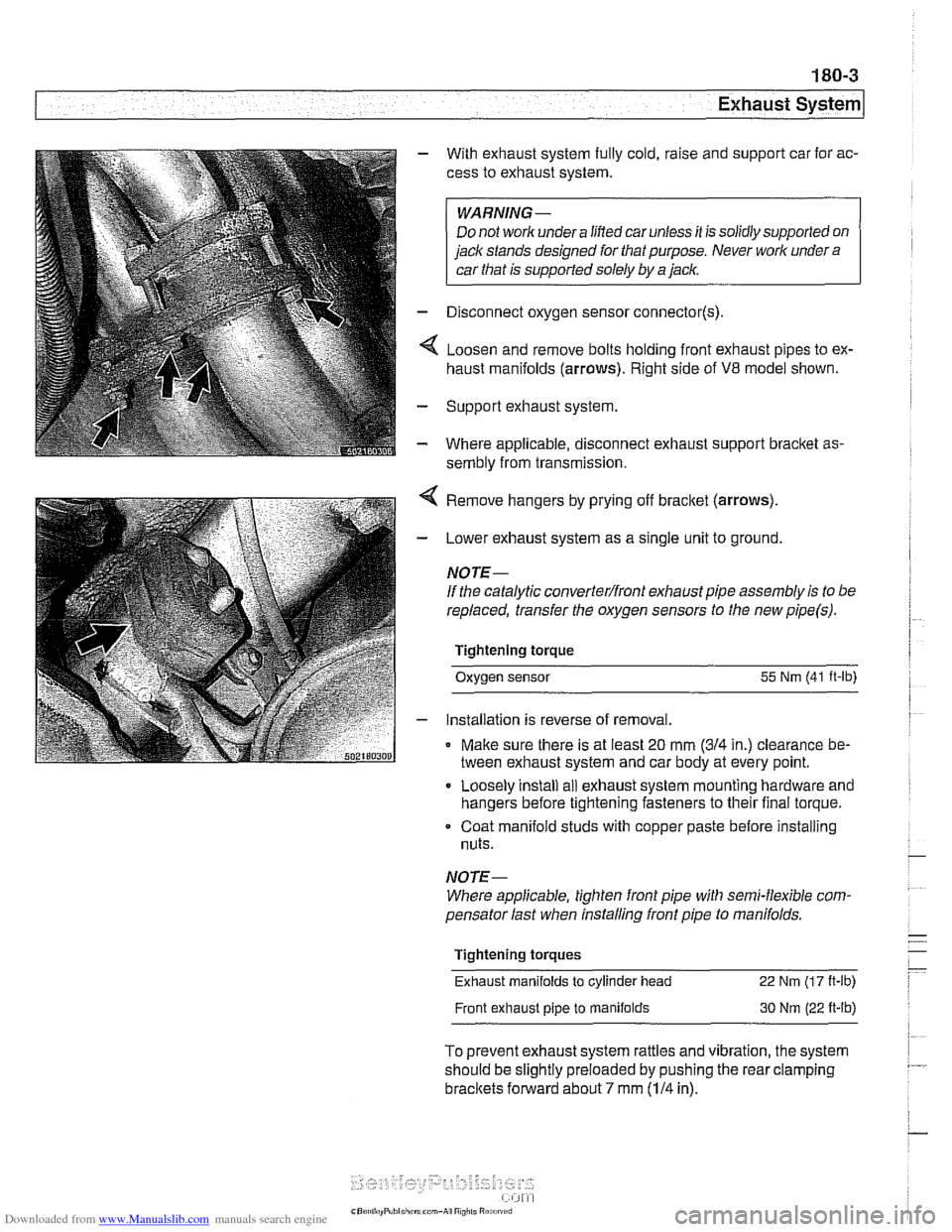
4 Loosen and remove bolts holding front exhaust pipes to ex-
haust manifolds (arrows). Right side of
V8 model shown.
- Support exhaust system
- Where applicable, disconnect exhaust support bracket as-
sembly from transmission.
< Remove hangers by prying off bracket (arrows).
- Lower exhaust system as a single unit to ground.
NOTE-
If the catalytic converterlfront exhaust pipe assembly is to be
replaced, transfer the oxygen sensors to the new
pipe(s).
Tightening torque
Oxygen sensor
55 Nm (41 ft-lb)
- installation is reverse of removal.
* Make sure there is at least 20 mm (314 in.) clearance be-
tween exhaust system and car body at every point.
Loosely install
ail exhaust system mounting hardware and
hangers before tightening fasteners to their final torque.
Coat manifold studs with copper paste before installing
nuts.
NOTE-
Where applicable, tighten front pipe with semi-flexible com-
pensator last when installing front pipe to
manifolds.
Tightening torques
Exhaust manifolds
to cylinder head 22 Nm (1 7 It-lb)
Front exhaust pipe to manifolds 30 Nm (22 ft-lb)
To prevent exhaust system rattles and vibration, the system
should be slightly preloaded by pushing the rear clamping
brackets forward about 7 mm (114 in).