light BMW 540I SEDAN 2000 Owner's Manual
[x] Cancel search | Manufacturer: BMW, Model Year: 2000, Model line: 540I SEDAN, Model: BMW 540I SEDAN 2000Pages: 217, PDF Size: 1.69 MB
Page 103 of 217
103n
RepairsIndexOverview Controls Car care Technology Data
Automatic climate control Seat heating
*
Steering wheel heating
*
Microfilter, activated-charcoal
filterThe microfilter removes dust and pollen
from the incoming air. The activated-
charcoal filter provides additional
protection by filtering gaseous pollut-
ants from the outside air. Your BMW
center replaces this combined filter as a
standard part of your scheduled main-
tenance. A substantial reduction in air
flow indicates that the filter must be
replaced before scheduled mainte-
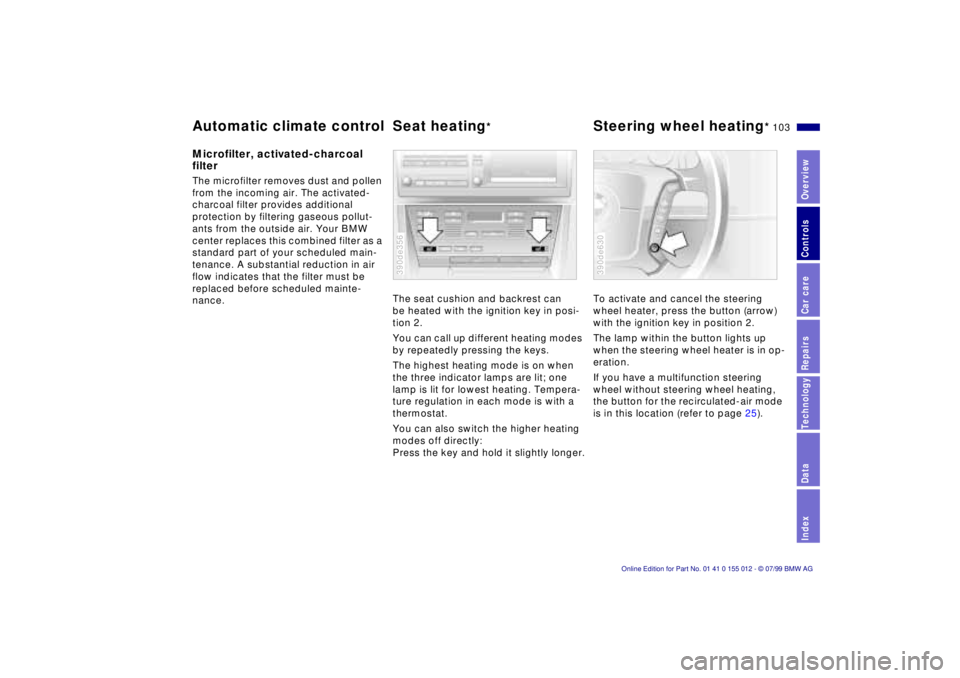
nance.The seat cushion and backrest can
be heated with the ignition key in posi-
tion 2.
You can call up different heating modes
by repeatedly pressing the keys.
The highest heating mode is on when
the three indicator lamps are lit; one
lamp is lit for lowest heating. Tempera-
ture regulation in each mode is with a
thermostat.
You can also switch the higher heating
modes off directly:
Press the key and hold it slightly longer.
390de356
To activate and cancel the steering
wheel heater, press the button (arrow)
with the ignition key in position 2.
The lamp within the button lights up
when the steering wheel heater is in op-
eration.
If you have a multifunction steering
wheel without steering wheel heating,
the button for the recirculated-air mode
is in this location (refer to page 25).390de630
Page 108 of 217
108n
Glove compartment Storage facilitiesTo openPull the handle and the lamp comes on.To closeFold the cover up.To lockUse one of the master keys to lock the
vehicle. A master key is also required
for unlocking.
For example, if you turn over only
your door and ignition keys for va-
let parking (refer to page 34), access to
the glove compartment is not possi-
ble.< 390de060
To prevent injury in the event of an
accident, close the glove com-
partment immediately after use.<
Rechargeable flashlight
*
Located on the left-hand side of the
glove compartment.
Features integral overload-protection,
so it can be left in its holder continu-
ously.
Be sure that the flashlight is
switched off when it is inserted
into its holder. Failure to comply with
this precaution could lead to overcharg-
ing and damage.<
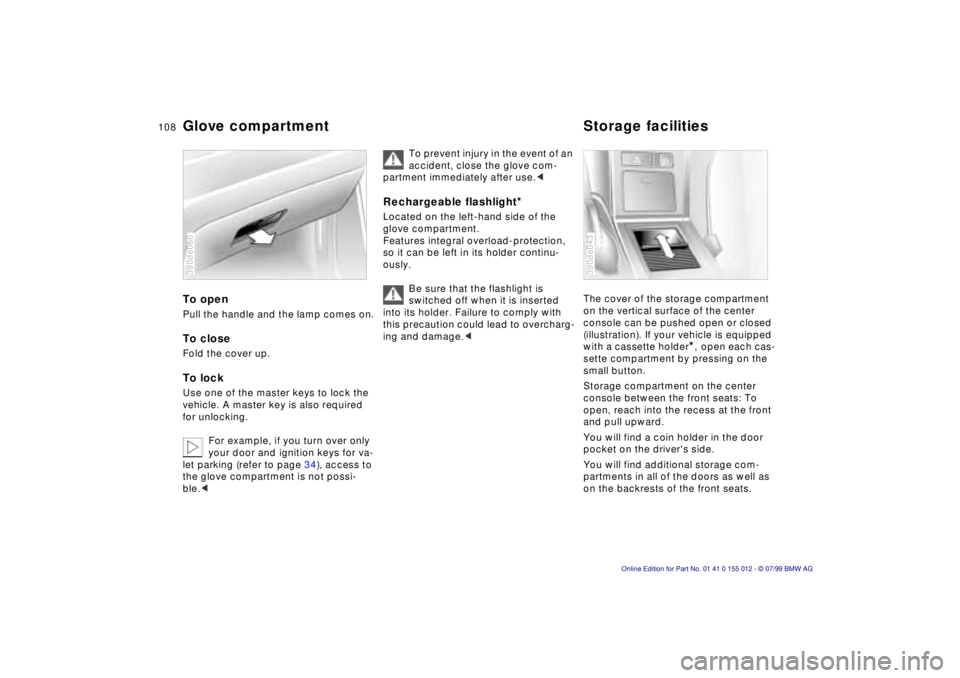
The cover of the storage compartment
on the vertical surface of the center
console can be pushed open or closed
(illustration). If your vehicle is equipped
with a cassette holder
*, open each cas-
sette compartment by pressing on the
small button.
Storage compartment on the center
console between the front seats: To
open, reach into the recess at the front
and pull upward.
You will find a coin holder in the door
pocket on the driver's side.
You will find additional storage com-
partments in all of the doors as well as
on the backrests of the front seats.
390de043
Page 110 of 217
110n
Ashtray, front Cigarette lighter
*
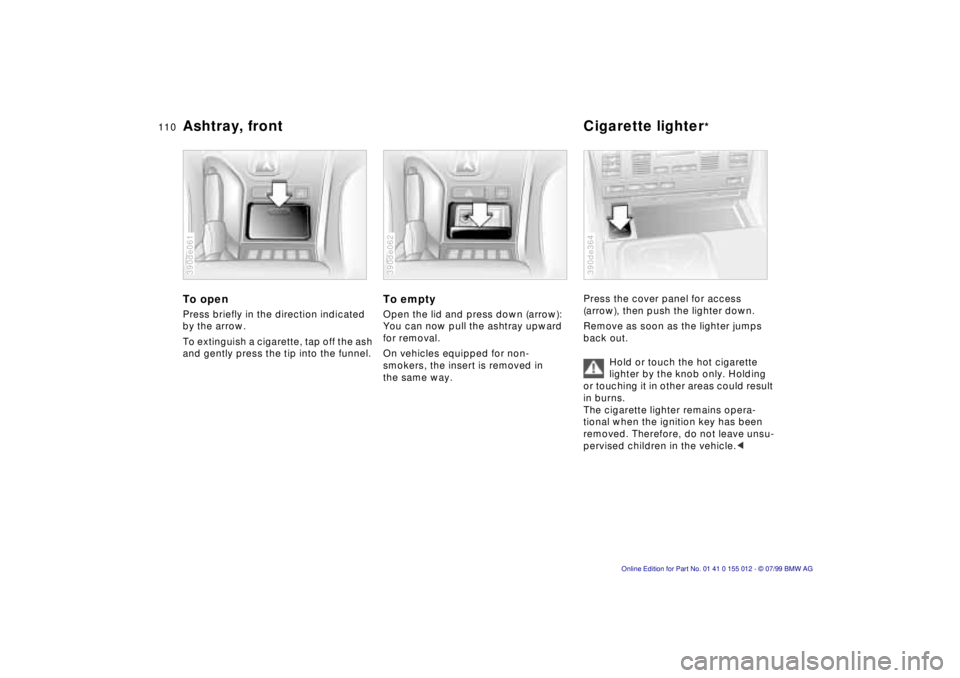
To openPress briefly in the direction indicated
by the arrow.
To extinguish a cigarette, tap off the ash
and gently press the tip into the funnel.390de061
To emptyOpen the lid and press down (arrow):
You can now pull the ashtray upward
for removal.
On vehicles equipped for non-
smokers, the insert is removed in
the same way.390de062
Press the cover panel for access
(arrow), then push the lighter down.
Remove as soon as the lighter jumps
back out.
Hold or touch the hot cigarette
lighter by the knob only. Holding
or touching it in other areas could result
in burns.
The cigarette lighter remains opera-
tional when the ignition key has been
removed. Therefore, do not leave unsu-
pervised children in the vehicle.< 390de364
Page 111 of 217
111n
RepairsIndexOverview Controls Car care Technology Data
Cigarette lighter
*
Ashtray, rear
Cigarette lighter socket Suitable for attaching power supplies
for flashlights, car vacuum cleaners,
etc., up to a rating of approx. 200 watts
at 12 volts. Avoid damage to the socket
caused by inserting plugs of different
shapes or sizes.Non-smoker's equipment
packageOn vehicles with the non-smoker's
equipment package, the socket is
concealed by a cover.
For access to the socket: Lift the cover
off.
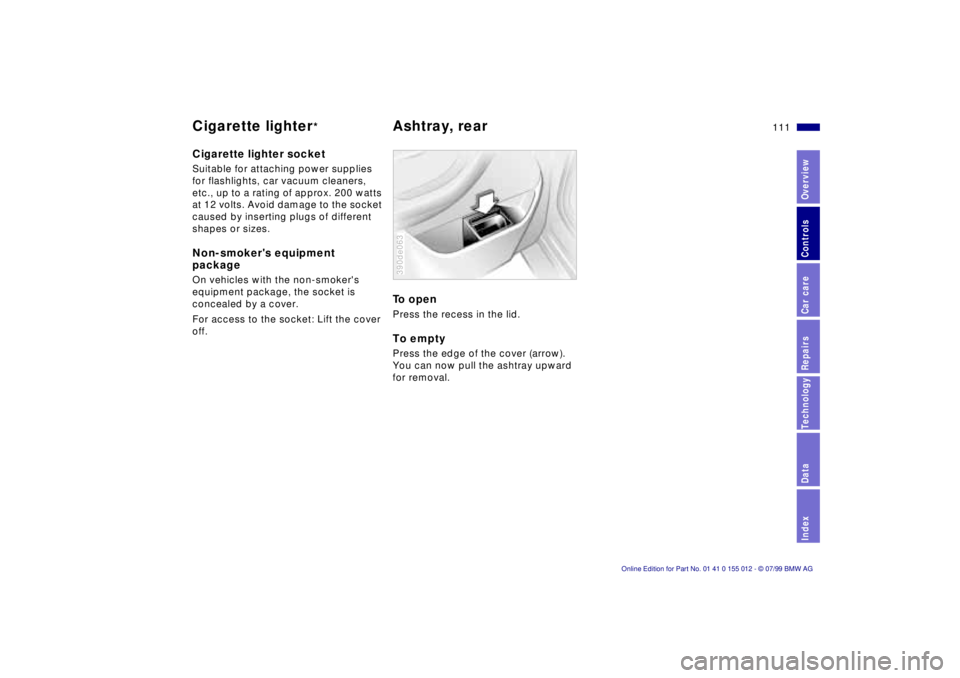
To openPress the recess in the lid.To emptyPress the edge of the cover (arrow).
You can now pull the ashtray upward
for removal.390de063
Page 116 of 217
116n
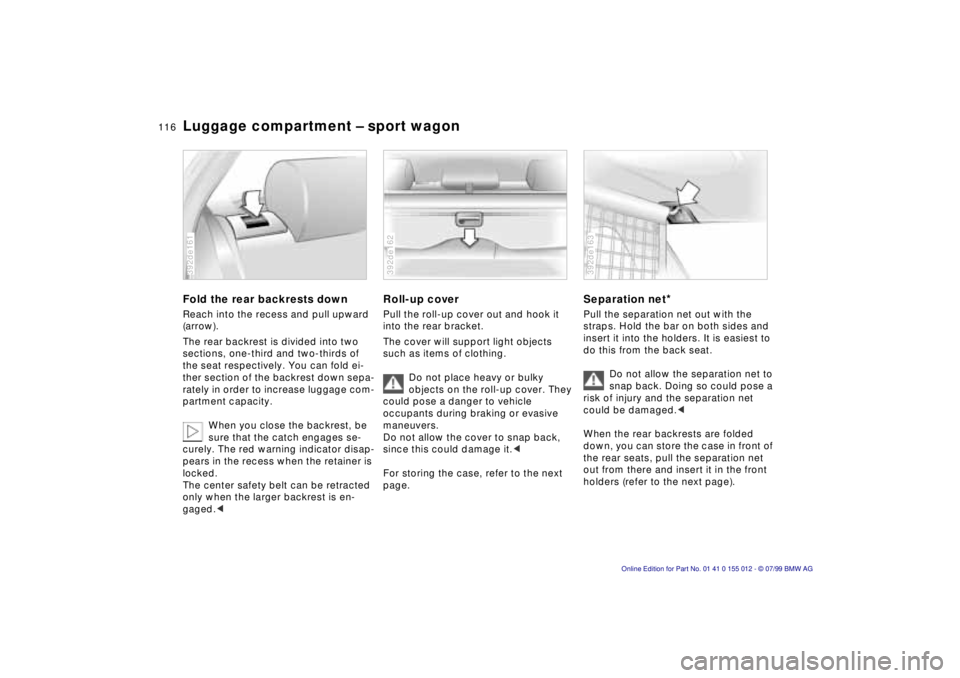
Luggage compartment Ð sport wagonFold the rear backrests downReach into the recess and pull upward
(arrow).
The rear backrest is divided into two
sections, one-third and two-thirds of
the seat respectively. You can fold ei-
ther section of the backrest down sepa-
rately in order to increase luggage com-
partment capacity.
When you close the backrest, be
sure that the catch engages se-
curely. The red warning indicator disap-
pears in the recess when the retainer is
locked.
The center safety belt can be retracted
only when the larger backrest is en-
gaged.<392de161
Roll-up coverPull the roll-up cover out and hook it
into the rear bracket.
The cover will support light objects
such as items of clothing.
Do not place heavy or bulky
objects on the roll-up cover. They
could pose a danger to vehicle
occupants during braking or evasive
maneuvers.
Do not allow the cover to snap back,
since this could damage it.<
For storing the case, refer to the next
page.392de162
Separation net
*
Pull the separation net out with the
straps. Hold the bar on both sides and
insert it into the holders. It is easiest to
do this from the back seat.
Do not allow the separation net to
snap back. Doing so could pose a
risk of injury and the separation net
could be damaged.<
When the rear backrests are folded
down, you can store the case in front of
the rear seats, pull the separation net
out from there and insert it in the front
holders (refer to the next page).392de163
Page 120 of 217
120n
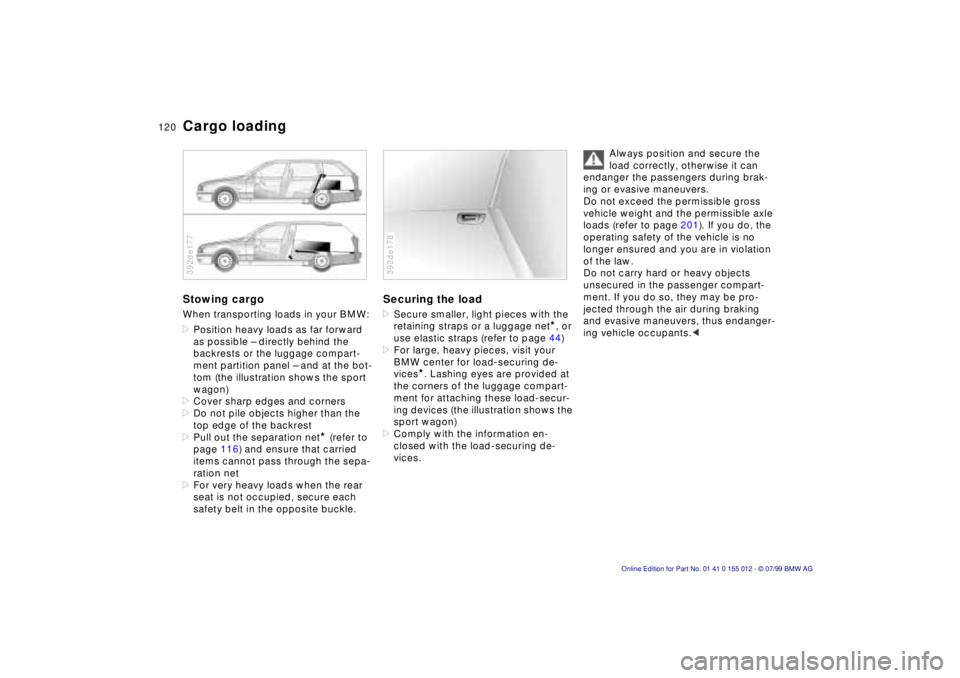
Cargo loading Stowing cargoWhen transporting loads in your BMW:
>Position heavy loads as far forward
as possible Ð directly behind the
backrests or the luggage compart-
ment partition panel Ð and at the bot-
tom (the illustration shows the sport
wagon)
>Cover sharp edges and corners
>Do not pile objects higher than the
top edge of the backrest
>Pull out the separation net
* (refer to
page 116) and ensure that carried
items cannot pass through the sepa-
ration net
>For very heavy loads when the rear
seat is not occupied, secure each
safety belt in the opposite buckle.
392de177
Securing the load >Secure smaller, light pieces with the
retaining straps or a luggage net
*, or
use elastic straps (refer to page 44)
>For large, heavy pieces, visit your
BMW center for load-securing de-
vices
*. Lashing eyes are provided at
the corners of the luggage compart-
ment for attaching these load-secur-
ing devices (the illustration shows the
sport wagon)
>Comply with the information en-
closed with the load-securing de-
vices.
392de178
Always position and secure the
load correctly, otherwise it can
endanger the passengers during brak-
ing or evasive maneuvers.
Do not exceed the permissible gross
vehicle weight and the permissible axle
loads (refer to page 201). If you do, the
operating safety of the vehicle is no
longer ensured and you are in violation
of the law.
Do not carry hard or heavy objects
unsecured in the passenger compart-
ment. If you do so, they may be pro-
jected through the air during braking
and evasive maneuvers, thus endanger-
ing vehicle occupants.<
Page 124 of 217

124n
Break-in procedureTo ensure that your vehicle provides
maximum economy throughout a long
service life, we request that you ob-
serve the following:Engine and differentialUp to 1,200 miles (2,000 km):
Drive at varying engine speeds and road
speeds, but do not exceed 4,500 rpm
and the following road speeds during
this initial period:
BMW 528i: 100 mph (160 km/h)
BMW 540i: 106 mph (170 km/h)
Obey your local and state maximum
speed limits.
Refrain from using full throttle and avoid
pressing the accelerator beyond the
kickdown point.
Once you have driven 1,200 miles
(2,000 km), engine and vehicle speeds
can gradually be increased.
You should also comply with these
break-in procedures if the engine or dif-
ferential is replaced later in the course
of the vehicle service life.
TiresDue to technical factors associated
with their manufacture, tires do not
achieve their full traction potential until
an initial break-in period has elapsed
for this reason, drive with extra care
during the initial 200 miles (300 km).
Obey your local and state maximum
speed limits.
When the vehicle is operated on
wet or slushy roads, a wedge of
water may form between the tire and
the road surface. This phenomenon is
referred to as aquaplaning, or hydro-
planing, and can lead to partial or com-
plete loss of traction, vehicle control
and braking effectiveness. Reduce your
speed on wet roads.<
Brake systemApproximately 300 miles (500 km) must
elapse before the brake pads and rotors
achieve the optimal pad-surface and
wear patterns required for trouble-free
operation and long service life later on.
To break in the separate parking brake
drums, apply the parking brake lightly
when coasting to a standstill (at a traffic
signal, for instance), provided that traf-
fic conditions allow you to do so. To
avoid corrosion, repeat this procedure
from time to time.
The brake lamps do not come on
when the parking brake is applied.
Vacuum for the brake system servo unit
on your BMW is available only when the
engine is running. When you move the
car with the engine shut off Ð when
towing, for instance Ð substantially
higher levels of pedal force will be
required to brake the vehicle.<
Page 125 of 217

125n
RepairsIndexOverview Controls Car care Technology Data
Driving notes
Brakes:
Do not drive with your foot resting
on the brake pedal. Even light but con-
sistent pedal pressure can lead to high
temperatures, brake wear and possibly
even brake failure.
Aquaplaning:
When driving on wet or slushy roads,
reduce road speed. If you do not, a
wedge of water can form between tires
and road surface. This phenomenon is
referred to as aquaplaning or hydro-
planing. It is characterized by a partial
or complete loss of contact between
the tires and the road surface. The ulti-
mate results are loss of steering and
braking control.
Driving through water:
Do not drive through water more than
1 foot (30 cm) deep. Drive only at walk-
ing speed. Driving at a faster speed
could cause damage to the engine, the
electrical system and the transmission.
Rear parcel tray:
Do not use the rear parcel tray to store
heavy or bulky objects. They could
pose a danger to the occupants during
braking, evasive maneuvers, or in a
crash.
Clothes hooks:
Hang items of clothing from the hooks
so that they will not obstruct the driver's
vision. In order to avoid personal
injuries during braking or evasive
maneuvers, do not hang heavy objects
on the hooks.<
Page 129 of 217
129n
RepairsIndexOverview Controls Car care Technology Data
Disc brakesDriving notesWhen driving in wet conditions and in
heavy rain, it is a good idea to apply
light pressure to the brake pedal every
few miles (kilometers). Watch traffic
conditions to ensure that this maneuver
does not endanger other road users.
The heat which is generated by the
brake applications helps to dry the
brake pads and rotors.
Maximum braking force is obtained
while the wheels continue to rotate,
peaking when the wheels remain on the
verge of locking without actually doing
so. ABS maintains this state automati-
cally. If the ABS fails, you should revert
to the staggered braking technique de-
scribed below (refer to page 131).
Extended or steep mountain descents
do not necessarily have to lead to re-
duced braking efficiency. Shift down to
a gear in which only minimal periodic
brake applications are required or move
the selector lever to the appropriate
lower range with automatic transmis-
sion.
You can increase the engine's braking
effect by selecting progressively lower
gears, downshifting as far as 1st gear,
or the 1st or 2nd shift position, on steep
descents.Should engine braking prove inade-
quate, you should still avoid extended,
continuous braking. Instead of main-
taining low to moderate pressure over
an extended period of time, you should
decelerate by applying more substantial
pressure to the brake pedal (watch for
following traffic!), then releasing the
pedal, then repeating the application.
This staggered braking technique al-
lows the brakes to cool in the intervals
between active braking phases, pre-
venting overheating and ensuring that
full braking capacity remains available
at all times.
Do not coast with the clutch de-
pressed or with the transmission
or selector lever in neutral. Do not coast
with the engine shut off. The engine
provides no braking effect when the
clutch is depressed or the transmission
is in neutral, and there is no power-as-
sist for braking or steering when the
engine is not running.
Never allow floor mats, carpets or any
other objects to protrude into the area
around the accelerator, clutch and
brake pedals and obstruct their move-
ment.<
Dynamic Brake Control (DBC)
*
If you apply the brakes rapidly, this sys-
tem automatically produces the maxi-
mum braking force boost and thus
helps to achieve the shortest possible
braking distance during "panic stops."
All of the benefits of the ABS system
are exploited under these circum-
stances.
Do not reduce the pressure on the
brake pedal for the duration of the
brake application. When the brake
pedal is released, the DBC is deacti-
vated.
In the event of a malfunction, the yellow
warning lamp comes on. Conventional
braking efficiency is available without
limitations.
Have the system checked and repaired
at your BMW center as soon as possi-
ble.
For "Information for your safety"
covering the ABS system, refer to
page 128. This information also gener-
ally applies for DBC.<
Page 132 of 217

132n
Winter operation Power steering Level control system
*
Skid controlRelease the accelerator pedal and
depress the clutch pedal. Countersteer
carefully and attempt to regain control
of the vehicle.ParkingEngage 1st or reverse gear. If your car
is equipped with an automatic transmis-
sion, place the selector lever in "Park."
On vehicles with manual transmission,
also apply the parking brake when
parking on inclined surfaces. In order to
prevent the parking brake linings from
locking due to frost or corrosion, dry
them by gently applying the parking
brake as the vehicle is coming to a
stop. Make sure that following traffic is
not endangered.
The brake lamps do not come on
when the parking brake is
applied.<
If there is a change in steering behavior,
for instance greater steering effort or if
steering becomes lighter as speed
increases in vehicles equipped with
Servotronic
*:
Contact your BMW center immediately
for an inspection.
If the power steering fails,
increased effort will be required
to steer the vehicle.<
The warning lamp for the level
control system comes on, or the
message "LEVEL CONTROL
INACTIVE" appears in the Check Con-
trol: There is a malfunction in the level
control system.
Stop and inspect the vehicle. If it is
riding significantly lower in the rear than
in the front, or if it is sitting at an incline
(left rear compared to right rear),
consult the nearest authorized BMW
center. Drive with appropriate caution
in the meantime. The vehicle has
reduced ground clearance or driving
comfort is noticeably reduced.
Even if the attitude of the vehicle is
normal, you should consult the nearest
authorized BMW center if the warning
lamp indicates a system fault.