wheel BMW 540I SEDAN 2000 Owner's Manual
[x] Cancel search | Manufacturer: BMW, Model Year: 2000, Model line: 540I SEDAN, Model: BMW 540I SEDAN 2000Pages: 217, PDF Size: 1.69 MB
Page 75 of 217
75n
RepairsIndexOverview Controls Car care Technology Data
Automatic transmission with Steptronic
*
Before leaving the vehicle when
the engine is running, shift the se-
lector lever to the "Park" or "Neutral"
position and apply the parking brake.
The vehicle could move if this is not
done. Do not leave the car unattended
with the engine running. An unattended
vehicle with a running engine repre-
sents a potential safety hazard.
If you should inadvertently select "Neu-
tral" while traveling at high speed, re-
move your foot from the accelerator
pedal immediately. Allow the engine
speed to drop to idle before selecting
the desired drive position. Damage
could otherwise occur due to excessive
engine speed.<
P ParkSelect "Park" only when the vehicle is
stationary. The transmission locks to
prevent the rear wheels from turning.R ReverseSelect "Reverse" only when the vehicle
is stationary.N NeutralSelect "Neutral" only if your journey is
interrupted for a long period.
D Drive
(automatic shift program)This position is designed for driving un-
der all normal operating conditions. All
forward gears are available."Kickdown" In the "Kickdown" mode, you achieve
maximum performance.
To activate this mode, depress the ac-
celerator pedal beyond the full-throttle
position, at which a resistance point
must be overcome.
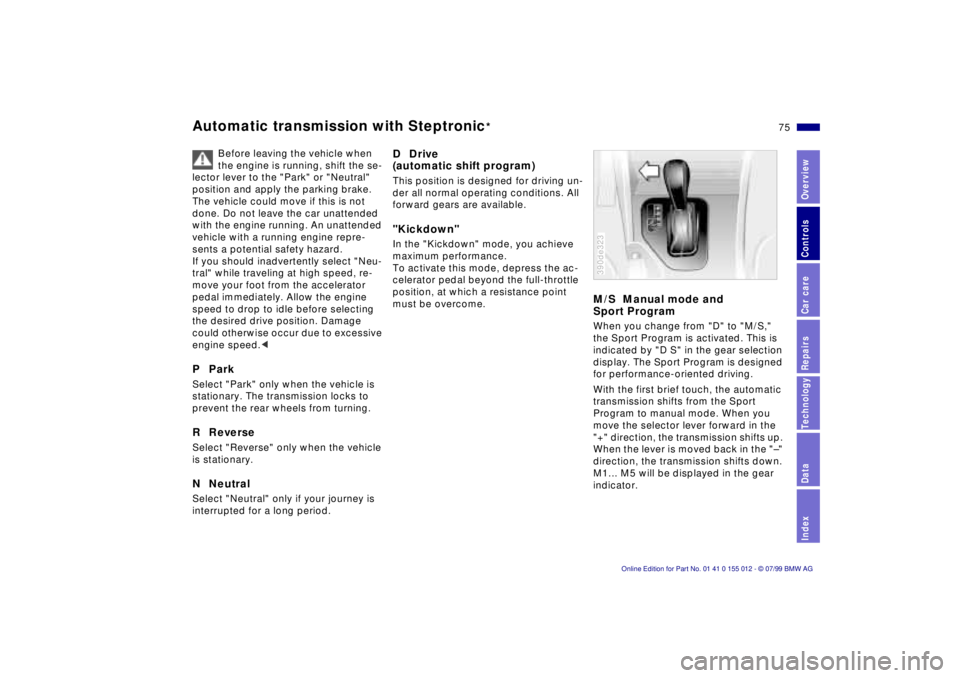
M/S Manual mode and
Sport ProgramWhen you change from "D" to "M/S,"
the Sport Program is activated. This is
indicated by "D S" in the gear selection
display. The Sport Program is designed
for performance-oriented driving.
With the first brief touch, the automatic
transmission shifts from the Sport
Program to manual mode. When you
move the selector lever forward in the
"+" direction, the transmission shifts up.
When the lever is moved back in the "Ð"
direction, the transmission shifts down.
M1... M5 will be displayed in the gear
indicator.390de323
Page 92 of 217
92n
Tire Pressure Control (RDC)
*
The concept RDC monitors the tire pressures at all
four wheels, even when the vehicle is
moving. The system provides an alert
whenever the inflation pressure drops
significantly below the specified pres-
sure in one or more tires.
In order for the system to "learn" the
correct tire inflation pressure, check the
inflation pressure in all tires. Refer to
the table of "Tire inflation pressures"
beginning on page 29 and make any
necessary corrections. Then activate
the system.
This indicator lamp in the in-
strument cluster or the Check
Control will inform you if the tire
pressure is not correct.
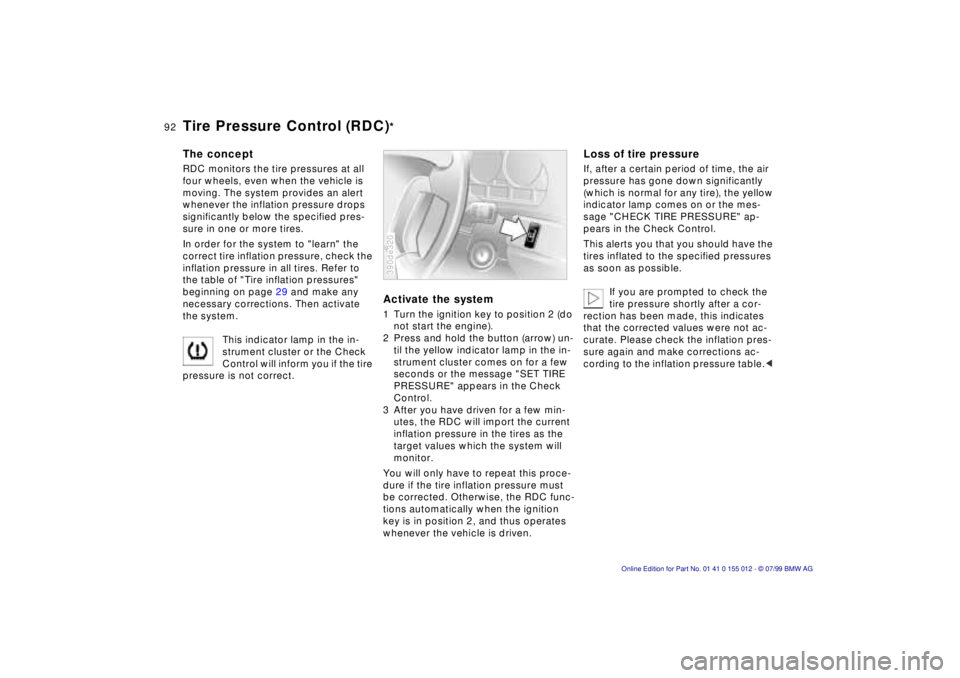
Activate the system1 Turn the ignition key to position 2 (do
not start the engine).
2 Press and hold the button (arrow) un-
til the yellow indicator lamp in the in-
strument cluster comes on for a few
seconds or the message "SET TIRE
PRESSURE" appears in the Check
Control.
3 After you have driven for a few min-
utes, the RDC will import the current
inflation pressure in the tires as the
target values which the system will
monitor.
You will only have to repeat this proce-
dure if the tire inflation pressure must
be corrected. Otherwise, the RDC func-
tions automatically when the ignition
key is in position 2, and thus operates
whenever the vehicle is driven.390de320
Loss of tire pressureIf, after a certain period of time, the air
pressure has gone down significantly
(which is normal for any tire), the yellow
indicator lamp comes on or the mes-
sage "CHECK TIRE PRESSURE" ap-
pears in the Check Control.
This alerts you that you should have the
tires inflated to the specified pressures
as soon as possible.
If you are prompted to check the
tire pressure shortly after a cor-
rection has been made, this indicates
that the corrected values were not ac-
curate. Please check the inflation pres-
sure again and make corrections ac-
cording to the inflation pressure table.<
Page 93 of 217

93n
RepairsIndexOverview Controls Car care Technology Data
Tire Pressure Control (RDC)
*
Flat tireIf there is a tire failure with a loss of air
pressure, the red indicator lamp comes
on or the message "TIRE DEFECT" ap-
pears in the Check Control. In addition,
a gong sounds.
If this occurs, reduce vehicle speed im-
mediately and stop the vehicle in a safe
location. Avoid hard brake applications.
Do not oversteer. Replace the wheel
and flat tire.
The spare tire which is available in
your vehicle as standard equip-
ment is equipped with the electronics
required for RDC and, following activa-
tion of the system, is also monitored af-
ter it is mounted.<
The RDC cannot alert you to se-
vere and sudden tire damage
caused by external factors.<
Have the tires changed by your
authorized BMW center.
Your BMW center has the information
needed for working with RDC and is
equipped with the necessary special
tools.<
System interferenceDuring the period of the malfunction,
the yellow indicator lamp comes on
or the message "TIRE CONTROL
INACTIVE" appears in the Check
Control.
You will also see the same message
>in the event of a system fault
>if a wheel is mounted without the
RDC electronics
>if, in addition to the spare tire,
additional wheels with RDC
electronics are on board.
Please contact your authorized BMW
center for additional information.
Page 101 of 217

101n
RepairsIndexOverview Controls Car care Technology Data
Automatic climate controlAir supply
In the "AUTO" program, the air
flow is controlled automati-
cally. AUTO will appear in the display
(refer to the overview on page 98). Use
"+" and "-" to vary the air flow. When
your setting is displayed by bars, the
automatic air flow is switched off. Auto-
matic air distribution maintains its set-
ting. You can reactivate the automatic
air flow by pressing the "AUTO" button.
When you press "Ð " during operation at
minimum blower speed all displays are
canceled: The fan, heating and air con-
ditioner are switched off. The outside
air supply is closed. By pressing any
button of the automatic climate control
(except the "REST" button 16), you can
switch the system back on.
To defrost windshield and door
windows
This program quickly removes
ice and condensation from the
windshield and the side windows.
Air conditioner
The air is cooled and dehu-
midified and Ð depending on
the temperature setting Ð warmed again
when the air conditioner system is
switched on. Depending on the
weather, the windshield may fog over
briefly when the engine is started.
Use the button to switch off the air con-
ditioner at outside temperatures below
approx. +417 (+56). This will help to
prevent the windows from fogging up.
If the windows fog over after switching
the air conditioner off, switch it back on.
Condensation forms in the air con-
ditioner system during operation,
which then exits under the vehicle.
Traces of condensed water of this kind
are thus normal.<
Automatic recirculated-air
control (AUC)
You can respond to unpleas-
ant external odors by tempo-
rarily stopping the flow of outside air.
The system then recirculates the air
currently within the vehicle. Press the
button repeatedly to run through the
following control sequence:
>Indicator lamps off: Outside air flow
operational.
>Left-hand indicator lamp on Ð AUC
mode: The system recognizes pollut-
ants in the outside air and blocks the
flow of air when necessary. The sys-
tem then recirculates the air currently
within the vehicle.
Depending on the air quality, the au-
tomatic system then switches back
and forth between outside air supply
and recirculation of the air within the
vehicle.
>Right-hand indicator lamp on: The
flow of external air into the vehicle is
permanently blocked. The system
then recirculates the air currently
within the vehicle.
If you have a multifunction steering
wheel with the recirculated-air button
(refer to page 25), you can also use it to
switch between "Off" and the recircu-
lated-air mode or AUC and the recircu-
lated-air mode.
Page 103 of 217
103n
RepairsIndexOverview Controls Car care Technology Data
Automatic climate control Seat heating
*
Steering wheel heating
*
Microfilter, activated-charcoal
filterThe microfilter removes dust and pollen
from the incoming air. The activated-
charcoal filter provides additional
protection by filtering gaseous pollut-
ants from the outside air. Your BMW
center replaces this combined filter as a
standard part of your scheduled main-
tenance. A substantial reduction in air
flow indicates that the filter must be
replaced before scheduled mainte-
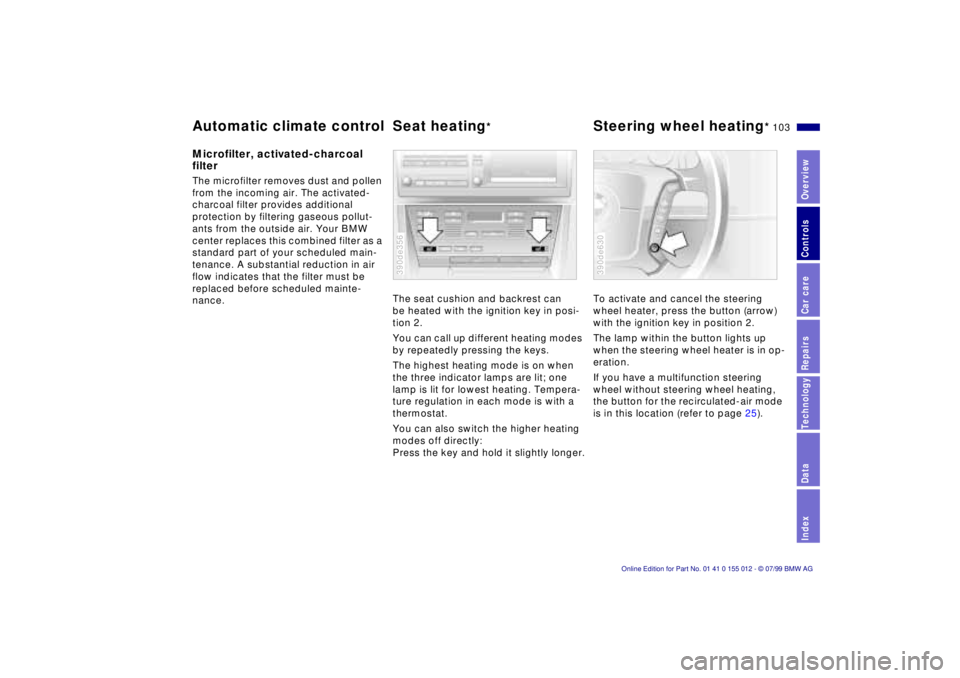
nance.The seat cushion and backrest can
be heated with the ignition key in posi-
tion 2.
You can call up different heating modes
by repeatedly pressing the keys.
The highest heating mode is on when
the three indicator lamps are lit; one
lamp is lit for lowest heating. Tempera-
ture regulation in each mode is with a
thermostat.
You can also switch the higher heating
modes off directly:
Press the key and hold it slightly longer.
390de356
To activate and cancel the steering
wheel heater, press the button (arrow)
with the ignition key in position 2.
The lamp within the button lights up
when the steering wheel heater is in op-
eration.
If you have a multifunction steering
wheel without steering wheel heating,
the button for the recirculated-air mode
is in this location (refer to page 25).390de630
Page 123 of 217
Overview
Controls and features
Operation, care
and maintenance
Owner service procedures
Technical data
Index Advanced technology
123n
RepairsIndexOverview Controls Car care Technology Data
Under the hood:
Hood143
Engine compartment144
Washer fluids148
Washer nozzles148
Engine oil149
Coolant151
Brake fluid152
Vehicle Identification
Number153
Care and maintenance:
The BMW Maintenance
System154
Caring for your car155
Airbags160
Vehicle storage160
Laws and regulations:
Technical modifications161
OBD connector162 Special operating instructions:
Break-in procedure124
Driving notes125
Catalytic converter126
Antilock Brake System
(ABS)127
Disc brakes128
Brake system130
Winter operation130
Power steering132
Level control system132
Cellular phone133
Radio reception133
Wheels and tires:
Tire inflation pressure134
Tire condition134
Tire replacement135
Tire rotation136
Wheel and tire
combinations137
Winter tires138
Snow chains139
Approved wheel and tire
specifications140
Page 127 of 217

127n
RepairsIndexOverview Controls Car care Technology Data
Antilock Brake System (ABS)The conceptABS enhances active safety by helping
to prevent the wheels from locking un-
der braking. The reason: Locked wheels
are dangerous. When the front wheels
slide, the driver loses steering control
over the vehicle. Traction loss at the
rear wheels can cause the rear end to
break into an uncontrolled skid.
ABS is designed to meet two essential
requirements during every brake appli-
cation:
>To help provide vehicle stability
>To help retain steering and maneu-
vering capability on all types of road
surface (asphalt, cement, dirt, mois-
ture, snow and ice).
The system can achieve the shortest
braking distances possible under most
conditions (on straight-away and in
curves, on asphalt, ice, wet road sur-
faces, etc.).
Braking with ABSThe system becomes operative once
the vehicle exceeds a speed of approx.
6 mph (10 km/h). The ABS is deacti-
vated whenever the vehicle's speed
drops back below approx. 4 mph
(6 km/h). This means that the wheels
can lock in the final phase of a brake
application Ð a factor of no significance
in actual use.
If you are in a situation which requires
full braking, you will exploit the full ben-
efits of the ABS system if you apply
maximum brake pressure ("panic stop").
Since the vehicle maintains steering re-
sponsiveness, you can avoid possible
obstacles with a minimum of steering
effort, despite the full brake application.
The ABS system closed-loop control
circuit cycles in fractions of a second.
A pulsation at the brake pedal indicates
to the driver that ABS is active, that is,
that the vehicle is within its maximum
braking range. In addition, the audible
pulsation that accompanies the control
operation calls the attention of the
driver to the reduced traction between
the tires and the road surface (slippery
road surface), and serves as a reminder
that the speed of the car should be re-
duced to adapt to road conditions.On road surfaces which have a loose
layer on a firm base (on gravel or snow,
for instance), the braking distances with
ABS may be longer than with the
wheels locked. The same applies when
snow chains have been mounted. How-
ever, ABS continues to provide en-
hanced vehicle stability and steering re-
sponse under these conditions.
Page 129 of 217

129n
RepairsIndexOverview Controls Car care Technology Data
Disc brakesDriving notesWhen driving in wet conditions and in
heavy rain, it is a good idea to apply
light pressure to the brake pedal every
few miles (kilometers). Watch traffic
conditions to ensure that this maneuver
does not endanger other road users.
The heat which is generated by the
brake applications helps to dry the
brake pads and rotors.
Maximum braking force is obtained
while the wheels continue to rotate,
peaking when the wheels remain on the
verge of locking without actually doing
so. ABS maintains this state automati-
cally. If the ABS fails, you should revert
to the staggered braking technique de-
scribed below (refer to page 131).
Extended or steep mountain descents
do not necessarily have to lead to re-
duced braking efficiency. Shift down to
a gear in which only minimal periodic
brake applications are required or move
the selector lever to the appropriate
lower range with automatic transmis-
sion.
You can increase the engine's braking
effect by selecting progressively lower
gears, downshifting as far as 1st gear,
or the 1st or 2nd shift position, on steep
descents.Should engine braking prove inade-
quate, you should still avoid extended,
continuous braking. Instead of main-
taining low to moderate pressure over
an extended period of time, you should
decelerate by applying more substantial
pressure to the brake pedal (watch for
following traffic!), then releasing the
pedal, then repeating the application.
This staggered braking technique al-
lows the brakes to cool in the intervals
between active braking phases, pre-
venting overheating and ensuring that
full braking capacity remains available
at all times.
Do not coast with the clutch de-
pressed or with the transmission
or selector lever in neutral. Do not coast
with the engine shut off. The engine
provides no braking effect when the
clutch is depressed or the transmission
is in neutral, and there is no power-as-
sist for braking or steering when the
engine is not running.
Never allow floor mats, carpets or any
other objects to protrude into the area
around the accelerator, clutch and
brake pedals and obstruct their move-
ment.<
Dynamic Brake Control (DBC)
*
If you apply the brakes rapidly, this sys-
tem automatically produces the maxi-
mum braking force boost and thus
helps to achieve the shortest possible
braking distance during "panic stops."
All of the benefits of the ABS system
are exploited under these circum-
stances.
Do not reduce the pressure on the
brake pedal for the duration of the
brake application. When the brake
pedal is released, the DBC is deacti-
vated.
In the event of a malfunction, the yellow
warning lamp comes on. Conventional
braking efficiency is available without
limitations.
Have the system checked and repaired
at your BMW center as soon as possi-
ble.
For "Information for your safety"
covering the ABS system, refer to
page 128. This information also gener-
ally applies for DBC.<
Page 131 of 217

131n
RepairsIndexOverview Controls Car care Technology Data
Winter operationRubber seals and components In order to prevent the weather-strip-
ping from freezing, apply BMW rubber
treatment or silicone spray to the seals
on the doors, hood and luggage com-
partment lid/tailgate.
A full range of car-care products is
available from your BMW center.< Snow chainsBMW snow chains
* can be mounted on
both summer and winter tires. Mount
them in pairs on the rear wheels only
and comply with the manufacturer's
safety precautions. Do not exceed a
maximum speed of 30 mph (50 km/h).
For maximum traction, we recommend
that you manually deactivate the
ASC+T/DSC
* when driving with snow
chains mounted. Refer to page 91.
Starting offWe recommend that you use the man-
ual control switch to deactivate ASC+T/
DSC
* when starting off in deep snow or
when rocking the car to free it (refer to
page 91).
Driving on low-traction road
surfacesUse smooth, gentle pressure to control
the accelerator pedal. Avoid excessive
engine speeds and shift to the next
higher gear at an early point. Adapt
your speed and driving style when ap-
proaching grades or slopes. Maintain
an adequate distance between yourself
and the car ahead.BrakesWinter road conditions substantially
reduce the amount of traction available
between the tires and the road surface.
The resulting increases in braking dis-
tance are considerable and should be
kept in mind at all times.
ABS is intended to prevent the wheels
from locking during brake applications,
thus helping to maintain vehicle stability
and steering response. If the ABS does not respond in a critical
braking situation and the wheels lock:
Reduce the pressure on the brake
pedal until the wheels just start to roll
again while still maintaining enough
force to continue braking.
Following that, increase pedal pressure
again. Reduce the pressure as the
wheels lock, then reapply pressure.
Repeat this procedure. This type of
staggered braking will reduce the brak-
ing distance, and the vehicle still re-
mains responsive to steering.
You can then attempt to steer around
hazards after you have reduced pres-
sure on the brake pedal.
Do not shift down on slick road
surfaces. Doing so could cause
the rear wheels to lose traction and
skid, which could result in the loss of
vehicle control.<
Depress the clutch during hard
braking on road surfaces which
provide only poor or uneven traction.<
Page 135 of 217

135n
RepairsIndexOverview Controls Car care Technology Data
Tire replacementTo maintain good handling and vehicle
response, use only tires of a single
tread configuration from a single manu-
facturer. BMW tests and approves
wheel/tire combinations. Refer to
page 137.DOT Quality GradesTreadwear
Traction AA A B C
Temperature A B C
All passenger car tires must con-
form to Federal Safety Require-
ments in addition to these grades.
when tested under controlled condi-
tions on a specified government test
course.
For example, a tire graded 150 would
wear one and one-half (1 1/2) times as
well on the government course as a tire
graded 100. The relative performance
of tires depends upon the actual condi-
tions of their use, however, and may
depart significantly from the norm due
to variations in driving habits, service
practices and differences in road cha-
racteristics and climate.
TractionThe traction grades, from highest to
lowest, are AA, A, B and C.
Those grades represent the tire's ability
to stop on wet pavement as measured
under controlled conditions on speci-
fied government test surfaces of as-
phalt and concrete. A tire marked C
may have poor traction performance.
The traction grade assigned to this
tire is based on straight-ahead
braking traction tests, and does not
include acceleration, cornering, hydro-
planing, or peak traction characteri-
stics.<
TemperatureThe temperature grades are A (the
highest), B and C, representing the
tire's resistance to the generation of
heat and its ability to dissipate heat
when tested under controlled condi-
tions on a specified indoor laboratory
test wheel.
Sustained high temperature can cause
the material of the tire to degenerate
and reduce tire life, and excessive tem-
perature can lead to sudden tire failure.
The grade C corresponds to a level of
performance which all passenger car
tires must meet under the Federal Mo-
tor Vehicle Safety Standard No. 109.
Grades B and A represent higher levels
of performance on the laboratory test
wheel than the minimum required by
law.
The temperature grade for this tire
is established for a tire that is pro-
perly inflated and not overloaded. Ex-
cessive speed, underinflation, or exces-
sive loading, either separately or in
combination, can cause heat buildup
and possible tire failure.<