engine BMW 540I SEDAN 2000 Service Manual
[x] Cancel search | Manufacturer: BMW, Model Year: 2000, Model line: 540I SEDAN, Model: BMW 540I SEDAN 2000Pages: 217, PDF Size: 1.69 MB
Page 131 of 217

131n
RepairsIndexOverview Controls Car care Technology Data
Winter operationRubber seals and components In order to prevent the weather-strip-
ping from freezing, apply BMW rubber
treatment or silicone spray to the seals
on the doors, hood and luggage com-
partment lid/tailgate.
A full range of car-care products is
available from your BMW center.< Snow chainsBMW snow chains
* can be mounted on
both summer and winter tires. Mount
them in pairs on the rear wheels only
and comply with the manufacturer's
safety precautions. Do not exceed a
maximum speed of 30 mph (50 km/h).
For maximum traction, we recommend
that you manually deactivate the
ASC+T/DSC
* when driving with snow
chains mounted. Refer to page 91.
Starting offWe recommend that you use the man-
ual control switch to deactivate ASC+T/
DSC
* when starting off in deep snow or
when rocking the car to free it (refer to
page 91).
Driving on low-traction road
surfacesUse smooth, gentle pressure to control
the accelerator pedal. Avoid excessive
engine speeds and shift to the next
higher gear at an early point. Adapt
your speed and driving style when ap-
proaching grades or slopes. Maintain
an adequate distance between yourself
and the car ahead.BrakesWinter road conditions substantially
reduce the amount of traction available
between the tires and the road surface.
The resulting increases in braking dis-
tance are considerable and should be
kept in mind at all times.
ABS is intended to prevent the wheels
from locking during brake applications,
thus helping to maintain vehicle stability
and steering response. If the ABS does not respond in a critical
braking situation and the wheels lock:
Reduce the pressure on the brake
pedal until the wheels just start to roll
again while still maintaining enough
force to continue braking.
Following that, increase pedal pressure
again. Reduce the pressure as the
wheels lock, then reapply pressure.
Repeat this procedure. This type of
staggered braking will reduce the brak-
ing distance, and the vehicle still re-
mains responsive to steering.
You can then attempt to steer around
hazards after you have reduced pres-
sure on the brake pedal.
Do not shift down on slick road
surfaces. Doing so could cause
the rear wheels to lose traction and
skid, which could result in the loss of
vehicle control.<
Depress the clutch during hard
braking on road surfaces which
provide only poor or uneven traction.<
Page 143 of 217
143n
RepairsIndexOverview Controls Car care Technology Data
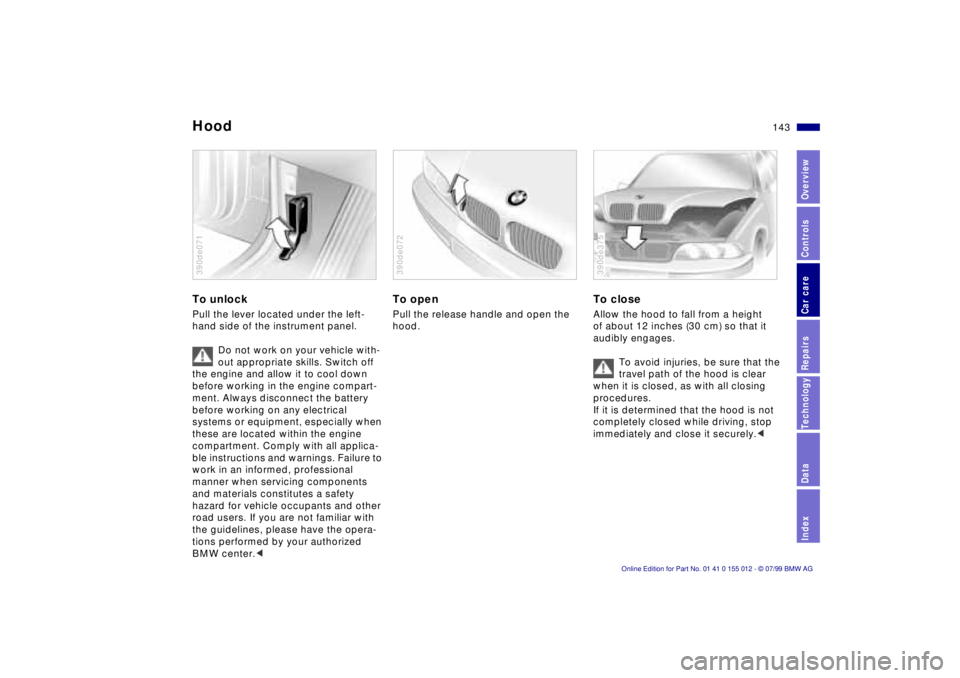
HoodTo unlockPull the lever located under the left-
hand side of the instrument panel.
Do not work on your vehicle with-
out appropriate skills. Switch off
the engine and allow it to cool down
before working in the engine compart-
ment. Always disconnect the battery
before working on any electrical
systems or equipment, especially when
these are located within the engine
compartment. Comply with all applica-
ble instructions and warnings. Failure to
work in an informed, professional
manner when servicing components
and materials constitutes a safety
hazard for vehicle occupants and other
road users. If you are not familiar with
the guidelines, please have the opera-
tions performed by your authorized
BMW center.<390de071
To openPull the release handle and open the
hood.390de072
To closeAllow the hood to fall from a height
of about 12 inches (30 cm) so that it
audibly engages.
To avoid injuries, be sure that the
travel path of the hood is clear
when it is closed, as with all closing
procedures.
If it is determined that the hood is not
completely closed while driving, stop
immediately and close it securely.< 390de375
Page 144 of 217
144n
390de620
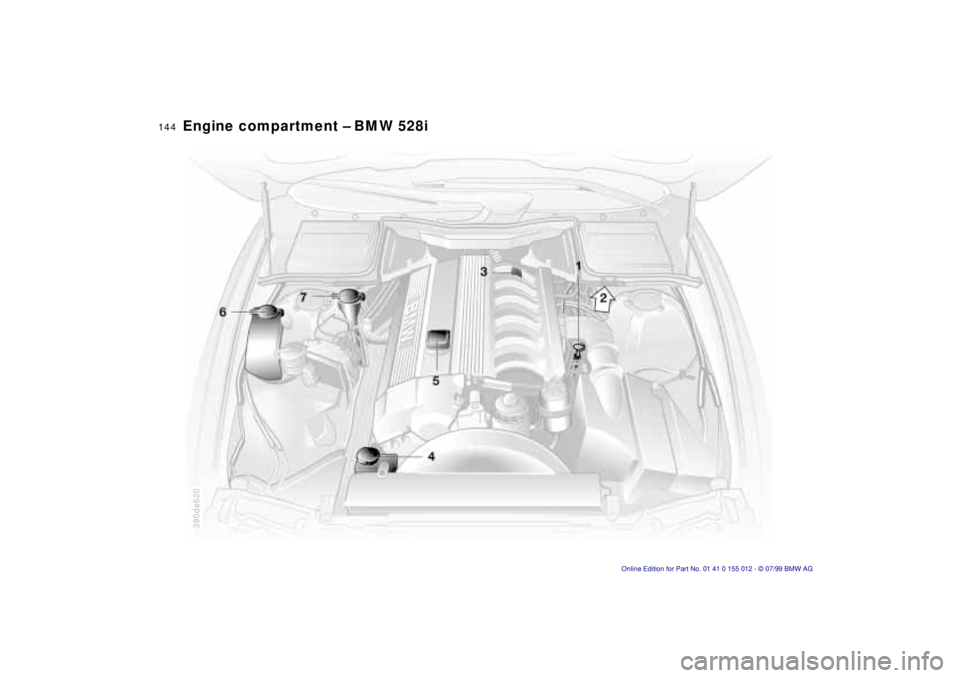
Engine compartment Ð BMW 528i
Page 145 of 217

145n
RepairsIndexOverview Controls Car care Technology Data
Engine compartment Ð BMW 528i1 Engine oil dipstick149
2 Reservoir for brake fluid (under the
housing of the microfilter)152
3 Auxiliary terminal for jump
starting182
4 Coolant expansion tank151
5 Engine oil filler neck149
6 Reservoir for intensive-cleaning
system
*
148
7 Reservoir for headlamp washer
* and
windshield washer system148
Page 146 of 217
146n
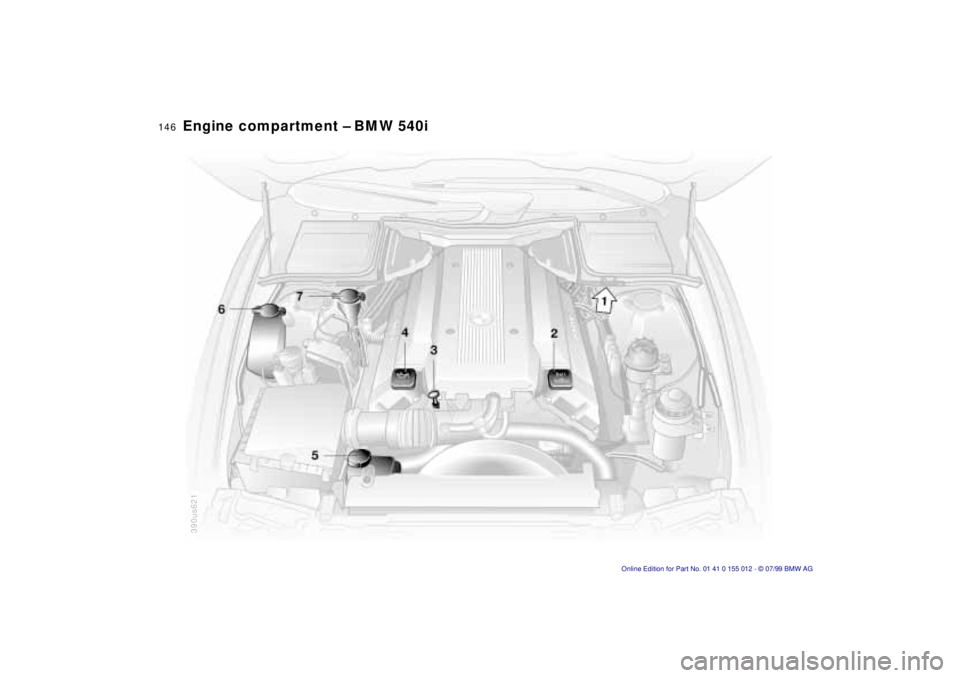
Engine compartment Ð BMW 540i
390us621
Page 147 of 217

147n
RepairsIndexOverview Controls Car care Technology Data
Engine compartment Ð BMW 540i1 Reservoir for brake fluid (under the
housing of the microfilter)152
2 Auxiliary terminal for jump
starting182
3 Engine oil dipstick149
4 Engine oil filler neck149
5 Coolant expansion tank151
6 Reservoir for intensive-cleaning
system
*
148
7 Reservoir for headlamp washer
* and
windshield washer system148
Page 149 of 217
149n
RepairsIndexOverview Controls Car care Technology Data
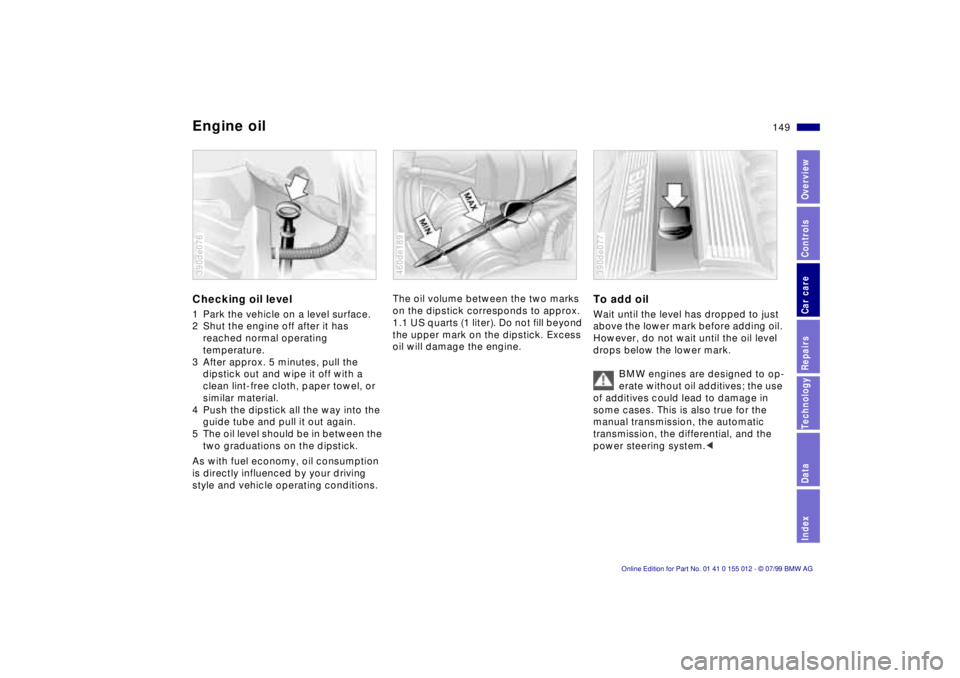
Engine oilChecking oil level1 Park the vehicle on a level surface.
2 Shut the engine off after it has
reached normal operating
temperature.
3 After approx. 5 minutes, pull the
dipstick out and wipe it off with a
clean lint-free cloth, paper towel, or
similar material.
4 Push the dipstick all the way into the
guide tube and pull it out again.
5 The oil level should be in between the
two graduations on the dipstick.
As with fuel economy, oil consumption
is directly influenced by your driving
style and vehicle operating conditions.390de076
The oil volume between the two marks
on the dipstick corresponds to approx.
1.1 US quarts (1 liter). Do not fill beyond
the upper mark on the dipstick. Excess
oil will damage the engine.460de189
To add oilWait until the level has dropped to just
above the lower mark before adding oil.
However, do not wait until the oil level
drops below the lower mark.
BMW engines are designed to op-
erate without oil additives; the use
of additives could lead to damage in
some cases. This is also true for the
manual transmission, the automatic
transmission, the differential, and the
power steering system.< 390de077
Page 150 of 217
150n
Engine oilSpecified engine oils The quality of the engine oil selected
has critical significance for the opera-
tion and service life of an engine. Based
on extensive testing, BMW has ap-
proved only certain engine oils.
Use only approved "BMW High Perfor-
mance Synthetic Oil."
If you are unable to obtain "BMW High
Performance Synthetic Oil," you may
use small amounts of synthetic oil in
between oil changes. Only use oils with
the specification API SH or higher.
Ask your authorized BMW center
for details concerning the specific
"BMW High Performance Synthetic Oil"
or "synthetic oils" which have been ap-
proved.<
You can also call BMW of North
America at 1-800-831-1117 or visit
this website: www.bmwusa.com to
obtain this information.
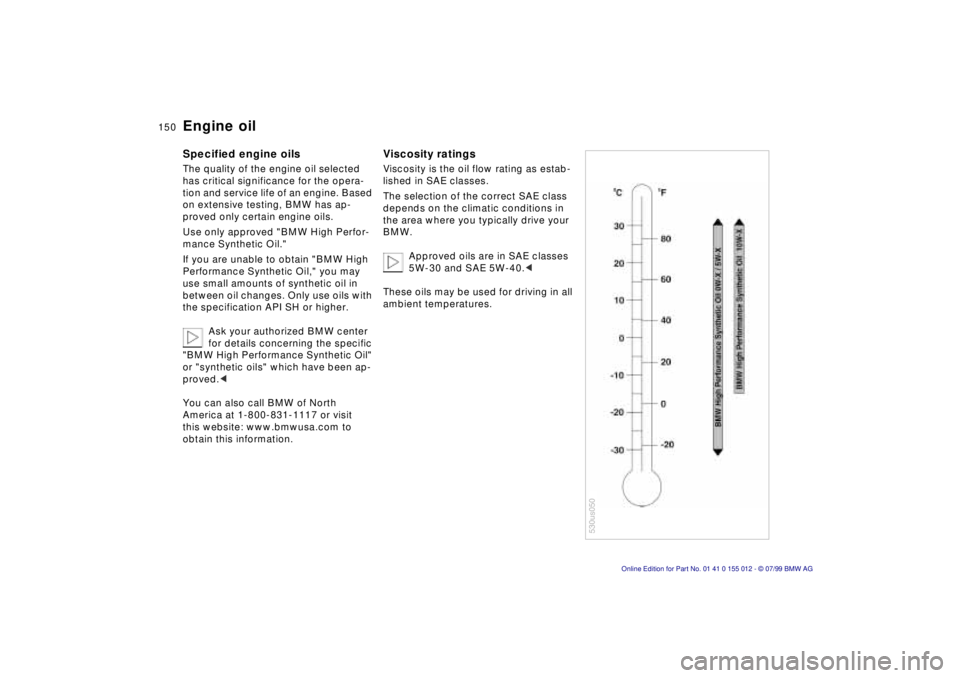
Viscosity ratingsViscosity is the oil flow rating as estab-
lished in SAE classes.
The selection of the correct SAE class
depends on the climatic conditions in
the area where you typically drive your
BMW.
Approved oils are in SAE classes
5W-30 and SAE 5W-40.<
These oils may be used for driving in all
ambient temperatures.
530us050
Page 151 of 217
151n
RepairsIndexOverview Controls Car care Technology Data
Engine oil Coolant
Comply with the applicable envi-
ronmental laws regulating the dis-
posal of used oil.<
Recommendation: Have the oil
changed by your BMW center.
Continuous exposure to used oil
has caused cancer in laboratory
testing. For this reason, any skin areas
that come into contact with oil should
be thoroughly washed with soap and
water.
Always store oil, grease, etc., out of
reach of children. Comply with all warn-
ing labels and information on lubricant
containers.<
Do not add coolant to the cooling
system when the engine is hot. If
you attempt to do so, escaping coolant
can cause burns.
To avoid the possibility of damage later
on, never use anything other than fac-
tory-approved, nitrite and amino-free
extended-duty antifreeze with corrosion
inhibitor. Your authorized BMW center
is familiar with the official specifica-
tions.
Antifreeze and anticorrosion agents are
hazardous to health. You should always
store them in their original container
and in a location which is inaccessible
to children.
Extended-duty antifreeze with corrosion
inhibitor contains the flammable sub-
stance ethylene glycol. For this reason,
do not spill antifreeze with corrosion in-
hibitor on hot engine parts. It could
catch fire and cause serious burns.<
Comply with the applicable envi-
ronmental laws regulating the dis-
posal of extended-duty antifreeze with
corrosion inhibitor.<
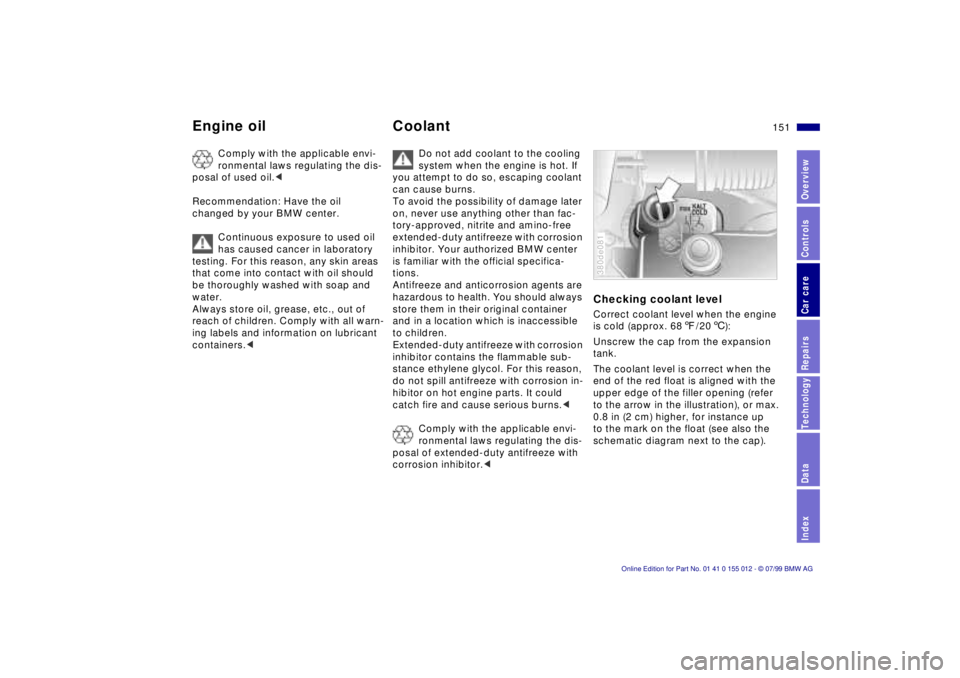
Checking coolant levelCorrect coolant level when the engine
is cold (approx. 687/206):
Unscrew the cap from the expansion
tank.
The coolant level is correct when the
end of the red float is aligned with the
upper edge of the filler opening (refer
to the arrow in the illustration), or max.
0.8 in (2 cm) higher, for instance up
to the mark on the float (see also the
schematic diagram next to the cap).380de081
Page 152 of 217

152n
Coolant Brake fluidAdding coolantWait until the engine cools before re-
moving the cap from the expansion
tank. The needle of the coolant gauge
in the instrument cluster must be lo-
cated in the blue zone; otherwise, there
is a danger of scalding.
1 Start by turning the cap counter-
clockwise. Pause to allow any
accumulated pressure to escape,
then open.
2 If the coolant is low, slowly add
coolant until the correct level is
reached Ð do not overfill.
The coolant is a mixture of water and
extended-duty antifreeze with corrosion
inhibitor. Always maintain the pre-
scribed all-season 50:50 mixture ratio
for year-round protection against inter-
nal corrosion. No other additives are re-
quired.
Replace the coolant every four years.If the indicator lamp for the
brake hydraulic system appears
or if the "CHECK BRAKE FLUID"
warning appears in the Check
Control: The brake fluid level is
too low in the reservoir.
The brake fluid reservoir is located
under the microfilter housing on the
driver's side of the car. Should you de-
termine that the brake fluid is low, refer
the problem to your BMW center, who
can trace and rectify any sources of
leakage when refilling the reservoir.
Your BMW center is familiar with the
specifications for approved brake fluids
(DOT 4).
Brake fluid loss results in extended
pedal travel. For this situation, refer to
the notes on page 130.
Brake fluid is hygroscopic, that is,
it absorbs moisture from the air
over time.
In order to ensure the safety and
reliability of the brake system, have the
brake fluid changed every two years by
an authorized BMW center. Refer also
to the Service and Warranty Information
Booklet (US models) or to the Warranty
and Service Guide Booklet (Canadian
models).
Brake fluid is toxic and damages the
vehicle's paint. You should always store
it in its original container and in a loca-
tion which is out of reach of children.
Do not spill the fluid and do not fill the
brake fluid reservoir beyond the "MAX"
mark. The brake fluid could ignite upon
contact with hot engine parts and cause
serious burns.<
Comply with the applicable
environmental laws regulating the
disposal of brake fluid.<