engine BMW 540I SEDAN 2000 Workshop Manual
[x] Cancel search | Manufacturer: BMW, Model Year: 2000, Model line: 540I SEDAN, Model: BMW 540I SEDAN 2000Pages: 217, PDF Size: 1.69 MB
Page 153 of 217
153n
RepairsIndexOverview Controls Car care Technology Data
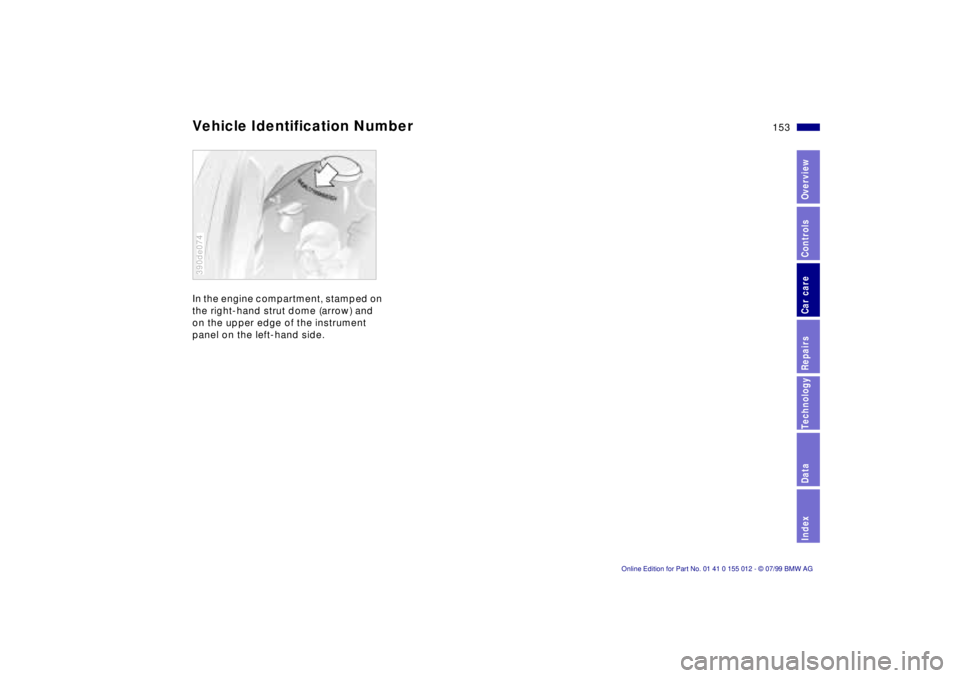
Vehicle Identification Number In the engine compartment, stamped on
the right-hand strut dome (arrow) and
on the upper edge of the instrument
panel on the left-hand side.390de074
Page 154 of 217
154n
The BMW Maintenance System has
been designed as a reliable means of
providing maximum driving and operat-
ing safety Ð and as cost-effectively as
possible for you.
Please keep in mind that regular main-
tenance is not only necessary for the
safety of your vehicle, but also plays a
significant role in maintaining the resale
value of the vehicle.
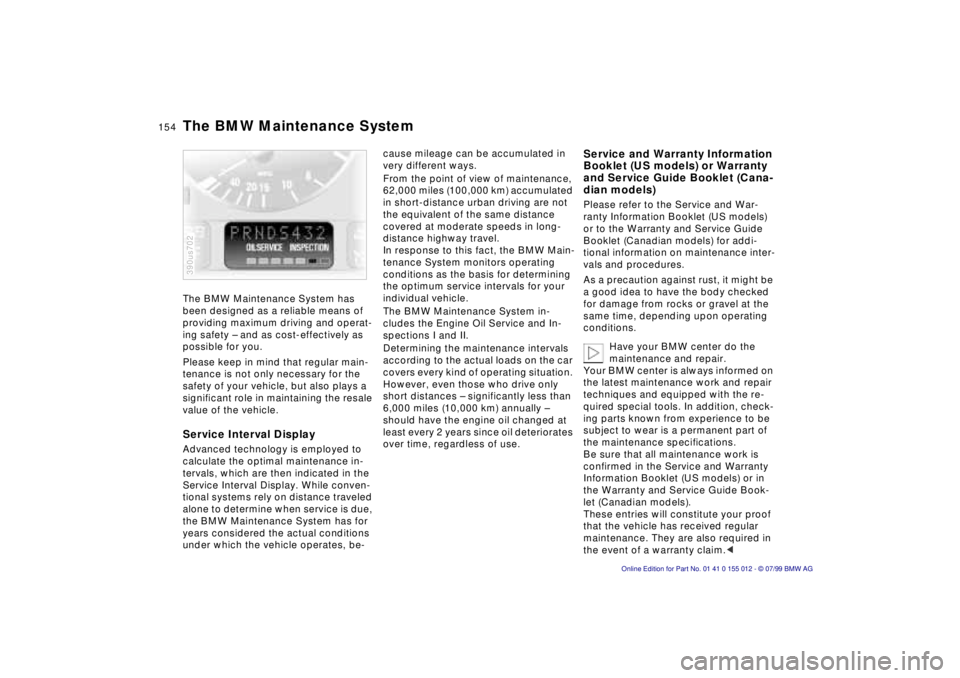
Service Interval DisplayAdvanced technology is employed to
calculate the optimal maintenance in-
tervals, which are then indicated in the
Service Interval Display. While conven-
tional systems rely on distance traveled
alone to determine when service is due,
the BMW Maintenance System has for
years considered the actual conditions
under which the vehicle operates, be-390us702
cause mileage can be accumulated in
very different ways.
From the point of view of maintenance,
62,000 miles (100,000 km) accumulated
in short-distance urban driving are not
the equivalent of the same distance
covered at moderate speeds in long-
distance highway travel.
In response to this fact, the BMW Main-
tenance System monitors operating
conditions as the basis for determining
the optimum service intervals for your
individual vehicle.
The BMW Maintenance System in-
cludes the Engine Oil Service and In-
spections I and II.
Determining the maintenance intervals
according to the actual loads on the car
covers every kind of operating situation.
However, even those who drive only
short distances Ð significantly less than
6,000 miles (10,000 km) annually Ð
should have the engine oil changed at
least every 2 years since oil deteriorates
over time, regardless of use.
Service and Warranty Information
Booklet (US models) or Warranty
and Service Guide Booklet (Cana-
dian models)Please refer to the Service and War-
ranty Information Booklet (US models)
or to the Warranty and Service Guide
Booklet (Canadian models) for addi-
tional information on maintenance inter-
vals and procedures.
As a precaution against rust, it might be
a good idea to have the body checked
for damage from rocks or gravel at the
same time, depending upon operating
conditions.
Have your BMW center do the
maintenance and repair.
Your BMW center is always informed on
the latest maintenance work and repair
techniques and equipped with the re-
quired special tools. In addition, check-
ing parts known from experience to be
subject to wear is a permanent part of
the maintenance specifications.
Be sure that all maintenance work is
confirmed in the Service and Warranty
Information Booklet (US models) or in
the Warranty and Service Guide Book-
let (Canadian models).
These entries will constitute your proof
that the vehicle has received regular
maintenance. They are also required in
the event of a warranty claim.<
The BMW Maintenance System
Page 161 of 217

161n
RepairsIndexOverview Controls Car care Technology Data
Any authorized BMW center will be glad
to inform you of the advisability, legal
requirements and factory recommenda-
tions with regard to technical modifica-
tions on the car. For this purpose, the
center requires the Vehicle Identifica-
tion Number and, in some cases, also
the engine number.
Light-Emitting Diodes (LEDs)Light-emitting diodes installed behind
translucent lenses serve as the light
source for many of the controls and dis-
plays in your vehicle. The concept be-
hind their operation is related to that
employed for lasers, and they are offi-
cially designated as Class 1 light-emit-
ting diodes.
Do not remove the protective lens
and avoid staring directly at the
unfiltered beam for extended periods
(several hours), as inflammation of the
iris could result.<
Technical modifications
Page 162 of 217
162n
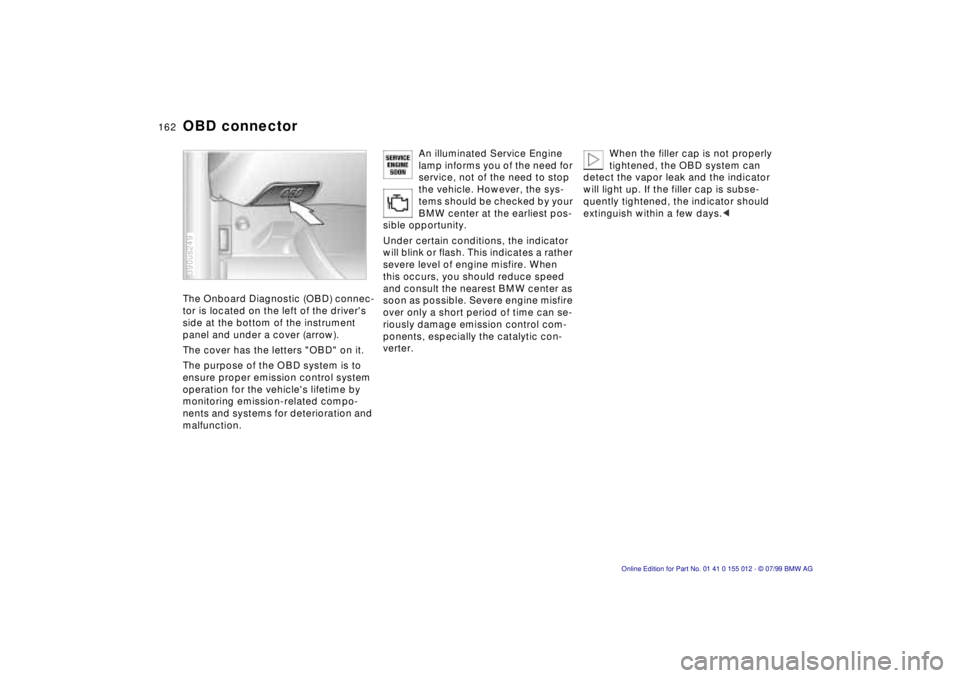
OBD connectorThe Onboard Diagnostic (OBD) connec-
tor is located on the left of the driver's
side at the bottom of the instrument
panel and under a cover (arrow).
The cover has the letters "OBD" on it.
The purpose of the OBD system is to
ensure proper emission control system
operation for the vehicle's lifetime by
monitoring emission-related compo-
nents and systems for deterioration and
malfunction.390us249
An illuminated Service Engine
lamp informs you of the need for
service, not of the need to stop
the vehicle. However, the sys-
tems should be checked by your
BMW center at the earliest pos-
sible opportunity.
Under certain conditions, the indicator
will blink or flash. This indicates a rather
severe level of engine misfire. When
this occurs, you should reduce speed
and consult the nearest BMW center as
soon as possible. Severe engine misfire
over only a short period of time can se-
riously damage emission control com-
ponents, especially the catalytic con-
verter.
When the filler cap is not properly
tightened, the OBD system can
detect the vapor leak and the indicator
will light up. If the filler cap is subse-
quently tightened, the indicator should
extinguish within a few days.<
Page 167 of 217
167n
RepairsIndexOverview Controls Car care Technology Data
Lamps and bulbsThe lamps and bulbs make essential
contributions to the safety of your vehi-
cle. For this reason, follow the instruc-
tions below carefully when replacing a
bulb. If you are not familiar with any of
the procedures, consult your authorized
BMW center.
Do not touch the glass portion of a
new bulb with your bare hands
since even small amounts of impurities
burn into the surface and reduce the
service life of the bulb. Use a clean
cloth, paper napkin, or a similar mate-
rial, or hold the bulb by its metallic
base.<
A replacement bulb set is available from
your BMW center.
Whenever working on the electri-
cal system, switch off the electri-
cal accessory you are working on or
disconnect the cable from the negative
terminal of the battery. Failure to do this
could result in short circuits.
To prevent injuries and damage, comply
with any instructions provided by the
bulb manufacturer.<
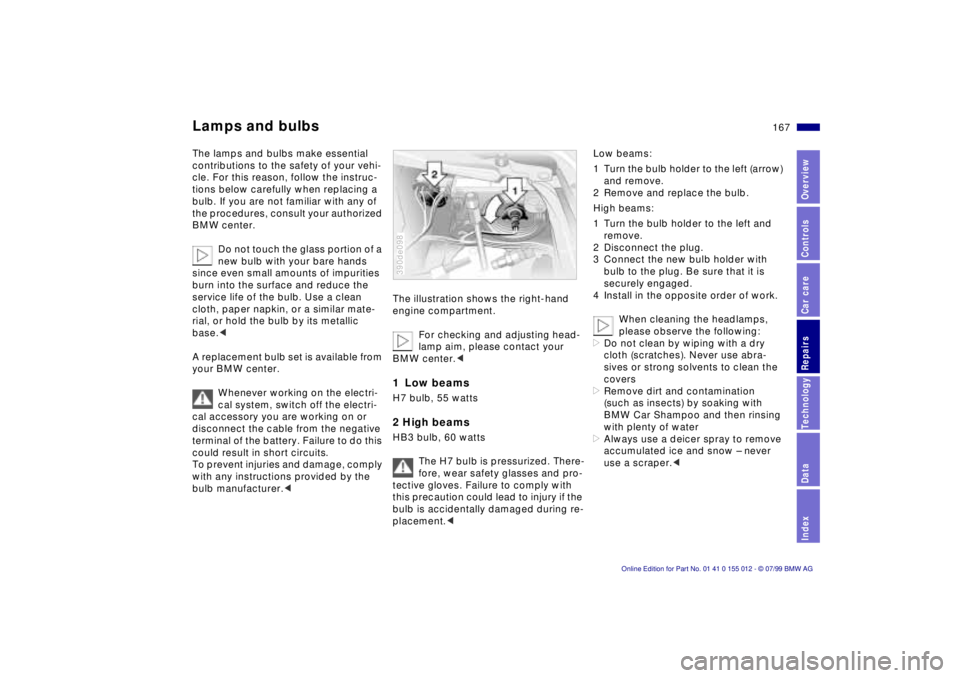
The illustration shows the right-hand
engine compartment.
For checking and adjusting head-
lamp aim, please contact your
BMW center.< 1 Low beams H7 bulb, 55 watts 2 High beamsHB3 bulb, 60 watts
The H7 bulb is pressurized. There-
fore, wear safety glasses and pro-
tective gloves. Failure to comply with
this precaution could lead to injury if the
bulb is accidentally damaged during re-
placement.< 390de098
Low beams:
1 Turn the bulb holder to the left (arrow)
and remove.
2 Remove and replace the bulb.
High beams:
1 Turn the bulb holder to the left and
remove.
2 Disconnect the plug.
3 Connect the new bulb holder with
bulb to the plug. Be sure that it is
securely engaged.
4 Install in the opposite order of work.
When cleaning the headlamps,
please observe the following:
>Do not clean by wiping with a dry
cloth (scratches). Never use abra-
sives or strong solvents to clean the
covers
>Remove dirt and contamination
(such as insects) by soaking with
BMW Car Shampoo and then rinsing
with plenty of water
>Always use a deicer spray to remove
accumulated ice and snow Ð never
use a scraper.<
Page 173 of 217
173n
RepairsIndexOverview Controls Car care Technology Data
Changing tires
Safety measures in the event of a
flat tire or wheel change:
Stop the vehicle as far as possible from
passing traffic. Park on a firm, flat,
surface. Switch on the hazard flashers.
Turn the steering wheel to the straight-
ahead position, remove the key and
engage the steering lock. Shift into 1st
or reverse (selector lever in Park with
automatic transmission) and engage the
parking brake. All passengers should
be outside the car and well away from
your immediate working area (behind a
guardrail, for instance).
If a warning triangle or portable hazard
warning lamp is available, set it up on
the roadside at an appropriate distance
from the rear of the vehicle. Comply
with all safety guidelines and regula-
tions.
Change the wheel only on a level, firm
surface which is not slippery. Avoid
jacking the car on a soft or slippery sup-
port surface (snow, ice, loose gravel,
etc.), since it could slide sideways.
Position the jack on a firm support
surface.
Do not place wooden blocks or similar
objects under the jack. If this is done,
the jack might not be able to reach its
full support capacity because of the
limited height.
Do not lie under the vehicle or start the
engine when the vehicle is supported
by the jack Ð risk of fatal injury.<
What you will needIn order to avoid rattling noises later,
note the position of the tools when you
remove them and return them to their
original position when you are through
using them.
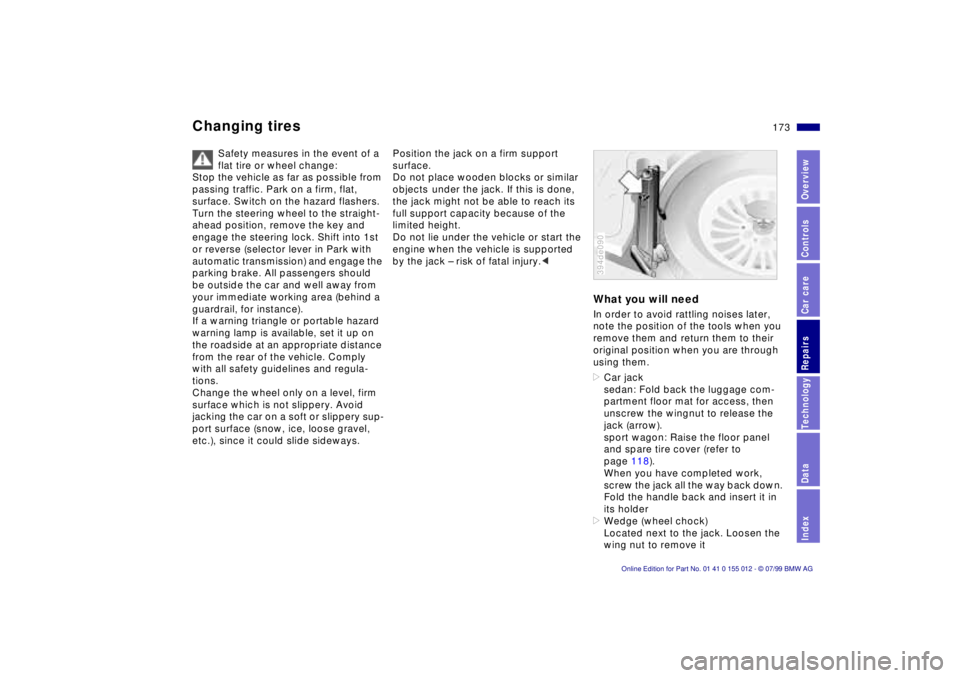
>Car jack
sedan: Fold back the luggage com-
partment floor mat for access, then
unscrew the wingnut to release the
jack (arrow).
sport wagon: Raise the floor panel
and spare tire cover (refer to
page 118).
When you have completed work,
screw the jack all the way back down.
Fold the handle back and insert it in
its holder
>Wedge (wheel chock)
Located next to the jack. Loosen the
wing nut to remove it394de090
Page 177 of 217
177n
RepairsIndexOverview Controls Car care Technology Data
Battery
A highly-explosive gas is
generated when the battery is
charged.
If you happen to get acid in your
eyes, rinse thoroughly for
15 minutes with clear water.
Following that, consult a physician
immediately. If you get acid spray on
your skin or clothing, rinse with plenty
of water. If electrolyte is accidentally
swallowed, consult a physician immedi-
ately.
In order to protect the battery
case from ultraviolet radiation,
do not place it in direct sunlight.
A discharged battery can freeze. Store
the battery in areas where temperature
remains above freezing.
MaintenanceThe battery is absolutely maintenance-
free, that is, the original electrolyte will
normally last for the service life of the
battery under moderate climatic condi-
tions.
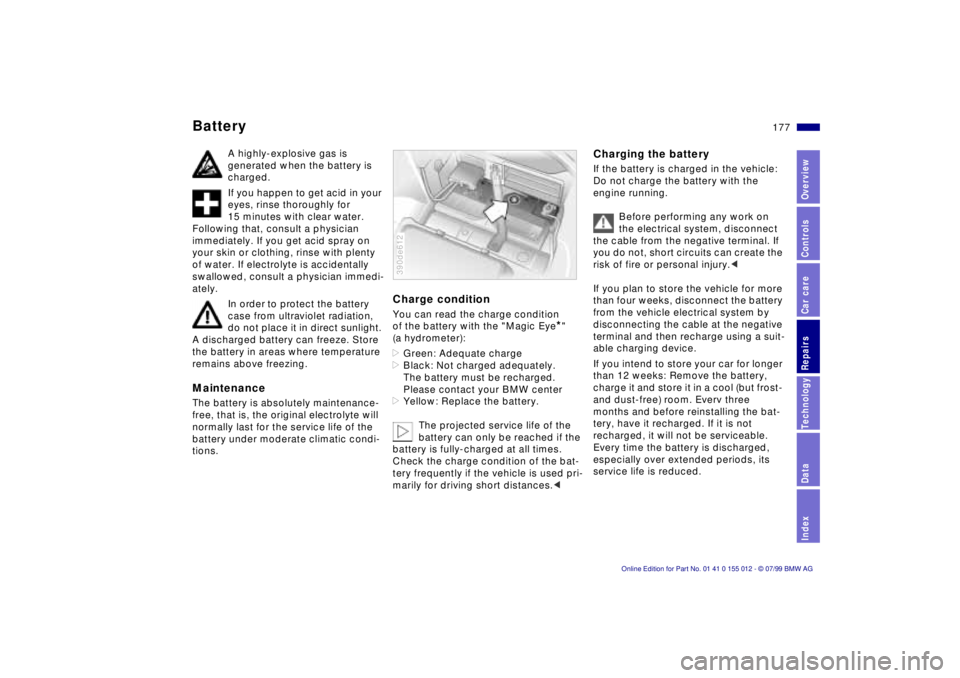
Charge conditionYou can read the charge condition
of the battery with the "Magic Eye
*"
(a hydrometer):
>Green: Adequate charge
>Black: Not charged adequately.
The battery must be recharged.
Please contact your BMW center
>Yellow: Replace the battery.
The projected service life of the
battery can only be reached if the
battery is fully-charged at all times.
Check the charge condition of the bat-
tery frequently if the vehicle is used pri-
marily for driving short distances.<
390de612
Charging the batteryIf the battery is charged in the vehicle:
Do not charge the battery with the
engine running.
Before performing any work on
the electrical system, disconnect
the cable from the negative terminal. If
you do not, short circuits can create the
risk of fire or personal injury.<
If you plan to store the vehicle for more
than four weeks, disconnect the battery
from the vehicle electrical system by
disconnecting the cable at the negative
terminal and then recharge using a suit-
able charging device.
If you intend to store your car for longer
than 12 weeks: Remove the battery,
charge it and store it in a cool (but frost-
and dust-free) room. Everv three
months and before reinstalling the bat-
tery, have it recharged. If it is not
recharged, it will not be serviceable.
Every time the battery is discharged,
especially over extended periods, its
service life is reduced.
Page 178 of 217
178n
Battery Fuses Removal and installation
Do not disconnect the battery
when the engine is running. Dis-
connecting the battery cable when the
engine is running will cause a voltage
surge which will damage the vehicle's
onboard electronics.
Do not make any modifications in the
wires to the positive terminal. If you do
so, the protective function of the safety
battery terminal is no longer ensured.
Repairs and disposal may only be
performed by specially-trained person-
nel.<
390de611
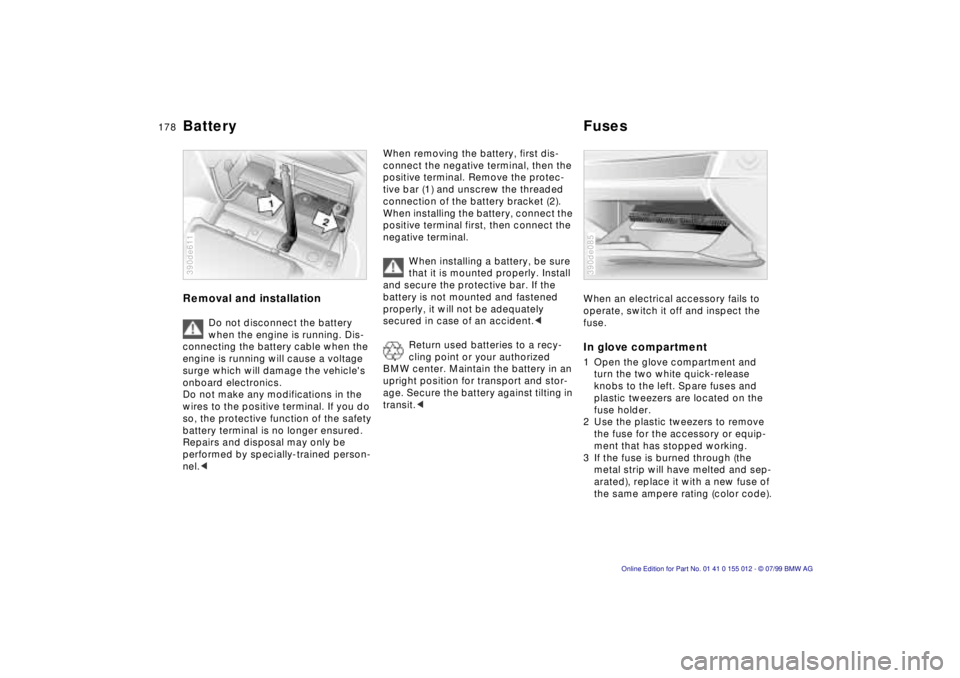
When removing the battery, first dis-
connect the negative terminal, then the
positive terminal. Remove the protec-
tive bar (1) and unscrew the threaded
connection of the battery bracket (2).
When installing the battery, connect the
positive terminal first, then connect the
negative terminal.
When installing a battery, be sure
that it is mounted properly. Install
and secure the protective bar. If the
battery is not mounted and fastened
properly, it will not be adequately
secured in case of an accident.<
Return used batteries to a recy-
cling point or your authorized
BMW center. Maintain the battery in an
upright position for transport and stor-
age. Secure the battery against tilting in
transit.<
When an electrical accessory fails to
operate, switch it off and inspect the
fuse.In glove compartment1 Open the glove compartment and
turn the two white quick-release
knobs to the left. Spare fuses and
plastic tweezers are located on the
fuse holder.
2 Use the plastic tweezers to remove
the fuse for the accessory or equip-
ment that has stopped working.
3 If the fuse is burned through (the
metal strip will have melted and sep-
arated), replace it with a new fuse of
the same ampere rating (color code).390de085
Page 182 of 217
182n
Never use spray starter fluids.
If the battery is discharged, the engine
can be started with the use of two
jumper cables and the battery of an-
other vehicle. Always use jumper ca-
bles with fully insulated handles on the
terminal clamps.
Do not touch high-voltage wiring
and cables on a running engine.
There is a risk of fatal injury if you do
this.<
Carefully comply with the following in-
structions to avoid personal injury and
damage to one or both vehicles:
1 Ensure that the battery on the sup-
port vehicle is also rated at 12 volts,
and that the capacities of the two
batteries (Ah) are roughly comparable
(printed on casing).
2 Leave your battery connected to the
car electrical system.
3 Make sure that there is no contact
between the bodywork of the two ve-
hicles Ð short circuit risk.
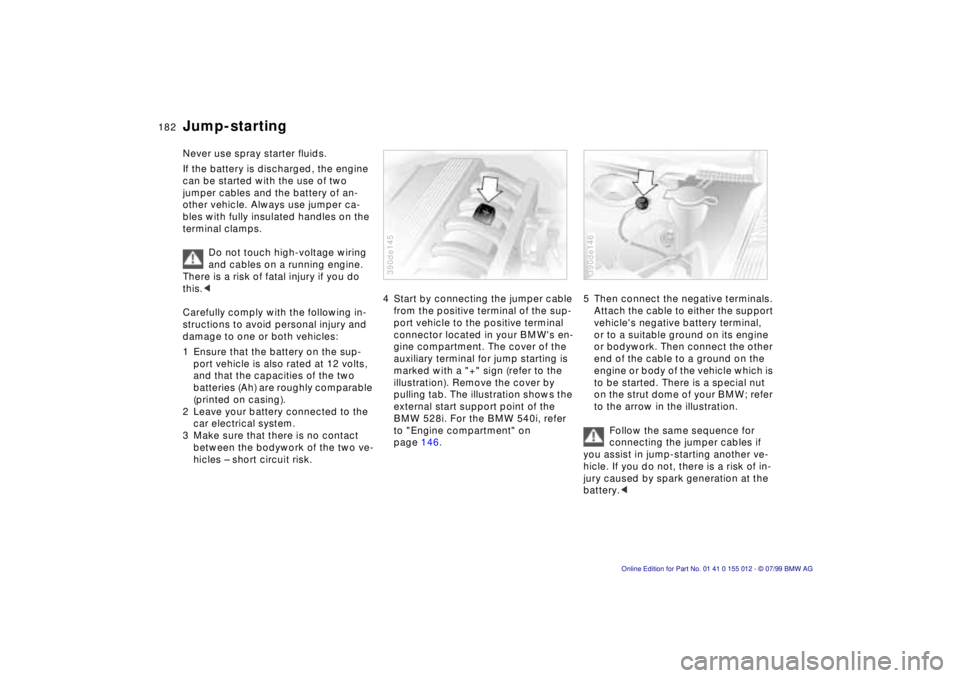
4 Start by connecting the jumper cable
from the positive terminal of the sup-
port vehicle to the positive terminal
connector located in your BMW's en-
gine compartment. The cover of the
auxiliary terminal for jump starting is
marked with a "+" sign (refer to the
illustration). Remove the cover by
pulling tab. The illustration shows the
external start support point of the
BMW 528i. For the BMW 540i, refer
to "Engine compartment" on
page 146.390de145
5 Then connect the negative terminals.
Attach the cable to either the support
vehicle's negative battery terminal,
or to a suitable ground on its engine
or bodywork. Then connect the other
end of the cable to a ground on the
engine or body of the vehicle which is
to be started. There is a special nut
on the strut dome of your BMW; refer
to the arrow in the illustration.
Follow the same sequence for
connecting the jumper cables if
you assist in jump-starting another ve-
hicle. If you do not, there is a risk of in-
jury caused by spark generation at the
battery.< 390de146
Jump-starting
Page 183 of 217
183n
RepairsIndexOverview Controls Car care Technology Data
Jump-starting Towing the vehicle 6 Start the engine of the support
vehicle and let it run.
7 Start the engine on the vehicle need-
ing the jump-start, and allow it to run
as usual. If the first start attempt is
not successful, wait a few minutes
before another attempt in order to al-
low the discharged battery to re-
charge.
8 Before disconnecting the jumper ca-
bles from your BMW, turn on the
headlamps, the rear window de-
froster and the highest blower speed
and allow the engine to run at least
10 seconds to prevent a voltage
surge at the voltage regulator.
9 Then disconnect the jumper cables in
the opposite order.
Have the battery recharged if neces-
sary.
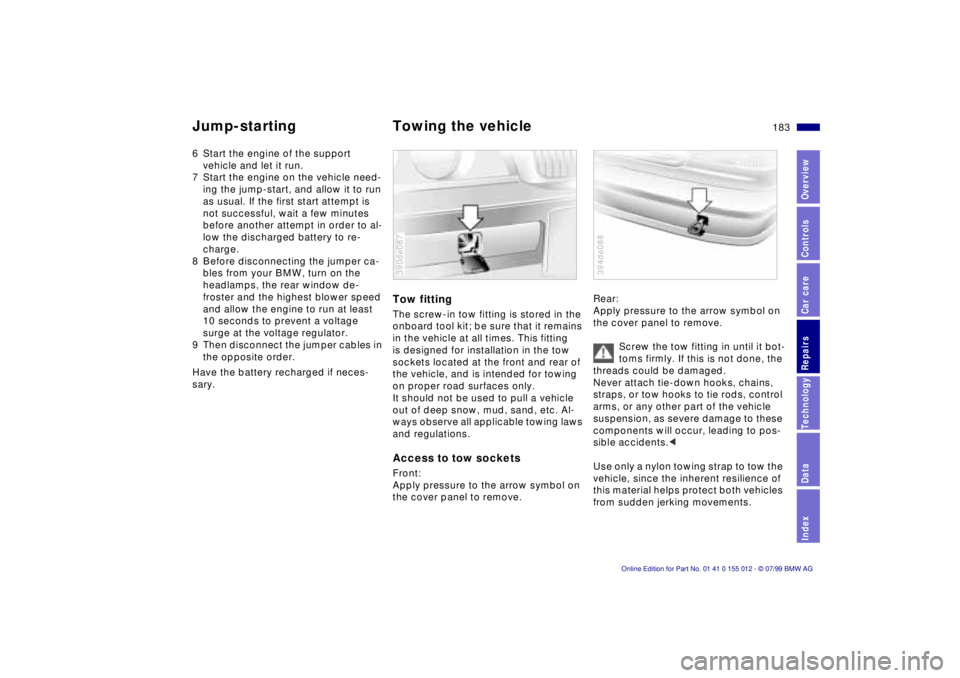
Tow fittingThe screw-in tow fitting is stored in the
onboard tool kit; be sure that it remains
in the vehicle at all times. This fitting
is designed for installation in the tow
sockets located at the front and rear of
the vehicle, and is intended for towing
on proper road surfaces only.
It should not be used to pull a vehicle
out of deep snow, mud, sand, etc. Al-
ways observe all applicable towing laws
and regulations.Access to tow socketsFront:
Apply pressure to the arrow symbol on
the cover panel to remove.390de087
Rear:
Apply pressure to the arrow symbol on
the cover panel to remove.
Screw the tow fitting in until it bot-
toms firmly. If this is not done, the
threads could be damaged.
Never attach tie-down hooks, chains,
straps, or tow hooks to tie rods, control
arms, or any other part of the vehicle
suspension, as severe damage to these
components will occur, leading to pos-
sible accidents.<
Use only a nylon towing strap to tow the
vehicle, since the inherent resilience of
this material helps protect both vehicles
from sudden jerking movements.394de088