automatic transmission BMW 6 SERIES 2009 User Guide
[x] Cancel search | Manufacturer: BMW, Model Year: 2009, Model line: 6 SERIES, Model: BMW 6 SERIES 2009Pages: 272, PDF Size: 9.16 MB
Page 75 of 272
Controls
73Reference
At a glance
Driving tips
Communications
Navigation
Entertainment
Mobility
If the sensor is not aligned properly, e. g. due to
damage, the active cruise control cannot be
activated.
System limitations
As with conventional cruise control sys-
tems, active cruise control in no way
diminishes or substitutes for the driver's own
personal responsibility, alertness and aware-
ness in adjusting speed, braking or otherwise
controlling the vehicle. The driver should
decide when to use the system on the basis of
road, traffic, visibility, and weather conditions.
Active cruise control is intended for use on free-
way-type roadways where traffic is moving rel-
atively smoothly. Do not use this system in city
driving; in complex driving situations; on curvy,
winding roads, slippery roads or roads with
sharp curves such as highway off-ramps; during
inclement weather such as snow, strong rain or
fog; or when entering interchanges, service/
parking areas or toll booths. It is also important
to regulate your vehicle’s speed and distance
setting within applicable legal limits. Always be
ready to take action or apply the brakes if nec-
essary, especially when the system is actively
following a vehicle in front of you.<
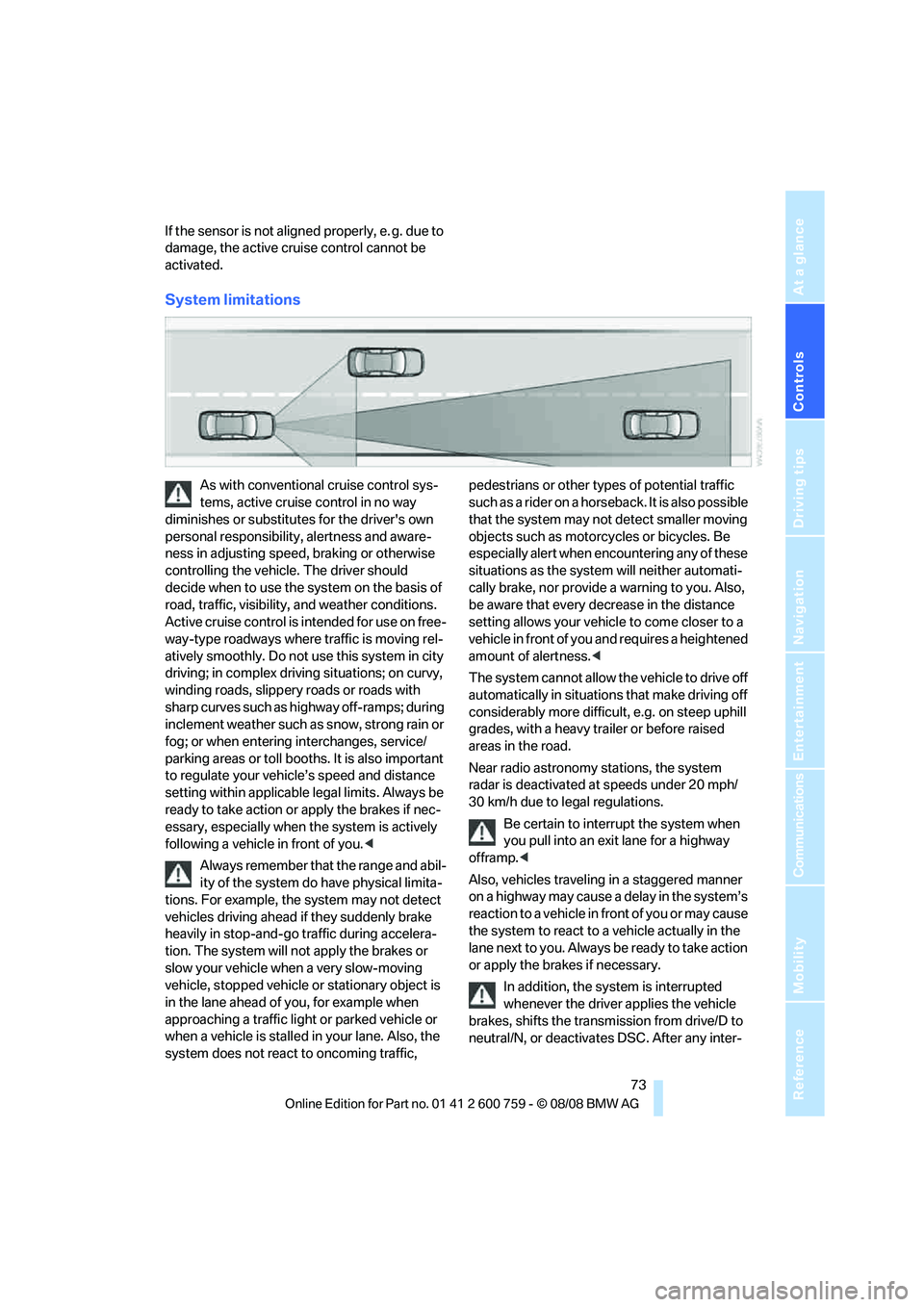
Always remember that the range and abil-
ity of the system do have physical limita-
tions. For example, the system may not detect
vehicles driving ahead if they suddenly brake
heavily in stop-and-go traffic during accelera-
tion. The system will not apply the brakes or
slow your vehicle when a very slow-moving
vehicle, stopped vehicle or stationary object is
in the lane ahead of you, for example when
approaching a traffic light or parked vehicle or
when a vehicle is stalled in your lane. Also, the
system does not react to oncoming traffic, pedestrians or other types of potential traffic
s u c h a s a r i d e r o n a h o r s e b a c k . I t i s a l s o p o s s i b l e
that the system may not detect smaller moving
objects such as motorcycles or bicycles. Be
especially alert when encountering any of these
situations as the system will neither automati-
cally brake, nor provide a warning to you. Also,
be aware that every decrease in the distance
setting allows your vehicle to come closer to a
vehicle in front of you and requires a heightened
amount of alertness.<
The system cannot allow the vehicle to drive off
automatically in situations that make driving off
considerably more difficult, e.g. on steep uphill
grades, with a heavy trailer or before raised
areas in the road.
Near radio astronomy stations, the system
radar is deactivated at speeds under 20 mph/
30 km/h due to legal regulations.
Be certain to interrupt the system when
you pull into an exit lane for a highway
offramp.<
Also, vehicles traveling in a staggered manner
on a highway may cause a delay in the system’s
reaction to a vehicle in front of you or may cause
the system to react to a vehicle actually in the
lane next to you. Always be ready to take action
or apply the brakes if necessary.
In addition, the system is interrupted
whenever the driver applies the vehicle
brakes, shifts the transmission from drive/D to
neutral/N, or deactivates DSC. After any inter-
Page 130 of 272
Things to remember when driving
128 the road surface, ultimately undermining your
ability to steer and brake the vehicle.<
The risk of hydroplaning increases as the tread
depth of the tires decreases, refer also to Mini-
mum tire tread on page217.
Driving through water
Do not drive through water on the road if it
is deeper than 1 ft/30 cm, and then only at
walking speed at the most. Otherwise, the vehi-
cle's engine, the electrical systems and the
transmission may be damaged.<
Using handbrake on inclines
On inclines, do not hold the vehicle in
place for a long time by riding the clutch;
use the handbrake. Otherwise greater clutch
wear will result.<
Braking safely
Your BMW is equipped with ABS as a standard
feature. In situations that require it, it is best to
brake with full force. Since the vehicle maintains
steering responsiveness, you can still avoid
possible obstacles with a minimum of steering
effort.
Pulsation of the brake pedal, combined with
sounds from the hydraulic circuits, indicate that
ABS is in its active mode.
Do not drive with your foot resting on the
brake pedal. Even light but consistent
pedal pressure can lead to high temperatures,
brake wear and possibly even brake failure.<
Driving in wet conditions
When roads are wet or there is heavy rain,
briefly exert gentle pressure on the brake pedal
every few miles. Monitor traffic conditions to
ensure that this maneuver does not endanger
other road users. The heat generated in this
process helps dry the pads and rotors to ensure
that full braking efficiency will then be available
when you need it.
Hills
To prevent overheating and thus reduced
efficiency of the brake system, downshift to a gear in which only minimal brake applica-
tions are needed when descending long or
steep downhill stretches. Even light but consis-
tent pressure on the brake can lead to high tem-
peratures, brake wear and possibly even brake
failure.<
The braking effect of the engine can be further
increased by downshifting, if necessary all the
way down into first gear. This strategy helps
you avoid placing excessive loads on the brake
system. For information on downshifting in the
manual mode of the sport automatic transmis-
sion, refer to page63.
Do not drive with the clutch depressed, in
idle or with the engine switched off, other-
wise there will be no engine braking action or
support of the braking force and steering.
Never allow floor mats, carpets or any other
objects to protrude into the area of movement
of the pedals and impair their operation.<
Corrosion on brake rotors
When the vehicle is driven only occasionally,
during extended periods when the vehicle is not
used at all, and in operating conditions where
brake applications are less frequent, there is an
increased tendency for corrosion to form on
rotors, while contaminants accumulate on the
brake pads. This occurs because the minimum
pressure which must be exerted by the pads
during brake applications to clean the rotors is
not reached.
Should corrosion form on the brake rotors, the
brakes will tend to respond with a pulsating
effect that even extended application will fail to
cure.
When vehicle is parked
Condensation forms in the air conditioner sys-
tem during operation, and then exits under the
vehicle. Traces of condensed water under the
vehicle are therefore normal.
Before driving into a car wash
To prevent the exterior mirrors on this vehicle
from being damaged, always fold them in by
hand before entering an automatic car wash.
Page 131 of 272
Driving tips
129Reference
At a glance
Controls
Communications
Navigation
Entertainment
Mobility
You can find valuable information on this topic
under Care, starting on page227.
Sport automatic transmission
Insert the remote control into the ignition lock.
The engine can be switched off with the trans-
mission in neutral. Also refer to page40.
Cargo loading
To avoid loading the tires beyond their
approved carrying capacity, never over-
load the vehicle. Overloading can lead to over-
heating and increases the rate at which damage
develops inside the tires. The ultimate result
can assume the form of a sudden blow-out.<
Make sure that no fluids leak in the cargo
bay; otherwise the vehicle could be dam-
aged.<
Determining loading limit
1.Locate the following statement on your
vehicle's placard
*:
The combined weight of occupants
and cargo should never exceed
XXX lbs. or YYY kg, as otherwise the vehicle
may be damaged and unstable driving con-
ditions may result.<
2.Determine the combined weight of the
driver and passengers that will be riding in
your vehicle.
3.Subtract the combined weight of the driver
and passengers from XXX lbs. or YYY kg.
4.The resulting figure equals the available
amount of cargo and luggage load capacity.
For example, if the XXX amount equals 800 lbs. and there will be four 150-lb. pas-
sengers in your vehicle, the amount of avail-
able cargo and luggage load capacity is
200 lbs.:
800 lbs. minus 600 lbs. = 200 lbs.
5.Determine the combined weight of luggage
and cargo being loaded on the vehicle. That
weight may not safely exceed the available
cargo and luggage load capacity calculated
in step 4.
6.If your vehicle will be towing a trailer, part of
the load from your trailer will be transferred
to your vehicle. Consult the manual for
transporting a trailer to determine how this
may reduce the available cargo and luggage
load capacity of your vehicle.
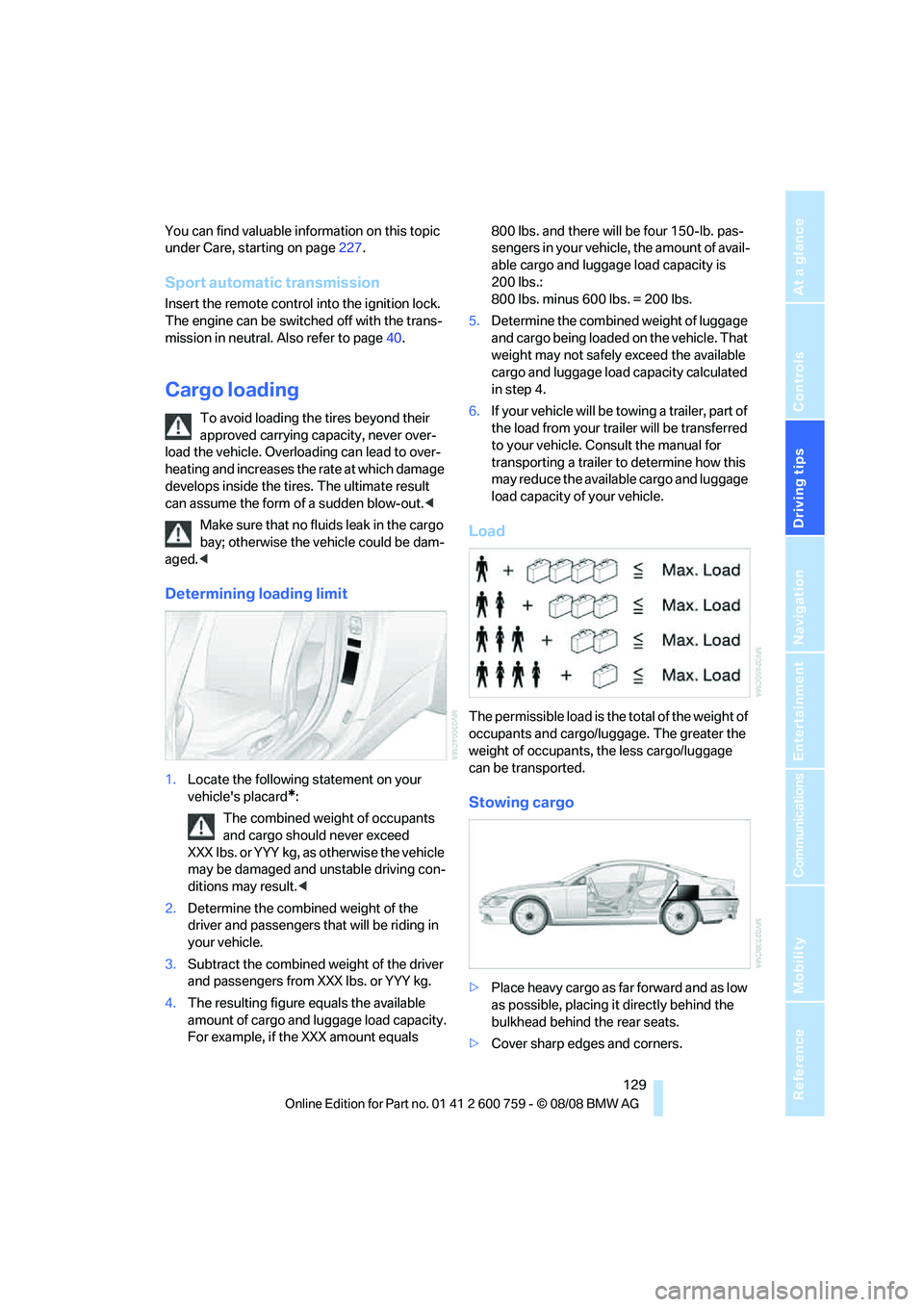
Load
The permissible load is the total of the weight of
occupants and cargo/luggage. The greater the
weight of occupants, the less cargo/luggage
can be transported.
Stowing cargo
>Place heavy cargo as far forward and as low
as possible, placing it directly behind the
bulkhead behind the rear seats.
>Cover sharp edges and corners.
Page 229 of 272
Mobility
227Reference
At a glance
Controls
Driving tips
Communications
Navigation
Entertainment
Care
Car-care products
Regular cleaning and care make a significant
contribution to retaining your BMW's value.
For the cleaning and care of your vehicle, BMW
recommends using only products that BMW
has approved for this purpose.
Your BMW center will be glad to advise you
about products and services for the cleaning
and care of your BMW.
Genuine BMW Care Products are materi-
als tested, laboratory tested, and tested in
actual use. They offer optimum care and pro-
tection for your vehicle.<
Do not use cleaners that contain alcohol
or solvents; they can damage your vehi-
cle.<
Cleaning agents can contain substances
that are dangerous or pose health risks.
You should therefore heed the warnings and
hazard indications on the packaging. Open the
doors or windows on your vehicle whenever
cleaning the interior. Make sure there is suffi-
cient ventilation in enclosed spaces. Use only
products that are formulated for vehicle clean-
ing.<
Exterior care
Washing your vehicle
In the winter months, it is especially
important to ensure that the vehicle is
washed on a regular basis. Otherwise, signifi-
cant soiling and road salt can cause damage to
the vehicle.<
After washing the vehicle, apply the
brakes briefly to dry them. Failure to do so
may lead to a reduction in braking efficiency and
also to corrosion of the brake rotors.<
Car washes
Give preference to cloth car washes.Do not use high-pressure car washes
because they can cause drops of water to
penetrate in the vicinity of the windshield.<
Before driving into the car wash, make sure that
it is suitable for your BMW. Pay attention to the
following points:
>Dimensions of your vehicle, refer to
page243.
>If necessary, fold in the outside rearview
mirrors, refer to page55.
>Maximum permissible tire width.
>The convertible top must not be treated
with wax. Make sure that a program without
wax or a special convertible program is
available.
Preparations for driving into the car wash:
>Deactivate rain sensor to prevent unwanted
wiper activation.
>Remove additional add-on parts, e.g. spoil-
ers or phone antennas, if they could be
damaged.
Automatic transmission
Before driving into the car wash, make sure the
vehicle is able to roll by making sure to:
1.Insert the remote control into the ignition
lock, even with comfort access.
2.Shift into transmission position N.
3.Release the parking brake.
4.Switch off the engine.
5.Leave the remote control in the ignition lock
so that the vehicle can roll.
Steam cleaners/high-pressure
cleaning jets
When using steam jets or high-pressure
washers, ensure that you maintain suffi-
cient clearance to the vehicle and do not exceed
a temperature of 606.
Insufficient distance or excessive pressure or
temperature can damage parts of the vehicle or
Page 240 of 272
Giving and receiving assistance
238
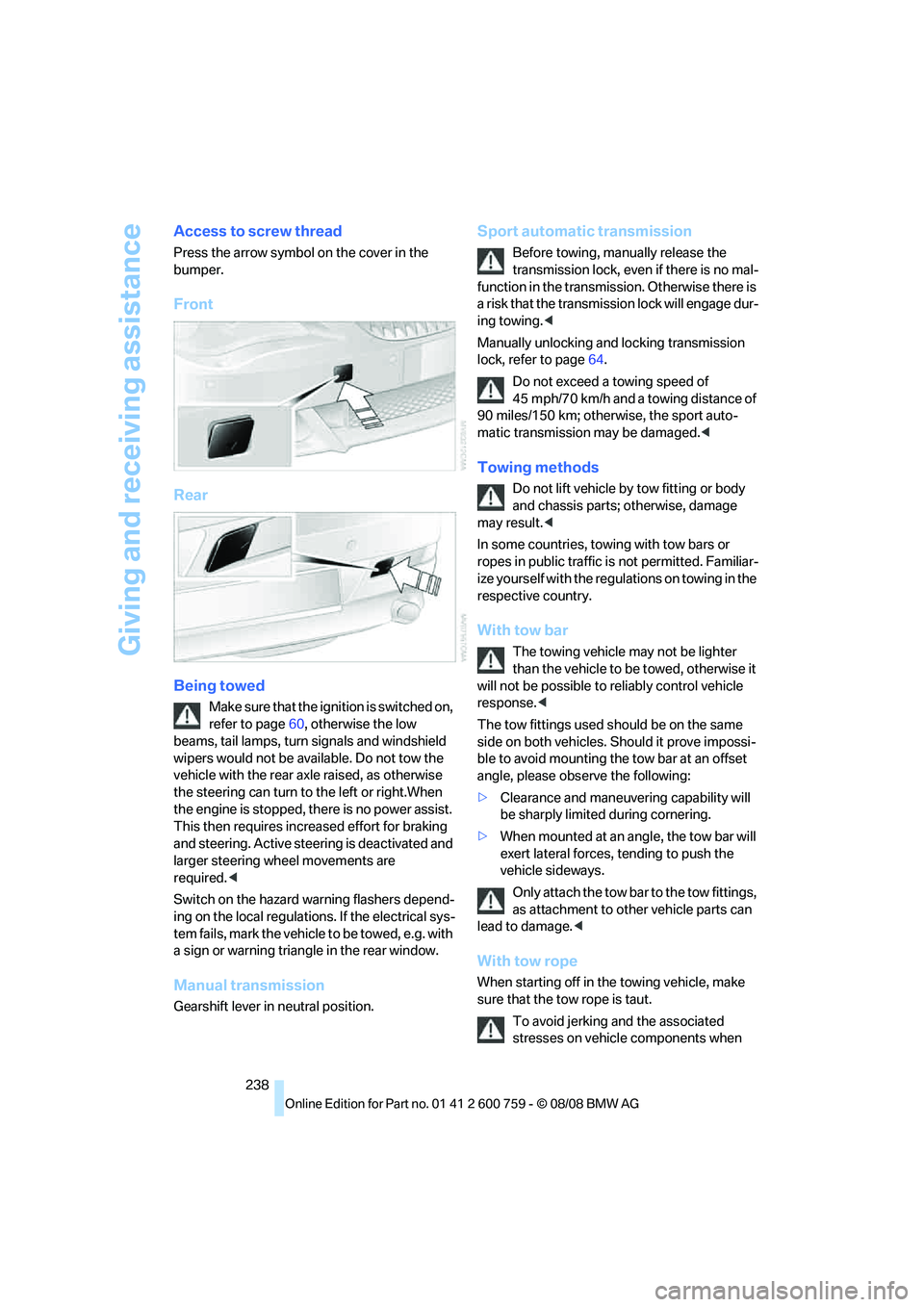
Access to screw thread
Press the arrow symbol on the cover in the
bumper.
Front
Rear
Being towed
Make sure that the ignition is switched on,
refer to page60, otherwise the low
beams, tail lamps, turn signals and windshield
wipers would not be available. Do not tow the
vehicle with the rear axle raised, as otherwise
the steering can turn to the left or right.When
the engine is stopped, there is no power assist.
This then requires increased effort for braking
and steering. Active steering is deactivated and
larger steering wheel movements are
required.<
Switch on the hazard warning flashers depend-
ing on the local regulations. If the electrical sys-
tem fails, mark the vehicle to be towed, e.g. with
a sign or warning triangle in the rear window.
Manual transmission
Gearshift lever in neutral position.
Sport automatic transmission
Before towing, manually release the
transmission lock, even if there is no mal-
function in the transmission. Otherwise there is
a risk that the transmission lock will engage dur-
ing towing.<
Manually unlocking and locking transmission
lock, refer to page64.
Do not exceed a towing speed of
45 mph/70 km/h and a towing distance of
90 miles/150 km; otherwise, the sport auto-
matic transmission may be damaged.<
Towing methods
Do not lift vehicle by tow fitting or body
and chassis parts; otherwise, damage
may result.<
In some countries, towing with tow bars or
ropes in public traffic is not permitted. Familiar-
ize yourself with the regulations on towing in the
respective country.
With tow bar
The towing vehicle may not be lighter
than the vehicle to be towed, otherwise it
will not be possible to reliably control vehicle
response.<
The tow fittings used should be on the same
side on both vehicles. Should it prove impossi-
ble to avoid mounting the tow bar at an offset
angle, please observe the following:
>Clearance and maneuvering capability will
be sharply limited during cornering.
>When mounted at an angle, the tow bar will
exert lateral forces, tending to push the
vehicle sideways.
Only attach the tow bar to the tow fittings,
as attachment to other vehicle parts can
lead to damage.<
With tow rope
When starting off in the towing vehicle, make
sure that the tow rope is taut.
To avoid jerking and the associated
stresses on vehicle components when
Page 241 of 272
Mobility
239Reference
At a glance
Controls
Driving tips
Communications
Navigation
Entertainment
towing, always use nylon ropes or nylon straps.
Only attach tow ropes to the tow fittings, as
attachment to other vehicle parts can lead to
damage.<
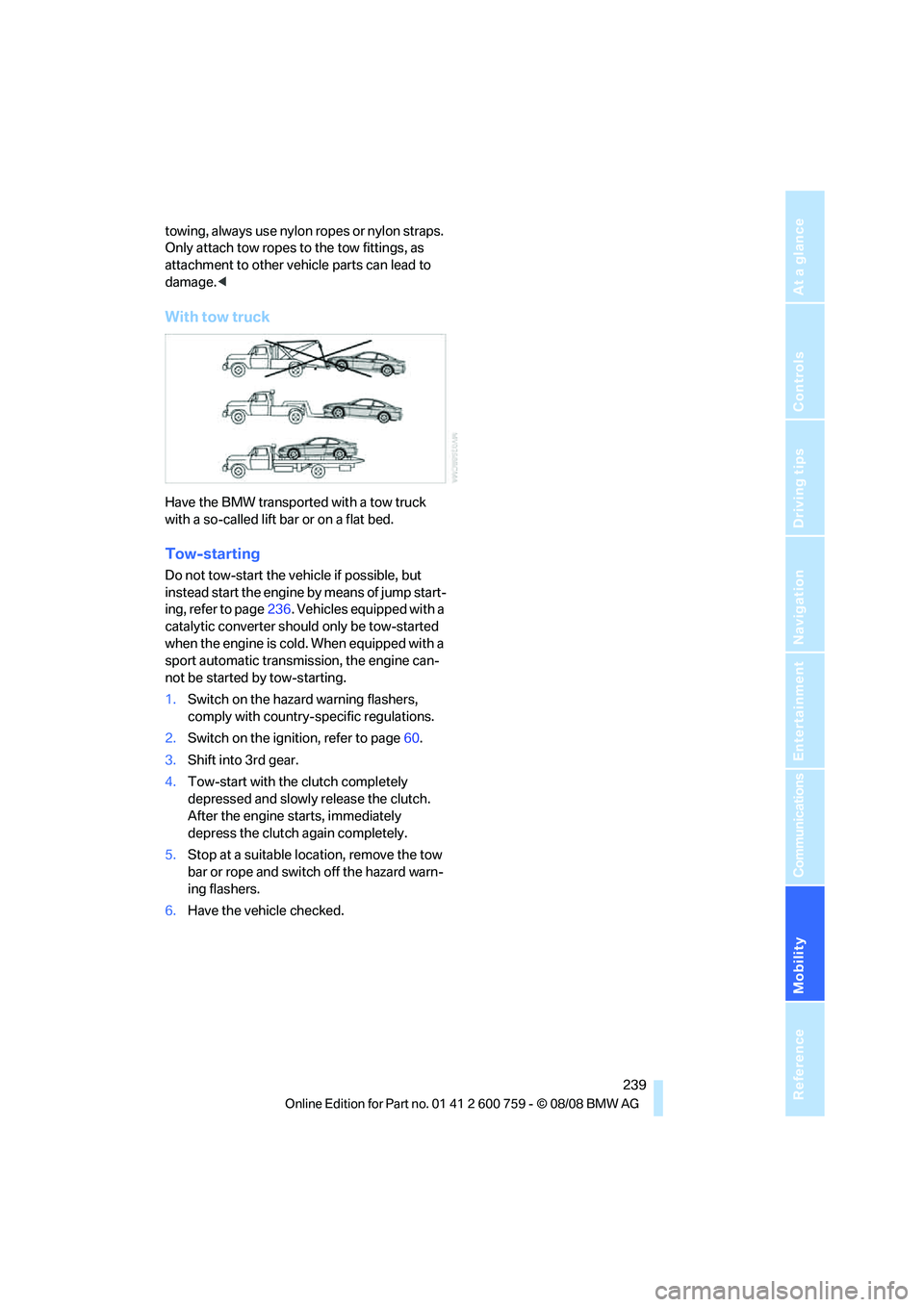
With tow truck
Have the BMW transported with a tow truck
with a so-called lift bar or on a flat bed.
Tow-starting
Do not tow-start the vehicle if possible, but
instead start the engine by means of jump start-
ing, refer to page236. Vehicles equipped with a
catalytic converter should only be tow-started
when the engine is cold. When equipped with a
sport automatic transmission, the engine can-
not be started by tow-starting.
1.Switch on the hazard warning flashers,
comply with country-specific regulations.
2.Switch on the ignition, refer to page60.
3.Shift into 3rd gear.
4.Tow-start with the clutch completely
depressed and slowly release the clutch.
After the engine starts, immediately
depress the clutch again completely.
5.Stop at a suitable location, remove the tow
bar or rope and switch off the hazard warn-
ing flashers.
6.Have the vehicle checked.
Page 257 of 272
Reference 255
At a glance
Controls
Driving tips
Communications
Navigation
Entertainment
Mobility
Dimensions
– Convertible244
– Coupe243
Directional indicators, refer to
Turn signals65
Direction announcements,
refer to Voice
instructions151
Direction instructions, refer to
Voice instructions151
Directory, refer to Phone
book194
Directory for navigation, refer
to Address book144
Displacement, refer to Engine
data242
"Display"86
Display, refer to iDrive
controls16
Display elements, refer to
Instrument cluster12
Displaying vehicle data207
Display lighting, refer to
Instrument lighting108
"Display off"22
Displays
– on Control Display, refer to
iDrive16
– refer to Instrument
cluster12
"Display settings"85,99
Displays on the windshield,
refer to Head-Up Display98
Disposal
– battery of remote control
with comfort access40
– coolant223
– vehicle battery233
Distance, refer to
Computer78
Distance control, refer to
Active cruise control68
Distance to destination, refer
to Computer78
Distance warning, refer to
PDC Park Distance
Control87
Door entry lighting, refer to
Interior lamps108Door key, refer to Keys/
remote control30
Door lock34
"Door locks"32,80
Doors
– manual operation34
– remote control32
DOT Quality Grades216
Draft-free ventilation114
Drinks holder, refer to Cup
holders120
"Driver's door only"32
Driving lamps, refer to Parking
lamps/low beams
104
Driving route, refer to
Displaying route149
Driving stability control
systems88
Driving through water128
Driving tips, refer to General
driving notes126
Dry air, refer to Cooling
function113
Drying the air, refer to Cooling
function113
DSC Dynamic Stability
Control89
– indicator lamp13,89
– malfunction90
DTC Dynamic Traction
Control89
– activating89
– indicator lamp13,90
DVD for navigation134
Dynamic Brake Control DBC
– warning lamp90
Dynamic Drive90
Dynamic Driving Control64
"Dynamic route" in
navigation147
Dynamic Stability Control
DSC89
Dynamic Traction Control
DTC89
E
Easy entry, refer to Entering
rear53Easy entry/exit56
Eject button, refer to Buttons
in area of CD player160
Electrical malfunction
– convertible top45
– door lock34
– driver's door34
– fuel filler door212
– glass sunroof43
– luggage compartment lid36
– storage compartment, hotel
function35
Electrical steering wheel
adjustment56
Electric convertible top44
Electronic brake-force
distribution88
Electronic oil level check222
Emergency operation, refer to
Manual operation
– convertible top45
– door lock34
– driver's door34
– fuel filler door212
– glass sunroof43
– hotel function35
– luggage compartment lid36
– transmission lock, sport
automatic transmission64
Emergency release for
luggage compartment lid in
cargo bay37
Emergency request235
Emergency services, refer to
Roadside Assistance236
"Enabled services"207
"Enabled TeleServices"204
"Enable services"207
"End call"194
Page 258 of 272
Everything from A to Z
256 Engine
– breaking-in126
– data242
– overheated, refer to Coolant
temperature76
– speed242
– starting61
– starting, comfort access38
– switching off61
– switching off when equipped
with Automatic
transmission, with comfort
access40
Engine compartment221
Engine coolant223
Engine oil
– adding223
– additives, refer to Approved
engine oils223
– approved oils223
– electronic oil level check222
– interval between changes,
refer to Service
requirements79
– oil change223
– oil grades, refer to Approved
engine oils223
– recommended oils223
– temperature77
– temperature gauge77
"Engine oil level"222
Engine output, refer to Engine
data242
Engine speed, refer to Engine
data242
Engine starting, refer to
Starting engine61
"Enter address"136,144
Entering destination via town/
city name137
Entering intersection,
navigation138
Entering rear53
Entering the
address136,139
Entering town/city for
navigation137
Entering zip code for
navigation138"Entertainment"160
Entertainment sound output
on/off161
Entry map for destination141
Equalizer, refer to Tone
control163
"Equalizer", tone control163
"ESN"171
ESP Electronic Stability
Program, refer to DSC
Dynamic Stability
Control89
Event Data Recorders226
Exhaust system, refer to Hot
exhaust system127
Exterior mirrors55
– adjusting55
– automatic dimming
feature56
– automatic heating55
– folding in and out55
– tilting down passenger-side
exterior mirror56
External audio device119
Eye for tow-starting and
towing, refer to Tow
fitting237
F
Fader, refer to Tone
control162
"Fader", tone control162
Failure messages, refer to
Check Control81
False alarm
– refer to Avoiding
unintentional alarms38
– refer to Switching off
alarm37
Fastening safety belts, refer to
Safety belts54
Fastest route for
navigation146
"Fast route" in navigation147
Filler neck for washer fluid67
Filter, refer to Microfilter/
activated-charcoal filter114First aid, refer to First-aid
kit236
First-aid kit236
Flashing
– during locking/unlocking,
refer to Setting confirmation
signals33
– triple turn signal
activation66
Flat tire
– Flat Tire Monitor90
– run-flat tires92,93,218
– Tire Pressure Monitor92
– TPM Tire Pressure
Monitor92
– warning lamp92,93
Flat tire, refer to Run-flat
tires218
Flat Tire Monitor90
– false alarms91
– initializing system91
– snow chains219
– system limits91
– warning lamp92
Fluid reservoir, refer to Filler
neck for washer fluid67
FM, waveband164
"FM" waveband160,164
Fog lamps108
– indicator lamp13,108
Folding into raised position
convertible top
compartment floor,
Convertible37
Footbrake, refer to Braking
safely128
Footwell lamps, refer to
Interior lamps108
Forward, fast
– CD changer178
– CD player178
For your own safety
6
Freeway, refer to Route
criteria146
Front airbags95
Front passenger airbags
– deactivating96
"FTM"91
Page 259 of 272
Reference 257
At a glance
Controls
Driving tips
Communications
Navigation
Entertainment
Mobility
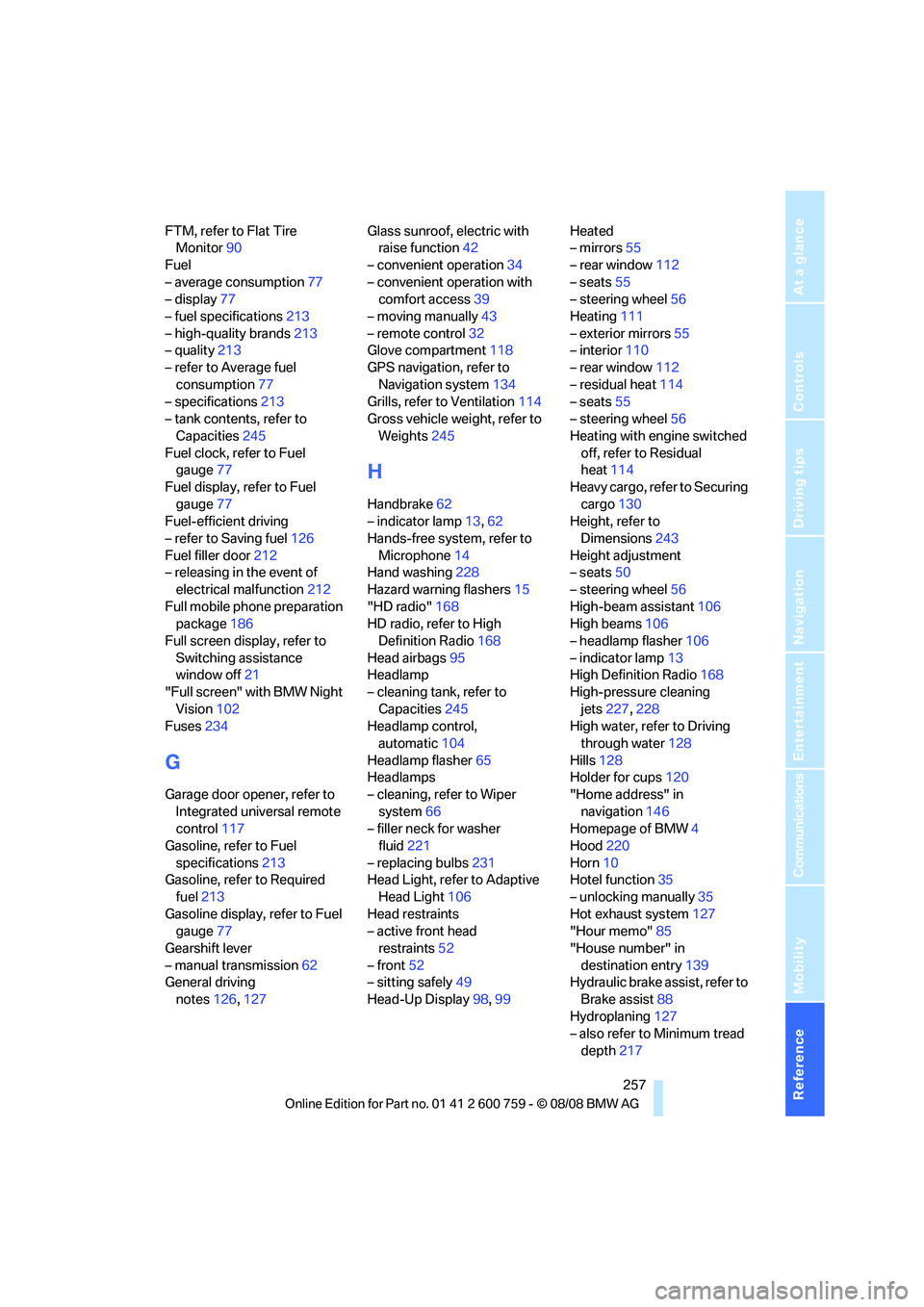
FTM, refer to Flat Tire
Monitor90
Fuel
– average consumption77
– display77
– fuel specifications213
– high-quality brands213
– quality213
– refer to Average fuel
consumption77
– specifications213
– tank contents, refer to
Capacities245
Fuel clock, refer to Fuel
gauge77
Fuel display, refer to Fuel
gauge77
Fuel-efficient driving
– refer to Saving fuel126
Fuel filler door212
– releasing in the event of
electrical malfunction212
Full mobile phone preparation
package186
Full screen display, refer to
Switching assistance
window off21
"Full screen" with BMW Night
Vision102
Fuses234
G
Garage door opener, refer to
Integrated universal remote
control117
Gasoline, refer to Fuel
specifications213
Gasoline, refer to Required
fuel213
Gasoline display, refer to Fuel
gauge77
Gearshift lever
– manual transmission62
General driving
notes126,127Glass sunroof, electric with
raise function42
– convenient operation34
– convenient operation with
comfort access39
– moving manually43
– remote control32
Glove compartment118
GPS navigation, refer to
Navigation system134
Grills, refer to Ventilation114
Gross vehicle weight, refer to
Weights245
H
Handbrake62
– indicator lamp13,62
Hands-free system, refer to
Microphone14
Hand washing228
Hazard warning flashers15
"HD radio"168
HD radio, refer to High
Definition Radio168
Head airbags95
Headlamp
– cleaning tank, refer to
Capacities245
Headlamp control,
automatic104
Headlamp flasher65
Headlamps
– cleaning, refer to Wiper
system66
– filler neck for washer
fluid221
– replacing bulbs231
Head Light, refer to Adaptive
Head Light106
Head restraints
– active front head
restraints52
– front52
– sitting safely49
Head-Up Display98,99Heated
– mirrors55
– rear window112
– seats55
– steering wheel56
Heating111
– exterior mirrors55
– interior110
– rear window112
– residual heat114
– seats55
– steering wheel56
Heating with engine switched
off, refer to Residual
heat114
Heavy cargo, refer to Securing
cargo130
Height, refer to
Dimensions243
Height adjustment
– seats50
– steering wheel56
High-beam assistant106
High beams106
– headlamp flasher106
– indicator lamp13
High Definition Radio168
High-pressure cleaning
jets
227,228
High water, refer to Driving
through water128
Hills128
Holder for cups120
"Home address" in
navigation146
Homepage of BMW4
Hood220
Horn10
Hotel function35
– unlocking manually35
Hot exhaust system127
"Hour memo"85
"House number" in
destination entry139
Hydraulic brake assist, refer to
Brake assist88
Hydroplaning127
– also refer to Minimum tread
depth217
Page 260 of 272
Everything from A to Z
258
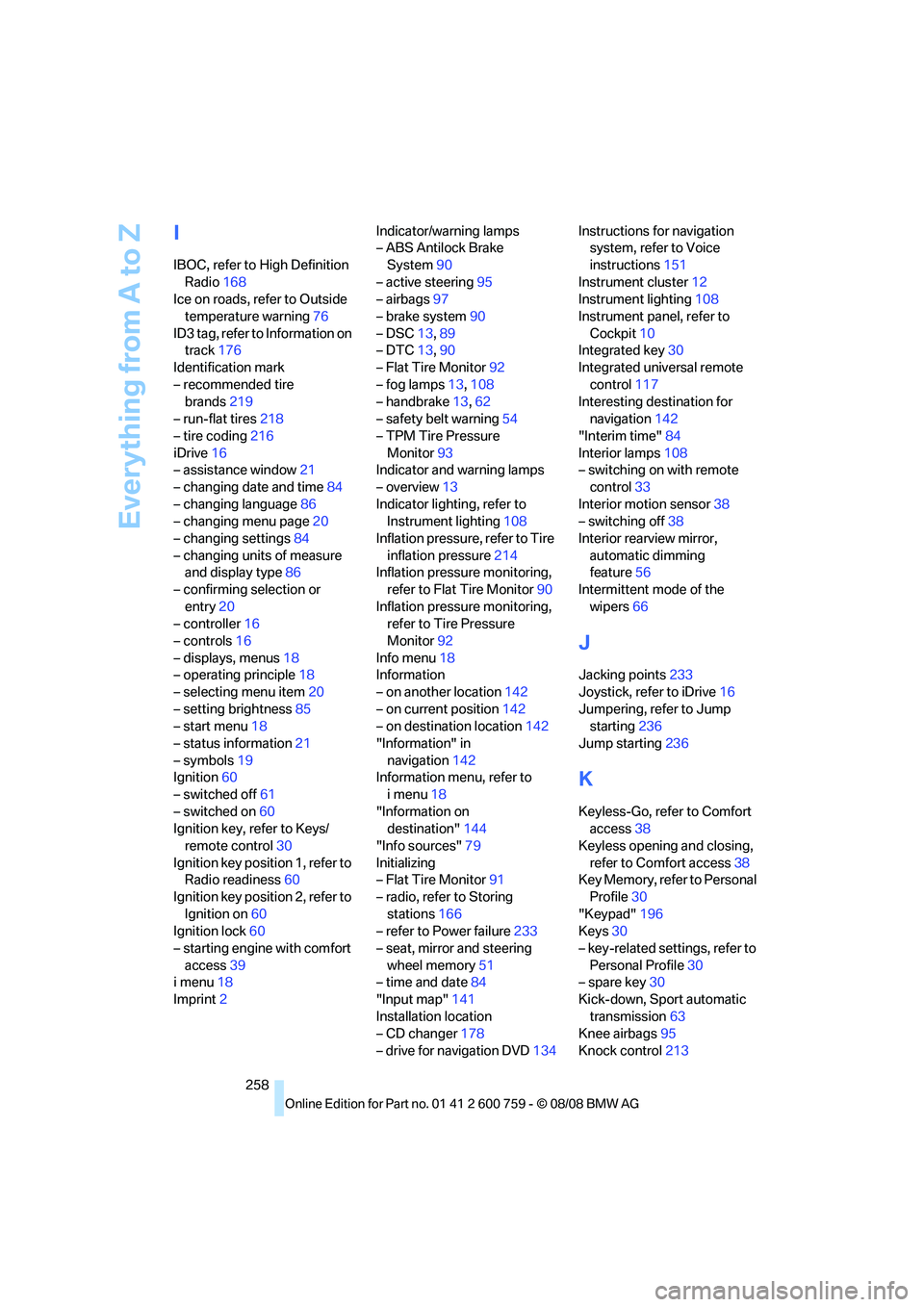
I
IBOC, refer to High Definition
Radio168
Ice on roads, refer to Outside
temperature warning76
ID3 tag, refer to Information on
track176
Identification mark
– recommended tire
brands219
– run-flat tires218
– tire coding216
iDrive16
– assistance window21
– changing date and time84
– changing language86
– changing menu page20
– changing settings84
– changing units of measure
and display type86
– confirming selection or
entry20
– controller16
– controls16
– displays, menus18
– operating principle18
– selecting menu item20
– setting brightness85
– start menu18
– status information21
– symbols19
Ignition60
– switched off61
– switched on60
Ignition key, refer to Keys/
remote control30
Ignition key position 1, refer to
Radio readiness60
Ignition key position 2, refer to
Ignition on60
Ignition lock60
– starting engine with comfort
access39
i menu18
Imprint2Indicator/warning lamps
– ABS Antilock Brake
System90
– active steering95
– airbags97
– brake system90
– DSC13,89
– DTC13,90
– Flat Tire Monitor92
– fog lamps13,108
– handbrake13,62
– safety belt warning54
– TPM Tire Pressure
Monitor93
Indicator and warning lamps
– overview13
Indicator lighting, refer to
Instrument lighting108
Inflation pressure, refer to Tire
inflation pressure214
Inflation pressure monitoring,
refer to Flat Tire Monitor90
Inflation pressure monitoring,
refer to Tire Pressure
Monitor92
Info menu18
Information
– on another location142
– on current position142
– on destination location142
"Information" in
navigation142
Information menu, refer to
imenu18
"Information on
destination"144
"Info sources"79
Initializing
– Flat Tire Monitor91
– radio, refer to Storing
stations166
– refer to Power failure233
– seat, mirror and steering
wheel memory51
– time and date84
"Input map"141
Installation location
– CD changer178
– drive for navigation DVD134Instructions for navigation
system, refer to Voice
instructions151
Instrument cluster12
Instrument lighting108
Instrument panel, refer to
Cockpit10
Integrated key30
Integrated universal remote
control117
Interesting destination for
navigation142
"Interim time"84
Interior lamps108
– switching on with remote
control33
Interior motion sensor38
– switching off38
Interior rearview mirror,
automatic dimming
feature56
Intermittent mode of the
wipers66
J
Jacking points233
Joystick, refer to iDrive16
Jumpering, refer to Jump
starting236
Jump starting236
K
Keyless-Go, refer to Comfort
access38
Keyless opening and closing,
refer to Comfort access38
Key Memory, refer to Personal
Profile30
"Keypad"196
Keys30
– key-related settings, refer to
Personal Profile30
– spare key30
Kick-down, Sport automatic
transmission63
Knee airbags95
Knock control213