lock BMW 645CI COUPE 2004 E63 User Guide
[x] Cancel search | Manufacturer: BMW, Model Year: 2004, Model line: 645CI COUPE, Model: BMW 645CI COUPE 2004 E63Pages: 216, PDF Size: 3.46 MB
Page 34 of 216
Opening and closing
32 If special circumstances should make it
absolutely necessary to operate the vehicle
with the lid open:
1.Coupe: close both windows as well as
the glass roof
Convertible: with closed top, close all
windows
2.Adjust the automatic climate control to
supply a high air volume, refer to
page 89.
Luggage compartment
There are four lashing eyes on the inner
corners of the luggage compartment for
securing luggage nets or securing straps to
fix luggage in position.
Also refer to Cargo loading, page 104.
Convertible: increasing luggage
compartment capacity
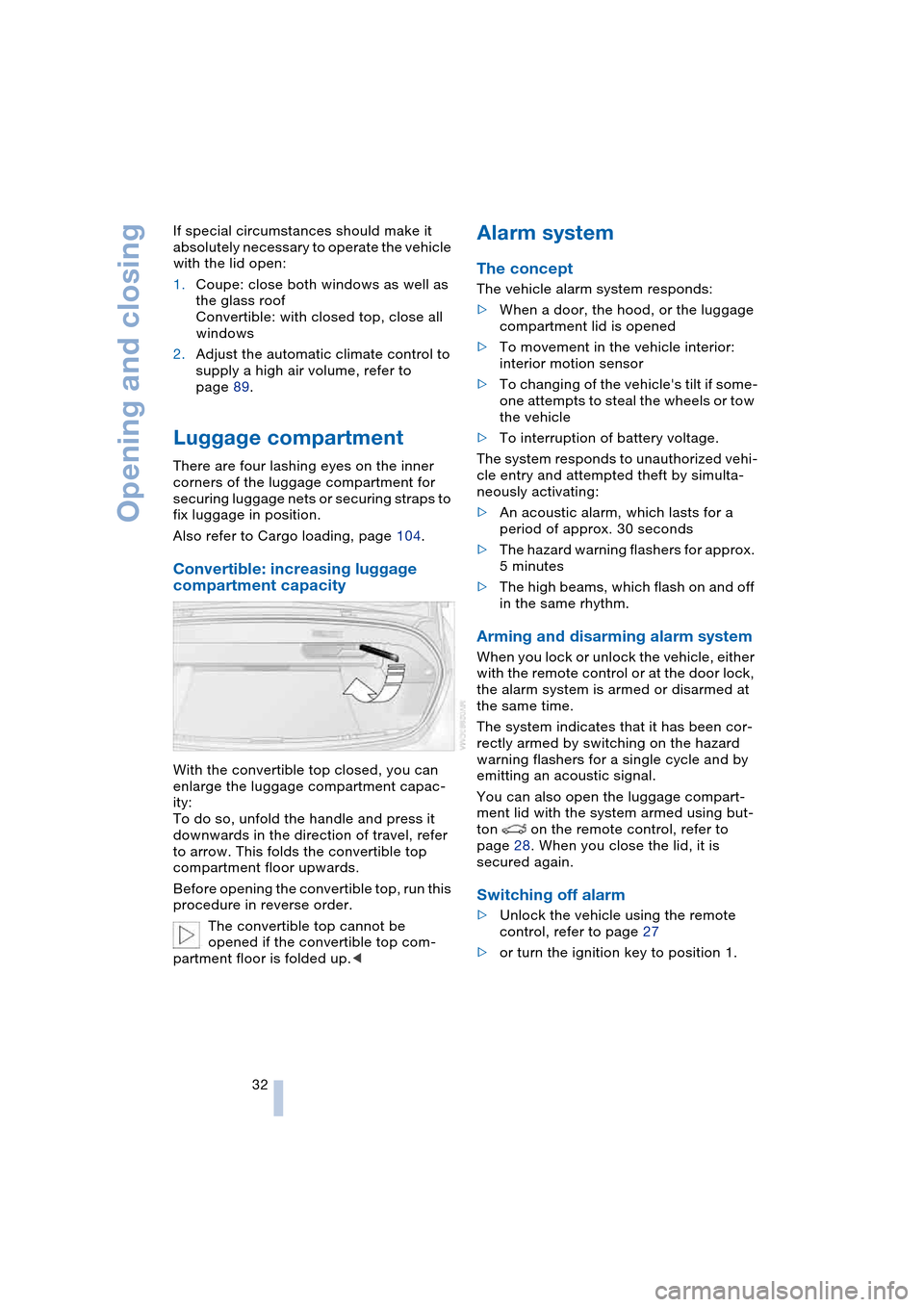
With the convertible top closed, you can
enlarge the luggage compartment capac-
ity:
To do so, unfold the handle and press it
downwards in the direction of travel, refer
to arrow. This folds the convertible top
compartment floor upwards.
Before opening the convertible top, run this
procedure in reverse order.
The convertible top cannot be
opened if the convertible top com-
partment floor is folded up.<
Alarm system
The concept
The vehicle alarm system responds:
>When a door, the hood, or the luggage
compartment lid is opened
>To movement in the vehicle interior:
interior motion sensor
>To changing of the vehicle's tilt if some-
one attempts to steal the wheels or tow
the vehicle
>To interruption of battery voltage.
The system responds to unauthorized vehi-
cle entry and attempted theft by simulta-
neously activating:
>An acoustic alarm, which lasts for a
period of approx. 30 seconds
>The hazard warning flashers for approx.
5 minutes
>The high beams, which flash on and off
in the same rhythm.
Arming and disarming alarm system
When you lock or unlock the vehicle, either
with the remote control or at the door lock,
the alarm system is armed or disarmed at
the same time.
The system indicates that it has been cor-
rectly armed by switching on the hazard
warning flashers for a single cycle and by
emitting an acoustic signal.
You can also open the luggage compart-
ment lid with the system armed using but-
ton on the remote control, refer to
page 28. When you close the lid, it is
secured again.
Switching off alarm
>Unlock the vehicle using the remote
control, refer to page 27
>or turn the ignition key to position 1.
Page 35 of 216
Controls
33Reference
At a glance
Driving tips
Communications
Navigation
Entertainment
Mobility
Indicator lamp displays
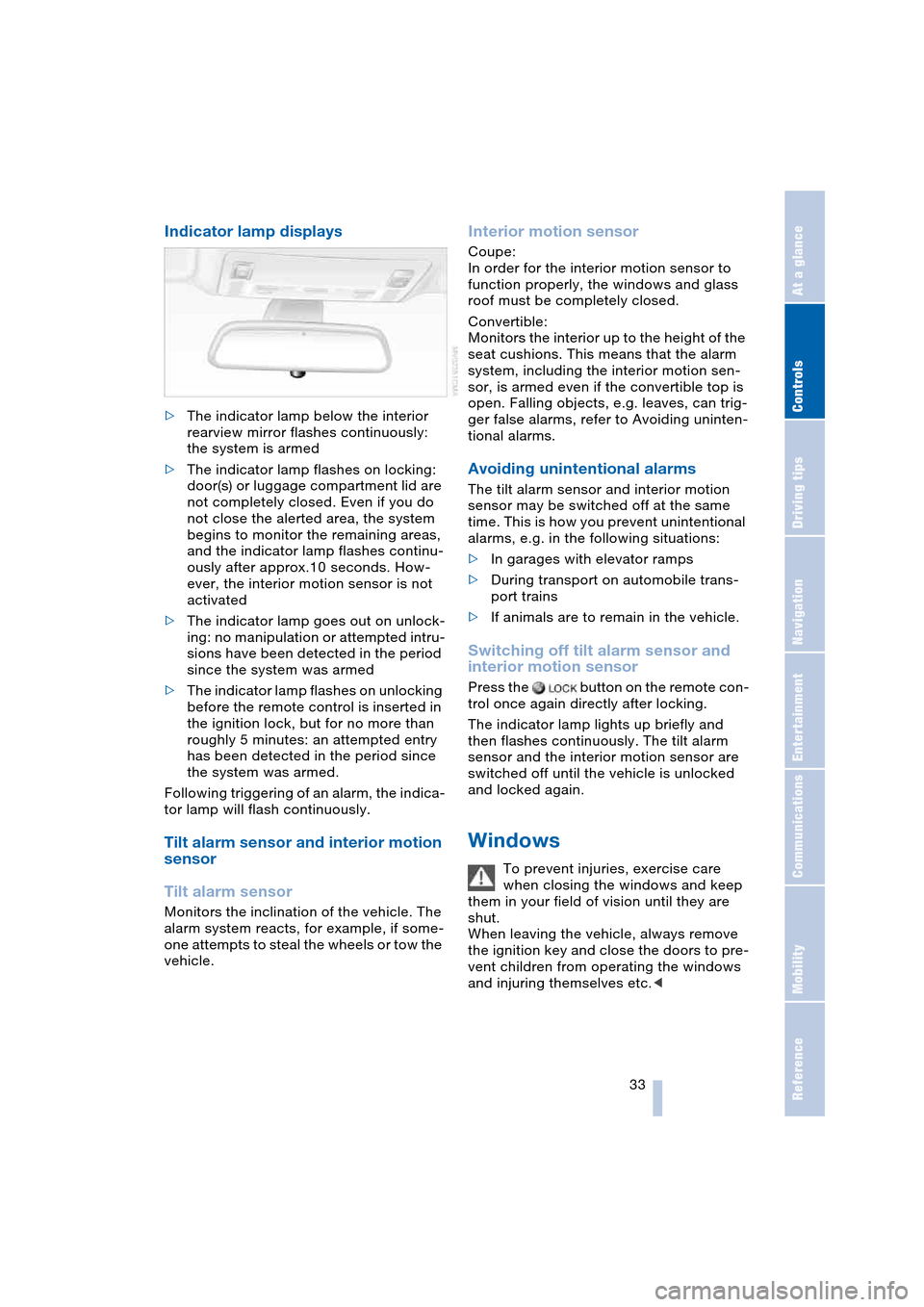
>The indicator lamp below the interior
rearview mirror flashes continuously:
the system is armed
>The indicator lamp flashes on locking:
door(s) or luggage compartment lid are
not completely closed. Even if you do
not close the alerted area, the system
begins to monitor the remaining areas,
and the indicator lamp flashes continu-
ously after approx.10 seconds. How-
ever, the interior motion sensor is not
activated
>The indicator lamp goes out on unlock-
ing: no manipulation or attempted intru-
sions have been detected in the period
since the system was armed
>The indicator lamp flashes on unlocking
before the remote control is inserted in
the ignition lock, but for no more than
roughly 5 minutes: an attempted entry
has been detected in the period since
the system was armed.
Following triggering of an alarm, the indica-
tor lamp will flash continuously.
Tilt alarm sensor and interior motion
sensor
Tilt alarm sensor
Monitors the inclination of the vehicle. The
alarm system reacts, for example, if some-
one attempts to steal the wheels or tow the
vehicle.
Interior motion sensor
Coupe:
In order for the interior motion sensor to
function properly, the windows and glass
roof must be completely closed.
Convertible:
Monitors the interior up to the height of the
seat cushions. This means that the alarm
system, including the interior motion sen-
sor, is armed even if the convertible top is
open. Falling objects, e.g. leaves, can trig-
ger false alarms, refer to Avoiding uninten-
tional alarms.
Avoiding unintentional alarms
The tilt alarm sensor and interior motion
sensor may be switched off at the same
time. This is how you prevent unintentional
alarms, e.g. in the following situations:
>In garages with elevator ramps
>During transport on automobile trans-
port trains
>If animals are to remain in the vehicle.
Switching off tilt alarm sensor and
interior motion sensor
Press the button on the remote con-
trol once again directly after locking.
The indicator lamp lights up briefly and
then flashes continuously. The tilt alarm
sensor and the interior motion sensor are
switched off until the vehicle is unlocked
and locked again.
Windows
To prevent injuries, exercise care
when closing the windows and keep
them in your field of vision until they are
shut.
When leaving the vehicle, always remove
the ignition key and close the doors to pre-
vent children from operating the windows
and injuring themselves etc.<
Page 37 of 216
Controls
35Reference
At a glance
Driving tips
Communications
Navigation
Entertainment
Mobility
Rear window
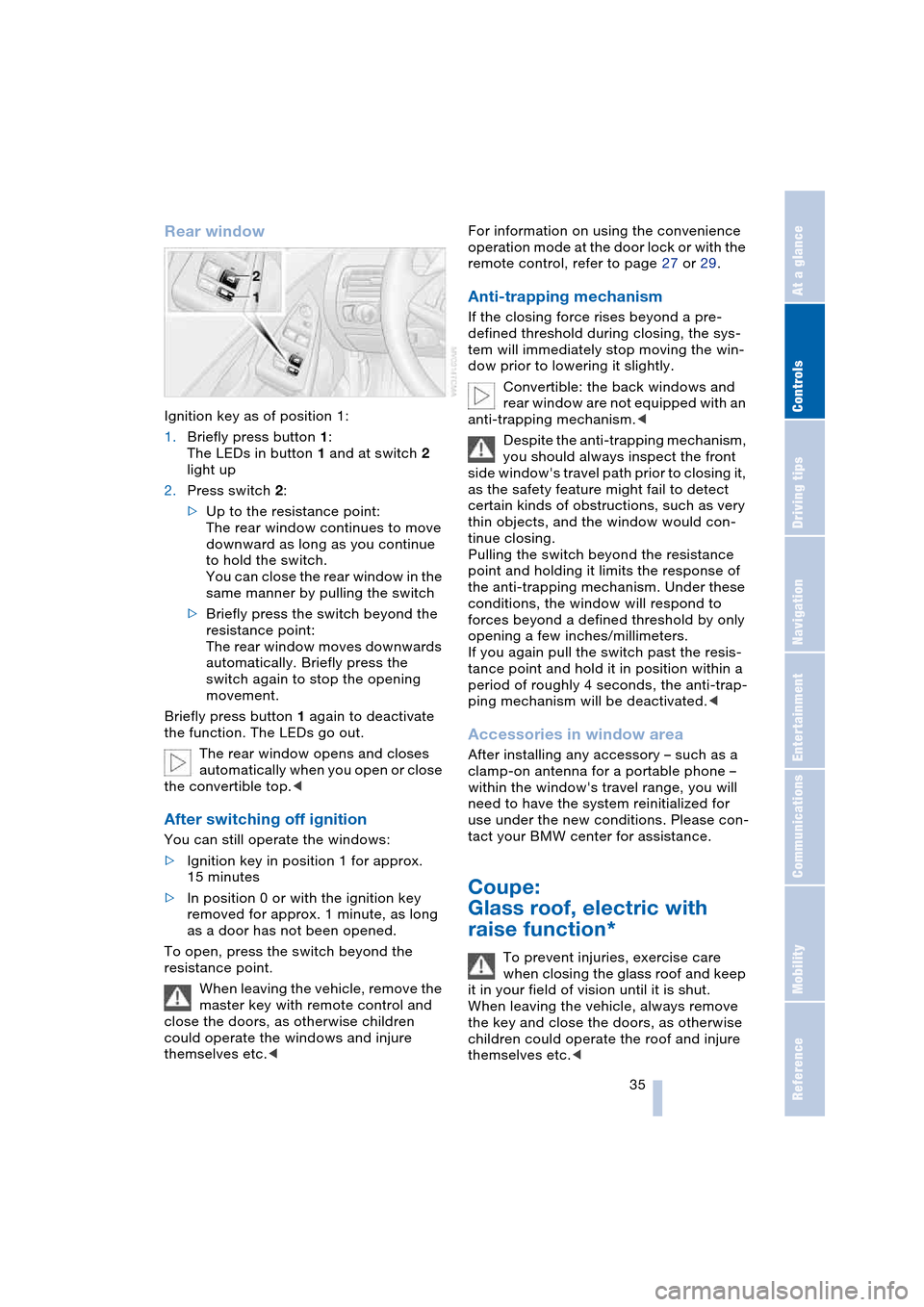
Ignition key as of position 1:
1.Briefly press button 1:
The LEDs in button 1 and at switch 2
light up
2.Press switch 2:
>Up to the resistance point:
The rear window continues to move
downward as long as you continue
to hold the switch.
You can close the rear window in the
same manner by pulling the switch
>Briefly press the switch beyond the
resistance point:
The rear window moves downwards
automatically. Briefly press the
switch again to stop the opening
movement.
Briefly press button 1 again to deactivate
the function. The LEDs go out.
The rear window opens and closes
automatically when you open or close
the convertible top.<
After switching off ignition
You can still operate the windows:
>Ignition key in position 1 for approx.
15 minutes
>In position 0 or with the ignition key
removed for approx. 1 minute, as long
as a door has not been opened.
To open, press the switch beyond the
resistance point.
When leaving the vehicle, remove the
master key with remote control and
close the doors, as otherwise children
could operate the windows and injure
themselves etc.
remote control, refer to page 27 or 29.
Anti-trapping mechanism
If the closing force rises beyond a pre-
defined threshold during closing, the sys-
tem will immediately stop moving the win-
dow prior to lowering it slightly.
Convertible: the back windows and
rear window are not equipped with an
anti-trapping mechanism.<
Despite the anti-trapping mechanism,
you should always inspect the front
side window's travel path prior to closing it,
as the safety feature might fail to detect
certain kinds of obstructions, such as very
thin objects, and the window would con-
tinue closing.
Pulling the switch beyond the resistance
point and holding it limits the response of
the anti-trapping mechanism. Under these
conditions, the window will respond to
forces beyond a defined threshold by only
opening a few inches/millimeters.
If you again pull the switch past the resis-
tance point and hold it in position within a
period of roughly 4 seconds, the anti-trap-
ping mechanism will be deactivated.<
Accessories in window area
After installing any accessory – such as a
clamp-on antenna for a portable phone –
within the window's travel range, you will
need to have the system reinitialized for
use under the new conditions. Please con-
tact your BMW center for assistance.
Coupe:
Glass roof, electric with
raise function*
To prevent injuries, exercise care
when closing the glass roof and keep
it in your field of vision until it is shut.
When leaving the vehicle, always remove
the key and close the doors, as otherwise
children could operate the roof and injure
themselves etc.<
Page 38 of 216
Opening and closing
36
Raising and closing glass roof
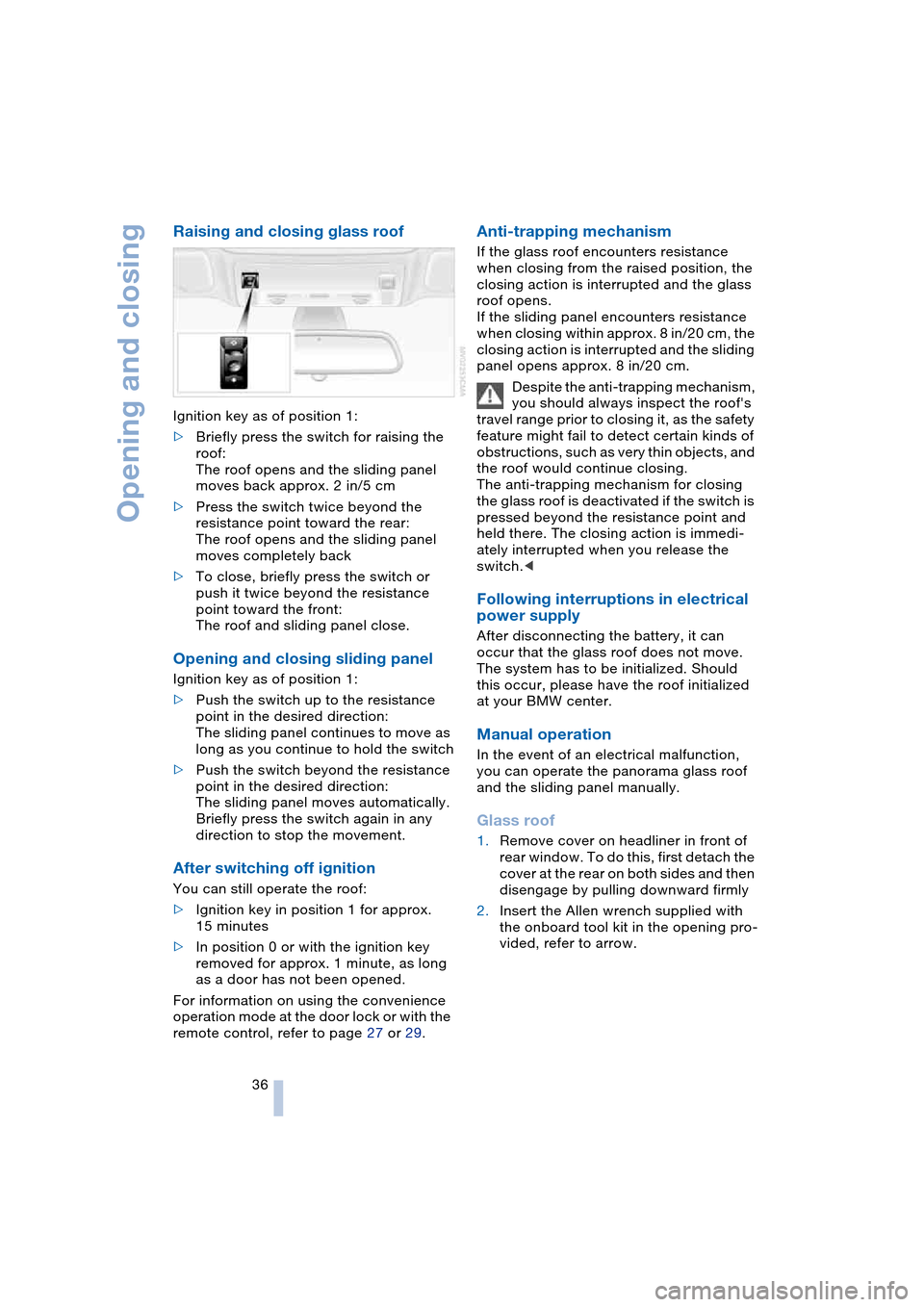
Ignition key as of position 1:
>Briefly press the switch for raising the
roof:
The roof opens and the sliding panel
moves back approx. 2 in/5 cm
>Press the switch twice beyond the
resistance point toward the rear:
The roof opens and the sliding panel
moves completely back
>To close, briefly press the switch or
push it twice beyond the resistance
point toward the front:
The roof and sliding panel close.
Opening and closing sliding panel
Ignition key as of position 1:
>Push the switch up to the resistance
point in the desired direction:
The sliding panel continues to move as
long as you continue to hold the switch
>Push the switch beyond the resistance
point in the desired direction:
The sliding panel moves automatically.
Briefly press the switch again in any
direction to stop the movement.
After switching off ignition
You can still operate the roof:
>Ignition key in position 1 for approx.
15 minutes
>In position 0 or with the ignition key
removed for approx. 1 minute, as long
as a door has not been opened.
For information on using the convenience
operation mode at the door lock or with the
remote control, refer to page 27 or 29.
Anti-trapping mechanism
If the glass roof encounters resistance
when closing from the raised position, the
closing action is interrupted and the glass
roof opens.
If the sliding panel encounters resistance
when closing within approx. 8 in/20 cm, the
closing action is interrupted and the sliding
panel opens approx. 8 in/20 cm.
Despite the anti-trapping mechanism,
you should always inspect the roof's
travel range prior to closing it, as the safety
feature might fail to detect certain kinds of
obstructions, such as very thin objects, and
the roof would continue closing.
The anti-trapping mechanism for closing
the glass roof is deactivated if the switch is
pressed beyond the resistance point and
held there. The closing action is immedi-
ately interrupted when you release the
switch.<
Following interruptions in electrical
power supply
After disconnecting the battery, it can
occur that the glass roof does not move.
The system has to be initialized. Should
this occur, please have the roof initialized
at your BMW center.
Manual operation
In the event of an electrical malfunction,
you can operate the panorama glass roof
and the sliding panel manually.
Glass roof
1.Remove cover on headliner in front of
rear window. To do this, first detach the
cover at the rear on both sides and then
disengage by pulling downward firmly
2.Insert the Allen wrench supplied with
the onboard tool kit in the opening pro-
vided, refer to arrow.
Page 39 of 216
Controls
37Reference
At a glance
Driving tips
Communications
Navigation
Entertainment
Mobility
3.Turn the Allen wrench and move the
glass roof in the desired direction.
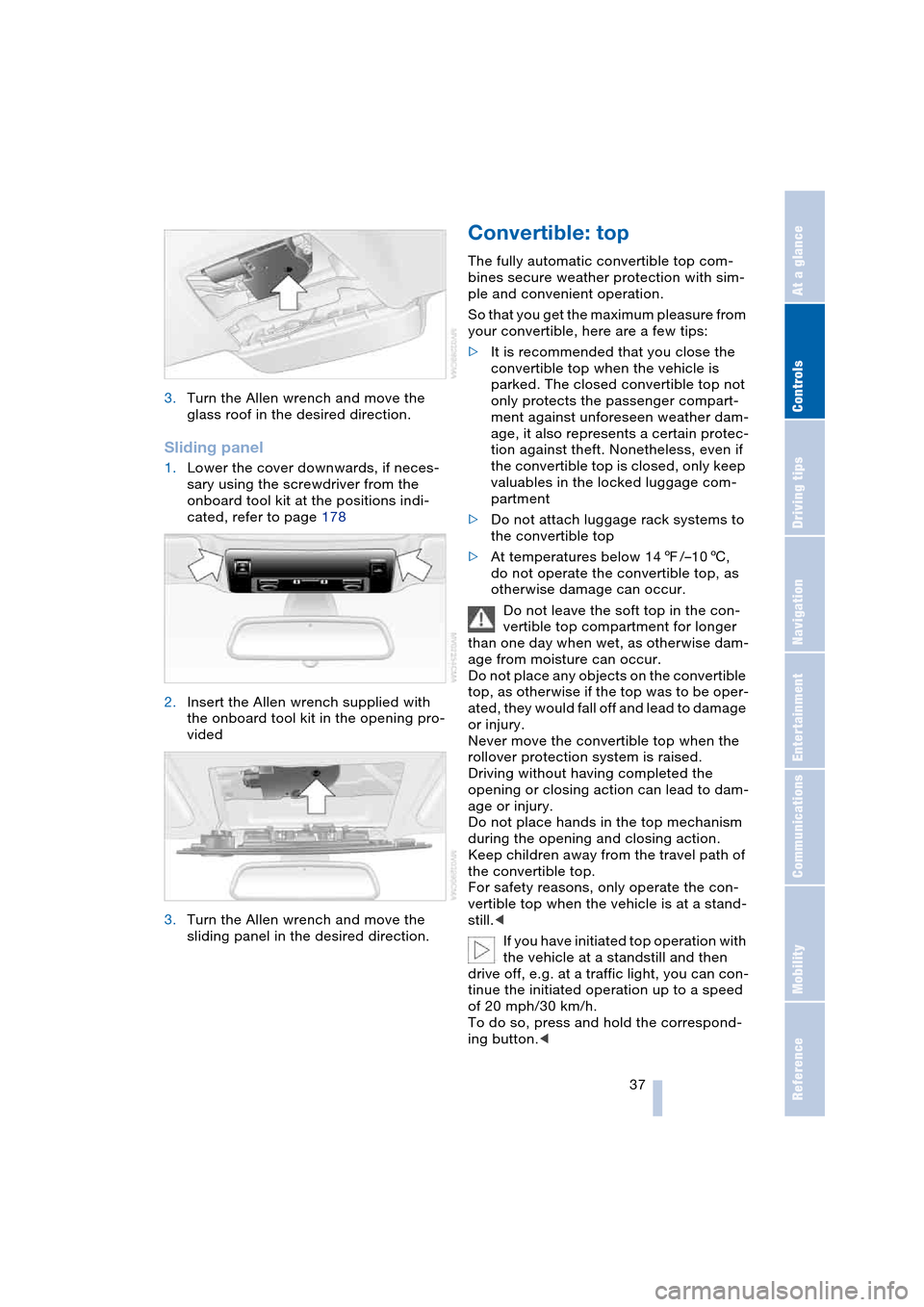
Sliding panel
1.Lower the cover downwards, if neces-
sary using the screwdriver from the
onboard tool kit at the positions indi-
cated, refer to page 178
2.Insert the Allen wrench supplied with
the onboard tool kit in the opening pro-
vided
3.Turn the Allen wrench and move the
sliding panel in the desired direction.
Convertible: top
The fully automatic convertible top com-
bines secure weather protection with sim-
ple and convenient operation.
So that you get the maximum pleasure from
your convertible, here are a few tips:
>It is recommended that you close the
convertible top when the vehicle is
parked. The closed convertible top not
only protects the passenger compart-
ment against unforeseen weather dam-
age, it also represents a certain protec-
tion against theft. Nonetheless, even if
the convertible top is closed, only keep
valuables in the locked luggage com-
partment
>Do not attach luggage rack systems to
the convertible top
>At temperatures below 147/–106,
do not operate the convertible top, as
otherwise damage can occur.
Do not leave the soft top in the con-
vertible top compartment for longer
than one day when wet, as otherwise dam-
age from moisture can occur.
Do not place any objects on the convertible
top, as otherwise if the top was to be oper-
ated, they would fall off and lead to damage
or injury.
Never move the convertible top when the
rollover protection system is raised.
Driving without having completed the
opening or closing action can lead to dam-
age or injury.
Do not place hands in the top mechanism
during the opening and closing action.
Keep children away from the travel path of
the convertible top.
For safety reasons, only operate the con-
vertible top when the vehicle is at a stand-
still.<
If you have initiated top operation with
the vehicle at a standstill and then
drive off, e.g. at a traffic light, you can con-
tinue the initiated operation up to a speed
of 20 mph/30 km/h.
To do so, press and hold the correspond-
ing button.<
Page 41 of 216
Controls
39Reference
At a glance
Driving tips
Communications
Navigation
Entertainment
Mobility
If the opening or closing action is inter-
rupted, it can happen that the luggage
compartment lid cannot be opened.<
Convenience operation using remote
control and driver's door lock
Refer to pages 27 and 29.
Manual closing in the event of an
electrical malfunction
Only close the convertible top manu-
ally if absolutely necessary; never
open it manually. The convertible top com-
partment lid cannot be locked in the event
of an electrical malfunction and would
open while the vehicle is being driven.
Improper handling can lead to damage.<
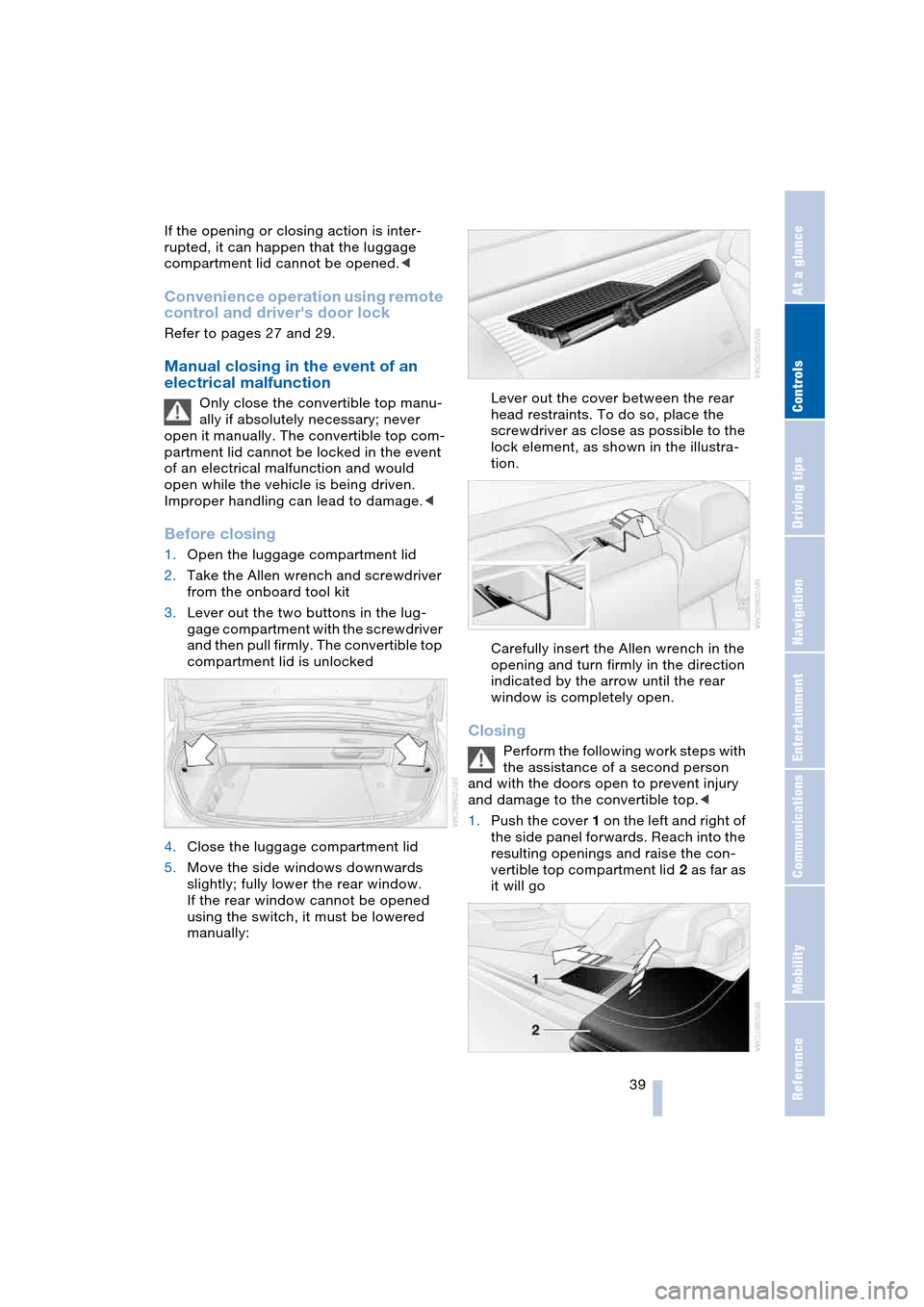
Before closing
1.Open the luggage compartment lid
2.Take the Allen wrench and screwdriver
from the onboard tool kit
3.Lever out the two buttons in the lug-
gage compartment with the screwdriver
and then pull firmly. The convertible top
compartment lid is unlocked
4.Close the luggage compartment lid
5.Move the side windows downwards
slightly; fully lower the rear window.
If the rear window cannot be opened
using the switch, it must be lowered
manually:Lever out the cover between the rear
head restraints. To do so, place the
screwdriver as close as possible to the
lock element, as shown in the illustra-
tion.
Carefully insert the Allen wrench in the
opening and turn firmly in the direction
indicated by the arrow until the rear
window is completely open.
Closing
Perform the following work steps with
the assistance of a second person
and with the doors open to prevent injury
and damage to the convertible top.<
1.Push the cover 1 on the left and right of
the side panel forwards. Reach into the
resulting openings and raise the con-
vertible top compartment lid 2 as far as
it will go
Page 42 of 216
Opening and closing
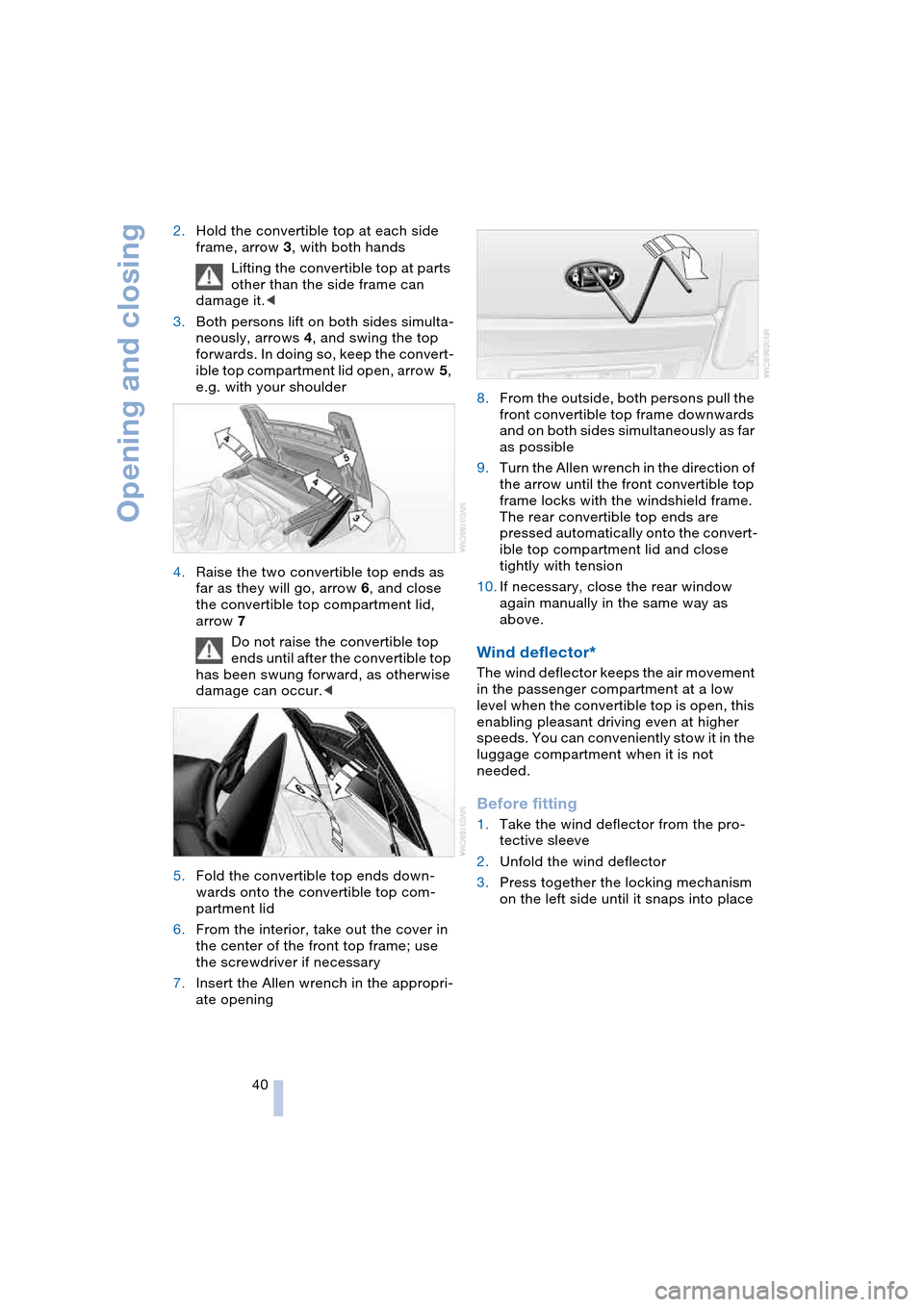
40 2.Hold the convertible top at each side
frame, arrow 3, with both hands
Lifting the convertible top at parts
other than the side frame can
damage it.<
3.Both persons lift on both sides simulta-
neously, arrows 4, and swing the top
forwards. In doing so, keep the convert-
ible top compartment lid open, arrow 5,
e.g. with your shoulder
4.Raise the two convertible top ends as
far as they will go, arrow 6, and close
the convertible top compartment lid,
arrow 7
Do not raise the convertible top
ends until after the convertible top
has been swung forward, as otherwise
damage can occur.<
5.Fold the convertible top ends down-
wards onto the convertible top com-
partment lid
6.From the interior, take out the cover in
the center of the front top frame; use
the screwdriver if necessary
7.Insert the Allen wrench in the appropri-
ate opening8.From the outside, both persons pull the
front convertible top frame downwards
and on both sides simultaneously as far
as possible
9.Turn the Allen wrench in the direction of
the arrow until the front convertible top
frame locks with the windshield frame.
The rear convertible top ends are
pressed automatically onto the convert-
ible top compartment lid and close
tightly with tension
10.If necessary, close the rear window
again manually in the same way as
above.
Wind deflector*
The wind deflector keeps the air movement
in the passenger compartment at a low
level when the convertible top is open, this
enabling pleasant driving even at higher
speeds. You can conveniently stow it in the
luggage compartment when it is not
needed.
Before fitting
1.Take the wind deflector from the pro-
tective sleeve
2.Unfold the wind deflector
3.Press together the locking mechanism
on the left side until it snaps into place
Page 43 of 216
Controls
41Reference
At a glance
Driving tips
Communications
Navigation
Entertainment
Mobility
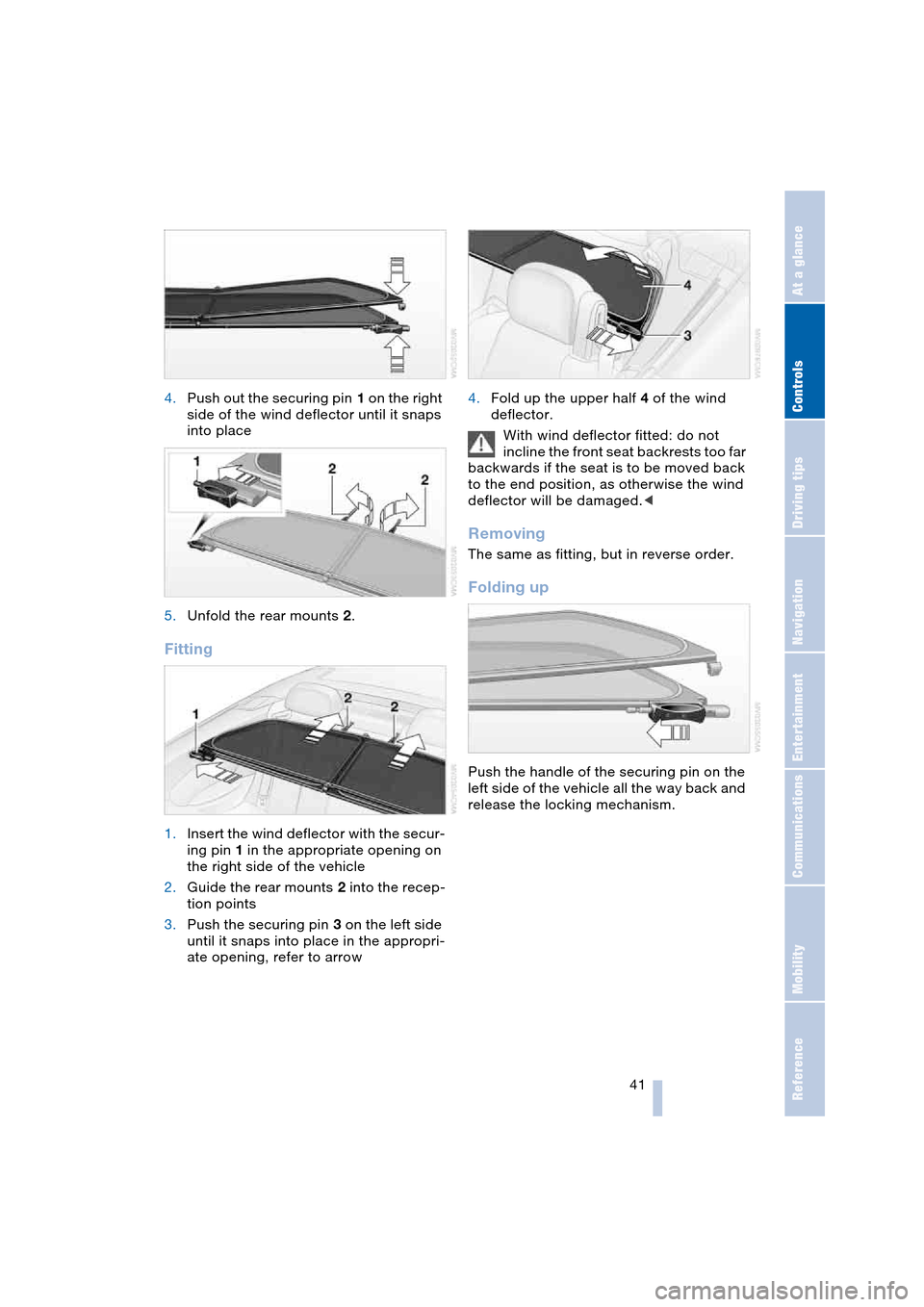
4.Push out the securing pin 1 on the right
side of the wind deflector until it snaps
into place
5.Unfold the rear mounts 2.
Fitting
1.Insert the wind deflector with the secur-
ing pin 1 in the appropriate opening on
the right side of the vehicle
2.Guide the rear mounts 2 into the recep-
tion points
3.Push the securing pin 3 on the left side
until it snaps into place in the appropri-
ate opening, refer to arrow4.Fold up the upper half 4 of the wind
deflector.
With wind deflector fitted: do not
incline the front seat backrests too far
backwards if the seat is to be moved back
to the end position, as otherwise the wind
deflector will be damaged.<
Removing
The same as fitting, but in reverse order.
Folding up
Push the handle of the securing pin on the
left side of the vehicle all the way back and
release the locking mechanism.
Page 44 of 216
Adjustments
42
Adjustments
Sitting safely
The ideal sitting position can make a vital
contribution to relaxed, fatigue-free driving.
The sitting position also plays an important
role together with the safety belts and air-
bags in providing occupants with maximum
levels of passive safety in an accident. To
ensure that the safety systems operate with
optimal efficiency, we strongly urge you to
observe the instructions contained in the
following section.
For additional information on transporting
children safely, refer to page 51.
Sitting safely with airbags
Always maintain an adequate dis-
tance between yourself and the air-
bags. Always hold the steering wheel by
its rim with hands at the 9 o'clock and
3 o'clock positions, to minimize the risk of
injuries to your hands and arms in the event
of airbag deployment.
No one and nothing is to come between the
airbags and the seat occupant.
Do not use the cover of the front airbag on
the front passenger side as a storage area.
Make sure that the front passenger is sit-
ting correctly and does not rest feet or legs
on the instrument panel, otherwise leg inju-
ries can occur if the knee and front airbags
are triggered.
Never let an occupant's head rest near or
on a side airbag because the inflating air-
bag could cause a serious or fatal injury.<
Even if you adhere to all the instructions
injuries resulting from contact with airbags
cannot be fully excluded, depending on the
circumstances. The ignition and inflation
noise may provoke a mild – usually tempo-
rary – hearing loss in extremely sensitive
individuals.
For airbag locations and additional infor-
mation on airbags, refer to page 81.
Sitting safely with safety belts
Fasten your safety belt before starting any
trip. Airbags complement the safety belt as
an additional safety device, but they do not
represent a substitute.
Your vehicle has four seats that are all
equipped with a safety belt.
At all times, occupants should sit
upright and be properly restrained:
infants and small children in appropriate
child-restraint systems; larger children and
adults using the safety belts.
Never allow more than one person to wear
a single safety belt. Never allow infants or
small children to ride in a passenger's lap.
Expectant mothers should always wear
their safety belts, taking care to position
the lap belt against the lower hips, where it
will not exert pressure against the abdomi-
nal area.
Do not route the belt across your neck, or
run it across sharp edges. Be sure that the
belt does not become caught or jammed.
Avoid twisting the belt while routing it firmly
across the hips and shoulder. Do not allow
the belt to rest against hard or fragile
objects. Otherwise, in the event of a frontal
impact, a loose lap belt could slide over
your hips, leading to abdominal injury.
Avoid wearing clothing that prevents the
belt from fitting properly and pull the lap
belt periodically to readjust the tension
across your shoulder in order to avoid a
reduction in the retention effect of the
safety belt.<
For instructions on operating safety belts,
refer to page 47.
Page 46 of 216
Adjustments
44
Seat, mirror and steering
wheel memory
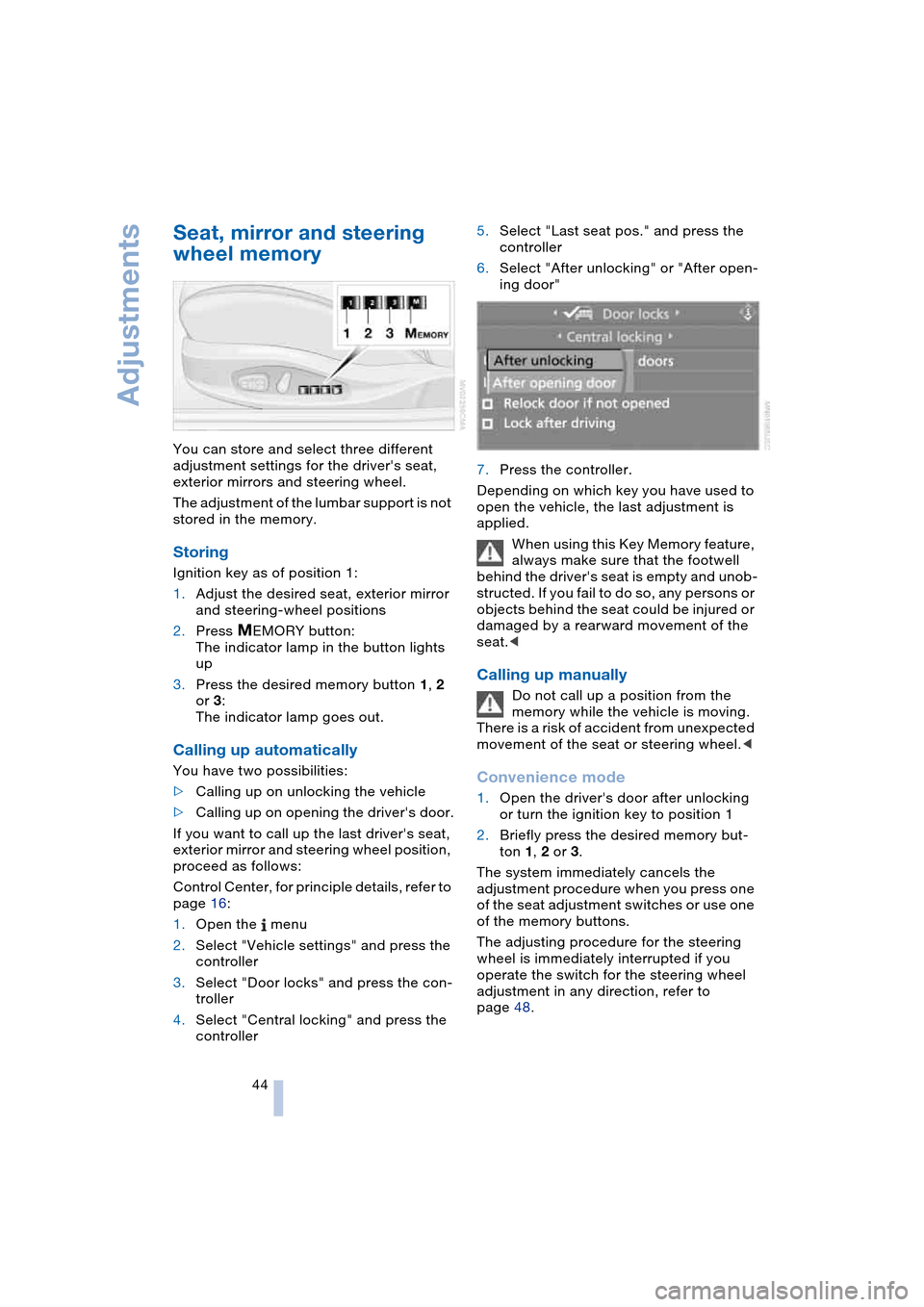
You can store and select three different
adjustment settings for the driver's seat,
exterior mirrors and steering wheel.
The adjustment of the lumbar support is not
stored in the memory.
Storing
Ignition key as of position 1:
1.Adjust the desired seat, exterior mirror
and steering-wheel positions
2.Press
MEMORY button:
The indicator lamp in the button lights
up
3.Press the desired memory button 1, 2
or 3:
The indicator lamp goes out.
Calling up automatically
You have two possibilities:
>Calling up on unlocking the vehicle
>Calling up on opening the driver's door.
If you want to call up the last driver's seat,
exterior mirror and steering wheel position,
proceed as follows:
Control Center, for principle details, refer to
page 16:
1.Open the menu
2.Select "Vehicle settings" and press the
controller
3.Select "Door locks" and press the con-
troller
4.Select "Central locking" and press the
controller5.Select "Last seat pos." and press the
controller
6.Select "After unlocking" or "After open-
ing door"
7.Press the controller.
Depending on which key you have used to
open the vehicle, the last adjustment is
applied.
When using this Key Memory feature,
always make sure that the footwell
behind the driver's seat is empty and unob-
structed. If you fail to do so, any persons or
objects behind the seat could be injured or
damaged by a rearward movement of the
seat.<
Calling up manually
Do not call up a position from the
memory while the vehicle is moving.
There is a risk of accident from unexpected
movement of the seat or steering wheel.<
Convenience mode
1.Open the driver's door after unlocking
or turn the ignition key to position 1
2.Briefly press the desired memory but-
ton 1, 2 or 3.
The system immediately cancels the
adjustment procedure when you press one
of the seat adjustment switches or use one
of the memory buttons.
The adjusting procedure for the steering
wheel is immediately interrupted if you
operate the switch for the steering wheel
adjustment in any direction, refer to
page 48.