front BMW 7 SERIES 2016 G11 Manual Online
[x] Cancel search | Manufacturer: BMW, Model Year: 2016, Model line: 7 SERIES, Model: BMW 7 SERIES 2016 G11Pages: 314, PDF Size: 7.9 MB
Page 219 of 314
CAUTION
If metal objects fall into the socket, they
can cause a short circuit. There is risk of prop‐
erty damage. Replace the cigarette lighter or
socket cover again after using the socket.◀
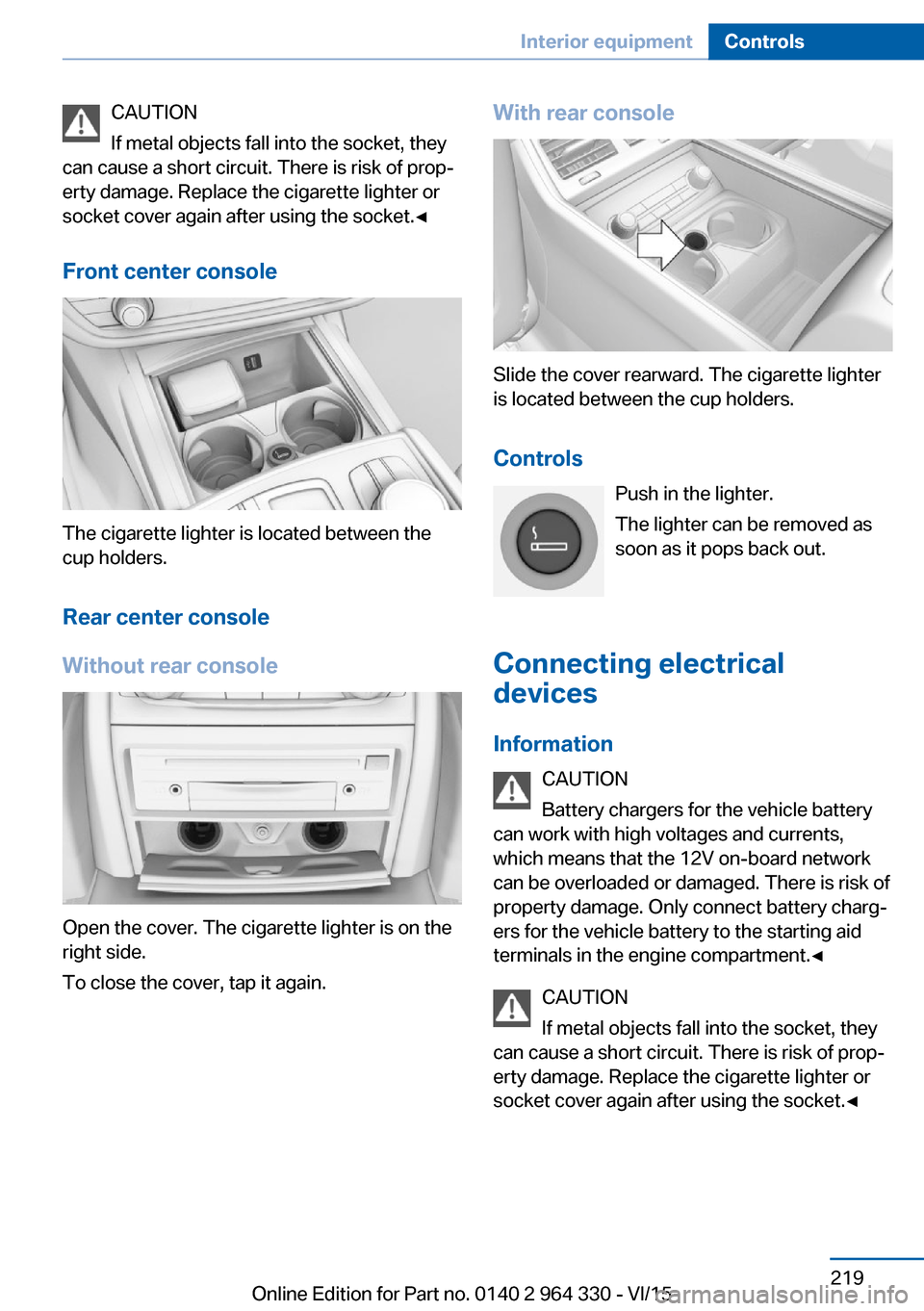
Front center console
The cigarette lighter is located between the
cup holders.
Rear center console
Without rear console
Open the cover. The cigarette lighter is on the
right side.
To close the cover, tap it again.
With rear console
Slide the cover rearward. The cigarette lighter
is located between the cup holders.
Controls Push in the lighter.
The lighter can be removed as
soon as it pops back out.
Connecting electrical devices
Information CAUTION
Battery chargers for the vehicle battery
can work with high voltages and currents,
which means that the 12V on-board network
can be overloaded or damaged. There is risk of
property damage. Only connect battery charg‐
ers for the vehicle battery to the starting aid
terminals in the engine compartment.◀
CAUTION
If metal objects fall into the socket, they
can cause a short circuit. There is risk of prop‐
erty damage. Replace the cigarette lighter or
socket cover again after using the socket.◀
Seite 219Interior equipmentControls219
Online Edition for Part no. 0140 2 964 330 - VI/15
Page 220 of 314
Sockets
General information
The lighter socket can be used as a socket for
electrical equipment when operation and the
drive-ready state are switched on.
Information
The total load of all sockets must not exceed
140 watts at 12 volts.
Do not damage the socket by using non-com‐
patible connectors.
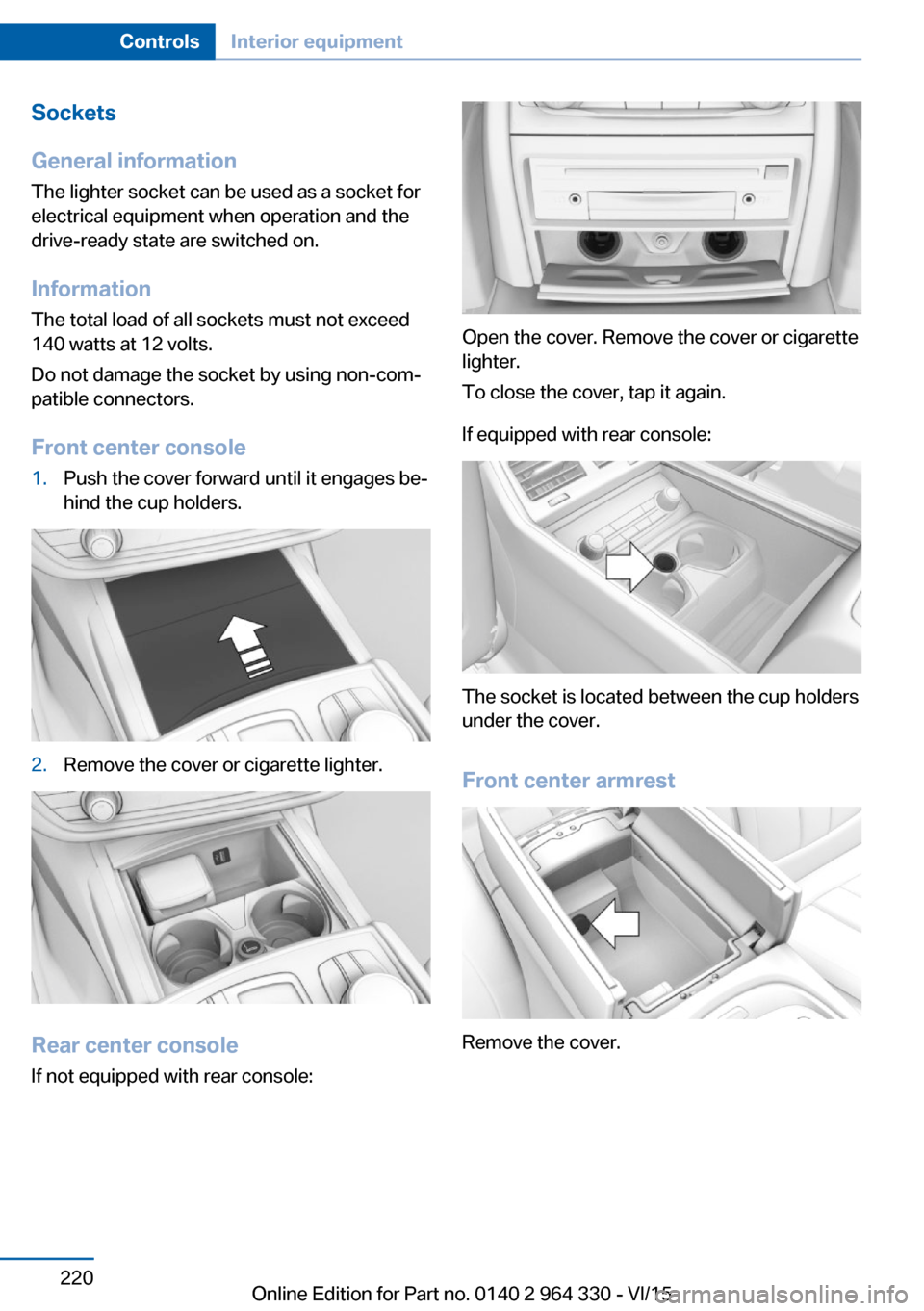
Front center console1.Push the cover forward until it engages be‐
hind the cup holders.2.Remove the cover or cigarette lighter.
Rear center console
If not equipped with rear console:
Open the cover. Remove the cover or cigarette
lighter.
To close the cover, tap it again.
If equipped with rear console:
The socket is located between the cup holders
under the cover.
Front center armrest
Remove the cover.
Seite 220ControlsInterior equipment220
Online Edition for Part no. 0140 2 964 330 - VI/15
Page 225 of 314
Storage compartmentsVehicle features and optionsThis chapter describes all standard, country-
specific and optional features offered with the
series. It also describes features that are not
necessarily available in your car, e. g., due to
the selected options or country versions. This
also applies to safety-related functions and
systems. The respectively applicable country
provisions must be observed when using the
respective features and systems.
Information WARNING
Loose objects in the car's interior can be
thrown into the car's interior while driving, e.g.
in the event of an accident or during braking
and evasive maneuvers. There is risk of inju‐
ries. Secure loose objects in the car's inte‐
rior.◀
CAUTION
Anti-slip pads such as anti-slip mats can
damage the dashboard. There is risk of prop‐
erty damage. Do not use anti-slip pads.◀
Storage compartments The following storage compartments are avail‐
able in the vehicle interior:▷Glove compartment on the front passenger
side, refer to page 225.▷Glove compartment on the driver's side,
refer to page 226.▷Compartments in the doors, refer to
page 226.▷Storage compartment on the center con‐
sole, refer to page 226.▷Center armrest, refer to page 227.▷Storage compartment in the rear, refer to
page 227.▷Storage compartment in the rear center
console, refer to page 226.▷Pockets on the backrests of the front
seats.
Glove compartment
Front passenger side
Information WARNING
Folded open, the glove compartment
protrudes in the car's interior. Objects in the glove compartment can be thrown into the
car's interior while driving, e.g. in the event of
an accident or during braking and evasive ma‐
neuvers. There is risk of injuries. Always close
the glove compartment immediately after us‐ ing it.◀
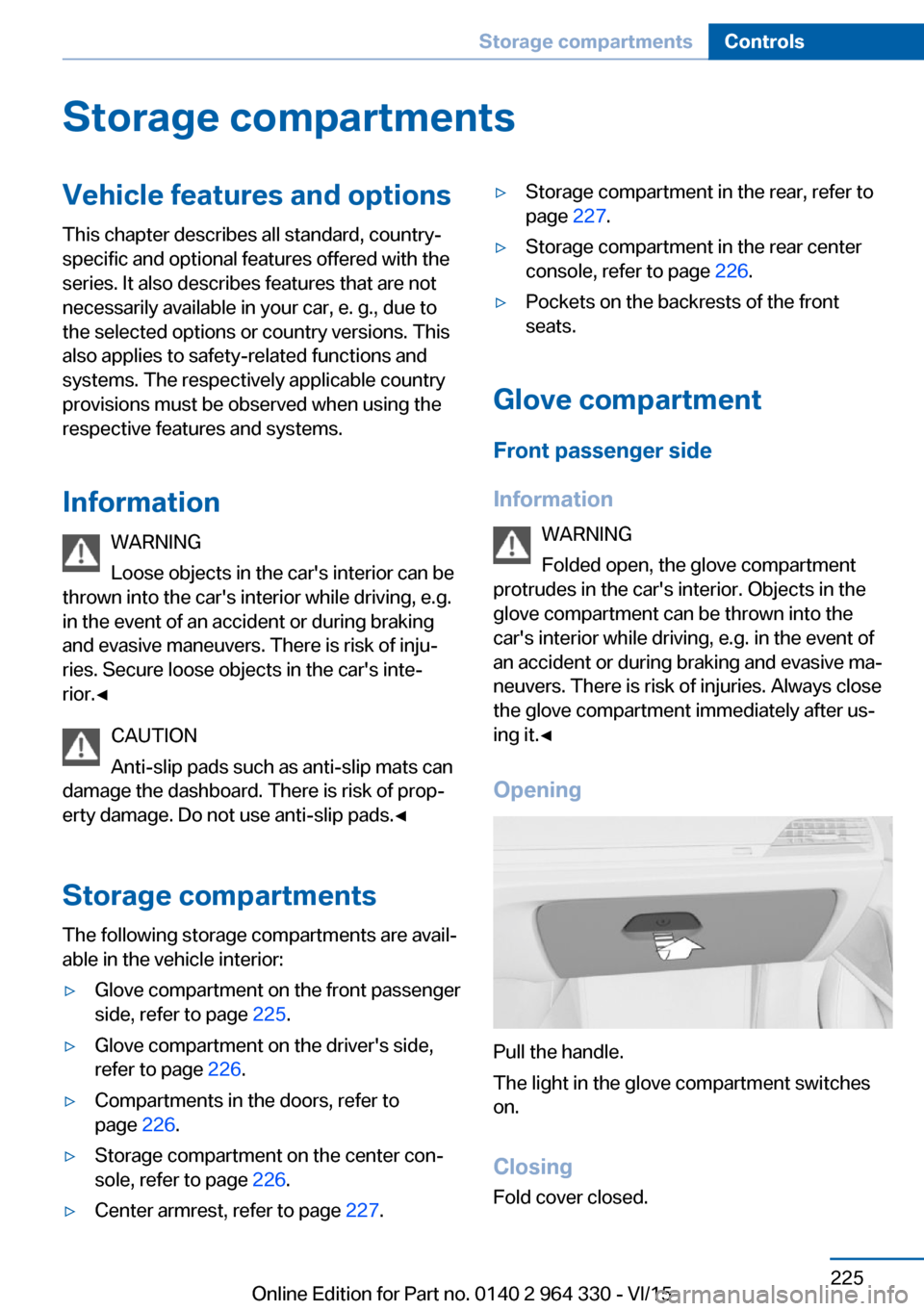
Opening
Pull the handle.
The light in the glove compartment switches
on.
ClosingFold cover closed.
Seite 225Storage compartmentsControls225
Online Edition for Part no. 0140 2 964 330 - VI/15
Page 227 of 314
Storage compartment in the
rear
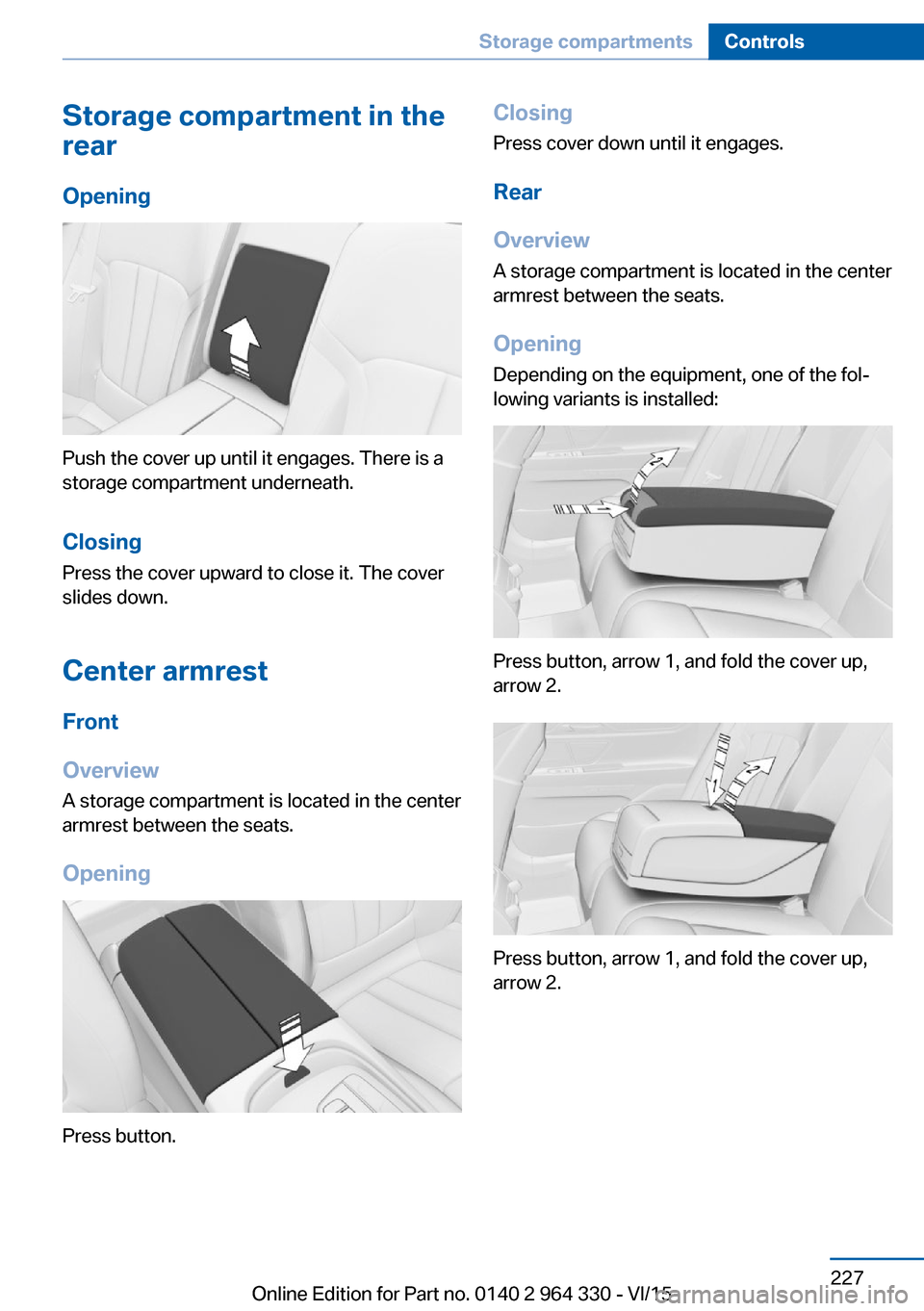
Opening
Push the cover up until it engages. There is a
storage compartment underneath.
Closing Press the cover upward to close it. The cover
slides down.
Center armrest
Front
Overview
A storage compartment is located in the center
armrest between the seats.
Opening
Press button.
ClosingPress cover down until it engages.
Rear
Overview
A storage compartment is located in the center armrest between the seats.
Opening
Depending on the equipment, one of the fol‐
lowing variants is installed:
Press button, arrow 1, and fold the cover up,
arrow 2.
Press button, arrow 1, and fold the cover up,
arrow 2.
Seite 227Storage compartmentsControls227
Online Edition for Part no. 0140 2 964 330 - VI/15
Page 228 of 314
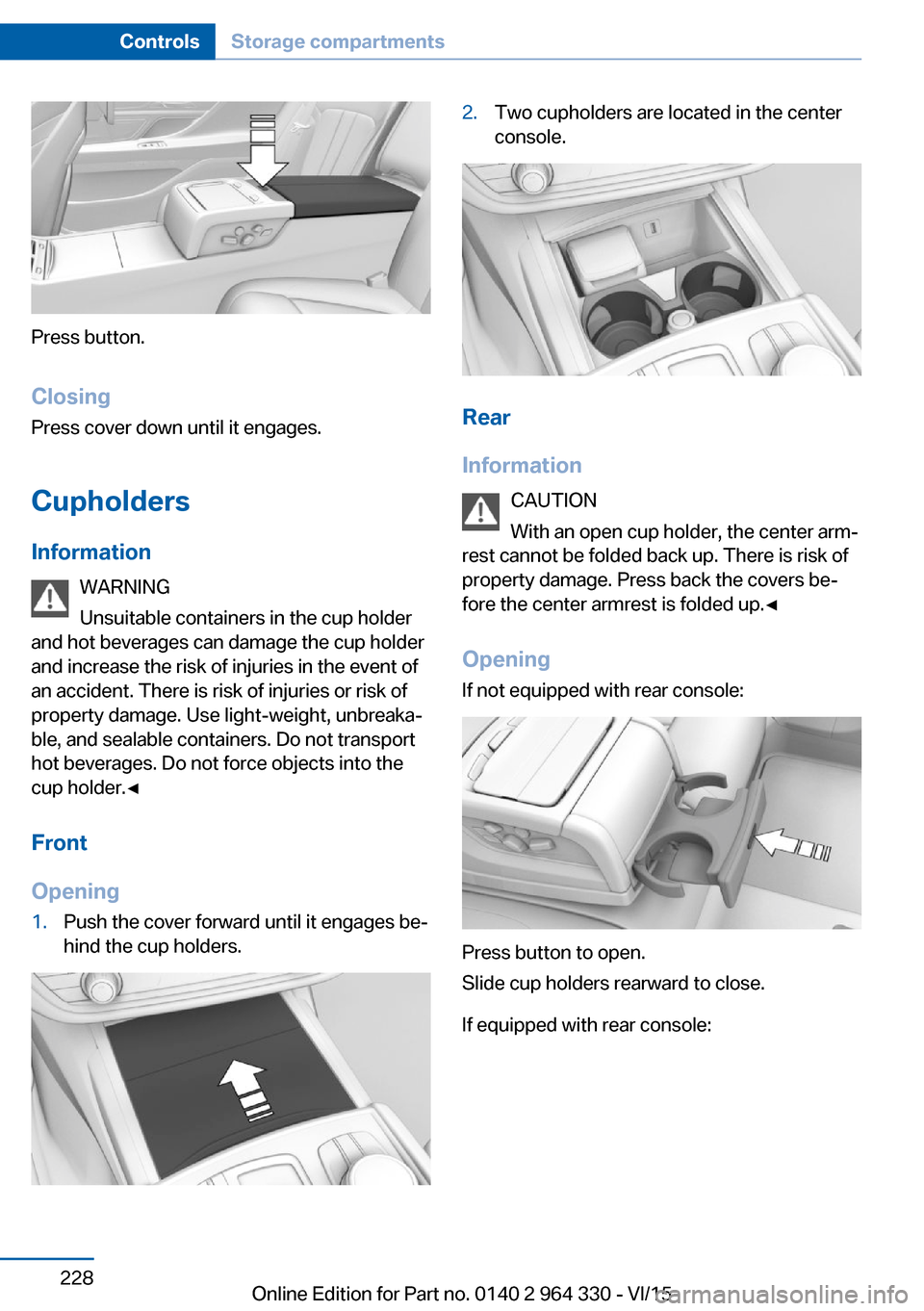
Press button.
Closing Press cover down until it engages.
Cupholders
Information WARNING
Unsuitable containers in the cup holder
and hot beverages can damage the cup holder
and increase the risk of injuries in the event of
an accident. There is risk of injuries or risk of
property damage. Use light-weight, unbreaka‐
ble, and sealable containers. Do not transport
hot beverages. Do not force objects into the
cup holder.◀
Front
Opening
1.Push the cover forward until it engages be‐
hind the cup holders.2.Two cupholders are located in the center
console.
Rear
Information CAUTION
With an open cup holder, the center arm‐
rest cannot be folded back up. There is risk of
property damage. Press back the covers be‐
fore the center armrest is folded up.◀
Opening If not equipped with rear console:
Press button to open.
Slide cup holders rearward to close.
If equipped with rear console:
Seite 228ControlsStorage compartments228
Online Edition for Part no. 0140 2 964 330 - VI/15
Page 255 of 314
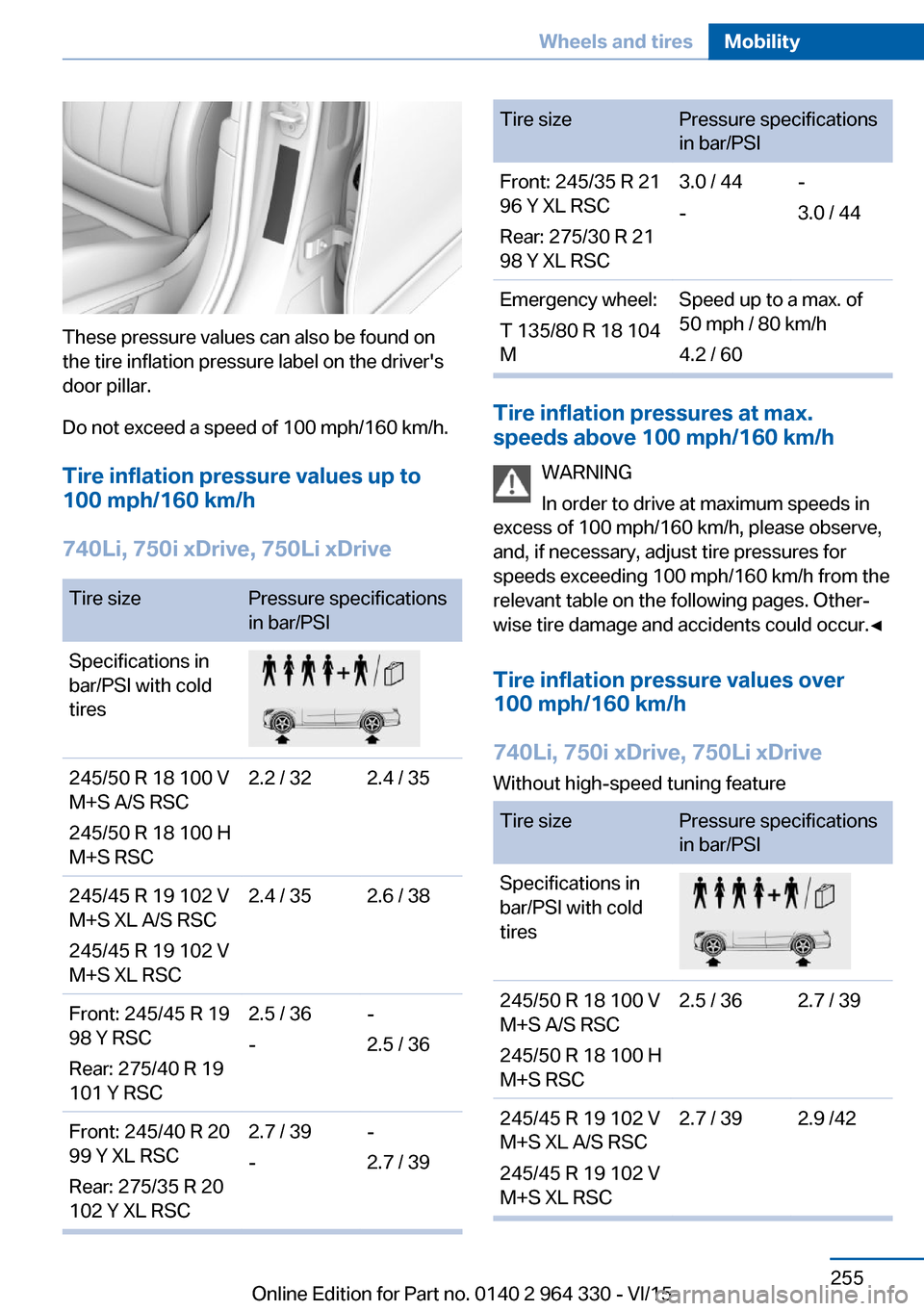
These pressure values can also be found on
the tire inflation pressure label on the driver's
door pillar.
Do not exceed a speed of 100 mph/160 km/h.
Tire inflation pressure values up to
100 mph/160 km/h
740Li, 750i xDrive, 750Li xDrive
Tire sizePressure specifications
in bar/PSISpecifications in
bar/PSI with cold
tires245/50 R 18 100 V
M+S A/S RSC
245/50 R 18 100 H
M+S RSC2.2 / 322.4 / 35245/45 R 19 102 V
M+S XL A/S RSC
245/45 R 19 102 V
M+S XL RSC2.4 / 352.6 / 38Front: 245/45 R 19
98 Y RSC
Rear: 275/40 R 19
101 Y RSC2.5 / 36
--
2.5 / 36Front: 245/40 R 20
99 Y XL RSC
Rear: 275/35 R 20
102 Y XL RSC2.7 / 39
--
2.7 / 39Tire sizePressure specifications
in bar/PSIFront: 245/35 R 21
96 Y XL RSC
Rear: 275/30 R 21
98 Y XL RSC3.0 / 44
--
3.0 / 44Emergency wheel:
T 135/80 R 18 104
MSpeed up to a max. of
50 mph / 80 km/h
4.2 / 60
Tire inflation pressures at max.
speeds above 100 mph/160 km/h
WARNING
In order to drive at maximum speeds in
excess of 100 mph/160 km/h, please observe,
and, if necessary, adjust tire pressures for
speeds exceeding 100 mph/160 km/h from the
relevant table on the following pages. Other‐
wise tire damage and accidents could occur.◀
Tire inflation pressure values over
100 mph/160 km/h
740Li, 750i xDrive, 750Li xDrive
Without high-speed tuning feature
Tire sizePressure specifications
in bar/PSISpecifications in
bar/PSI with cold
tires245/50 R 18 100 V
M+S A/S RSC
245/50 R 18 100 H
M+S RSC2.5 / 362.7 / 39245/45 R 19 102 V
M+S XL A/S RSC
245/45 R 19 102 V
M+S XL RSC2.7 / 392.9 /42Seite 255Wheels and tiresMobility255
Online Edition for Part no. 0140 2 964 330 - VI/15
Page 256 of 314
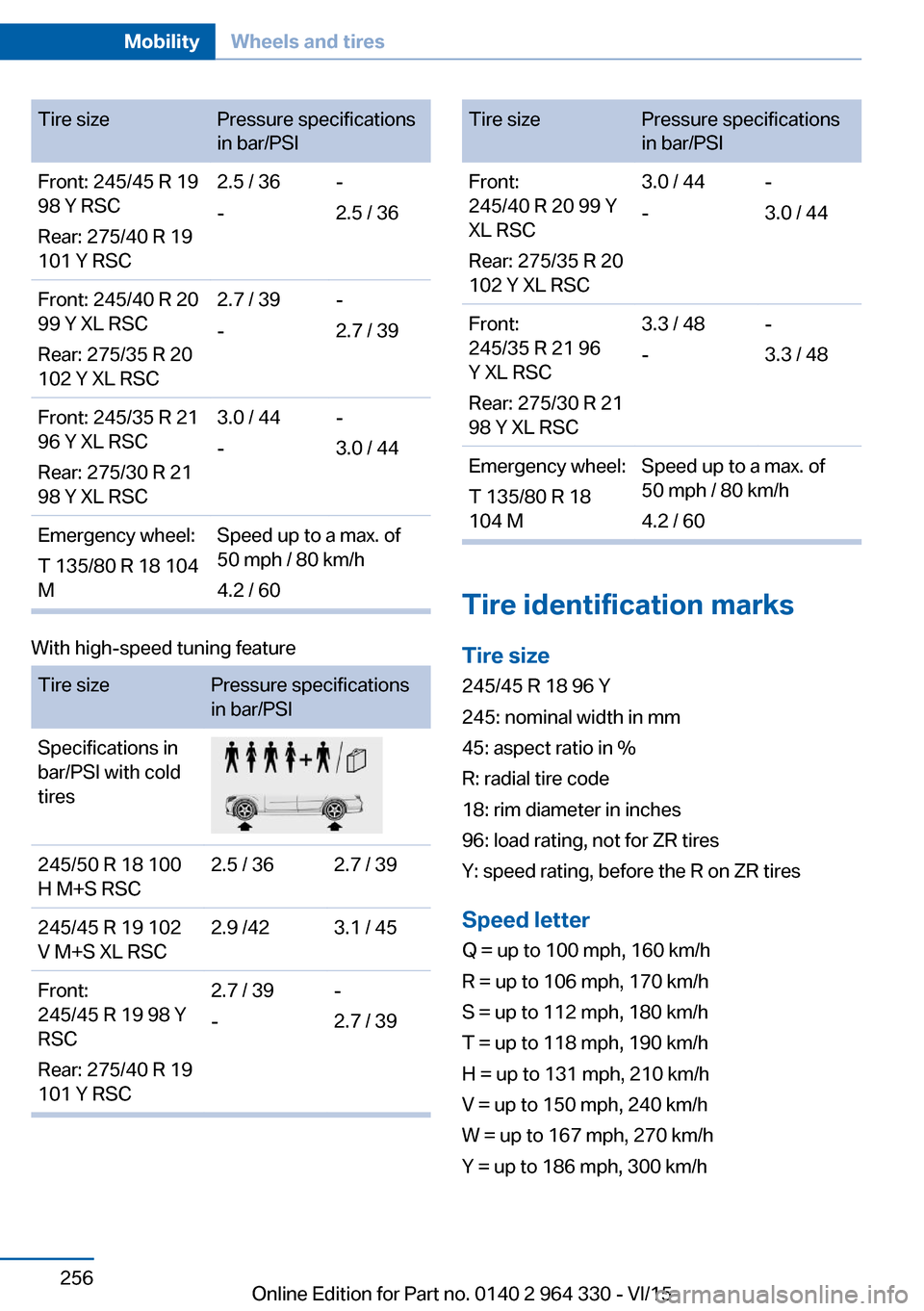
Tire sizePressure specifications
in bar/PSIFront: 245/45 R 19
98 Y RSC
Rear: 275/40 R 19
101 Y RSC2.5 / 36
--
2.5 / 36Front: 245/40 R 20
99 Y XL RSC
Rear: 275/35 R 20
102 Y XL RSC2.7 / 39
--
2.7 / 39Front: 245/35 R 21
96 Y XL RSC
Rear: 275/30 R 21
98 Y XL RSC3.0 / 44
--
3.0 / 44Emergency wheel:
T 135/80 R 18 104
MSpeed up to a max. of
50 mph / 80 km/h
4.2 / 60
With high-speed tuning feature
Tire sizePressure specifications
in bar/PSISpecifications in
bar/PSI with cold
tires245/50 R 18 100
H M+S RSC2.5 / 362.7 / 39245/45 R 19 102
V M+S XL RSC2.9 /423.1 / 45Front:
245/45 R 19 98 Y
RSC
Rear: 275/40 R 19
101 Y RSC2.7 / 39
--
2.7 / 39Tire sizePressure specifications
in bar/PSIFront:
245/40 R 20 99 Y
XL RSC
Rear: 275/35 R 20
102 Y XL RSC3.0 / 44
--
3.0 / 44Front:
245/35 R 21 96
Y XL RSC
Rear: 275/30 R 21
98 Y XL RSC3.3 / 48
--
3.3 / 48Emergency wheel:
T 135/80 R 18
104 MSpeed up to a max. of
50 mph / 80 km/h
4.2 / 60
Tire identification marks
Tire size 245/45 R 18 96 Y
245: nominal width in mm
45: aspect ratio in %
R: radial tire code
18: rim diameter in inches
96: load rating, not for ZR tires
Y: speed rating, before the R on ZR tires
Speed letter
Q = up to 100 mph, 160 km/h
R = up to 106 mph, 170 km/h
S = up to 112 mph, 180 km/h
T = up to 118 mph, 190 km/h
H = up to 131 mph, 210 km/h
V = up to 150 mph, 240 km/h
W = up to 167 mph, 270 km/h
Y = up to 186 mph, 300 km/h
Seite 256MobilityWheels and tires256
Online Edition for Part no. 0140 2 964 330 - VI/15
Page 260 of 314
Rotating wheels between axlesDifferent wear patterns can occur on the frontand rear axles depending on individual driving
conditions. The tires can be rotated between
the axles to achieve even wear. A dealer’s
service center or another qualified service cen‐
ter or repair shop will be glad to answer addi‐
tional questions at any time. After rotating,
check the tire pressure and correct if needed.
Rotating the tires is not permissible on vehi‐
cles with different tire sizes or rim sizes on the
front and rear axles.
Storage
Store wheels and tires in a cool, dry place with
as little exposure to light as possible.
Always protect tires against all contact with oil,
grease and fuels.
Do not exceed the maximum tire inflation pres‐
sure indicated on the side wall of the tire.
Run-flat tires
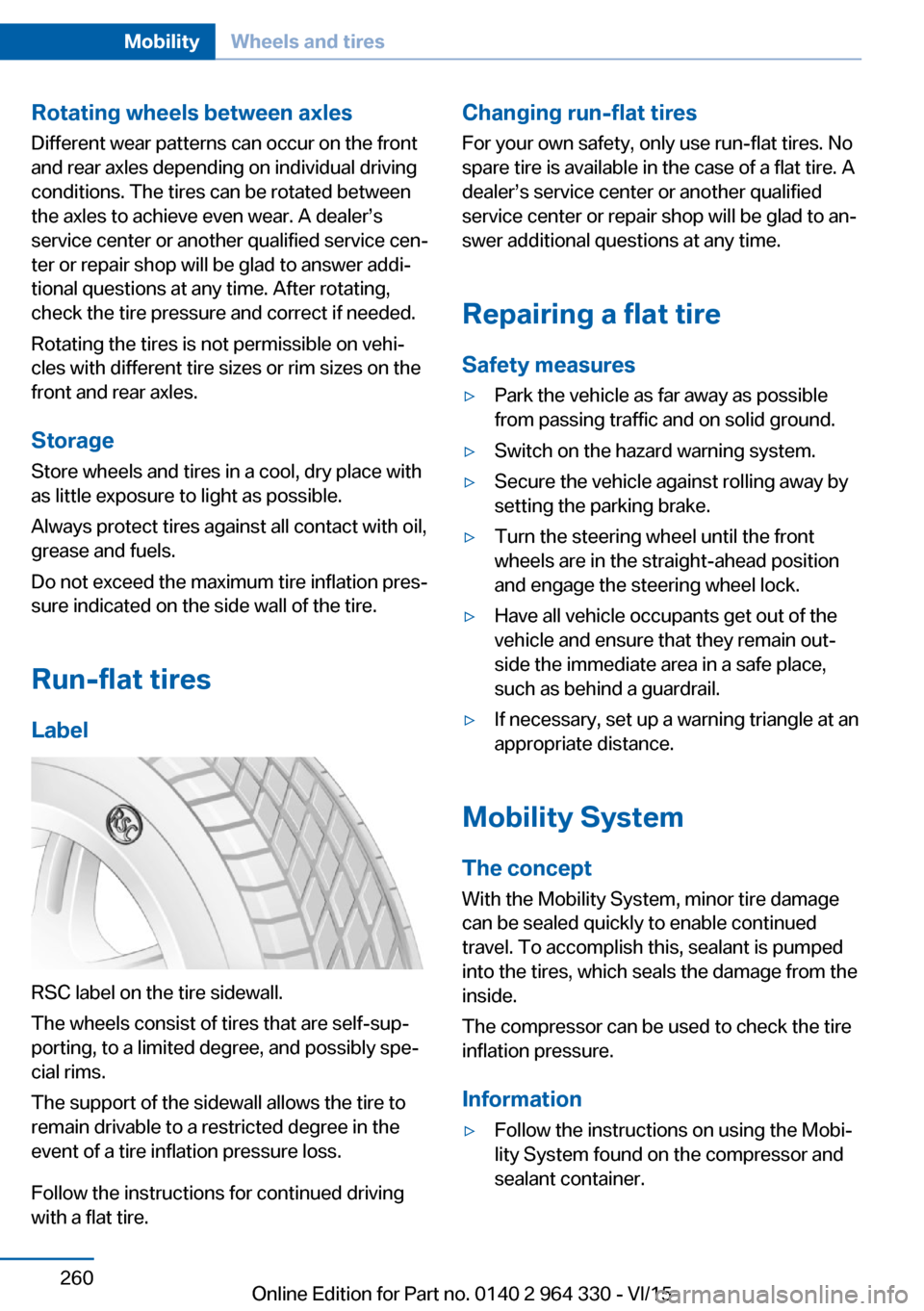
Label
RSC label on the tire sidewall.
The wheels consist of tires that are self-sup‐
porting, to a limited degree, and possibly spe‐
cial rims.
The support of the sidewall allows the tire to
remain drivable to a restricted degree in the
event of a tire inflation pressure loss.
Follow the instructions for continued driving
with a flat tire.
Changing run-flat tires
For your own safety, only use run-flat tires. No
spare tire is available in the case of a flat tire. A
dealer’s service center or another qualified
service center or repair shop will be glad to an‐
swer additional questions at any time.
Repairing a flat tire Safety measures▷Park the vehicle as far away as possible
from passing traffic and on solid ground.▷Switch on the hazard warning system.▷Secure the vehicle against rolling away by
setting the parking brake.▷Turn the steering wheel until the front
wheels are in the straight-ahead position
and engage the steering wheel lock.▷Have all vehicle occupants get out of the
vehicle and ensure that they remain out‐
side the immediate area in a safe place,
such as behind a guardrail.▷If necessary, set up a warning triangle at an
appropriate distance.
Mobility System
The concept
With the Mobility System, minor tire damage
can be sealed quickly to enable continued
travel. To accomplish this, sealant is pumped
into the tires, which seals the damage from the
inside.
The compressor can be used to check the tire
inflation pressure.
Information
▷Follow the instructions on using the Mobi‐
lity System found on the compressor and
sealant container.Seite 260MobilityWheels and tires260
Online Edition for Part no. 0140 2 964 330 - VI/15
Page 281 of 314
Replacing componentsVehicle features and optionsThis chapter describes all standard, country-
specific and optional features offered with the
series. It also describes features that are not
necessarily available in your car, e. g., due to
the selected options or country versions. This
also applies to safety-related functions and
systems. The respectively applicable country
provisions must be observed when using the
respective features and systems.
Onboard vehicle tool kit
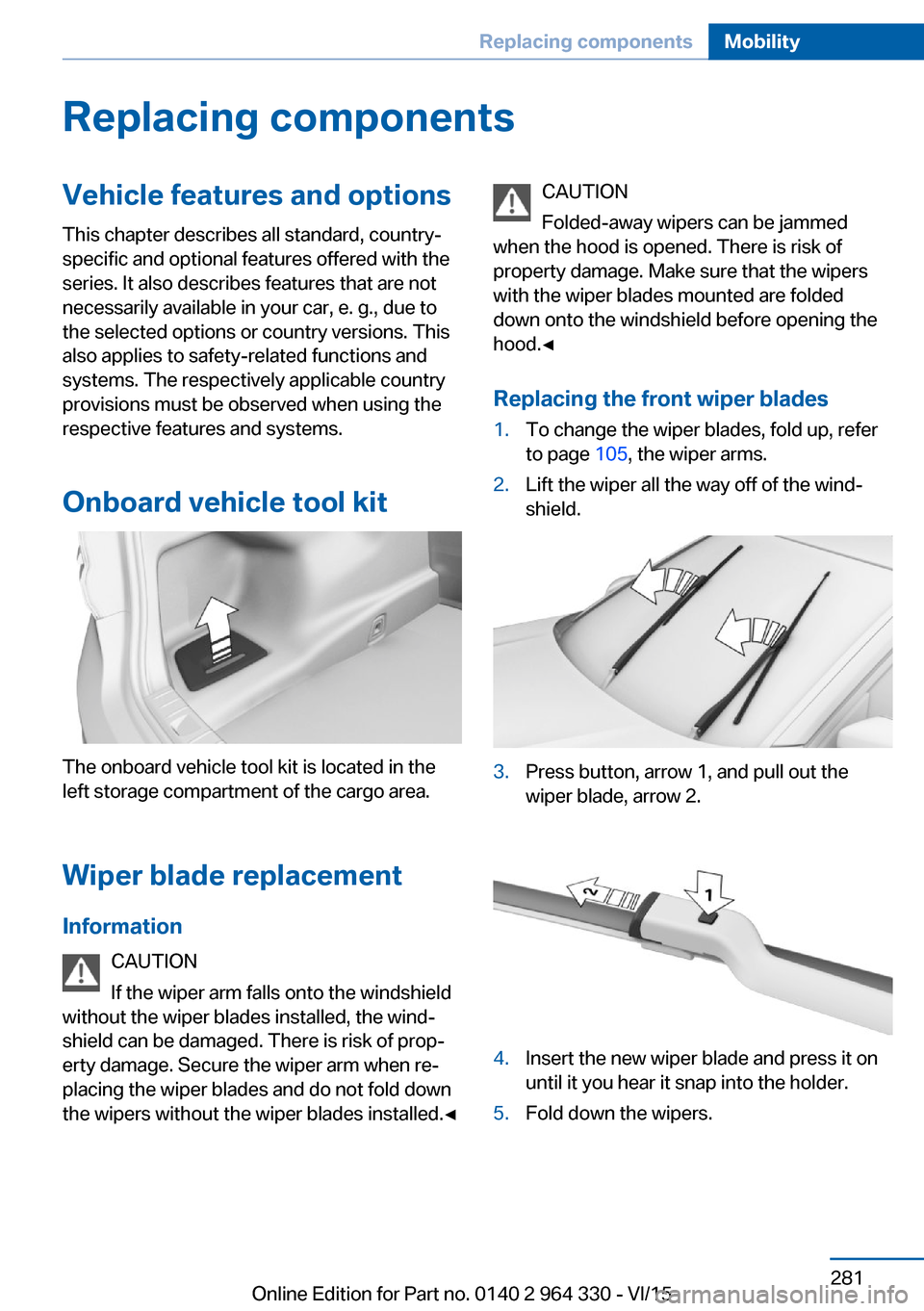
The onboard vehicle tool kit is located in the
left storage compartment of the cargo area.
Wiper blade replacement
Information CAUTION
If the wiper arm falls onto the windshield
without the wiper blades installed, the wind‐
shield can be damaged. There is risk of prop‐
erty damage. Secure the wiper arm when re‐
placing the wiper blades and do not fold down
the wipers without the wiper blades installed.◀
CAUTION
Folded-away wipers can be jammed
when the hood is opened. There is risk of
property damage. Make sure that the wipers
with the wiper blades mounted are folded
down onto the windshield before opening the
hood.◀
Replacing the front wiper blades1.To change the wiper blades, fold up, refer
to page 105, the wiper arms.2.Lift the wiper all the way off of the wind‐
shield.3.Press button, arrow 1, and pull out the
wiper blade, arrow 2.4.Insert the new wiper blade and press it on
until it you hear it snap into the holder.5.Fold down the wipers.Seite 281Replacing componentsMobility281
Online Edition for Part no. 0140 2 964 330 - VI/15
Page 283 of 314
▷Have all vehicle occupants get out of the
vehicle and ensure that they remain out‐
side the immediate area in a safe place,
such as behind a guardrail.▷If necessary, set up a warning triangle or
portable hazard warning lamp at an appro‐
priate distance.▷Perform wheel change only on a flat, solid
and slip-resistant surface. On soft or slip‐
pery ground, e.g., snow, ice, tiles, etc., the
vehicle or vehicle jack can slip away to the
side.▷Do not place wood blocks or similar items
under the vehicle jack; otherwise, it cannot
reach its carrying capacity because of the
restricted height.▷If the vehicle is raised, do not lie under the
vehicle and do not start the engine; other‐
wise, a fatal hazard exists.
Information
WARNING
The vehicle jack is optimized for lifting
the vehicle and for the jacking points on the
vehicle only. There is risk of injuries. Do not lift
any other vehicle or cargo using the vehicle
jack.◀
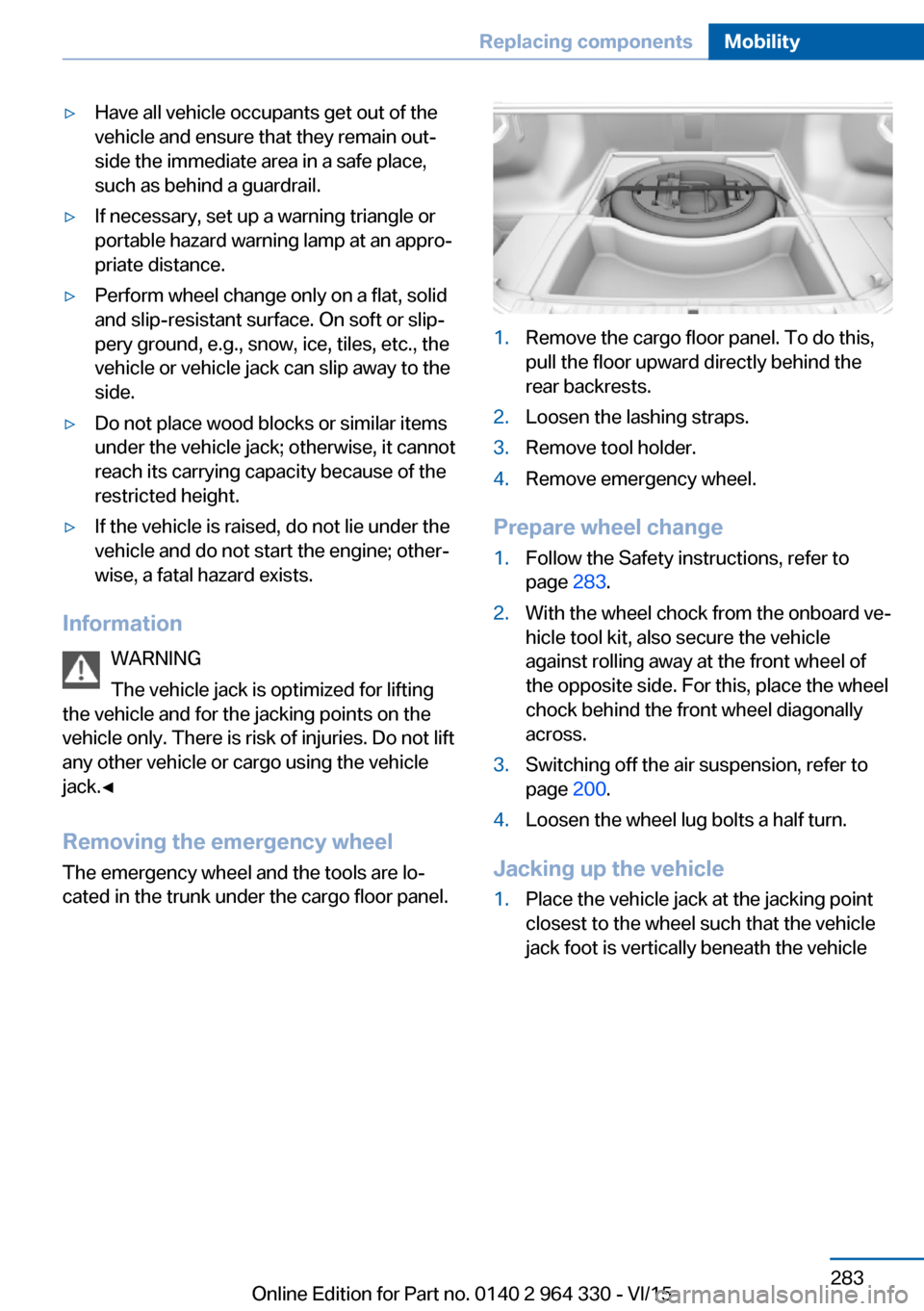
Removing the emergency wheel The emergency wheel and the tools are lo‐
cated in the trunk under the cargo floor panel.
1.Remove the cargo floor panel. To do this,
pull the floor upward directly behind the
rear backrests.2.Loosen the lashing straps.3.Remove tool holder.4.Remove emergency wheel.
Prepare wheel change
1.Follow the Safety instructions, refer to
page 283.2.With the wheel chock from the onboard ve‐
hicle tool kit, also secure the vehicle
against rolling away at the front wheel of
the opposite side. For this, place the wheel
chock behind the front wheel diagonally
across.3.Switching off the air suspension, refer to
page 200.4.Loosen the wheel lug bolts a half turn.
Jacking up the vehicle
1.Place the vehicle jack at the jacking point
closest to the wheel such that the vehicle
jack foot is vertically beneath the vehicleSeite 283Replacing componentsMobility283
Online Edition for Part no. 0140 2 964 330 - VI/15