ESP BMW 740I 1998 Service Manual
[x] Cancel search | Manufacturer: BMW, Model Year: 1998, Model line: 740I, Model: BMW 740I 1998Pages: 211, PDF Size: 1.68 MB
Page 177 of 211
176n
FusesIf an electrical accessory should fail,
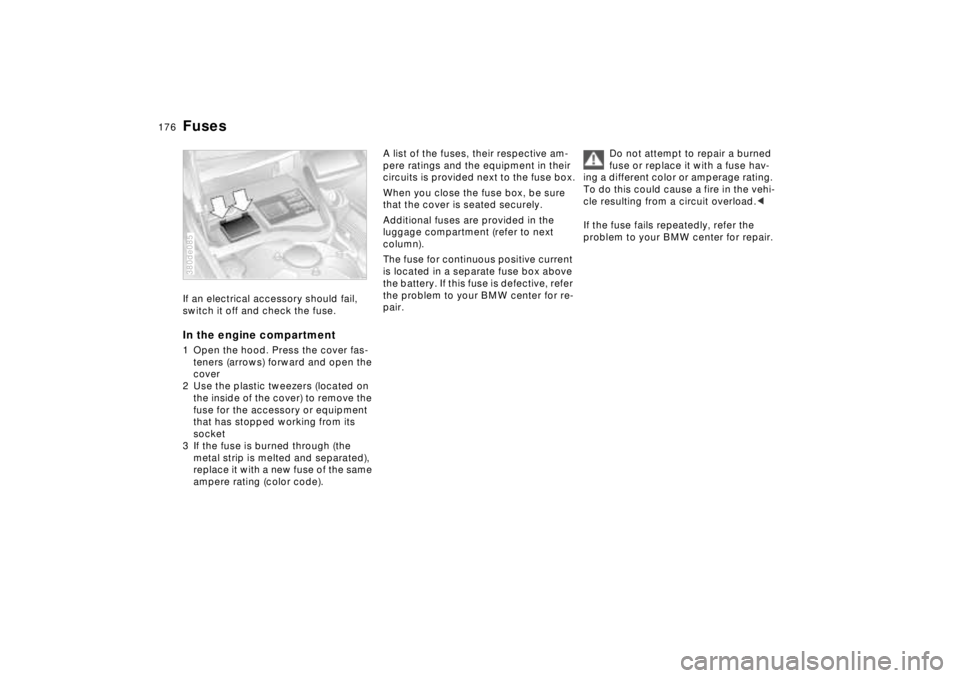
switch it off and check the fuse.In the engine compartment1 Open the hood. Press the cover fas-
teners (arrows) forward and open the
cover
2 Use the plastic tweezers (located on
the inside of the cover) to remove the
fuse for the accessory or equipment
that has stopped working from its
socket
3 If the fuse is burned through (the
metal strip is melted and separated),
replace it with a new fuse of the same
ampere rating (color code).380de085
A list of the fuses, their respective am-
pere ratings and the equipment in their
circuits is provided next to the fuse box.
When you close the fuse box, be sure
that the cover is seated securely.
Additional fuses are provided in the
luggage compartment (refer to next
column).
The fuse for continuous positive current
is located in a separate fuse box above
the battery. If this fuse is defective, refer
the problem to your BMW center for re-
pair.Do not attempt to repair a burned
fuse or replace it with a fuse hav-
ing a different color or amperage rating.
To do this could cause a fire in the vehi-
cle resulting from a circuit overload.<
If the fuse fails repeatedly, refer the
problem to your BMW center for repair.
Page 178 of 211
177n
RepairsIndexOverview Controls Car care Technology Data
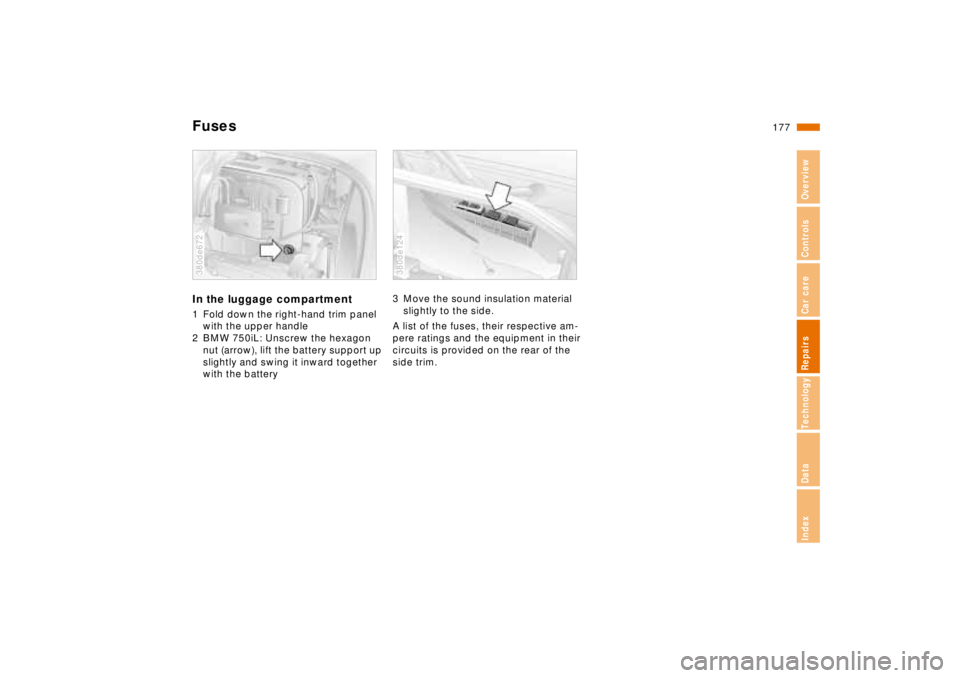
FusesIn the luggage compartment1 Fold down the right-hand trim panel
with the upper handle
2 BMW 750iL: Unscrew the hexagon
nut (arrow), lift the battery support up
slightly and swing it inward together
with the battery380de672
3 Move the sound insulation material
slightly to the side.
A list of the fuses, their respective am-
pere ratings and the equipment in their
circuits is provided on the rear of the
side trim.380de124
Page 182 of 211
181n
RepairsIndexOverview Controls Car care Technology Data
Towing the vehicle
The towed vehicle should always
be the lighter of the two vehicles.
If this is not the case, it is no longer
possible to control vehicle response.<
Tow-startingIt is not possible to start the engine of
vehicles equipped with automatic trans-
mission by towing or pushing.
For instructions on jump starting, refer
to page 179.
Never attempt to use your vehicle to
push another car, as damage to the
energy-absorbing bumpers could
result.
Towing a vehicle with automatic
transmission1 Place selector lever in position N
2 Towing speed:
Max. 45 mph (70 km/h)
3 Towing distance:
Max. 95 miles (150 km)
4 Leave the ignition key at position 1 to
ensure that the brake lamps, turn sig-
nals, horn and windshield wipers re-
main operative, and to prevent the
steering lock detent from engaging
5 Switch on the hazard-warning system
(observe country-specific regula-
tions).
Find some means of identifying the ve-
hicle in tow, for instance, place a sign
or warning triangle in the rear window.
Make sure that the ignition key re-
mains in position 1 even when the
electrical system has failed to prevent
the steering lock from engaging.
The steering and brakes are without
power assist when the engine is off.
This means that increased effort is re-
quired for steering and braking.<
Towing with a commercial tow
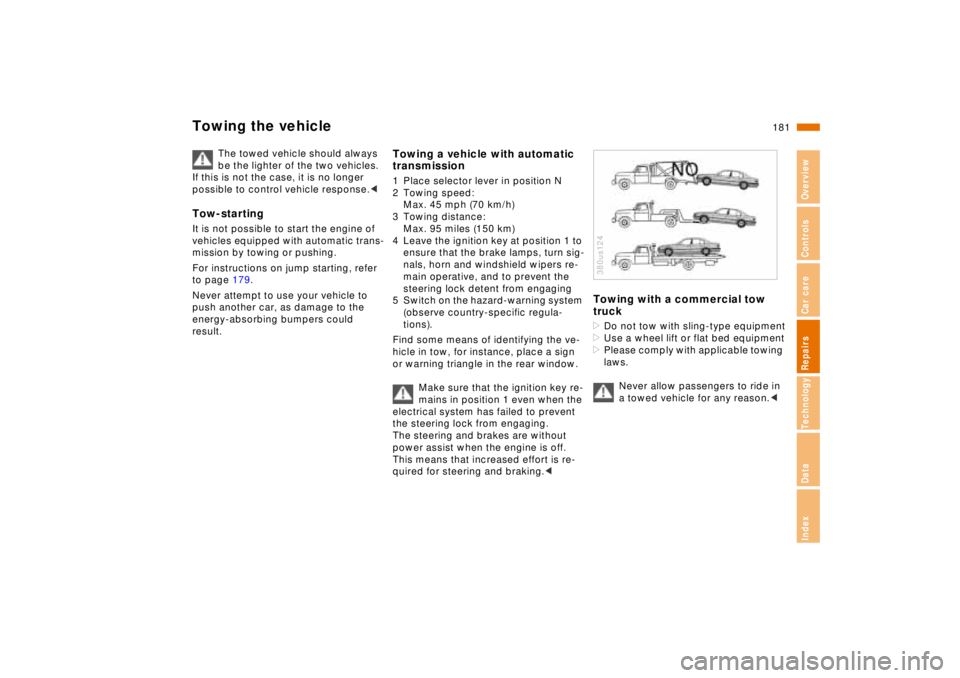
truck>Do not tow with sling-type equipment
>Use a wheel lift or flat bed equipment
>Please comply with applicable towing
laws.
Never allow passengers to ride in
a towed vehicle for any reason.< 380us124
Page 186 of 211

185n
RepairsIndexOverview Controls Car care Technology Data
In order to take driving conditions into
account, ATC registers corners and
both uphill and downhill gradients. For
example, if you maintain speed through
a curve, the transmission does not up-
shift.
On uphill gradients, it shifts only when
the engine speed increases in order to
make more efficient use of power re-
serves. On downhill gradients ATC
downshifts when the speed of the vehi-
cles increases causing the driver to
step on the brakes.
With respect to road conditions, ATC
monitors the friction between the tires
and the road. The system responds to
slippery road surfaces (snow and ice)
by activating the winter program.
Second gear is used when moving
away from a standstill, upshifts occur
sooner, and on descents downshifting
does not occur in spite of the applica-
tion of brakes. This enables you to
"feel" the road as you drive and pro-
duces greater dynamic stability. If the
friction between the tires and the road
is adequate, the normal system is again
activated. The system also leaves the
winter program when you shift from
drive position "D" to "S," "3" or "2," or if
the ASC+T/DSC
* is deactivated.By recognizing traffic conditions, ATC
can retain maximum driving comfort.
For instance, the system recognizes
stop-and-go traffic and then proceeds
only in second gear until it encounters
higher starting loads.
Of course the selector lever can still be
used to select specific gear ratios. Per-
formance-oriented driving is enabled by
shifting from drive position "D" to "S,"
"3" or "2." Positions "3" and "2" each
limit upshifts to the next gear. Position
"2" is best for driving on steep mountain
slopes with a heavy load.Precision sensors monitor the number
of revolutions of the wheels. When
equipped with DSC, they also monitor
steering angle, lateral acceleration,
brake pressure and the movement of
the vehicle around its vertical axis.
If differences in the wheel speeds oc-
cur, the system counteracts the danger
of wheelspin by reducing torque. If nec-
essary, the system also responds with
additional applications of the brakes at
the rear wheels.
If the system detects an instability in the
vehicle's condition, the braking action
can also be directed to the front wheels
by the DSC in order to stabilize the ve-
hicle.
You may need some time to become
accustomed to this system intervention.
However, it helps provide optimum pro-
pulsive force and driving stability.
The braking intervention may be ac-
companied by a certain degree of
noise.
ATC ASC+T/DSC
*
Page 188 of 211
187n
RepairsIndexOverview Controls Car care Technology Data
BMW Active Seat
*
Safety belt tensioner DSP sound system
*
This causes a movement of the spinal
column which is barely detectable, to-
gether with an improvement in the flow
of blood to the intervertebral disks and
the muscle structure in the area of the
spinal column.
The passengers do not suffer as much
from muscle tension, back pain in the
lumbar region or symptoms of fatigue.
As a result, the Active Seat represents a
significant contribution to driving com-
fort and driving safety.
The safety belt tensioner responds to
collisions by tightening the belts to en-
sure that occupants remain firmly posi-
tioned in their seats. A gas-pressure
system retracts the buckle assembly to
tension the shoulder and lap belts
within fractions of a second. This re-
duces the tendency to slide under the
lap belt.
390de330
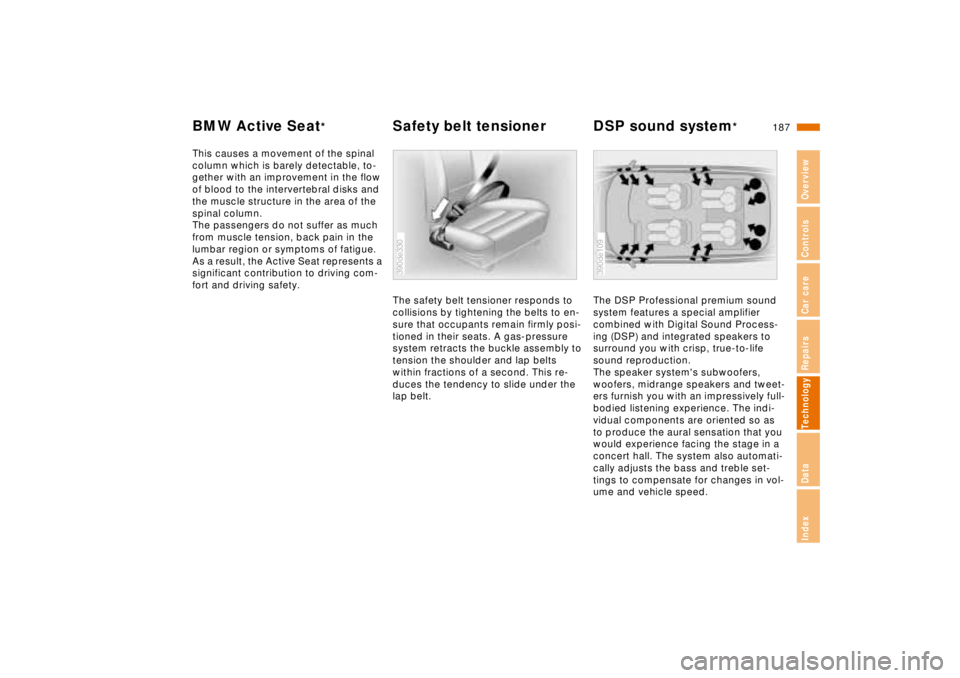
The DSP Professional premium sound
system features a special amplifier
combined with Digital Sound Process-
ing (DSP) and integrated speakers to
surround you with crisp, true-to-life
sound reproduction.
The speaker system's subwoofers,
woofers, midrange speakers and tweet-
ers furnish you with an impressively full-
bodied listening experience. The indi-
vidual components are oriented so as
to produce the aural sensation that you
would experience facing the stage in a
concert hall. The system also automati-
cally adjusts the bass and treble set-
tings to compensate for changes in vol-
ume and vehicle speed.390de109
Page 189 of 211
188n
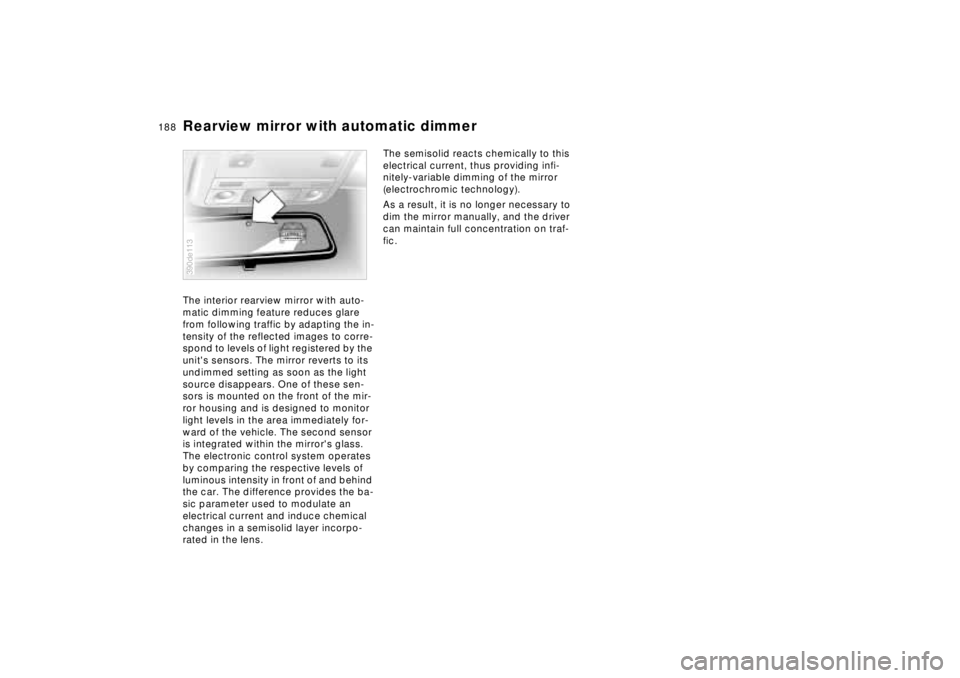
Rearview mirror with automatic dimmerThe interior rearview mirror with auto-
matic dimming feature reduces glare
from following traffic by adapting the in-
tensity of the reflected images to corre-
spond to levels of light registered by the
unit's sensors. The mirror reverts to its
undimmed setting as soon as the light
source disappears. One of these sen-
sors is mounted on the front of the mir-
ror housing and is designed to monitor
light levels in the area immediately for-
ward of the vehicle. The second sensor
is integrated within the mirror's glass.
The electronic control system operates
by comparing the respective levels of
luminous intensity in front of and behind
the car. The difference provides the ba-
sic parameter used to modulate an
electrical current and induce chemical
changes in a semisolid layer incorpo-
rated in the lens. 390de113
The semisolid reacts chemically to this
electrical current, thus providing infi-
nitely-variable dimming of the mirror
(electrochromic technology).
As a result, it is no longer necessary to
dim the mirror manually, and the driver
can maintain full concentration on traf-
fic.
Page 191 of 211
190n
Xenon lamps
*
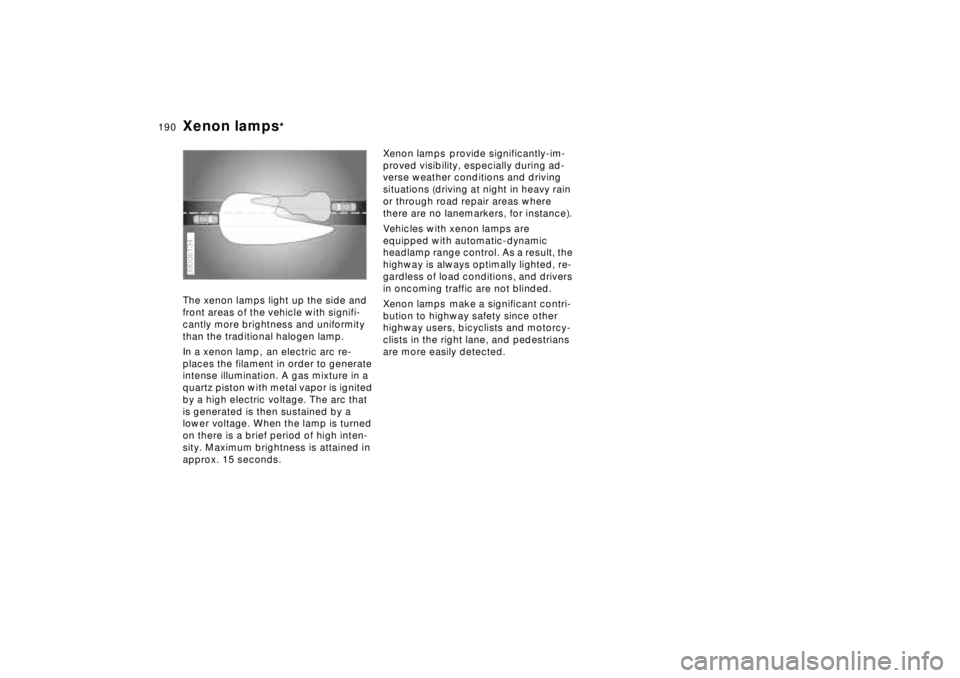
The xenon lamps light up the side and
front areas of the vehicle with signifi-
cantly more brightness and uniformity
than the traditional halogen lamp.
In a xenon lamp,
an electric arc re-
places the filament in order to generate
intense illumination. A gas mixture in a
quartz piston with metal vapor is ignited
by a high electric voltage. The arc that
is generated is then sustained by a
lower voltage. When the lamp is turned
on there is a brief period of high inten-
sity. Maximum brightness is attained in
approx. 15 seconds.
390de134
Xenon lamps
provide significantly-im-
proved visibility, especially during ad-
verse weather conditions and driving
situations (driving at night in heavy rain
or through road repair areas where
there are no lanemarkers, for instance).
Vehicles with xenon lamps are
equipped with automatic-dynamic
headlamp range control. As a result, the
highway is always optimally lighted, re-
gardless of load conditions, and drivers
in oncoming traffic are not blinded.
Xenon lamps make a significant contri-
bution to highway safety since other
highway users, bicyclists and motorcy-
clists in the right lane, and pedestrians
are more easily detected.
Page 210 of 211
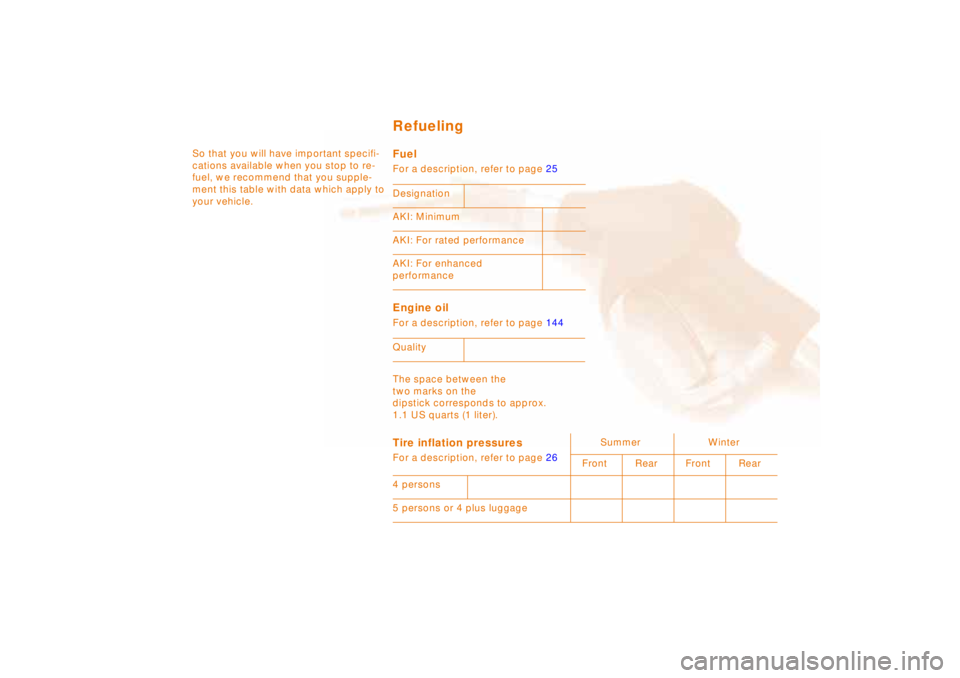
So that you will have important specifi-
cations available when you stop to re-
fuel, we recommend that you supple-
ment this table with data which apply to
your vehicle.
Fuel
For a description, refer to page 25
Engine oil For a description, refer to page 144
The space between the
two marks on the
dipstick corresponds to approx.
1.1 US quarts (1 liter). Designation
AKI: Minimum
AKI: For rated performance
AKI: For enhanced
performance
QualityTire inflation pressures For a description, refer to page 26Summer Winter
Front Rear Front Rear
4 persons
5 persons or 4 plus luggageRefueling