engine BMW 740I 1998 Workshop Manual
[x] Cancel search | Manufacturer: BMW, Model Year: 1998, Model line: 740I, Model: BMW 740I 1998Pages: 211, PDF Size: 1.68 MB
Page 159 of 211
158n
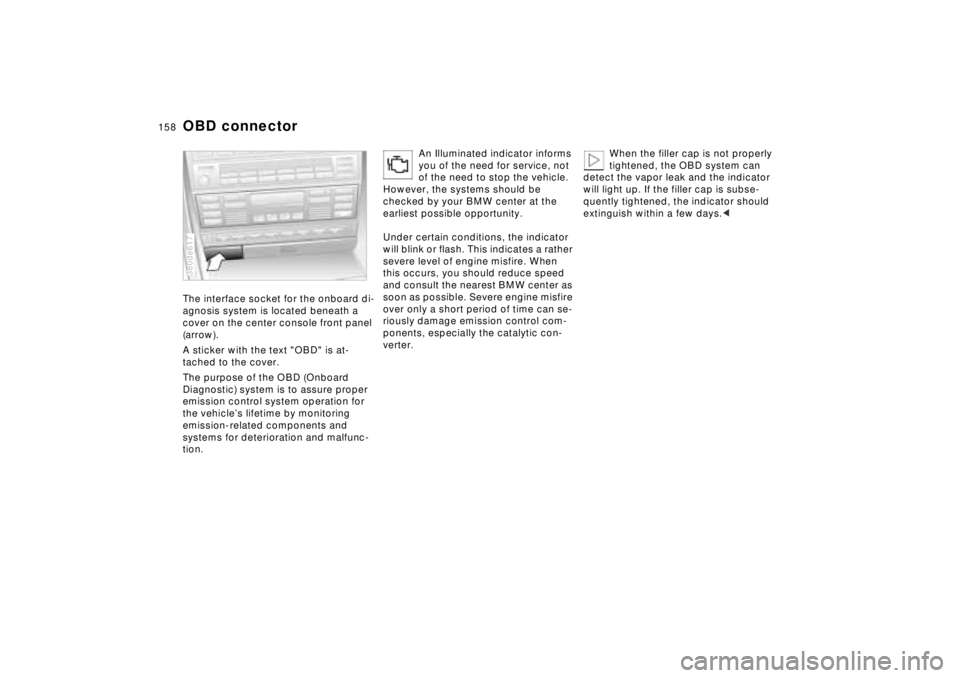
OBD connectorThe interface socket for the onboard di-
agnosis system is located beneath a
cover on the center console front panel
(arrow).
A sticker with the text "OBD" is at-
tached to the cover.
The purpose of the OBD (Onboard
Diagnostic) system is to assure proper
emission control system operation for
the vehicle’s lifetime by monitoring
emission-related components and
systems for deterioration and malfunc-
tion.380de617
An Illuminated indicator informs
you of the need for service, not
of the need to stop the vehicle.
However, the systems should be
checked by your BMW center at the
earliest possible opportunity.
Under certain conditions, the indicator
will blink or flash. This indicates a rather
severe level of engine misfire. When
this occurs, you should reduce speed
and consult the nearest BMW center as
soon as possible. Severe engine misfire
over only a short period of time can se-
riously damage emission control com-
ponents, especially the catalytic con-
verter.
When the filler cap is not properly
tightened, the OBD system can
detect the vapor leak and the indicator
will light up. If the filler cap is subse-
quently tightened, the indicator should
extinguish within a few days.<
Page 164 of 211
163n
RepairsIndexOverview Controls Car care Technology Data
Lamps and bulbsThe lamps and bulbs make essential
contributions to the safety of your vehi-
cle. Observe the following instructions
during bulb replacement carefully. If
you are not familiar with any of the pro-
cedures, consult your authorized BMW
center.
Do not touch the glass portion of a
new bulb with your bare hands
since even small amounts of impurities
burn in to the surface, thus reducing the
service life of the bulb. Use a clean
cloth, paper napkin, or a similar mate-
rial, or hold the bulb by its metallic
base.<
A replacement bulb set is available from
your BMW center.
Whenever working on the electri-
cal system, switch off the electri-
cal accessory you are working on or
disconnect the cable from the negative
terminal of the battery. Failure to do this
could result in short circuits.
To prevent injuries and damage, comply
with any instructions provided by the
bulb manufacturer.<
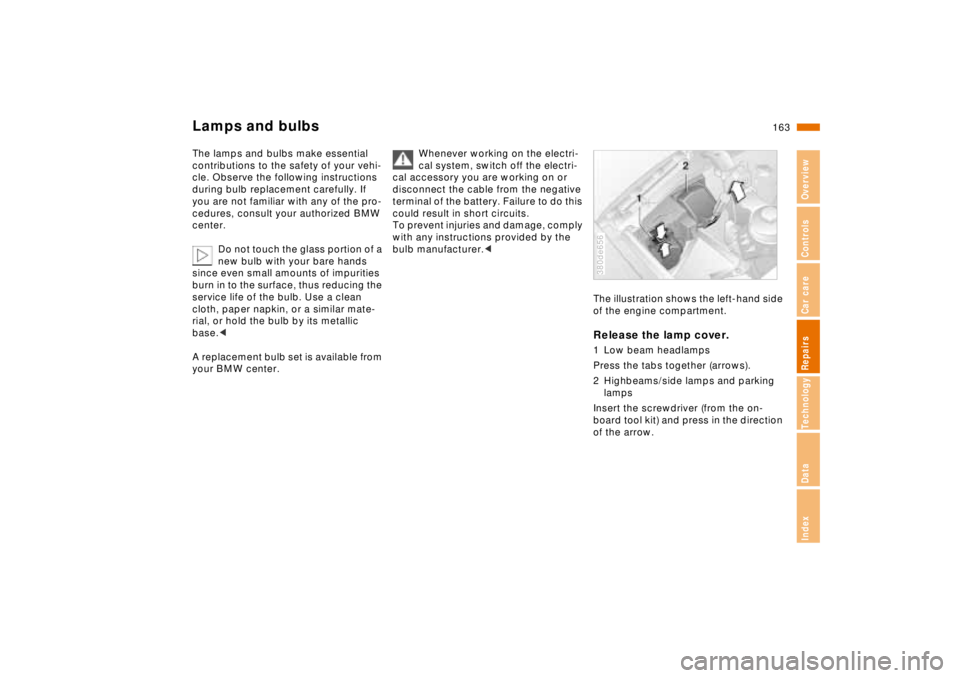
The illustration shows the left-hand side
of the engine compartment.Release the lamp cover.1 Low beam headlamps
Press the tabs together (arrows).
2 Highbeams/side lamps and parking
lamps
Insert the screwdriver (from the on-
board tool kit) and press in the direction
of the arrow.380de656
Page 171 of 211
170n
Changing tires
Safety measures in the event of a
flat tire or wheel change:
Stop the vehicle as far as possible from
passing traffic. Park on a firm, flat, sur-
face.
Switch on the hazard flashers.
Turn the steering wheel to the straight-
ahead position, remove the key and en-
gage the steering lock. Make sure that
the selector lever is in Park, and engage
the parking brake.
All passengers should be outside the
car and well away from your immediate
working area (for instance, behind a
guardrail).
If a warning triangle or portable hazard
warning lamp is available, set it up on
the roadside at an appropriate distance
from the rear of the vehicle.
Comply with all safety guidelines and
regulations.
Change the wheel only on a level, firm
surface which is not slippery. Avoid
jacking the car on a soft or slippery sup-
port surface (snow, ice, loose gravel,
etc.), since it could slide sideways.
Position the jack on a firm support sur-
face.
Do not place wooden blocks or similar
objects under the jack. If this is done,
the jack might not be able to reach its
full support capacity because of the
limited height. Do not lie under the vehi-
cle or start the engine when the vehicle
is supported by the jack - risk of fatal
injury.<
What you will needIn order to avoid rattling noises later,
note the position of the tools when you
remove them and return them to their
original position when you are through
using them.
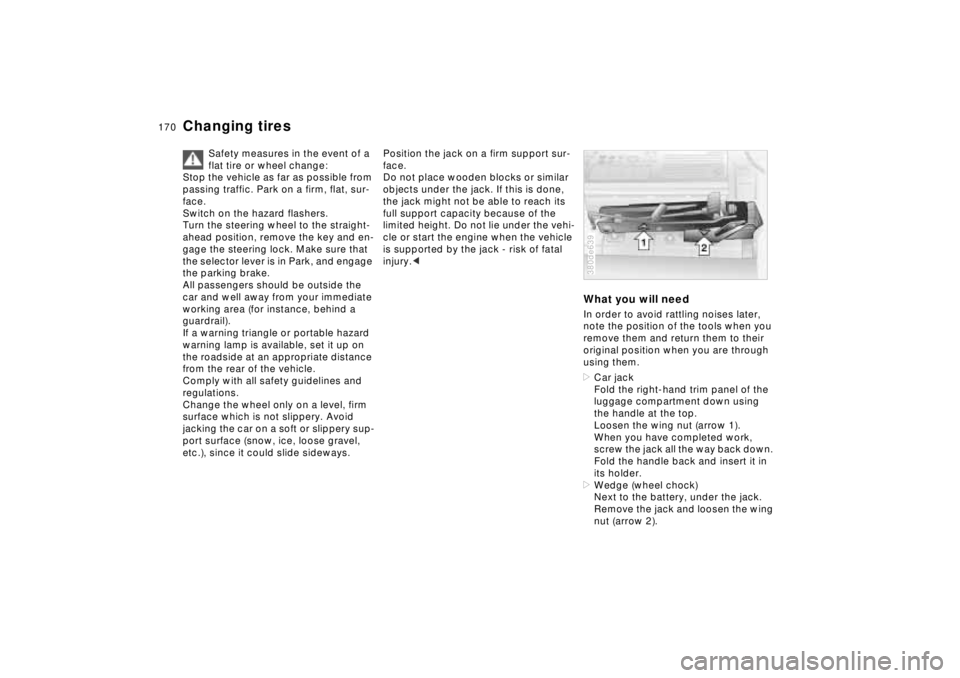
>Car jack
Fold the right-hand trim panel of the
luggage compartment down using
the handle at the top.
Loosen the wing nut (arrow 1).
When you have completed work,
screw the jack all the way back down.
Fold the handle back and insert it in
its holder.
>Wedge (wheel chock)
Next to the battery, under the jack.
Remove the jack and loosen the wing
nut (arrow 2).380de639
Page 175 of 211
174n
BatteryDo not short circuit the battery termi-
nals. This creates a risk of personal in-
jury from high-voltage sparks.
A highly-explosive gas is
generated when the battery is
charged.
If you happen to get acid in
your eyes, rinse thoroughly for
15 minutes with clear water.
Consult a physician immediately. If you
get acid spray on your skin or clothing,
rinse with plenty of water. If electrolyte
is accidentally ingested, consult a phy-
sician immediately.
In order to protect the battery
case from ultraviolet radiation,
do not place it in direct sunlight.
A discharged battery can freeze. Store
the battery in areas where temperature
remains above freezing.Car careThe battery is completely maintenance-
free, that is, the original electrolyte will
normally last for the service life of the
battery.
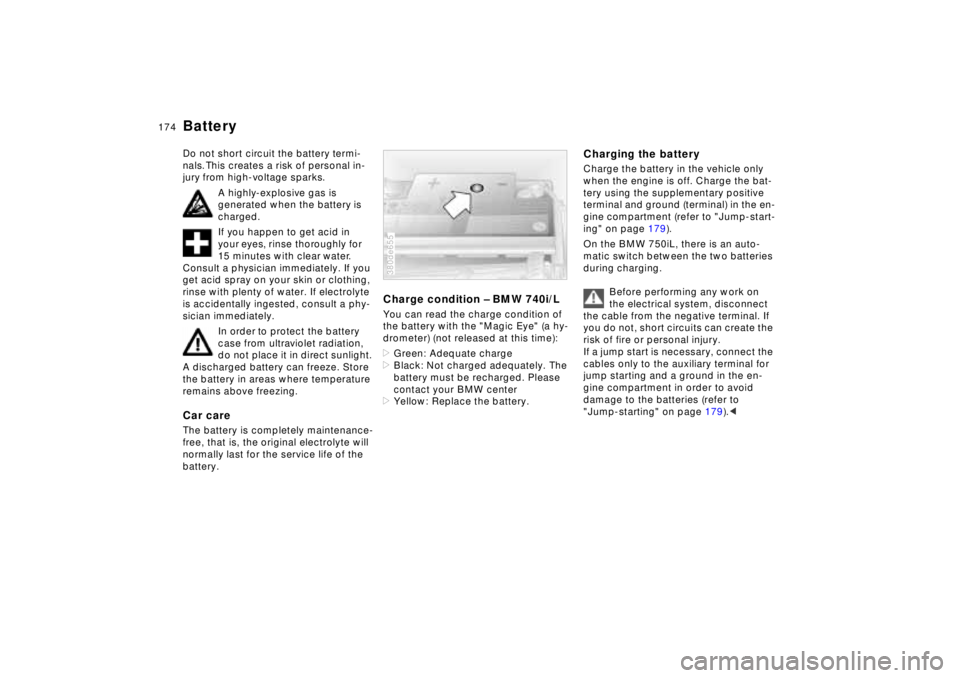
Charge condition – BMW 740i/LYou can read the charge condition of
the battery with the "Magic Eye" (a hy-
drometer) (not released at this time):
>Green: Adequate charge
>Black: Not charged adequately. The
battery must be recharged. Please
contact your BMW center
>Yellow: Replace the battery.380de655
Charging the batteryCharge the battery in the vehicle only
when the engine is off. Charge the bat-
tery using the supplementary positive
terminal and ground (terminal) in the en-
gine compartment (refer to "Jump-start-
ing" on page 179).
On the BMW 750iL, there is an auto-
matic switch between the two batteries
during charging.
Before performing any work on
the electrical system, disconnect
the cable from the negative terminal. If
you do not, short circuits can create the
risk of fire or personal injury.
If a jump start is necessary, connect the
cables only to the auxiliary terminal for
jump starting and a ground in the en-
gine compartment in order to avoid
damage to the batteries (refer to
"Jump-starting" on page 179).<
Page 176 of 211
175n
RepairsIndexOverview Controls Car care Technology Data
BatteryIf you plan to store the vehicle for
longer than 4 weeks, disconnect the
battery from the vehicle electrical sys-
tem by disconnecting the cable at the
negative terminal.
If you intend to store your car for longer
than six weeks: Remove the battery,
charge it and store it in a cool (but frost-
free) room. After a period not exceeding
6 months and before reinstalling the
battery, have it recharged. If it is not re-
charged, it will not be serviceable. Ev-
ery time the battery is discharged, es-
pecially over extended periods, its
service life is reduced.
Avoid environmental pollution
when disposing of old batteries.<
Return used batteries to a recy-
cling point or to your authorized
BMW center. Maintain the battery in an
upright position for transport and stor-
age. Secure the battery against tilting in
transit.<
Removal and installation
Do not disconnect the battery
when the engine is running. Dis-
connecting the battery cable when the
engine is running will cause a voltage
surge that will damage the vehicle's on-
board electronics.
Do not make any modifications in the
wires to the positive terminal. If you do
so, the protective function of the safety
battery terminal is no longer ensured.
Repairs and disposal may only be per-
formed by specially-trained personnel.<
BMW 750iL: Please contact your autho-
rized BMW center for additional infor-
mation.
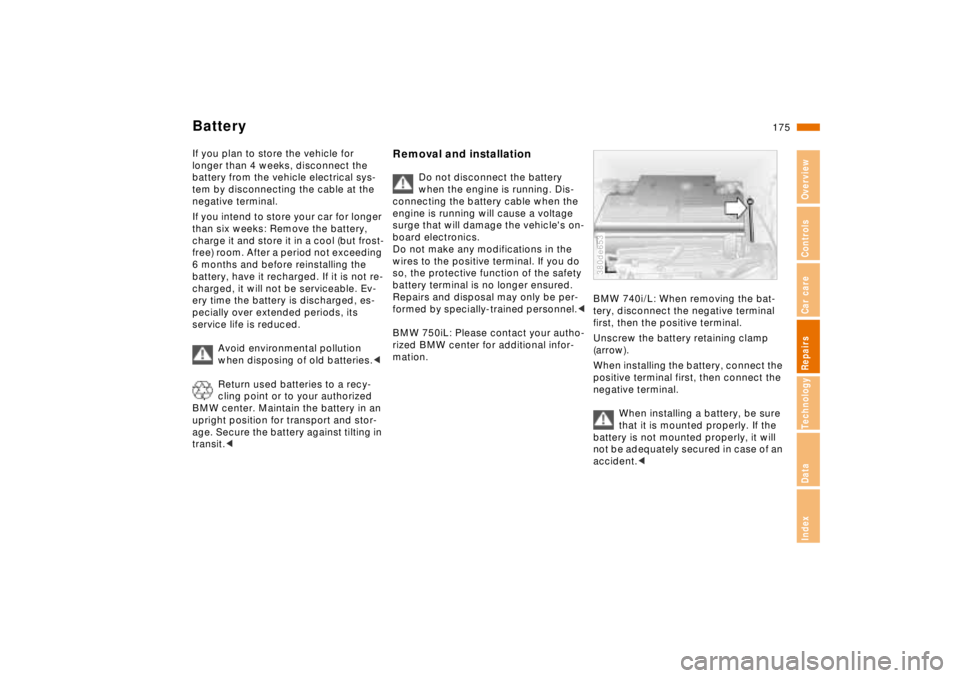
BMW 740i/L: When removing the bat-
tery, disconnect the negative terminal
first, then the positive terminal.
Unscrew the battery retaining clamp
(arrow).
When installing the battery, connect the
positive terminal first, then connect the
negative terminal.
When installing a battery, be sure
that it is mounted properly. If the
battery is not mounted properly, it will
not be adequately secured in case of an
accident.< 380de653
Page 177 of 211
176n
FusesIf an electrical accessory should fail,
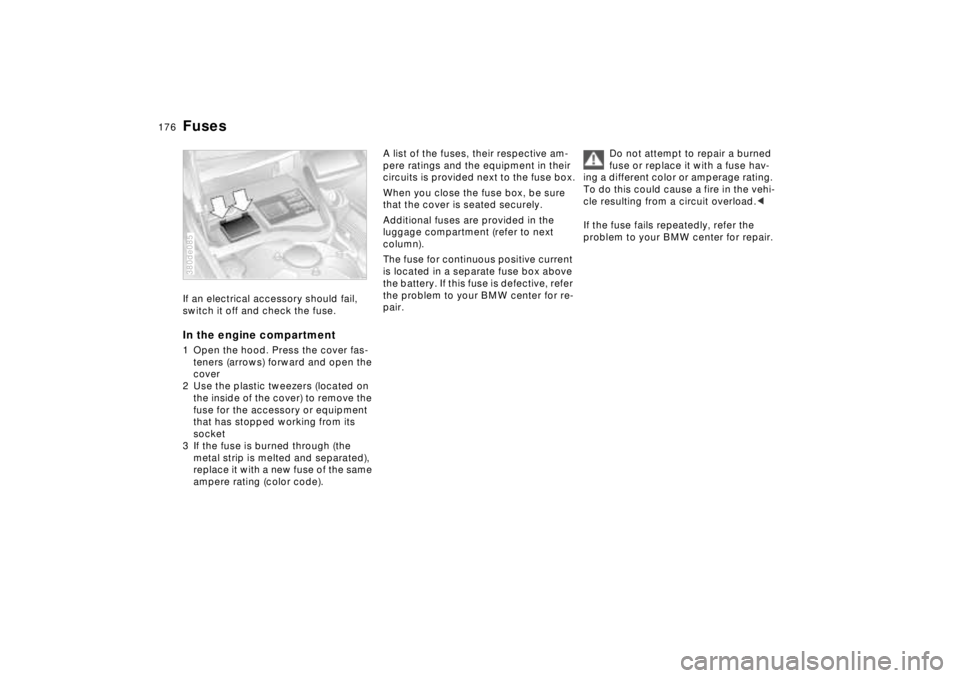
switch it off and check the fuse.In the engine compartment1 Open the hood. Press the cover fas-
teners (arrows) forward and open the
cover
2 Use the plastic tweezers (located on
the inside of the cover) to remove the
fuse for the accessory or equipment
that has stopped working from its
socket
3 If the fuse is burned through (the
metal strip is melted and separated),
replace it with a new fuse of the same
ampere rating (color code).380de085
A list of the fuses, their respective am-
pere ratings and the equipment in their
circuits is provided next to the fuse box.
When you close the fuse box, be sure
that the cover is seated securely.
Additional fuses are provided in the
luggage compartment (refer to next
column).
The fuse for continuous positive current
is located in a separate fuse box above
the battery. If this fuse is defective, refer
the problem to your BMW center for re-
pair.Do not attempt to repair a burned
fuse or replace it with a fuse hav-
ing a different color or amperage rating.
To do this could cause a fire in the vehi-
cle resulting from a circuit overload.<
If the fuse fails repeatedly, refer the
problem to your BMW center for repair.
Page 180 of 211
179n
RepairsIndexOverview Controls Car care Technology Data
Jump-startingNever use spray starter fluids to start
the engine.
If the battery is discharged, you can use
two jumper cables to start your car with
power from the battery of a second ve-
hicle. Always use jumper cables with
fully insulated handles on the terminal
clamps.
Do not touch high-voltage wiring
and cables on a running engine.
There is a risk of fatal injury if you do
this.<
Carefully comply with the following in-
structions to avoid personal injury and
damage to one or both vehicles:
1 Ensure that the battery on the sup-
port vehicle is also rated at 12 volts,
and that the capacities of the two
batteries (Ah) are roughly comparable
(printed on casing)
2 Leave your battery connected to the
car electrical system
3 Make sure that there is no contact
between the bodywork of the two ve-
hicles – short circuit risk.
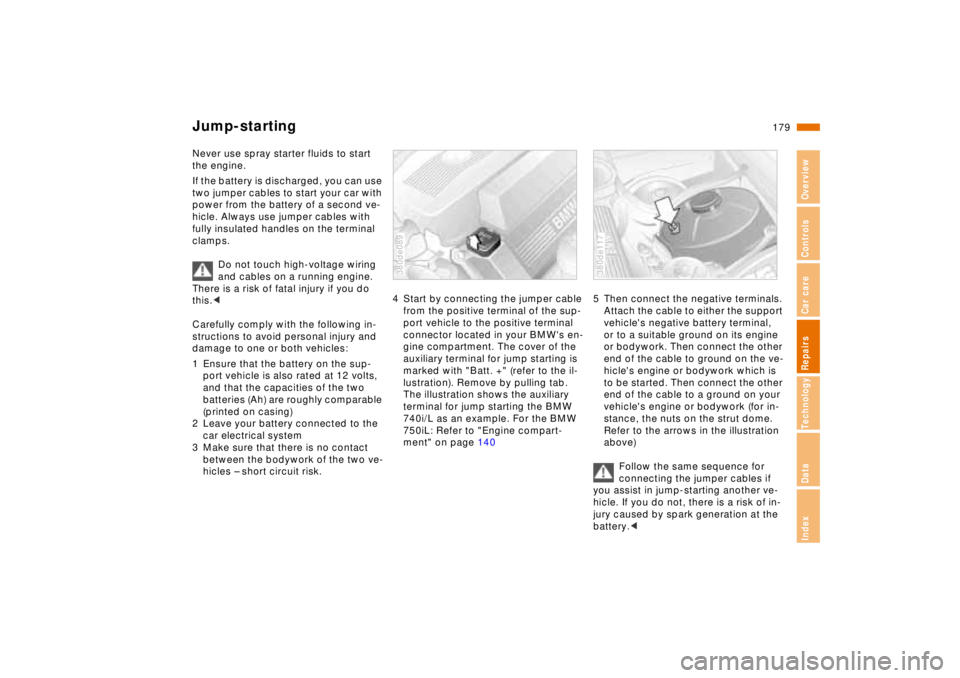
4 Start by connecting the jumper cable
from the positive terminal of the sup-
port vehicle to the positive terminal
connector located in your BMW's en-
gine compartment. The cover of the
auxiliary terminal for jump starting is
marked with "Batt. +" (refer to the il-
lustration). Remove by pulling tab.
The illustration shows the auxiliary
terminal for jump starting the BMW
740i/L as an example. For the BMW
750iL: Refer to "Engine compart-
ment" on page 140380de089
5 Then connect the negative terminals.
Attach the cable to either the support
vehicle's negative battery terminal,
or to a suitable ground on its engine
or bodywork. Then connect the other
end of the cable to ground on the ve-
hicle's engine or bodywork which is
to be started. Then connect the other
end of the cable to a ground on your
vehicle's engine or bodywork (for in-
stance, the nuts on the strut dome.
Refer to the arrows in the illustration
above)
Follow the same sequence for
connecting the jumper cables if
you assist in jump-starting another ve-
hicle. If you do not, there is a risk of in-
jury caused by spark generation at the
battery.< 380de117
Page 181 of 211
180n
Jump-starting Towing the vehicle6 If the battery of the support vehicle is
weak, start its engine and let it run
7 Start the engine on the vehicle need-
ing the jump-start, and allow it to run
as usual. If the first start attempt is
not successful, wait a few minutes
before another attempt in order to
allow the discharged battery to re-
charge
8 Before disconnecting the jumper ca-
bles from your BMW, turn on the rear
window defroster and set the blower
to the highest speed; allow the en-
gine to run approx. 10 seconds. This
will prevent a voltage surge from the
voltage regulator to the electrical ac-
cessories
9 Then disconnect the jumper cables in
reverse sequence.
Have the battery recharged if neces-
sary.
Tow fittingThe screw-in tow fitting is stored in the
onboard tool kit; be sure that it remains
in the vehicle at all times. This fitting is
designed for installation in the tow
sockets located at the front and rear of
the vehicle, and is intended for towing
on proper road surfaces only.
It should not be used to pull a vehicle
out of deep snow, mud, sand, etc. Al-
ways observe all applicable towing laws
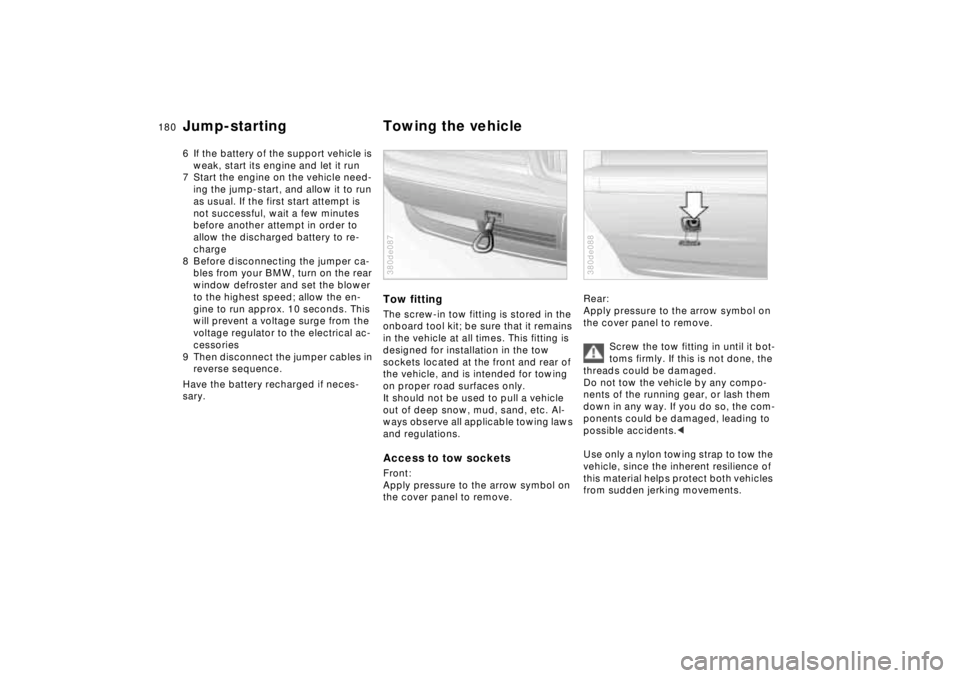
and regulations.Access to tow socketsFront:
Apply pressure to the arrow symbol on
the cover panel to remove.380de087
Rear:
Apply pressure to the arrow symbol on
the cover panel to remove.
Screw the tow fitting in until it bot-
toms firmly. If this is not done, the
threads could be damaged.
Do not tow the vehicle by any compo-
nents of the running gear, or lash them
down in any way. If you do so, the com-
ponents could be damaged, leading to
possible accidents.<
Use only a nylon towing strap to tow the
vehicle, since the inherent resilience of
this material helps protect both vehicles
from sudden jerking movements.380de088
Page 182 of 211
181n
RepairsIndexOverview Controls Car care Technology Data
Towing the vehicle
The towed vehicle should always
be the lighter of the two vehicles.
If this is not the case, it is no longer
possible to control vehicle response.<
Tow-startingIt is not possible to start the engine of
vehicles equipped with automatic trans-
mission by towing or pushing.
For instructions on jump starting, refer
to page 179.
Never attempt to use your vehicle to
push another car, as damage to the
energy-absorbing bumpers could
result.
Towing a vehicle with automatic
transmission1 Place selector lever in position N
2 Towing speed:
Max. 45 mph (70 km/h)
3 Towing distance:
Max. 95 miles (150 km)
4 Leave the ignition key at position 1 to
ensure that the brake lamps, turn sig-
nals, horn and windshield wipers re-
main operative, and to prevent the
steering lock detent from engaging
5 Switch on the hazard-warning system
(observe country-specific regula-
tions).
Find some means of identifying the ve-
hicle in tow, for instance, place a sign
or warning triangle in the rear window.
Make sure that the ignition key re-
mains in position 1 even when the
electrical system has failed to prevent
the steering lock from engaging.
The steering and brakes are without
power assist when the engine is off.
This means that increased effort is re-
quired for steering and braking.<
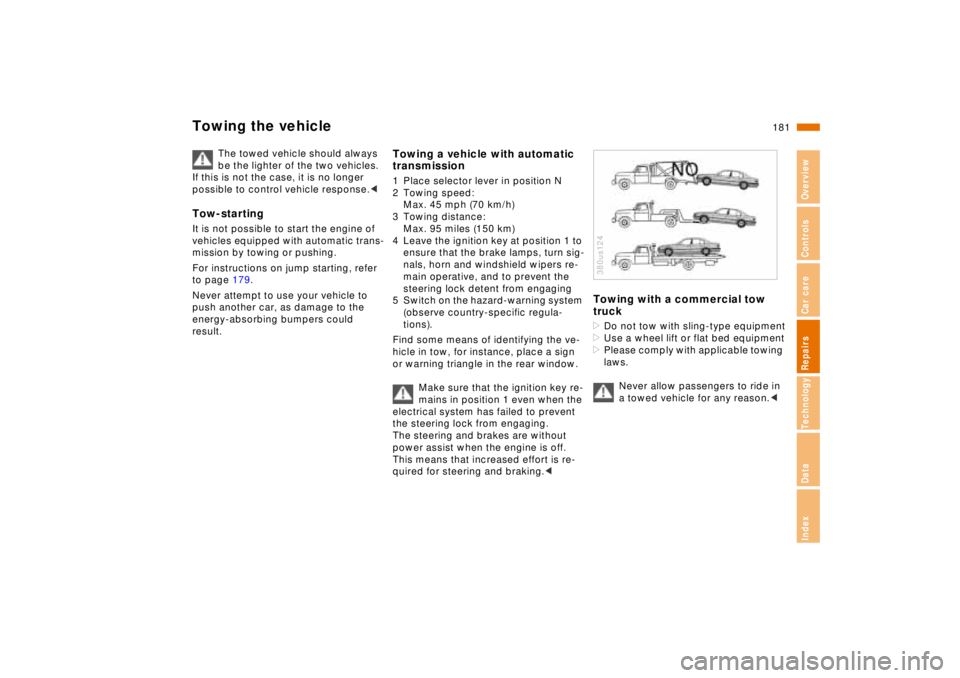
Towing with a commercial tow
truck>Do not tow with sling-type equipment
>Use a wheel lift or flat bed equipment
>Please comply with applicable towing
laws.
Never allow passengers to ride in
a towed vehicle for any reason.< 380us124
Page 186 of 211

185n
RepairsIndexOverview Controls Car care Technology Data
In order to take driving conditions into
account, ATC registers corners and
both uphill and downhill gradients. For
example, if you maintain speed through
a curve, the transmission does not up-
shift.
On uphill gradients, it shifts only when
the engine speed increases in order to
make more efficient use of power re-
serves. On downhill gradients ATC
downshifts when the speed of the vehi-
cles increases causing the driver to
step on the brakes.
With respect to road conditions, ATC
monitors the friction between the tires
and the road. The system responds to
slippery road surfaces (snow and ice)
by activating the winter program.
Second gear is used when moving
away from a standstill, upshifts occur
sooner, and on descents downshifting
does not occur in spite of the applica-
tion of brakes. This enables you to
"feel" the road as you drive and pro-
duces greater dynamic stability. If the
friction between the tires and the road
is adequate, the normal system is again
activated. The system also leaves the
winter program when you shift from
drive position "D" to "S," "3" or "2," or if
the ASC+T/DSC
* is deactivated.By recognizing traffic conditions, ATC
can retain maximum driving comfort.
For instance, the system recognizes
stop-and-go traffic and then proceeds
only in second gear until it encounters
higher starting loads.
Of course the selector lever can still be
used to select specific gear ratios. Per-
formance-oriented driving is enabled by
shifting from drive position "D" to "S,"
"3" or "2." Positions "3" and "2" each
limit upshifts to the next gear. Position
"2" is best for driving on steep mountain
slopes with a heavy load.Precision sensors monitor the number
of revolutions of the wheels. When
equipped with DSC, they also monitor
steering angle, lateral acceleration,
brake pressure and the movement of
the vehicle around its vertical axis.
If differences in the wheel speeds oc-
cur, the system counteracts the danger
of wheelspin by reducing torque. If nec-
essary, the system also responds with
additional applications of the brakes at
the rear wheels.
If the system detects an instability in the
vehicle's condition, the braking action
can also be directed to the front wheels
by the DSC in order to stabilize the ve-
hicle.
You may need some time to become
accustomed to this system intervention.
However, it helps provide optimum pro-
pulsive force and driving stability.
The braking intervention may be ac-
companied by a certain degree of
noise.
ATC ASC+T/DSC
*