ESP BMW 745LI SEDAN 2002 Service Manual
[x] Cancel search | Manufacturer: BMW, Model Year: 2002, Model line: 745LI SEDAN, Model: BMW 745LI SEDAN 2002Pages: 208, PDF Size: 6.33 MB
Page 162 of 208
At a glanceControlsDriving tipsCommunicationsNavigationEntertainmentMobilityReference
161
Hands-free system On vehicles prewired for installation of a
mobile phone, the hands-free microphone
is located on the front headliner.
The hands-free system is automatically
activated whenever you establish or
receive a call using the following:
>Button in the steering wheel
>Control Display
>Key Pad
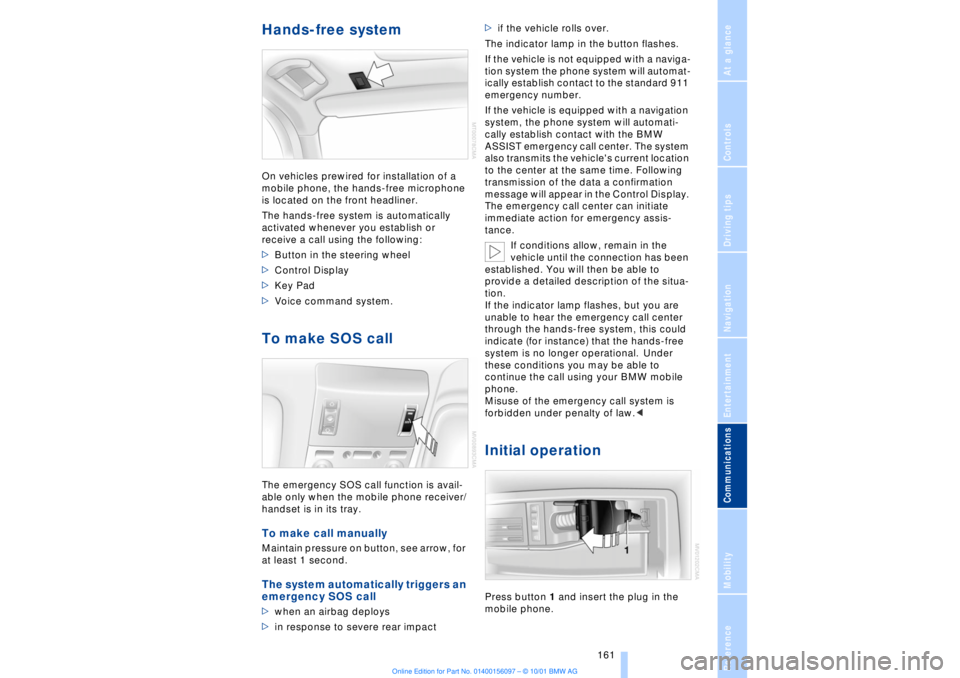
>Voice command system.To make SOS call The emergency SOS call function is avail-
able only when the mobile phone receiver/
handset is in its tray.To make call manually Maintain pressure on button, see arrow, for
at least 1 second. The system automatically triggers an
emergency SOS call >when an airbag deploys
>in response to severe rear impact >if the vehicle rolls over.
The indicator lamp in the button flashes.
If the vehicle is not equipped with a naviga-
tion system the phone system will automat-
ically establish contact to the standard 911
emergency number.
If the vehicle is equipped with a navigation
system, the phone system will automati-
cally establish contact with the BMW
ASSIST emergency call center. The system
also transmits the vehicle's current location
to the center at the same time. Following
transmission of the data a confirmation
message will appear in the Control Display.
The emergency call center can initiate
immediate action for emergency assis-
tance.
If conditions allow, remain in the
vehicle until the connection has been
established. You will then be able to
provide a detailed description of the situa-
tion.
If the indicator lamp flashes, but you are
unable to hear the emergency call center
through the hands-free system, this could
indicate (for instance) that the hands-free
system is no longer operational. Under
these conditions you may be able to
continue the call using your BMW mobile
phone.
Misuse of the emergency call system is
forbidden under penalty of law.<
Initial operationPress button 1 and insert the plug in the
mobile phone.
Page 171 of 208
Wheels and tires
170
Wheels and tiresTire inflation pressure Information for your safety The factory-mounted radial tires have been
specially selected to provide optimal
performance when installed on your
vehicle; if properly cared for they will
furnish a combination of tremendous safety
and excellent ride comfort.
It is not merely the tire's service life, but
also driving comfort and Ð above all else Ð
driving safety that depend on the condition
of the tires and the maintenance of the
specified tire pressure.
Incorrect inflation pressure is a frequent
cause of tire damage. Tire inflation pres-
sures also have a substantial effect on your
BMW's handling response.
Check tire inflation pressures regu-
larly Ð at least every two weeks and
before beginning a longer trip. If you fail to
observe this precaution you may be driving
on tires with incorrect tire pressures, a
condition that can not only compromise
your vehicle's stability, but also lead to tire
damage and the risk of an accident.
Remember to check the inflation pressure
in your spare tire. Inflate the spare tire to
the highest pressure specified for any tire
on the vehicle.<
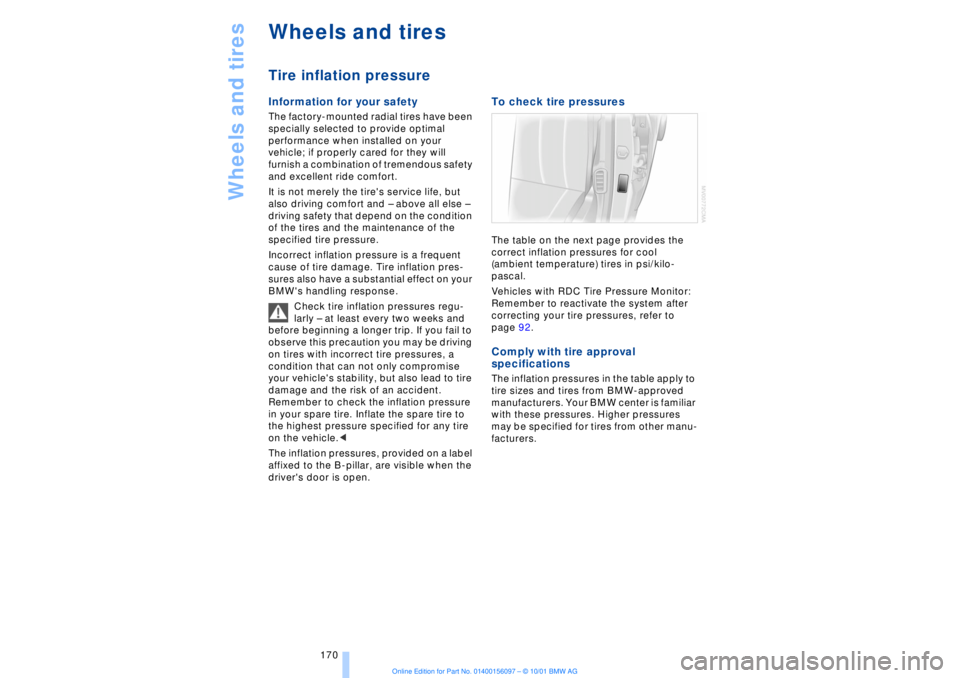
The inflation pressures, provided on a label
affixed to the B-pillar, are visible when the
driver's door is open.
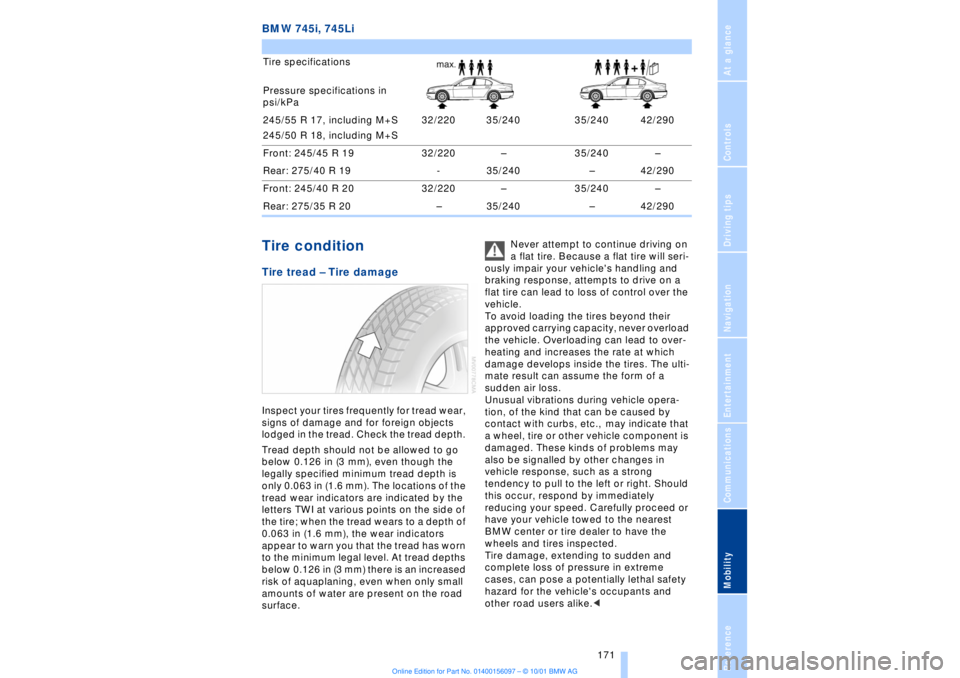
To check tire pressures The table on the next page provides the
correct inflation pressures for cool
(ambient temperature) tires in psi/kilo-
pascal.
Vehicles with RDC Tire Pressure Monitor:
Remember to reactivate the system after
correcting your tire pressures, refer to
page 92. Comply with tire approval
specificationsThe inflation pressures in the table apply to
tire sizes and tires from BMW-approved
manufacturers. Your BMW center is familiar
with these pressures. Higher pressures
may be specified for tires from other manu-
facturers.
Page 172 of 208
At a glanceControlsDriving tipsCommunicationsNavigationEntertainmentMobilityReference
171
BMW 745i, 745LiTire condition Tire tread Ð Tire damageInspect your tires frequently for tread wear,
signs of damage and for foreign objects
lodged in the tread. Check the tread depth.
Tread depth should not be allowed to go
below 0.126 in (3 mm), even though the
legally specified minimum tread depth is
only 0.063 in (1.6 mm). The locations of the
tread wear indicators are indicated by the
letters TWI at various points on the side of
the tire; when the tread wears to a depth of
0.063 in (1.6 mm), the wear indicators
appear to warn you that the tread has worn
to the minimum legal level. At tread depths
below 0.126 in (3 mm) there is an increased
risk of aquaplaning, even when only small
amounts of water are present on the road
surface. Never attempt to continue driving on
a flat tire. Because a flat tire will seri-
ously impair your vehicle's handling and
braking response, attempts to drive on a
flat tire can lead to loss of control over the
vehicle.
To avoid loading the tires beyond their
approved carrying capacity, never overload
the vehicle. Overloading can lead to over-
heating and increases the rate at which
damage develops inside the tires. The ulti-
mate result can assume the form of a
sudden air loss.
Unusual vibrations during vehicle opera-
tion, of the kind that can be caused by
contact with curbs, etc., may indicate that
a wheel, tire or other vehicle component is
damaged. These kinds of problems may
also be signalled by other changes in
vehicle response, such as a strong
tendency to pull to the left or right. Should
this occur, respond by immediately
reducing your speed. Carefully proceed or
have your vehicle towed to the nearest
BMW center or tire dealer to have the
wheels and tires inspected.
Tire damage, extending to sudden and
complete loss of pressure in extreme
cases, can pose a potentially lethal safety
hazard for the vehicle's occupants and
other road users alike.< Tire specifications
Pressure specifications in
psi/kPa
245/55 R 17, including M+S
245/50 R 18, including M+S 32/220 35/240 35/240 42/290
Front: 245/45 R 19 32/220 Ð 35/240 Ð
Rear: 275/40 R 19 - 35/240 Ð 42/290
Front: 245/40 R 20 32/220 Ð 35/240 Ð
Rear: 275/35 R 20 Ð 35/240 Ð 42/290
Page 173 of 208
Wheels and tires
172
Tire replacement To maintain good handling and vehicle
response, use only tires of a single tread
configuration from a single manufacturer.
BMW tests and approves specific wheel
and tire combinations. DOT Quality Grades Treadwear
Traction AA A B C
Temperature A B C
All passenger car tires must conform
to Federal Safety Requirements in
addition to these grades.< TreadwearThe treadwear grade is a comparative
rating based on the wear rate of the tire
when tested under controlled conditions
on a specified government test course.
For example, a tire graded 150 would wear
one and one-half (1g) times as well on the
government course as a tire graded 100.
The relative performance of tires depends
upon the actual conditions of their use,
however, and may depart significantly from
the norm due to variations in driving habits,
service practices and differences in road
characteristics and climate.TractionThe traction grades, from highest to lowest,
are AA, A, B, and C.
Those grades represent the tire's ability to
stop on wet pavement as measured under
controlled conditions on specified govern-
ment test surfaces of asphalt and concrete.
A tire marked C may have poor traction
performance.
The traction grade assigned to this
tire is based on straight-ahead
braking traction tests, and does not include
acceleration, cornering, hydroplaning, or
peak traction characteristics.< TemperatureThe temperature grades are A (the highest),
B, and C, representing the tire's resistance to the generation of heat and its ability to
dissipate heat when tested under
controlled conditions on a specified indoor
laboratory test wheel.
Sustained high temperature can cause the
material of the tire to degenerate and
reduce tire life, and excessive temperature
can lead to sudden tire failure. The grade C
corresponds to a level of performance
which all passenger car tires must meet
under the Federal Motor Safety Standard
No. 109. Grades B and A represent higher
levels of performance on the laboratory test
wheel than the minimum required by law.
The temperature grade for this tire is
established for a tire that is properly
inflated and not overloaded. Excessive
speed, underinflation, or excessive
loading, either separately or in combina-
tion, can cause heat buildup and possible
tire failure.<
Uniform Tire Quality Grading Quality grades can be found where appli-
cable on the tire sidewall between tread
shoulder and maximum section width. For
example:
Treadwear 200 Traction AA
Temperature A
Do not use retreaded tires, since
driving safety may be impaired.
Possible variations in the design and the
age (which could be substantial) of the
carcasses can lead to unusually rapid
wear.< Tire age The tire's date of manufacture is indicated
on the sidewall:
DOT ... 4901 indicates that a tire was
manufactured in week 49 of the year 2001.
Regardless of milage or wear, BMW
recommends that you replace all tires Ð
including the spare tire Ð after a maximum
of 6 years, even though the tires may have
a theoretical service life of up to 10 years.
Page 174 of 208
At a glanceControlsDriving tipsCommunicationsNavigationEntertainmentMobilityReference
173
Wheel and tire
combinationsThe right choice
Use only wheel and tire combinations
that BMW has approved for your
particular vehicle. Variations in factors such
as manufacturing tolerances mean that
even wheels and tires with identical official
size ratings could actually have different
dimensions than the approved units. These
differences could lead to body contact, and
with it the risk of severe accidents . If non-
approved wheels and tires are used, BMW
cannot evaluate their suitability, and there-
fore cannot be held liable for driving
safety.<
BMW tests certain tire brands for each tire
size, classifies them as road-safe and
approves them. Consult your BMW center
for more information. Observe any country-
specific regulations, e.g. on making a
corresponding entry in the vehicle
documents.
The correct combination of wheels
and tires is a vital factor in ensuring
reliable operation of various vehicle
systems such as ABS and DSC.
It is therefore important to ensure that tires
from a single manufacturer with a single
tread configuration are always mounted on
all vehicle wheels. After a flat tire, always
remember to have the specified wheel and
tire combination remounted on the vehicle
as soon as possible.<
Storage Always store wheels and tires in a cool, dry
place with as little exposure to light as
possible. Always protect tires against all
contact with oil, grease and fuels.
Special characteristics of
winter tires Choosing the right tire BMW recommends winter tires Ð M+S
radial tires for use in cold winter driving
conditions. Although all-season M+S tires
provide better winter traction than standard
summer tires with H, V, W and ZR speed
ratings, they generally fail to provide the
same levels of cold-weather performance
as winter tires.
When mounting, always install winter tires
of a single tread configuration and from a
single manufacturer on all four wheels to
ensure safe tracking and secure steering
response. Observe speed ratings
Never exceed the maximum speed for
which the tires are rated.
Unprofessional attempts by laymen to
service tires can lead to damage and acci-
dents.
Have this work performed by skilled
professionals only. The technicians at your
BMW center will be glad to assist you with
the required professional knowledge and
specialized equipment.<
Tire condition, tire pressure Because winter tires display a noticeable
loss in their ability to cope with cold-
weather driving conditions once the tread
wears to below 0.16 in (4 mm), to ensure
continued safety you should always have
such tires replaced.
Always maintain the specified inflation
pressures in all tires, and remember to
have the wheel and tire assemblies
balanced every time either a wheel or a tire
is replaced. Snow chains*
BMW narrow-link snow chains
are
approved exclusively for use in pairs on
the rear wheels, and should only be
Page 177 of 208
Under the hood
176
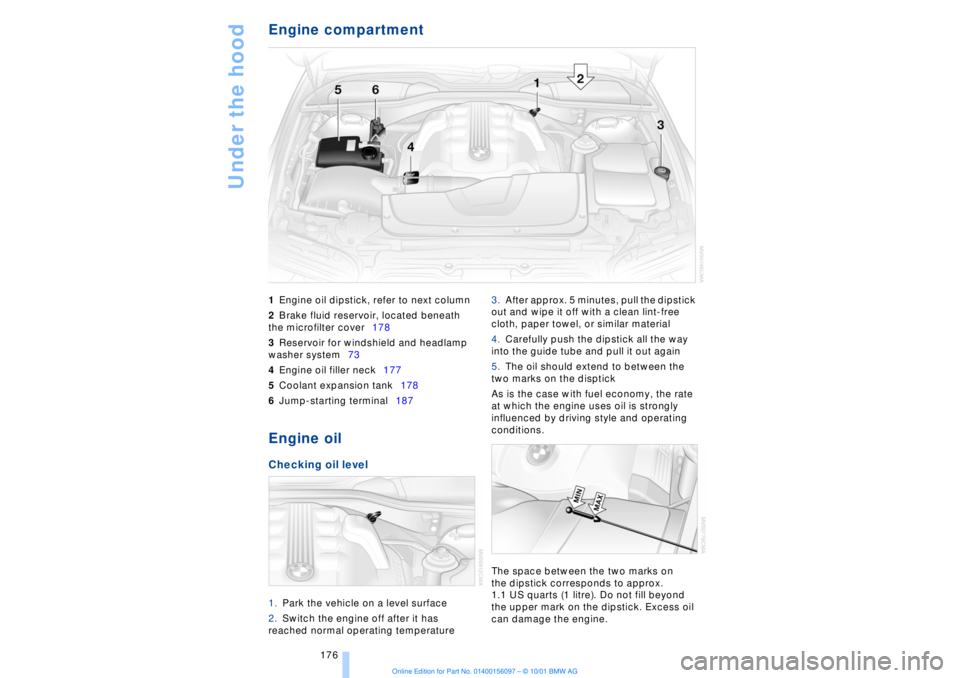
Engine compartment 1Engine oil dipstick, refer to next column
2Brake fluid reservoir, located beneath
the microfilter cover178
3Reservoir for windshield and headlamp
washer system73
4Engine oil filler neck177
5Coolant expansion tank178
6Jump-starting terminal187 Engine oilChecking oil level1.Park the vehicle on a level surface
2.Switch the engine off after it has
reached normal operating temperature 3.After approx. 5 minutes, pull the dipstick
out and wipe it off with a clean lint-free
cloth, paper towel, or similar material
4.Carefully push the dipstick all the way
into the guide tube and pull it out again
5.The oil should extend to between the
two marks on the disptick
As is the case with fuel economy, the rate
at which the engine uses oil is strongly
influenced by driving style and operating
conditions.
The space between the two marks on
the dipstick corresponds to approx.
1.1 US quarts (1 litre). Do not fill beyond
the upper mark on the dipstick. Excess oil
can damage the engine.
Page 181 of 208
Rules and regulations
180
Rules and regulationsCalifornia Proposition 65
Warning California laws require us to state the
following warning:
Engine exhausts, some of its constit-
uents, and certain vehicle compo-
nents contain or emit chemicals known to
the State of California to cause cancer and
birth defects or other reproductive harm.< OBD connector The Onboard Diagnostic (OBD) interface
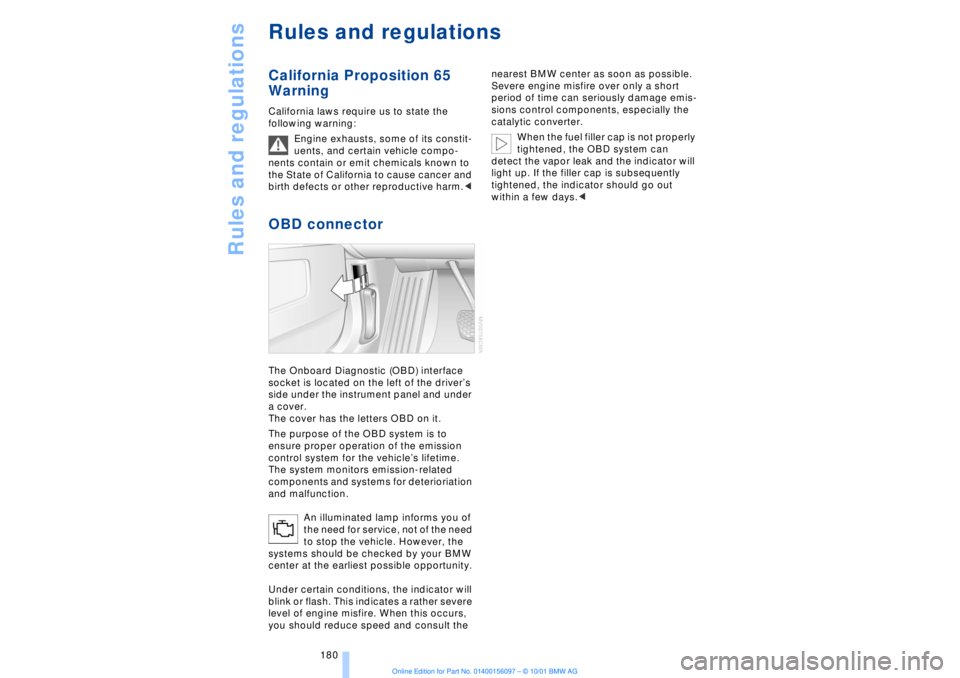
socket is located on the left of the driverÕs
side under the instrument panel and under
a cover.
The cover has the letters OBD on it.
The purpose of the OBD system is to
ensure proper operation of the emission
control system for the vehicleÕs lifetime.
The system monitors emission-related
components and systems for deterioriation
and malfunction.
An illuminated lamp informs you of
the need for service, not of the need
to stop the vehicle. However, the
systems should be checked by your BMW
center at the earliest possible opportunity.
Under certain conditions, the indicator will
blink or flash. This indicates a rather severe
level of engine misfire. When this occurs,
you should reduce speed and consult the nearest BMW center as soon as possible.
Severe engine misfire over only a short
period of time can seriously damage emis-
sions control components, especially the
catalytic converter.
When the fuel filler cap is not properly
tightened, the OBD system can
detect the vapor leak and the indicator will
light up. If the filler cap is subsequently
tightened, the indicator should go out
within a few days.<
Page 183 of 208
Replacing components
182
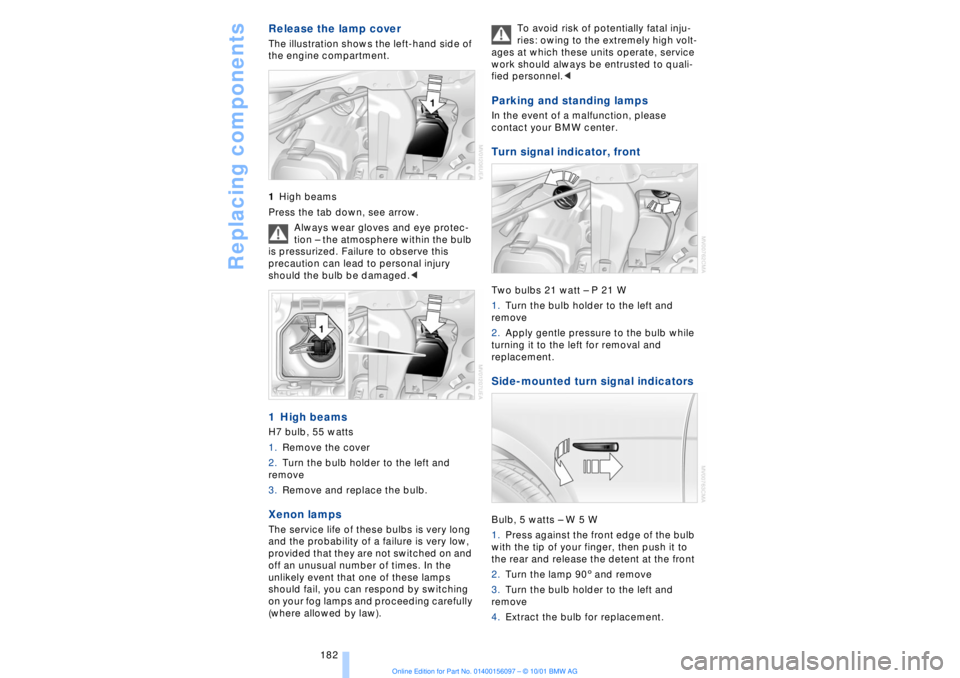
Release the lamp cover The illustration shows the left-hand side of
the engine compartment.
1High beams
Press the tab down, see arrow.
Always wear gloves and eye protec-
tion Ð the atmosphere within the bulb
is pressurized. Failure to observe this
precaution can lead to personal injury
should the bulb be damaged.< 1 High beams H7 bulb, 55 watts
1.Remove the cover
2.Turn the bulb holder to the left and
remove
3.Remove and replace the bulb. Xenon lamps
The service life of these bulbs is very long
and the probability of a failure is very low,
provided that they are not switched on and
off an unusual number of times. In the
unlikely event that one of these lamps
should fail, you can respond by switching
on your fog lamps and proceeding carefully
(where allowed by law). To avoid risk of potentially fatal inju-
ries: owing to the extremely high volt-
ages at which these units operate, service
work should always be entrusted to quali-
fied personnel.<
Parking and standing lamps In the event of a malfunction, please
contact your BMW center. Turn signal indicator, front Two bulbs 21 watt Ð P 21 W
1.Turn the bulb holder to the left and
remove
2.Apply gentle pressure to the bulb while
turning it to the left for removal and
replacement. Side-mounted turn signal indicators Bulb, 5 watts Ð W 5 W
1.Press against the front edge of the bulb
with the tip of your finger, then push it to
the rear and release the detent at the front
2.Turn the lamp 903 and remove
3.Turn the bulb holder to the left and
remove
4.Extract the bulb for replacement.