brake BMW M3 CONVERTIBLE 2001 E46 User Guide
[x] Cancel search | Manufacturer: BMW, Model Year: 2001, Model line: M3 CONVERTIBLE, Model: BMW M3 CONVERTIBLE 2001 E46Pages: 195, PDF Size: 1.96 MB
Page 68 of 195
68n
Parking brake Manual transmission excessive pressure. Keep your thumb
pressed against the release button
while carefully pulling up the lever to
apply moderate pressure.
Excessive pressure can lead to over-
braking and loss of traction (fishtailing)
at the rear axle.
The brake lamps do not come on when
the parking brake is engaged.
Set the parking brake when parking on
steep hills, because under certain
conditions, putting the vehicle into first
or reverse gear may not be enough to
prevent it from rolling away.<
To avoid corrosion and one-sided
braking, apply the parking brake lightly
from time to time when coasting to a
standstill (at a traffic signal, for
instance), provided that it is safe to do
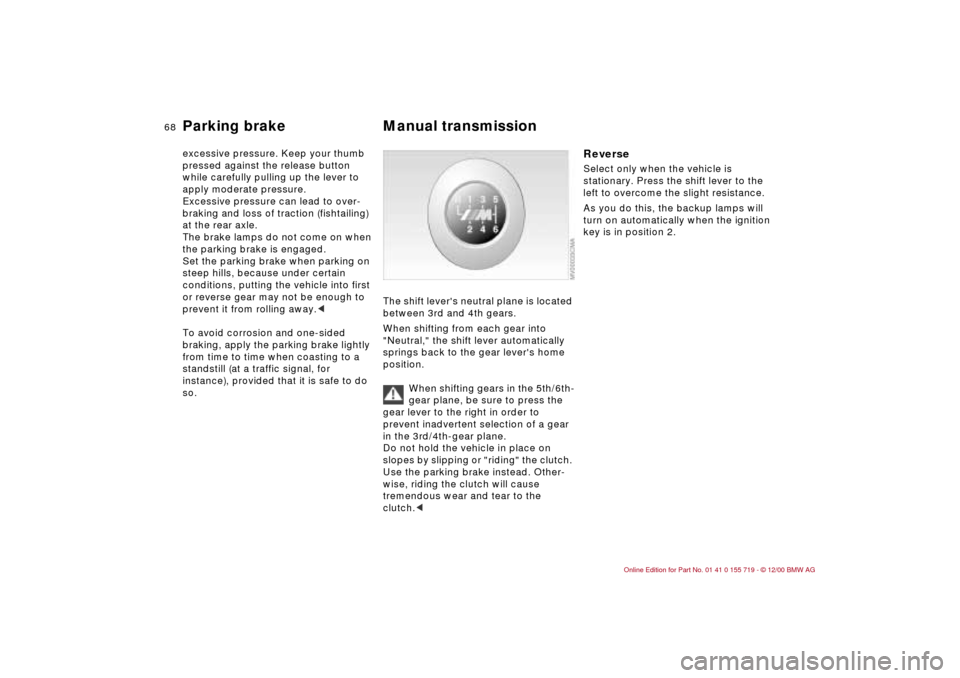
so. The shift lever's neutral plane is located
between 3rd and 4th gears.
When shifting from each gear into
"Neutral," the shift lever automatically
springs back to the gear lever's home
position.
When shifting gears in the 5th/6th-
gear plane, be sure to press the
gear lever to the right in order to
prevent inadvertent selection of a gear
in the 3rd/4th-gear plane.
Do not hold the vehicle in place on
slopes by slipping or "riding" the clutch.
Use the parking brake instead. Other-
wise, riding the clutch will cause
tremendous wear and tear to the
clutch.<
Reverse Select only when the vehicle is
stationary. Press the shift lever to the
left to overcome the slight resistance.
As you do this, the backup lamps will
turn on automatically when the ignition
key is in position 2.
Page 72 of 195

72n
Cruise control To activate the system From ignition key position 2.
Press button 3 and the indicator lamp
on the instrument cluster (refer to
page 23) will come on. You can now
use the cruise control.
Do not use cruise control on
twisting roads, when high traffic
density prevents driving at a constant
speed, when the road surface is slick
(snow, rain, ice), or when the road
surface is loose (rocks, sand).< To deactivate the system Press button 3 as often as you need to
until the indicator lamp on the instru-
ment cluster goes out.
Cruise control is also deactivated when
the ignition key is in position 0.
The speed stored in memory is deleted.
To store and maintain speed or to
acceleratePress button 1 briefly: the system regis-
ters and maintains the current vehicle
speed. Every time you tap the button,
the speed increases by approx.
0.6 mph (1 km/h).
Press and hold button 1: the vehicle
accelerates without pressure on the
accelerator pedal. When you release
the button, the system registers and
maintains the current speed.
If, on a downhill gradient, the
engine braking effect is not suffi-
cient, the controlled speed may be
exceeded. Speed can drop on uphill
grades if the engine output is insuffi-
cient.< To deceleratePress button 2 briefly: if you are already
driving with active cruise control, the
speed is decreased by approx. 0.6 mph
(1 km/h) every time you tap the button.
Press and hold button 2: with the cruise
control active, the system automatically
reduces the throttle opening to slow the
vehicle. When you release the button,
the system registers and maintains the
current speed.
To interrupt the cruise control When the cruise control is on, press
button 3. The indicator lamp will stay
on.
You can use the cruise control again
whenever you want by calling up the
speed that was stored last.
In addition, cruise control is interrupted
automatically
>if the brakes are applied
>when you depress the clutch pedal,
>if you exceed or fall below the
programmed speed for an extended
period (by depressing the acceler-
ator, for example).Recall the stored speed.Press button 4: the vehicle accelerates
to and maintains the last speed stored.
Page 76 of 195
76n
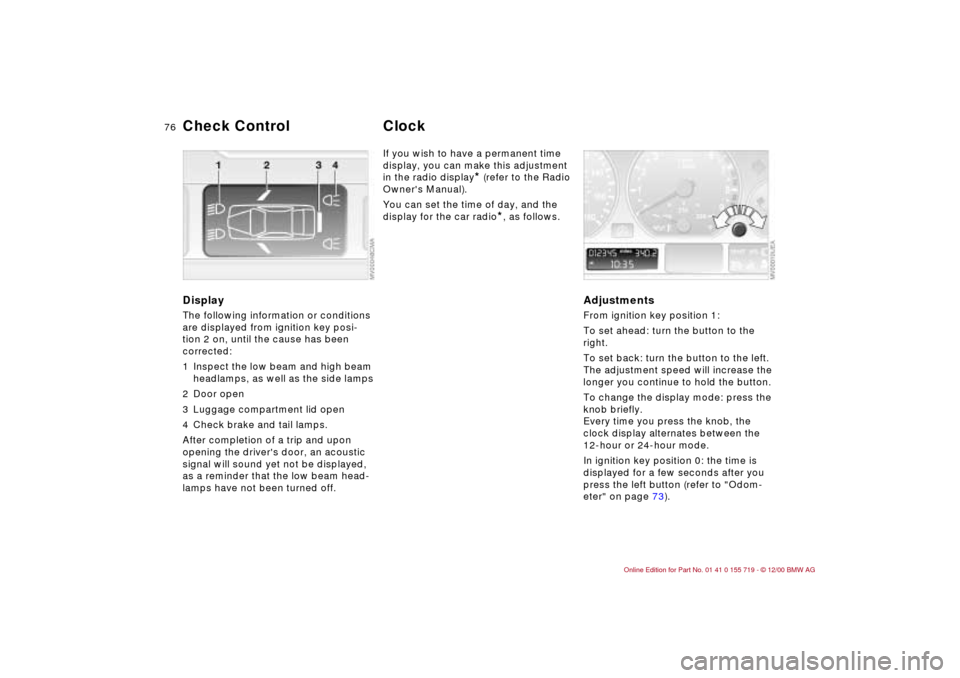
DisplayThe following information or conditions
are displayed from ignition key posi-
tion 2 on, until the cause has been
corrected:
1 Inspect the low beam and high beam
headlamps, as well as the side lamps
2 Door open
3 Luggage compartment lid open
4 Check brake and tail lamps.
After completion of a trip and upon
opening the driver's door, an acoustic
signal will sound yet not be displayed,
as a reminder that the low beam head-
lamps have not been turned off.
If you wish to have a permanent time
display, you can make this adjustment
in the radio display
* (refer to the Radio
Owner's Manual).
You can set the time of day, and the
display for the car radio
*, as follows.
Adjustments From ignition key position 1:
To set ahead: turn the button to the
right.
To set back: turn the button to the left.
The adjustment speed will increase the
longer you continue to hold the button.
To change the display mode: press the
knob briefly.
Every time you press the knob, the
clock display alternates between the
12-hour or 24-hour mode.
In ignition key position 0: the time is
displayed for a few seconds after you
press the left button (refer to "Odom-
eter" on page 73).
Check Control
Clock
Page 103 of 195
Overview
Controls and features
Operation, care
and maintenance
Owner service procedures
Technical data
Index Advanced technology
103n
IndexDataTechnologyRepairsCar careControlsOverview
Special operating instructions:
Break-in procedures104
Driving notes105
Catalytic converter105
Antilock Brake System
(ABS)106
Disc brakes108
Brake system109
Winter operation110
Power steering112
Cellular phone112
Radio reception112
Hardtop113
Wheels and tires:
Tire inflation pressures115
Tire condition115
Tire replacement116
Tire rotation117
Wheel and tire
combinations118
Special features of winter
tires119
Snow chains119
Approved wheel and tire
specifications120Under the hood:
Hood121
Engine compartment124
Washer fluids126
Washer nozzles126
Engine oil127
Coolant129
Brake fluid130
Vehicle Identification
Number130
Care and maintenance:
The BMW Maintenance
System131
Caring for your vehicle132
Cleaning and caring for the
convertible top137
Airbags139
Storing your vehicle140
Laws and regulations:
Technical modifications141
California Proposition 65
Warning141
OBD connector142
Car care
Page 104 of 195

104n
To ensure that your vehicle continues to
provide maximum economy throughout
an extended service life, we request
that you devote careful attention to the
following section.
Your BMW M3 convertible is a
masterpiece of superlative tech-
nology. To create the basis for many
years of driving pleasure, we urge you
to observe the following precautions
during the initial operation period.<
Engine and differential>Up to 1,200 miles (2,000 km): drive at
varying engine and road speeds, but
do not exceed the following engine or
road speeds: 5,500 rpm or 105 mph
(170 km/h)
Do not depress the accelerator pedal to
the full throttle position.
>Following the Break-In Inspection at
1,200 miles (2,000 km), you can
gradually increase engine or road
speeds.
Follow the same break-in procedure if
either the engine or the differential is
replaced in the future.
TiresDue to technical factors associated
with their manufacture, tires do not
achieve their full traction potential until
after an initial break-in period. You
should therefore drive with extra care
during the initial 200 miles (300 km).
Obey your local and state maximum
speed limits.
When the vehicle is operated on
wet or slushy roads, a wedge of
water may form between the tire and
the road surface. This phenomenon is
referred to as aquaplaning, or hydro-
planing, and can lead to partial or
complete loss of traction, vehicle
control and braking effectiveness.
Reduce your speed on wet roads.<
Brake systemApproximately 300 miles ( 500 km) must
elapse before the brake pads and discs
achieve the optimal pad-surface and
wear patterns required for troublefree
operation and long service life later on.
To break-in the separate parking brake
drums, apply the parking brake lightly
when coasting to a standstill (at a traffic
signal, for instance), provided that
traffic conditions allow you to do so. To
avoid corrosion, repeat this procedure
from time to time.
The brake lamps do not come on
when the parking brake is
engaged.
Vacuum for the brake system servo unit
on your BMW is available only when the
engine is running. When you move the
vehicle with the engine off – when
towing, for example – substantially
higher levels of pedal force will be
required to brake the vehicle.
(500 km). Drive cautiously during this
break-in period and do not shift at high
engine speeds.
Break-in procedures
Page 105 of 195

105n
IndexDataTechnologyRepairsCar careControlsOverview
Brakes: do not rest your foot on
the brake pedal while driving.
Even light but consistent pressure on
the brake pedal can lead to high
temperatures, brake wear and possibly
even brake system failure.
Aquaplaning: when driving on wet or
slushy roads, reduce vehicle speed. If
you do not, a wedge of water may form
between the tires and the road surface.
This phenomenon is referred to as
aquaplaning, or hydroplaning, and can
lead to partial or complete loss of
contact between the tires and road
surface, vehicle control and braking
ability.
Driving through water: do not drive
through water on the road if it is deeper
than 1 foot (30 cm), and then only at
walking speed at the most. Otherwise,
the vehicle's engine, the electrical
systems and the transmission may be
damaged.<
The catalytic converter reduces harmful
pollutants in the exhaust emissions.
It is designed for use with unleaded fuel
only. Even minute quantities of lead
would be enough to permanently
damage both the catalytic converter
and the system's oxygen sensor.
To ensure efficient, trouble-free engine
operation and to avoid potential
damage:
>Be sure to comply with the required
scheduled maintenance work and
repair procedures.
>Fill the fuel tank well before it is
empty.
>Tow-start only when the engine is
cold, otherwise unburned, residual
fuel in the catalytic converter could
ignite and cause damage. It is better
to jump-start the vehicle with outside
assistance.
>Avoid other situations where the fuel
is not burned, or burns incompletely,
such as engaging the starter
frequently or for extended periods, or
repeated start attempts in which the
engine does not start (stopping and
restarting an engine which is running
properly does not present a problem).
Never let the engine run with any of
the spark plug cables disconnected. Be sure to observe the instruc-
tions above to prevent unburned
fuel from reaching the catalytic
converter. Otherwise there is danger of
overheating and damage to the cata-
lytic converter.
High temperatures occur in any vehicle
equipped with a catalytic converter.
Heat shields are installed adjacent to
some sections of the exhaust system.
Never remove these shields; do not
apply undercoating to their surfaces.
When driving, standing at idle, and
parking the vehicle, take extra care to
avoid contact between the exhaust
system and flammable materials (grass,
hay, leaves, etc.). Such contact could
start a fire, resulting in personal injury
and property damage.<
Driving notes Catalytic converter
Page 106 of 195

106n
Antilock Brake System (ABS)The concept ABS helps prevent the wheels from
locking while braking, thereby
enhancing active driving safety. This is
because locked wheels are dangerous.
When the front wheels slide, the driver
loses steering control over the vehicle.
Traction loss at the rear wheels can
cause the rear end to break into an
uncontrolled skid.
Under any given road conditions, ABS
can brake the vehicle within the
shortest possible distance and with the
greatest possible driving stability (on
straight-aways and curves, asphalt, ice,
wet road surfaces, etc.).
ABS is designed to meet two essential
requirements during every brake appli-
cation:
>To help provide vehicle stability
>To help maintain steering control and
maneuverability – on all types of road
surfaces (asphalt, concrete, mud, wet
road surfaces, snow, ice).
Braking with ABSThe system is operative once the
vehicle exceeds a speed of approx.
6 mph (10 km/h). The ABS is deacti-
vated whenever the vehicle's speed
drops back below approx. 4 mph
(6 km/h). This means that the wheels
can lock in the final phase of a panic
stop – a factor of no significance in
actual use.
If you are in a situation that requires full
braking, you will exploit the full benefits
of the ABS system if you apply
maximum pedal pressure ("panic stop").
Do not let up on the brake pedal even
after it starts pulsating. Since the
vehicle maintains steering response,
you retain the ability to avoid obstacles
using careful steering inputs.
The ABS system's closed-loop control
circuit cycles in fractions of a second.
Pulsation at the brake pedal shows you
that ABS is active and that you are thus
approaching the limits of the brake
system's effective response range. In
addition, a pulsation – a result of the
control function cycles – indicates to
the driver that vehicle speed should be
reduced to adapt to road surface condi-
tions when there is reduced traction and grip between tires and road surface
(slippery road surface).
On road surfaces with a loose surface
layer over a firm base, e.g. on gravel or
snow, as well as when driving with
snow chains on, braking distances may
be longer than with the wheels locked.
However, ABS continues to provide
enhanced vehicle stability and steering
response under these conditions.
Information for your safetyNot even ABS can suspend the laws of
physics. The consequences of brake
applications with inadequate clear-
ances for safety between vehicles,
excessive speed or if aquaplaning
occurs are always the responsibility of
the driver. You should never allow the
added safety of ABS to lull you into a
false sense of security, or mislead you
into taking risks that could affect your
own safety and that of others.
Do not make any modifications to
the ABS system.
Service procedures on ABS are to be
performed by authorized technicians
only.<
Page 107 of 195
107n
IndexDataTechnologyRepairsCar careControlsOverview
Antilock Brake System (ABS)Antilock Brake System (ABS)/
Cornering Brake Control (CBC) CBC is an advanced engineering
feature of the ABS. When braking while
cornering at high speed or braking
during high lateral acceleration in
curves, or when braking during a lane
change, vehicle stability is improved
and steering response is enhanced.
In the event of a malfunction
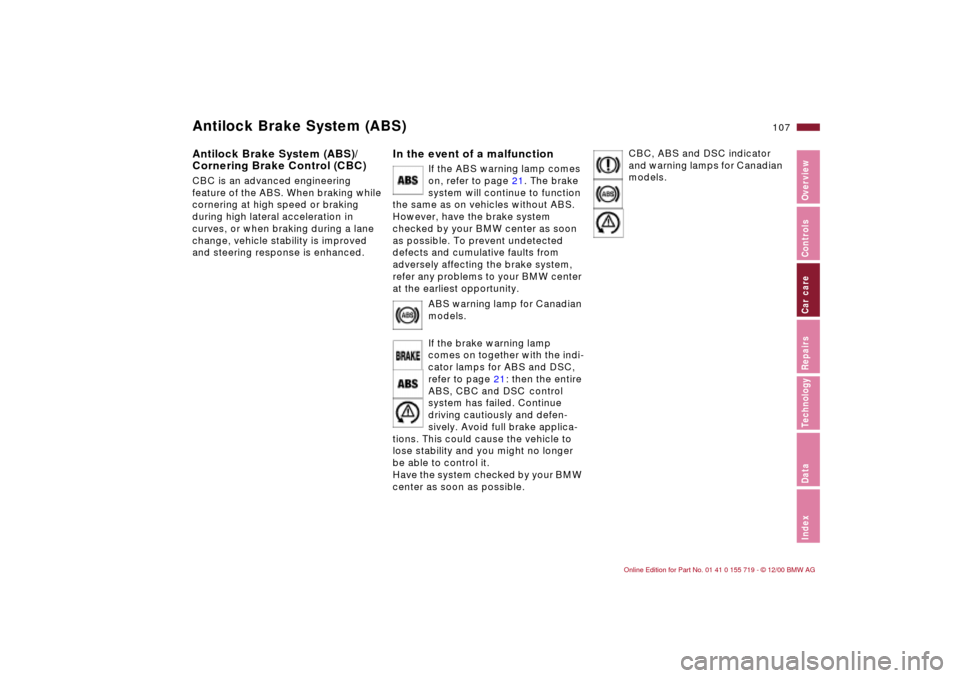
If the ABS warning lamp comes
on, refer to page 21. The brake
system will continue to function
the same as on vehicles without ABS.
However, have the brake system
checked by your BMW center as soon
as possible. To prevent undetected
defects and cumulative faults from
adversely affecting the brake system,
refer any problems to your BMW center
at the earliest opportunity.
ABS warning lamp for Canadian
models.
If the brake warning lamp
comes on together with the indi-
cator lamps for ABS and DSC,
refer to page 21: then the entire
ABS, CBC and DSC
control
system has failed. Continue
driving cautiously and defen-
sively. Avoid full brake applica-
tions. This could cause the vehicle to
lose stability and you might no longer
be able to control it.
Have the system checked by your BMW
center as soon as possible.
CBC, ABS and DSC indicator
and warning lamps for Canadian
models.
Page 108 of 195

108n
Disc brakesDisc brakes furnish optimum decelera-
tion and braking control with greater
fade resistance under heavy use.
Using your vehicle only occasionally,
leaving your vehicle parked for
extended periods, and making only
minimal demands on your brakes
promotes brake disc corrosion and
brake pad contamination, because the
minimal loads required for your disc
brakes to self-clean have not been
reached.
If the brake discs are corroded, they will
tend to respond to braking with a
pulsating effect that even extended
brake applications will fail to cure.
For your own safety: use only
brake pads that BMW has
approved for your particular vehicle
model. BMW cannot evaluate non-
approved brake pads to determine if
they are suited for use, and therefore
cannot ensure the operating safety of
the vehicle if they are installed.<
Driving notes When driving in wet conditions and in
heavy rain, it is effective to apply light
pressure to the brakes every few miles.
Be aware of traffic conditions to ensure
that this maneuver does not endanger
other road users. The heat which is
generated by the brake applications
helps to dry the brake pads and discs.
Maximum braking force is obtained
while the wheels are not locked, but
rather when they are still barely turning
immediately prior to locking. ABS main-
tains this state automatically. If the ABS
should ever fail, pump the brakes if
possible (refer to page 111).
Drive down long or steep descents in
the mountains using a gear that
requires the least amount of braking.
Doing this prevents putting excessive
loads on the brakes, which in turn
keeps the brake system from possibly
being damaged. Stay within the allow-
able engine speed range. For further
information, refer to page 73.
Braking effect on the engine can be
further increased by downshifting, into
first gear, if necessary. Should the braking effect from the
engine prove inadequate, you should
still avoid extended, continuous
braking. Instead, decelerate the vehicle
by stepping hard on the brake pedal
(while watching out for drivers behind
you), and, if necessary, continue to
decelerate by pumping the brakes
(staggered braking). This staggered
braking technique allows the brakes to
cool in the intervals between active
braking phases. This prevents over-
heating and ensures that full braking
capacity remains available at all times.
Do not coast with the clutch
depressed, with the shift lever in
neutral or with the engine shut off. The
engine does not provide any braking
effect with the transmission in neutral or
with the engine shut off.
Do not allow floor mats, carpets or any
other objects to protrude into the area
around the brake pedal, the clutch or
the accelerator which could obstruct
their freedom of movement.<
Page 109 of 195

109n
IndexDataTechnologyRepairsCar careControlsOverview
Brake system Brake fluid level
If the brake warning lamp
comes on with the parking
brake released: the brake fluid
level is too low in the reservoir (refer to
page 130).
If the brake fluid level is too low and
brake pedal travel has become notice-
ably longer, there may be a defect in
one of the brake system's hydraulic
circuits.
Brake warning lamp for Cana-
dian models.
Proceed to the nearest BMW
center. Greater pressure on the
brake pedal may be necessary under
these conditions, and brake pedal
travel may be significantly longer.
Please remember to adapt your driving
style accordingly.<
Brake pads
If the warning lamp for the brake
pads comes on: only the
minimum pad thickness still
remains on the brake pads. Proceed to
the nearest BMW center as soon as
possible to have the pads replaced.
For your own safety: use only
brake pads that BMW has
approved for your particular vehicle
model. BMW cannot evaluate non-
approved brake pads to determine if
they are suited for use, and therefore
cannot ensure the operating safety of
the vehicle if they are installed.<