brake BMW M3 CONVERTIBLE 2001 E46 Owner's Guide
[x] Cancel search | Manufacturer: BMW, Model Year: 2001, Model line: M3 CONVERTIBLE, Model: BMW M3 CONVERTIBLE 2001 E46Pages: 195, PDF Size: 1.96 MB
Page 111 of 195

111n
IndexDataTechnologyRepairsCar careControlsOverview
Winter operationBrakesWinter road conditions substantially
reduce the amount of traction available
between the tires and the road surface;
the resulting increase in braking
distance is considerable and should
always be kept in mind.
ABS is intended to prevent the wheels
from locking during brake applications,
thus helping to maintain vehicle stability
and steering response.
If the ABS does not respond in a critical
braking situation and the wheels lock:
reduce the pressure on the brake pedal
until the wheels just start to roll again
while still maintaining enough force to
continue braking.
Then increase the pressure, reduce the
pressure when the wheels lock, reapply
pressure etc.
Pumping the brakes will reduce braking
distance while helping you maintain
steering control over the vehicle.
You can then attempt to steer around
hazards after you have reduced pres-
sure on the brake pedal. Do not downshift to decelerate on
slick road surfaces. Doing so
could cause loss of traction at the rear
wheels, which could result in the loss of
vehicle control.<
Depress the clutch during hard
braking on road surfaces that
provide only poor or uneven traction.<
Skid control Depress the clutch and release the
accelerator pedal. Countersteer care-
fully and attempt to regain control of the
vehicle.
ParkingEngage either 1st gear or reverse.
Apply the parking brake whenever you
park on inclined surfaces. In order to
prevent the parking brake pads from
locking due to frost or corrosion, dry
them by gently applying the parking
brake as the vehicle is coming to a
stop. Make sure that following traffic is
not endangered.
The brake lamps do not come on
when the parking brake is
applied.<
Page 125 of 195

125n
IndexDataTechnologyRepairsCar careControlsOverview
Engine compartment 1 Filler neck for headlamp and
wind-
shield washer system126
2 Coolant expansion tank129
3 Auxiliary terminal for jump-starting –
positive terminal164
4 Engine oil filler cap127
5 Engine oil dipstick127
6 Brake fluid reservoir130
Page 130 of 195
130n
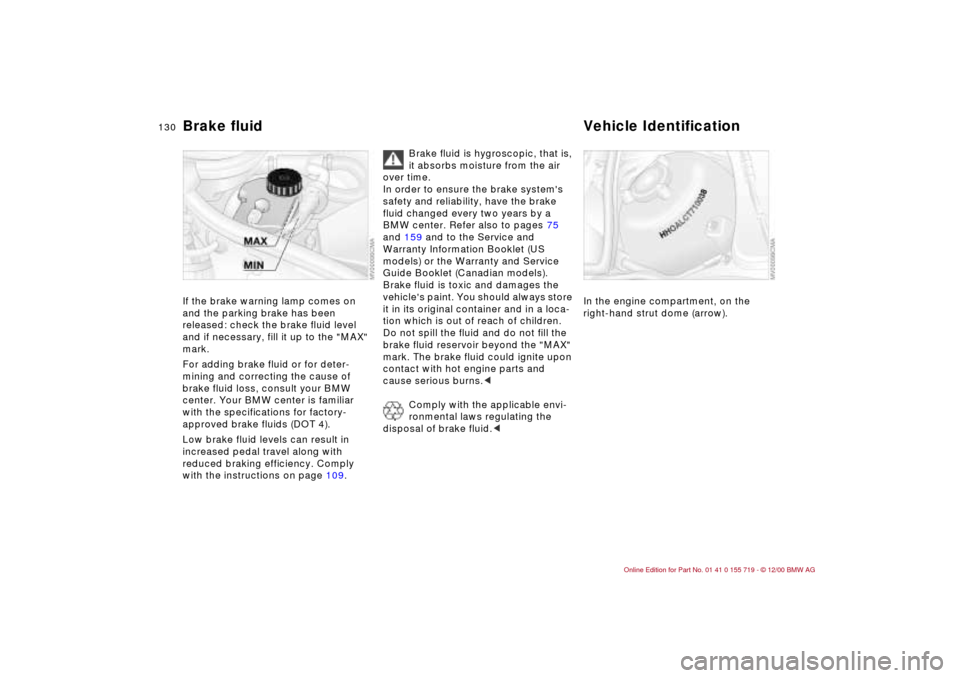
Brake fluid Vehicle Identification If the brake warning lamp comes on
and the parking brake has been
released: check the brake fluid level
and if necessary, fill it up to the "MAX"
mark.
For adding brake fluid or for deter-
mining and correcting the cause of
brake fluid loss, consult your BMW
center. Your BMW center is familiar
with the specifications for factory-
approved brake fluids (DOT 4).
Low brake fluid levels can result in
increased pedal travel along with
reduced braking efficiency. Comply
with the instructions on page 109.
Brake fluid is hygroscopic, that is,
it absorbs moisture from the air
over time.
In order to ensure the brake system's
safety and reliability, have the brake
fluid changed every two years by a
BMW center. Refer also to pages 75
and 159 and to the Service and
Warranty Information Booklet (US
models) or the Warranty and Service
Guide Booklet (Canadian models).
Brake fluid is toxic and damages the
vehicle's paint. You should always store
it in its original container and in a loca-
tion which is out of reach of children.
Do not spill the fluid and do not fill the
brake fluid reservoir beyond the "MAX"
mark. The brake fluid could ignite upon
contact with hot engine parts and
cause serious burns.<
Comply with the applicable envi-
ronmental laws regulating the
disposal of brake fluid.<
In the engine compartment, on the
right-hand strut dome (arrow).
Page 132 of 195

132n
Washing your vehicle You can wash your BMW at an auto-
matic car wash, even when it is new.
Car wash systems that do not employ
brushes are preferable.
Wipe away tough dirt and loosen and
remove dead insects before washing
the vehicle.
In order to avoid spots, do not wash the
vehicle when the hood is warm, or
during or immediately after exposure to
strong sunlight.
When using an automatic car wash, be
sure that:
>The car wash system is suited for the
dimensions of your vehicle.
>No damage will occur on vehicles
with attached body accessories (such
as spoilers or antennas). Consult the
car wash operator if necessary.
>The wheels and tires of your vehicle
cannot be damaged by the convey-
ance devices of the car wash system.
>The vehicle is cleaned with minimum
brush pressure, and that plenty of
water is available for washing and
rinsing. Vehicles with rain sensor
*:
Clean the windshield regularly. Wax
from automatic car washes or insects
can cause malfunctions in the rain
sensor
* function.
Turn the rain sensor off (refer to
page 69) when going through an
automatic car wash, otherwise, damage
could occur from unintended wiper
activation.<
Parts of the vehicle that are inacces-
sible to the automatic washer – such as
door sills, door and hood edges, etc. –
should be cleaned by hand.
In the winter months, it is especially
important to be sure that the vehicle is
washed on a regular basis. Large quan-
tities of dirt and road salt are difficult to
remove, and they also damage the
vehicle.
If spray wands or high-pressure
washers are used, be sure to
maintain an adequate distance between
the spray source and the vehicle's
surface. Inadequate distance and
excessive pressure can damage or
weaken the finish, making it more
susceptible to subsequent attack. In
addition, moisture could penetrate to
vehicle components, leading to long-
term damage.<
When cleaning the headlamps,
please observe the following:
>Do not clean by wiping with a dry
cloth (this causes scratches). Never
use abrasives or strong solvents to
clean the covers.
>Remove dirt and contamination (such
as insects) by soaking with BMW Car
Shampoo and then rinsing with plenty
of water.
>Always use a deicer spray to remove
accumulated ice and snow – never
use a scraper.<
After washing the vehicle, apply
the brakes briefly to dry them.
Braking efficiency might otherwise be
reduced by the moisture and the brake
discs could also corrode.<
Caring for your vehicle
Page 133 of 195

133n
IndexDataTechnologyRepairsCar careControlsOverview
Caring for your vehicleExterior finish To provide effective corrosion protec-
tion, multilayer paintwork is applied at
the factory. Cataphoretic immersion
priming techniques are supplemented
with special body-cavity protectants
and application of specially developed
and extensively tested materials.
A layer of flexible PVC is first applied to
the undercarriage. Following this, a
comprehensive undercoating treat-
ment with a wax-based protectant is
applied. Regular maintenance makes
an important contribution to maintaining
the safety and value of your vehicle.
Increasing awareness of the effects of
harmful environmental factors on
vehicle finishes have led paint and
vehicle manufacturers to initiate
ongoing programs designed to further
improve the durability of their finishes.
Despite this, regional environmental
factors can have negative effects on
your vehicle's finish. Consider these
factors in determining the frequency
and extent of your efforts to maintain
the vehicle finish.
Depending upon material and type of
impact (perforation of paint layer), phys-
ical stresses from sand, road salt,
gravel, etc., can cause corrosion to start extending beneath the finish,
starting at the point of impact.
Road dirt, tar spots, dead insects,
animal droppings (strong alkali effect)
and tree excretions (resins and pollen)
all contain substances capable of
causing damage when allowed to
remain on the finish of your vehicle for
any period of time. This includes spots,
etching, flaking, and separations in the
top coat.
In industrial areas, deposits of flue dust,
lime, oily soot, precipitation containing
sulfur-dioxide (acid rain) and other envi-
ronmental pollutants will damage the
vehicle's finish unless adequate care is
provided – even though this is generally
limited to the outside horizontal
surfaces.
In coastal regions, high levels of atmo-
spheric salt and humidity promote
corrosion.
In tropical zones, high humidity and
heavy ultraviolet radiation prevail, in
addition to temperatures of over 105 7
(+40 6) in the shade. Under these
conditions, light paints can reach
temperatures up to 175 7 (+80 6) and
dark ones up to 250 7 (+120 6).
Caring for the vehicle finish Regular washing is a preventive
measure against long-term effects from
substances that are harmful to the
vehicle's finish, especially if you drive
your vehicle in areas with high levels of
air pollution or aggressive natural
substances (tree resins, pollen).
Nevertheless, you should immediately
remove especially aggressive
substances. Failure to do so can lead to
changes in the paint's chemical struc-
ture or to discoloration. Gasoline spilled
during refueling, oil, grease and brake
fluid should always be cleaned away
immediately, as should bird droppings.
Any contamination remaining on the
surface of the vehicle will be especially
conspicuous after washing. Use
cleaning fluid or alcohol with a clean
cloth or cotton pad to remove these
stains. Remove tar spots with tar
remover. After cleaning, the affected
areas should be waxed to ensure
continued protection.
Use the cleaning and car-care
products available at your BMW
center.<
Page 140 of 195

140n
Storing your vehicle
If you intend to store the vehicle
for more than 3 months, be sure to
follow the maintenance instructions on
this page.<
Storage preparationsHave your BMW center perform the
following procedures:
1 Clean and apply a rustproofing agent
or other treatment to the engine,
engine compartment, undercarriage,
axles and major components in
accordance with approved repair
procedures. First wash the vehicle
surface, then clean the interior,
following up with paint- and chrome
care, after which you clean the
rubber seals for the hood and doors.
2 Change the engine oil and oil filter
with the engine warm. As an addi-
tional corrosion protection measure,
an anticorrosive agent can be added
to the engine in accordance with the
manufacturer's instructions.
3 Check the coolant level and concen-
tration, top up if necessary.
4 Check the fluid level of the wind-
shield washer fluid reservoir; top up if
necessary.
5 Fill the fuel tank completely to
prevent the formation of condensa-
tion.
6 Increase the tire inflation pressure to
51 psi (350 Kilopascal).Before parking the vehicle1 To prevent the brake discs and
drums from corroding, dry the
parking and footbrake by applying
the brakes.
2 Park the vehicle in a covered, dry,
and well-ventilated area. Place the
transmission in first gear or, if neces-
sary, chock the wheels to prevent the
vehicle from rolling. Do not set the
parking brake.
3 Remove the battery, charge it
completely and store it in a cool (but
frost-free) room.
4 Remove the hardtop and store it
separately. Refer to page 114.
5 Close the convertible top.During storageRecharge the battery every six months.
If it is not recharged, it will not be
useable. Every time the battery is
discharged, especially over extended
periods, its service life is reduced.
Removing the vehicle from
storageRecharge the battery if the "Magic
Eye
*" turns black. Refer to page 157.
Then have Inspection I performed by
your BMW center, including a brake
fluid replacement if necessary.
Page 149 of 195
149n
IndexDataTechnologyRepairsCar careControlsOverview
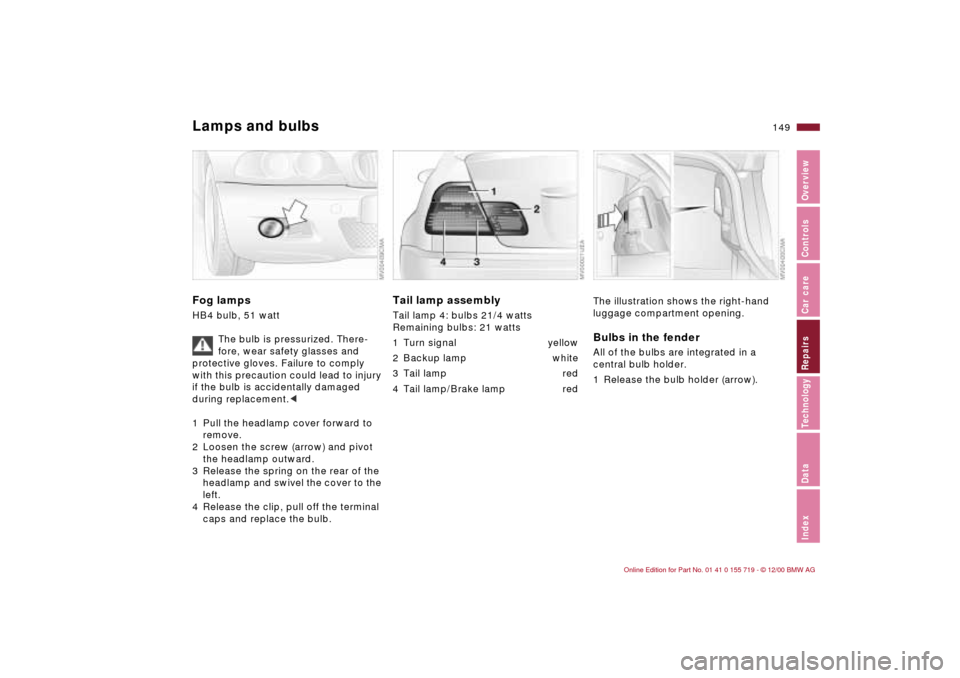
Lamps and bulbsFog lamps HB4 bulb, 51 watt
The bulb is pressurized. There-
fore, wear safety glasses and
protective gloves. Failure to comply
with this precaution could lead to injury
if the bulb is accidentally damaged
during replacement.<
1 Pull the headlamp cover forward to
remove.
2 Loosen the screw (arrow) and pivot
the headlamp outward.
3 Release the spring on the rear of the
headlamp and swivel the cover to the
left.
4 Release the clip, pull off the terminal
caps and replace the bulb.
Tail lamp assemblyTail lamp 4: bulbs 21/4 watts
Remaining bulbs: 21 watts
1 Turn signal yellow
2 Backup lamp white
3 Tail lamp red
4 Tail lamp/Brake lamp red
The illustration shows the right-hand
luggage compartment opening.Bulbs in the fenderAll of the bulbs are integrated in a
central bulb holder.
1 Release the bulb holder (arrow).
Page 151 of 195
151n
IndexDataTechnologyRepairsCar careControlsOverview
Lamps and bulbsCenter (high-mount) brake lamp
LED strip in luggage compartment lid.
Please contact a BMW center in case of
a malfunction.
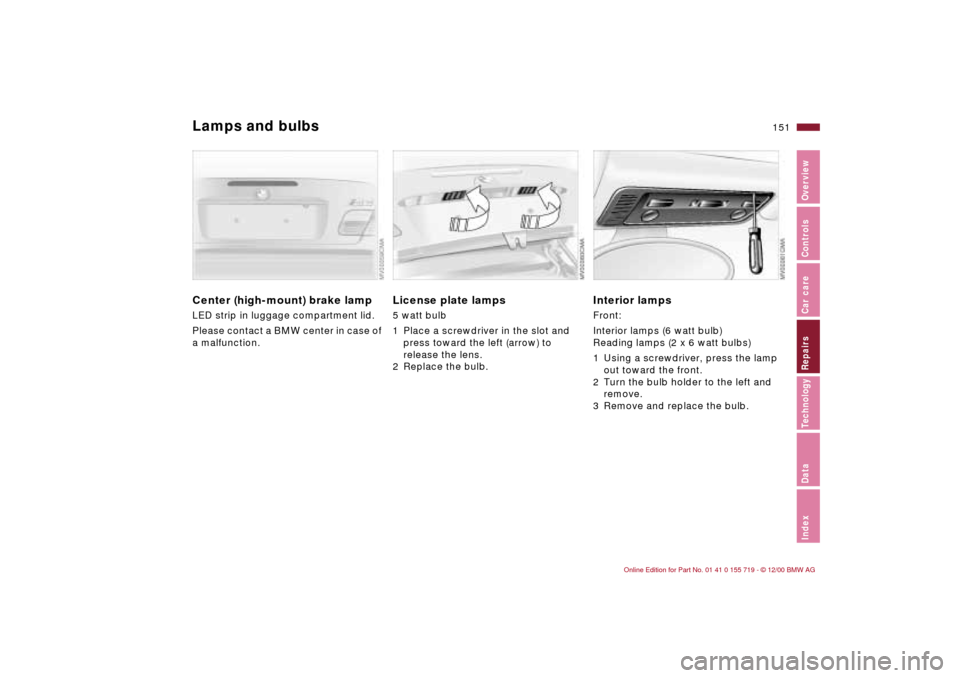
License plate lamps 5 watt bulb
1 Place a screwdriver in the slot and
press toward the left (arrow) to
release the lens.
2 Replace the bulb.
Interior lamps Front:
Interior lamps (6 watt bulb)
Reading lamps (2 x 6 watt bulbs)
1 Using a screwdriver, press the lamp
out toward the front.
2 Turn the bulb holder to the left and
remove.
3 Remove and replace the bulb.
Page 153 of 195
153n
IndexDataTechnologyRepairsCar careControlsOverview
Repairing a flat tire
Precautions in case of a flat tire:
Stop the vehicle as far as possible
from passing traffic; turn on the hazard
warning flashers.
Turn the steering wheel to the straight-
ahead position and engage the steering
lock. Engage the parking brake and
shift into 1st or reverse.
All passengers should be outside the
vehicle and well away from your imme-
diate working area (behind a guardrail,
for instance).
If a warning triangle or portable hazard
warning lamp is available, set it up on
the roadside at an appropriate distance
from the rear of the vehicle. Comply
with all safety guidelines and regula-
tions.<
M Mobility systemAn M Mobility system for fixing flat tires
is included with your BMW M3 convert-
ible. With the aid of this system, you
can apply a liquid sealant to the inside
of the tire, thereby sealing off the
damaged area, and then continue
driving.
The M Mobility system makes trans-
porting a spare wheel superfluous,
thereby reducing the amount of weight
you have to carry around.
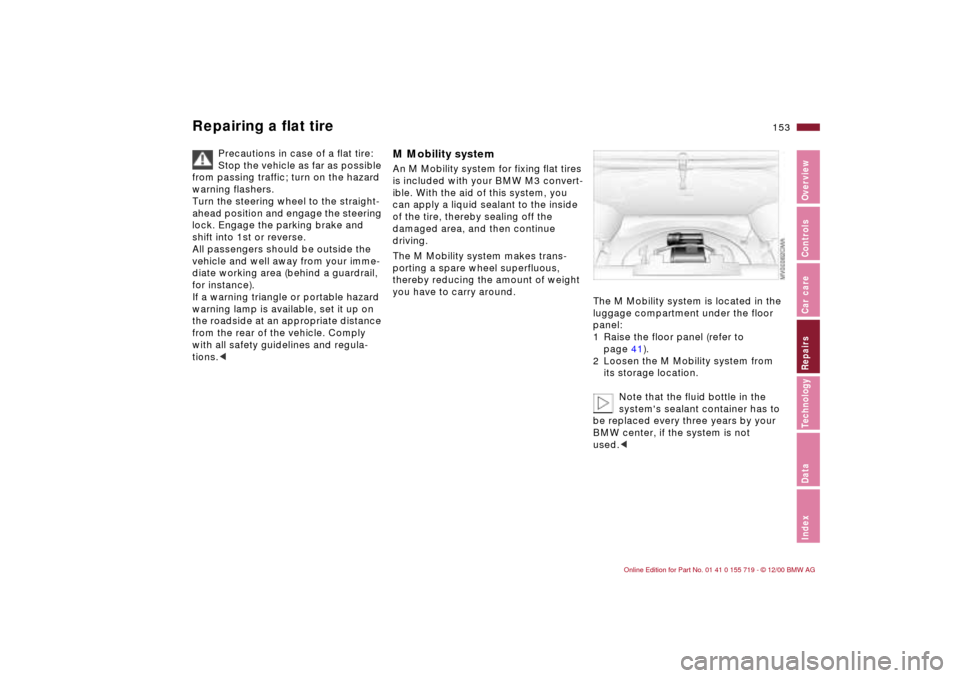
The M Mobility system is located in the
luggage compartment under the floor
panel:
1 Raise the floor panel (refer to
page 41).
2 Loosen the M Mobility system from
its storage location.
Note that the fluid bottle in the
system's sealant container has to
be replaced every three years by your
BMW center, if the system is not
used.<
Page 159 of 195

159n
IndexDataTechnologyRepairsCar careControlsOverview
BatteryCharging the battery Charge the battery in the vehicle only
when the engine is not running.
Before doing any work on the
electrical system, be sure to
disconnect the cable from the battery's
negative terminal. Failure to do so can
result in short-circuits, a fire or personal
injury.<
If you plan to park the vehicle for longer
than 4 weeks, disconnect the battery
from the vehicle electrical system by
disconnecting the cable at the negative
terminal. Then recharge the battery with
an appropriate battery charger.
If the vehicle is parked for more than
12 weeks, remove the battery, recharge
it and store it in a cool yet frost- and
dust-free area. During storage, have the
battery recharged every 3 months.
Also, recharge the battery before it is
reinstalled. If this is not done, the
battery will not be serviceable. Every
time the battery is discharged, espe-
cially over extended periods, its service
life is reduced.
Return used batteries to a recy-
cling point or your BMW center.
Maintain the battery in an upright posi-
tion for transport and storage. Secure
the battery to prevent it from tilting
during transport.<
Storage periods during which the
battery is disconnected are not
taken into consideration by the Service
Interval Display for changing the brake
fluid.
For this reason, be sure that the brake
fluid is changed every two years,
regardless of the information displayed.
Comply with the information on this
subject on page 130.<