brake BMW M3 CONVERTIBLE 2001 E46 Owner's Manual
[x] Cancel search | Manufacturer: BMW, Model Year: 2001, Model line: M3 CONVERTIBLE, Model: BMW M3 CONVERTIBLE 2001 E46Pages: 195, PDF Size: 1.96 MB
Page 6 of 195
6n
For your own safety
Use unleaded gasoline only. Fuels
containing up to and including
10 % ethanol or other oxygenates with
up to 2.8 % oxygen by weight (i.e. 15 %
MTBE or 3 % methanol plus an equiva-
lent amount of co-solvent) will not void
the applicable warranties covering
defects in materials or workmanship.
Field experience has indicated signifi-
cant differences in fuel quality (volatility,
composition, additives, etc.) among
gasolines offered for sale in the United
States and Canada. The use of poor-
quality fuels may result in drivability,
starting and stalling problems espe-
cially under certain environmental
conditions, such as high ambient
temperature and high altitude.
Should you encounter driveability prob-
lems which you suspect could be
related to the fuel you are using, we
recommend that you respond by
switching to a recognized high-quality
brand.
Failure to comply with these recom-
mendations may result in unscheduled
maintenance.
Obey pertinent safety rules when you
are handling gasoline.
<
Important safety information!
For your own safety, use genuine parts
and accessories approved by BMW.
When you purchase accessories tested
and approved by BMW and Original
BMW Parts, you simultaneously acquire
the assurance that they have been thor-
oughly tested by BMW to ensure
optimum performance when installed
on your vehicle.
BMW warrants these parts to be free
from defects in material and workman-
ship.
BMW will not accept any liability for
damage resulting from installation of
parts and accessories not approved by
BMW.
BMW cannot test every product on the
market to verify if it can be used on a
BMW safely and without risk to either
the vehicle, its operation, or its occu-
pants.
Original BMW Parts, BMW Accessories
and other products approved by BMW,
together with professional advice on
using these items, are available from all
BMW centers.
Installation and operation of non-BMW
approved accessories such as alarms,
radios, amplifiers, radar detectors,
wheels, suspension components, brake
dust shields, telephones (including
operation of any portable cellular phone
from within the vehicle without using an
externally mounted antenna) or trans-
ceiver equipment (such as CB, walkie-
talkie, ham radio or similar) may cause
extensive damage to the vehicle,
compromise its safety, interfere with
the vehicle's electrical system or affect
the validity of the BMW Limited
Warranty. Contact your BMW center for
additional information.
<
Maintenance, replacement, or
repair of the emission control
devices and systems may be performed
by any automotive repair establishment
or individual using any certified auto-
motive part.
<
Symbol on vehicle parts
Indicates that you should consult
the relevant section of this
Owner's Manual for information on a
specific part or assembly.
Page 10 of 195

Contents
Overview
Controls and features
Cockpit16
Instrument cluster18
Indicator and warning lamps20
Multifunction steering wheel
(MFL)24
Hazard warning flashers25
Warning triangle25
Refueling26
Fuel specifications27
Tire inflation pressures27
Opening and closing:
Keys32
Electronic vehicle
immobilizer33
Central locking system33
Opening and closing – via the
door lock34
Opening and closing – via the
remote control35
Opening and closing – from
inside38
Luggage compartment lid39
Luggage compartment40
Alarm system42
Electric power windows44
Convertible top45
Adjustments:
Seats48
Mirrors52
Seat and mirror memory54
Steering wheel55
Car Memory, Key Memory55
Passenger safety systems:
Safety belts57
Transporting children safely58
Airbags61
Rollover protection system64
Driving:
Steering/Ignition lock66
Starting the engine66
Switching off the engine67
Parking brake67
Manual transmission68
Turn signal indicator/Headlamp
flasher69
Washer/Wiper system69
Rear window defroster71
Cruise control71
Everything under control:
Odometer73
Tachometer73
Engine oil temperature gauge73
Fuel gauge74
Coolant temperature gauge74
Service Interval Display75
Check Control76
Clock76
Computer77
Technology for safety and
convenience:
Park Distance Control (PDC)79
Dynamic Stability Control
(DSC)80
Tire Pressure Warning (RDW)81
M Engine dynamics control83
Contents
Page 11 of 195

11n
Controls and features
Operation, care and maintenance
Lamps:
Side lamps/Low beam
headlamps84
Instrument lighting84
High beams/Parking lamps85
Fog lamps85
Interior lamps86
Reading lamps86
Controlling the climate
for pleasant driving:
Automatic climate control88
Heated seats93
Interior conveniences:
Glove compartment94
Storage compartments95
Cellular phone96
Ashtray, front96
Cigarette lighter97
Ashtray, rear97
Loading and transporting:
Ski bag98
Cargo loading100
Roof-mounted luggage rack for
the hardtop101
Special operating instructions:
Break-in procedures104
Driving notes105
Catalytic converter105
Antilock Brake System
(ABS)106
Disc brakes108
Brake system109
Winter operation110
Power steering112
Cellular phone112
Radio reception112
Hardtop113
Wheels and tires:
Tire inflation pressures115
Tire condition115
Tire replacement116
Tire rotation117
Wheel and tire
combinations118
Special features of winter
tires119
Snow chains119
Approved wheel and tire
specifications120
Under the hood:
Hood121
Engine compartment124
Washer fluids126
Washer nozzles126
Engine oil127
Coolant129
Brake fluid130
Vehicle Identification130
Care and maintenance:
The BMW Maintenance
System131
Caring for your vehicle132
Cleaning and caring for the
convertible top137
Airbags139
Storing your vehicle140
Laws and regulations:
Technical modifications141
California Proposition 65
Warning141
OBD connector142
Page 19 of 195

19n
IndexDataTechnologyRepairsCar careControlsOverview
Instrument cluster
1 Fuel gauge with indicator lamp for
fuel reserve74
2 Turn signal indicator23
3 Speedometer
4 Indicator lamp for
>
Battery charge current20
>
High beams23
>
Engine oil pressure/Engine oil
level20, 21
5 Tachometer and engine oil temper-
ature gauge73
6 Engine coolant temperature gauge
with "Coolant temperature too high"
indicator74
7 Indicator and warning lamps (clock-
wise) for
>
Parking brake/Brake system
hydraulic circuits/Cornering
Brake Control (CBC)20, 21
>
Antilock Brake System (ABS)21
>
Brake pads22
>
Tire Pressure Warning
(RDW)20, 22
>
Rollover protection system22
>
Airbags21
>
Please fasten safety belts, lock
backrest21
>
Cruise control238 Reset button for
>
Clock76
>
Unit of measure for outside
temperature display77
9 Indicator lamp for Dynamic Stability
Control (DSC)22
10 Display panel for
>
Odometer73
>
Trip odometer73
>
Clock76
>
Service Interval75
Computer display, using the turn
signal lever to operate, refer to
page 77:
>
Clock
>
Outside temperature
>
Average fuel consumption
>
Cruising range
>
Average speed
11 Check Control display76
12 Trip odometer, reset to zero7313 Indicator and warning lamps (clock-
wise) for
>
Fog lamps23
>
Add washer fluid22
>
Coolant level22
>
Electronic Engine Power Control
(EML)22
>
Service Engine Soon22
You can have the outside temper-
ature and distance traveled shown
in other units of measurement.
<
Page 20 of 195
20n
Indicator and warning lamps
Technology
that monitors itself
Many of the systems in your BMW
monitor themselves automatically, both
during engine starts and while you are
driving. Indicator and warning lamps
identified by "
l
" are tested for proper
operation whenever the ignition key is
turned. They each light up once for
different periods of time.
If a fault should occur in one of these
systems, the corresponding lamp does
not go out after the engine is started, or
it lights up while the vehicle is moving.
You will see how to react to this below.
Red: stop immediately
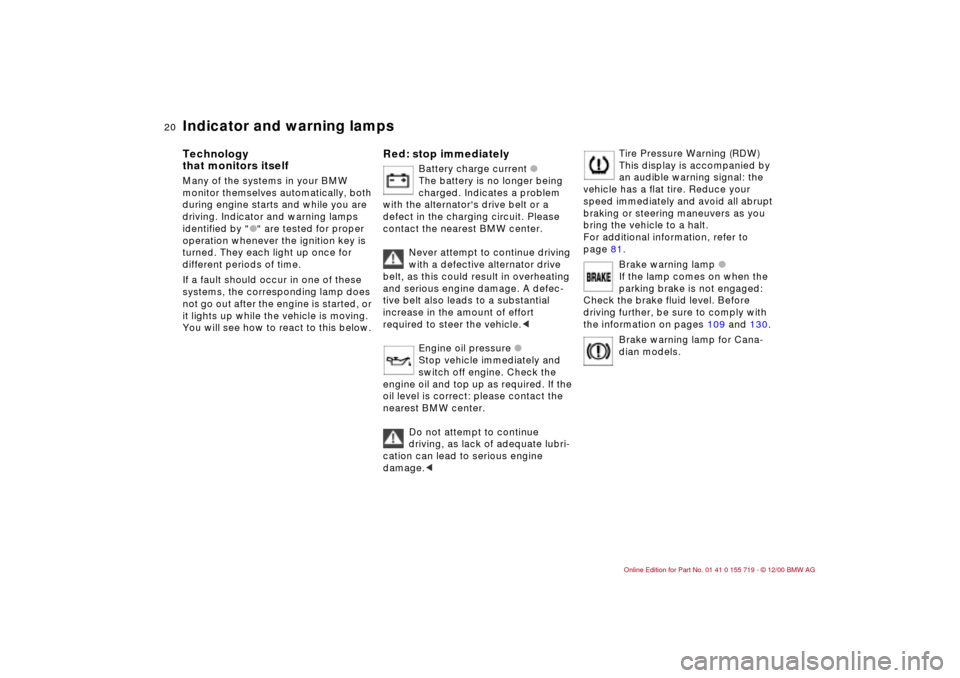
Battery charge current
l
The battery is no longer being
charged. Indicates a problem
with the alternator's drive belt or a
defect in the charging circuit. Please
contact the nearest BMW center.
Never attempt to continue driving
with a defective alternator drive
belt, as this could result in overheating
and serious engine damage. A defec-
tive belt also leads to a substantial
increase in the amount of effort
required to steer the vehicle.
<
Engine oil pressure
l
Stop vehicle immediately and
switch off engine. Check the
engine oil and top up as required. If the
oil level is correct: please contact the
nearest BMW center.
Do not attempt to continue
driving, as lack of adequate lubri-
cation can lead to serious engine
damage.
<
Tire Pressure Warning (RDW)
This display is accompanied by
an audible warning signal: the
vehicle has a flat tire. Reduce your
speed immediately and avoid all abrupt
braking or steering maneuvers as you
bring the vehicle to a halt.
For additional information, refer to
page 81.
Brake warning lamp l
If the lamp comes on when the
parking brake is not engaged:
Check the brake fluid level. Before
driving further, be sure to comply with
the information on pages 109 and 130.
Brake warning lamp for Cana-
dian models.
Page 21 of 195
21n
IndexDataTechnologyRepairsCar careControlsOverview
Indicator and warning lampsRed: an important reminder
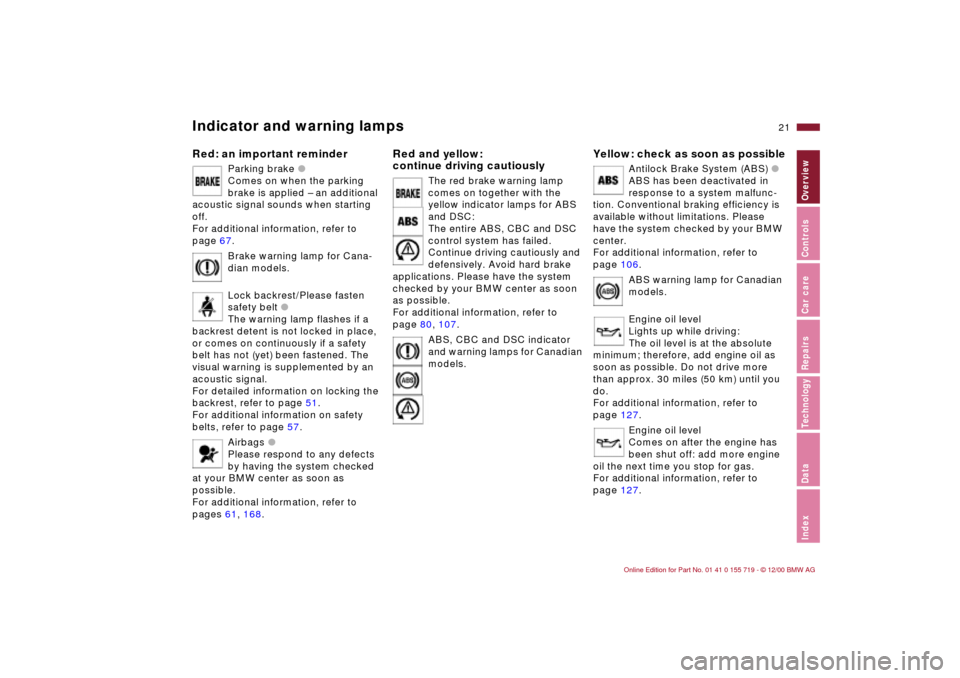
Parking brake l
Comes on when the parking
brake is applied – an additional
acoustic signal sounds when starting
off.
For additional information, refer to
page 67.
Brake warning lamp for Cana-
dian models.
Lock backrest/Please fasten
safety belt l
The warning lamp flashes if a
backrest detent is not locked in place,
or comes on continuously if a safety
belt has not (yet) been fastened. The
visual warning is supplemented by an
acoustic signal.
For detailed information on locking the
backrest, refer to page 51.
For additional information on safety
belts, refer to page 57.
Airbags l
Please respond to any defects
by having the system checked
at your BMW center as soon as
possible.
For additional information, refer to
pages 61, 168.
Red and yellow:
continue driving cautiously
The red brake warning lamp
comes on together with the
yellow indicator lamps for ABS
and DSC:
The entire ABS, CBC and DSC
control system has failed.
Continue driving cautiously and
defensively. Avoid hard brake
applications. Please have the system
checked by your BMW center as soon
as possible.
For additional information, refer to
page 80, 107.
ABS, CBC and DSC indicator
and warning lamps for Canadian
models.
Yellow: check as soon as possible
Antilock Brake System (ABS) l
ABS has been deactivated in
response to a system malfunc-
tion. Conventional braking efficiency is
available without limitations. Please
have the system checked by your BMW
center.
For additional information, refer to
page 106.
ABS warning lamp for Canadian
models.
Engine oil level
Lights up while driving:
The oil level is at the absolute
minimum; therefore, add engine oil as
soon as possible. Do not drive more
than approx. 30 miles (50 km) until you
do.
For additional information, refer to
page 127.
Engine oil level
Comes on after the engine has
been shut off: add more engine
oil the next time you stop for gas.
For additional information, refer to
page 127.
Page 22 of 195
22n
Indicator and warning lamps
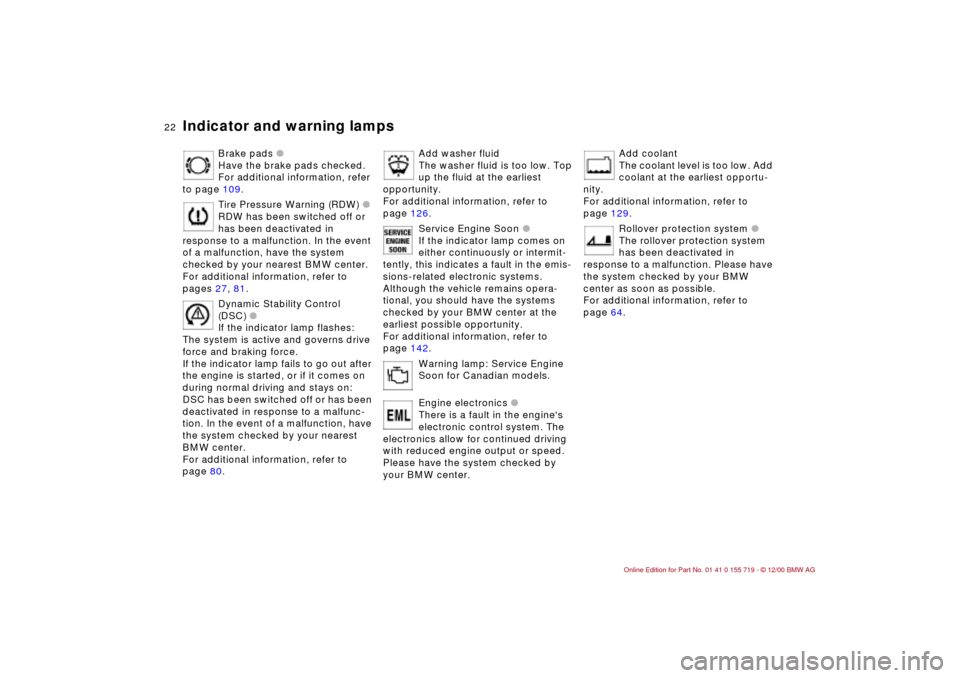
Brake pads
l
Have the brake pads checked.
For additional information, refer
to page 109.
Tire Pressure Warning (RDW)
l
RDW has been switched off or
has been deactivated in
response to a malfunction. In the event
of a malfunction, have the system
checked by your nearest BMW center.
For additional information, refer to
pages 27, 81.
Dynamic Stability Control
(DSC)
l
If the indicator lamp flashes:
The system is active and governs drive
force and braking force.
If the indicator lamp fails to go out after
the engine is started, or if it comes on
during normal driving and stays on:
DSC has been switched off or has been
deactivated in response to a malfunc-
tion. In the event of a malfunction, have
the system checked by your nearest
BMW center.
For additional information, refer to
page 80.
Add washer fluid
The washer fluid is too low. Top
up the fluid at the earliest
opportunity.
For additional information, refer to
page 126.
Service Engine Soon
l
If the indicator lamp comes on
either continuously or intermit-
tently, this indicates a fault in the emis-
sions-related electronic systems.
Although the vehicle remains opera-
tional, you should have the systems
checked by your BMW center at the
earliest possible opportunity.
For additional information, refer to
page 142.
Warning lamp: Service Engine
Soon for Canadian models.
Engine electronics
l
There is a fault in the engine's
electronic control system. The
electronics allow for continued driving
with reduced engine output or speed.
Please have the system checked by
your BMW center.
Add coolant
The coolant level is too low. Add
coolant at the earliest opportu-
nity.
For additional information, refer to
page 129.
Rollover protection system
l
The rollover protection system
has been deactivated in
response to a malfunction. Please have
the system checked by your BMW
center as soon as possible.
For additional information, refer to
page 64.
Page 31 of 195
Overview
Controls and features
Operation, care
and maintenance
Owner service procedures
Technical data
Index Advanced technology
31n
IndexDataTechnologyRepairsCar careControlsOverview
Driving:
Steering/Ignition lock66
Starting the engine66
Switching off the engine67
Parking brake67
Manual transmission68
Turn signal indicator/Headlamp
flasher69
Washer/Wiper system69
Rear window defroster71
Cruise control71
Everything under control:
Odometer73
Tachometer73
Engine oil temperature gauge73
Fuel gauge74
Coolant temperature gauge74
Service Interval Display75
Check Control76
Clock76
Computer77
Technology for driving comfort
and safety:
Park Distance Control (PDC)79
Dynamic Stability Control
(DSC)80
Tire Pressure Warning (RDW)81
M Engine dynamics control83Lamps:
Side lamps/Low beam
headlamps84
Instrument lighting84
High beams/Parking lamps85
Fog lamps85
Interior lamps86
Reading lamps86
Controlling the climate
for pleasant driving:
Automatic climate control88
Heated seats93
Cabin convenience:
Glove compartment94
Storage compartments95
Cellular phone96
Ashtray, front96
Cigarette lighter97
Ashtray, rear97
Loading and transporting
cargo:
Ski bag98
Cargo loading100
Roof-mounted luggage rack for
the hardtop101
Page 66 of 195
66n
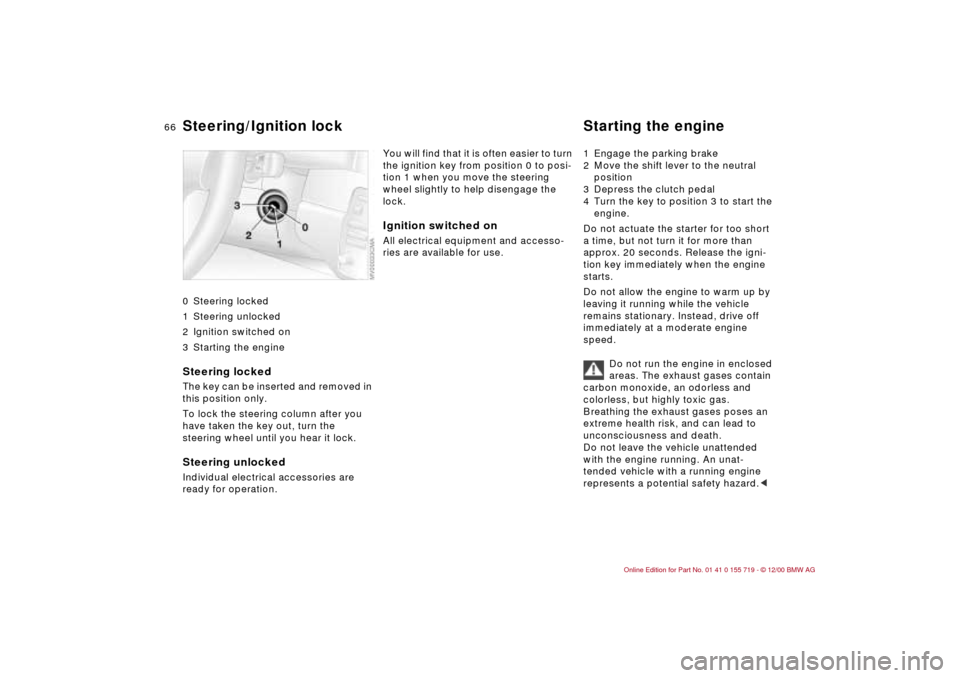
0 Steering locked
1 Steering unlocked
2 Ignition switched on
3 Starting the engine
Steering locked The key can be inserted and removed in
this position only.
To lock the steering column after you
have taken the key out, turn the
steering wheel until you hear it lock.Steering unlocked Individual electrical accessories are
ready for operation.
You will find that it is often easier to turn
the ignition key from position 0 to posi-
tion 1 when you move the steering
wheel slightly to help disengage the
lock. Ignition switched onAll electrical equipment and accesso-
ries are available for use. 1 Engage the parking brake
2 Move the shift lever to the neutral
position
3 Depress the clutch pedal
4 Turn the key to position 3 to start the
engine.
Do not actuate the starter for too short
a time, but not turn it for more than
approx. 20 seconds. Release the igni-
tion key immediately when the engine
starts.
Do not allow the engine to warm up by
leaving it running while the vehicle
remains stationary. Instead, drive off
immediately at a moderate engine
speed.
Do not run the engine in enclosed
areas. The exhaust gases contain
carbon monoxide, an odorless and
colorless, but highly toxic gas.
Breathing the exhaust gases poses an
extreme health risk, and can lead to
unconsciousness and death.
Do not leave the vehicle unattended
with the engine running. An unat-
tended vehicle with a running engine
represents a potential safety hazard.<
Steering/Ignition lock Starting the engine
Page 67 of 195
67n
IndexDataTechnologyRepairsCar careControlsOverview
Starting the engine Switching off the engine Parking brake If the engine does not start on the first
attempt (if it is very hot or cold, for
instance):
>Press the accelerator pedal halfway
down while engaging the starter.
Cold starts at very low temperatures,
starting at approx. 5 7 (–15 6) and at
high altitudes (over 1,000 meters):
>On the first start attempt, engage the
starter for a longer period (approx.
10 seconds)
>Press the accelerator pedal halfway
down while engaging the starter.
Engine idle speed is controlled by the
engine computer system. Increased
speeds at startup are normal and
should decrease as the engine warms
up. If engine speed does not decrease,
service is required.
To prevent the battery from
discharging, always deactivate elec-
trical devices that are not in use. Switch
the ignition off when the vehicle is not
being driven.Turn the ignition key to position 1 or 0.
Do not remove the ignition key
while the vehicle is still moving.
If you did so, the steering lock would
engage when the steering wheel is
turned.
When you leave the vehicle, always
remove the ignition key and engage the
steering lock.
Set the parking brake when parking on
steep hills, because under certain
conditions, putting the vehicle into first
or reverse gear may not be enough to
prevent it from rolling away.
The power assist is not available when
the engine is not on. This means that
more effort is required for braking.<
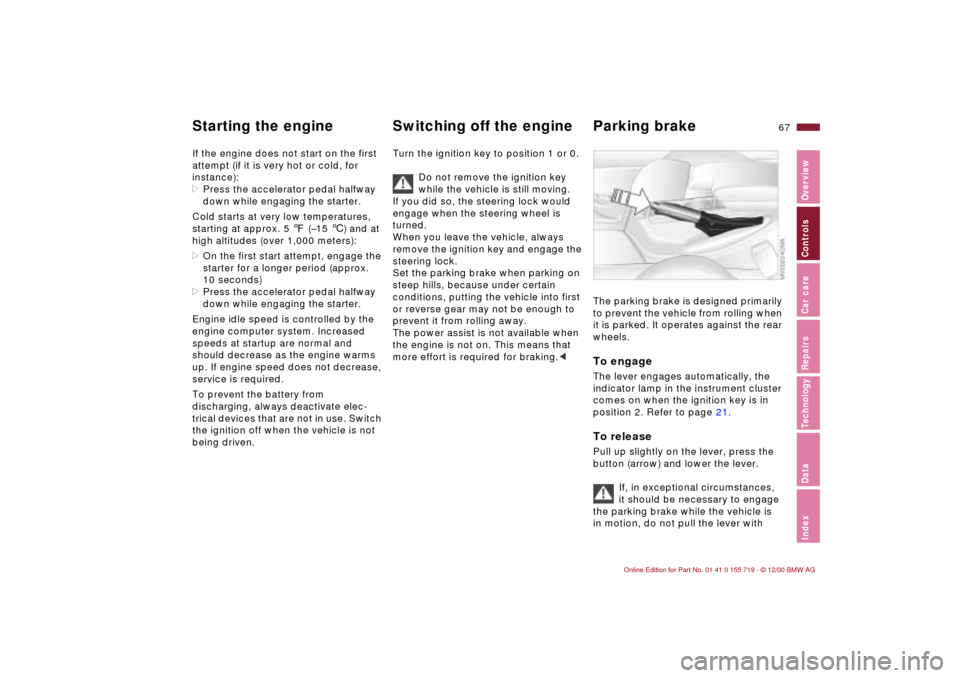
The parking brake is designed primarily
to prevent the vehicle from rolling when
it is parked. It operates against the rear
wheels. To engageThe lever engages automatically, the
indicator lamp in the instrument cluster
comes on when the ignition key is in
position 2. Refer to page 21.To releasePull up slightly on the lever, press the
button (arrow) and lower the lever.
If, in exceptional circumstances,
it should be necessary to engage
the parking brake while the vehicle is
in motion, do not pull the lever with