tires BMW M3 CONVERTIBLE 2001 E46 User Guide
[x] Cancel search | Manufacturer: BMW, Model Year: 2001, Model line: M3 CONVERTIBLE, Model: BMW M3 CONVERTIBLE 2001 E46Pages: 195, PDF Size: 1.96 MB
Page 111 of 195

111n
IndexDataTechnologyRepairsCar careControlsOverview
Winter operationBrakesWinter road conditions substantially
reduce the amount of traction available
between the tires and the road surface;
the resulting increase in braking
distance is considerable and should
always be kept in mind.
ABS is intended to prevent the wheels
from locking during brake applications,
thus helping to maintain vehicle stability
and steering response.
If the ABS does not respond in a critical
braking situation and the wheels lock:
reduce the pressure on the brake pedal
until the wheels just start to roll again
while still maintaining enough force to
continue braking.
Then increase the pressure, reduce the
pressure when the wheels lock, reapply
pressure etc.
Pumping the brakes will reduce braking
distance while helping you maintain
steering control over the vehicle.
You can then attempt to steer around
hazards after you have reduced pres-
sure on the brake pedal. Do not downshift to decelerate on
slick road surfaces. Doing so
could cause loss of traction at the rear
wheels, which could result in the loss of
vehicle control.<
Depress the clutch during hard
braking on road surfaces that
provide only poor or uneven traction.<
Skid control Depress the clutch and release the
accelerator pedal. Countersteer care-
fully and attempt to regain control of the
vehicle.
ParkingEngage either 1st gear or reverse.
Apply the parking brake whenever you
park on inclined surfaces. In order to
prevent the parking brake pads from
locking due to frost or corrosion, dry
them by gently applying the parking
brake as the vehicle is coming to a
stop. Make sure that following traffic is
not endangered.
The brake lamps do not come on
when the parking brake is
applied.<
Page 115 of 195
115n
IndexDataTechnologyRepairsCar careControlsOverview
Information for your safetyThe factory-approved radial tires are
matched to the vehicle and have been
selected to provide optimum safety and
driving comfort on your vehicle.
It is not merely the tire's service life, but
also driving comfort and – above all
else – driving safety that depend on the
condition of the tires and the mainte-
nance of the specified tire pressure.
Incorrect inflation pressure is a frequent
cause of tire damage. It also signifi-
cantly influences the roadholding ability
of your BMW.
Check tire inflation pressures on a
regular basis (refer to page 27), at
least every two weeks and before
beginning a longer trip. If this is not
done, incorrect tire pressures can
cause driving instability and tire
damage, ultimately resulting in acci-
dents.<
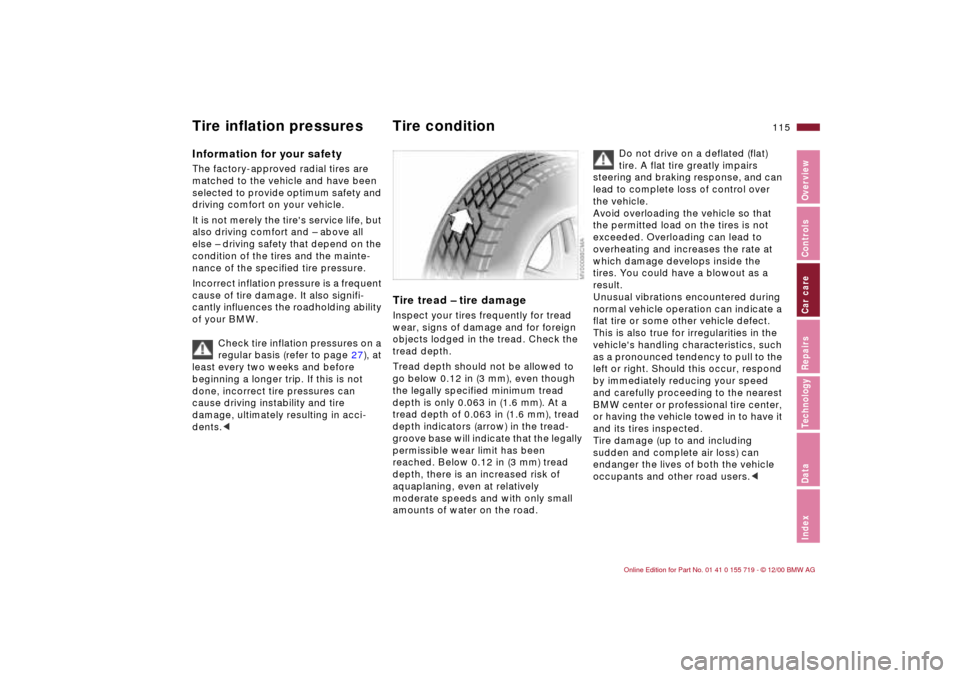
Tire tread – tire damageInspect your tires frequently for tread
wear, signs of damage and for foreign
objects lodged in the tread. Check the
tread depth.
Tread depth should not be allowed to
go below 0.12 in (3 mm), even though
the legally specified minimum tread
depth is only 0.063 in (1.6 mm). At a
tread depth of 0.063 in (1.6 mm), tread
depth indicators (arrow) in the tread-
groove base will indicate that the legally
permissible wear limit has been
reached. Below 0.12 in (3 mm) tread
depth, there is an increased risk of
aquaplaning, even at relatively
moderate speeds and with only small
amounts of water on the road.
Do not drive on a deflated (flat)
tire. A flat tire greatly impairs
steering and braking response, and can
lead to complete loss of control over
the vehicle.
Avoid overloading the vehicle so that
the permitted load on the tires is not
exceeded. Overloading can lead to
overheating and increases the rate at
which damage develops inside the
tires. You could have a blowout as a
result.
Unusual vibrations encountered during
normal vehicle operation can indicate a
flat tire or some other vehicle defect.
This is also true for irregularities in the
vehicle's handling characteristics, such
as a pronounced tendency to pull to the
left or right. Should this occur, respond
by immediately reducing your speed
and carefully proceeding to the nearest
BMW center or professional tire center,
or having the vehicle towed in to have it
and its tires inspected.
Tire damage (up to and including
sudden and complete air loss) can
endanger the lives of both the vehicle
occupants and other road users.<
Tire inflation pressures Tire condition
Page 116 of 195

116n
To maintain good handling and vehicle
response, use only tires of a single
tread configuration from a single manu-
facturer. BMW tests and approves
wheel and tire combinations. Refer to
page 120.
DOT Quality Grades Treadwear
Traction AA A B C
Temperature A B C
All passenger vehicle tires must
conform to Federal Safety
Requirements in addition to these
grades.
when tested under controlled condi-
tions on a specified government test
course.
For example, a tire graded 150 would
wear one and one-half (1 g) times as
well on the government course as a tire
graded 100. The relative performance
of tires depends upon the actual condi-
tions of their use, however, and may
depart significantly from the norm due
to variations in driving habits, service
practices and differences in road char-
acteristics and climate.TractionThe traction grades, from highest to
lowest, are AA, A, B, and C.
Those grades represent the tire's ability
to stop on wet pavement as measured
under controlled conditions on speci-
fied government test surfaces of
asphalt and concrete. A tire marked C
may have poor traction performance.
The traction grade assigned to
this tire is based on straight-
ahead braking traction tests, and does
not include acceleration, cornering,
hydroplaning, or peak traction charac-
teristics.< TemperatureThe temperature grades are A (the
highest), B, and C, representing the
tire's resistance to the generation of
heat and its ability to dissipate heat
when tested under controlled condi-
tions on a specified indoor laboratory
test wheel.
Sustained high temperature can cause
the material of the tire to degenerate
and reduce tire life, and excessive
temperature can lead to sudden tire
failure. The grade C corresponds to a
level of performance which all
passenger vehicle tires must meet
under the Federal Motor Vehicle Safety
Standard No. 109. Grades B and A
represent higher levels of performance
on the laboratory test wheel than the
minimum required by law.
The temperature grade for this tire
is established for a tire that is
properly inflated and not overloaded.
Excessive speed, underinflation, or
excessive loading, either separately or
in combination, can cause heat buildup
and possible tire failure.< Uniform Tire Quality Grading Quality grades can be found where
applicable on the tire sidewall between
tread shoulder and maximum section
width. For example:
Tread wear 200 Traction AA
Temperature A
Tire replacement
Page 117 of 195

117n
IndexDataTechnologyRepairsCar careControlsOverview
Tire replacement Tire rotation
Do not use retreaded tires. Driving
safety may be impaired by their
use. The reason for this are possible
variations in tire casing structures and,
in part, because they are already quite
old, which can lead to a deterioration in
their durability.<
Tire ageThe date on which the tire was manu-
factured is indicated by the code on the
sidewall:
DOT ... 1101 means that the tire was
produced in the 11th week of the year
2001.
BMW recommends replacing all tires
after 6 years at the latest, even if a tire
life of 10 years is possible.
Spare tires over 6 years old should be
used only in case of emergency. A tire
in this condition should be replaced by
a new tire immediately, and should not
be mounted together with new tires.
Re-initialize the Tire Pressure Warning
(RDW) after rotating the tires. Refer to
page 81 for further information.Summer tires
Due to different tire sizes on the
front and rear axles (refer to
page 120), the tires may not be rotated
from one axle to the other.<
Winter tiresThe wheels are designed specifically
for use at the front or rear only.
Because the front and rear wheels
feature different rim depths (refer to
page 120), you should never attempt to
switch wheels from the front to rear or
vice versa.
Page 118 of 195

118n
Wheel and tire combinations The right choice
Only use wheels and tires that
have been approved by BMW for
the corresponding vehicle model, as
otherwise body contact and serious
accidents can result despite the use of
the same nominal size, e.g. due to
tolerances. BMW cannot evaluate non-
approved wheels and tires to determine
if they are suited for use, and therefore
cannot ensure the operating safety of
the vehicle if they are installed.<
For wheel and tire sizes approved by
BMW, refer to page 120.
Failure to use the specified wheel
and tire combinatons can have an
adverse effect on the performance of
various systems such as ABS and DSC.
For this reason, use only tires made by
the same manufacturer and that have
the same tread configuration on the
vehicle. And after a flat tire, for
instance, restore the approved wheel
and tire combination as soon as
possible.<
Codes on the tires and wheels The marking on the tire has the
following meaning.
The codes on radial tires:
The speed rating indicates the
approved maximum speed for the tire.
Summer tires:
S = up to 112 mph (180 km/h)
T = up to 118 mph (190 km/h)
H = up to 130 mph (210 km/h)
V = up to 150 mph (240 km/h)
W = up to 167 mph (270 km/h)
Y = up to 187 mph (300 km/h)
ZR = over 150 mph (240 km/h) Example:
Nominal width
in mm
Aspect
ratio in %
Radial tire ID code
Rim diameter in inches
Load rating
(not on ZR tires)
Speed rating
(before R on ZR tires)
225/45 R
1892W
Winter tires:
Q M+S = up to 100 mph (160 km/h)
T M+S = up to 118 mph (190 km/h)
H M+S = up to 130 mph (210 km/h)
Codes stamped on light-alloy wheels:
Protect tire valve from dirt by using
screw-on valve stem caps. Dirt in the
valves frequently leads to slow leaks. Storage Always store tires in a cool, dry place.
Store them away from light whenever
possible. Protect the tires against
contact with oil, grease and fuel. Example:
Rim width
in inches
Code letter for
flange type
Symbol for full-drop
center rim
Rim diameter in inches
Hump on the 2 rim shoulders
8 x 18 H 2
J
Page 119 of 195

119n
IndexDataTechnologyRepairsCar careControlsOverview
Use narrow-link BMW snow chains on
winter tires in pairs only and only on the
rear wheels. Comply with all manufac-
turer's safety precautions when
mounting the chains.
Deactivate the Tire Pressure
Warning system (RDW) when
using snow chains. Malfunction warn-
ings and undetected losses in pressure
are a possibility when driving with snow
chains.
For further information, refer to
page 81.<
Tire condition, tire pressureOnce winter tires wear to a tread depth
of less than 0.16 in (4 mm), their perfor-
mance under winter driving conditions
deteriorates noticeably. Worn tires
should therefore be replaced to ensure
continued safety.
Inflate tires to specified pressure and
have the wheels balanced every time
the tires or wheels have been rotated;
re-initialize the Tire Pressure Warning
system (RDW) as well. Refer to page 81
for further information.
Special features of winter tires Snow chains
*
Choosing the right tireBMW recommends winter tires (M+S
radial tires) for driving in adverse winter
road conditions. So-called all-season
tires with the M+S identification mark
do indeed possess better winter trac-
tion than summer tires that have the H,
V, W, Y and ZR speed ratings, but they
generally fail to provide the same levels
of performance as winter tires.
In the interest of safe tracking and
steering response, install winter tires
made by the same manufacturer with
the same tread configuration on all four
wheels. Do not exceed specified
maximum speeds
Never exceed the maximum
speed for which the tires are
rated.
Unprofessional attempts by laymen to
service tires can lead to damage and
accidents.
Have this work performed by skilled
professionals only. Any BMW center
has the required technical knowledge
and the proper equipment and will be
happy to assist you.<
Page 120 of 195

120n
Approved wheel and tire specifications Depending on the tire size, certain tire brands tested by BMW have been
classified and approved as safe in traffic. Contact your BMW center for a list
of these tires.
Observe any country-specific regulations, e.g. on making a corresponding
entry in the vehicle documents.
Tire specifications Light-alloy wheel
BMW M3 convertible
Summer tires
Front: 225/45 ZR 18 8J x 18 EH2
Rear: 255/40 ZR 18 9J x 18 EH2
Front: 225/40 ZR 19 8J x 19 EH2
Rear: 255/35 ZR 19 9.5J x 19 EH2
Winter tires (M+S)
Front: 225/45 R 17 91 H
Rear: 225/45 R 17 91 H7.5J x 17 EH2 IS47
7.5J x 17 EH2 IS25
Snow chains
*
It is not possible to mount snow chains
on tires with 18-/19-inch wheels.
Deactivate the Tire Pressure
Warning system (RDW) when
using snow chains. Malfunction warn-
ings and undetected losses in pressure
are a possibility when driving with snow
chains.
For further information, refer to
page 81.
always remember the different rim
depths on the front and rear wheels.
Failure to mount the tires approved for
each wheel can lead to damage.<
Page 132 of 195

132n
Washing your vehicle You can wash your BMW at an auto-
matic car wash, even when it is new.
Car wash systems that do not employ
brushes are preferable.
Wipe away tough dirt and loosen and
remove dead insects before washing
the vehicle.
In order to avoid spots, do not wash the
vehicle when the hood is warm, or
during or immediately after exposure to
strong sunlight.
When using an automatic car wash, be
sure that:
>The car wash system is suited for the
dimensions of your vehicle.
>No damage will occur on vehicles
with attached body accessories (such
as spoilers or antennas). Consult the
car wash operator if necessary.
>The wheels and tires of your vehicle
cannot be damaged by the convey-
ance devices of the car wash system.
>The vehicle is cleaned with minimum
brush pressure, and that plenty of
water is available for washing and
rinsing. Vehicles with rain sensor
*:
Clean the windshield regularly. Wax
from automatic car washes or insects
can cause malfunctions in the rain
sensor
* function.
Turn the rain sensor off (refer to
page 69) when going through an
automatic car wash, otherwise, damage
could occur from unintended wiper
activation.<
Parts of the vehicle that are inacces-
sible to the automatic washer – such as
door sills, door and hood edges, etc. –
should be cleaned by hand.
In the winter months, it is especially
important to be sure that the vehicle is
washed on a regular basis. Large quan-
tities of dirt and road salt are difficult to
remove, and they also damage the
vehicle.
If spray wands or high-pressure
washers are used, be sure to
maintain an adequate distance between
the spray source and the vehicle's
surface. Inadequate distance and
excessive pressure can damage or
weaken the finish, making it more
susceptible to subsequent attack. In
addition, moisture could penetrate to
vehicle components, leading to long-
term damage.<
When cleaning the headlamps,
please observe the following:
>Do not clean by wiping with a dry
cloth (this causes scratches). Never
use abrasives or strong solvents to
clean the covers.
>Remove dirt and contamination (such
as insects) by soaking with BMW Car
Shampoo and then rinsing with plenty
of water.
>Always use a deicer spray to remove
accumulated ice and snow – never
use a scraper.<
After washing the vehicle, apply
the brakes briefly to dry them.
Braking efficiency might otherwise be
reduced by the moisture and the brake
discs could also corrode.<
Caring for your vehicle
Page 153 of 195
153n
IndexDataTechnologyRepairsCar careControlsOverview
Repairing a flat tire
Precautions in case of a flat tire:
Stop the vehicle as far as possible
from passing traffic; turn on the hazard
warning flashers.
Turn the steering wheel to the straight-
ahead position and engage the steering
lock. Engage the parking brake and
shift into 1st or reverse.
All passengers should be outside the
vehicle and well away from your imme-
diate working area (behind a guardrail,
for instance).
If a warning triangle or portable hazard
warning lamp is available, set it up on
the roadside at an appropriate distance
from the rear of the vehicle. Comply
with all safety guidelines and regula-
tions.<
M Mobility systemAn M Mobility system for fixing flat tires
is included with your BMW M3 convert-
ible. With the aid of this system, you
can apply a liquid sealant to the inside
of the tire, thereby sealing off the
damaged area, and then continue
driving.
The M Mobility system makes trans-
porting a spare wheel superfluous,
thereby reducing the amount of weight
you have to carry around.
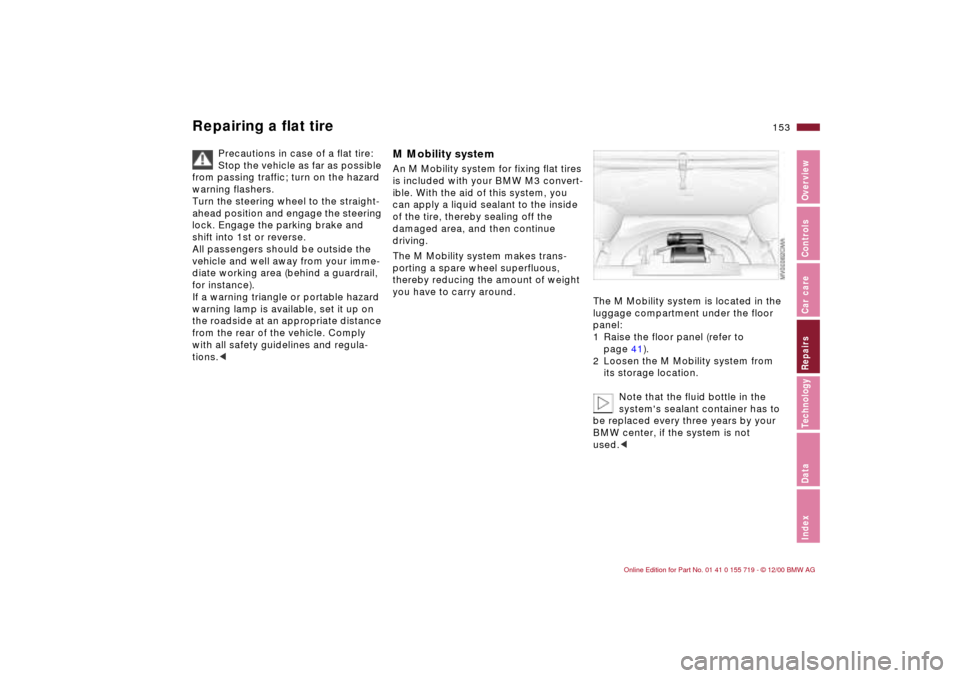
The M Mobility system is located in the
luggage compartment under the floor
panel:
1 Raise the floor panel (refer to
page 41).
2 Loosen the M Mobility system from
its storage location.
Note that the fluid bottle in the
system's sealant container has to
be replaced every three years by your
BMW center, if the system is not
used.<
Page 189 of 195

Everything from A to Z
189n
IndexDataTechnologyRepairsCar careControlsOverview
Headlamp flasher69, 85
Headlamp washer
system125, 126, 181
Heated mirror52
Heated seats93
Heater and ventilation88
Heavy loads100
Height50, 179
High beam lamps69, 85
indicator lamps23
High Performance Synthetic
Oils128
High-speed engine171
Holder for beverage
cans, refer to Beverage
holder
Hood121
opening121
unlocking121
Horn17IIce warning77
Identification number,
vehicle130
Identification, tires118, 120
Ignition key32
Ignition key position66
Ignition lock66
Imprint4
Indicator lamps20tIndividual settings
car memory, key
memory55
Inflation pressures115t
INSPECTION75
Instrument cluster18
Instrument lighting84
Instruments18
Interference
cellular phone112
Interior lamps36, 86
bulb replacement151t
remote control36
Interior mirror
automatic dimming
feature53
Interior motion sensor42
disarm43t
Interior rearview mirror
automatic dimming
feature53, 173
Intermittent operation69
JJump-starting164KKey Memory55
Keys32
with remote control32
LLamp switch84
Lamps
footwell lamps86
high beam headlamps85
instrument lighting84
interior lamps86
parking lamp85
reading lamps86
Lamps and bulbs146
LAMPS ON warning84
Lashing eyes101
LATCH attachment for child
seat59
Leather care136
Length179
License plate lamp
bulb replacement151t
Lighter97
Load-securing devices101
Low beam headlamps84
lamp malfunction147t
Lower rollover protection
system64t
Luggage
compartment40, 41
capacity180
emergency release39t
enlarging41
floor mat41
floor panel41fold down convertible top
compartment base41
remote control37
Luggage compartment
lamps39
bulb replacement152t
Luggage compartment
lid39
emergency release39t
Luggage rack101
Lumbar support49
MM Engine dynamics
control83
M Mobility system153
M+S-tires119
M3 engine concept171
Maintenance75, 131
Make-up mirror53
Malfunction of ABS107
Manual convertible
top operation in case of
electrical defect162t
Manual transmission68
Manual-shift gear lever68
Master key32
Maximum speed181
Memory54
MFL (Multifunction steering
wheel)24