tires BMW M3 CONVERTIBLE 2001 E46 Owner's Manual
[x] Cancel search | Manufacturer: BMW, Model Year: 2001, Model line: M3 CONVERTIBLE, Model: BMW M3 CONVERTIBLE 2001 E46Pages: 195, PDF Size: 1.96 MB
Page 11 of 195

11n
Controls and features
Operation, care and maintenance
Lamps:
Side lamps/Low beam
headlamps84
Instrument lighting84
High beams/Parking lamps85
Fog lamps85
Interior lamps86
Reading lamps86
Controlling the climate
for pleasant driving:
Automatic climate control88
Heated seats93
Interior conveniences:
Glove compartment94
Storage compartments95
Cellular phone96
Ashtray, front96
Cigarette lighter97
Ashtray, rear97
Loading and transporting:
Ski bag98
Cargo loading100
Roof-mounted luggage rack for
the hardtop101
Special operating instructions:
Break-in procedures104
Driving notes105
Catalytic converter105
Antilock Brake System
(ABS)106
Disc brakes108
Brake system109
Winter operation110
Power steering112
Cellular phone112
Radio reception112
Hardtop113
Wheels and tires:
Tire inflation pressures115
Tire condition115
Tire replacement116
Tire rotation117
Wheel and tire
combinations118
Special features of winter
tires119
Snow chains119
Approved wheel and tire
specifications120
Under the hood:
Hood121
Engine compartment124
Washer fluids126
Washer nozzles126
Engine oil127
Coolant129
Brake fluid130
Vehicle Identification130
Care and maintenance:
The BMW Maintenance
System131
Caring for your vehicle132
Cleaning and caring for the
convertible top137
Airbags139
Storing your vehicle140
Laws and regulations:
Technical modifications141
California Proposition 65
Warning141
OBD connector142
Page 27 of 195
27n
IndexDataTechnologyRepairsCar careControlsOverview
Fuel specifications Tire inflation pressuresThe engine uses lead-free gasoline
only.
Required fuel:
>Premium Unleaded Gasoline,
min. 91 AKI.
AKI = Anti Knock Index
Do not use leaded fuels. The use
of leaded fuels will cause perma-
nent damage to the system's oxygen
sensor and the catalytic converter.<
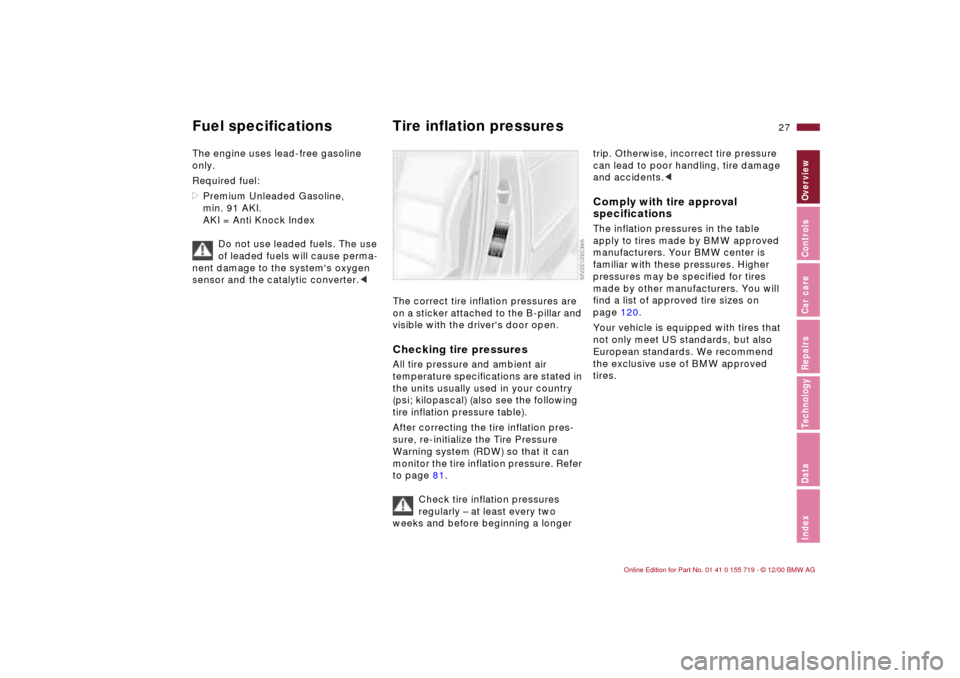
The correct tire inflation pressures are
on a sticker attached to the B-pillar and
visible with the driver's door open.Checking tire pressuresAll tire pressure and ambient air
temperature specifications are stated in
the units usually used in your country
(psi; kilopascal) (also see the following
tire inflation pressure table).
After correcting the tire inflation pres-
sure, re-initialize the Tire Pressure
Warning system (RDW) so that it can
monitor the tire inflation pressure. Refer
to page 81.
Check tire inflation pressures
regularly – at least every two
weeks and before beginning a longer
trip. Otherwise, incorrect tire pressure
can lead to poor handling, tire damage
and accidents.< Comply with tire approval
specifications The inflation pressures in the table
apply to tires made by BMW approved
manufacturers. Your BMW center is
familiar with these pressures. Higher
pressures may be specified for tires
made by other manufacturers. You will
find a list of approved tire sizes on
page 120.
Your vehicle is equipped with tires that
not only meet US standards, but also
European standards. We recommend
the exclusive use of BMW approved
tires.
Page 28 of 195
28n
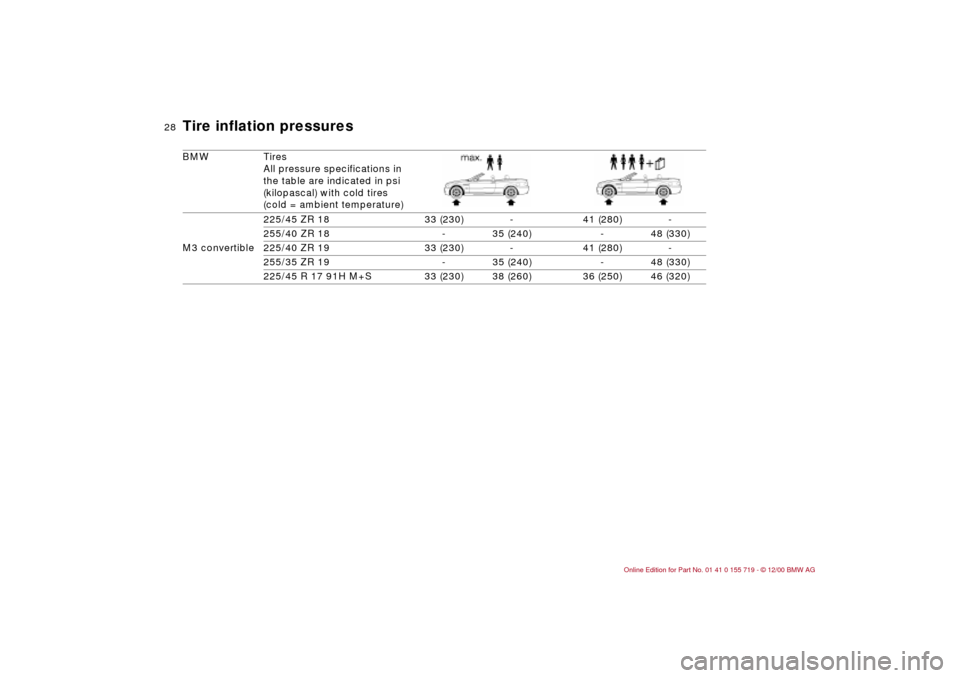
BMW Tires
All pressure specifications in
the table are indicated in psi
(kilopascal) with cold tires
(cold = ambient temperature)
225/45 ZR 18 33 (230) - 41 (280) -
255/40 ZR 18 - 35 (240) - 48 (330)
M3 convertible 225/40 ZR 19 33 (230) - 41 (280) -
255/35 ZR 19 - 35 (240) - 48 (330)
225/45 R 17 91H M+S 33 (230) 38 (260) 36 (250) 46 (320)
Tire inflation pressures
Page 81 of 195
81n
IndexDataTechnologyRepairsCar careControlsOverview
Tire Pressure Warning (RDW)The conceptThe Tire Pressure Warning system
(RDW) monitors the tire inflation pres-
sure in all four tires while driving. The
system is designed to detect whenever
the inflation pressure in a tire drops off
significantly.
By monitoring the speeds of the tires
relative to each other, a flat tire can be
detected and reported because its
speed suddenly deviates drastically
from that of the other tires.
Initializing the systemInitializing is necessary to familiarize the
system with the correct inflation pres-
sure.
Repeat this process after any changes
in tire inflation pressure, tire rotation or
replacement. Do not carry out further
system initialization after correcting the
inflation pressure and letting the system
"learn" what condition is required.
1 Check the tire inflation pressure in all
the tires, comparing them with the
inflation pressure table (page 28),
and adjusting their pressure if neces-
sary
2 Turn the ignition key to position 2
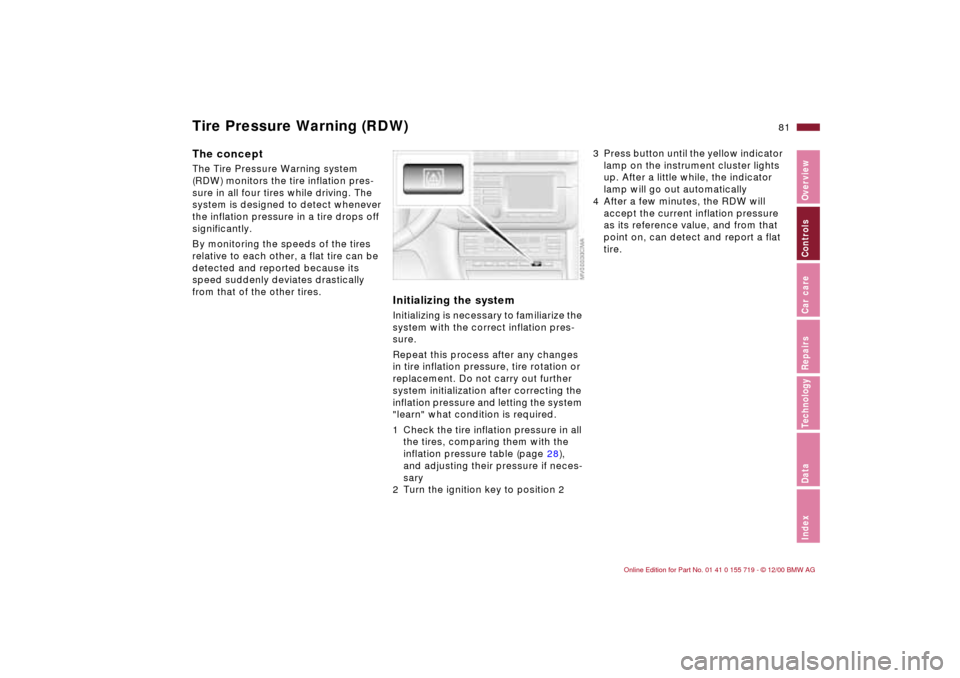
3 Press button until the yellow indicator
lamp on the instrument cluster lights
up. After a little while, the indicator
lamp will go out automatically
4 After a few minutes, the RDW will
accept the current inflation pressure
as its reference value, and from that
point on, can detect and report a flat
tire.
Page 82 of 195
82n
Tire Pressure Warning (RDW)Activating/deactivating the
systemThe system is automatically active in
ignition key position 2 and is therefore
always on during driving.
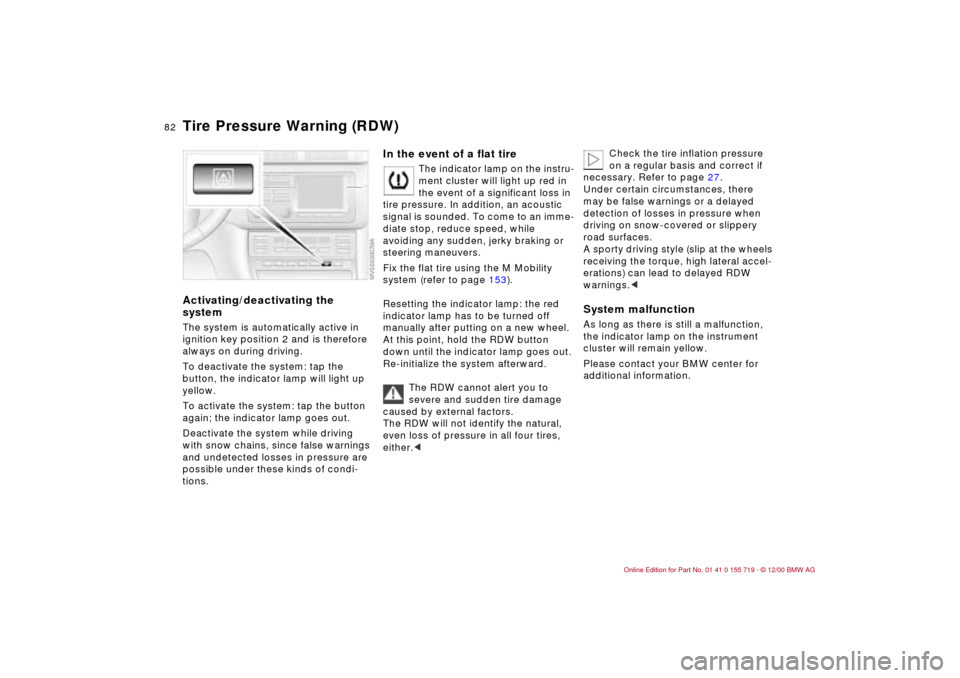
To deactivate the system: tap the
button, the indicator lamp will light up
yellow.
To activate the system: tap the button
again; the indicator lamp goes out.
Deactivate the system while driving
with snow chains, since false warnings
and undetected losses in pressure are
possible under these kinds of condi-
tions.
In the event of a flat tire
The indicator lamp on the instru-
ment cluster will light up red in
the event of a significant loss in
tire pressure. In addition, an acoustic
signal is sounded. To come to an imme-
diate stop, reduce speed, while
avoiding any sudden, jerky braking or
steering maneuvers.
Fix the flat tire using the M Mobility
system (refer to page 153).
Resetting the indicator lamp: the red
indicator lamp has to be turned off
manually after putting on a new wheel.
At this point, hold the RDW button
down until the indicator lamp goes out.
Re-initialize the system afterward.
The RDW cannot alert you to
severe and sudden tire damage
caused by external factors.
The RDW will not identify the natural,
even loss of pressure in all four tires,
either.<
Check the tire inflation pressure
on a regular basis and correct if
necessary. Refer to page 27.
Under certain circumstances, there
may be false warnings or a delayed
detection of losses in pressure when
driving on snow-covered or slippery
road surfaces.
A sporty driving style (slip at the wheels
receiving the torque, high lateral accel-
erations) can lead to delayed RDW
warnings.<
System malfunctionAs long as there is still a malfunction,
the indicator lamp on the instrument
cluster will remain yellow.
Please contact your BMW center for
additional information.
Page 103 of 195
Overview
Controls and features
Operation, care
and maintenance
Owner service procedures
Technical data
Index Advanced technology
103n
IndexDataTechnologyRepairsCar careControlsOverview
Special operating instructions:
Break-in procedures104
Driving notes105
Catalytic converter105
Antilock Brake System
(ABS)106
Disc brakes108
Brake system109
Winter operation110
Power steering112
Cellular phone112
Radio reception112
Hardtop113
Wheels and tires:
Tire inflation pressures115
Tire condition115
Tire replacement116
Tire rotation117
Wheel and tire
combinations118
Special features of winter
tires119
Snow chains119
Approved wheel and tire
specifications120Under the hood:
Hood121
Engine compartment124
Washer fluids126
Washer nozzles126
Engine oil127
Coolant129
Brake fluid130
Vehicle Identification
Number130
Care and maintenance:
The BMW Maintenance
System131
Caring for your vehicle132
Cleaning and caring for the
convertible top137
Airbags139
Storing your vehicle140
Laws and regulations:
Technical modifications141
California Proposition 65
Warning141
OBD connector142
Car care
Page 104 of 195

104n
To ensure that your vehicle continues to
provide maximum economy throughout
an extended service life, we request
that you devote careful attention to the
following section.
Your BMW M3 convertible is a
masterpiece of superlative tech-
nology. To create the basis for many
years of driving pleasure, we urge you
to observe the following precautions
during the initial operation period.<
Engine and differential>Up to 1,200 miles (2,000 km): drive at
varying engine and road speeds, but
do not exceed the following engine or
road speeds: 5,500 rpm or 105 mph
(170 km/h)
Do not depress the accelerator pedal to
the full throttle position.
>Following the Break-In Inspection at
1,200 miles (2,000 km), you can
gradually increase engine or road
speeds.
Follow the same break-in procedure if
either the engine or the differential is
replaced in the future.
TiresDue to technical factors associated
with their manufacture, tires do not
achieve their full traction potential until
after an initial break-in period. You
should therefore drive with extra care
during the initial 200 miles (300 km).
Obey your local and state maximum
speed limits.
When the vehicle is operated on
wet or slushy roads, a wedge of
water may form between the tire and
the road surface. This phenomenon is
referred to as aquaplaning, or hydro-
planing, and can lead to partial or
complete loss of traction, vehicle
control and braking effectiveness.
Reduce your speed on wet roads.<
Brake systemApproximately 300 miles ( 500 km) must
elapse before the brake pads and discs
achieve the optimal pad-surface and
wear patterns required for troublefree
operation and long service life later on.
To break-in the separate parking brake
drums, apply the parking brake lightly
when coasting to a standstill (at a traffic
signal, for instance), provided that
traffic conditions allow you to do so. To
avoid corrosion, repeat this procedure
from time to time.
The brake lamps do not come on
when the parking brake is
engaged.
Vacuum for the brake system servo unit
on your BMW is available only when the
engine is running. When you move the
vehicle with the engine off – when
towing, for example – substantially
higher levels of pedal force will be
required to brake the vehicle.
(500 km). Drive cautiously during this
break-in period and do not shift at high
engine speeds.
Break-in procedures
Page 105 of 195

105n
IndexDataTechnologyRepairsCar careControlsOverview
Brakes: do not rest your foot on
the brake pedal while driving.
Even light but consistent pressure on
the brake pedal can lead to high
temperatures, brake wear and possibly
even brake system failure.
Aquaplaning: when driving on wet or
slushy roads, reduce vehicle speed. If
you do not, a wedge of water may form
between the tires and the road surface.
This phenomenon is referred to as
aquaplaning, or hydroplaning, and can
lead to partial or complete loss of
contact between the tires and road
surface, vehicle control and braking
ability.
Driving through water: do not drive
through water on the road if it is deeper
than 1 foot (30 cm), and then only at
walking speed at the most. Otherwise,
the vehicle's engine, the electrical
systems and the transmission may be
damaged.<
The catalytic converter reduces harmful
pollutants in the exhaust emissions.
It is designed for use with unleaded fuel
only. Even minute quantities of lead
would be enough to permanently
damage both the catalytic converter
and the system's oxygen sensor.
To ensure efficient, trouble-free engine
operation and to avoid potential
damage:
>Be sure to comply with the required
scheduled maintenance work and
repair procedures.
>Fill the fuel tank well before it is
empty.
>Tow-start only when the engine is
cold, otherwise unburned, residual
fuel in the catalytic converter could
ignite and cause damage. It is better
to jump-start the vehicle with outside
assistance.
>Avoid other situations where the fuel
is not burned, or burns incompletely,
such as engaging the starter
frequently or for extended periods, or
repeated start attempts in which the
engine does not start (stopping and
restarting an engine which is running
properly does not present a problem).
Never let the engine run with any of
the spark plug cables disconnected. Be sure to observe the instruc-
tions above to prevent unburned
fuel from reaching the catalytic
converter. Otherwise there is danger of
overheating and damage to the cata-
lytic converter.
High temperatures occur in any vehicle
equipped with a catalytic converter.
Heat shields are installed adjacent to
some sections of the exhaust system.
Never remove these shields; do not
apply undercoating to their surfaces.
When driving, standing at idle, and
parking the vehicle, take extra care to
avoid contact between the exhaust
system and flammable materials (grass,
hay, leaves, etc.). Such contact could
start a fire, resulting in personal injury
and property damage.<
Driving notes Catalytic converter
Page 106 of 195

106n
Antilock Brake System (ABS)The concept ABS helps prevent the wheels from
locking while braking, thereby
enhancing active driving safety. This is
because locked wheels are dangerous.
When the front wheels slide, the driver
loses steering control over the vehicle.
Traction loss at the rear wheels can
cause the rear end to break into an
uncontrolled skid.
Under any given road conditions, ABS
can brake the vehicle within the
shortest possible distance and with the
greatest possible driving stability (on
straight-aways and curves, asphalt, ice,
wet road surfaces, etc.).
ABS is designed to meet two essential
requirements during every brake appli-
cation:
>To help provide vehicle stability
>To help maintain steering control and
maneuverability – on all types of road
surfaces (asphalt, concrete, mud, wet
road surfaces, snow, ice).
Braking with ABSThe system is operative once the
vehicle exceeds a speed of approx.
6 mph (10 km/h). The ABS is deacti-
vated whenever the vehicle's speed
drops back below approx. 4 mph
(6 km/h). This means that the wheels
can lock in the final phase of a panic
stop – a factor of no significance in
actual use.
If you are in a situation that requires full
braking, you will exploit the full benefits
of the ABS system if you apply
maximum pedal pressure ("panic stop").
Do not let up on the brake pedal even
after it starts pulsating. Since the
vehicle maintains steering response,
you retain the ability to avoid obstacles
using careful steering inputs.
The ABS system's closed-loop control
circuit cycles in fractions of a second.
Pulsation at the brake pedal shows you
that ABS is active and that you are thus
approaching the limits of the brake
system's effective response range. In
addition, a pulsation – a result of the
control function cycles – indicates to
the driver that vehicle speed should be
reduced to adapt to road surface condi-
tions when there is reduced traction and grip between tires and road surface
(slippery road surface).
On road surfaces with a loose surface
layer over a firm base, e.g. on gravel or
snow, as well as when driving with
snow chains on, braking distances may
be longer than with the wheels locked.
However, ABS continues to provide
enhanced vehicle stability and steering
response under these conditions.
Information for your safetyNot even ABS can suspend the laws of
physics. The consequences of brake
applications with inadequate clear-
ances for safety between vehicles,
excessive speed or if aquaplaning
occurs are always the responsibility of
the driver. You should never allow the
added safety of ABS to lull you into a
false sense of security, or mislead you
into taking risks that could affect your
own safety and that of others.
Do not make any modifications to
the ABS system.
Service procedures on ABS are to be
performed by authorized technicians
only.<
Page 110 of 195

110n
Winter operationThe onset of winter is often accompa-
nied by rapid changes in weather.
Adaptations in driving style should be
accompanied by preparations on the
vehicle itself to ensure that your
progress through the winter remains
safe and trouble-free. CoolantBe sure that the coolant mixture
contains the year-round ratio of 50:50
water and extended-duty antifreeze/
corrosion inhibitor. This mixture
provides protection against freezing
down to approx. –34 7 (–37 6). Have
the coolant replaced every 3 years. LocksBMW door lock deicer can be used to
free them if frozen. This deicer also
contains lubricant.
After using the deicer, treatment with
BMW lock cylinder grease is recom-
mended.
Rubber components To prevent the weather-stripping from
freezing, apply a spray-on rubber treat-
ment or silicone spray to the door, hood
and luggage compartment lid seals.
A full range of car care products is
available from your BMW center.<
Snow chains Mount BMW snow chains
* only in pairs
on rear tires and always follow the
manufacturer's safety precautions. Do
not exceed a maximum speed of
30 mph (50 km/h) with snow chains. In
rare situations like these, it may be a
good idea to turn the DSC off briefly,
refer to page 80.
Deactivate the Tire Pressure Warning
system (RDW) when driving with snow
chains mounted. Snow chains can
cause the system to generate false
alarms and/or fail to detect pressure
loss, refer to page 81
Starting offWhen trying to drive out of deep snow,
or when "rocking" the vehicle to free it,
it may be prudent to temporarily deacti-
vate the DSC system. Refer to page 80. Driving on low-traction road
surfacesUse smooth, gentle pressure to control
the accelerator pedal. Avoid excessive
engine speeds and shift to the next
higher gear at an early point. Adapt
your speed and driving style when
approaching grades or slopes. Maintain
an adequate distance between yourself
and the vehicle ahead.