steering wheel BMW M3 CONVERTIBLE 2001 E46 Owner's Manual
[x] Cancel search | Manufacturer: BMW, Model Year: 2001, Model line: M3 CONVERTIBLE, Model: BMW M3 CONVERTIBLE 2001 E46Pages: 195, PDF Size: 1.96 MB
Page 10 of 195

Contents
Overview
Controls and features
Cockpit16
Instrument cluster18
Indicator and warning lamps20
Multifunction steering wheel
(MFL)24
Hazard warning flashers25
Warning triangle25
Refueling26
Fuel specifications27
Tire inflation pressures27
Opening and closing:
Keys32
Electronic vehicle
immobilizer33
Central locking system33
Opening and closing – via the
door lock34
Opening and closing – via the
remote control35
Opening and closing – from
inside38
Luggage compartment lid39
Luggage compartment40
Alarm system42
Electric power windows44
Convertible top45
Adjustments:
Seats48
Mirrors52
Seat and mirror memory54
Steering wheel55
Car Memory, Key Memory55
Passenger safety systems:
Safety belts57
Transporting children safely58
Airbags61
Rollover protection system64
Driving:
Steering/Ignition lock66
Starting the engine66
Switching off the engine67
Parking brake67
Manual transmission68
Turn signal indicator/Headlamp
flasher69
Washer/Wiper system69
Rear window defroster71
Cruise control71
Everything under control:
Odometer73
Tachometer73
Engine oil temperature gauge73
Fuel gauge74
Coolant temperature gauge74
Service Interval Display75
Check Control76
Clock76
Computer77
Technology for safety and
convenience:
Park Distance Control (PDC)79
Dynamic Stability Control
(DSC)80
Tire Pressure Warning (RDW)81
M Engine dynamics control83
Contents
Page 11 of 195

11n
Controls and features
Operation, care and maintenance
Lamps:
Side lamps/Low beam
headlamps84
Instrument lighting84
High beams/Parking lamps85
Fog lamps85
Interior lamps86
Reading lamps86
Controlling the climate
for pleasant driving:
Automatic climate control88
Heated seats93
Interior conveniences:
Glove compartment94
Storage compartments95
Cellular phone96
Ashtray, front96
Cigarette lighter97
Ashtray, rear97
Loading and transporting:
Ski bag98
Cargo loading100
Roof-mounted luggage rack for
the hardtop101
Special operating instructions:
Break-in procedures104
Driving notes105
Catalytic converter105
Antilock Brake System
(ABS)106
Disc brakes108
Brake system109
Winter operation110
Power steering112
Cellular phone112
Radio reception112
Hardtop113
Wheels and tires:
Tire inflation pressures115
Tire condition115
Tire replacement116
Tire rotation117
Wheel and tire
combinations118
Special features of winter
tires119
Snow chains119
Approved wheel and tire
specifications120
Under the hood:
Hood121
Engine compartment124
Washer fluids126
Washer nozzles126
Engine oil127
Coolant129
Brake fluid130
Vehicle Identification130
Care and maintenance:
The BMW Maintenance
System131
Caring for your vehicle132
Cleaning and caring for the
convertible top137
Airbags139
Storing your vehicle140
Laws and regulations:
Technical modifications141
California Proposition 65
Warning141
OBD connector142
Page 15 of 195
Overview
Controls and features
Operation, care
and maintenance
Owner service procedures
Technical data
Index Advanced technology
15n
IndexDataTechnologyRepairsCar careControlsOverview
Cockpit16
Instrument cluster18
Indicator and warning lamps20
Multifunction steering wheel
(MFL)24
Hazard warning flashers25
Warning triangle25
Refueling26
Fuel specifications27
Tire inflation pressures27
Overview
Page 17 of 195

17n
IndexDataTechnologyRepairsCar careControlsOverview
Cockpit
1 Side lamps/Low beam
headlamps84
2
d
Turn signal indicator69
>
Parking lamps85
>
High beams85
>
Headlamp flasher69
>
Computer77
3 Washer/Wiper system69
4 Hazard warning flashers25
5 Shift lever68
6 Rear window defroster71
7 Central locking system33
8 Adjusting steering wheel55
9 Horn: the entire surface
10 Fog lamps85
Page 23 of 195
23n
IndexDataTechnologyRepairsCar careControlsOverview
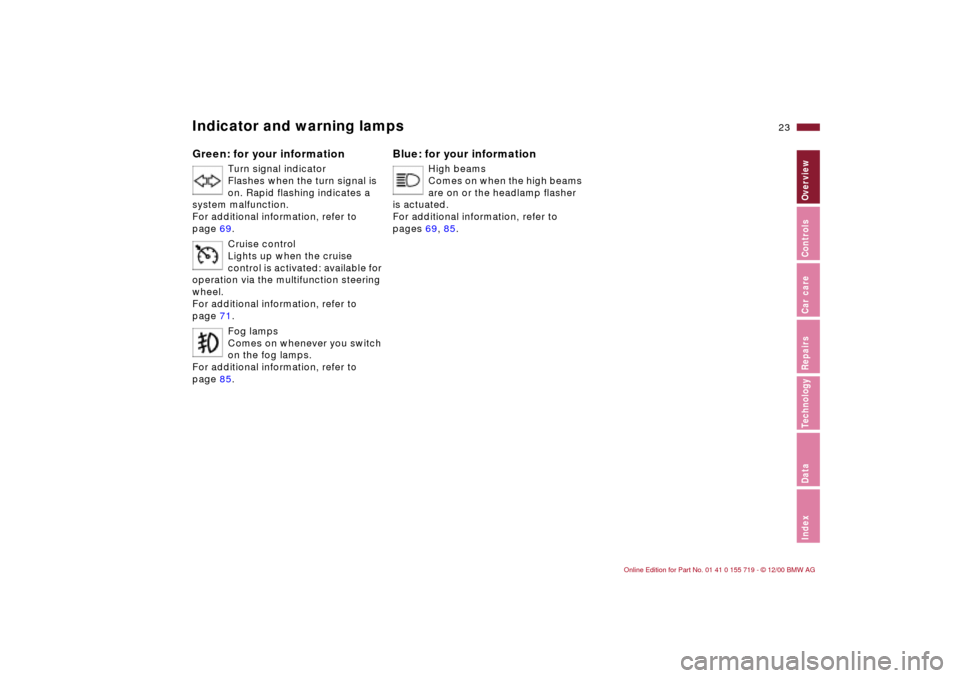
Indicator and warning lampsGreen: for your information
Turn signal indicator
Flashes when the turn signal is
on. Rapid flashing indicates a
system malfunction.
For additional information, refer to
page 69.
Cruise control
Lights up when the cruise
control is activated: available for
operation via the multifunction steering
wheel.
For additional information, refer to
page 71.
Fog lamps
Comes on whenever you switch
on the fog lamps.
For additional information, refer to
page 85.
Blue: for your information
High beams
Comes on when the high beams
are on or the headlamp flasher
is actuated.
For additional information, refer to
pages 69, 85.
Page 24 of 195
24n
Multifunction steering wheel (MFL)
The buttons integrated in the multi-
function steering wheel (MFL) are
provided so that you can operate a
number of accessories quickly and
without being distracted from traffic
conditions. You can operate:
>selected radio functions
>the cruise control
>selected cellular phone functions
*.
In order to operate a system via
the MFL, the corresponding
systems must be activated.<
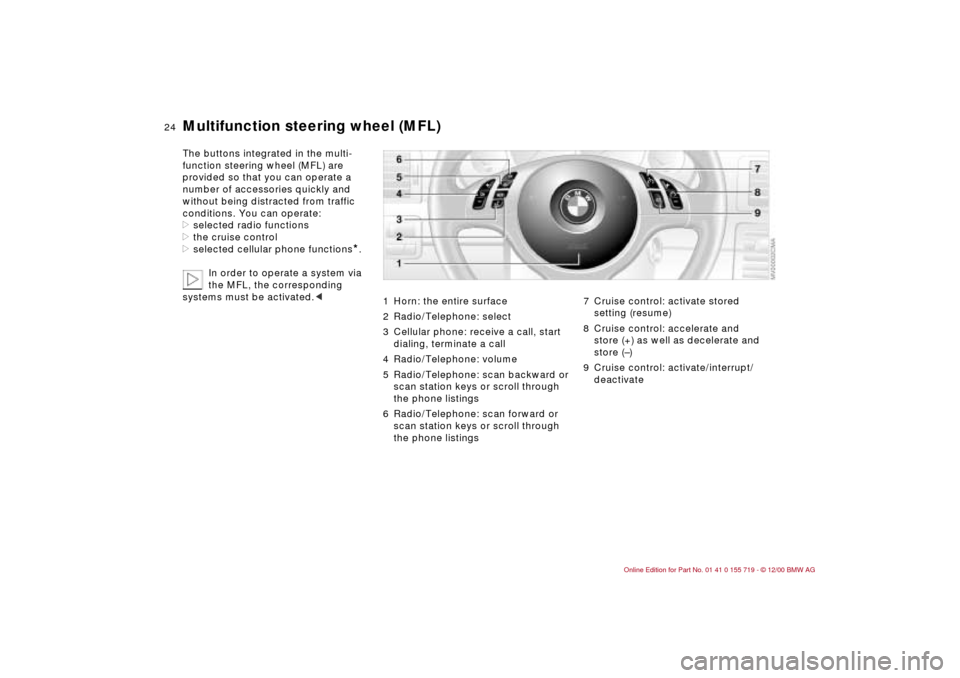
1 Horn: the entire surface
2 Radio/Telephone: select
3 Cellular phone: receive a call, start
dialing, terminate a call
4 Radio/Telephone: volume
5 Radio/Telephone: scan backward or
scan station keys or scroll through
the phone listings
6 Radio/Telephone: scan forward or
scan station keys or scroll through
the phone listings
7 Cruise control: activate stored
setting (resume)
8 Cruise control: accelerate and
store (+) as well as decelerate and
store (–)
9 Cruise control: activate/interrupt/
deactivate
Page 30 of 195
30n
Locks and security systems:
Keys32
Electronic vehicle
immobilizer33
Central locking system33
Opening and closing – via the
door lock34
Opening and closing – via the
remote control35
Opening and closing – from
inside38
Luggage compartment lid39
Luggage compartment40
Alarm system42
Electric power windows44
Convertible top45
Adjustments:
Seats48
Mirrors52
Seat and mirror memory54
Steering wheel55
Car Memory, Key Memory55
Passenger safety systems:
Safety belts57
Transporting children safely58
Airbags61
Rollover protection system64
Controls
Page 48 of 195
48n
For your personal safety when adjusting
the seat position, please follow the
instructions below carefully:
Never try to adjust your seat while
driving the vehicle. The seat could
respond with an unexpected move-
ment, and the ensuing loss of vehicle
control could lead to an accident.
Be sure that the safety belt remains
firmly against your body at all times. In
the event of a frontal impact, a loose lap
belt could slide over the hips, leading to
abdominal injury. In addition, the safety
belt's restraint effectiveness is reduced
if the belt is worn loosely.
Never ride with the backrest reclined to
an extreme angle (especially important
for the front passenger to remember). If
you do so, there is a risk that you will
slide under the safety belt in an acci-
dent, thus reducing the protection
provided by the safety belt.<
Correct sitting posture To reduce strain on the spinal column,
sit all the way back in the seat and rest
your back fully against the backrest.
The ideal sitting posture is achieved
with your head extending from your
spine in a straight line.
For long-distance driving, you may wish
to increase the backrest tilt angle
slightly to reduce muscular tension. You
should be able to grasp the steering
wheel at its highest point with your
arms slightly bent.
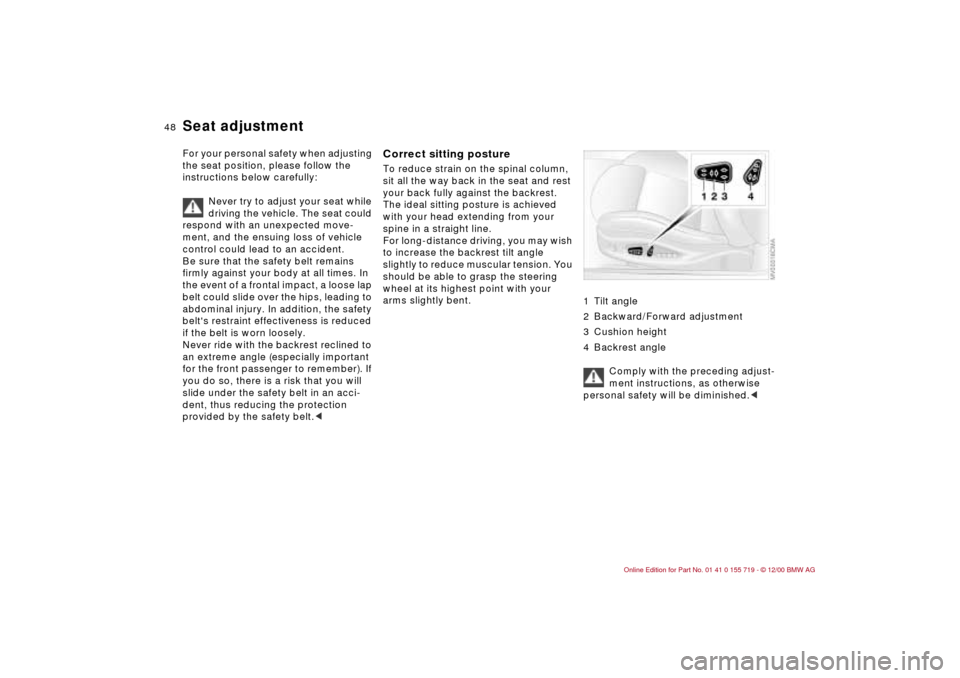
1 Tilt angle
2 Backward/Forward adjustment
3 Cushion height
4 Backrest angle
Comply with the preceding adjust-
ment instructions, as otherwise
personal safety will be diminished.<
Seat adjustment
Page 55 of 195
55n
IndexDataTechnologyRepairsCar careControlsOverview
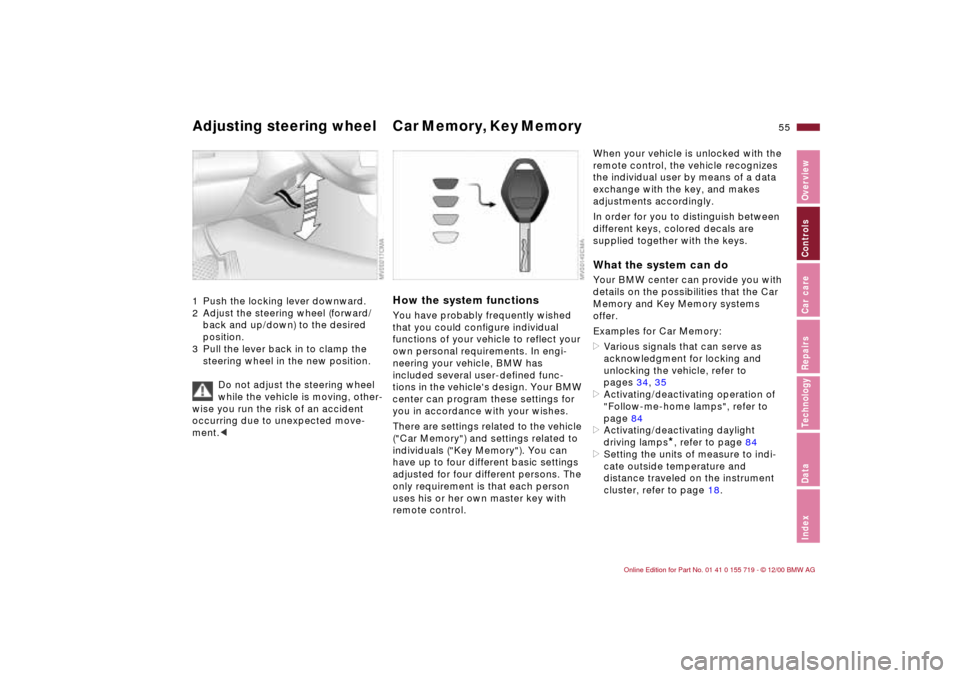
Adjusting steering wheel Car Memory, Key Memory 1 Push the locking lever downward.
2 Adjust the steering wheel (forward/
back and up/down) to the desired
position.
3 Pull the lever back in to clamp the
steering wheel in the new position.
Do not adjust the steering wheel
while the vehicle is moving, other-
wise you run the risk of an accident
occurring due to unexpected move-
ment.<
How the system functionsYou have probably frequently wished
that you could configure individual
functions of your vehicle to reflect your
own personal requirements. In engi-
neering your vehicle, BMW has
included several user-defined func-
tions in the vehicle's design. Your BMW
center can program these settings for
you in accordance with your wishes.
There are settings related to the vehicle
("Car Memory") and settings related to
individuals ("Key Memory"). You can
have up to four different basic settings
adjusted for four different persons. The
only requirement is that each person
uses his or her own master key with
remote control.
When your vehicle is unlocked with the
remote control, the vehicle recognizes
the individual user by means of a data
exchange with the key, and makes
adjustments accordingly.
In order for you to distinguish between
different keys, colored decals are
supplied together with the keys.What the system can doYour BMW center can provide you with
details on the possibilities that the Car
Memory and Key Memory systems
offer.
Examples for Car Memory:
>Various signals that can serve as
acknowledgment for locking and
unlocking the vehicle, refer to
pages 34, 35
>Activating/deactivating operation of
"Follow-me-home lamps", refer to
page 84
>Activating/deactivating daylight
driving lamps
*, refer to page 84
>Setting the units of measure to indi-
cate outside temperature and
distance traveled on the instrument
cluster, refer to page 18.
Page 62 of 195

62n
AirbagsSitting correctly with airbags
For your safety, comply with the
following instructions for the
airbags. If you do not, the airbags may
not be able to provide their maximum
protection. All passengers in the vehicle
should be aware of and comply with
this information:
The airbags are supplemental restraint
devices designed to provide extra
protection; they are not a substitute for
safety belts. Wear your safety belt at all
times. The airbags will not be triggered
in the event of a minor accident, a
vehicle rollover, or collisions from the
rear. In these instances, the safety belt
provides optimal protection.
Airbags are located under cover panels
in the steering wheel, in the instrument
panel and in the side trim panels in the
front and rear
*.
Adjust your seat to a position that
provides maximum distance between
you and the steering wheel, the instru-
ment panel and the door while still
allowing comfortable and safe access
to all vehicle controls.
To avoid sustaining hand and arm inju-
ries, always grasp the steering wheel
on the rim with the hands at the 9 and
3 o'clock positions. Do not place your
hands on the center pad.
Never allow any objects to obstruct the
area between the airbag and an occu-
pant.
Do not use the cover panel above the
passenger side airbag as a storage
area.
Do not apply adhesive materials to the
cover panels of the airbags, cover them
or modify them in any other way.
Do not install a rear-facing child
restraint system in the front passenger
seat of this vehicle.
Children under 13 years of age and
children less than 5 feet (150 cm) tall
should ride only in the rear seat.
Infants or small children should never
be held on the lap of a passenger.
If your vehicle is equipped with side
airbags in the rear passenger area
*, be
sure that child restraints are mounted
correctly and provided with the
greatest-possible distance between the
airbags in the side trim panels. Do not
allow children to lean out of the child's
seat in the direction of the side trim
panels. If they do so, serious injuries
can occur if the airbag is triggered.
(infants and small children in appro-
priate child restraint systems; larger
children and adults using the safety
belts). Never let an occupant's head
rest near or on a side airbag because
the inflating airbag could cause a
serious or fatal injury. Please note that
the word "Airbag" imprinted on the door
trim panel indicates the airbag's loca-
tion.
Accident research shows that the
safest place for children in an automo-
bile is in the rear seat. However, a child
sitting in the rear seat and not properly
restrained may place his or her head on
or near the airbag, if so equipped. For
example, a child — even though belted
— may fall asleep with his or her head
against the side airbag. It may be diffi-
cult for a driver to ensure that children
in the rear seat will remain properly
positioned at all times and not place
their heads on or near the side airbag.
Therefore, we recommend that the rear
seat side airbags, if so equipped, be
deactivated if children will travel in the
rear seat.
The rear seat side airbags may already
have been deactivated, either at the
time of manufacture or by a BMW