battery BMW M3 CONVERTIBLE 2006 E46 User Guide
[x] Cancel search | Manufacturer: BMW, Model Year: 2006, Model line: M3 CONVERTIBLE, Model: BMW M3 CONVERTIBLE 2006 E46Pages: 174, PDF Size: 2.68 MB
Page 93 of 174
93
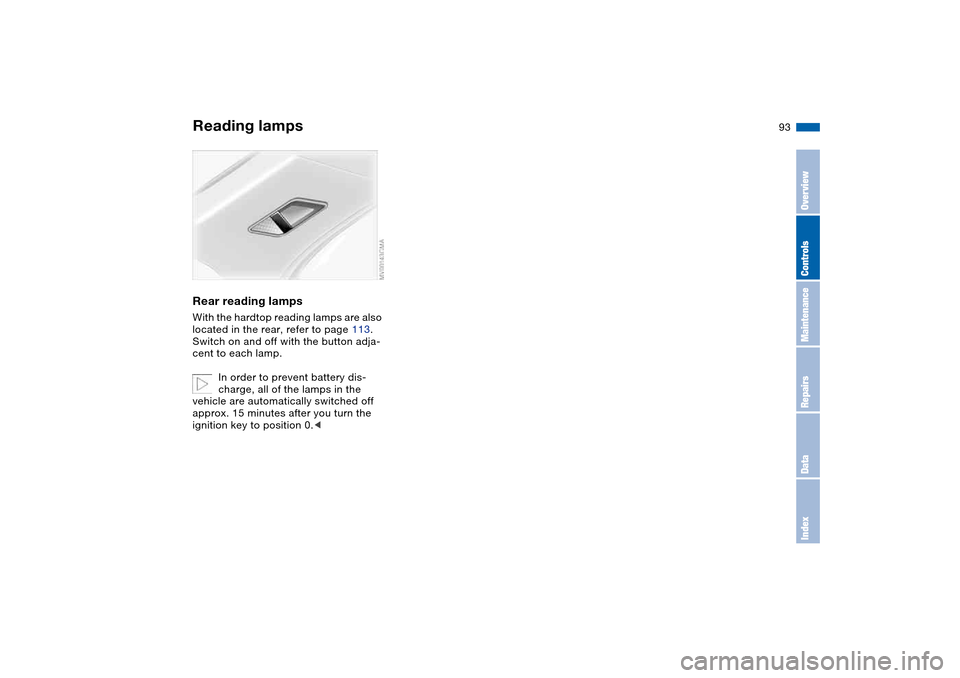
Rear reading lampsWith the hardtop reading lamps are also
located in the rear, refer to page 113.
Switch on and off with the button adja-
cent to each lamp.
In order to prevent battery dis-
charge, all of the lamps in the
vehicle are automatically switched off
approx. 15 minutes after you turn the
ignition key to position 0.
Page 137 of 174
137
Lamps and bulbsThe lamps and bulbs make essential
contributions to the safety of your vehi-
cle. Therefore, proceed carefully when
handling bulbs. BMW recommends that
you have such work performed by your
BMW center if you are not familiar with
the procedures.
Do not touch the glass portion of
a new bulb with your bare hands
since even small amounts of impurities
burn in to the surface and reduce the
service life of the bulb. Use a clean
cloth, paper napkin, or a similar mate-
rial, or hold the bulb by its metallic
base.<
A replacement bulb set is available from
your BMW center.
Before working on the electrical
system, switch off the electrical
accessory you are working on or dis-
connect the cable from the negative
terminal of the battery. Failure to
observe this precaution could result in
short circuits.
To prevent injuries and damage when
changing a bulb, be sure to comply with
any instructions provided by the bulb
manufacturer.<
Low beams and high beams>Low beams: H7 bulb, 55 watts
>High beams: H7 bulb, 55 watts
The H7 bulb is pressurized. There-
fore, wear safety glasses and pro-
tective gloves. Failure to comply with
this precaution could lead to injury if the
bulb is damaged.<
Please contact a BMW center in case of
a malfunction.Parking lamps5 watt bulb
Please contact a BMW center in case of
a malfunction.
When cleaning the headlamps, please
follow the instructions in the Caring for
your vehicle brochure.Xenon lamps*The service life of these bulbs is very
long and the probability of a failure is
very low, provided that they are not
switched on and off an unusual number
of times. If one of these bulbs should
nevertheless fail, it is possible to con-
tinue driving with great caution using
the fog lamps, provided traffic laws in
your area do not prohibit this.
Because of the extremely high
voltages involved, any work on the
xenon lighting system, including bulb-
changing, should be carried out by
technically qualified personnel only.
Otherwise, there is a risk of fatal
injury.<
OverviewControlsMaintenanceRepairsDataIndex
Page 144 of 174
144
4. Adjust the tire inflation pressure to
29 psi / 200 kilopascal. For this pur-
pose, with the ignition key in
position 2:
>Increase the tire pressure: switch
on the compressor, position I. To
check the current inflation pres-
sure, turn off the device briefly
>Reduce the tire pressure: press
button 8, or turn screw 8 on the
manometer.
Do not run the compressor for
longer than 10 minutes, otherwise
the unit may overheat and be dam-
aged.<
If the tire fails to hold the pres-
sure, drive the vehicle again, see
Distributing the sealant. Then repeat
Steps 1 through 4.
The use of the M Mobility system may
be ineffective if the damaged area in
the tire is larger than approx. 1/8 in /
4 mm. If the tire cannot be temporarily
repaired with the M Mobility system,
please consult the nearest BMW cen-
ter, or a workshop that has appropri-
ately trained personnel working in
accordance with BMW specifications,<
The tire pressure must be at least
29 psi / 200 kilopascal. Otherwise,
do not continue driving.<
Driving on
Do not exceed the maximum
speed limit of 45 mph / 80 km/h;
otherwise, accidents may occur.<
Have the damaged tire replaced
as soon as possible. Reinitialize
the Flat Tire Monitor, and refer to
page 87 for further information.
Have the sealant bottle of the M Mobil-
ity system replaced.<
Battery
Battery posts, terminals, and
related accessories contain lead
and lead compounds. Wash hands after
handling.<
MaintenanceThe battery is completely maintenance-
free. This means that the original bat-
tery acid will normally last for the ser-
vice life of the battery under moderate
climate conditions. Your BMW center
will be glad to advise you if you have
any questions concerning the battery.
Please consult your BMW center
whenever you have any questions
concerning the battery.
connections provided in the engine
compartment. For information on the
connections, see Jump-starting,
page 147.
Tire repair with the M Mobility system
Page 145 of 174
145
Disposal
After changing the battery, have
the old battery disposed of by
your BMW center or bring it to a recy-
cling point. Maintain the battery in an
upright position for transport and stor-
age. Secure the battery against tilting in
transit.<
Power lossAfter a temporary power loss, e.g. due
to a discharged battery, some equip-
ment will be limited in its use and will
have to be reinitialized. Individual set-
tings are also lost and must be reset:
>Seat and mirror memory
The position settings must be stored
again, refer to page 51
>The trap protection of the electric
power windows must be re-initial-
ized, refer to page 39
>Clock
must be reset, refer to page 82
>Radio
Stations must be reset, refer to the
Owner's Manual for Radio/Onboard
Computer
>Navigation system
The system will not be operable
immediately, refer to the Owner's
Manual for Radio/Onboard Com-
puter.
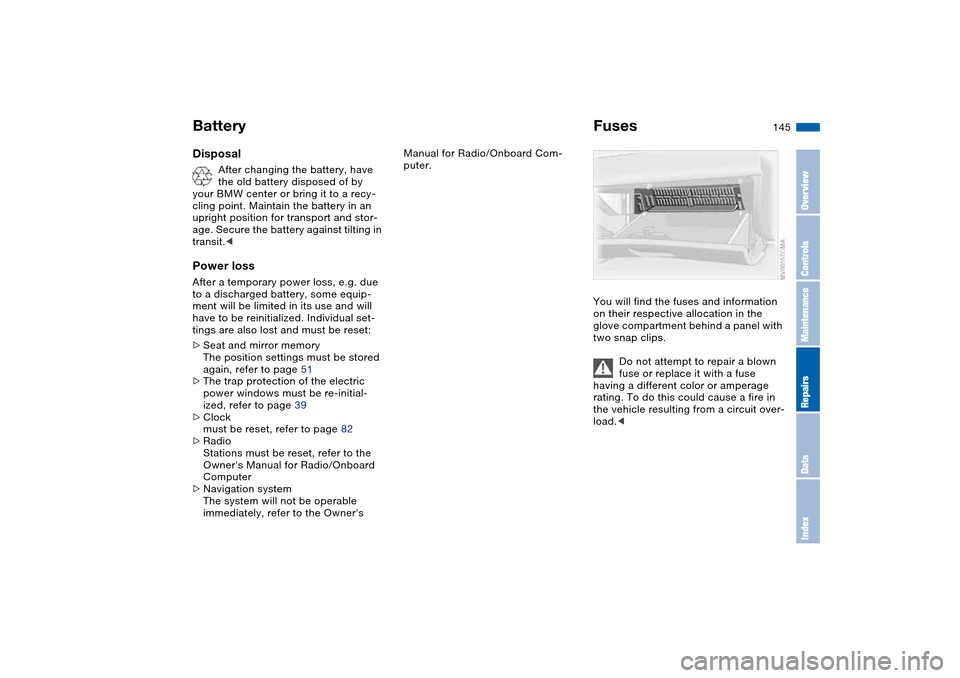
FusesYou will find the fuses and information
on their respective allocation in the
glove compartment behind a panel with
two snap clips.
Do not attempt to repair a blown
fuse or replace it with a fuse
having a different color or amperage
rating. To do this could cause a fire in
the vehicle resulting from a circuit over-
load.<
Battery
OverviewControlsMaintenanceRepairsDataIndex
Page 147 of 174
147
Mobile Service*To establish contact with the BMW
Group's Mobile Service:
Press button 2 for at least 2 seconds.
The indicator lamp above the buttons
lights up. As soon as a telephone con-
nection has been set up with the Mobile
Service, the indicator lamp flashes.
Depending on the country you are in,
your vehicle's current location will also
be transmitted if your vehicle is
equipped with an activated BMW Assist
function.
Jump-startingWhen your battery is discharged, you
can use two jumper cables to start your
vehicle with power from the battery in a
second vehicle. You can also use the
same method to help start another
vehicle. Use only jumper cables with
fully insulated handles on the terminal
clamps.
Do not touch high-voltage wiring
and cables on a running engine.
Contact with components carrying high
voltage can be harmful or fatal.
Carefully observe the following instruc-
tions to avoid personal injury and/or
damage to one or both vehicles.
approximately the same capacity –
measured in Ah. This information is
provided on the battery
2. Stop the engine of the support vehi-
cle
3. Switch off all consumers in both
vehicles.
Make absolutely certain that there
is no contact between the body-
work of the two vehicles, otherwise
there is a short circuit hazard.<
Connecting the jumper cables
Be sure to connect the jumper
cables in the right order; other-
wise there is a risk of injury due to
sparks being created near the battery.<
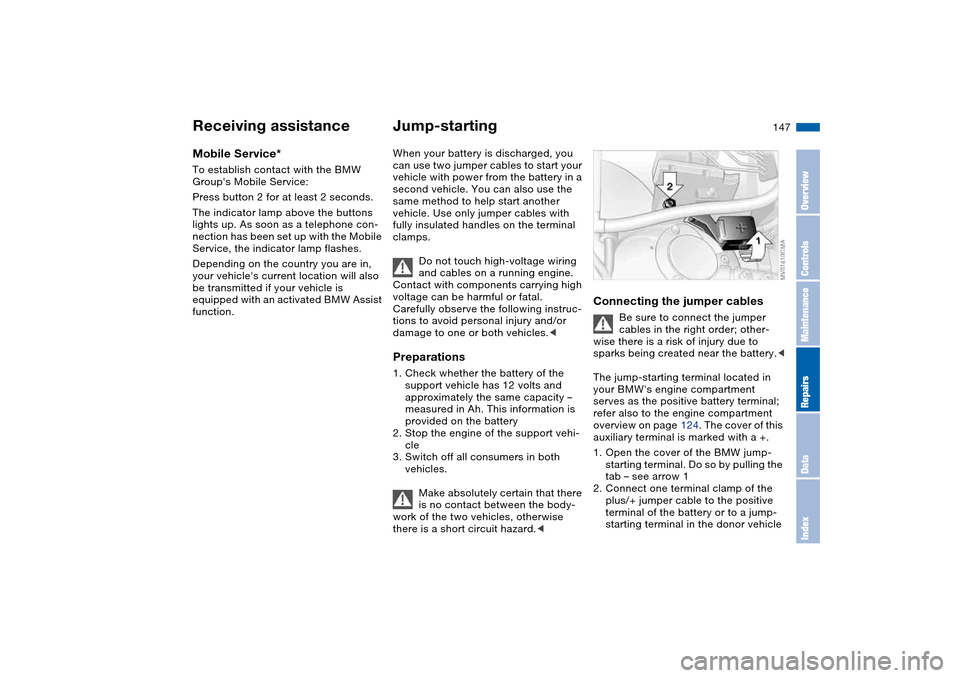
The jump-starting terminal located in
your BMW's engine compartment
serves as the positive battery terminal;
refer also to the engine compartment
overview on page 124. The cover of this
auxiliary terminal is marked with a +.
1. Open the cover of the BMW jump-
starting terminal. Do so by pulling the
tab – see arrow 1
2. Connect one terminal clamp of the
plus/+ jumper cable to the positive
terminal of the battery or to a jump-
starting terminal in the donor vehicle
Receiving assistance
OverviewControlsMaintenanceRepairsDataIndex
Page 148 of 174
148
3. Connect the second terminal clamp
of the plus/+ jumper cable to the
positive terminal of the battery or to a
jump-starting terminal in the vehicle
to be started
4. Your BMW is equipped with a special
nut – see arrow 2 – to serve as the
ground or negative terminal.
Attach a terminal clamp of the
minus/– jumper cable to the negative
terminal of the support vehicle's bat-
tery or to a suitable ground on its
engine or bodywork
5. Attach the second terminal clamp of
the minus/– jumper cable to the neg-
ative terminal of the battery or to a
suitable ground on the engine or
bodywork of the vehicle to be
started.Starting the engine1. Start the engine of the support vehi-
cle and let it run for several minutes
at a slightly elevated engine idle
speed
2. Start the engine of the other vehicle
as usual.
If the first start attempt is not suc-
cessful, wait a few minutes before
another attempt in order to allow the
discharged battery to recharge3. Allow the engines to run for several
minutes
4. Disconnect the jumper cables in
reverse sequence.
Have the battery recharged at your
BMW center as required.
Do not use spray starter fluids to
start the engine.
Page 160 of 174
Everything from A to ZA
ABS Antilock Brake
System 113
indicator lamp 19
Accessories, refer to For
your own safety 6
Accident, refer to Emer-
gency call 146
Activated-charcoal filter 98
Adaptive brake lamp, refer
to Brake force display 89
Adding brake fluid 129
Additional sources of infor-
mation 4
Air conditioning mode
automatic climate
control 96
Air distribution
automatic climate
control 96
individual 96
Air outlets, refer to Ventila-
tion 94
Air pressure, refer to Tire
inflation pressure 116
Air recirculation, refer to
Recirculated-air mode 97
Air supply
automatic climate
control 96
Air, drying, refer to Air con-
ditioning mode 96Airbags 55
deactivating 55
indicator lamp 18, 57
safe seating position 46
Airing out, refer to Ventila-
tion 94
AKI, refer to Fuel specifica-
tions 25
Alarm system 36
avoiding unintentional
alarms 37
All-season tires, refer to
Winter tires 120
Alternative oils 127
Antifreeze
coolant 128
washer fluid 126
Antilock Brake System
(ABS) 113
indicator lamp 19
Anti-theft system 28
Anti-theft warning system,
refer to Alarm system 36
Approved axle loads, refer
to Weights 156
Approved gross weight,
refer to Weights 156
Armrest 99
Artificial leather, refer to the
Caring for your vehicle
brochureAshtray
front 100
rear 101
Assistant systems, refer to
Dynamic Stability Control
(DSC) 86
AUC Automatic recircu-
lated-air control 97
AUTO program 96
Automatic
cruise control 77
headlamp control 90
Automatic air distribution,
refer to AUTO program 96
Automatic air supply, refer
to AUTO program 96
Automatic car wash, refer to
the Caring for your vehicle
brochure
Automatic climate control 94
Automatic curb monitor 52
Automatic dimming, interior
rearview mirror 53
Automatic recirculated-air
control (AUC) 97
Automatic windshield
washer, refer to Rain sen-
sor 76
Average fuel
consumption 84
Average speed 84Avoiding unintentional
alarms 37
Axle loads, refer to
Weights 156
B
Backrest
unlocking 49
Backrest, refer to Seat
adjustment 47
Backup lamps 69
bulb replacement 139
Bandages, refer to First-aid
kit 23
Bar, for towing 149
Battery 144
charge 144
disposal 145
indicator lamp 18
jump-starting 147
remote control 28, 29
Battery charge current 18
Battery charge indicator
lamp 18
Belts, refer to Safety
belts 50
Beverage holders 100
Blower
automatic climate
control 96
BMW Maintenance
System 130
Page 161 of 174
Everything from A to Z
161
BMW sports seat 47
Bore, refer to Engine
data 154
Bottle holders, see Bever-
age holders 100
Brake fluid 129
indicator lamp 18, 129
level 129
Brake force display 89
Brake lamps
bulb replacement 139
indicator lamp, defective
lamp 81
Brake lamps, refer to Brake
force display 89
Brake pads
brake fluid level 18, 129
breaking in 110
Brake rotors
breaking in 110
Brake system
brake pads, indicator
lamp 19
Brake wear warning
indicator lamp 19Brakes
ABS 113
brake fluid 129
brake force display 89
brake pads 112
breaking in 110
driving notes 111
indicator/warning lamp
18, 19
parking brake 68
Break-in procedures 110
Bridging, refer to Jump-
starting 147
Bulb replacement 137
Bulb replacement, refer to
Lamps and bulbs 137
Buttons in steering wheel 22
C
California Proposition 65
warning 6
Can holders, see Beverage
holders 100
Capacities 157
Car battery 144
Car care, refer to the Caring
for your vehicle brochure
Car keys, refer to Keys 28
Car phone hookup
microphone 100
Car radio, refer to the
Owner's Manual for RadioCar telephone, refer to the
separate Owner's Manual
Car vacuum cleaner, con-
necting 101
Car wash, refer to the Caring
for your vehicle brochure
Carpet care, refer to the
Caring for your vehicle
brochure
Cassette operation, refer to
the Owner's Manual for
Radio/Onboard Computer
CBC Cornering Brake Con-
trol 113
warning lamp 19
CD changer, refer to the
Owner's Manual for
Radio/Onboard Computer
CD operation, refer to the
Owner's Manual for
Radio/Onboard Computer
Center armrest
front 99
Center high-mount brake
lamp
bulb replacement 140
Central locking system 28
button 32
passenger
compartment 32
Check Control 81Check Gas Cap
indicator lamp 19
Child seats, refer to Child-
restraint systems 58
Child-restraint mounting
system LATCH 60
Child-restraint systems 58
Cigarette lighter 100
Cleaning chrome parts, refer
to the Caring for your vehi-
cle brochure
Cleaning light alloy wheels,
refer to the Caring for your
vehicle brochure
Cleaning position, convert-
ible top 44
Cleaning the vehicle, refer to
the Caring for your vehicle
brochure
Cleaning windshield 77
Clock 82
12-/24-hour mode 82
setting, refer also to the
Owner's Manual for
Radio/Onboard Computer
Closing
from inside 32
from outside 29
Clutch
breaking in 110
Cockpit 14
OverviewControlsMaintenanceRepairsDataIndex
Page 162 of 174
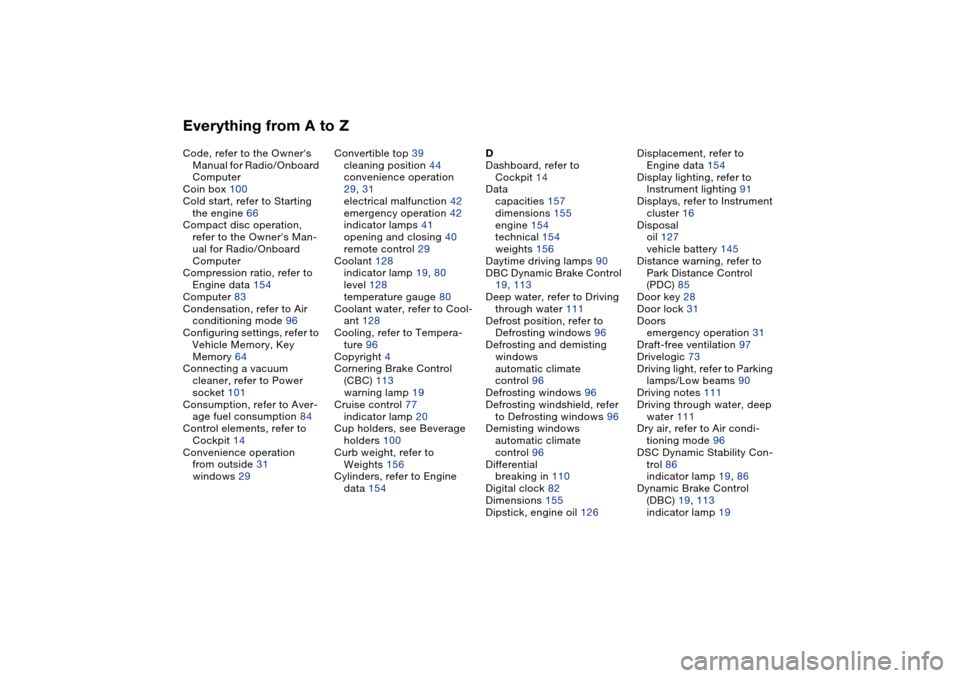
Everything from A to ZCode, refer to the Owner's
Manual for Radio/Onboard
Computer
Coin box 100
Cold start, refer to Starting
the engine 66
Compact disc operation,
refer to the Owner's Man-
ual for Radio/Onboard
Computer
Compression ratio, refer to
Engine data 154
Computer 83
Condensation, refer to Air
conditioning mode 96
Configuring settings, refer to
Vehicle Memory, Key
Memory 64
Connecting a vacuum
cleaner, refer to Power
socket 101
Consumption, refer to Aver-
age fuel consumption 84
Control elements, refer to
Cockpit 14
Convenience operation
from outside 31
windows 29Convertible top 39
cleaning position 44
convenience operation
29, 31
electrical malfunction 42
emergency operation 42
indicator lamps 41
opening and closing 40
remote control 29
Coolant 128
indicator lamp 19, 80
level 128
temperature gauge 80
Coolant water, refer to Cool-
ant 128
Cooling, refer to Tempera-
ture 96
Copyright 4
Cornering Brake Control
(CBC) 113
warning lamp 19
Cruise control 77
indicator lamp 20
Cup holders, see Beverage
holders 100
Curb weight, refer to
Weights 156
Cylinders, refer to Engine
data 154D
Dashboard, refer to
Cockpit 14
Data
capacities 157
dimensions 155
engine 154
technical 154
weights 156
Daytime driving lamps 90
DBC Dynamic Brake Control
19, 113
Deep water, refer to Driving
through water 111
Defrost position, refer to
Defrosting windows 96
Defrosting and demisting
windows
automatic climate
control 96
Defrosting windows 96
Defrosting windshield, refer
to Defrosting windows 96
Demisting windows
automatic climate
control 96
Differential
breaking in 110
Digital clock 82
Dimensions 155
Dipstick, engine oil 126Displacement, refer to
Engine data 154
Display lighting, refer to
Instrument lighting 91
Displays, refer to Instrument
cluster 16
Disposal
oil 127
vehicle battery 145
Distance warning, refer to
Park Distance Control
(PDC) 85
Door key 28
Door lock 31
Doors
emergency operation 31
Draft-free ventilation 97
Drivelogic 73
Driving light, refer to Parking
lamps/Low beams 90
Driving notes 111
Driving through water, deep
water 111
Dry air, refer to Air condi-
tioning mode 96
DSC Dynamic Stability Con-
trol 86
indicator lamp 19, 86
Dynamic Brake Control
(DBC) 19, 113
indicator lamp 19
Page 169 of 174
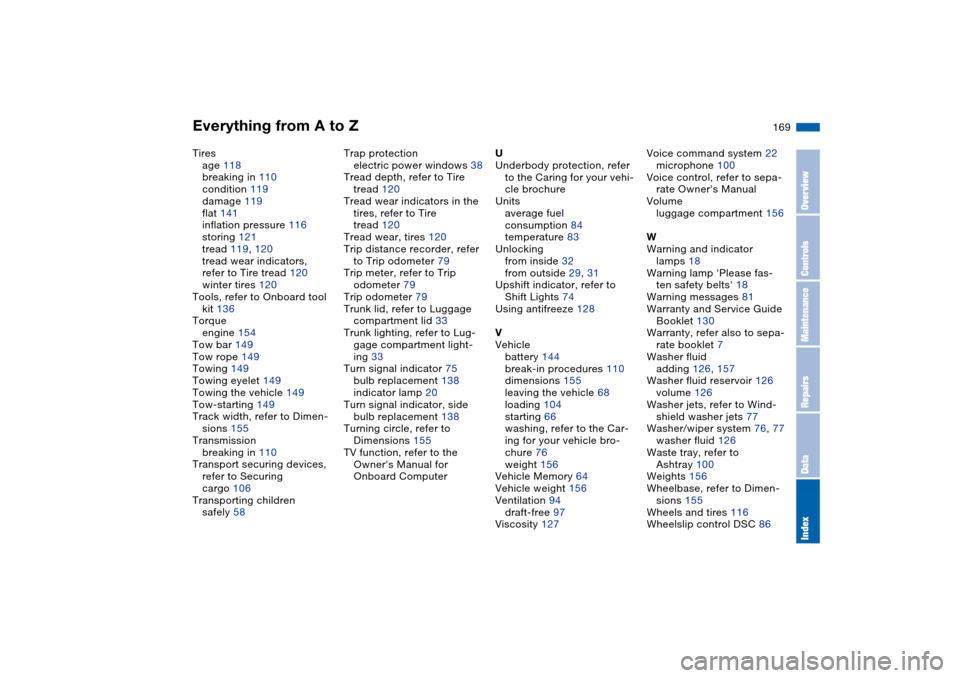
Everything from A to Z
169
Tires
age 118
breaking in 110
condition 119
damage 119
flat 141
inflation pressure 116
storing 121
tread 119, 120
tread wear indicators,
refer to Tire tread 120
winter tires 120
Tools, refer to Onboard tool
kit 136
Torque
engine 154
Tow bar 149
Tow rope 149
Towing 149
Towing eyelet 149
Towing the vehicle 149
Tow-starting 149
Track width, refer to Dimen-
sions 155
Transmission
breaking in 110
Transport securing devices,
refer to Securing
cargo 106
Transporting children
safely 58Trap protection
electric power windows 38
Tread depth, refer to Tire
tread 120
Tread wear indicators in the
tires, refer to Tire
tread 120
Tread wear, tires 120
Trip distance recorder, refer
to Trip odometer 79
Trip meter, refer to Trip
odometer 79
Trip odometer 79
Trunk lid, refer to Luggage
compartment lid 33
Trunk lighting, refer to Lug-
gage compartment light-
ing 33
Turn signal indicator 75
bulb replacement 138
indicator lamp 20
Turn signal indicator, side
bulb replacement 138
Turning circle, refer to
Dimensions 155
TV function, refer to the
Owner's Manual for
Onboard ComputerU
Underbody protection, refer
to the Caring for your vehi-
cle brochure
Units
average fuel
consumption 84
temperature 83
Unlocking
from inside 32
from outside 29, 31
Upshift indicator, refer to
Shift Lights 74
Using antifreeze 128
V
Vehicle
battery 144
break-in procedures 110
dimensions 155
leaving the vehicle 68
loading 104
starting 66
washing, refer to the Car-
ing for your vehicle bro-
chure 76
weight 156
Vehicle Memory 64
Vehicle weight 156
Ventilation 94
draft-free 97
Viscosity 127Voice command system 22
microphone 100
Voice control, refer to sepa-
rate Owner's Manual
Volume
luggage compartment 156
W
Warning and indicator
lamps 18
Warning lamp 'Please fas-
ten safety belts' 18
Warning messages 81
Warranty and Service Guide
Booklet 130
Warranty, refer also to sepa-
rate booklet 7
Washer fluid
adding 126, 157
Washer fluid reservoir 126
volume 126
Washer jets, refer to Wind-
shield washer jets 77
Washer/wiper system 76, 77
washer fluid 126
Waste tray, refer to
Ashtray 100
Weights 156
Wheelbase, refer to Dimen-
sions 155
Wheels and tires 116
Wheelslip control DSC 86
OverviewControlsMaintenanceRepairsDataIndex